
Audio News
HzProject HzCORE
HzProject HzCORE
https://ift.tt/zLj2CKs
Network audio sits at an intriguing crossroads between the audio industry wanting to operate on its terms and clashing with the broader applications of the equipment. Building products from materials typically reserved for space-bound gear is unnecessary. One area where polishing the approach seems reliably feasible is with server solutions. The benefits of ensuring the server does not introduce unwanted noise (whether over the network or USB) are generally repeatable and worth pursuing. And, taking cannonball polishing to the next level, the HzCORE Server from South Korean firm HzProject feels like a mirror-finished projectile.
HzCORE has internal SSD storage (1TB, 4TB or 8TB) to hold music files, but its primary function is to deliver music files via Ethernet in Roon’s RAAT form to Roon Ready devices (from streaming directly or sending music files stored on an internal SSD) or via USB output to non-Roon Ready DACs. (an Audirvana version is also in the pipeline). It combines internal storage with enough processing hardware to run Roon robustly. It’s a genuinely formidable piece of overengineering on every count. HzProject is a new entrant to the market, and HzCORE’s specifications make a very definite statement.
Physical storage
The physical storage is straightforward. The review sample arrived with a 4TB SSD installed, but the mounting is standard, and other capacities would be possible. The drive sits in a CNC-machined enclosure designed to shield it from interference from the rest of the HzCORE’s internals.
These internals are where things start to get interesting. Initially, you’ll find more purpose-built enclosures for different components, but they are not merely identical drive covers. The clock housing is an aluminium-and-wood layered sandwich, while the power supplies live in enclosures made of aluminium and copper. Each enclosure has been designed for its specific role rather than a generic, one-size-fits-all approach.
The components themselves are notable as well. There are two separate PSUs, one 5V and one 12V. These supplies are further separated, so there are dedicated taps for each major component on the board, and each is isolated from the others. Both power supplies are linear, and the back panel uses an IEC socket rather than an external brick.
Home of the clock
Inside its wood-and-metal housing, the clock is a high-quality oven-controlled crystal oscillator with dual outputs for the motherboard and Ethernet sections. The processing hardware is designed so there is no need for forced cooling. This ensures the HzCORE remains entirely silent in operation, with not even a faint hum from the power supplies breaking the stillness.
Let me rephrase if the preceding paragraph induced a slight ‘my eyes glaze over’ moment. The HzCORE is roughly twice as powerful as my resident Roon Nucleus, which I’ve never considered slow. In use, it runs with confidence and overall slickness that suggests, regardless of what Roon might have planned, the HzCORE will handle it all.
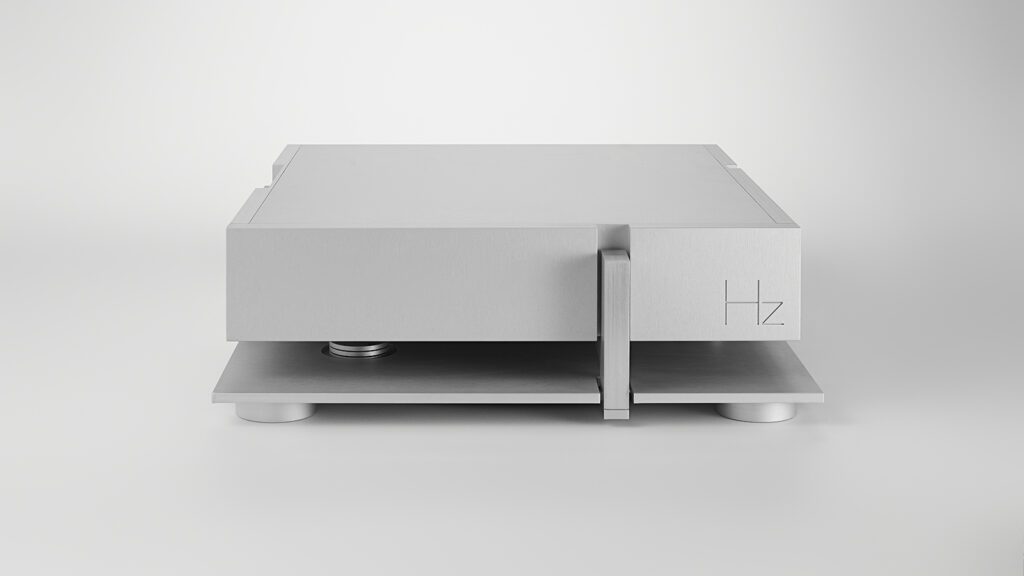
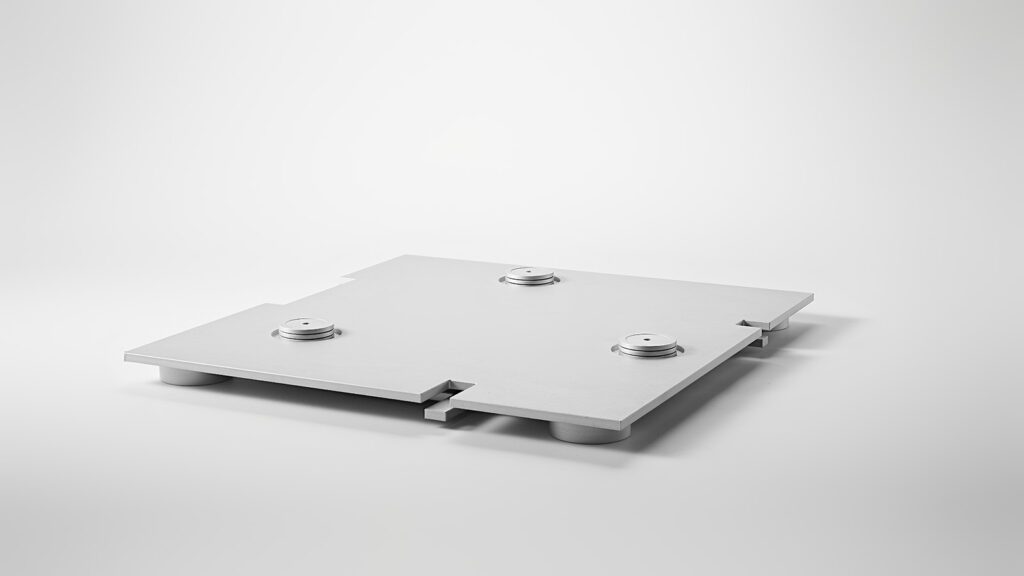
The HzCORE’s chassis enhances that sense of permanence. It’s built from 15mm-thick aluminium and feels absurdly substantial. What’s genuinely interesting is that HzProject’s isolation efforts go beyond simply placing everything in a big metal box. The chassis has three partially decoupled feet that sit proud of the main enclosure thanks to Stillpoints isolators. An optional platform supports the HzCORE, and the trio of feet slot into apertures that enable the entire server to rest on special isolation gears within the sub-chassis. This casework adds up to a lot of metal and engineering, and the result occupies a fair amount of space, but you can see where the effort goes.
Striking
The HzProject HzCORE is a striking-looking piece of kit as well. Placed on the support platform, the HzCORE resembles an architectural-scale model of an ambitious brutalist device; imagine Boston’s City Hall meeting the National Theatre in London. Yet it looks sensational because the HzCORE uses high-quality aluminium rather than weathered concrete. I had not previously considered a server as a visually distinctive front end for a system, but this unit is striking and sufficiently well-finished that it could legitimately be the focal point of a system.
Surprises did not end there. I volunteered for this review because I straddle the line between a Roon enthusiast and an evangelist, yet I’m not blind to its limitations. My personal Nucleus NUC does not act as the content library; that role falls to a venerable Melco N1A. This setup allows me to test non-Roon devices, and I genuinely feel that files from the Melco can sound better than the same file stored on the Nucleus, and I doubted whether the HzCORE would do both jobs as well as my split role duo.
It didn’t take long for an 88.2kHz rip of Dead Can Dance’s Toward the Within [4AD] to make me reconsider this belief. I’ve used the opening Rakim as a test piece for years because it’s a magnificent recording that can stand up to repeated listening, and that is especially true here. The HzCORE doesn’t alter the basics feeding my front end of a Chord Electronics trio (2Go and 2Yu) into a Hugo M scaler and TT2 DAC. Still, it does help refine what they are doing and often appreciably so.
Palpable improvement
From the opening applause, there is a palpable improvement to the already superb soundstage of this live recording. The HzCORE doesn’t interfere with the tonality or attempt to augment the sensational bass. The effect is more that every component that makes up the track is slotted together to form a more solid, cohesive whole. Boosting the tempo with Pale Green Ghosts by John Grant [Bella Union] makes the timing and cohesion of the title track sound a touch faster and more together, while still framing Grant’s magnificent vocals as the main event. The result isn’t a change to the presentation of a familiar set of electronics I’m fond of; it’s still my system, but better.
Extra horsepower
It also offers another capability. Where that extra processing power becomes evident is when you start using the additional features of Roon. Upsampling, both PCM and DSD transcoding, is audibly better than on my Nucleus, and the headphone DSP options, tested with a pair of Focal Clear MGs connected to the TT2, are also enhanced. Roon is good software, but even running as an OS, it’s fairly hardware-intensive. The HzCORE’s extra grunt is noticeable.
Interestingly, even though HzProject describes their tuning as optimized for network rather than USB, I’ve found the performance with the TT2 connected directly via USB to be equally impressive, with the same improvements in upsampling and headphone adjustments applying via this connection as well. I’ve also found it interesting that content played directly from Qobuz—thus not benefiting from being stored on the HzCORE—sounds better than the same files stored on my Melco. The differences are subtle, but listening to the thunderous Nox Anima by Scratch Massive [Bordel] streamed on Qobuz still leaves me feeling that the HzCORE is achieving something that stored music on my Melco cannot. That sense of cohesion and control permeating the Dead Can Dance recording remains perceptible here.
BC to AD?
No network hardware has ever created a kind of ‘BC/AD’ moment in my listening, but the HzCORE is probably the closest. There’s always—at least for me—a certain awkwardness in reconciling hardware that successfully handles other heavy-duty tasks without breaking a sweat yet might have limitations around the seemingly simple business of moving a music file from one location to another. Still, this visually striking device shows there is more to it. In an industry of incremental gains, the HzCORE represents a concerted effort to make everything “just so.” The result is a genuinely formidable Roon Core that can compete with anything else on the market.
Technical specifications
- Type: Music Server
- Network input/output: 1 × Gigabit Ethernet (1000BASE-T)
- Audio output: USB
- Memory: 64GB DDR4-3200 (2 × 32GB modules)
- System Storage: 256GB MLC SSD (for OS and system files)
- Music Library Storage: 1TB / 4TB / 8TB options (2.5” SATA SSD)
- Clock & Timing: Master Clock Accuracy: ±10ppb OCXO
- Number of Isolated Power Rails: 5
- Transformer Design: Dual toroidal
- Power Regulation: Ultra-low-noise linear regulators
- Noise Floor: <10μVrms (10Hz–100kHz)
- Thermal Cooling System: Fanless passive design
- Operating System: Audio-optimised Linux
- Primary Roles: Roon Core/Roon Streamer, Audirva‐na Core Player (expected soon)
- Dimensions (WxDxH): 36.6×38.9×10.5cm
- 36.6×38.9×12.8cm (with optional platform)
- Weight: 10.5kg, 14.5kg (with optional platform)
- Price: £6,900, $8,300, €8,400 (with 4TB SSD), optional platform £790, $870, €880
Manufacturer
HzProject
UK distributor
BOBUSIAN
+44(0)7922 277944
The post HzProject HzCORE appeared first on hi-fi+.
HI-FI News,Audio
via Articles Archive – hi-fi+ https://ift.tt/YgrE02B
April 7, 2026 at 10:30AM
-
Product on sale
 Audiophile Vinyl Records Cleaning BundleOriginal price was: €69.90.€59.90Current price is: €59.90. incl. VAT
-
Product on saleEasy Start Vinyl Records Cleaning KitOriginal price was: €69.90.€59.90Current price is: €59.90. incl. VAT
-
Vinyl Records Cleaner Easy Groove Concentrate€34.95 incl. VAT
-
Easy Groove Super Set€199.00 incl. VAT
-
Easy Groove Enzycaster – vinyl records prewash cleaner€34.95 incl. VAT
-
Easy Groove Extreme MK. II- vinyl records prewash cleaner€45.00 incl. VAT
-
Vinyl Records Cleaner – Easy Groove Virgin Concentrate€35.00 incl. VAT
-
Easy Groove Spray&Wipe vinyl records cleaner€34.95 incl. VAT







