
World News
Innuos Introduces the Pulsar
As I proceed work on a follow-up assessment of the Next-Gen Power Supply Upgrade to the Innuos Statement music server and streamer ($21,700), Innuos has launched its new Pulsar Network music participant + USB reclocker ($6899). A stripped-down model of the flagship Statement, the Pulsar lacks each a ripper and inner storage. What it boasts as an alternative is over 130,000µF of Mundorf capacitors, a big high-end inductor, and an audio-grade, 300VA toroidal transformer. The Pulsar favors its optimized USB output with reclocking over its non-dedicated USB, and lacks S/PDIF and AES/EBU outputs.
While I see no point out of Roon on the Innuos web site—the Statement works seamlessly with Roon—the Pulsar presents Tidal and Qobuz integration with albums saved on a NAS, web radio and Paradise Radio, and the chance to combine BBC Sounds, Spotify Connect and Airplay primarily based on the offered Logitech Media Server platform. You may use the Pulsar as an endpoint for a essential music server, HQ Player, or any Logitech Media server-based server.
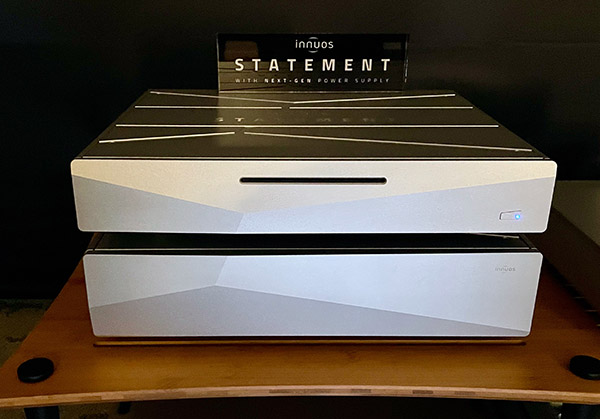
The Pulsar was hardly the one recreation within the room. It was paired with the Innuos Phoenixnet community change ($3749), MSB Technology’s The Premier DAC ($27,500), a Vinnie Rossi Brama built-in amp ($38,995), PS Audio PS15 Power Plant ($7999), and Magico loudspeakers. Cables have been by Kimber Kable, and the rack a Quadraspire SV2T ($3300).
Innuos’s Nuno Vitorino defined that MSB’s USB-to-optical adapter transformed the Pulsar’s USB to optical earlier than sending it to the DAC. He additionally mentioned that the Innuos OCXO reclocker operates at 25MHz—there isn’t any have to convert from 10MHz to 25MHz, as is usually the case—and that Innuos servers embody two inner linear energy provides, one for the innuOS Operating System’s SSD (strong state drive) and the opposite for the devoted USB output.
Vitorino cued up a 24/ or 32/352.8 MQA file of Patricia Barber’s model of “This Town” from her album Clique. The Pulsar labored in consort with the room’s different parts to breed devices and voice in right proportion. Every observe from the piano sang, and cymbals sounded lifelike slightly than overly sizzling. In a convincing comparability between the unit’s commonplace USB output and devoted USB output with reclocking, the devoted output delivered bigger scale photographs, extra element and texture, and put Barber nearer to her mike and the viewers. An wonderful system.
-
Product on sale
 Audiophile Vinyl Records Cleaning BundleOriginal price was: €69.90.€59.90Current price is: €59.90. incl. VAT
-
Product on saleEasy Start Vinyl Records Cleaning KitOriginal price was: €69.90.€59.90Current price is: €59.90. incl. VAT
-
Vinyl Records Cleaner Easy Groove Concentrate€34.95 incl. VAT
-
Easy Groove Super Set€199.00 incl. VAT
-
Easy Groove Enzycaster – vinyl records prewash cleaner€34.95 incl. VAT
-
Easy Groove Extreme MK. II- vinyl records prewash cleaner€45.00 incl. VAT
-
Vinyl Records Cleaner – Easy Groove Virgin Concentrate€35.00 incl. VAT
-
Easy Groove Spray&Wipe vinyl records cleaner€34.95 incl. VAT


