
World News
Innuos ZENith Next-Gen Streamer-Server
Innuos ZENith Next-Gen Streamer-Server
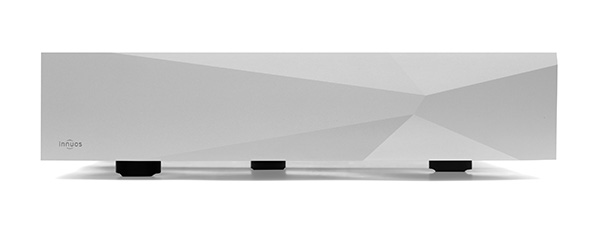
The Innuos ZENith Next-Gen ($20,700 as geared up) does what streamer-servers do: retailer music information, learn them into reminiscence, and ship them on to a D/A converter to make music. In Innuos’s advanced (but logical) lineup of streamers and streamer-servers, the ZENith Next-Gen sits slightly below the flagship Statement and above the ZENith Mk.3 (footnote 1). The ZENith Mk.3 stays within the Innuos lineup for now however will probably be changed at AXPONA shortly after this situation hits mailboxes and newsstands.
Though comparable in lots of respects, with a really comparable look, these two merchandisethe ZENith Next-Gen and the ZENith Mk.3are very completely different beasts. There is one fairly apparent distinction: a CD slot on the Mk.3 (with, in fact, a CD drive inside), which makes it straightforward to tear CDs to the server’s inner reminiscence. This characteristic is absent from the extra purist ZENith Next-Gen. But with the Next-Gen you’ll be able to have your cake and eat it: Attach any USB CD ripper to one of many USB ports, and it’ll work simply the identical because the built-in ripper on the Mk.3. The different variations between the Mk.3 and the Next-Gen are much less apparent, however these variations go a lot deeper; see the Details part, beneath.
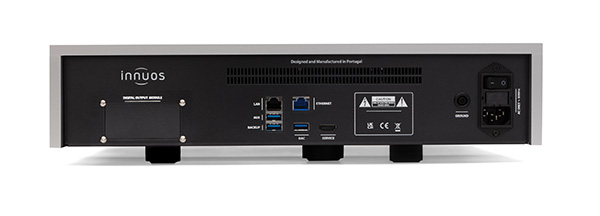
If you need to, you’ll be able to depart off the inner storage within the ZENith Next-Gen and use it as a pure streamer. In addition to the community connection meant to ship information to a streaming DAC, there’s one other you’ll be able to join on to a community change, offering entry to streaming companies and music information saved in your native community.
All that is tied collectively by Innuos Sense. Currently on revision 3.2, that is Innuos’s proprietary app, which manages music-data entry in addition to (through the related participant) music playback. Sense is a downloadable app that runs on iOS and Android tablets and telephones; it is also in-built to the ZENith with the intention to use it with an internet browser by typing in an IP tackle or my.innuos.com. During my audition, I used Sense on an M4 iPad Pro, however most frequently I accessed it, with good reliability, on my laptop computer.
Using the Sense app, you’ll be able to stream music from Deezer, Idagio, Qobuz, and Tidal. Also constructed into Sense is entry, with no subscription, to a lot of web radio stations (which regardless of the extreme lossy compression employed by most, I’ve come to take pleasure in and worth). You also can use Tidal Connect to play music immediately from the Tidal app; you may quickly have the ability to do the identical factor with Qobuz Connect (footnote 2).
What’s extra, should you favor Roon’s information-rich setting to Innuos Sense, the ZENith Next-Gen can serve that up, too. To make this as plain as doable: You have your alternative of Roon (with a subscription) and Innuos Sense. You can use both or each or a mix; extra on this beneath.
Details
The following comes from Innuos founder and R&D Director Nuno Vittorino, with whom I’ve had previous conversations about digital audio and sonics, at hi-fi reveals, by web, and in my New York City condo. "As you understand, we have been investigating for years elements inside a digital supply that have an effect on varied facets of sound, corresponding to PRaT, soundstage width and depth, in addition to element and realism of devices and voices. There had been three technical variables that we have been investigating up to now years: Processing latency, energy provide impedance (AC stage) and resistance (DC stage)," and "additional minimizing electrical noise past the facility provides." To scale back latency, the analysis and design crew works to shorten processing instances at varied levels and to shorten the sign path; Innuos has discovered that such modifications can enhance sonics. Reducing PS impedance/resistance determines "how briskly the facility provide can present present in a clear approach, serving to once more with decreasing processing latency." And then there’s the difficulty of digital noiseEMIwhich, Innuos has discovered, is without doubt one of the chief contributors to sonic degradation previous to D/A conversion.
How does this translate into {hardware} and software program? Vitorino was remarkably forthcoming. "Starting with the goal of lowering processing latency," Vitorino stated, "we developed the next applied sciences:"
Real-Time Operating System. "We tailored our personal SenseOS to make use of a Linux Real-time kernel (footnote 3), which permits a lot better management over course of latency." The Linux real-time kernel was developed to permit Linux to deal with time-critical operations. Linux has been round perpetually, however the real-time kernel was completed solely in late 2024. At least one different server/streamer producer is using it.
Audiocore. "Using the brand new Real-Time kernel now permits us to regulate processes in order that we are able to dedicate particular processor cores to particular audio duties, from USB/Ethernet interrupt requests to audio decoding. This minimizes interruptions to the sound-processing chain. For a real-world analogy, consider crossing New York in a automotive. We’d make sure you’d get inexperienced lights at each intersection."
More Processor Cores. "In order to take advantage of out of this know-how, we wanted new processors with extra cores, however we wanted to retain low energy consumption. … [T]he ZENith Next-Gen makes use of eight actual cores."
The Power Supply. For so long as I’ve identified in regards to the firm, Innuos has centered on the standard of its energy provides. The energy provide on the Next-Gen is completely completely different from the one on the ZENith Mk.3. It begins with a 300VA toroidal transformer. "We had began with the Statement Next-Gen to work with energetic rectification," Vitorino stated, "which is a way more environment friendly and quick approach to convert AC to DC. … We used the identical energetic rectification know-how"they name it ARC (footnote 4)on the NEXith Next-Gen because the Statement Next-Gen. "This is all remoted in a devoted, EMI-shielded enclosure to stop each noise transmission and absorption.
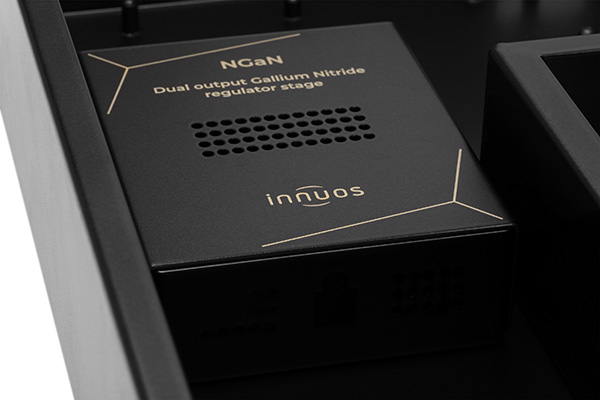
"Given the necessities on the brand new processors, we developed a dual-rail regulator primarily based on gallium nitride MOSFETs that we name NGaN." The picture of the ZENith’s insides reveals the separate NGaN module. "The benefit of this methodology is that the regulator works at a a lot sooner switching frequency, which will be exactly adjusted with out loss." Plus, the upper frequency makes filtering the ensuing noise simpler. "NGaN is extraordinarily environment friendly in velocity while additionally operating very cool, with no heatsink requirement," Vitorino continued. When paired with the toroidal transformer, "this tremendously reduces electrical impedance, leading to extra fast energy distribution, which helps to provide a extra exact sound. Win-win."
The Mainboard. "For the aim of minimizing electrical noise, we centered on the mainboard. Developed along with our motherboard producer, the PreciseAudio mainboard is a extremely custom-made motherboard that goes properly past something we now have executed earlier than." "PreciseAudio" is an Innuos commerce identify. "Not solely did we take away pointless, EMI-prone elements, … we now have custom-made the switching regulators with the producer for additional noise discount. Additionally, we now have for the primary time been supplied entry to low-level management of the mainboard, so we are able to customise energy facets for the processor, the RAM, clocks, and plenty of different areas. We can now tune each facet of I/O, from reminiscence to processors to the PCIe bus, so as to optimize it for decrease latency, energy noise, and EMI."
All that mainboard customization, in flip, permits the usage of "extra exact energy provides with sooner CPUs that might usually require a noisier energy supply." The result’s "even sooner efficiency with a good decrease noisefloor." Faster CPUs can be utilized whereas producing much less warmth. It’s a virtuous circle. In conjunction with real-time Linux, which permits the unmodified working system to reply promptly to time-sensitive instructions, system latency is "dramatically" lowered, Vitorino stated. "The ZENith NextGen is the primary Innuos system that includes all these applied sciences in a single system," he wrote in an electronic mail. In this respect, not even the Statement can match it.
Flexibility. "We determined to make it a extra versatile product," Vitorino advised me. You can now purchase the ZENith Next-Gen with no inner storage, which makes it a pure streamer. Or "storage will be factory-fitted or user-fitted through a M.2 SSD, leading to as much as 16TB storage." That’s two separate SSDs, one factory-installed, one accesible to the person. The factory-fitted SSD is related on to the mainboard, lowering latency and the EMI that may consequence from a wired connection. But the storage modules do not act like they’re separate. "Our software program crew developed the Expandable Storage Management System (XSM) so as to add storage seamlessly as one single pool with storage 100% usable, but guaranteeing that within the case one SSD fails, solely what’s contained on that SSD is affected and never the entire storage." The SSD that runs the OS has its personal separate energy provide and runs at very low energy (a 3rd of a watt), producing much less noise and warmth.
Actually there is a third SSD, the one used to retailer and run the working systemthe specialised Linux and the remainder of the Innuos software program. For this SSD, Innuos makes use of the SSD in a mode often called "pSLC SSD," quick for "pseudo single-level cell," which implies that solely each second or third bit is used for storageonly one bit per storage cell. In a traditional SSD, every cell holds as much as 4 bits, relying on the SSD sort. pSLC makes storage dearer (although inexpensive than "true" SLC, which has one bit per cell natively), sooner, and fewer liable to failure. It’s an method utilized in cost-constrained mission-critical functions like information facilities.
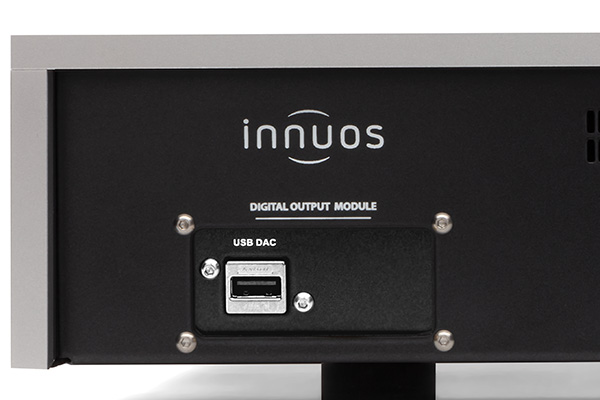
As beforehand talked about, "the ZENith Next-Gen additionally contains replaceable Digital Output modules." Current selections are the PhoenixUSB Lite reclocker modulea modular model of the freestanding Innuos PhoenixUSBan identical module for I2S, and a module combining S/PDIF on RCA, AES3, and TosLink. "Other modules are deliberate sooner or later, together with devoted output modules to particular DAC protocols."
A closing distinction between the Next-Gen and the Mk.3: The Next-Gen’s chassis is extra superior than the one wrapping the Mk.3, with a "10mm-thick CNC-machined, bead-blasted and anodized" aluminum enclosure and a brand new vibration-dampened platform that "helps to isolate the toroidal transformer." On the EMI entrance, the Next-Gen has a chassis-ground connection with the intention to floor the Next-Gen chassis as you’ll that of a phono preamp.
So, whereas the Mk.3 was the start line for the Next-Gen, the Next-Gen is a a lot finer-tuned, extra refined machine. Mercedes followers may consider it because the AMG model of the Innuos ZENith.
Innuos Sense
Jason Victor Serinus’s auditions of Innuos servers have documented properly the event of the Innuos management app, beginning in 2020 (footnote 5). In 2020, Jason discovered the software program "irritating," as he wrote in his evaluate of the primary model of the Innuos Statement. Some issues simply did not work. Innuos was not alone on this; server makers had been battling changing into software program firms. Innuos began out as a server firm, nevertheless it takes time to construct a versatile, user-friendly music-management app.
I’ve been utilizing Innuos Sense for shut to 2 years (footnote 6), throughout which era the software program has auto-updated many instances; I’m utilizing model 3.2.1. It is not goodsome wanted options are lacking, and value isn’t fairly optimizedhowever outright errors are uncommon. Consequently, I’m prepared now to name Innuos Sense mature.
Sense (along with the {hardware}) accomplishes its core missionprotecting observe of, serving up, and taking part in again musicvery properly. On my M4 iPad Pro specifically it’s immediately responsive. The design is logical, elegant, and in some respects (on the iPad’s beautiful Retina show) visually gorgeous.
Setup
The setup a part of the software program is nothing particular, nevertheless it’s utilitarian and straightforward to make use of. It’s logical. Once I added the ZENith to my system, related it, and turned it on, the software program discovered the ZENith immediately. I chosen it. DACs on the identical community are detected mechanically. There are only some key settings, which largely depend upon the D/A converter in use. You should inform the ZENith how your DAC handles DSDno assist, through DoP (DSD over PCM), or nativeand whether or not to allow MQA software program decoding or enable MQA to move via to be decoded by {hardware}. Another alternative: which USB latency mode must you use, Normal or Low. Normal is the extra error-free choice, it’s stated, however assuming it really works, Low sounds higher. I can affirm: It’s a small distinction, nevertheless it’s actual. If you want steering with setup, there’s a superb data base and a neighborhood of supportive customers (footnote 7).
Footnote 1: Another reliable comparability could be with the ZEN Next-Gen, which has much less processing energy however shares most of the ZENith’s Next-Gen’s purist/perfectionist options.
Footnote 2: In February 2025, Qobuz was beta-testing Qobuz Connect, which lets you ship music on to your UPnP-enabled system, as with Tidal Connect. Innuos confirms that its merchandise will probably be prepared when Qobuz Connect is offered
Footnote 3: Real-Time Linux was first included in Linux kernel v6.12, which was launched on November 17, 2024.
Footnote 4: A few years in the past at High End Munich, I first witnessed an Innuos demonstration of the development a greater energy provide could make within the music ensuing from an all-digital server. I can not clarify it, however I heard what I heard.
Footnote 5: See stereophile.com/content material/innuos-statement-music-server. I like to recommend studying this evaluate for extra perception into how Innuos fights noise and different points that may have an effect on digital sound.
Footnote 6: I first began utilizing Innuos Sense with the Innuos Statement, which has been in my system since mid-2023.
Footnote 7: See innuos.com/assist and neighborhood.innuos.com.
HI-FI News
through InnerFidelity https://ift.tt/0FjAwcY
April 23, 2025 at 03:13PM
-
Product on sale
 Audiophile Vinyl Records Cleaning BundleOriginal price was: €69.90.€59.90Current price is: €59.90. incl. VAT
-
Product on saleEasy Start Vinyl Records Cleaning KitOriginal price was: €69.90.€59.90Current price is: €59.90. incl. VAT
-
Vinyl Records Cleaner Easy Groove Concentrate€34.95 incl. VAT
-
Easy Groove Super Set€199.00 incl. VAT
-
Easy Groove Enzycaster – vinyl records prewash cleaner€34.95 incl. VAT
-
Easy Groove Extreme MK. II- vinyl records prewash cleaner€45.00 incl. VAT
-
Vinyl Records Cleaner – Easy Groove Virgin Concentrate€35.00 incl. VAT
-
Easy Groove Spray&Wipe vinyl records cleaner€34.95 incl. VAT


