
World News
McIntosh C12000 preamplifier
McIntosh C12000 preamplifier
As I used to be speaking with an audio-retailer good friend not too long ago, he reached for a Rolls-Royce metaphor to explain the McIntosh model. Expensive? Sure, however not as costly as some boutique high-end merchandise. Fast? Sure, however there are quicker issuesadditionally larger issues, smaller issues, wackier issues, and cheaper issues.
But if you have a look at a Rolls or a Bentley, you instantly acknowledge it for what it’s, and also you wish to sit down in it. And so it’s with McIntosh, besides you do not wish to sit down in it; you wish to sit down in entrance of it, between the audio system of the hi-fi system it occupies.
History issues. When a brand new mannequin from Bentley seems, there’s a connection to what got here earlier than it, an extended custom. There is not any pretense of reinventing wheels; as a substitute, it is about rolling these wheels a bit of farther on down the street. That heritage ends in a comforting familiarity. From the primary audio merchandise McIntosh supplied, in 1949, down to the current lineup, any educated client can have a look at it and instantly know what it is for and acknowledge its worth. In specific, individuals worth a legacy of high quality, particularly when so many older, classic merchandise are on the market and nonetheless working. It feels good figuring out that the factor you are shopping for is prone to final and be pleasing and satisfying to make use of for a very long time.
The C12000 is McIntosh’s present flagship preamplifier. It’s a part of McIntosh’s Hybrid Drive sequence of merchandise that mix tubes and transistors in fascinating methods. The first McIntosh product to include such a mixturethough it preceded the advertising time period by a number of yearswas the MA252 stereo built-in amplifier, launched in 2017. It was "hybrid" within the acquainted sense, pairing a tubed preamplifier stage with a 100W stable state amplifier. The vary has since expanded to incorporate amplifiers, preampseven a CD/SACD participant.
Currently, McIntosh gives eight preamplifiers, however solely the C12000 is Hybrid Drive. This prime-cut, all-analog, dual-chassis mannequin, with separate bins for the facility controller unit and the signal-path circuitry, continues a line began with the stable state C100, McIntosh’s first two-chassis preamp, which was launched in 1997. The C100 was adopted eight years later by the C1000, a hybrid gadget: You might select both the stable state chassis (C1000P) or the tubed chassis (C1000T), or you can get each preamp chassis and the C1000C controller for $26,000. The C1000 was succeeded in 2015 by the C1100, however, although additionally a dual-chassis preamp, the C1100 was all-tube.
The C12000, which is now McIntosh’s flagship stereo preamp, returns to the C1000’s hybrid strategy, however now each units of electronics, tubed and stable state, occupy a single chassistwo chassis altogether together with the controller. With the C12000, the worth for a flagship McIntosh dual-mode preamplifier has fallen by quite a bit, to $16,000.
Separation of powers
The very first thing to notice in regards to the two-box C12000 (after noting that there are two bins) is that though they’re freestanding, the 2 chassis should be joined by a pair of three’-long cables terminating in proprietary 23-conductor connectors. Three toes is not lengthy, so the 2 preamp bins want to sit down aspect by aspect or maybe vertically with appropriate separation; McIntosh says do not stack them. (In truth, within the proprietor’s guide, McIntosh suggests slicing a gap within the shelf above to make sure satisfactory air flow.)
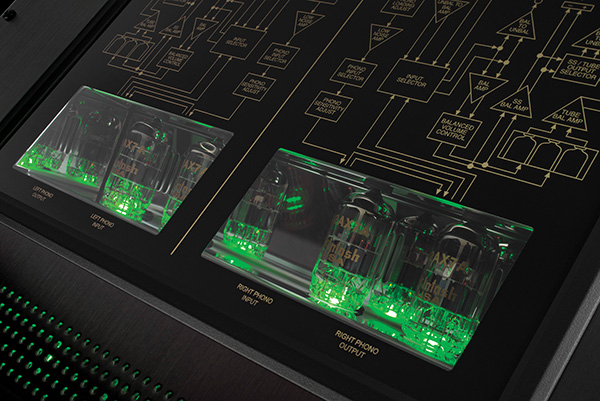
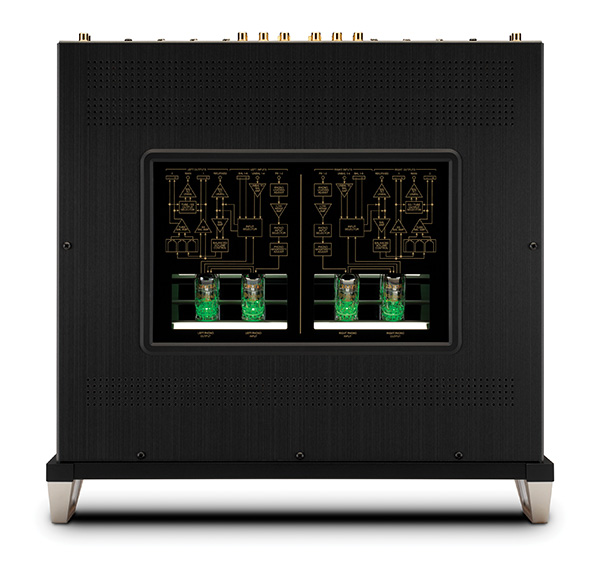
Fit’n’finish is great. Both chassis function the identical load-bearing handles discovered on different premium McIntosh fashions; the handles are each useful and aesthetic. Aesthetics are additional enhanced by the standard, backlit McIntosh logos in opposition to black glass and, on the preamplifier module, a pair of meters that glow blue and home windows that show green-illuminated 12AX7 tubes. Captain Nemo would dig it.
I requested McIntosh whether or not this two-box strategy improved the preamp’s specs. Joe Guelzow, McIntosh Labs’ digital design engineer, responded: "Yes, when in comparison with different tube preamplifiers we produce at McIntosh, discount in noise may be [lower] by a minimum of 4dB and even 10dB, relying on the enter. The dual-chassis design fully separates all energy provide, microprocessor, and management circuits from the pure audio circuits for complete noise isolation." The specified S/N ratio of the high-level output is rated at a powerful 107dB (A-weighted), measured at 2.5V. If that is correct, that is an exceptionally quiet preamplifier (footnote 1).
Unusually for a two-channel preamp, the rear panels of each chassis are comparatively full. The controller’s again panel is dominated by set off inputs and outputs on 3.5mm ministereo jacks, supposed to regulate different connected McIntosh parts, sending remote-control alerts and turning the lights on and off. The solely different connectors on the controller’s rear panel are a USB port for manufacturing facility updates and the left- and right-channel connectors for the customized, 23-pin umbilical cables that join the management module to the preamp module. An AC energy twine socket completes the image.
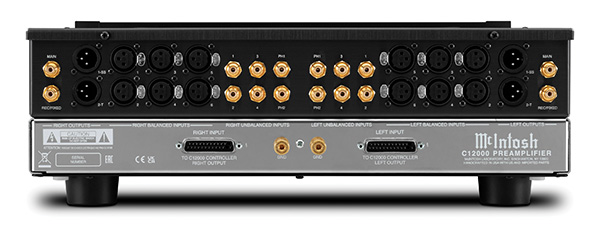
A look on the preamp module’s again panel offers an thought of what the C12000 designers had been aiming for. It’s what you do not see: There are not any digital inputs. There’s no DAC on board, simply plenty of old-school analog RCA and XLR jacks: six pairs of balanced line inputs and 4 pairs of single-ended line inputs plus two pairs of single-ended inputs for the phono stage. For outputs, there are two pairs of balanced, a pair of unbalanced labeled "Main," and one other pair of unbalanced labeled "Rec/Fixed out." The two pairs of balanced outputs are labeled "1-SS" for stable state, "2-T" for tubed. To swap from stable state to tube, you turn from output 1 to output 2. The unbalanced Main outputs may be set to both tube or stable state by way of inner settings.
Here’s one other factor you will not see on the C12000, even behind the scenes in setup mode: tone controls. Other McIntosh preamplifiers have tone controls, whether or not accessed by way of inner menus or perhaps staring you within the face as on the C53 preamp and its eight-knob front-panel equalizer. The C12000 is clearly supposed as a minimalist, high-performance preamp. Joe Guelzow once more: "Integrating analog tone controls right into a system akin to this one would additionally introduce noise, because of the quantity of parts wanted to have the ability to combine analog tone controls. Alternatively, digital tone controls might additionally introduce their very own high-frequency noise whereas additionally taking away from the ‘pure analog’ many lovers want." Include me out. I do not need tone controls and would not use them.
The phono stage is tube-based; there is no such thing as a stable state choice. For this reviewer, that’s completely cool, because it permits for attempting completely different mixtures of tube and stable state amplification. You can use a tubed phono stage right into a stable state line stage. You can run a stable state output to a subwoofer and ship the tubed output to the loudspeaker amplifiers.
Moving on to entrance panels: The preamplifier module’s entrance panel is straightforward. Beyond the aforementioned emblem, meters, and tubes, the one front-panel aspect is a ¼" headphone jack, about which extra later.

The controller’s entrance panel is the place the operational motion takes place. Two giant knobs management Input and Volume. Two small knobs function numerous setup controls. Four push switches are labeled Setup, HXD, Mute, and Standby/On. In the center is an data window.
Operating in tandem with the controller unit is a big, multi-purpose distant managementvirtually a wand, actuallymeasuring 9½" lengthy. It’s what you’d name "Universal," capable of management different parts in your system, McIntosh parts particularly.
Internal affairs
What’s inside? Ron Cornelius, McIntosh product specialist, gave me an outline: "The most essential distinction between the C12000 and all different McIntosh preamps is, it’s each twin mono and totally balanced. … In the C12000 management module, every channel’s energy provide has its personal R-core energy transformer, and within the C12000 preamp module, every channel has its personal circuit boards. The C12000 has twice the elements put in in twice the chassis to attain the very best doable efficiency as in contrast [for example] to the C2700 preamplifier. Balanced circuits, like balanced cables, will cancel induced noise." Design engineer Guelzow piled on: "The tube circuitry is particularly tuned for the 12AX7As and 12AT7 vacuum tubes utilized within the C12000’s circuits, whereas the stable state channels make the most of a discrete, high-fidelity, totally differential audio operational amplifier to drive their outputs."
For a while, I’ve contemplated the connection between efficiency specs printed by producers and the precise, audible outcomes. How do measurable components akin to distortion and signal-to-noise ratio relate to subjective soundstage and timbral high quality? I requested Ron Cornelius to share his/McIntosh’s opinion: "McIntosh designs for the bottom doable distortion and highest sign to noise. These two are sometimes associated. As to sound high quality, picture measurement, and dynamic vary, the full achieve of the preamp and the utmost voltage output are essential. The C12000’s most output voltage vary is greater than our different fashions, at 10V RMS unbalanced and 20V RMS balanced."
The C12000’s 12AX7A-based tubed phono stage achieves excellent specs; 0.05% THD, S/N ratio of 83dB (A-weighted). There are two single-ended phono inputs. Instead of 1 being devoted to transferring magnet, the opposite to transferring coil, as is usually the case, every enter may be adjusted as desired. Resistive and capacitive loading and achieve settings may be set independently for every. Two MC cartridges? No downside. Users who run two tonearms or turntables are offered for.
You might not get a DAC with this C12000 meatball, however you do get a high-power, class-A headphone amplifier, output from that ¼" jack on the preamplifier module entrance panel. You can select from three achieve/ impedance settings for optimum headphone matching. And there may be one distinctive, defeatable headphone setting, which McIntosh has trademarked with the acronym HXD: Headphone Crossfeed Director. When engaged, this circuitry crossfeeds parts of the left- and right-channel alerts to extra intently match the expertise of loudspeaker listeningto liberate the stereo picture from inside your cranium.
Footnote 1: As I used to be enhancing, it occurred to me that S/N ratio could be completely different for the tubed and stable state sectionswould not it? I despatched a notice to Guelzow, who was type sufficient to measure the S/N ratio for the sections individually. His outcomes, by way of the balanced outputs: 109.1dB on the stable state outputs, 108.8dB on the tubed outputs. Why are these numbers a lot greater than JA’s Guelzow’s measurements had been made at 2.5V; John’s had been made at 1V. That’s a distinction of 8dB. Assuming a set noise stage, this brings the 2 units of measurements exactly into line.Jim Austin
HI-FI News
by way of InnerFidelity https://ift.tt/TvN2oPm
October 20, 2023 at 04:19PM
-
Product on sale
 Audiophile Vinyl Records Cleaning BundleOriginal price was: €69.90.€59.90Current price is: €59.90. incl. VAT
-
Product on saleEasy Start Vinyl Records Cleaning KitOriginal price was: €69.90.€59.90Current price is: €59.90. incl. VAT
-
Vinyl Records Cleaner Easy Groove Concentrate€34.95 incl. VAT
-
Easy Groove Super Set€199.00 incl. VAT
-
Easy Groove Enzycaster – vinyl records prewash cleaner€34.95 incl. VAT
-
Easy Groove Extreme MK. II- vinyl records prewash cleaner€45.00 incl. VAT
-
Vinyl Records Cleaner – Easy Groove Virgin Concentrate€35.00 incl. VAT
-
Easy Groove Spray&Wipe vinyl records cleaner€34.95 incl. VAT







