
World News
Merging Hapi MkII multichannel digital processor
Merging Hapi MkII multichannel digital processor
I’ve been working a 5.1 system for years. Recently, I expanded it to five.3 with the addition of two extra subwoofers. This system is manageable with one among my eight-channel DACs.
Even extra just lately, I dipped my toe into Dolby Atmos, which made it essential to lash up at the very least 4 extra channels. That was a giant downside, since neither JRiver nor Roon can assist and sync a couple of output machine at a time, and the multichannel DACs I already owned faucet out at eight channels.
I turned to the Arvus H2-4D Renderer, which presents 16 channels of digital output over AES3 and 16 channels of balanced-analog output. This labored, however piping every thing by way of the Arvus meant forswearing DSP, together with DiracLive. I actually wanted a DAC with at the very least 12 channels.
The Merging+Hapi has been round for years (footnote 1). It’s one among Merging Technology’s skilled audio converters, meant for studio monitoring, at recording websites and in mastering studios that make use of Merging’s Pyramix software program, which helps DSD recording and playback as much as DSD256. The MkII is the most recent era.
Merging Technology has first-class audio efficiency in its DNA. Its founder, Claude Cellier, previously labored for well-known Swiss audio maker Nagra Kudelski, the place he performed a key function within the design and growth of the Nagra IV-S and T-Audio TC analog tape recorders. One want solely scan the Hapi MkII’s specs (see Sidebar 1) to be impressed with their depth of element and spectacular efficiency of this unit.
In its base configuration, the Hapi MkII helps eight channels of enter or output through AES3, ADAT, or stereo S/PDIF (footnote 2). Expansion slots mean you can add as much as two plugin playing cards, every of which may assist eight channels of D/A, A/D, or two-way A/D/A.
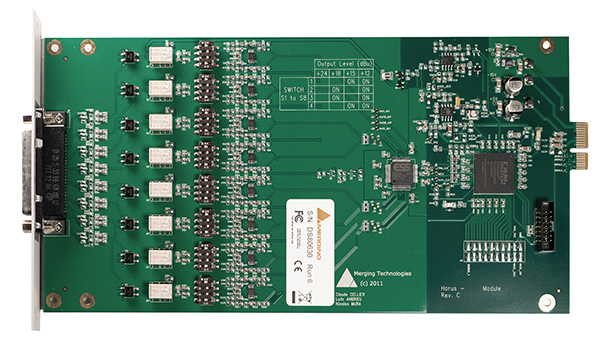
The DA8P board (above) gives eight channels of D/A conversion, with balanced analog outputso, two such boards assist 16 channels of D/A conversion. It is able to changing PCM as much as 384kHz and DSD as much as DSD256, with extraordinarily low specified noise and distortion and broad dynamic vary. A bonus is the excessive output voltage, helpful in a system like mine the place the DAC drives the amplifiers instantly.
The Hapi MkII appeared to be the logical subsequent step for me. Support for greater than eight channels meant I might, when referred to as upon, play again music in Dolby Atmosalthough in these auditions, the music maxed out at eight channels. I used to be interested in the concept that I’d be utilizing it to overview different tools with recordings that had been recorded and mastered on the Hapi or its massive brother, the Horus. As they used to say within the TV commercials, "I simply needed to have it!" So I purchased it.
Don’t fear be Hapi
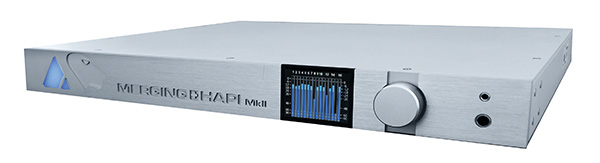
As befits a critical skilled machine, the bodily look of the Hapi MkII is extreme, clear, and neat. On the entrance left are two blue-illuminated buttons formed like nested pyramids. The bigger button is the ability change; the smaller accesses the setup menu. On the intense proper are 6.35mm and three.5mm (¼" and 1/8") headphone jacks. Adjacent to those is a knob that serves as each a rotary management for navigating the menu settings and as quantity management. To the left of the knob is an OLED used to show menu settings throughout setup and the amount ranges of the varied channels. It is all completely useful and strikingly much like its sibling, the NADAC+8 (footnote 3), which, in distinction with the Hapi MkII, is meant for audiophile use. However, the Hapi MkII lacks the graciously styled chassis and superior management ballistics of the NADAC. The shows are related, however the Hapi should squeeze bars representing 16 channels onto the identical OLED display that the NADAC makes use of for eight. The Hapi MkII additionally lacks a devoted distant management. All these points may be resolved by accessing the Hapi’s webpage with a smartphone or pill.

Except for the headphone jacks, all of the connectors are on the again. At the far proper is an AC energy inlet and a jack for an auxiliary energy provide, meant primarily for backup. At far left are two optical jacks for ADAT or S/PDIF enter/output, two BNC connectors for Word Clock enter/output, a DB-25 jack for AES3 enter/ outputeight channels of everya DB15 connector for varied sync features, and a pair of RJ45 Ethernet connections. In between are the 2 enlargement slots; on my Hapi, they’re occupied by two DA8P boards, populated by extra DB-25 connectors serving up 16 channels of analog outputeight on every board. The pinout of those is industry-standard AES59 (Tascam Analog). I used Mogami Gold DB-25-to-XLR snakes to attach these analog outputs to my energy amplifiers.
The knowledge supply used with the Hapi MkII have to be RAVENNA/AES67-compatible (footnote 4). In my system, that is achieved by working a MAD ASIO driver bundle equipped by Merging on my PC. The Arvus H2-4D Renderer talked about above is one other instance of a RAVENNA-compatible knowledge supply. Any Dante (footnote 5) machine can also be appropriate. Merging makes it RAVENNA-capable. The RAVENNA/ AES67 Virtual Audio Device (VAD) serves the identical perform for Mac OS.
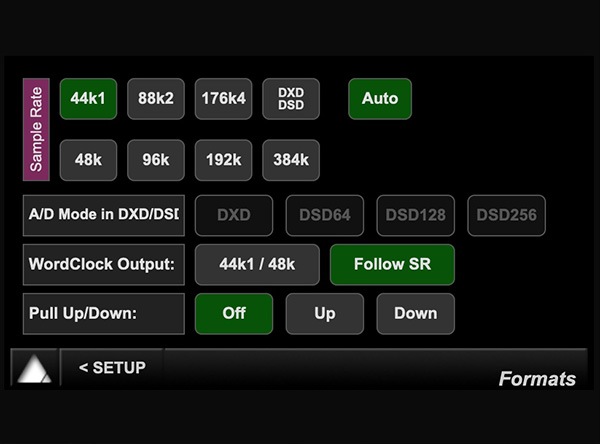
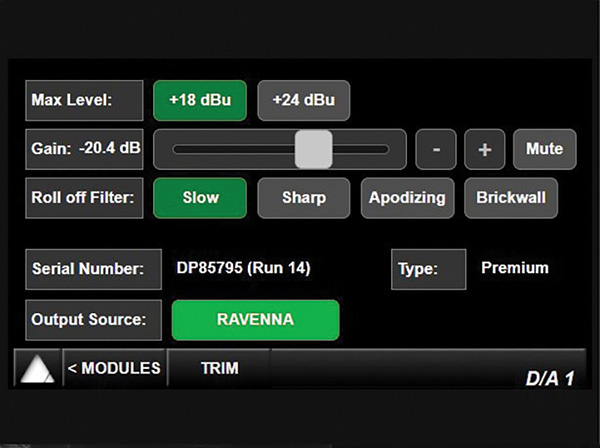
Data arrives on the Hapi by Ethernet. At first I plugged the Hapi to an area Ethernet change, shared by my PC/server and LAN. This labored, however I skilled frequent sign interruptions and extreme buffering. Merging says that RAVENNA operations don’t demand something from the community past 1Gbps functionality; they add, nonetheless, that RAVENNA hogs (my phrase, not theirs) bandwidth, so that they advocate protecting it on a separate LAN, other than different home or studio operations. I’ve a managed change on order. Until it arrives, I’ll join the Hapi on to my PC’s second Ethernet jack with a CAT6a cable, creating a non-public area. This labored.
Physically connecting the Hapi and server to the LAN is one factor; making the logical connections is one other. This activity has develop into a lot simpler since my earlier Merging experiences, with the NADAC+8 and Anubis. Partly it’s because I’ve discovered from these experiences, however a lot of the enchancment is because of the truth that the Merging ASIO Device"MAD" for briefis a tremendously enhanced, extra steady model of the sooner RAVENNA/AES67 ASIO Driver, and the Aneman instrument, which permits the consumer to map particular channel connections amongst a number of RAVENNA gadgets, is extra coherent, constant, and higher documented than earlier than.
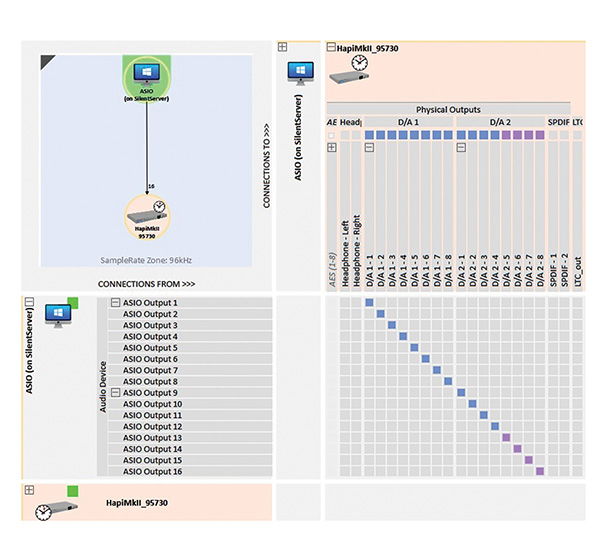
Still, the Hapi MkII is just not "Plug-and-Play." The Aneman instrument reveals all of the accessible gadgets. The consumer drags the chosen ones into an lively zone, proven within the higher left of Aneman’s "Matrix View" (see picture). The accessible inputs are stacked on the decrease left, the accessible outputs are arrayed throughout the higher proper, and the matrix of their intersections is on the decrease proper. The blue squares present the mapping of my PC server’s supply channels to the Hapi’s output channels. The full freedom to route the channels is very helpful for lively multiamping of a number of multiway audio system or, as in my case, for the impartial EQ of a number of subwoofers in a multichannel system. You may even route some channels to the AES3 or S/PDIF digital outputs relatively than by way of the DAC, in case you are utilizing lively loudspeakers.
All this may occasionally appear intimidating, however it’s manageable with a little bit of consideration and energy, and the setup is versatile and steady. If it’s essential reboot the server or the Hapi, this setup is preserved.
Up and working
Now that I set it up, as a 16-channel DAC with channels mapped, the Hapi serves as a 16-channel DACnothing extraso I’ve little direct interplay with it. JRiver or Roon serves because the consumer interface, simply as earlier than. Choose the album or observe on the server and it performs with out hiccups. Transitions between PCM and DSD are seamless. Once it is arrange, it is simple to overlook in regards to the Hapi MkII.
That similar, self-effacing character extends to the sound.

Let’s start with a current recording of Robert Schumann’s Kreisleriana, Op.16, and Humoreske, Op.20, carried out by Jimin Oh-Havenith on an album bearing the title inSANE (24/96 5.1 FLAC obtain from Audite). The title most likely alludes to the varied psychological problems Schumann was identified with throughout his quick life, however no rationalization is obtainable within the booklet. These are stunning performances, introduced in a close-up perspective however with an open acoustic ambiance. I used to be struck by the heat, weight, and richness of the piano. Pictures within the booklet confirmed my suspicion that it was a Bösendorfer, recorded with a microphone array tightly clustered across the instrument. The recording venue was Konzerthaus Liebfrauen, a 500-seat live performance corridor transformed from a Baroque church constructed in the course of the 18th century, in Wernigerode, which is halfway between Hanover and Leipzig in central Germany.
You can by no means know with certainty whether or not the playback of a recording is correct until you had been current on the efficiency and possess eidetic acoustic reminiscence, however through the Hapi, what I hear is a Bösendorfer proper there the place my heart speaker sits and, by gum, apparently I’m listening to it within the corridor I see in photos.
Footnote 1: The identify Hapi was initially utilized by legendary audio designer Bill Hegeman for a number of variations of his preamp.
Footnote 2: The base configuration can be sufficient for customers with eight or fewer channels and lively, digital-input loudspeakers, such because the Kii Three, Dutch & Dutch 8C, KEF LS50 Wireless II or LS60 Wireless, or the just lately reviewed JBL 4329P.
Footnote 3: NADAC is brief for network-attached DAC; see Jon Iverson’s NADAC report and my take right here.
Footnote 4: A little bit of pro-audio nomenclature: To interface with knowledge sources, Hapi makes use of RAVENNA/AES67, an open-source audio-over-internet-protocol normal developed for the published {industry}. RAVENNA is bidirectional and helps multicasting and correct synchronization: All gadgets on the community derive their very own, domestically generated media clocks from the community clock distributed with Precision Time Protocol (aka PTP).
Footnote 6: Dante is one other audio-over-IP expertise that’s extensively used within the pro-audio world.
HI-FI News
through InnerFidelity https://ift.tt/PgokQUY
December 20, 2023 at 04:03PM
-
Product on sale
 Audiophile Vinyl Records Cleaning BundleOriginal price was: €69.90.€59.90Current price is: €59.90. incl. VAT
-
Product on saleEasy Start Vinyl Records Cleaning KitOriginal price was: €69.90.€59.90Current price is: €59.90. incl. VAT
-
Vinyl Records Cleaner Easy Groove Concentrate€34.95 incl. VAT
-
Easy Groove Super Set€199.00 incl. VAT
-
Easy Groove Enzycaster – vinyl records prewash cleaner€34.95 incl. VAT
-
Easy Groove Extreme MK. II- vinyl records prewash cleaner€45.00 incl. VAT
-
Vinyl Records Cleaner – Easy Groove Virgin Concentrate€35.00 incl. VAT
-
Easy Groove Spray&Wipe vinyl records cleaner€34.95 incl. VAT







