
Audio News
Network Acoustics Muon2
Network Acoustics Muon2
https://ift.tt/kgjEazZ
I’ve witnessed enough shifts in audio to recognise a familiar pattern. We saw it with standalone DACs in the 1990s, lossless compression in the 2000s, and streaming in the 2010s. Now network switches are reaching the final stage of that transition, making the Network Acoustics Muon2 a product arriving at just the right moment.
We’ve travelled from outright dismissal, through ridicule of early adopters and outrage over seemingly unjustifiable prices, to cautious interest and, finally, broad acceptance. There’s a curious pattern, too: some of the loudest critics during the phases of ‘dismissal’ and ‘anger’ briefly disappear, then re-emerge claiming they understood the benefits of the new paradigm from the start. We’ve all been guilty of a little revisionism. Whether the subject is network audio, next-generation hybrid and electric engines, mirrorless cameras, the changing shape of Warhammer figures, or your search history, it’s not necessarily a bad thing… unless you’re Stalin.
State of the art
The Muon2 is a state-of-the-art audiophile network switch. Unlike earlier top-end switches from Network Acoustics and some competitors, it uses a single-box design. That choice isn’t about saving space or money. Instead, the company spent seven years developing a chassis that thoroughly isolates the signal and power sections. The experience gained while developing the company’s Origin power supply, reviewed in Issue 249, has clearly paid off. The Muon2’s hybrid supply combines the precision of switch-mode technology with the fluidity of a linear supply—qualities that make the Origin so impressive.
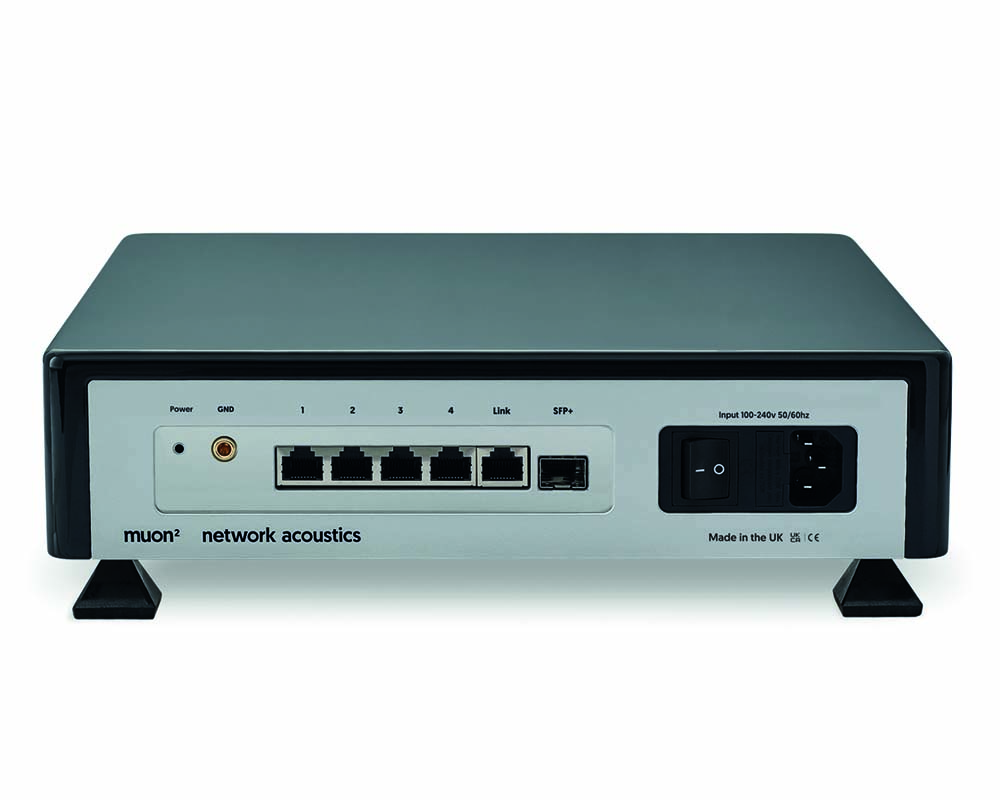
There are five 10MB-2.5GB LAN ports and one 10GB SFP+ port, offering some measure of future-proofing. This isn’t an off-the-shelf network switch: Network Acoustics partnered with a high-performance switch manufacturer to create a model built to its own specifications. Five ports should be ample for most systems, supporting a connection to the router, network storage or media servers, and playback devices such as streamers or Ethernet-equipped DACs.
Limiting SFP+
Some manufacturers regard SFP+ as the ideal connection between a switch and a media renderer. Network Acoustics, by contrast, recommends using it only for the router-to-switch link. The reasoning is sound: it keeps the inherently noisy router and internet connection away from the sensitive equipment that handles the music. But SFP+ ports are beginning to appear on audio servers and renderers, so time will tell which approach prevails. Either way, it seems unlikely that SFP+ will become so ubiquitous that the Muon2 is left behind. Its future-proofing credentials appear well judged.
The Muon2 also has a grounding terminal, reflecting the growing importance of grounding in audio. A decade ago, grounding connections were mostly found on turntables and phono stages. Now they’re appearing on a much wider range of components. Grounding accessories are following a trajectory similar to that of network switches, although audiophile switches have a few years’ head start. Put it this way: if you haven’t yet embraced good grounding practices, your 2026 self may thank you in 2028.
Get wood
One of the most distinctive features of the Muon2 is its enclosure. Rather than the usual aluminium case, it has a solid beechwood chassis developed with speaker-cabinet specialist AUER Acoustics. Finished in high-gloss metallic black or silver, it can look from a distance like any other metal box. Beech was selected for its natural neutrality and resistance to resonance compared with more conventional metal and composite enclosures.
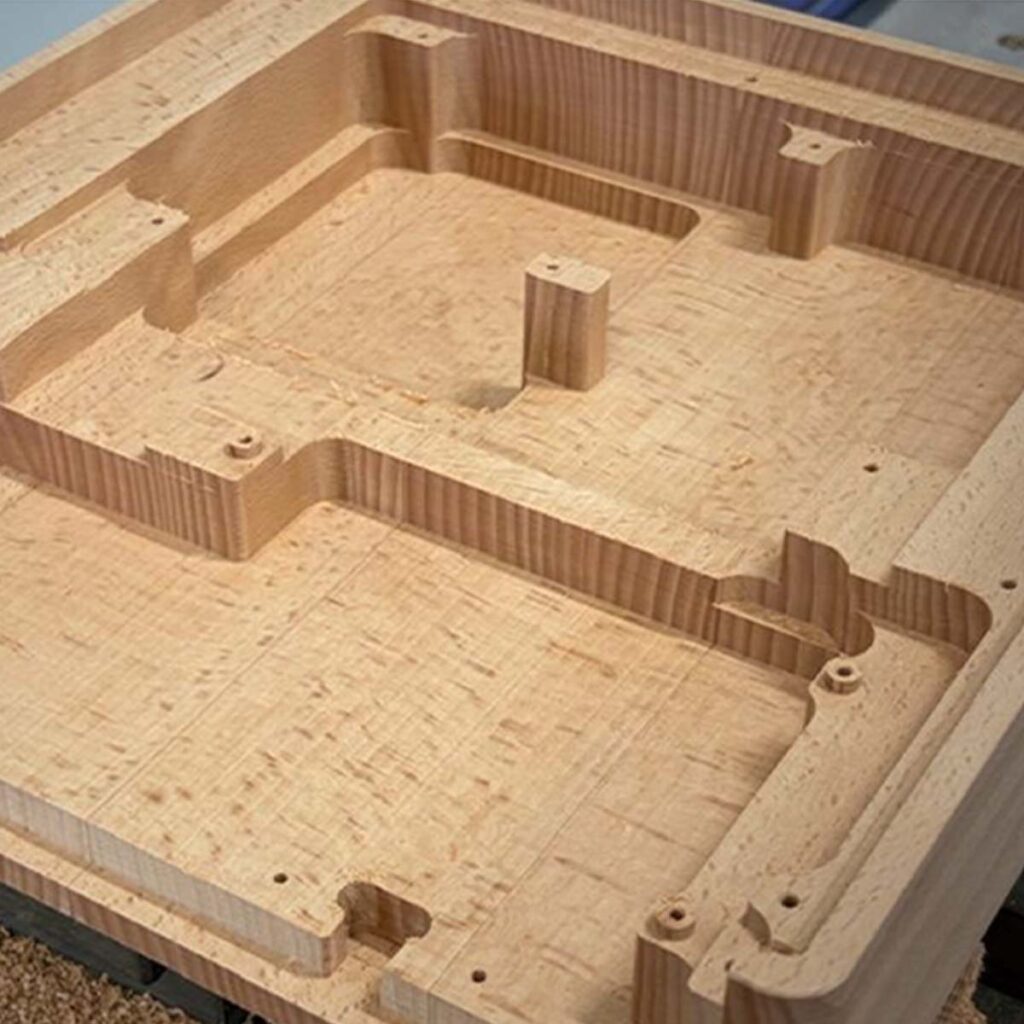
I’m not sure this design will inspire a wider trend in audio. Some circuits need extensive shielding, and a solid beech enclosure adds considerable weight and cost. But in purely sonic terms, perhaps more products should consider it. At the very least, loudspeaker makers committed to walnut for their ‘made of solid tree’ designs might want to give beech a look.
Last piece in the jigsaw
One final detail deserves mention: the Muon2 rests on three custom-made stone Pyramid Isolators. As the name implies, they’re pyramid-shaped, with one positioned at the front and two at the rear. Early Muon2 samples lacked properly shaped recesses beneath the baseplate, making installation slightly awkward. On a scale where ‘one’ is setting a coffee cup on a coaster and ‘ten’ is ‘underwater bagpipe juggling’, the task rated about three and a half. That issue has since been fixed on current versions.
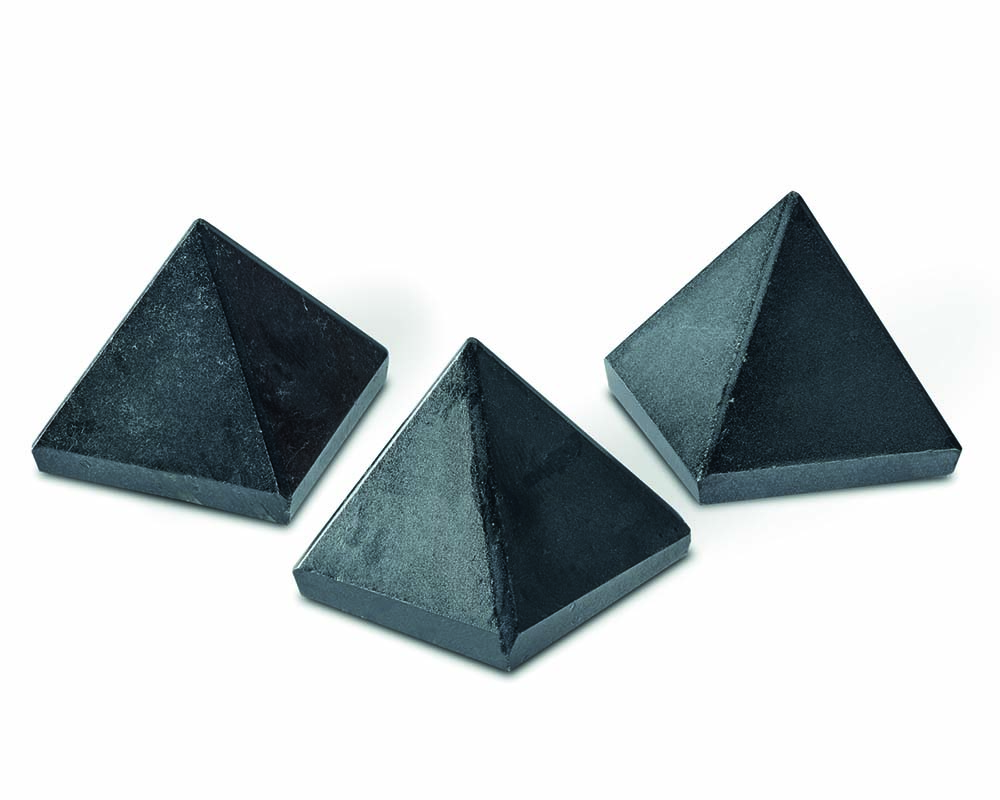
The Network Acoustics Muon2 uses a standard IEC power inlet. It’s heavy enough to stay put with most power cables, though an exceptionally thick, heavy, and stiff cord might lift it slightly off its three pyramid feet. It’s also one of the rare components that doesn’t automatically benefit from upgrading the power cable. A good one is welcome, but any improvement is subtle compared with the switch’s overall performance.
Proselytiser
I tried the Muon2 with a range of equipment at different price levels. I even became a willing advocate, taking it on a listening tour of some excellent network systems, as well as a few that cost far less than the switch itself. “At no time did the Muon2 disgrace itself,” as the British understatement goes.
Let’s start with the obvious caveat. The Muon2 improves the sound of a friend’s KEF LSX IIs, bought a couple of years ago, but pairing a £1,200 system with a switch costing almost £7,000 is hard to justify. Sonically, though, the combination works: the LSX IIs sound larger, with a wider and deeper soundstage and more clearly defined bass. I wouldn’t be surprised if a few Muon2s found their way into demonstration rooms, where they could show what an affordable network system can do. It’s rather like using a huge power amplifier to drive tiny two-way speakers.
In practice, the Muon2 is most likely to find a home in systems built around mid- to high-end network components. I used it mainly with the Innuos Nazaré and, before it went back, the ZENith Next-Gen servers, feeding a Chord DAVE DAC and Hugo M Upscaler. This is where the Muon2 really excels—and it does so brilliantly.
Sounds like analogue
‘Sounds like analogue’ has become a familiar description of network streaming. Yet products such as the Muon2 give the phrase real meaning: the sound has a spacious, natural quality and an airy openness more often associated with analogue. That character isn’t limited to audiophile-approved recordings or intimate jazz sessions in smoky early-1960s clubs, though those sound wonderful through the Muon2. The same openness and sense of space come through across all kinds of music.
This doesn’t mean ‘Kraftwerk on period instruments’. Rather, when you play ‘The Robots’ [The Man Machine, Kling Klang/EMI], its taut, proto-clubby rhythm comes into sharp focus. The beat’s attack, decay, sustain, and release are rendered with precision, making the presentation both clear and revealing. It’s like a lesson in 1970s synth programming, without losing the track’s undeniable energy.
Real and energised
Move on to almost anything else and the music sounds more vivid, more lifelike, and more energised. ‘Magpie’ by The Unthanks [Mount the Air, Rabble Rouser] is atmospheric to begin with, but the Muon2 takes it to another level: mesmerising and deeply affecting. It was powerful enough to send me back to the same song—and the equally affecting ‘Bread & Roses’—on their Diversions Vol 5: Live and Unaccompanied album. The soaring purity of their treble makes their voices notoriously difficult to resolve, but the Muon2 handles them with ease. That’s its great strength: it clears away the noise, both literal and figurative, between listener and music, drawing you into the performance.
Networked audio is entering an ‘everything matters’ era, as listeners discover that every component in the data chain can influence the final result. With the Network Acoustics Muon2, that influence works firmly in your favour. It takes network audio to a new level of realism.
Technical specifications
- Type: Audiophile-grade network switch
- Ethernet ports: 5x 10MB-2.5GB RJ45 port, 1x 10GB SFP+ port
- Clock: ultra-low jitter
- Power supply: hybrid linear/SMPS
- Accessories: 3x pyramid isolators
- Finish: gloss black or silver
- Dimensions (HxWxD): 9 x 29 x 29cm
- Weight: 3.3kg
- Price: £6,995, €7,999, $7,999
Manufacturer
Network Acoustics
+44(0)2380 612627
The post Network Acoustics Muon2 appeared first on hi-fi+.
HI-FI News
via Articles Archive – hi-fi+ https://ift.tt/6b7aJQY
November 11, 2026 at 11:45AM
-
Product on sale
 Audiophile Vinyl Records Cleaning BundleOriginal price was: €69.90.€59.90Current price is: €59.90. incl. VAT
-
Product on saleEasy Start Vinyl Records Cleaning KitOriginal price was: €69.90.€59.90Current price is: €59.90. incl. VAT
-
Vinyl Records Cleaner Easy Groove Concentrate€34.95 incl. VAT
-
Easy Groove Super Set€199.00 incl. VAT
-
Easy Groove Enzycaster – vinyl records prewash cleaner€34.95 incl. VAT
-
Easy Groove Extreme MK. II- vinyl records prewash cleaner€45.00 incl. VAT
-
Vinyl Records Cleaner – Easy Groove Virgin Concentrate€35.00 incl. VAT
-
Easy Groove Spray&Wipe vinyl records cleaner€34.95 incl. VAT







