
Audio News
New American Symphonies
New American Symphonies
https://ift.tt/QgZoJ8L
New American Symphonies
On the new album New American Symphonies there is a musical discovery – or more precisely: a rediscovery.

A collaboration between FIDELITY and the Copper Magazine
The Original article appeared in Copper Magazine, issue 233.
Roy Harris wrote his Trombone Symphony originally in 1938 for Tommy Dorsey, but it has only now been recorded for the first time. This magnificent piece shows influences from both jazz and classical music, and you can also hear traces of musicals and contemporary popular music. When you listen, you naturally wonder why it took so long to bring it into the public light. New American Symphonies has been available in stereo and as an immersive-audio version in various formats since August 14.
The album combines the Trombone Symphony with Night Suite, a modern work by composer Scott Ninmer. The performance with trombonist Jim Pugh is musically and sonically outstanding – not surprising, since it was produced by Jim Anderson and Ulrike Schwarz in Digital Extreme Definition (DXD). New American Symphonies brings together a large ensemble with around half a dozen woodwinds, four trumpets, three trombones, piano, bass, drums, guitar and percussion. Among the premier New York musicians are pianists Bill Charlap and Jim Beard, as well as saxophonist Ted Nash. The ensemble for the Trombone Symphony was conducted by Marin Alsop.
New American Symphonies is available as a download via Native DSD and HDtracks, on all major streaming services, and as an LP from Citizen Vinyl.
According to a press release, years of research by Jim Pugh were required to bring the Trombone Symphony to light. He ultimately discovered Roy Harris’ original manuscripts in the Library of Congress. Pugh found that Tommy Dorsey’s orchestra had once attempted to rehearse parts of the Symphony, but abandoned the project. It was never publicly performed. Hard to believe. As Pugh notes: “When you close your eyes and hear the first movement, you can already sense where jazz would develop 35 or 40 years later … It’s like a remarkable little time capsule that slipped through the meshes of history.”
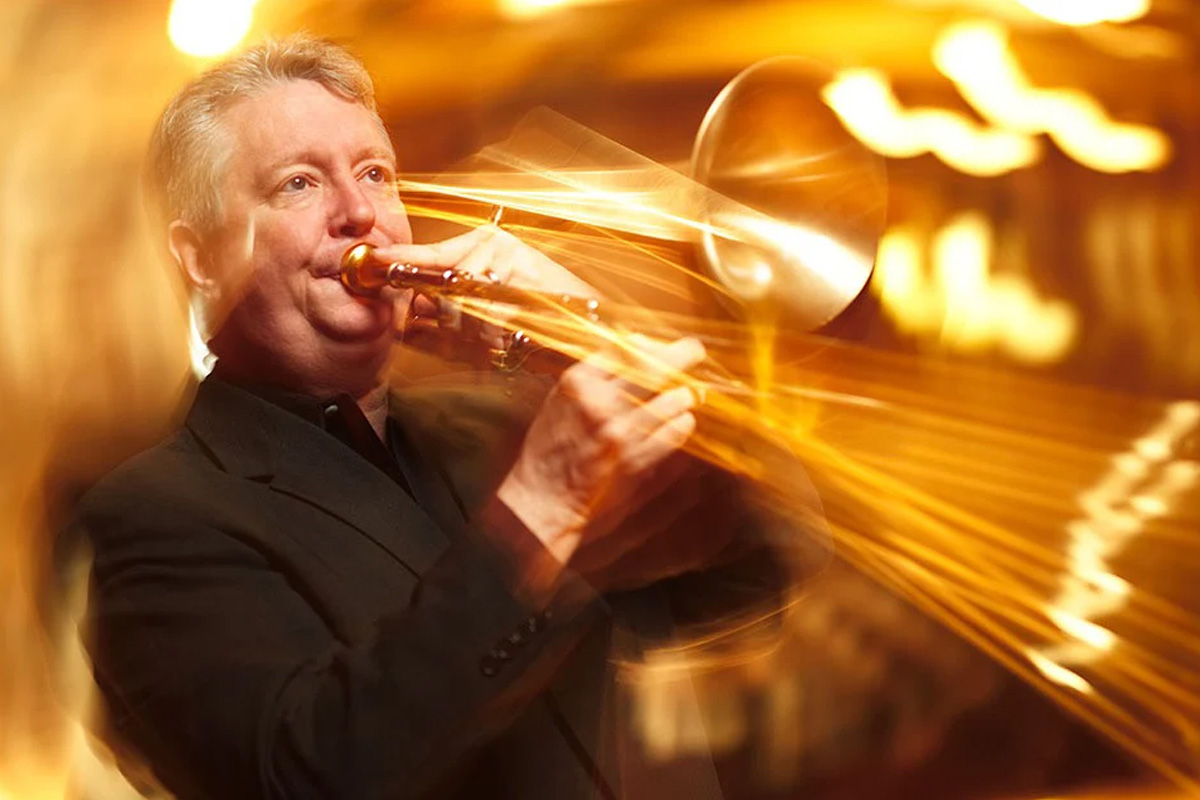
Indeed, the first movement sounds extraordinarily contemporary and could just as easily serve as the overture to a Bernstein Broadway musical as a work by a current composer. The tempo is brisk – not surprising that Dorsey’s orchestra would have had trouble playing it. The timbres are exceptionally varied, plus the ensemble’s cohesion and fascinating solo passages and dialogues between piano, woodwinds and brass. In fact, the album’s press contact even sent me the complete scores. It is fascinating to study the orchestration on paper and then hear how it comes to life.
Audiences of 1930s popular music would have scratched their heads in wonder at the time. Classical music lovers, however, would have appreciated it – it stands on par with composers like Gershwin and Copland.
The second movement is more restrained, with a steady tempo and fills the room with rich, deep timbres. Jim Pugh’s beautifully sonorous, warm-toned horn complements the music perfectly. It unfolds in dignified quiet, and as expected, the trombone carries a large portion of the melody. Beautiful.
Scott Ninmer’s Night Suite sounds modern in its big-band jazz character, chord voicings, and harmonic color palette. The music feels freer, less strictly “composed,” and allows more room for improvisation and solo moments. In the first movement, “Eventide,” Pugh has ample opportunity to soloi while the band masters the call-and-response principle. The music would easily fit into a playlist with Don Sebesky, Maynard Ferguson, the Jazz at Lincoln Center Orchestra, Christian McBride and other large brass and woodwind ensembles.
The second movement, “Gliding Through the Darkness,” begins with an arpeggiated electric guitar figure doubled by various instruments. Then brass and woodwinds join in, placing lush accents in the background. “Too Late,” the third movement in a mid-tempo, feels airier and more buoyant, with interwoven melodies and pronounced jazz feel. After hearing the guitarist, I realized I had heard him before but couldn’t place him at first. A look at the liner notes revealed: Jon Herington, known for Steely Dan. I can imagine Donald Fagen enjoying that. I, for one, like it very much.
Sonically, the recording is simply stunning. The soundstage is expansive, wide, and deep – and this is in stereo. I will listen to the immersive version at the next opportunity. The tonal balance is, to my ears, flawless. Instrumental textures distinguish themselves with ease and remain clearly defined even as the orchestration becomes complex. The recording has weight, presence, and excellent dynamics. At no point does it feel like you are listening to “a recording” – rather, you seem to dive directly into the music. On a high-end system, this performance is simply wonderful. It reminds us why we do all this – the passion for audiophile music reproduction.
Of course I had to ask Jim Anderson and Ulrike Schwarz how New American Symphonies came about.
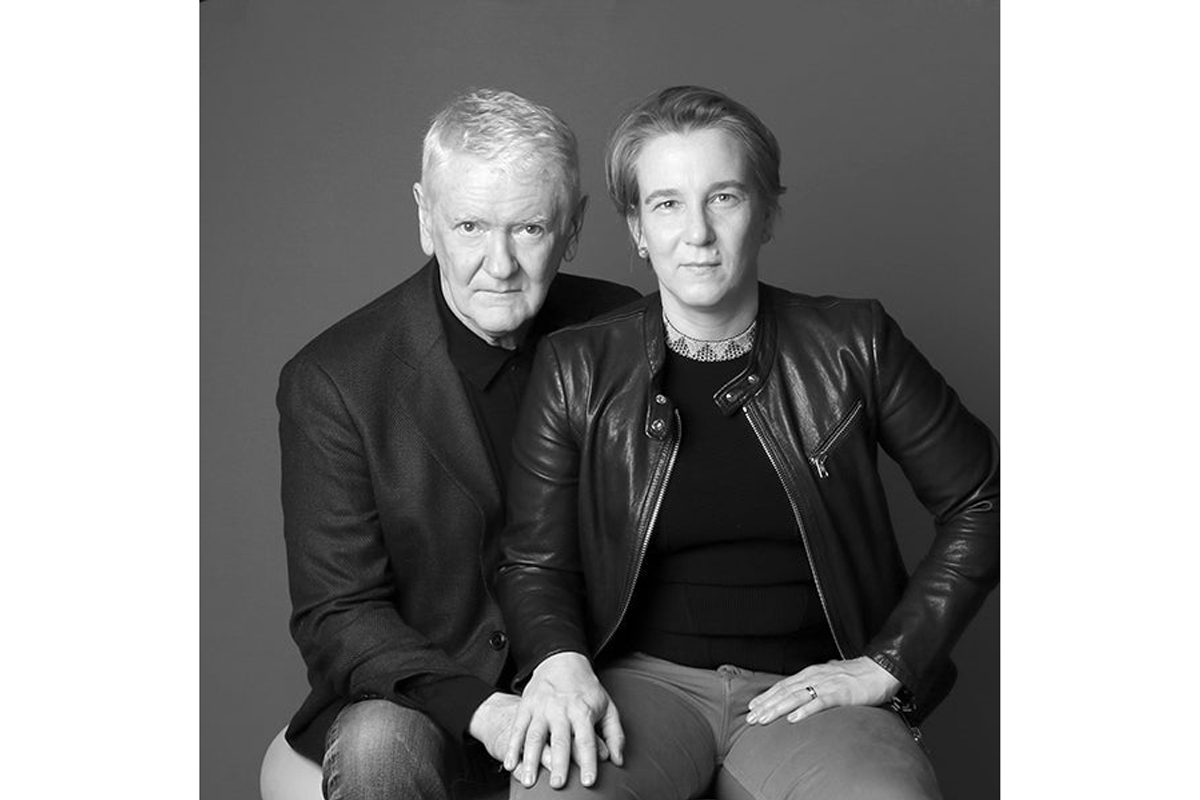
Frank Doris: How could the Trombone Symphony, such a brilliant work, have remained unnoticed for decades?
Jim Anderson: It lay in a box in the Library of Congress. The story begins actually with Jim Pugh. He read a biography about Leonard Bernstein, describing how the composers of the 1930s wrote for Benny Goodman, Artie Shaw and others. And in one sentence it said: “And Roy Harris wrote a trombone concerto for Tommy Dorsey.” Jim thought: “What?”
So he began to look into it more closely, and eventually got permission to go to the Library of Congress and inspect Roy Harris’ estate. They worked through box after box. First he found a score, then individual parts. Finally he discovered the score of one movement and the parts for a second. He then reconstructed both parts.
Then he spoke with Harris’ widow and gained permission to go into the studio and find out how the work sounded. If you listen closely, the first movement is basically a piano concerto for Bill Charlap. It had been written essentially for Harris’ wife, who was the pianist. The second movement is essentially Tommy Dorsey’s solo. And then you realize the music does not continue. There is no third movement. The reason is that the Dorsey band, after a performance at the Rainbow Room in New York, tried to play the piece and declared it unplayable. It was subsequently shelved. I think one of the scores even reads “abandoned” or something of that nature.
Ulrike Schwarz: And on the trumpet part there were some particularly unfriendly annotations. The musicians didn’t like the piece.
JA: Jim [Pugh] never told me exactly what was written there, but some trumpeter had noted something quite obscene about the piece and declared it simply unplayable. It was certainly not the typical bebop of the 1930s. I mean, the work was clearly ahead of its time by years. But we went into the studio with some of the city’s finest musicians – and with some of the world’s best musicians. We recorded it in about six hours.
As for Ninmer’s piece: He had been Jim’s student and has since built a quite successful career as a composer and arranger. Today he is a member of the United States Marine Band. He wrote Night Suite in honor of Jim, one of his former professors. While we were in the middle of Ninmer’s recording, I said: “Jim, whatever happened to that Trombone Concerto we recorded?” He answered: “It’s just lying around.” And I said: “With these two pieces we could have an album.” That is how the two works came together.
FD: For me, it’s a combination that works because it shows the development of music over several decades – and demonstrates how far ahead of its time the Trombone Symphony was, while Night Suite looks back a little.
It sounds as if there is a lot of improvisation in Night Suite and as if there were spaces reserved for Jim Pugh’s improvisations.
JA: Very much so. It is heavily influenced by jazz. You hear Jim first presenting the melody, then long sections of improvisation.
FD: I love Jim Pugh’s sound, his tone. The sound of the trombone and the way he plays it were the perfect instrument for this music. If someone had played harmonica, it would have been distracting. But the trombone was simply … You immediately understand why the piece is called Trombone Symphony and written for exactly this instrument. It fits perfectly.
JA: Well, Frank, what’s truly interesting about Jim is that we have known each other since seventh or eighth grade, since junior high school in Butler, Pennsylvania. I heard him play 60 years ago. Even back then he was a real wunderkind. He studied with Matty Shiner, the leading trombone teacher in Pittsburgh at the time. Later he went to the Eastman School of Music and studied with Emory Remington. He learned from the best. At the same time, he was simply a phenomenon. One could almost call him a natural occurrence. He was born to play this instrument.
FD: The sound of the recording is superb. Copper readers will of course want the technical details.
Ulrike Schwarz: The recording system consisted of 32 DXD channels with Merging Technologies Pyramix. I think we had eight more channels in addition. Everything was mixed with Merging Technologies’ SuperClock. For both recordings we used ribbon microphones for Jim’s trombone, an RCA and an AEA KU4.
JA: Jim plays with Steely Dan. He told me: “When we’re on tour, we have an AEA KU4 for the horn section.” So we brought it into the studio.
FD: Was everything recorded live?
JA: Yes, everything live. There was a little editing, but Jim didn’t need to make any corrections. And in the Trombone Symphony, Marin [Alsop] conducted.
[Editor’s note: Some microphones had to be repositioned when the saxophonists changed instruments; also some flute parts had to be recorded as overdubs.]
And for the first piece, Harris, Marin conducted as well. Both pieces were recorded in two three-hour sessions each.
FD: So you did not dismantle and then reassemble the entire setup for the two pieces? Was it the same configuration?
JA: The recordings took place in separate sessions. One took place in Studio A at Power Station, the other in Studio C at Power Station.
US: You should mention that one recording was made in 1995 and the other in 2023.
FD: So much for my highly sensitive ears!
JA: Honestly, that says a lot about our mixing work, because the two pieces fit together so seamlessly that you would never guess there was a gap of 30 years between them.
FD: … a gap between them? No, I’d never have guessed. I’m just joking about my ears not being good enough to hear the difference. But no – it is completely seamless.
US: My job was to connect the two recordings sonically so that you truly do not get the sense that there are 30 years between them. When I first heard the Trombone Symphony, I could hardly believe what was happening. I think Harris’ [Night Suite] is such an outstanding performance and such an outstanding work.
JA: It also contributes a lot to the history of American music.
FD: I wonder how much more undiscovered material is out there.
JA: Oh God, there must be a lot. In the 1980s I was in Andrés Segovia’s studio. There was a stack – really a stack, perhaps 60 centimeters high – of manuscripts sent to him by various significant composers to correct and arrange for guitar. And he said: “I’ll work through those piece by piece.” We looked at some of them, and they were simply fantastic works.
And that was just Segovia and the guitar. Who knows what else awaits discovery when people look through those boxes in the Library of Congress?
FD: There could be an entire world of undiscovered music waiting to be found and heard.
JA: Exactly why we launched New American Symphonies. Both pieces feel distinctly American and clearly show their roots. I think these two works substantially enrich the trombone repertoire.
FD: An instrument that is not heard as often today as in the past. It’s a pity, because it has a very beautiful sound.
JA: In Harris’s second movement, Jim has a tone that very much reminds of Tommy Dorsey.
FD: Listeners will develop a whole new appreciation, a new understanding, or at least a new curiosity for the trombone through this recording.
JA: I completely agree. I recall one of my teachers saying: “If you have a good trombone section, you have a big band. If you have that trombone section, everything else will be great.”
Our sincere thanks go to Copper Magazine.
The contribution New American Symphonies appeared first on FIDELITY online.
HI-FI News
via FIDELITY online https://ift.tt/JUxhzol
September 24, 2026 at 01:39PM
-
Product on sale
 Audiophile Vinyl Records Cleaning BundleOriginal price was: €69.90.€59.90Current price is: €59.90. incl. VAT
-
Product on saleEasy Start Vinyl Records Cleaning KitOriginal price was: €69.90.€59.90Current price is: €59.90. incl. VAT
-
Vinyl Records Cleaner Easy Groove Concentrate€34.95 incl. VAT
-
Easy Groove Super Set€199.00 incl. VAT
-
Easy Groove Enzycaster – vinyl records prewash cleaner€34.95 incl. VAT
-
Easy Groove Extreme MK. II- vinyl records prewash cleaner€45.00 incl. VAT
-
Vinyl Records Cleaner – Easy Groove Virgin Concentrate€35.00 incl. VAT
-
Easy Groove Spray&Wipe vinyl records cleaner€34.95 incl. VAT


