
World News
Oskar Heil Kithara
Oskar Heil Kithara
I believe I first grew to become acquainted with the title Oskar Heil very long time again once I reviewed one among Mark & Daniel’s loudspeakers outfitted with the AMT ribbon tweeter (Air Motion Transformer). As everyone these days is aware of, the AMT is a ribbon tweeter however not of a traditional kind in that it strikes air in a semi-perpendicular method using an accordion sort of folded diaphragm (made from polyethylene, polyester or polyimide), and the diaphragm that includes a sequence of aluminum struts positioned in a high-intensity magnetic discipline. Since that overview I’ve come throughout AMT-transducers in I don’t what number of loudspeakers ranging from Adam Audio, ELAC, Martin Logan and so on. and so on. and so on. and so on.
Dr. Oskar Heil (1908-1994) was a German physicist and inventor who, along with his speaker ingredient, is thought for pioneering work on microwave turbines and FET transistors lengthy earlier than the primary microwave ovens and lengthy earlier than FETs discovered their approach into audio amplifiers (Heil filed his FET patent in 1935).
In growing the AMT method, Heil had two premises. According to the primary one, human ear is a far more delicate to variations (variations) in frequency area than to loudness variations (i.e. is much less delicate to fluctuations within the amplitude of sound vibrations, and may simply adapt to them). The voice of an opera singer famously stands out properly from the orchestra, though the amount of the orchestra’s voice is many occasions greater than the singer’s voice. The smallest amplitude variations that people can detect is a few decibel, equal to an influence distinction of 26 %. On the opposite hand, human ear is especially delicate to frequency variations, particularly in the midst of the listening to vary, from a number of hundred hertz to a couple thousand hertz. In that vary human ear can distinguish pitch variations of 0.06 % (i.e. lower than the vibrato of a violin). 0.06 % versus 26 %! No surprise then that some query the speaker trade’s obsession with amplitude variations of 1-2 decibels whereas ignoring, for instance, the often-heard pitch shifts at excessive frequencies attributable to the driving force cone.
The second premise states that human potential to localize the route of the sound relies on listening to the part variations of the sound particularly between 500-3000 Hz. The premise implies, the flexibility to find sound sources deteriorates considerably, and the realism of the replica suffers, until the driving force/cone is ready to reproduce transients rapidly sufficient and with out including its personal distortion to the sound. Hence, the need of lightness of the cone.
We needn’t agree on each level (even a heavier cone may be made to maneuver rapidly with a sufficiently highly effective magnet), however there’s no denying that the road of pondering emanating from the above premises was what motivated Dr. Oskar Heil to develop his superb speaker unit for medium and excessive frequencies: the Air Motion Transformer.
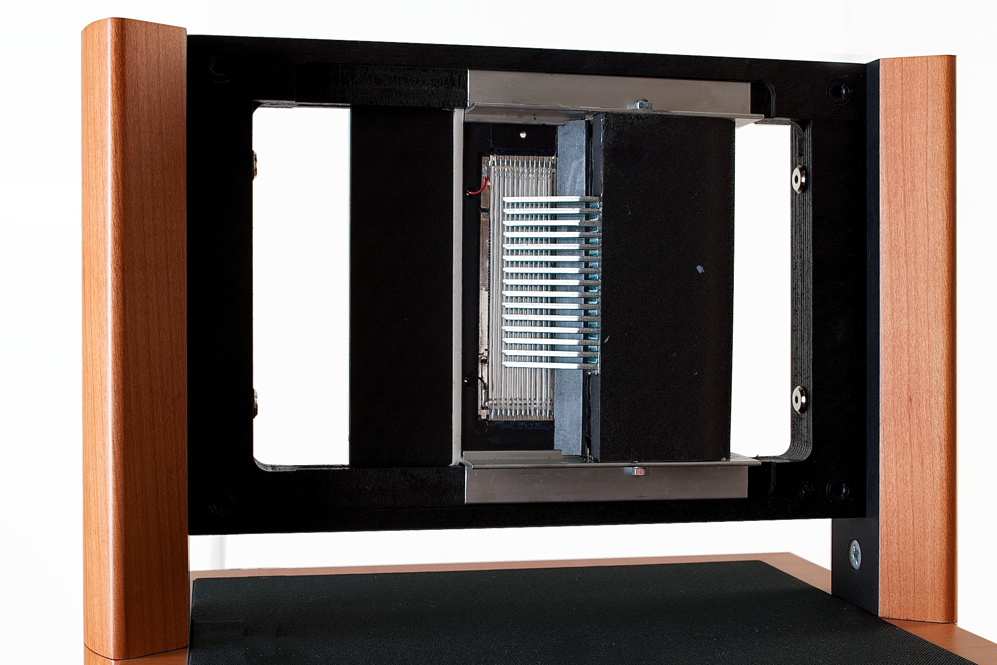
HEIL AMT/AVT RIBBON DRIVER
It’s solely logical that Heil determined to deal with the cone and its resonances. The essential process was to pick out the suitable cone materials. As it’s well-known, any materials, when it’s made to play/sound, produces resonances of a special spectrum, simply as musical devices produce their very own attribute higher harmonics, and thus change into recognizable. According to Heil, the identical property that’s helpful for telling aside musical devices is an issue for the speaker driver designer, as a result of the cone’s personal nonlinearities amplify and masks the music sign.
In order for the cone to have the ability to transfer a considerable amount of air by means of the membrane with minimal loss and to breed sudden transients (present/voltage shifts) rapidly, the cone, in accordance with Heil, needed to be very mild. But not too skinny and lightweight as a result of it would contribute to the cone’s deformity with audible resonances and distortions. Traditionally, these points have been solved by dampening the cone or by distributing the replica duty over a bigger floor space. Heil didn’t wish to proceed that approach as a result of neither trick helped the cone to behave utterly cylindrically, or to stop distortion within the necessary frequency vary of human listening to. This is true of dynamic drivers particularly, however Heil wasn’t too excited in regards to the electrostatic and ribbon speaker items of his time both. He wished to strive one thing utterly totally different.
Dr. Heil’s Air Motion Transformer (AMT) speaker ingredient for medium and excessive frequencies was patented in 1973. The membrane of the unit could be very skinny plastic and the transferring mass on the order of a gram. Parallel aluminum conductors are metallized to the membrane at common intervals. The diaphragm is folded accordion-like into pleats. A wire runs on the facet of every fold. The stream of present in adjoining folds is at all times reverse. The diaphragm is put in in the midst of a robust magnetic discipline. The poles of the magnetic circuit come to the back and front of the membrane. The construction doesn’t require an enormous magnet or a transformer, as a result of the resistance of the “voice coil” (aluminum conductors) is excessive sufficient. Also, the resonance frequency of the construction can robotically be set outdoors the reproducible frequency band.
When a music sign is fed to the unit, the pleats alternately increase and contract like bellows, forcing air out on one facet of the pleats and sucking in on the opposite facet. Relative to the motion of the conductors, the air is moved 5 occasions the quantity in comparison with the traditional driver cone, which is why the AMT tweeter is usually referred to as the AVT (Air Velocity Transformer) speaker unit. The efficient floor space of a typical AMT tweeter is equal to the floor space of a seven-inch cone driver. AMT instigated comparable know-how, reminiscent of Manger’s Sound Transducer and Rowen’s LMT (Linear Motion Transformer) driver.
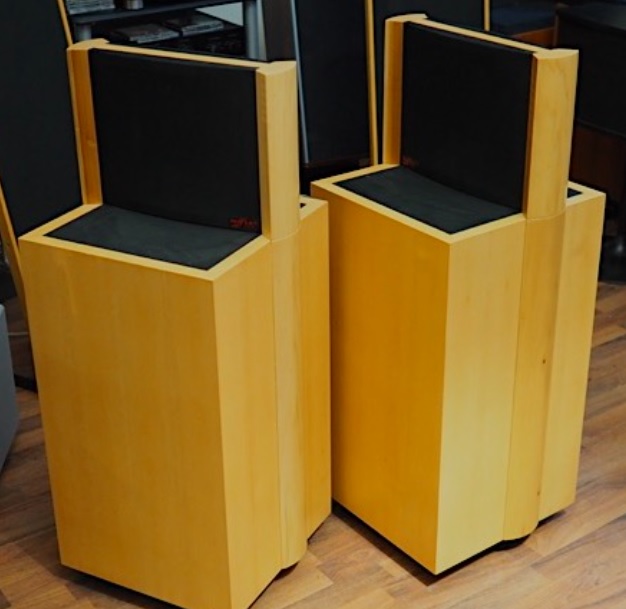
KITHARA AND HOW IT SOUNDS
The first loudspeakers using the AMT know-how had been manufactured within the USA in California within the Seventies and Nineteen Eighties. The audio system glided by the title ESS Heil, and it was ESS’s Nelson Pass who assisted Dr. Oskar Heil with crossover design and the woofer choice. It seems that Heil himself wouldn’t have been too fond of those audio system, so he determined to design his personal AMT reminiscent of Heil Air Motion Kithara loudspeaker. Heil was then 80 years outdated. It was the Swiss Precide SA that took the duty for the manufacturing. According to some sources, the speaker has been upgraded a number of occasions over time (the woofer, cupboard, crossover, wiring). The pair examined on this overview was from the mid 2000.
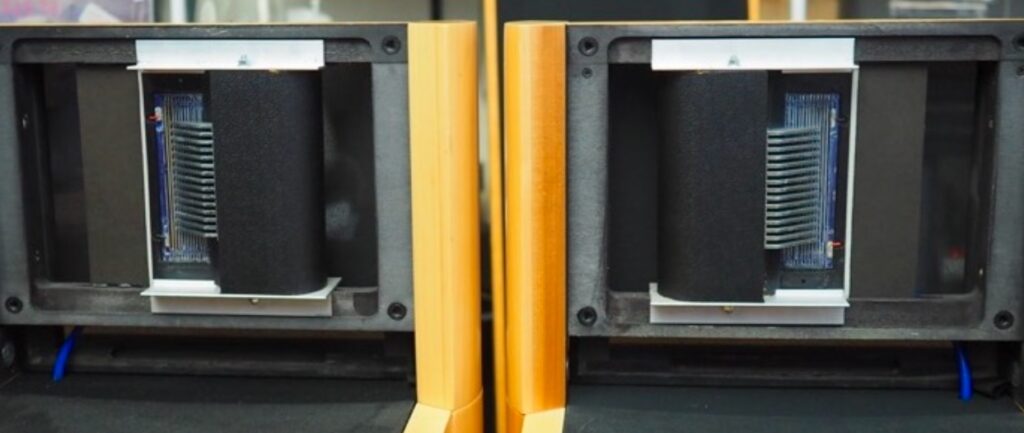
The 2-way Heil AMT Kithara appears to be like like its creator, absolutely designed to maneuver air rapidly and effectively within the space that’s most necessary to human listening to. Heil Kithara weighs 35kg and measures 110 cm excessive. On high there’s a protracted AMT/AVT ingredient in a wood console radiating sound to each instructions, ie. is a dipole tranducer. Just under the Heil mid/tweeter there’s a reflex loaded 10 inch woofer mounted dealing with upwards for one of the best part relationship with the excessive frequency AMT unit. The port is on the backside of the cupboard 180 levels to the ground. Kithara’s AMT unit will not be a typical AMT driver that may be present in quite a few 2/3-way designs dealing with the very best octaves. The AMT unit in Kithara is made to breed frequencies from 700Hz upwards, that means that it is ready to cowl full 5 octaves, which slightly makes it like a quasi huge bandwidth driver. The woofer part does 28Hz – 700Hz.
I drove the Kitharas with Brinkmann Marconi hybrid-preamp and Brinkmann 250/150W mono blocks. Irrespectively of Kithara’s excessive 94 dB (W/m) sensitivity I bought the impression that such transistor amps can be the way in which to go together with these audio system, slightly than their smaller energy tube cousins. The nominal impedance is 4 ohms.
In a big, barely sonorous area, Kithara’s tonal stability turned out to be properly studied and thought of, and that impression remained all through the listening session. The sound is clearly not a results of the fantasy world of a younger speaker designer. Something in regards to the sound whispered me that the tone or tone stability had a darkish flavour. This high quality was not as a result of extreme mid/higher bass however barely rounded greater octaves. However, I wouldn’t say the HF division was subdued, simply that the presentation was totally different from what I’ve heard from quite a few AMT tweeters in different audio system (sealed or BR). The rationalization in all probability lies in the truth that Kithara’s AMT driver radiates sound ahead and backward (dipole), and never simply ahead as is the case in 9 out of 10 loudspeakers whit the AMT tweeter. The high quality didn’t disturb me in any respect with traditional or different artwork music, with which Kithara’s mid-tweeter rendered the sound, within the desired approach, spacious and ethereal and nuanced. It was with sure studio materials that the phenomenon reminded of itself. The listening top considerably affected the impression however not considerably. The radiation sample of the tall and slender Heil unit is horizontally wider than vertically.
It is noteworthy, although, that Mark & Daniel developed, to go together with the Heil’s tweeter, an Omni-Harmonizer that was requested to breed frequencies from 7 okHz to 35 okHz, simply so as to add a little bit of air and power to the very best notes. Nowadays, audio system with two AMT tweeters, on in entrance and the opposite behind, are usually not that unusual.
Kithara’s bass was usually superb. I personally may need taken away one or two decibels right here and there (room reflections?) however no severe faults right here. Plus, I used to be satisfied that Kithara is extra room pleasant than audio system with ahead shouting bass.
Intellectually probably the most intriguing query was how properly or not Heil had managed to combine his personal giant ribbon ingredient with the woofer output? The danger of some kind of cancelation across the crossover frequency is probably going right here, relying on the gap and placement of the drivers (Kithara’s AMT unit stands 1.5-2 inches away from the middle of the woofer). My tackle this level was that the speaker is able to moderately seamless efficiency though the mixing isn’t maybe excellent (some DIY fans have have reported of the unit’s inherent attenuation one and a half octaves above the crossover frequency). Subjectively the best method to detect issues on this regard is to hear how logically music proceeds.
When it got here to frequencies between 700Hz and 7000Hz, Kithara proved absolute delicacy. Lutes and guitars benefitted from exact assaults, purity of the sound, luxurious timbres. Thanks to its AMT unit, Kithara made many music, from Bach to Nightwish, from Bela Fleck to Ella Fitzgerald, very auspicious, very listenable. If a clear midrange and delightful harmonics imply something to you, Heil Kithara is ready to show what a loudspeaker can obtain on this regard, at all times sustaining a sure degree of high quality, and at all times remaining beneficial to the music in hand. However, it’s an uncommon loudspeaker, and subsequently I like to recommend an audition earlier than inserting cash on the desk.
Technical knowledge:
Type: two-way bass reflex for speaker, Drivers: AMT midrange/tweeter & 10 inch woofer; Frequency response: 28Hz – 23kHz (+/- 5dB), Crossover: 650Hz/second order (12dB/octave); Impedance: min. 4 ohm; Sensitivity: 94dB/W/m; Dimensions: 110cm x 40cm x 40cm; and weight 35kg.
HI-FI News
through Inner Magazines https://ift.tt/9HCnOrb
July 21, 2024 at 06:16PM
-
Product on sale
 Audiophile Vinyl Records Cleaning BundleOriginal price was: €69.90.€59.90Current price is: €59.90. incl. VAT
-
Product on saleEasy Start Vinyl Records Cleaning KitOriginal price was: €69.90.€59.90Current price is: €59.90. incl. VAT
-
Vinyl Records Cleaner Easy Groove Concentrate€34.95 incl. VAT
-
Easy Groove Super Set€199.00 incl. VAT
-
Easy Groove Enzycaster – vinyl records prewash cleaner€34.95 incl. VAT
-
Easy Groove Extreme MK. II- vinyl records prewash cleaner€45.00 incl. VAT
-
Vinyl Records Cleaner – Easy Groove Virgin Concentrate€35.00 incl. VAT
-
Easy Groove Spray&Wipe vinyl records cleaner€34.95 incl. VAT







