
World News
Public Domain Day 2024
Public Domain Day 2024


January 1, 2024 is Public Domain Day: Works from 1928 are open to all, as are sound recordings from 1923!
By Jennifer Jenkins
Director, Duke Center for the Study of the Public Domain
CC BY 4.0
Please observe that this web site is simply about US legislation; the copyright phrases in different nations could also be totally different.[1]
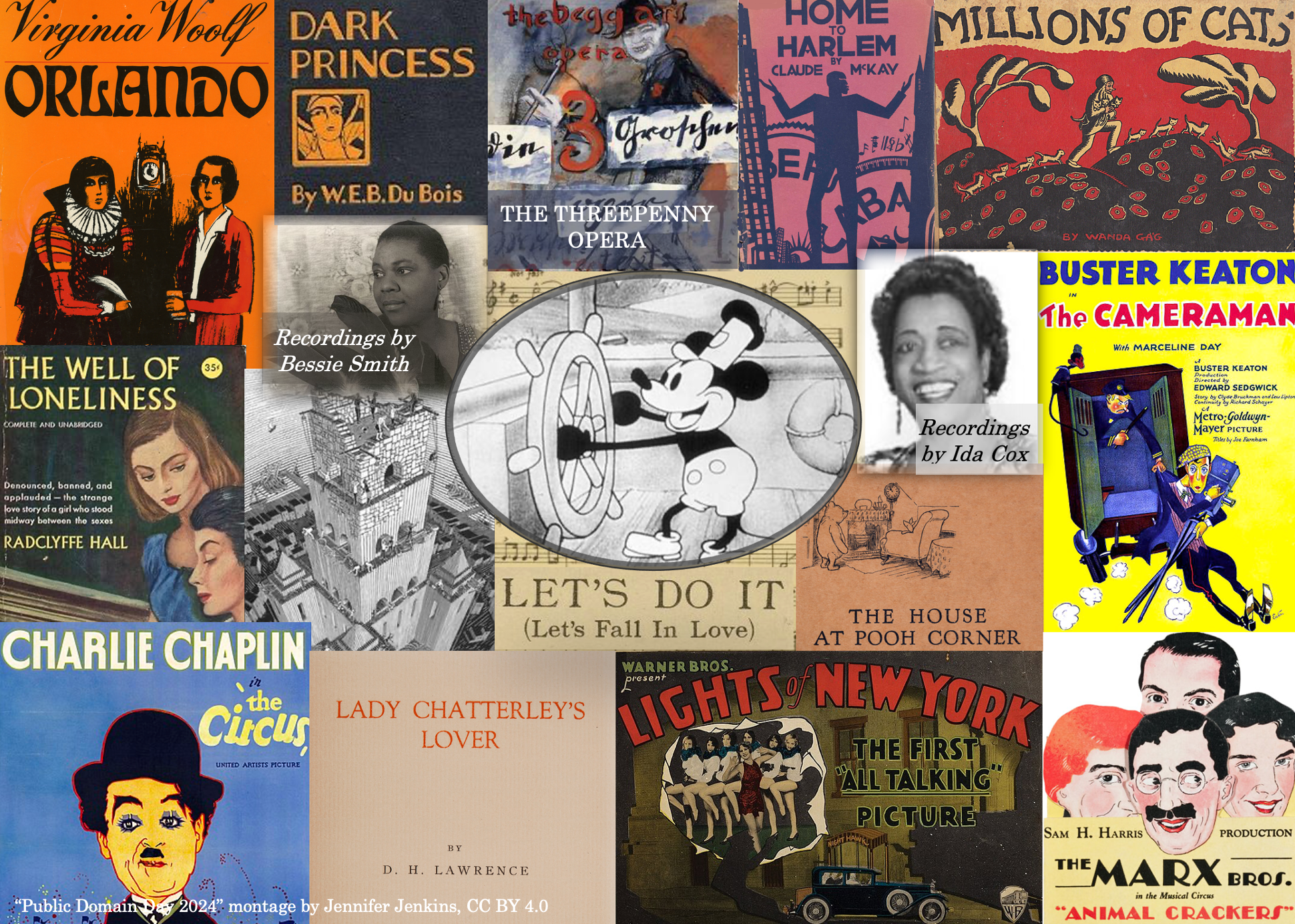
On January 1, 2024, 1000’s of copyrighted works from 1928 will enter the US public area, together with sound recordings from 1923. They might be free for all to repeat, share, and construct upon. This yr’s highlights embody Lady Chatterley’s Lover by D. H. Lawrence and The Threepenny Opera by Bertolt Brecht, Buster Keaton’s The Cameraman and Cole Porter’s Let’s Do It, and a trove of sound recordings from 1923. And, after all, 2024 marks the long-awaited arrival of Steamboat Willie – that includes Mickey and Minnie Mouse – into the general public area. That story is so fascinating, so wealthy in irony, so rife with misinformation about what it is possible for you to to do with Mickey and Minnie now that they’re within the public area that it deserved its personal article, “Mickey, Disney, and the Public Domain: a 95-year Love Triangle.” Why is it a love triangle? What rights does Disney nonetheless have? How is trademark legislation concerned? Read all about it right here.
Here is only a handful of the works that might be within the US public area in 2024.[2] They had been first set to enter the general public area after a 56-year time period in 1984, however a time period extension pushed that date to 2004. They had been then supposed to enter the general public area in 2004, after being copyrighted for 75 years. But earlier than this might occur, Congress hit one other 20-year pause button and prolonged their copyright time period to 95 years.[3] Now the wait is over. (To discover extra materials from 1928, you may go to the Catalogue of Copyright Entries.)
Books and Plays
- D.H Lawrence, Lady Chatterley’s Lover
- Bertolt Brecht, The Threepenny Opera (within the unique German, Die Dreigroschenoper)
- Virginia Woolf, Orlando
- Erich Maria Remarque, All Quiet on the Western Front (within the unique German, Im Westen nichts Neues)
- W.E.B. Du Bois, Dark Princess
- Claude McKay, Home to Harlem
- A. A. Milne, illustrations by E. H. Shepard, House at Pooh Corner (introducing the Tigger character)
- J. M. Barrie, Peter Pan; or the Boy Who Wouldn’t Grow Up (as a result of it was not "revealed" for copyright functions till 1928)[4]
- Radclyffe Hall, The Well of Loneliness
- Evelyn Waugh,Decline and Fall
- Agatha Christie, The Mystery of the Blue Train
- Wanda Gág, Millions of Cats (the oldest American image e book nonetheless in print)
- Robert Frost, West-Running Brook
- Ben Hecht and Charles MacArthur, The Front Page
These are just some of the 1000’s of works getting into the general public area in 2024. They current a snapshot of the cultural struggles of the time, a few of which appear decidedly related at the moment: there are books that had been banned for obscenity, a critique of the inhumanity of capitalist society, works from the Harlem Renaissance, and a reminder of the lingering trauma from World War I. There are works exploring gender fluidity and sexuality, together with Orlando, a feminist traditional a couple of character “liberated from restraints of time and intercourse,” and The Well of Loneliness, an exploration of lesbian love. There are literary classics and nice theatrical works, bestsellers and works of excessive tradition. There are even in style kids’s books—cat lovers can rejoice over Millions of Cats and Tigger bouncing into the Hundred Acre Wood.
Films
- Steamboat Willie and Plane Crazy (the silent model) (directed by Walt Disney and Ub Iwerks) [5]
- The Cameraman (directed by Edward Sedgwick and Buster Keaton)
- Lights of New York (directed by Bryan Foy; billed as “the primary ‘all-talking’ image”)
- The Circus (directed by Charlie Chaplin)
- The Passion of Joan of Arc (directed by Carl Theodor Dreyer)
- The Singing Fool (directed by Lloyd Bacon; follow-up to The Jazz Singer)
- Speedy (directed by Ted Wilde; Harold Lloyd’s final silent theatrical launch)
- In Old Arizona (“100% all speaking” movie that includes singing cowboys)
- The Man Who Laughs (directed by Paul Leni; encompasses a character who impressed the looks of the Joker from Batman)
- Should Married Men Go Home? (directed by Leo McCarey and James Parrott; the primary Laurel and Hardy movie to invoice them as a staff)
- The Wind (directed by Victor Sjöström)
- The Wedding March (directed by Erich von Stroheim)
- The Crowd (directed by King Vidor)
- The Last Command (directed by Josef von Sternberg; Emil Jannings gained the primary Academy Award for Best Actor)
- Street Angel (directed by Frank Borzage; Janet Gaynor gained the primary Academy Award for Best Actress)
Yes, Steamboat Willie is lastly getting into the general public area. Welcome, Mickey and Minnie Mouse! Read what this implies right here. But many extra great movies may even be freed from copyright. 1928 was a part of the transitional interval from silent movies to “talkies,” and it introduced us each among the final nice silent footage and the “first ‘all-talking’ image.” There are options from comedic giants corresponding to Buster Keaton, Charlie Chaplin, Harold Lloyd, and Laurel and Hardy. There are movies chosen for preservation within the National Film Registry as a result of they’re “culturally, traditionally, or aesthetically important.” There are winners of among the first Academy Awards. Sadly, many movies from the period have been misplaced endlessly, whereas others survive solely as a result of serendipitous tales of rediscovery. Please observe that whereas the unique footage from the listed movies might be within the public area, newly added materials corresponding to musical accompaniment may nonetheless be copyrighted. [6]
Musical Compositions
- Animal Crackers (musical starring the Marx Brothers; e book by George S. Kaufman and Morrie Ryskind and lyrics and music by Bert Kalmar and Harry Ruby)
- Mack the Knife (unique German lyrics by Bertolt Brecht and music by Kurt Weill; from The Threepenny Opera)
- Let’s Do It (Let’s Fall in Love) (Cole Porter; from the musical Paris)
- Sonny Boy (George Gard DeSylva, Lew Brown & Ray Henderson; from the movie The Singing Fool starring Al Jolson)
- When You’re Smiling (lyrics by Mark Fisher and Joe Goodwin and music by Larry Shay)
- Empty Bed Blues (J. C. Johnson)
- I Wanna Be Loved By You (lyrics by Bert Kalmar and music by Herbert Stothart and Harry Ruby; from the musical Good Boy)
- Makin’ Whoopee! (lyrics by Gus Khan and music by Walter Donaldson)
- You’re My Necessity, You’re The Cream in My Coffee (George Gard DeSylva, Lew Brown & Ray Henderson; from the musical Hold Everything!)
- I Can’t Give You Anything But Love, Baby (lyrics by Dorothy Fields and music by James Francis)
- Ramona (lyrics by L. Wolfe Gilbert and music by Mabel Wayne)
- There’s a Rainbow ‘Round My Shoulder (Al Jolson, Billy Rose, Dave Dreyer; from the movie The Singing Fool)
- Beau Koo Jack (lyrics by Walter Melrose and music by Alex Hill and Louis Armstrong)
- Pick Pocket Blues (Bessie Smith)
This yr’s musical line-up consists of Broadway songs, jazz requirements, early blues, and pop music addressing some acquainted themes.[7] Only the musical compositions—the music and lyrics that you just may see on a bit of sheet music—are getting into the general public area, not the recordings of these songs, that are coated by a separate copyright.[8] The lyrics and music to Cole Porter’s Let’s Do It (Let’s Fall In Love) had been revealed in 1928 and might be free for anybody to repeat, carry out, file, adapt, or interpolate into their very own music. But the later recordings by Eartha Kitt, Lady Gaga, and others are nonetheless copyrighted. Note, nonetheless, that sound recording rights are extra restricted than composition rights—you may legally imitate a sound recording, even when your imitation sounds precisely the identical, you simply can not copy from the precise recording.To hear some nice variations of public area songs and different materials, go to WNYC’s Public Domain Song Project.
Sound Recordings from 1923
- Charleston (recorded by James P. Johnson)
- Yes! We Have No Bananas (recorded by Billy Jones; Furman and Nash; Eddie Cantor; Belle Baker; The Lanin Orchestra)
- Who’s Sorry Now (recorded by Lewis James; The Happy Six; the Original Memphis Five)
- Down Hearted Blues (recorded by Bessie Smith; Tennessee Ten)
- Lawdy, Lawdy Blues (recorded by Ida Cox)
- Southern Blues and Moonshine Blues (recorded by Ma Rainey)
- Down South Blues (recorded by Hannah Sylvester; The Virginians)
- Wolverine Blues (recorded by the Benson Orchestra of Chicago)
- Tin Roof Blues (recorded by the New Orleans Rhythm Kings)
- That American Boy of Mine and Parade of the Wooden Soldiers (recorded by Paul Whiteman and his Orchestra)
- Dipper Mouth Blues and Froggie More (recorded by King Oliver’s Creole Jazz Band, that includes Louis Armstrong)
- Bambalina (recorded by the Ray Miller Orchestra)
- Swingin’ Down the Lane (recorded by the Isham Jones Orchestra; The Shannon Four; The Columbians)
In 2022, beneath a brand new legislation known as the Music Modernization Act,[9] a long time of sound recordings created from the arrival of recording expertise via the top of 1922 went into the general public area. In 2023 there was a pause, with no sound recordings getting into the general public area. Now, in 2024, recordings from 1923 are open for authorized reuse. You can obtain, remix, or use them in a soundtrack. Yes, these recordings are a century outdated, however higher late than by no means! As you look via the checklist above, observe that solely the 1923 recordings made by these artists are getting into the general public area, not their later recordings.
To take heed to outdated recordings, go to the Library of Congress National Jukebox—in 2024 the Library of Congress will make all the 1923 recordings in its assortment obtainable for obtain from this web site, whereas recordings from 1924 ahead might be streaming-only till they’re within the public area.
Copyright may even expire over artistic endeavors corresponding to M.C. Escher’s Tower of Babel woodcut. While we had been in a position to find the copyright records indicating that Escher’s work is copyrighted via the top of 2023, we didn’t discover definitive copyright info for different notable artworks. What we do know is that artwork revealed in 1928 – together with drawings, work, and images – might be within the public area in 2024, however many works had been really copyright-free earlier as a result of noncompliance with the discover and renewal “formalities” that copyright legislation used to require.

Keep studying to be taught extra in regards to the public area! You can use the hyperlinks beneath to leap to totally different sections of this web site.
Why Celebrate the Public Domain?
Some materials is born within the public area. This consists of concepts, details, and uncooked knowledge, which may by no means be copyrighted. It additionally consists of official works of the US authorities corresponding to laws, authorized opinions, and NASA photos.[10] But for copyrighted tradition, the general public area arrives solely after a protracted wait. Why have fun? When works go into the general public area, they will legally be shared, with out permission or price. Community theaters can display the movies. Youth orchestras can carry out the music publicly, with out paying licensing charges. Online repositories such because the Internet Archive, HathiTrust, Google Books, and the New York Public Library could make works absolutely obtainable on-line. This helps allow entry to cultural supplies that may in any other case be misplaced to historical past. 1928 was a lengthy time in the past and the overwhelming majority of works from 1928 aren’t commercially obtainable. You couldn’t purchase them, and even discover them, in the event you needed. When they enter the general public area in 2024, anybody can rescue them from obscurity and make them obtainable, the place we are able to all uncover, get pleasure from, and breathe new life into them.
The public area can be a wellspring for creativity. The complete level of copyright is to advertise creativity, and the general public area performs a central position in doing so. Copyright legislation provides authors vital rights that encourage creativity and distribution—it is a superb factor. But it additionally ensures that these rights final for a “restricted time,” in order that once they expire, works go into the general public area, the place future authors can legally construct on the previous—reimagining the books, making them into movies, adapting the songs and films. That’s a great factor too!
Think of all of the movies, cartoons, books, performs, musicals, video video games, songs, and different works based mostly on Greek mythology, or on the works of Shakespeare. Think of the literature that has constructed on Jane Austen’s novels, Mary Shelley’s Frankenstein, Bram Stoker’s Dracula, Lewis Carroll’s Alice in Wonderland, or the music that’s based mostly on Pachelbel’s Canon. As defined in a New York Times editorial: “When a piece enters the general public area it means the general public can afford to make use of it freely, to provide it new foreign money . . . [public domain works] are a vital a part of each artist’s sustenance, of each individual’s sustenance.”
Shakespeare’s works have given us the whole lot from The Lion King and Rosencrantz and Guildenstern Are Dead (from Hamlet) to 10 Things I Hate About You and Kiss Me Kate (from The Taming of the Shrew) to West Side Story (from Romeo and Juliet). That is the promise of the general public area. Who is aware of what the works getting into the general public area in 2024 may encourage? As with Shakespeare, the flexibility freely to reinvent these works could spur a variety of creativity, from the intense to the whimsical, and in doing so permit the unique artists’ legacies to endure. And after all Shakespeare himself, who predated copyright legislation, borrowed closely from his predecessors. One work evokes one other. That is how the general public area feeds creativity.
Let me take only one instance: feminist remakes of public area works. It is hanging how typically remakes have remodeled the unique by giving voices and company to the feminine characters. For up to date examples, one might look to the film Poor Things presently taking part in in theaters (impressed by Frankenstein) and Natalie Haynes’ 2023 e book Stone Blind (reimagining the Medusa fantasy). After F. Scott Fitzgerald’s The Great Gatsby went into the general public area in 2021, Nghi Vo’s The Chosen and the Beautiful reinvented the e book from the angle of an interesting Jordan Baker character, and Jillian Cantor’s Beautiful Little Fools retells the Gatsby story via the voices of three of its feminine characters (Jordan, Daisy Buchanan, and Catherine McCoy). This type of retelling does what artwork does finest; will get us to reimagine a state of affairs from a special, however uncared for perspective. Those retellings are precisely what the general public area permits.
The United States is a rustic that’s all the time reimagining itself and retelling its personal story. One approach it does so is thru its iconic works of fiction. As Gatsby was set to enter the general public area, Blake Hazard, Fitzgerald’s great-granddaughter, stated: “We’re now trying to a brand new interval and attempting to view it with enthusiasm, realizing some thrilling issues could come.” And that’s simply what occurred. The New York Times reported a wealth of recent editions with introductions by the likes of Times critic and Pulitzer-Prize winner Wesley Morris and Harvard scholar David J. Alworth, bringing “contemporary evaluation, practically a century later, of what our concepts of ‘American’ now entail.” The e book was tailored into TV reveals, animations, graphic novels, and musicals. There had been new works corresponding to Michael Farris Smith’s prequel Nick, which tells the backstory of Nick Carraway, Self-Made Boys, a young-adult “Great Gatsby remix” centering on trans love, The Gay Gatsby, and The Great Gatsby Undead (the zombie version). The hosts of Planet Money even created an audio e book, studying your complete e book on the air.
Winnie-the-Pooh’s entry into the general public area in 2022 likewise sparked a variety of creativity. The most publicity went to celeb and incongruous reuses, from Ryan Reynolds’ “Winnie-the-Screwed” advert for Mint Mobile to a comic book strip wherein Pooh celebrates his nudity, to the horror movie Winnie-the-Pooh: Blood and Honey. A sustainable bathroom paper firm even turned it into an announcement about deforestation with Winnie-the-Pooh: the Deforested Edition, wherein the Hundred Acre Wood has been lower down. Pooh and Christopher Robin can’t climb timber. Owl’s house is a mere stump.

Images from the unique Winnie-the-Pooh (1926) alongside photos from Winnie-the-Pooh: the Deforested Edition (2023)
These are the sorts of makes use of that acquire public consideration; there are various extra creators who constructed upon the newly public-domain Pooh e book—I do know this as a result of they’ve been type sufficient to ship me cuddlier drawings and poems corresponding to this that didn’t generate as a lot buzz, however do mirror how Pooh impressed artists and writers on a smaller scale.
Are all of those new works critically acclaimed or one thing of which rights holders would approve? Some sure, some no. But they’re a part of our tradition, and time will inform whether or not they are going to be rewarded in both the business market or {the marketplace} of concepts. You can take a look at the Shakespeare or Jane Austen remakes which have stood the take a look at of time to get an thought of public area reuses with enduring attraction. And simply as Pride and Prejudice and Zombies didn’t diminish the luster of Jane Austen’s novel (not less than for me), the unique works getting into the general public area extra just lately—from Gatsby to Winnie-the-Pooh—stay intact
The public area provides us not simply materials to construct upon however materials to be taught from, with classes each joyful and sobering. This yr’s works provide a temporal cross part of our cultural previous, capturing the period in its complexity. In 1928 the Harlem Renaissance was in full swing, however there was additionally legally-enforced segregation, and lots of works from the period comprise racial slurs and demeaning depictions.[11] Unfortunately, among the movies getting into the general public area present performances in blackface, a distressing reminder of the racist stereotypes that dominated portrayals of African-Americans in in style tradition. When such works enter the general public area, anybody is free to grapple with them, to critique, clarify, and even remake them. The public area is a repository of our historical past—a file of all our tradition, not simply the components we like. Indeed, it’s exactly as a result of the works are now not topic to regulate by their copyright holders that each their magnificence and their ugliness will be freely explored by at the moment’s students and residents.
The Tip of the (Melting) Iceberg
Many of the works featured above are well-known; that’s the reason we included them. Their copyright holders benefitted from 20 extra years of copyright as a result of the works had enduring reputation and had been nonetheless incomes royalties. But when Congress prolonged the copyright time period for works like Steamboat Willie, it additionally did so for all the works whose business viability had lengthy subsided. For the overwhelming majority—most likely 99%—of works from 1928, no copyright holder financially benefited from continued copyright. Yet they remained off limits, for no good cause. A Congressional Research Service report indicated that solely round 2% of copyrights between 55 and 75 years outdated retain business worth. After 75 years, that share is even decrease. Most older works are “orphan works,” the place the copyright proprietor can’t be discovered in any respect.
Now that these works are within the public area, anybody could make them obtainable to the general public. This permits entry to our cultural heritage—entry to supplies that may in any other case be forgotten. 1928 was a very long time in the past. The majority of works from that yr are out of circulation. When they enter the general public area in 2024, anybody can republish or publish them on-line. (Empirical research have proven that public area books are cheaper, obtainable in additional editions and codecs, and extra more likely to be in print—see right here, right here, and right here.) The works listed above are simply the tip of the iceberg. Many extra works are ready to be rediscovered.
Unfortunately, a part of this iceberg has already melted. As the story of silent movies reveals, the truth that works from 1928 are legally obtainable doesn’t imply they’re really obtainable. Much of our silent movie heritage has been misplaced— destroyed, discarded, or allowed to decay.[12] Some older movies have disintegrated, rotting of their cans, whereas preservationists eagerly waited for them to enter the general public area in order that they may legally digitize them, proof of what lengthy copyright phrases do to the conservation of cultural artifacts.[13] For the fabric that has survived, nonetheless, the long-awaited entry into the general public area remains to be one thing to have fun.
Another a part of the iceberg consists of works from 1928 and later that will already be within the public area as a result of the copyright homeowners didn’t adjust to the “formalities” that was essential for copyright safety. In the previous, your work went into the general public area in the event you didn’t embody a copyright discover—e.g. “Copyright 1928 Walt Disney”—when publishing it, or in the event you didn’t renew the copyright after 28 years. We know that works revealed in 1928 and earlier are out of copyright in 2024, however so are works revealed from 1929-1977 and not using a copyright discover, works revealed from 1978 via 3/1/1989 and not using a discover and with out subsequent registration inside 5 years (the registration fastened the shortage of copyright discover), and works revealed from 1929-1963 with a discover however and not using a copyright renewal.
 For instance, the 1928 movie that impressed the title of Steamboat Willie – Buster Keaton’s Steamboat Bill, Jr. – went into the general public area in 1956 as a result of non-renewal. The similar is true of H. P. Lovecraft’s quick story “The Call of Cthulhu.” It was revealed within the February 1928 subject of the pulp journal Weird Times. While the March and April problems with Weird Times had their copyrights renewed, it seems that the February subject didn’t, letting its “obscene and unimaginable monstrosity” slither into the general public area in 1956.
Current copyright legislation now not has these necessities. Even although these works may technically be within the public area, nonetheless, as a sensible matter, customers generally should assume they’re nonetheless copyrighted (or threat a lawsuit) as a result of the related copyright info is tough to search out—older records will be fragmentary, confused, or misplaced. That’s why Public Domain Day is so important. On January 1, 2024, the general public will know for positive that every one works revealed in 1928 and earlier are free to be used with out tedious or inconclusive analysis to search out out if the copyright holder complied with formalities or resolve date discrepancies. Still, it’s value shining a light-weight on this “invisible public area”—together with all the works that entered the general public area years in the past as a result of non-renewal.[14]
This evaluation highlights an extra level: the sheer complexity of the principles now we have set to control our collective tradition.[15] That harms each residents and present artists, who can’t know what works they’re and aren’t allowed to make use of with out costly skilled recommendation. We have tried to offer some authorized background right here and within the footnotes, however generally it’s simpler to search out Woozles and Heffalumps than definitive copyright info.

The Copyright Term Extension Blues
While the US lastly turned on the general public area spigot in 2019, after a 20-year drought, Canada’s authorities just lately determined to show its spigot off. In 2022, Canada froze its public area for 20 years with its C-19 copyright legislation—doing the identical factor the US did in 1998, with all the destructive results which have now been effectively documented.
The verdict is in: including an additional 20 years to the US copyright time period was a “massive mistake.” This will not be a quote from somebody who’s equivocal about copyright; it’s a quote from the previous head of our Copyright Office. Another former Director of the Copyright Office proposed shortening the copyright time period by 20 years except copyright homeowners “assert their continued curiosity in exploiting the work by registering with the Copyright Office in a well timed method.” Copyright holders corresponding to Disney might readily safe “the total advantage of the extra twenty years,” whereas all the works now not being exploited would enter the general public area, fulfilling copyright’s purpose of benefiting the general public.
Indeed, there’s a consensus amongst policymakers, economists, and lecturers that prolonged copyright extensions impose prices that far outweigh their advantages. Why? The advantages are minuscule—economists (together with 5 Nobel laureates) have proven that time period extension doesn’t spur extra creativity. At the identical time, it causes monumental hurt, locking away hundreds of thousands of older works which can be now not producing any income for the copyright holders. Films have disintegrated as a result of preservationists can’t digitize them. The works of historians and journalists are incomplete. Artists discover their cultural heritage off limits. (See research just like the Hargreaves Review commissioned by the UK authorities, empirical comparisons of the supply of copyrighted works and public area works, and financial research of the consequences of copyright.)
So…nobody can be foolish sufficient to maintain extending copyright, proper? Wrong! Countries corresponding to Canada, New Zealand, and Japan have just lately lengthened their copyright phrases by 20 years—not on account of reasoned debate, however to adjust to commerce offers that require harmonization of copyright phrases. With harmonization, there’s a catch: nations are all the time made to harmonize with the longer time period, by no means the shorter time period, even when the shorter time period is a better option for each financial and coverage causes. As Professor Michael Geist defined, the Canadian time period extension will “value Canadian schooling hundreds of thousands of {dollars} and would delay works getting into the general public area for a complete era,” but the federal government selected to take action with out mitigation measures “to scale back the financial value and cultural hurt that comes from time period extension.” Canada might have given the total copyright time period to rights holders who needed it whereas permitting works that had been now not being commercially exploited—together with orphan works—to enter the general public area, however the authorities rejected these suggestions.
This is irrational. It can be extra environment friendly to easily levy a brand new tax on the general public and provides the proceeds to the small share of copyright holders whose works are nonetheless earning money after a life-plus-50 time period. The time period extensions not solely switch wealth to a tiny subset of rights homeowners, but in addition lock away the remaining works from future creators and the general public. Nonetheless, regardless of overwhelming proof that time period extension does extra hurt than good, nations are nonetheless extending their copyrights. Even as we have fun a brand new crop of public area works, it is very important understand that the worldwide public area remains to be shrinking. This makes an understanding of its important contributions—to creativity, entry, schooling, historical past—all of the extra vital.
Conclusion
Each yr, I create this information to the works that might be getting into the US public area. This yr is very symbolic due to Mickey Mouse’s long-anticipated entry into the general public area. Each yr’s web site is a celebration, however as soon as once more it’s a bittersweet one.
We have fun the emergence of 1000’s works into the general public area, the place everybody can construct on them, remake them, current new variations of them, or use them for schooling or just enjoyment. The analysis is sophisticated and mind-numbingly finicky—and we’re legal professionals whose skilled experience is copyright and the general public area; additional proof of the obstacles that poorly chosen copyright regimes can current to those that need to obey the legislation however can not simply discover out what materials is free to make use of and what’s not. A clearer system would profit us all: artists, residents and entrepreneurs. But it isn’t the complexity of the analysis that gives the bittersweet sentiment; our annual assessment will get a gratifying diploma of consideration and a Center for the Study of the Public Domain that was unwilling to…examine the general public area can be a wierd beast certainly.
The melancholy comes from the pointless losses that our present system causes—the overwhelming majority of works that now not retain business worth and aren’t in any other case obtainable, but we lock all of them as much as present exclusivity to a tiny minority. Those works which, bear in mind, represent a part of our collective tradition, are merely off limits to be used with out concern of authorized legal responsibility. Since most of them are “orphan works” (the place the copyright proprietor can’t be discovered) we couldn’t get permission from a rights holder even when we needed to. And lots of these works don’t survive that lengthy cultural winter, as with the misplaced silent movies talked about earlier. Professor Hal Abelson, the MIT laptop scientist, as soon as requested: “What does it imply to be human if we don’t have a shared tradition? And what does a shared tradition imply in the event you can’t share it?” On Public Domain Day, that act of grateful sharing begins for one more yr of our tradition, one thing to have fun certainly. Yet we must also spare a second to remorse that which now we have misplaced.
Want to be taught extra in regards to the public area? Here is the authorized background on how we acquired our present copyright phrases (together with summaries of court docket circumstances), why the general public area issues, and solutions to Frequently Asked Questions. You can even learn James Boyle’s e book The Public Domain: Enclosing the Commons of the Mind (Yale University Press, 2008)—naturally, you may learn the total textual content of The Public Domain on-line without charge and you might be free to repeat and redistribute it for non-commercial functions.
More info on the copyright time period will be discovered on this glorious chart on Copyright Term and the Public Domain within the United States. For extra steerage from the Copyright Office, see its circulars on Duration of Copyright, How to Investigate the Copyright Status of a Work, and Copyright Restoration Under the URAA. For an in depth information to figuring out public area materials, you may buy Stephen Fishman’s The Public Domain: How to Find & Use Copyright-Free Writings, Music, Art & More. You can even learn “In Ambiguous Battle: The Promise (and Pathos) of Public Domain Day,” an article by Center Director Jennifer Jenkins revealing the promise and the bounds of assorted makes an attempt to reverse the erosion of the general public area, referring to a earlier Public Domain Day.
[1] Our featured works are solely getting into the general public area beneath US copyright legislation. The copyright time period for older works is totally different in different nations. In the EU, works from authors who died in 1953 are going into the general public area in 2024 after a life-plus-70 yr time period. So Eugene O’Neill’s play Long Day’s Journey into Night might be within the public area there. But within the US, that play was revealed posthumously in 1956 and its copyright doesn’t expire till 2052. Conversely, if you might be within the US, Agatha Christie’s Poirot novel The Mystery of the Blue Train enters the US public area in 2024. But within the EU, Agatha Christie’s works are nonetheless copyrighted. Generally, beneath the precept of lex loci delicti, customers are ruled by the legislation within the jurisdiction the place they’re utilizing the artistic work. See Itar-Tass Russian News Agency v. Russian Kurier, Inc., 153 F.3d 82 (2nd Cir. 1998). But observe that this inquiry will be extra sophisticated and fact-specific, relying on the circumstances surrounding the use.
[2] Only the unique works revealed in 1928 are getting into the US public area. Later variations of them—variations, motion pictures, or translations—should be copyrighted. The unique German model of All Quiet on the Western Front (Im Westen nichts Neues) revealed in 1928 is within the public area, however translations from later years should be copyrighted. In addition, within the US, solely the writer’s works from 1928 and earlier are within the public area, not all the different work revealed by that writer. While you might be free to make use of the lyrics and music from Let’s Do It (Let’s Fall in Love), later songs by Cole Porter are nonetheless copyrighted.
[3] The 1998 Copyright Term Extension Act gave works revealed from 1923 via 1977 a 95-year time period, expiring on January 1 after the conclusion of the ninety fifth yr. Doing the maths, works from 1928 had been copyrighted for 95 years—via 2023—and are within the public area January 1 2024. (Unpublished works have a special time period – within the US, unpublished works from authors who died in 1953 might be getting into the general public area after a life-plus-70 time period.) Works revealed earlier than 1978 needed to meet sure necessities to be eligible for the 95-year time period—all of them needed to be revealed with a copyright discover, and works from earlier than 1964 additionally needed to have their copyrights renewed after an preliminary 28-year time period. The phrase “revealed” is vital and has a particular that means beneath copyright legislation. It refers to when the work was offered or distributed to most of the people with the authority of the copyright proprietor. Determining publication standing will be sophisticated, nonetheless, and range relying on the type of work—with music from earlier than 1978, for instance, solely distribution in written kind counted as a publication. In the US, works created since 1978 are handled in a different way from these revealed earlier than 1978. Works by pure individuals from 1978 ahead have a life-plus-70 time period, except they’re works of company authorship, that are copyrighted for 95 years after publication.
The works on our lists are within the public area due to both a 1928 registration or publication with a 1928 copyright discover. For many of the featured works we had been additionally in a position to observe down the renewal knowledge indicating that they’re nonetheless in-copyright via the top of 2023 and affirmatively getting into the general public area in 2024.
Foreign works from 1928 corresponding to D. H. Lawrence’s Lady Chatterley’s Lover and Bertolt Brecht’s The Threepenny Opera (Die Dreigroschenoper) are copyrighted till 2024 due to a provision that, in 1996, restored copyright over sure overseas works that had been within the public area due to non-compliance with discover or renewal necessities. Such works had been nonetheless copyrighted within the US till 2024 if 1) they complied with US discover and renewal formalities, 2) they had been revealed within the US inside 30 days of publication overseas, or 3) if neither of those are true, they had been nonetheless copyrighted of their house nation as of 1/1/96. If the homeowners of copyright in overseas works filed a Notice of Intent to Enforce (NIE) their restored copyright you’ll find that info right here. You can even discover copyright restoration records within the Copyright Office records or the Copyright Office’s new search portal right here.
[4] Peter Pan; or, the Boy Who Wouldn’t Grow Up is lastly getting into the general public area within the US, regardless of the play having been carried out since 1904 and the Peter Pan novel being revealed in 1911. Why the delay? Because the play’s script was not “revealed” for copyright functions till 1928, pushing again its copyright expiration till 2024. It might be public area within the US, however not within the United Kingdom, the place there’s a particular provision giving the Great Ormond Street Hospital for Children – to which J.M. Barrie assigned his copyright – the appropriate to obtain royalties from the play in perpetuity (simply royalties, not the appropriate to cease others from utilizing the play).
[5] Steamboat Willie was not the one Mickey Mouse movie from 1928. The mouse appeared in two different movies proven the identical yr—silent variations of Plane Crazy and The Gallopin’ Gaucho. The silent model of Plane Crazy is public area in 2024 however we couldn’t discover comparable knowledge for The Gallopin’ Gaucho. While the unique silent model of Plane Crazy will not be obtainable, we assume that the footage is similar or just like the footage within the publicly obtainable model that added sound the next yr. The copyright notices on the obtainable copies of these movies, which had been launched after sound was added, say MCMXXIX, or 1929, so that’s when the sound variations enter the general public area. Disney’s registrations and renewals for those self same movies declare a 1930 date, but when the date within the copyright discover is sooner than the registration date, the sooner date controls, so they’re within the public area in 2025. (According to the 1960 Copyright Law Revision Notice of Copyright Study, date discrepancies are resolved “in favor of the general public” and the “time period of safety is computed from the sooner date.” The 1960 Copyright Law Revision Copyright Renewal Study provides that “when the copyright discover on a printed work incorporates a date sooner than the yr when copyright was really secured, the primary time period, and therefore the renewal cut-off dates, are computed from the final day of the yr within the discover.”)
[6] The 1928 model of Charlie Chaplin’s The Circus is public area, however newly added materials in its Sixties rerelease, together with the brand new rating, remains to be copyrighted. However, the later copyright solely covers newly added artistic materials. The unique content material from the 1928 work stays free. If a movie has been restored or reconstructed, solely unique and artistic additions are eligible for copyright; if a restoration faithfully mimics the preexisting movie, it doesn’t comprise newly copyrightable materials. Putting talent, labor, and cash right into a challenge will not be sufficient to qualify it for copyright. The Supreme Court has made clear that “the sine qua non of copyright is originality.”
[7] Some lists of works from 1928 embody George Gershwin’s American in Paris and Maurice Ravel’s Bolero as a result of they had been written and carried out in 1928, however the copyright records present a date of 1929, making them public area in 2025. Under copyright legislation on the time, musical compositions weren’t copyrighted till a manuscript was revealed with a copyright discover, so in an abundance of warning we’re not itemizing them except we are able to discover sheet music with a 1928 copyright discover.
[8] US copyright legislation treats musical compositions and sound recordings in a different way. A composition consists of the lyrics and music that you just may see on a bit of sheet music. A sound recording is the embodiment of a selected efficiency of that composition, fastened on media corresponding to vinyl records or on digital audio information. If I write a music known as “Public Domain Day!” and also you file it, I get the copyright over the composition and also you get a separate copyright over your recording of my music. Note that US copyright legislation means that you can cowl a music with out permission whereas it’s nonetheless copyrighted beneath the “obligatory license” in 17 U.S.C. § 115, as long as you don’t “change the fundamental melody or elementary character” of the unique music and pay a pre-set royalty price. When a music is within the public area you may make covers with out complying with this provision, and you too can make different variations, performances, and interpolations.
[9] The Music Modernization Act’s “Classics Protection and Access Act” established a timeline for outdated recordings to enter the general public area. Recordings first revealed between 1923–1946 are public area in January 2024–2047 (the yr after a 100-year time period). Then there’s a ten-year pause from 2048–2058. After that, recordings first revealed between 1947–1956 are public area in January 2058–2067, after a 110-year time period. The time period for all remaining recordings first fastened from 1957 till February 15, 1972 ends on February 15, 2067. Note that the time period of safety for sound recordings in different nations is totally different from the one within the US: within the EU it’s 70 years, and elsewhere it’s 50 years.
[11] There was additionally rampant exploitation of Black expertise: Black musicians, for instance, had been routinely excluded from copyright’s advantages and denied each recognition and compensation for his or her work. To be taught extra in regards to the unequal therapy of Black artists, you may learn the wonderful scholarship of Professor Olufunmilayo Arewa, together with From J.C. Bach to Hip Hop: Musical Borrowing, Copyright and Cultural Context, Blues Lives: Promise and Perils of Musical Copyright and Writing Rights: Copyright’s Visual Bias and African American Music; Professor Kevin J. Greene, together with Copyright, Culture & (and) Black Music: A Legacy of Unequal Protection and “Copynorms,” Black Cultural Production, and the Debate over African-American Reparations; and Professor Lateef Mtima, together with Intellectual Property, Entrepreneurship and Social Justice: From Swords to Ploughshares.
[13] There is a slim provision within the legislation permitting for some restorations, however it’s restricted and doesn’t safeguard the work of many preservationists. The Library of Congress report confirms that “[t]he public area standing of some movies has inspired their survival,” referring to movies that got here out of copyright as a result of the rights weren’t renewed, which allowed others to spend money on their preservation. You can learn our evaluation of how lengthy copyright phrases thwart movie preservation efforts right here.
[14] Millions of books revealed from 1928–1963 are already within the public area as a result of the copyright homeowners didn’t renew the rights. Efforts have been underway to unlock this “secret” public area, however compiling a definitive checklist of these titles is a frightening activity. The related registration and renewal info is within the 450,000-page Catalog of Copyright Entries (“CCE”). Confirming that works with out obvious renewals are within the public area includes extra complexities. Happily, the HathiTrust Copyright Review Program studies: “Since 2008, over 195 reviewers at 53 establishments have reviewed 900,000 gadgets, figuring out that greater than 509,000 are now not protected by copyright and have entered the general public area.” These gadgets can subsequently be made obtainable on-line.
[15] Copyright legislation is advanced. It has been up to date many occasions, with every revision including to the complexity. The lawmaking course of has not produced a algorithm that’s understandable to common residents (and even legal professionals), and we wouldn’t have clear and complete records of copyright possession.
Written by Jennifer Jenkins. Special because of Sean Dudley for researching works and pictures from 1928 and creating video content material and to Michael Wright and Grant Young for constructing this web site.
Public Domain Day 2024 by Jennifer Jenkins, Director of Duke Law School’s Center for the Study of the Public Domain, is licensed beneath Creative Commons Attribution 4.0 License.
This web site will not be official authorized recommendation. Instead, it’s a abstract of United States legislation related to the general public area and a information to among the works getting into the general public area in 2024.
Vinyl
by way of Sidebar https://sidebar.io
December 29, 2023 at 12:12AM
-
Product on sale
 Audiophile Vinyl Records Cleaning BundleOriginal price was: €69.90.€59.90Current price is: €59.90. incl. VAT
-
Product on saleEasy Start Vinyl Records Cleaning KitOriginal price was: €69.90.€59.90Current price is: €59.90. incl. VAT
-
Vinyl Records Cleaner Easy Groove Concentrate€34.95 incl. VAT
-
Easy Groove Super Set€199.00 incl. VAT
-
Easy Groove Enzycaster – vinyl records prewash cleaner€34.95 incl. VAT
-
Easy Groove Extreme MK. II- vinyl records prewash cleaner€45.00 incl. VAT
-
Vinyl Records Cleaner – Easy Groove Virgin Concentrate€35.00 incl. VAT
-
Easy Groove Spray&Wipe vinyl records cleaner€34.95 incl. VAT


