
World News
Python FIFO Buffer Class for Audio – an Algorithm
Python FIFO Buffer Class for Audio – an Algorithm
A FIFO buffer is a generally wanted information construction for a lot of use-cases. Items are put into the buffer and retrieved within the order they had been put in. This is comparable performance as a Queue. The distinction between a Queue and a Buffer is that within the buffer the information that’s inserted are the entire identical information sort. Further an arbitrary quantity of information may be inserted and and the retrieval quantity can also be arbitrary.
What are the use instances, the place you wish to put and retrieve arbitrary quantity gadgets of the identical sort? Diverging into fields aside from information processing: Think financial institution accounts: Money is put in numerous quantity and brought out in portions as wanted..The identical applies to grain storage on a farm..But the banks and the granaries do these. What is left for us in IT is Audio Data, which arrives at very quick, however has to depart at a slower particular velocity in order that it may be heard. Today’s perpetrator for this are the Text to Speech engines that facilitate interactive machine/human communication. The machine will get textual content (in all probability from an AI engine) which it converts to Audio bytes to be despatched to the human at a selected velocity that the human can hear. As anticipated the machine generates audio bytes at a fast clip which then must be buffered so as to have the ability to preserve the supply to the human at a a lot slower fee. An analogy is your native fuel station. The Text to speech is the gasoline tanker which pumps plenty of gasoline at a fast fee, filling up the fuel tanks within the bowels of the fuel station. These are then delivered at a a lot slower fee into the shopper’s vehicles or different automobiles.
In abstract, conversion of textual content to speech (audio) can happen rather more quickly. There is the necessity for an Audio Buffer which receives audio from the textual content to speech (tts) to fill the buffer. This buffer is then drained on the fee of human speech and is understandable to the human.
Audio information: The information consists of a sequence of numbers representing values of a audio sign at common intervals (referred to as sampling fee). There can also be the idea of channels, which is a number of audio alerts, which ends up in a sequence of a number of values.
For the aim of this text we are going to contemplate just one channel on the enter aspect, and one channel on the output aspect.
Numpy: This is software program that facilitates storage/retrieval of arrays of numbers that’s optimized for efficiency.
Design:
The necessities are: to have the ability to enter in an arbitrary variety of audio information frames (a body is quantity representing an audio information level), which is a ordered array of audio sign values. On the output aspect be capable to retrieve an arbitrary quantity of those frames. We in fact have so as to add handy options to deal with the constraints, that are a restricted buffer dimension (causes buffer full situations on enter), no audio information out there (buffer empty on the output aspect). Other comfort options will embody zero-fill of audio information, within the case extra audio information is requested, than out there within the buffer retrieval.
Implementation:
The following describes an implementation of such a buffer in Python:
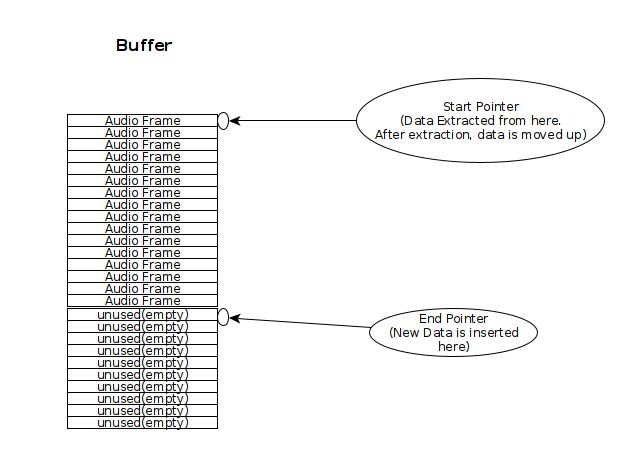
Incoming audio bytes are saved in Buffer. The Buffer has a ‘backside’ pointer, which factors to the extent to which the buffer is stuffed. It additionally has a ‘begin pointer’ which is the start of the buffer the place new information may be pushed. The begin pointer is fastened to the start of the buffer. The backside pointer is ‘dynamic’ and goes ‘up and down’: up when information is extracted and ‘down’ when information is inserted. The information is at all times inserted on the high (begin pointer) of the buffer leading to current information within the buffer being pushed ‘down’ thus rising the worth of the underside pointer.
The buffer empty situation happens when the underside pointer equals the beginning pointer. The buffer full situation happens when the underside pointer equals the size of the buffer.
We can even embody ‘swish fails’ to deal with the situations the place the buffer is full.
When the buffer is full and information must be inserted, elevate an Exception. When the buffer is empty (together with the case the place extra information is requested than out there within the buffer) return ‘zeroes’ for the lacking information. This is the audio equal of ‘silence’ when no phrases are spoken.
A diagram of this buffer is:
Coding: (Disclaimer: No AI was used to generate the code under. All blame(reward is best) is to be assigned to the Author..)
Following Object Oriented rules, the code is written as an class/object and is simple to make use of. The complete code is:
import numpy as np #numpy is the usual package deal or numerical array processing
class AudioBuf:
    def __init__(self,bufSize:int,identify:str='',dtype=np.int16):
        self.buffer = np.zeros((bufSize), dtype=dtype)
        self.bufSize=bufSize
        self.dtype=dtype
        self.idx=0
        self.identify=identify #give a reputation to the buffer.

    def putInBuf(self,inData:np.ndarray[np.dtype[np.int16]]):
        inData=inData[:, 0] #Get the first col = channel 0 - mono
        the rest = self.bufSize - self.idx #house out there for insertion
        if the rest < len(inData):
            msg=f'Error: Buffer {self.identify} is full'
            print(msg)
            self.showBuf()
            elevate WorthError(msg)
        self.buffer[self.idx:self.idx + len(inData)] = inData
        self.idx += len(inData)

    def getFromBuf(self,outDataLen:int = None)->np.ndarray:
        if not outDataLen: outDataLen=self.idx # return complete information of size just isn't specified
        if self.idx >= outDataLen:
            retVal = self.buffer[:outDataLen]
            self.buffer[0:self.idx-outDataLen]=self.buffer[outDataLen:self.idx]  #transfer buffer up
            self.idx -= outDataLen
        else:
            retVal=np.zeros((outDataLen), dtype=self.dtype)
            retVal[0:self.idx] = self.buffer[0:self.idx]
            self.idx=0
        return np.reshape(retVal,(-1,1))  #The -1 worth mechanically calculates to the variety of components

    def showBuf(self):
        print(f'AudioBuf : {self.identify} has size= {self.idx} with capability {self.bufSize}')
Conclusion:
Audio buffering is crucial and extra essential now as a result of quite a few audio processing purposes. The audio buffer algorithm introduced above is a handy python class. n
HI-FI News
through HackerNoon https://hackernoon.com
June 28, 2024 at 12:58AM
-
Product on sale
 Audiophile Vinyl Records Cleaning BundleOriginal price was: €83.88.€73.88Current price is: €73.88. incl. VAT
-
Product on saleEasy Start Vinyl Records Cleaning KitOriginal price was: €83.88.€73.88Current price is: €73.88. incl. VAT
-
Vinyl Records Cleaner Easy Groove Concentrate€41.94 incl. VAT
-
Easy Groove Super Set€238.80 incl. VAT
-
Easy Groove Enzycaster – vinyl records prewash cleaner€41.94 incl. VAT
-
Easy Groove Extreme MK. II- vinyl records prewash cleaner€54.00 incl. VAT
-
Vinyl Records Cleaner – Easy Groove Virgin Concentrate€42.00 incl. VAT
-
Easy Groove Spray&Wipe vinyl records cleaner€41.94 incl. VAT







