
World News
Relief for an Algorithmic Age
Relief for an Algorithmic Age
The solely time I ever work together with the work of American writer and social psychologist Jonathan Haidt is on my telephone through some type of social media, which, in some ways, is the epitome of irony — maybe solely rivaled by watching Christopher Nolan’s Oppenheimer on an iPad mini. You may know Haidt from his critically acclaimed e book, The Anxious Generation. That e book spent fifty-two weeks on the New York Times nonfiction bestseller record and it contends for a direct detrimental correlation between the arrival of smartphones and social media and the decline in psychological well being amongst younger adults. The Anxious Generation just isn’t solely the product of Haidt’s years of researching ethical politics, social sciences, and the consequences of expertise on the human psyche, but additionally the coronation of a motion, of kinds, by which he goals to each increase consciousness and foyer for regulatory reform to domesticate a more healthy digital setting for teenagers and younger adults.
One needn’t look too exhausting or too far to discern Haidt’s relative disdain for the rampant absorption of social media typically and smartphones specifically, particularly amongst adolescents. Ironically sufficient, this discourse is usually promulgated through social media, however Haidt’s endeavor is however commendable. There is no scarcity of proof to recommend that life on-line is not only marginally worse however critically opposed to psychological, social, relational, and emotional well being, and now we have nonetheless but to learn the way deep that rabbit gap goes. Exacerbating this situation is the obvious omnipresence of social media platforms which have flooded the digital market. As YouTuber Drew Gooden lately hilariously noticed, all the things from The Ring app to Venmo to an app that controls good lights is outfitted with a social connectivity “characteristic,” which can be extra of a bug. The gargantuan quantity of knowledge that’s uploaded to YouTube and TikTok each second means that the toothpaste is already out of the tube. There could also be no going again to the way in which issues have been.
Even nonetheless, this hasn’t deterred Haidt and his staff from researching and publicly acknowledging the deep ills that social media has wreaked and continues to wreak on a technology or two. The knowledge with which he’s working is, maybe, solely the start of what’s going to come down the pike in years to return, as those that’ve grown up on-line grapple with what meaning and what that’s achieved to them on an existential stage. The measurable results of the incessant and ubiquitous pressures to carry out are nonetheless simply trickling in, and but the outcomes are devastating, to say the least. As somebody who can nonetheless keep in mind a time earlier than wi-fi web, Spotify, and social media — heck, I nonetheless have the dial-up sound ingrained in my mind — I proceed to wrestle with the positives and negatives of life lived incessantly on-line. Although a few of my friends have been fast to reevaluate their upbringings and mine them for all of the traumas that specify who they’re now, I readily admit that mine personal is a hinge technology; that’s to say, I do know and am well-versed in each worlds, the one with out fixed connectivity and the one that may’t appear to reside with out it.
Looking again on my childhood as a mid-thirties grownup, I’m grateful for the notes of creativeness, creativity, and play that have been indicative of the occasions. This is to not say that Gen Z-ers aren’t imaginative or artistic by any stretch, however it’s truthful to say there may be an general dearth of real-world playfulness amongst these at the moment of their adolescence. When, because the comic Bo Burnham as soon as put it, there’s a stress to “carry out all the things to one another on a regular basis for no purpose,” it’s tough if not inconceivable to conceive of life every other manner. This isn’t an assertion that deserves pointed fingers, assigning blame, or disparaging dialogue; somewhat, it ought to warrant grace, particularly for many who have needed to “deal with the permanence of their errors in new and horrifying methods,” as David Zahl places it (35).
It is formidable to account for all of the pressures of on-line life. Just serious about it ingratiates me to those that are struggling to discover a sense of that means, objective, and identification that subsists even when their telephones are turned off. It additionally makes me grateful for the way in which I grew up.
I recall fairly fondly the hours my cousin(s) and I spent crafting our personal lightsabers out of picket dowels and bits of PVC to choreograph elaborate sword fights that paid gleeful homage to the Star Wars movies of the early-2000s. On a current go to to my hometown of Greenville, South Carolina, my cousin Joey gifted me a kind of DIY laser swords after discovering a group of them tucked away in his attic. As easy and ludicrous as it could be, holding such a trinket flooded me with reminiscences that I can solely categorize as playful indulgence. My cousins and I have been continuously discovered within the yard, filming a few of these battle sequences or some such different stunt with a handheld camcorder. We weren’t making TikToks, however house motion pictures for our personal enjoyment. I nonetheless have a few of these clips on a tough drive someplace.
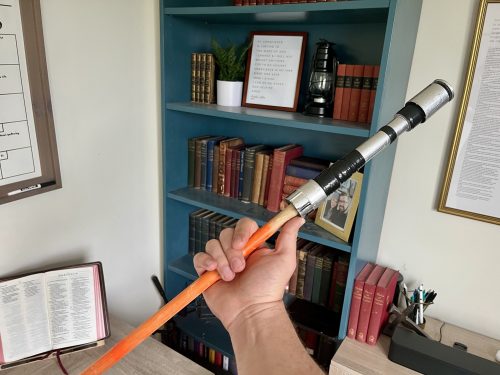
What is clear to me now that I didn’t acknowledge then was the basic innocence and resourcefulness of these days, which is gleaned from the truth that a number of early adolescent teenagers have been content material to hit one another with sticks within the yard with out caring about a lot else. I’m optimistic the neighbors thought we have been a bunch of dorks, and we in all probability (positively) have been, however we didn’t care. We didn’t have to outsource our play, as Zahl writes, “to YouTubers like Mr. Beast” (129), or to regardless of the algorithmic gods resolve we should always like. Perhaps we might have if that choice had been afforded to us, however on the time, we performed freely, unencumbered by the judgmental eyes of followers and performative connectivity. We did what we cherished as a result of we cherished doing it, however what everybody else may’ve thought. And with out invoking an excessive amount of of that “again in my day” nostalgia, I resonate with Andy Bernard from The Office, when he opines, “I want there was a option to know you have been within the good outdated days earlier than you truly left them.” There are some who by no means knew these days.
In a very affecting essay referred to as “A Time We Never Knew,” which was printed on Jonathan Haidt’s Substack outlet, After Babel, Gen Z essayist Freya India refers to a sentiment referred to as anemoia, which she defines as “nostalgia for a time or a spot one has by no means recognized.” While this time period may conjure the cliché hipster aesthetic of vinyl records and grainy movie inventory, it truly conveys one thing extra wistful than that.
As Freya notes, there’s a deeper and more true purpose why movies of excessive schoolers from the 90s are going viral on TikTok proper now. “There is one thing distinctly completely different and deserving of our consideration,” she says, “about on-line boards stuffed with Zoomers wishing that they lived earlier than social media. Wishing it didn’t exist. These are kids grieving their youth whereas they’re nonetheless kids.” Freya continues:
I’m grieving one thing I by no means knew. I’m grieving that giddy pleasure over ready for and taking part in a brand new vinyl for the primary time, when now we immediately stream songs on YouTube, use Spotify with no ready, and skip impatiently by way of new albums. I’m grieving the anticipation of going to the flicks, when all I’ve ever recognized is Netflix on demand and spoilers, and struggling to sit by way of [an] whole movie. I’m grieving easy joys — studying {a magazine}; taking part in a board recreation; hitting a swing-ball for hours — the place now even split-screen TikToks, the place two movies play on the identical time, don’t fulfill our insatiable, depressing must be entertained. I actually have a sense of loss for experiencing tragic information — a second in world historical past — with out being drenched in countless opinions on-line. I’m homesick for a time when one thing horrific occurred on this planet, and as a substitute of instantly opening Twitter, folks held one another. A time of extra shared feeling, and fewer frantic analyzing. A time of being each disconnected however supremely linked.
This, to make certain, isn’t meant to be an inter-generational referendum, additional highlighting the disparity between youngsters and their grandparents. The manner I grew up is, in some ways, simply as overseas to my youngsters as my dad and mom’ expertise was to me. “Next time you cringe at Gen Z for not coping, for not feeling minimize out for this world,” Freya continues, “keep in mind how painful it’s to suppose that the nice occasions are over. Then think about how far more painful it might be to understand you by no means knew them.”
Comparing the “righteousness” of eras is about as useful as comparative struggling (i.e. not useful in any respect). But it does provide a window right into a extra gracious understanding. Freya concludes her essay by entreating “some sympathy and a bit extra grace” for these held captive by the algorithm, which frees us to withstand the low-hanging fruit of casting aspersions on “them kids.” The pervasive hopelessness of those occasions is probably not novel to the human situation, however the public consciousness of it’s. The public discourse appears to commerce not essentially in clout however in grief, anxiousness, and despair that masquerades in a recreation of obsessive social efficiency, which belies the best tragedy of our day.
Perhaps essentially the most thoroughgoing casualty on this algorithmic period just isn’t essentially our consideration spans and even our psychological well being, however our incapacity for play, for these moments of joyful vulnerability and foolishness that don’t must be posted to be loved. A second of playfulness is discovered when the threats of efficiency, judgment, or productiveness are totally eliminated. “Something may be understood and skilled as play,” David Zahl says, “when it’s undertaken for its personal sake, somewhat than to get one thing else” (136). So whereas Jonathan Haidt is correct in giving us the statistics and surveys that verify the apparent, perhaps Zahl is on to one thing when he means that the reply for our time, as it’s in each time, is the Big Relief on the coronary heart of the Christian message, which is little greater than a euphemism for God’s grace. And what’s grace if not the liberty to be delightfully unproductive, hilariously unserious, and joyfully human, even when nobody is watching.
The publish Relief for an Algorithmic Age appeared first on Mockingbird.
Vinyl
through Mockingbird https://mbird.com/
May 7, 2025 at 09:06PM
-
Product on sale
 Audiophile Vinyl Records Cleaning BundleOriginal price was: €83.88.€73.88Current price is: €73.88. incl. VAT
-
Product on saleEasy Start Vinyl Records Cleaning KitOriginal price was: €83.88.€73.88Current price is: €73.88. incl. VAT
-
Vinyl Records Cleaner Easy Groove Concentrate€41.94 incl. VAT
-
Easy Groove Super Set€238.80 incl. VAT
-
Easy Groove Enzycaster – vinyl records prewash cleaner€41.94 incl. VAT
-
Easy Groove Extreme MK. II- vinyl records prewash cleaner€54.00 incl. VAT
-
Vinyl Records Cleaner – Easy Groove Virgin Concentrate€42.00 incl. VAT
-
Easy Groove Spray&Wipe vinyl records cleaner€41.94 incl. VAT







