
Audio News
Rotel DX-5
Rotel DX-5
https://ift.tt/2mlxC0H
Decades in the making, the Proper Hi-Fi World is finally adopting the compact “singing shoebox” silhouette. The Rotel DX-5 integrated stereo amplifier stands as the latest offering from a respected maker pushing strong performance from a small chassis. Traditional, full-width electronics grew from discrete components, power supplies with generous capacitance, and output transistors needing oversized heatsinks. But it isn’t the 1980s anymore, and more efficient audio electronics with surface-mount devices don’t demand that much real estate.
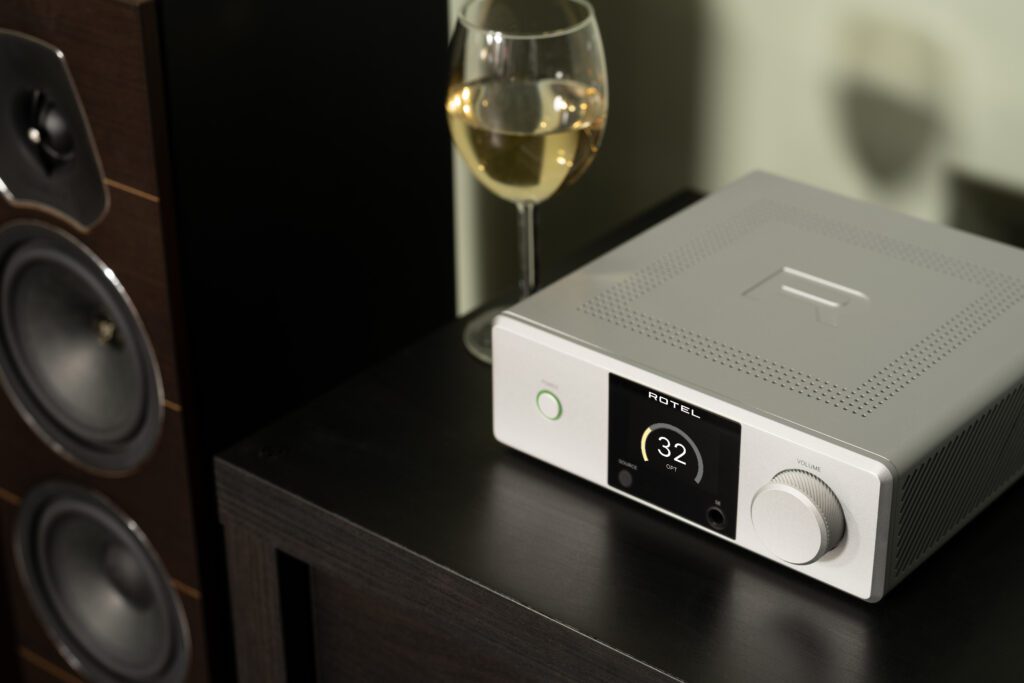
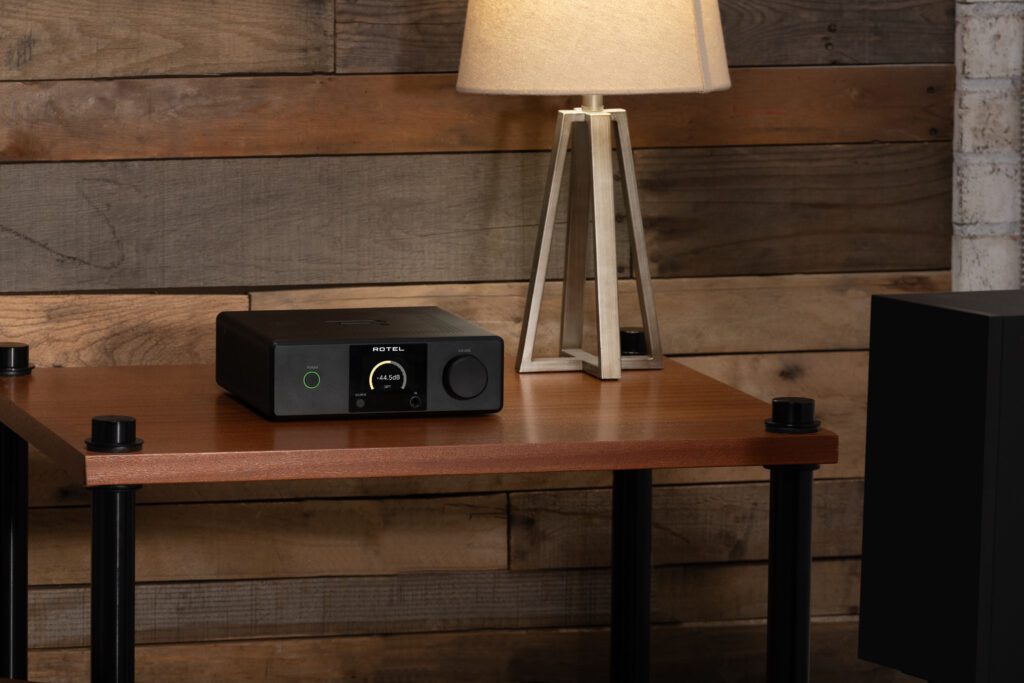
The DX-5 embodies Rotel’s view of what a modern integrated stereo amp should look like, how it should sound, and what it should specify. Its dimensions are 76 x 215 x 251mm (H x W x D), and its case conveys both visual and tactile appeal through plentiful anodised aluminium and thoughtful industrial-design details. Of course, a quality audio product goes beyond a nicely knurled volume control and a bold ‘R’ embossed into metal—though these elements are a solid starting point.
Intricate
Alongside the well-tuned volume dial, the fascia features a large, vividly rendered full-colour TFT screen with a ‘source selection’ button and a 6.3mm headphone outlet integrated into its lower section, plus a power button. At the rear, you’ll find a pair of speaker-binding posts (compatible with bare wire, banana plugs, and spades) and a pre-out for a subwoofer. The inputs include a single line-level analogue input via a pair of stereo RCA sockets, plus an HDMI ARC input, coaxial and optical sockets, and a USB-B input.
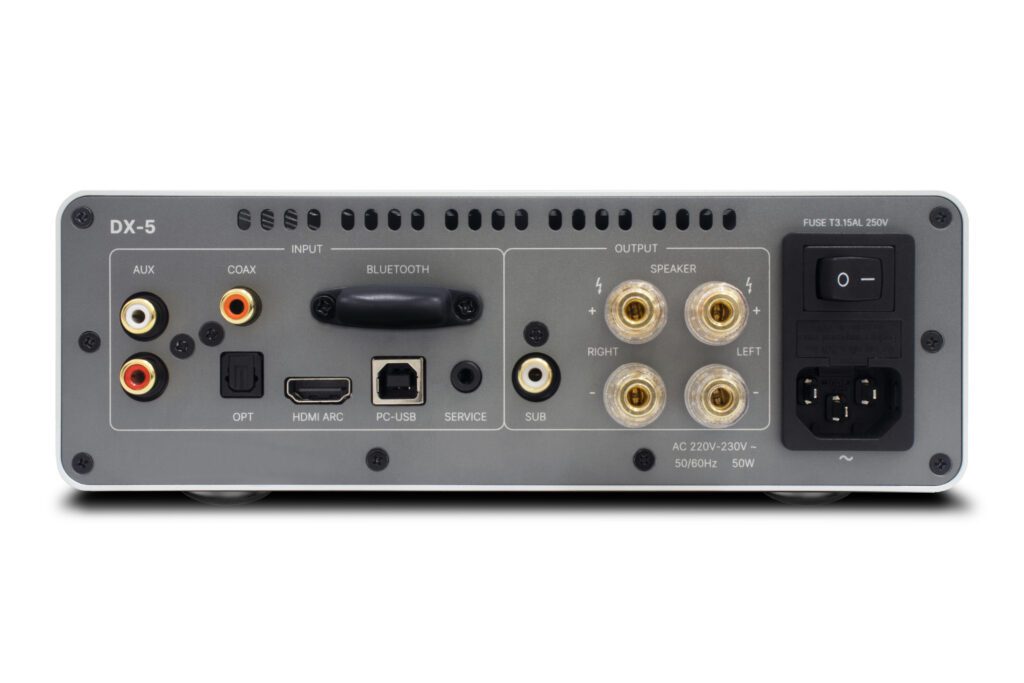
Under the ventilated, branded lid sits a high-current toroidal transformer, wound in-house, capable of delivering 25 watts of Class AB power into an eight-ohm load (rising to 33 watts per channel into four ohms). Digital-to-analogue conversion is handled by the increasingly common ESS Sabre ES9039Q2M chipset, which supports 32-bit/384kHz PCM and DSD512 via the USB-B input (with the necessary driver installed on the source device), and 24-bit/192kHz PCM through the coaxial and optical inputs. The DX-5 is certified Roon Tested, and Rotel suggests a prodigious 10Hz – 80kHz frequency response, while also claiming extremely low intermodulation distortion and high signal-to-noise ratios. Wireless connectivity is provided via Bluetooth, supporting SBC, AAC, and aptX HD codecs. A smaller and more discreet-than-normal Bluetooth antenna is integrated at the rear of the chassis.
Omissions
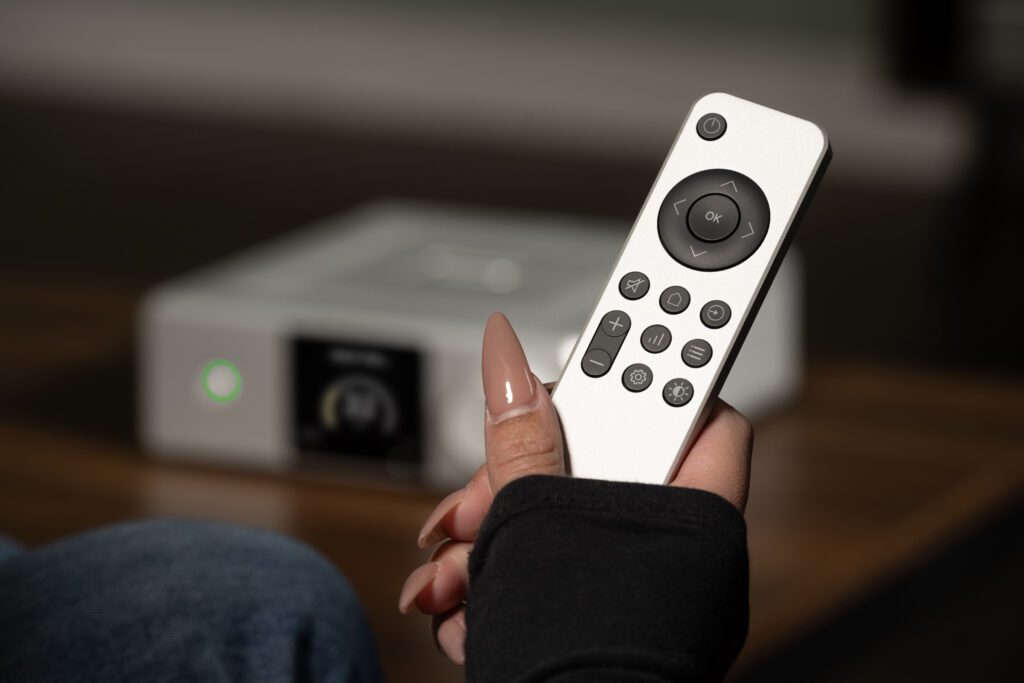
That’s about it for meaningful specifications, so you may start wondering about the more obvious gaps. The absence of a phono stage is understandable given the compact design and the space demands of pre-amplification for a turntable, even before shielding considerations. A single analogue input feels a touch limited, though—Rotel seems to be saying, “our DAC is better than any DAC in your digital source,” which is a bold claim. A lack of Wi‑Fi also feels restrictive—this isn’t a full network streamer, but adding the ability to use a streaming service’s Connect version would be welcome. And a control app would help, especially given the idiosyncrasies of the DX-5’s included remote.
There’s nothing wrong with its perceived value. This remote control stands out thanks to its substantial aluminium build, ergonomic proportions that fit the hand, and thoughtfully arranged buttons. Yet, it’s probably the most line-of-sight–dependent remote I’ve used. Point it squarely at the DX-5, and it works. Shift it even a degree or two, and… nothing.
My aim is true
Picture your hand steady and your aim true, having chosen the input you want and the volume you prefer. I used a Naim Uniti Star as both streamer and CD player (connected to the analogue input), a Colibri-equipped Apple MacBook Pro handling hi-res audio via USB-B, and a range of speakers from “sensible” to “only a reviewer would pair those two.” Yet in every case, the Rotel DX-5 has plenty sonically to offer.
The soundstage the DX-5 creates is, for example, spacious, well-defined, and, frankly, large. The arrangement of a complex recording like Fela Kuti’s Colonial Mentality [Kalakuta] becomes clear, with each element given space to breathe without crowding another, while the Rotel can unify the recording at the same time. Despite its ability to isolate elements, they still interact most naturally. The notion of “performance” remains intact even as separation occurs.
There’s plenty of dynamic variation in this recording, including fluctuations in attack, intensity, and overall loudness, plus harmonic variety within individual instruments. The DX-5 traces these fluctuations and conveys the energy of the massed voices behind Fela when the vocal line finally comes in. The gap between the quietest and loudest moments is substantial, despite Rotel’s modest power figures.
Impressive retrieval
Detail retrieval is equally impressive—the DX-5 excels at locating fleeting or minor occurrences in Belle and Sebastian’s Lazy Line Painter Jane [Jeepster], placing them in proper context while maintaining an entertaining rather than purely analytical tone. The Rotel can probe the somewhat flat, two-dimensional mix and offer a range of relevant observations.
Across these and many other recordings, the DX-5’s frequency response stays consistently even. Low frequencies are deep and textured, and its control of bass attack ensures confident, precise rhythm. The midrange is articulate and well-formed, with directness that helps voices come through clearly. The upper end mirrors the lower in detail and clarity.
Only when the amp is pushed to its limits does the DX-5 feel less than completely coherent. From the deepest lows to the upper midrange, it remains even and consistent—its tonality is notably neutral, with little warmth or chill altering the source’s inherent character. When pushed, the midrange can shift into the upper frequencies, making treble sound thinner and somewhat edgy or sibilant. A challenging recording like Dying For It by The Vaselines [53rd & 3rd], played loudly into difficult loudspeakers, can be tiring; most listeners using sensible partnering speakers at around 0.8 Mogwais won’t encounter that harshness.
Startlingly insightful
Unless you’re determined to stress-test the DX-5, the amp remains accurate in its musical operation, often entertaining, engaging, and occasionally strikingly insightful. It’s one of those products whose on-paper specs bear little relation to real-world performance. Yes, speaker choice matters, but the kind of loudspeakers that suit a 25W, £1,500 amp are a natural pairing.
In short, my time with the Rotel DX-5 was highly enjoyable. It isn’t flawless, but its shortcomings rarely intrude on the music, and it’s hard not to view this little star as a pocket rocket!
Technical specifications
- Type: class AB integrated stereo amplifier
- Analogue inputs: line-level RCA
- Digital inputs: coaxial, optical, HDMI ARC, USB-B
- Analogue outputs: subwoofer (pre), loudspeaker
- DAC: ESS Sabre ES9039Q2M
- Power output: 33wpc (4ohms) / 25wpc (8ohms)
- Bandwidth: not specified
- Sensitivity: 680mV
- Distortion: <0.03%
- Signal to Noise Ratio: >100dB
- Damping factor: 140 (20Hz – 20kHz @ 8ohms)
- Dimensions: 76 x 215 x 251mm (HxWxD)
- Weight: 4.1kg
- Price: £1,499, €1,499, $1,499
Manufacturer
Rotel
UK distributor
Henley Audio
+44(0)1235 511166
The post Rotel DX-5 appeared first on hi-fi+.
HI-FI News
via Articles Archive – hi-fi+ https://ift.tt/3f0KqBo
August 25, 2026 at 01:17PM
-
Product on sale
 Audiophile Vinyl Records Cleaning BundleOriginal price was: €69.90.€59.90Current price is: €59.90. incl. VAT
-
Product on saleEasy Start Vinyl Records Cleaning KitOriginal price was: €69.90.€59.90Current price is: €59.90. incl. VAT
-
Vinyl Records Cleaner Easy Groove Concentrate€34.95 incl. VAT
-
Easy Groove Super Set€199.00 incl. VAT
-
Easy Groove Enzycaster – vinyl records prewash cleaner€34.95 incl. VAT
-
Easy Groove Extreme MK. II- vinyl records prewash cleaner€45.00 incl. VAT
-
Vinyl Records Cleaner – Easy Groove Virgin Concentrate€35.00 incl. VAT
-
Easy Groove Spray&Wipe vinyl records cleaner€34.95 incl. VAT







