
World News
Smetana Má vlast
Smetana Má vlast
There’s extra to this hymn to Czech nationhood than the acquainted strains of Vltava, says Peter Quantrill, as he explores the historical past of the whole orchestral cycle on file
Smetana grew up talking German and Czech, although one in every of these languages got here extra naturally to him than the opposite. His father recorded the information of his son’s beginning (in March 1824) in Czech, however named him Friedrich. The boy grew up in a German-speaking tradition, not least due to his father’s occupation as a brewer. The household spoke Czech at dwelling however the younger Smetana wrote his diary in German, and struggled for a few years to grasp a ‘pure’ type of his native tongue.
Comic flip
This awkward bilingualism is vital to an understanding of the cycle of tone-poems that established Smetana’s status as the daddy of a local Czech music. After numerous failures to safe recognition or regular employment in Prague, he had left for Sweden in 1857. Returning dwelling briefly in 1861, Smetana stopped en route in Weimar to go to Liszt, who had proven him kindness when he was a younger composer on his uppers.
They mentioned methods to do for comedian opera what Wagner had completed for tragic and historic epics (he was within the midst of labor on The Ring on the time), and the thought for The Bartered Bride was born. ‘That night’, Smetana later recalled, ‘was decisive for my entire life: I swore there after which that no apart from I ought to be the creator of a local Czech music’.

Above: Václav Talich performed Má vlast as a gesture of defiance on the eve of the Nazi invasion in 1939
The success of the Bride propelled Smetana to superstar standing, and in 1868 he laid the muse stone for the brand new National Theatre constructing in Prague. Then his listening to started to fall him. In July 1870, he heard Die Walküre thrice in Munich, but 4 years later he had grow to be utterly deaf.
Smetana had already suffered greater than his share of tragedy, together with the deaths of his spouse and three of his 4 daughters. Now he needed to resign from his opera-house publish. His alternative was an outdated rival who noticed to it that none of Smetana’s operas can be placed on.
Now remoted and impoverished, the 50-year-old Smetana deliberate out a four-movement orchestral cycle: ‘musical footage of Czech glories and defeats’. Completed and carried out the next yr, this early model of Má vlast has an integrity of its personal as a would-be (and even anti-) symphony. The later additions of Tábor and Blaník do greater than carry a cyclical thematic unity to the ultimate model. They spherical out a musical portrait of the Czech nation seen from three contrasting views: the legendary, pure and historic.
Myths in music
In this manner, Má vlast turned an orchestral, wordless epic drama to emulate Wagner’s achievements on stage. We all know Vltava finest, as a musical drawing of Czechia’s longest river, operating from its two sources down into Prague and in the direction of its confluence with the Elbe. Playing or listening to the opposite instalments in equally picturesque style, nevertheless, undervalues the breadth of Smetana’s imaginative and prescient for the entire cycle.
The myths behind Vyšehrad and Šárka are tragic: a fortress overrun by invaders and a warrior-maiden who falls in love together with her enemy earlier than having him slaughtered. Just because the real-life Vyšehrad nonetheless stands and towers over Prague from its vantage-point, the symphonic poem serves as a perpetual reminder of a noble, a lot mythological native previous and its typically doomed makes an attempt to retain independence.
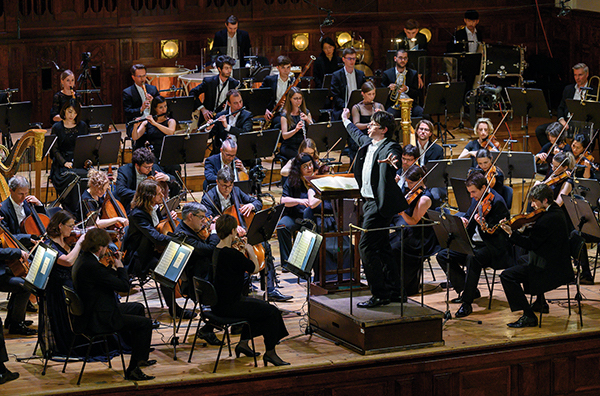
Above: In the midst of the latest pandemic, Václav Luks and his interval ensemble breathed new life into the cycle
In a associated manner, the character components of the cycle, Vltava and From Bohemia’s Woods And Fields, have a good time each landscapes and rural methods of life being radically reworked by the economic revolution of Smetana’s lifetime.
Finally, the cycle’s final two instalments type an prolonged set of chorale variations on an outdated hymn to retell the story of defeated Hussite warriors who retreat inside Mount Blank to await, in suspended animation, the undetermined level at which they’ll struggle for his or her nation as soon as extra.
It ought to be clear that the general tone and path of Má Vást is one in every of tragic wrestle. The Czech Philharmonic has not at all times performed it that manner. From Šejna to Neumann to Bělohlávek, successive generations of superb native conductors have fought (and never at all times gained) to form for themselves what seems like a collectively advanced interpretation, handed down like a much-reproduced postcard in a museum of Czech heritage.
The processional and marital character of Tábor and Blank presents a specific problem, in sustaining pressure throughout half an hour with out hustling by comparatively naked pages of rating; in steering away from empty bombast whereas projecting pleasure and majesty. This is essentially the most profitable side of the newest within the orchestra’s legion of recordings, below conductor Semyon Bychkov (on Pentatone).
Perhaps exactly as a result of he had not led them for half a century, the CPO responded with particular alacrity and electrical energy to Rafael Kubelik within the well-known live performance recorded after the autumn of Communism in Czechoslovakia. Chicago 1952 (Mercury), Vienna 1959 (Decca), Boston 1971 (DG), Munich 1984 (Orfeo), Prague 1990 (Supraphon) – Kubelik’s recorded engagements with the cycle quantity to a historical past of the classical file trade itself from mono to stereo, analogue to digital, LP to Compact Disc.
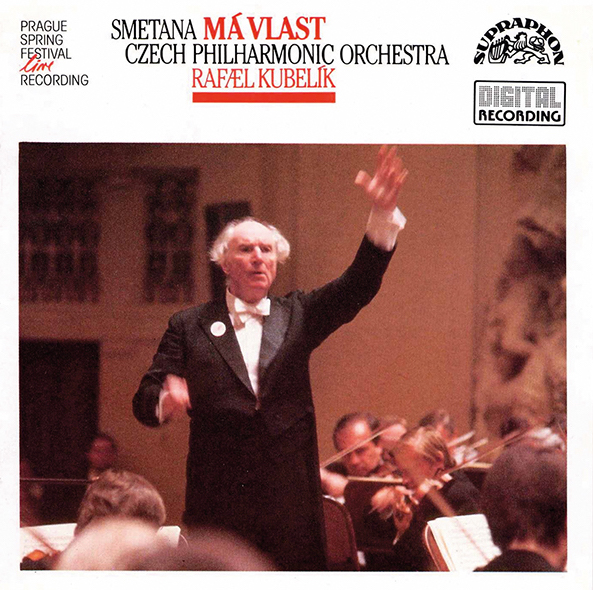
Above: Rafael Kubelík returned to Prague for this Má vlast having exiled himself from his dwelling in 1948
The 1990 model deserves a spot on the head of Má Vást on file, alongside different historic events [see boxout] when performances have taken on a political significance that may certainly have astonished and gratified Smetana. Yet the Czech PO doesn’t personal the piece. Norrington ruffled feathers when invited to carry ‘interval’ colors to it on the Prague Spring Festival in 1996. Rather than pure tone, it is the dearth of bass and Romantic conviction to his LCP recording that inform towards it.
Strings and tales
These aren’t complaints that may very well be levelled towards Harmoncourt or Luks, who fields an enormous string part in addition to a battalion of soft-grained brass. More intriguing is that their understanding of a ‘traditionally knowledgeable’ Má Vást leads them to undertake broader templ than most of their predecessors on file. They do that within the service of story-telling: the soldiers submitting into Blank, Šárka’s second of remorse earlier than the slaughter, the bardic introduction to Vyšehrad like turning the primary web page of an illuminated manuscript.
Harmoncourt took his concepts even additional with a late reappraisal in Amsterdam (which could be seen on YouTube). Kifill Petrenko attracts on his lengthy Wagnerian expertise in a captivating 2024 live performance obtainable on the BPO’s Digital Concert Hall. As essentially the most considerate Czech maestro of our time, Jakub Hrůša has already documented his evolving relationship with the piece by way of three recordings. Má Vást is not any pale set of postcards however an unfinished journey by Czech historical past.
Essential Recordings
Czech PO/Talich (1939)
Supraphon SU40552 (2CDs)
Complete with radio bulletins and fervent ovations after every motion, in mono, burning with a way of event.
Czech PO/Anceri (1968)
Supraphon SU43082 (15CDs)
The best Czech conductor of his technology, ‘late’ and reside: extra flowing and reflective, sturdy within the pastoral and poetic episodes.
Czech PO/Kubelik (1990)
Supraphon 1112082
A well-known homecoming, nearly (not fairly) overwhelmed by emotion by the top, in dry however involving trendy digital sound.
Vienna PO/Harmoncourt (2001)
RCA/Sony 82876543312
A lingering love-letter to the rating, quirky in narrative element, and the VPO stored on its toes by daring rhythmic pointing and accents.
Bamberg 50/Hrusa (2016/2020)
Tudor TUD7196 (CD), Accentus ACC40482 (3LP)
Affectionate however detailed panorama portray, with an additional dramatic pressure on the later, direct-to-disc LP model (if you could find it).
Collegium 1704/Luks (2021)
Accent ACC24378
A brand new and refreshing tackle ‘genuine’ Smetana: beneficiant in phrasing and atmosphere, stuffed with surprises however hardly iconoclastic.
HI-FI News
by way of Hi-Fi News https://ift.tt/I0JaYen
April 25, 2025 at 09:03PM
-
Product on sale
 Audiophile Vinyl Records Cleaning BundleOriginal price was: €69.90.€59.90Current price is: €59.90. incl. VAT
-
Product on saleEasy Start Vinyl Records Cleaning KitOriginal price was: €69.90.€59.90Current price is: €59.90. incl. VAT
-
Vinyl Records Cleaner Easy Groove Concentrate€34.95 incl. VAT
-
Easy Groove Super Set€199.00 incl. VAT
-
Easy Groove Enzycaster – vinyl records prewash cleaner€34.95 incl. VAT
-
Easy Groove Extreme MK. II- vinyl records prewash cleaner€45.00 incl. VAT
-
Vinyl Records Cleaner – Easy Groove Virgin Concentrate€35.00 incl. VAT
-
Easy Groove Spray&Wipe vinyl records cleaner€34.95 incl. VAT


