
World News
Software highlight: Cassette software program for the IBM PC
Software highlight: Cassette software program for the IBM PC
While individuals stick their noses up at floppies lately (or any bodily media for that matter), few understand that the unique IBM PC and PCJr each supported an much more primitive type of program storage: audio cassette tape.
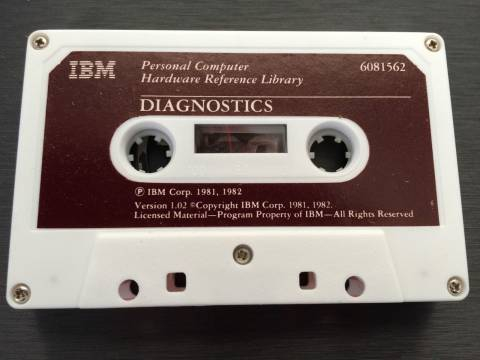
First, a slight clarification. It seems that the "Diagnostics 1.02" we had posted is definitely the "Advanced Diagnostics 1.02", in order that has been moved to a distinct launch. And now we’d like the usual 1.02. It seems there have been 4 totally different diagnostics releases.
https://winworldpc.com/product/ibm-pc-diagnostics/advanced-102
When the IBM PC was designed, including a cassette tape port for storage was a reasonably logical factor to do. Home oriented methods just like the Apple II, TI-99/4a, Commodore, and TRS-80s might use audio tape storage, and had many printed cassette tape titles. Many individuals already owned cassette tape recorders, and tape recorder methods have been vastly inexpensive than disk methods.
The apparent downside with cassette tape storage was that it was sequential entry solely, and really gradual.
When the IBM PC was launched in 1981, floppy drives have been catching on. But it nonetheless wasn’t absolute certainty how obtainable floppy drives can be available on the market.
In idea, having a cassette tape possibility helped defend IBM in opposition to market volatility. But some consider the one cause IBM added a cassette port was so they may market a decrease price "base mannequin" with out floppy drives that was TECHNICALY useful.
As it turned out, many of the enterprise market that adopted IBM PCs have been greater than keen to spend the additional cash for a floppy drive. This, though solely single sided "160k" drives have been initially supported and available. It is feasible some could have bought a floppy-less base mannequin solely so as to add their very own present floppy drives.

So how does this work?
An IBM PC geared up with no floppy drives, or if disk boot fails, will boot on to ROM "Cassette" BASIC. From there, you may load from, or enter and save a program to cassette.
IBM didn’t manufacture their very own connector cables (apart from the PCJr) or cassette recorder. The IBM PC used the identical cable because the TRS-80, and will use any respectable high quality cassette recorder.
Annoyingly, there is no such thing as a method offered to entry the disk system from ROM’s Cassette Basic. Similarly, there is no such thing as a method offered to entry the cassette from PC-DOS’s Disk Basic.
You can use a pc or cellular gadget to play again the cassette file. But you could want to regulate bass and treble settings, and never all sound gadgets simply allow this (but they are going to have a zillion different choices).
Treble and bass settings primarily muffle the audio, lowering static and hiss. Unfortunately, our cassette applications ARE static and hiss! 
Cassette operation in IBM PC ROM Cassette Basic is slightly odd. When you save a program to tape, you should give it a reputation. Then if you load this system, you should specify the identical identify – or it will not load. For instance, to load a program named Hello, you’d kind:
load "hiya"
I assume the thought is which you could give it a reputation after which run via a number of applications on the tape till it will get to the one with that identify. It will print the identify of any applications it skips. But how are you alleged to know the identify prematurely? Most different cassette methods merely load the primary program they encounter.
IBM BASIC would not immediate you to press play or cease, and it is not very informative when one thing goes unsuitable.
The TI-99/4a was a lot friendlier, however hey, IBM’s acquired to be IBM.

The IBM Advanced Diagnostics cassette consists of a two half program. The first is a BASIC loader stub. The second is a binary machine language program that the stub masses.
To start loading the diagnostics, the place "ldcass" is this system identify, kind:
load "ldcass"
Since computer systems cannot "pause", you should hit the pause button in your participant software program the second the loader stub finishes loading (hear for the second relay click on). Type "RUN", after which resume playback.
The loader stub additionally gives the flexibility to repeat the superior diagnostics to a brand new cassette tape.
This entails loading the stub, saving it as "ldcass", then typing "run 100" which can load and re-save the binary machine language portion.
Details are offered within the stub’s program itemizing feedback. If you’re transferring from laptop to an actual cassette recorder, this additionally entails switching the cables.

Interestingly the diagnostics program does have an possibility to check the floppy drives, though it could actually’t do anything with them. In the occasion of a floppy system failure, one might nonetheless load and run the cassette diagnostics.
It seems that the posted model is definitely the "Advanced" diagnostics. The Advanced diagnostics have extra testing choices than the usual diagnostics shipped with the IBM PC.
I’ve revised the obtain and added a "contemporary" recording sampled immediately from a 5150’s cassette output. This ought to comprise much less distortion, and may match higher for some individuals.
The commonplace "Diagnostics For The IBM PC" have been bundled the IBM Guide To Operations guide shipped with every IBM Personal Computer.
It seems that there have been two variations of the GTO guide, one for a floppy system, and one for a cassette (floppy-less) system.
From some analysis and extrapolating from Minuszerodegres.web , the next GTO manuals would have shipped with early IBM PC mannequin 5150 methods.
Title                                    Spine       Document
GTO "First Edition (August 1981)"        6025000     6025003 Floppy Diagnostics 1.00 - 6172230
GTO "First Edition (August 1981)"        6025117?    6025113? Cassette Diagnostics 1.00? - ???????
GTO "First Edition (Revised April 1982)" 6025000     6025003 Floppy Diagnostics 1.02 - 6081552
GTO "First Edition (Revised April 1982)" 6025117     6025113 Cassette Diagnostics 1.02 - 6081562
All later Guide To Operations manuals have been floppy-only.
The "IBM PC Advanced Diagnostics" have been bundled with the IBM Hardware Maintenance Service guide, a guide meant for restore personnel and superior customers. Each guide contained each a floppy disk and cassette tape.
Again, from some analysis and extrapolating from Minuszerodegres.web, the next HMS manuals would have shipped.
Title                              Spine    Document
HMS "First Edition (August 1981)"  6025072  6025075 Advanced Diag 1.00 - Disk 6172231 Cass 6172401
HMS "Revised Edition (July 1982)"? 6025072  6025075 Advanced Diag 1.02 - Disk 6081557 Cass 6081566
All later Hardware Maintenance Service manuals have been floppy-only.
In abstract there ought to be 4 totally different diagnostic cassettes:
- Diagnostics 1.00
- Diagnostics 1.02
- Advanced Diagnostics 1.00
- Advanced Diagnostics 1.02 (now we have this one)

Were there some other applications launched on cassette? Well, one, apparently. "IBM Typing Tutor" however nobody has ever seen one!

It was listed in a 1983 IBM product record

And the binder with the disk model has each the disk and cassette half numbers printers on it.
Winworld does have the disk model: https://winworldpc.com/product/ibm-typing-tutor
?
Is that it actually it? Nobody appears to have ever seen any business cassette applications.
There is a minimum of one different program that may USE the cassette port, though it’s not for storage:
"One program that particularly helps the cassette port is Electronic Arts Music Construction Set. This program has a setting to output 1 be aware PC Speaker or 4 be aware (tweaked) PC Speaker music, and has an choice to output it to the interior PC Speaker or the cassette port. 4-voice output could sound higher via a powered speaker than the interior speaker, however the fundamental sound would be the identical."
The WinWorld library has Music Construction Set: https://winworldpc.com/product/music-construction-set
"There’s a minimum of one early recreation that helps saving to a cassette (Galaxy from Avalon Hill) "
IBM PCJr
The IBM PCJr, the home-oriented scaled down follow-up to the IBM PC, additionally included a cassette port.
It required a distinct connector cable, this time one manufactured by IBM.
There aren’t any recognized PCjr cassette titles, not even a diagnostic.
The PCJr, did, nonetheless add help for ROM cartridges, for which there have been a number of, together with Lotus 1-2-3.
Once once more, a cassette port on a house laptop nonetheless made a little bit of sense on the time, and IBM provided a floppy-less base model. But at this level it was much more possible that the one cause for it was the low base worth.
IBM XT and later
The IBM Portable Personal Computer mannequin 5155 and IBM XT Model 5160 omitted cassette ports, however retained ROM fundamental for compatibility.
Clones, such because the Columbia Data Product 1600, Eagle PC, and Compaq Portable, additionally omitted cassette ports in addition to omitting ROM fundamental.
One Russian clone was reported to have had a cassette port, and early revision Compaq Portable motherboards had an unpopulated element space that would have been for a cassette interface.
XT class computer systems now not supported a configuration with "zero" floppy drives, though that had been technically legitimate on the IBM PC mannequin 5150. Software was typically exhausting coded to count on a floppy drive, even when it ran from a tough drive. For instance the IBM Assistant/PFS software program crapped itself operating in DOSBOX as a result of it reported zero floppy drives.
Although Cassette BASIC was retained for ROM compatibility on XT, AT, PS/2, and a few Aptiva computer systems, it was ineffective because it couldn’t save applications. With a tough drive put in, customers of those machines would by no means even see ROM Basic.
IBM’s PC-DOS Disk Basic wouldn’t run with out Basic in ROM. In all chance, this was initially achieved to save lots of RAM, because it re-used present code in ROM. Microsoft’s Basic and GWBASIC, shipped with most clones, didn’t have that restriction. Oddly, QBASIC within the first launch of IBM DOS 5 artificially required ROM Basic to run, in all probability as a result of licensing causes.
The IBM PC 5150 was discontinued in 1987, and even the final one off the meeting line had the cassette port.
Vinyl
through Hacker News https://ift.tt/0pyM4BN
October 10, 2024 at 05:54AM
-
Product on sale
 Audiophile Vinyl Records Cleaning BundleOriginal price was: €69.90.€59.90Current price is: €59.90. incl. VAT
-
Product on saleEasy Start Vinyl Records Cleaning KitOriginal price was: €69.90.€59.90Current price is: €59.90. incl. VAT
-
Vinyl Records Cleaner Easy Groove Concentrate€34.95 incl. VAT
-
Easy Groove Super Set€199.00 incl. VAT
-
Easy Groove Enzycaster – vinyl records prewash cleaner€34.95 incl. VAT
-
Easy Groove Extreme MK. II- vinyl records prewash cleaner€45.00 incl. VAT
-
Vinyl Records Cleaner – Easy Groove Virgin Concentrate€35.00 incl. VAT
-
Easy Groove Spray&Wipe vinyl records cleaner€34.95 incl. VAT


