
World News
Stenheim Alumine Two.Five loudspeaker
Stenheim Alumine Two.Five loudspeaker
Stereophile has favorably reviewed three loudspeakers from Swiss producer Stenheim. Art Dudley reviewed the Alumine standmount in April 2012 and the Alumine Five floorstander in March 2018. More not too long ago, Herb Reichert reviewed Stenheim’s three-and-a-half-way Alumine Three tower in October 2021. My project for this month’s subject was to assessment the corporate’s Alumine Two. Five floorstander, which, at $23,500/pair, suits neatly between the Alumine Two ($13,500/pair) and Three ($36,500/pair).
Stenheim was based by 4 engineers who beforehand had labored at Goldmund. A few years after the introduction of the corporate’s first loudspeaker, the Alumine Two standmount, in 2011, Stenheim was acquired by Jean-Pascal Panchard, who had been an engineer at Nagra and operated an audio retailer. Panchard is now the CEO and chief designer for Stenheim.
The Alumine Two.Five …
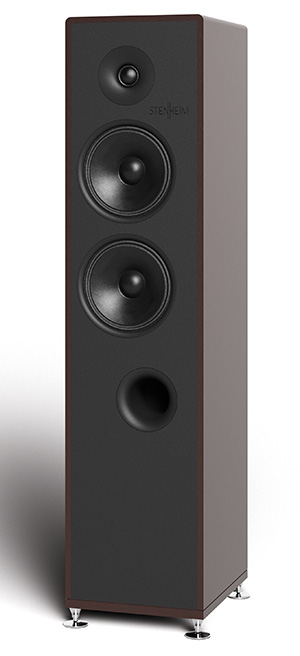
… is an elegant-looking, slim tower standing 38" excessive on spiked toes. In frequent with Stenheim’s different Alumine audio system, the enclosure is shaped from precision-machined aluminum panels, with inside bracing for a inflexible construction. The three drive modelsa 1" tweeter and two 6.5" woofersare mounted vertically in line on the entrance baffle, barely offset from the centerline. The woofers, equipped by French firm PHL, characteristic a half-roll encompass and a 5" cellulose-fiber cone with a proprietary coating. The woofers are reflex-loaded with a barely flared port 3" in diameter, mounted near the underside of the entrance baffle, offset on the opposite aspect of the centerline. The soft-dome tweeter, sourced from Norwegian producer SEAS, makes use of a considerable half-roll encompass and is acoustically loaded with a shallow waveguide. Electrical connection is through a single pair of WBT binding posts. The crossover makes use of high-quality elements together with Mundorf capacitors.
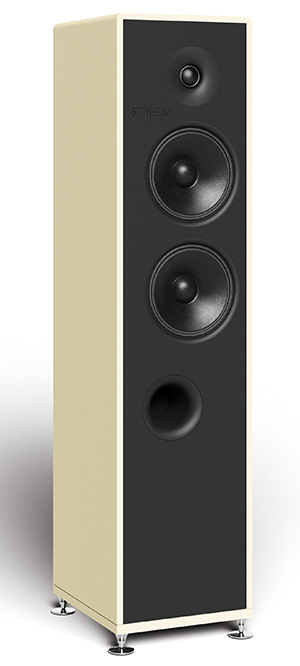
Panchard defined in a Zoom dialog that the tweeter is similar one used within the Alumine Two. The Alumine Two.Five’s crossover frequency is round 2.5kHz, with a topology near Linkwitz-Riley to present section coherence between the midrange and excessive frequencies. "We work quite a bit on the crossover, on the selection of the elements, to get one of the best steadiness potential, to have a pure sound," Panchard mentioned.
The loudspeaker’s printed specs describe the Alumine Two.Five as a "two-way" design. However, the title implies that it’s really a 2.5-way speaker, the place solely the higher woofer’s output extends all the best way as much as cross over to the tweeter. I requested Panchard for clarification.
"Yes, it is a two-and-a-half manner," he replied. "We have each drivers working in parallel till round 120, 125Hz, then just one is taking part in within the midrange; … we did not wish to have a three-way. We love the Alumine Two. It was our first loudspeaker. Iconic. We needed to maintain the qualities of the Alumine Two, however with a second bass driver to strengthen the bottom frequencies."
About these lows: "Hofmann’s Iron Law" dictates that for a given enclosure quantity, you possibly can have excessive sensitivity or prolonged low frequencies however not each. Yet a continuing characteristic of Jean-Pascal Panchard’s Stenheim designs has been a excessive specified sensitivity. The Alumine Two.Five is rated at 93dB (footnote 1). According to Panchard, the loudspeaker is positioned immediately on the ground for the sensitivity measurement and due to this fact radiates into half-space. "The half-space worth is then the minimal sensitivity a consumer can get in a well-damped monitoring room," Panchard instructed Herb Reichert when Herb reviewed Stenheim’s Alumine Three.
"I like the very best effectivity or sensitivity," Panchard instructed me. "We get this pleasure coming from the excessive effectivity, a really dynamic and microdynamic, very detailed, full of life sound. Of course, you possibly can have a lot greater effectivity, however then it is advisable have horns, or a lot larger audio system, or you possibly can sacrifice the bottom frequencies. That’s at all times a problem: to get the very best effectivity with a full bandwidth. So we attempt to attain the very best potential effectivity with a fairly sized enclosure but additionally to maintain the sound very pure."
I requested Panchard what his objective was for the woofers; was the alignment maximally flat or was it overdamped?
He mentioned that it was one thing between these two prospects, since his objective was to optimally reproduce transients. A tuning that gave a better sensitivity would have slowed down the bass. "So after all we do not attain 20Hz, however we needed the low frequencies to sound wealthy and provides the identical impression by way of pace and coherency because the midrange."
Setting up
I used my Roon Nucleus+ server to feed audio knowledge over my community to a Roon Ready MBL N31 CD participant/DAC. This was linked first to the mixture of the Ayre KX-8 preamplifier that I reviewed within the May 2025 subject and an Ayre VX-8 energy amplifier, then on to the VX-8, and at last to a pair of Parasound JCA100 Tribute monoblock amplifiers.
The first subject I needed to cope with was which loudspeaker to make use of because the left and which for the suitable. The drive models are mounted asymmetrically on the entrance baffle, mirror imaged on the pair of audio system. The handbook does not specify which edges of the baffle ought to be dealing with one another and which ought to face the sidewalls. (With hindsight, serial numbers on the rear panels ending with "L" or "R" ought to have given me a clue.) I experimented each with the drivers on the skin edges and on the within edges and located that the stereo imaging was extra steady and exact with the tweeters and woofers on the within edges. It got here as a aid, due to this fact, after I requested Jean-Pascal Panchard which was optimum and he responded that except you’ve gotten a really slim room or want to put the Alumine Two.Fives very near the sidewalls, Stenheim recommends positioning the audio system with the drivers on the within edges.
With that query resolved, the following subject was the place I ought to place the audio system. The handbook means that for one of the best outcomes, the audio system ought to be a minimum of 50cm (~20") away from the again and sidewalls and shouldn’t be positioned equidistant from these partitions. "It is at all times really helpful to depart a larger distance between the speaker and the again wall than between the speaker and the sidewall," the handbook says.
After some experimentation, I ended up with the Alumine Two.Fives’ entrance baffles 74" from the wall behind the audio system, the right-hand woofers 50" from the books that line that speaker’s closest sidewall, and the left-hand woofers 35" from the LPs that line that speaker’s sidewall. The low frequencies sounded a bit of light-weight with the audio system this removed from the wall behind them, nevertheless it wasn’t potential to maneuver them nearer to that wall as a result of brief flight of stairs behind the right-hand speaker that results in the vestibule.
I subsequently moved the audio system 6" nearer to the listening chair, which optimized the copy of soundstage depth with out considerably affecting the extent of the low frequencies.

With the Alumine Two.Fives in these new positions, the 1/3-octave warble tones on my Editor’s Choice CD (footnote 2) had been reproduced cleanly with full weight all the way down to the 63Hz band. The 50Hz and 40Hz tones had been decrease in degree however nonetheless audible. I might simply hear the 32Hz tone, which was boosted by my room’s lowest-frequency mode, however I could not hear the 25Hz and 20Hz tones. The half-stepspaced tonebursts on Editor’s Choice spoke cleanly and evenly all the way down to 63Hz, although there was some emphasis between 2kHz and 4kHz. I heard no audible wind noise from the port with the lowest-frequency tones, and the tonebursts and warble tones sounded clear, with no "doubling" (second-harmonic distortion). With the Stenheim audio system toed in to the listening place and the tweeters slightly below the peak of my ears at 36" from the ground, the dual-mono pink noise monitor on Editor’s Choice was reproduced as a steady central picture. The excessive frequencies sounded clean and the midrange uncolored. The noise sounded hole if I stood up. Moving my head back and forth, I heard little or no comb filtering.
Enough listening to check tones; on to music.
Footnote 1: At the rated (nominal) impedance of 8 ohms, the 2 frequent modelsdB/W/1m and dB/2.83V/1mgive the identical numerical consequence.
Footnote 2: While this CD is out of print, the test-tone information could be downloaded freed from cost right here.
HI-FI News
through Stereophile.com https://ift.tt/E6Pwrbs
May 23, 2025 at 03:19PM
-
Product on sale
 Audiophile Vinyl Records Cleaning BundleOriginal price was: €69.90.€59.90Current price is: €59.90. incl. VAT
-
Product on saleEasy Start Vinyl Records Cleaning KitOriginal price was: €69.90.€59.90Current price is: €59.90. incl. VAT
-
Vinyl Records Cleaner Easy Groove Concentrate€34.95 incl. VAT
-
Easy Groove Super Set€199.00 incl. VAT
-
Easy Groove Enzycaster – vinyl records prewash cleaner€34.95 incl. VAT
-
Easy Groove Extreme MK. II- vinyl records prewash cleaner€45.00 incl. VAT
-
Vinyl Records Cleaner – Easy Groove Virgin Concentrate€35.00 incl. VAT
-
Easy Groove Spray&Wipe vinyl records cleaner€34.95 incl. VAT


