Tag Archives: Compact Disc

Listening Report: Samantha Fierke Swings Out Of the Gate With Compelling New Jazz Album, Mirage

If you’ve been paying attention some of you might know by now that I generally don’t run negative reviews for numerous reasons. This is largely because life is simply too short for the negativity and because I’ve read reviews from too many powerful reviewers of the past who unnecessarily destroyed (or tried to destroy) careers simply because of their particular tastes and professional aesthetic as well as a fair amount of ego.

My approach is more thoughtful, if I do say so myself, in that if I don’t like something enough, I simply won’t report on it. 

These days I receive a lot of pitches for new music by many up-and-coming and plenty of (with a nod to Monty Python) “I’m-not-quite-dead-yet” older artists still fighting the good fight. Often, I will get advance streams and CDs and even the occasional LP sent to me unsolicited. I do try to get around to these at some point to listen to, even if they’re not necessarily on my radar. I mean, if somebody cares enough to send me their music I’m going to at least give it a shot and see if it’s something I might enjoy it enough to the point where I might want to tell you, Dear Readers, about it. 

This is my musician side of me trying to do the right thing, frankly…

Of the latest batch of CDs that came through in the past couple months some have jumped out at me but one of them is particularly intriguing as the artist is still in college!

Samantha Fiercke has a new album out called Mirage which is both an invigorating and lovely listening experience that neatly bridges some gaps between the vocal flavors Chick Corea pursued over the years (with Brazilian singer Flora Purim as well as his wife, ex Mahavishnu Orchestra member Gayle Moran) coupled with more introspective, quirky and beautiful jazz-pop constructs this side of Joni Mitchell’s mid-‘70s “jazzy” period.

Mirage opens up with an arresting track that showcases Fierke’s terrific Brazil-meets-Bombay vocal capabilities, “Kick It Loose.” And then Sam takes you on a rich journey through more familiar jazz flavors (“I Remember Butterflies”) to the Bill Evans-like waltz of “Sweet Girl.” Sam starts to get into near jazz fusion realms with “When People Speak.” The mesmerizing “Shower Song” sounds like a lost track k.d. lang might have recorded around the time of her landmark Ingenue album.

This multi layered vocalist swings, sways and swaggers. Re-reading the official press release some details jumped out underscoring Sam’s talent:  “During the “Mirage” recording and arranging process, Fierke received guidance from Grammy nominated jazz vocalists Gretchen Parlato, Jane Monheit and Oleta Adams as well as Grammy winner Taylor Eigsti, mentors and role models who have taken an interest in the promising singer-songwriter.”

So, yeah, its not just me, your humble record reviewer, recognizing this young artists’ talents.

Mirage is beautifully recorded and as modern CDs go it sounds pretty sweet all in all. It is modern and crisp but not harsh in that way some home brewed (often digital) recordings can be. So kudos go out to producer/drummer Loyd Warden and the quality of bassist Mickey Jamieson’s home studio and its ability to capture the natural acoustic sound of their instruments as well as pianist Samuel Luetkemeyer. The band is completely in tune with what Samantha Fierke is doing. 

You can find Samantha Fierke’s Mirage up on Qobuz, Tidal and Apple Music streaming in CD quality. You can click on the name of the streaming services and it will take you to the album there, respectively.

Better still, if you like this music and want to support independent artists, please visit https://samdoesjazz.com/ to buy the CD which is always a good thing, especially for up-and-coming talent. Support independent music!

Mirage is a promising first full album from a fine new young artist to watch. Listen.

Listening Report: Lou Reed’s Words and Music Take Center Stage On New Light In The Attic Super Deluxe Edition Multi-Disc 45 RPM Vinyl Set

Your interest level in purchasing the new super deluxe edition, two-LP-plus-45-plus-CD set celebrating Lou Reed’s earliest and newly discovered demo recordings will ultimately depend on how much of a fan of the artist you are. As your humble reviewer, I hope that I’ll give you some perspective which may help your decision making process in considering this very special new set called Lou Reed: Words And Music May 1965. 

First, it is important to understand the context of these recordings which were discovered by archivists working their way through Lou Reed’s estate. Found among the hundreds of tapes, CDs, demos and test pressings, they unearthed a sealed envelope which appeared to have been mailed by Lou to himself at his parents home address where he was still living at the time from May 1965. Employing a process commonly known as a “poor man’s copyright,” it is a way to informally secure your rights to the music within — which has been postmarked as well as notarized before it was even sealed — without actually submitting forms of copyright to the government. To the latter concept, I know from first hand experience these submissions can be daunting and can add up costs wise quickly these days if you have a lot of song or are on a tight budget (which most musicians are!).  

I have a few early cassettes of my own music like this tucked away in my archive (an aside:  heh heh, maybe someday after I’m gone someone will discover them and make a fancy boxed set out for the universe to appreciate… well… if I ever get as famous as Lou Reed they might, but I won’t be holding my breath).  But, I digress…

Anyhow… 

What the archivists found inside the envelope was a batch of amazing and fascinating early home recordings of some of Lou Reed’s most important and influential songs made on a consumer grade reel-to-reel tape recorder. Lou Reed: Words And Music May 1965 presents Lou at his most nascent, before the Velvet Underground was even a concept — much less a formal band sponsored by Andy Warhol with a psychedelic light show. 

Here Lou is mostly playing his songs in a simple, coffee-house, folk-styled form that was popular in the late 50s and early 60s (just before The Byrds more or less invented “folk rock”).  Along the way you’ll hear Lou actually singing campfire favorites like “Michael, Row The Boat Ashore” and even a curious twist on Dylan’s “Don’t Think Twice, It’s Alright.”  

Young Lewis Reed at this stage was more or less just like any other kid on the block in 1964….

Well, Lou was probably never like just any kid on the block…  

And as you’ll read in Lou Reed: Words And Music May 1965 an included reproduction of a typewritten letter to his former teacher at Syracuse University and friend, Delmore Schwartz,  shows that Lou was already at that time beginning to soak up the edgy dark corners of New York’s art scene which would be central to his artistic essence.

Lou was at this time was into his career as a staff writer at budget label Pickwick Records where he first met his future musical partner, John Cale (who is on some of these recordings). 

In this context, it is thus amazing to hear these primal demos of “I’m Waiting For The Man,” “Heroin,” and a very early version of “Pale Blue Eyes” (which is especially notable as it wasn’t recorded formally until The Velvet Underground’s third album, after John Cale had left the band).

In the deluxe edition of Lou Reed: Words And Music May 1965 you get the entire demo tape spread out across two 45 RPM, 180 gram black vinyl discs which are generally quiet and well centered. It also includes a seven-inch 45 RPM disc with rehearsals and other early home recordings including including with his high school group The Jades. For digital convenience, a CD version of the album is included containing all the music.   

In general the sound quality is remarkably good on the original recordings contained in Lou Reed: Words And Music May 1965 so the 45 RPM two LP treatment is in some ways justified.  The LP pressings are really good as well – the vinyl is black, dark, quiet and well centered. So all those checklist items tick off neatly for me…

The set also comes with a lovely full album sized booklet with an insightful essay by influential writer/critic Greil Marcus plus track-by-track analysis by Don Fleming and Jason Stern (who oversee the Lou Reed Archive).   

The packaging for Lou Reed: Words And Music May 1965 itself is quite stunning featuring a layered, die-cut outer sleeve with compelling images of young Lou Reed (including the famous early shot of a preppy-looking Lou playing in a band at a frat party at Syracuse University).

Clearly, Light in the Attic Records pulled out the stops given the historic nature of these recordings. You’ll see photos of the original reel of tape containing the demos as well as other early Lou Reed memorabilia.

Still, at the end of the day whether you purchase this album comes down to how much you love Lou Reed’s music. This super deluxe package celebrates what is ultimately a raw demo tape. If you are a deep fan, and you appreciate the special joy of vinyl special edition packages, you’ll want this as it is a very thoughtful and beautifully assembled tribute to the artist and the music within. There is also a standard single disc 33 & 1/3 RPM version of the album available as well as compact disc plus many nifty bundles and related merch (t-shirts! slip mats!) available at the Light In The Attic website (click here).  

Any way you decide to go, you should at least hear Lou Reed: Words And Music May 1965. This is an important archival release.    

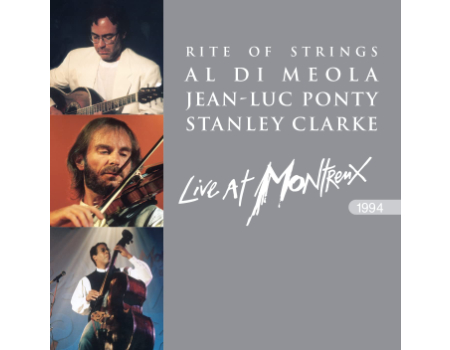
First Time CD Release Of 1994 Montreux Jazz Festival Concert by Superstar Supergroup Rite Of Strings Features Jean-Luc Ponty, Al Di Meola and Stanley Clarke

A new 1994 archival concert release from the archives of The Montreux Jazz Festival called Rite of Strings – Live at Montreux 1994 features the dynamic acoustic trio of Stanley Clarke on bass, Al Di Meola on guitar and Jean-Luc Ponty on violin. 

A magical recording by a magicial trio, these three super-musicians work really well together, complimenting and supporting one another while seemingly keeping each other in musical check. All of these players are master musicians and can run high speed circles around each another if they wanted to.

But they don’t… 

And there-in lies the joy of why Mercury Records’ new two-CD set titled Rite of Strings – Live at Montreux 1994 works for me as an end-to-end album listen. Here, these jazz fusion super-stars lift and inspire one-another, allowing for moments of technical brilliance where their shredding-inclined nimble fingers can sparkle, yet forcing each other to back off and give the music the necessary space to breathe.

No one steps on any musical toes (if you will), something I can’t always say about other similar powerhouse combos like this which I’ve seen in both rock and jazz worlds. Sometimes fewer notes can say a lot more in communicating and connecting with an audience.

OnRite of Strings – Live at Montreux 1994each artist gets a tasty solo spotlight. I especially liked Mr. Di Meola’s “Summer Country Song.” Mr. Ponty’s ethereal “Eulogy To Oscar Romero” finds the violinist masterfully employing digital delays and other special effects.  

Now, I have to admit that prior to this CD release of Rite of Strings – Live at Montreux 1994 I’d completely missed out on the DVD release of this concert (released in 2005, an especially bad year for me personally, so I’m not surprised it slipped through the cracks). 

Perhaps more surprising was discovering that this trio released a studio album (using the same super-group title, Rite Of Strings) in 1995, which I’ve honestly never seen before!  I think I may know why too: it was issued by the decidedly non-Jazz leaning record label I.R.S. Records just before it closed down in 1996. My guess is — and this just is a guess, so take it for all that is worth — that the combination of a jazz fusion album coming out from a rock oriented label which wasn’t in the best of health business-wise resulted in a very weak commercial release. 

I hope I’m wrong about that — the album was apparently a critical success (at least according to the Wiki). One of these days I hope to find a copy.

Until then, I’ll be enjoying this great trio recording in all its live-without-a-net glory on this fine new CD set.  If you have access to any of the high resolution streaming services you can find Rite of Strings – Live at Montreux 1994 on Qobuz in 48-kHz, 24-bit fidelity (click here), on Tidal in MQA (click here) and on Apple Music Lossless (click here).

You should check out Rite of Strings – Live at Montreux 1994 if you love any of these artists. This is the good stuff. 

Ripe For Halloween, Frank Zappa’s New 1975 Yugoslavian Concert Set Showcases Rare Transitional Band and Musical Experiments on CD and Streaming

Halloween was Frank Zappa’s favorite holiday so it is not surprising that there is a new release recorded in the general vicinity of Dracula’s Transylvania: Zappa ’75: Zagreb/Ljubljana.

1975 was a bit of an incredible year for this legendary composer, guitarist and all around musical icon. He completed a brand new album – One Size Fits All, widely considered one of his best rock albums – toured extensively, revised and updated his band which was evolving and even found time for orchestral performances of his music. And then along the way he got an invitation to play in Yugoslavia for his first and only time.

The two concerts they perform there in the cities of Zagreb and Ljubljana are the subject of a fascinating new two CD set issued by Universal Music and Zappa Records — called simply, Zappa ’75: Zagreb/Ljubljana. Taken from restored rare eight-track tapes as well as Zappa’s own stereo line mixes captured on his trusty, portable Nagra Stereo reel-to-reel recorder, the sessions provide a fascinating snapshot not only into the sound of his band in transition but we get to hear many classic Zappa compositions evolving before our very ears.

The short-lived group had not only the newly-anointed and soon-to-be-legendary drummer Terry Bozzio on board but also two briefly-tenured members, Andre Lewis on keyboards and Norma Bell on alto sax and vocals. These players were only in the band for a handful of months, making making these recordings all the more fascinating to hear their takes on the material. Also in the band was Napoleon Murphy Brock from the legendary “Roxy” era of the band on lead vocals and tenor sax. Original Mother of Invention Roy Estrada returned for one last time on bass. Borrowing a phrase from guitarist Robert Fripp, this five-piece assemblage was in its own way a small intelligent mobile unit. 

The interesting thing about these recordings on Zappa ’75: Zagreb/Ljubljana is that Zappa was able to test drive (if you will) many new ideas before a live audience that had never really seen him perform before. Zappa’s bands rarely made obvious mistakes, but if ever there was a location where they could take some risks with new ideas, this was it. And that’s where this set becomes more essential in the grand scheme of Zappa’s history. Now we can hear early versions of new material he was working on at that time, such as the so-called “prototype” version of “Filthy Habits,” which would later appear as part of the Läther-era material issued on the Sleep Dirt LP in 1979. 

We are also treated to early work-outs of then brand new compositions like “Black Napkins” and “Zoot Allures.”  And they play a great version of “Chunga’s Revenge,” again with many new ideas flowing from Zappa’s fretboard and fingertips. Of course the audience is treated to some “greatest hits” as the band breaks out numerous early Mothers of Invention tunes from Freak Out and We’re Only In It For The Money as well as later fan favorites from Overnight Sensation, Apostrophe and then new albums Bongofury and One Size Fits All.

In this light, it is perhaps worth pointing out that the cover of Zappa ’75: Zagreb/Ljubljana features a photo of Frank tuning his guitar, not really an image we get to see featured very often (at least on an album cover design). Perhaps this subconsciously represents the experimental tune-up nature of these recordings. Just a thought… 

But I digress… 

Overall the sound quality on Zappa ’75: Zagreb/Ljubljana is quite good all things considered. There are some fluctuations in sound, which the producers explain transparently in the liner notes. That these recordings exist at all in this sort of quality is quite remarkable! The eight-track recorder that they were working off of was apparently a very rare half-inch tape format version with special DBX noise reduction employed. This required much specialized tender-loving-care to extract the music from these tapes. And because they were performing at two venues with quite different acoustics, the overall sound quality does vary.   

But, in general, Zappa ’75: Zagreb/Ljubljana still sounds pretty great and is certainly very enjoyable if you are a Zappa fan (and especially if you are accustomed to listening to the many archival recordings which have been issued over the years).  Between the two shows, producers Joe Travers and Ahmet Zappa have assembled one nice compilation of all the music performed on that mini-tour in best possible quality. 

Some of the performances are  quite astounding particularly Terry Bozzio’s several incredible drum solos — for which he receives credit as composer, separate from Zappa’s work!  You can really hear Terry quickly emerging as the powerhouse center of Zappa’s universe around that time. He is now highly regarded as one of Zappa’s best ever drummers.

You can find Zappa ’75: Zagreb/Ljubljana streaming on Tidal MQA IN 24-bit, 44.1 kHz fidelity (click here), Apple Music Hi Res Lossless (click here) as well as Qobuz in 24-bit, 96 kHz resolution (click here). But if you like physical media —and want to read the recollections of the tour from Terry Bozzio and sound person Davy Moire — the CD may be your best bet. 

If you are a casual fan looking for high fidelity Zappa sounds like Hot Rats, this album is not for you (check out Waka Jawaka and The Grand Wazoo instead!).  But if you are a hardcore Zappa fan, you’ll want this for the interesting variants and many groovy then-new ideas Frank was test driving before an unsuspecting audience.  Zappa ’75: Zagreb/Ljubljana is ultimately essential listening for the deep Zappa fan.

The Beatles’ Revolver Super Deluxe Edition Revolver CD Boxed Set Features Wondrous Studio Outtakes

In Part One of my exploration of The Beatles fabulous new five CD boxed set celebrating their landmark sea-change album Revolver, we explored the wonderful new Stereo remix included in the set. Today in Part 2 we’ll explore the two discs worth of outtakes from the recording sessions. If you missed that first listening report, please click here to jump to it to catch up.

While on one hand it may seem a little skimpy to the “average” hardcore Beatle fanatic that we “only” get two CDs of fine sounding studio rarities, the reality is we fans should be grateful we get anything at all because much of this material has never been released anywhere, save for a handful of tracks which appeared on The Beatles’ Anthology series years ago. These types of recordings didn’t even seem to sneak out into the collector’s underground… at least I’ve never seen or heard of their existence out in the wilds of record collecting. The two CDs feature previously unseen conceptual art by photographer Robert Friedman which was being considered for the album cover prior to the arrival of Klaus Voorman’s incredible artwork.

One of the things I am taking away from listening to these two discs is the importance of the role of drummer Ringo Starr in elevating Revolver to the groundbreaking record that it is.

When you hear some of these earliest incarnations of the songs which emerged on Revolver, at times they sound like extensions of 1965’s Rubber Soul album. But, then when you hear Ringo laying down new ideas and innovative rhythms as the songs mature in the studio, the music ascends to new vistas.

Of course, most every casual Beatle fan knows that the song “Tomorrow Never Knows” features Ringo’s drumbeat as a central “hook” (if you will), a Tom Tom-centric style that no one else was doing at that time in rock or pop. When you hear the earliest version of the song, however, you realize it could gone down a less exciting path if Ringo had been a more pedestrian player.

The same goes for tracks like “She Said, She Said” with Lennon’s time-tripped out floating song structure. Listening to the outtakes it’s absolutely jaw-dropping to hear how Ringo pulls — and holds — that song together. His incredible time keeping sensibilities and innovative change ups are simply stunning. For any of you who ever questioned whether Ringo was the most important drummer in rock ‘n’ roll, I think this makes a huge case for that honor, him arguably setting the stage for all the wild ’n woolly hard rocking drummers to come in the late 60s and beyond.  

Play “And Your Bird Can Sing” in the new Stereo mix and you’ll notice there’s a little bit of a sort of inverted proto-disco Hi Hat cymbal rhythm he plays there on the transitional bridge (where the band is all doing a descending scale). It is these little details which transform that song from a simple pop rocker into a stratosphere-seeking masterwork.  No disrespect to the power of that incredible electric guitar solo riff, but listening to the early takes of the song — before the guitar hook was in place — this sounded like just a plain old rock tune.  Add the killer riff and some super sympathetic sophisticated drumming and you’ve given birth to a two minute pop epic for the ages. 

It’s amazing hearing John Lennon’s demo sketch for a song idea which was repurposed into the verse melody for “Yellow Submarine.”  Later, in an early group take the song actually takes on a folksy campfire flavor which — once they found the shuffling guitar strum and added Ringo’s kind of oom-pah flavored drum accompaniment (and iconic vocal delivery) — the song took on the infectious flavor that we all know and love. “Yellow Submarine” was a #1 hit around the world and reached the #2 spot in the United States.  Not bad for a children’s song!

One of the other important contributors to Revolver is producer George Martin who arranged the orchestral strings for one of The Beatles most groundbreaking songs, “Eleanor Rigby.” Here in this outtake you can hear the first sessions with the double string quartet, conducting the music he wrote which elevated McCartney’s poignant song again to another level.

And so it goes on Revolver which paints a portrait of The Beatles as arguable mothers of invention when it came to recording techniques and songwriting process. 

Of course, if I have any nits to pick again it’s simply the notion that as a Beatle fan most of us would like even more of this Revolver goodness!  Personally I could listen to every one of the outtakes that they have in the archives in chronological order, but that’s me talking as an obsessive hardcore Beatle fanatic. For the average person perhaps two CDs of demos and outtakes is more than enough as it does present kind of a mini audio documentary of what went down in that fertile time period. Maybe there will be a sequel set someday in the future. We can only wait and see…

The more I think about it, Revolver was more than just the beginning of The Beatles’ most creative and productive musical era.  It could be argued that it was exactly the sort of record the burgeoning psychedelic movement needed to lift it off the ground and into the popular mainstream. Yes, there were other psychedelic records happening in 1966 such as The Psychedelic Sounds Of The 13th Floor Elevators and Jefferson Airplane Takes Off. But Revolver arguably legitimized the psychedelic underground and helped to put it onto the airwaves and into mainstream media for the world to see and hear. There was no going back. 

Everything The Beatles did on Revolver set the stage for Sergeant Pepper a year later. After all these years of being a fan, it is still quite astounding to me — when you stop to think about it — how far they came in such a short time.  They went from the simplistic pop confections like “Love Me Do” to crafting proto-prog-funk-metal epics like “I Want You (She’s So Heavy) and the acoustic powerhouse “Here Comes The Sun” in less than 10 years time. 

50 years after they split up The Beatles music is still revered as among the most important — if not the most important — in pop music of the last 100 years. It is an influence that still resonates today with new listeners in the 21st century.

Deep dive studies like this super deluxe edition boxed set and the new Stereo mix will ensure that music fans for generations to come will be able to explore and fall in love with The Beatles’ art for generations to come.  Accordingly, the 100-page hardcover book included in the set goes a long way to put this album into historical perspective, with letters from Sir Paul McCartney himself as well as producer Giles Martin and a great perspective message by present day music icon Questlove (of The Roots). The track-by-track liner notes are excellent written by historian, author and radio producer Kevin Howlett. Complete with loads of unpublished photos, lyrics, original tape storage boxes and even period promotional materials. The book also includes a bit of Klaus Voormann’s graphic novel, birth of an icon: REVOLVER.

The Revolver super deluxe edition CD boxed set comes out next week on October 28th and is available for pre-order if you like listening on that format. It will also be streaming on most popular platforms. You can click on the album title anywhere in the review to jump to Amazon but no doubt this set will be available wherever great music is sold these days.

The Beatles Revolver: Super Deluxe Edition Boxed CD Set Showcases Pivotal Creative Period, Features Brand New Stereo Mix Of Landmark Album

By now you’ve probably heard that there’s a exciting new super deluxe edition boxed set being released this month celebrating The Beatles landmark 1966 recording, Revolver. We received an advance copy of the digital version of the set and today begin to explore it. 

While some casual fans are divided on the notion of when the Beatles’ psychedelic period began — many consider 1967’s Sergeant Pepper the beginning of that time — most serious Beatle-philes know that the band’s maturing creativity really began to flow a year or so before coming out of Rubber Soul and into the groundbreaking Revolver.  

And that concept has never felt truer and more evident than in this new expanded multi-disc edition of Revolver which features amazing new Stereo mixes of the entire album as well as a wealth of incredible studio outtakes. All of the exuberance of Pepper is in full flower here, perhaps even more so… 

Prepared with the use of exclusive Artificial Intelligence driven technology created for/by film producer Peter Jackson (who produced the wonderful new version of The Beatles’ Get Back film), the new Stereo mix offers wonderful new perspectives for this music. 

The proprietary “de-mixing” extraction programs used to make this new Stereo mix enabled release of the individual instrumental tracks from previously permanent mix-down limbo. The Beatles would often record entire segments of music together as a band on one track, notably drums, bass and rhythm guitars. This was great for making a punchy Mono mix but many of the early Stereo mixes made back in the day were not always as appealing. 

It is a bit involved to explain and beyond the scope of this review to go into that sort of detail, but in lay terms this new technology is akin to a program that could take apart the different color layers of a painting to reveal how the work was assembled. And then the producers are able to reassemble the work in a more three dimensional manner so you can see increased detailing of the colors, exposing the multi-layered thought processes which went into creating the masterwork.

But even that analogy isn’t 100-percent on target, I admit, but I hope you get the idea…

Since its original release, there has long been a Stereo version of Revolver but due to the limitations of the recording technology of the period, the sound design of the 1966 Stereo mix is not quite as enjoyable as the punchier and more balanced Mono mix. In 1966, Mono was still the dominant format for records and radio so The Beatles put most of their effort into that mix.

Old early Stereo mixes would often put drums in one channel while vocals and other instrumental overdubs might appear in the other channels. This often made for an awkward listening experience as high fidelity equipment matured over the years — especially if you were trying to listen on headphones or on a car stereo. Those mixes grew tiresome — for me, it never made sense to me having a drum kit banging away in one channel while the bass guitar was in the other. In that sense, when it comes to listening to rock and pop music in Stereo, it is often much more appealing when the drums and bass are locked in dead center. 

While this new de-mixing technology is no doubt painstaking and time-consuming to execute, at the end of the day the results are what matters. And the new Stereo remix Giles Martin has created for Revolver is overall wonderful. Most importantly, it sounds like Revolver should sound, presented in a much more pleasing Stereo sound stage than previously was possible with greater detail and presence of individual parts. 

The instruments are clearer and balances are generally very much improved. One caveat I have to acknowledge for hardcore Beatle-philes:  in keeping with most of the other remixed Beatles albums, the vocals are mostly more up front,  a wee bit higher in the mix (if you will). That isn’t a bad thing from my perspective as the goal here is not to replace the originals but to offer new insights into the music within. In some ways, this new Stereo mix strives to be as enjoyable as the Mono mix (which will always be the definitive version of the album — a fresh new mastering off the original tapes was included in the set!).

Everything in this new boxed set is presented on standard at 16 bit, 44.1 kHz compact discs. Overall, the CDs sound as good as CDs go. Certain songs sounded a bit bright to my ear — particularly “Taxman” and “Got To Get You Into My Life,” especially when you turn up the volume. But in general the CD version sounds very good indeed, especially tracks like “Eleanor Rigby,” “Here There And Everywhere” and “Yellow Submarine.”  “She Said, She Said” rocks madly in this new mix. There are many instances of increased detailing through out.

For those of you who purchased The Beatles In Mono boxed set from some years back, I briefly spot-checked compared the new Mono CD of Revolver included in the set and it stands up favorably to that earlier version. Again, the new CD sounds a bit brighter but other wise it sounds pretty much like Revolver should sound in digital form. 

The four disc Revolver boxed set includes two CDs of session outtakes which are amazing in their own right. I’ll explore those session in part two of this review series upcoming.   

If I have any disappointment about this new digital edition of Revolver  super deluxe edition set is is that it did not include a high resolution transfer of this great new Stereo mix on a physical Blu-ray Disc. However, the set will be streaming in high resolution (including a Dolby Atmos mix on some high end services). As soon as those are available I will be sure to update you all on them. 

Of course we have the new vinyl version of the Revolver super deluxe edition box set to look forward to as well (I will be covering that for another site). But for now I am quite happy with the new Stereo mix of Revolver and am glad to have it on CD. While I can certainly enjoy it at home on my Oppo universal disc player, the truth of the matter is that I still have a CD player in my car so it is great to be able to easily take all this new Beatles music on the road without having to rely on a streaming service. 

And, yes, the new Stereo mix of Revolver sounds great in the car.  I drove up to Sacramento over the weekend listening to it along the way and it rocked on the road!

The Revolver super deluxe edition boxed set comes out next week on October 28th and is available for pre-order. You can click on the album title anywhere in the review to jump to Amazon but it no doubt will be available wherever great music is sold these days.

Stay tuned for my exploration through the session outtakes… 

Listening Report: Out Of Earl’s Closet, Exploring A Music Industry Legend’s Personal Archive

There is every reason for an album like Earl’s Closet: The Lost Archive Of Earl Mcgrath to fail and yet it is a wonder when a collection like this — featuring disparate tracks from different artists made under wildly divergent recording conditions — somehow holds together as if it were meant to be. Such as the case this new album released by the good folks at Light In The Attic Records celebrating the life of a music industry insider named Earl McGrath.

McGrath was something of an impresario, an iconic character-about-town and socialite who made things happen in the music biz of the 1960s and early 70s, eventually becoming a producer and industry executive of note. So respected was McGrath that he was eventually chosen by the Rolling Stones to helm their own label!

Mr. McGrath passed away in 2016.  In the interim years assessing his estate, a literal pandora’s box of previously unreleased recordings was opened and thus this collection was ultimately assembled by Joe Hagan and produced for release with the help of Pat Thomas. 

I’m not going to recap Earl’s entire story here as I don’t want to spoil your enjoyment of the 20-page album-sized booklet included in the vinyl edition of Earl’s Closet: The Lost Archive Of Earl Mcgrath.  Its chockfull of fascinating stories of success, near hits and out-and-out misses. You’ll want to read it if only to learn about the connection between Michael McCarty (who offers the song “Christopher”) and B-grade sci-fi/horror movie icon Ed Wood as well as The Palace Guard (a band that was an early home to a young pre-Merry-Go-Round Emitt Rhodes). 

I must admit that when I first listened to this collection it didn’t connect with me.  But like many a great album, I soon realized it was “a grower” (as they say). Upon my second and third listens both via digital versions on Qobuz as well as on vinyl, I’ve grown to appreciate this album’s charms.

Earl’s Closet: The Lost Archive Of Earl Mcgrath opens up with a fine track by no less than Delbert McClinton singing a wonderful ode to the lonely life on the road in the joys of being in the moment with a bottle of wine or two called “Two More Bottles Of Wine.”

And then it jumps to a song by pre-fame Daryl Hall and John Oates, a quasi-acoustic demo of a neat tune which displays their knack for a catchy hook, “Baby Come Closer.” It is one of those songs which depending on how it as produced could’ve gone many different directions. But, in this under produced state the tune just works as “a song” if that makes some sense — which is ultimately what you want a good demo to do: display the essence of your songwriting capabilities while leaving room for the listener (ie. your potential producer or funder) to offer some input.  Oh, by the way, Earl apparently hooked up Hall & Oats with Atlantic Records leading to theirbreakthrough album Abandoned Luncheonette in 1973.  

As with the best of compilation albums I’ve listened to over the years – and I am a fan of the form mind you, with literally hundreds of different collections in my collection  – one of the best parts about Earl’s Closet: The Lost Archive Of Earl Mcgrath are the tunes by artists we’ve never really heard of before, at least not in any sort of the main stream sense.

I really liked Terry Allen’s tracks (“Gonna California,” “Cocaine Cowboy”) and The Kazoo Singers’ (you can’t make up a name like that, folks) “Only Yourself To Lose.”

The vinyl pressing on my copy of Earl’s Closet: The Lost Archive Of Earl Mcgrath plays well despite an ultimately minor but noticeable warp. Most importantly the album was well centered and the vinyl was quiet so that kept me happy.

The sound quality on Earl’s Closet: The Lost Archive Of Earl Mcgrath is variable and I mean that in the best possible way.  Go into this listening experience knowing that most of the recordings here were given to Mr. McGrath as a temptation for potential record deals and such, so I suspect that most of these recordings were never meant for commercial release. That said, many of the tracks actually sound very good but a handful of them definitely fall into the realm of amateur recordings.  

The early rehearsal-sounding recording by post-New York Dolls, pre-solo-career David Johansen sounds like a single microphone cassette recording, yet it is an early version of his soon to be seminal solo album track, “Funky But Chic” (and thus an essential listen if you are a fan — which I am!). Nonetheless, even the rough tracks have many riches to offer so one has to learn to listen for the performances and not get hung up on typical audiophile issues of fidelity and such.

You can listen to Earl’s Closet: The Lost Archive Of Earl Mcgrathon in CD quality via streaming services such as Qobuz (click here), Tidal (click here) and Apple Music (click here). As to whether you need this two LP set on vinyl will be a personal decision. I will leave you with some food for thought which might help you decide: when I first listened to Earl’s Closet: The Lost Archive Of Earl Mcgrath via a stream, the music didn’t do much to impact me (I was listening to it in the car while driving around the San Francisco Bay Area). But later, when I went back to listen to the LP in my office/studio in a more focused manner on vinyl, the album came alive for me, working well as a four-sided thoughtfully curated collection as opposed to a rambling playlist. 

Just sayin’… 

You can find Earl’s Closet: The Lost Archive Of Earl Mcgrath on Amazon easily by clicking on its title anywhere in this review. Alternately, if you want the special edition on red vinyl and possibly a T-shirt celebrating Earl’s early label Clean Records (which Atlantic Records backed!) click here to go to Light In The Attic’s site where you can find many variants to choose from. 

If you like this era of music and want to explore Earl McGrath’s universe, there are some fascinating early recordings here by artists you know and love such as The Jim Carroll Band’s “Tension” —  Earl had discovered Carroll, managed him and produced his first two albums!

Earl’s Closet: The Lost Archive Of Earl Mcgrath may well be just the musical elixir you need.  

Around The World With The Police on Blu-ray

It’s probably just as well that I never saw the original 1980s VHS video tape released version of the live quasi-documentary / concert video about Britain’s reggae-punk-pop sensations, The Police. Hold on to that thought for a moment…

Watching the new restored version of The Police Around The World has been very enjoyable in all its media-buzzed, manic pop thrilled, superstars-ascendant glory. The visuals are excellent as 1979-80 concert footage goes, especially for a then still-up-and-coming band. The Police were really big by 1980 but not as massive as they were about to get in the next couple of years by the time this video tape was originally released.  Apparently the film was shot in 16mm and transferred to HD video for the restoration process. 

Actually, The Police Around The World is quite stunning at times, showing the band just at that point between selling out larger theaters but before they became a stadium-filling act. The shows in Japan and Hong Kong are especially powerful but all the footage throughout shows just what a great band they were at that moment and how the fans were responding in kind. The music here is solid basic rock ‘n’ roll Stereo and it’s sounding very good indeed on the Blu-ray Disc at 48 kHz and 24 bits.

The accompanying CD is also very enjoyable because it gives you the full songs from many of the performances on the video and then some.  The performances are of course outstanding and still pretty exciting. This is prime Police from that initial adrenaline-rush era of hits including “Message In A Bottle,” “Bring On The Night,” “Can’t Stand Losing You,” “So Lonely” and of course “Roxanne.”  

My only nit with The Police Around The World package is that I wish the producers had also given us all the same album of songs on the Blu-ray as is found on the CD.  Adding them in high resolution Stereo audio probably would not have taken up much additional space on the disc.  Even with the bonus video clips that are included — full performances of four songs from Japan which are excellent! – they could’ve fleshed out the Blu-ray significantly.

Of course, there is that factor of bang for the buck and with it selling on Amazon for just over $20, The Police Around The World is a very fairly priced package all things considered.

Still, there are some what-ifs to consider. I was talking with a friend who is a much bigger Police fanatic than I, and learned that there hasn’t been much new archival material for the hardcore fans in some time. So I can appreciate the desire for more extras in the package.

Going back to my opening paragraph, the reason I mentioned that it was a good that I’d never seen the original VHS version of The Police Around The World is that apparently there have been quite a number of edits and even some changes to the program in making this new Blu-ray and DVD edition. Personally, I have no problem with this and certainly respect the decisions of the band to present their music as they see fit. Looking at some of the edits fans are missing on the new edition, many seem to be surrounding special effects and transitions and such.

If you are interested, click here to explore a fan wiki page with a very detailed contrasting of the differences. I don’t know why certain decisions were made but it is entirely possible that in trying to create an updated 21st century version — which involves going back to original source footage and high definition film scanning, transfer and restoration processes — that some of those old early video effects were not reproducible in high resolution.

Having done a fair amount of video editing (supervision) work in the late ’80s and early ’90s I know that some effects put to master U-Matic or Betacam tape stock were done on-the-fly in real time. So there isn’t necessarily just some button one can push to recreate that exact look and feel. Some elements may also be missing from the archives at this point. And, certain elements used from different interview sources may be unavailable for technical and licensing reasons for use on modern formats including streaming and Blu-ray. Assembling a collection like this can be a bit of a production Pandora’s Box!

So… it is understandable to me that a new incarnation of The Police Around The World might be created. Perhaps a bit more clarity in marketing future products/changes might help to set realistic expectations with the fans.

Personally, I’m thrilled that they have the original film elements of the concert footage in their archives. That is the most important thing!

Anyhow, I am hoping that this release is just the beginning of a new era of archival releases for The Police. I do hope that the band will take a cue from artists like Bruce Springsteen, The Grateful Dead, Frank Zappa and XTC who have done a great job of giving the fans everything they might want and more as far as archival releases go. Bob Dylan has also in many ways set a standard for how this kind of a series can be executed successfully for fan and artist alike. Oh…. and The Beatles haven’t done too shabby a job with mining their archives. 

Just sayin’….

All in all, if you are a fan you will want to own The Police Around The World.  The footage is great, the performances and the energy fantastic.  And it sounds pretty fabulous all things considered as 40-year-old punk-pop-reggae live recordings go. This has primed and rekindled my interest in their music with fresh ears and eyes. I for one am eager to see and hear more Police releases from the archives in the future. 

Listening Report: Ella Fitzgerald At The Hollywood Bowl

You can certainly simply put on the newly released live album by Ella Fitzgerald — Ella At The Hollywood Bowl — and enjoy it in its own right. But, you might do yourself a favor to do a little bit of “homework” listening to the albums that inspired the concert in the first place. 

In the mid 1950s, Jazz impresario, manager and producer Norman Granz had a very clear vision for his new client Ella Fitzgerald. He believed she had the power to break through to major concert hall stages, taking her career to a very different level.  Part of Granz’ master plan was to have Ella record music which is now known commonly as “The Great American Songbook.”  But in the mid-1950s, this music was still relatively fresh in the public mindset — some of these now iconic writers were still alive and working including George Gershwin, Jerome Kern, Cole Porter, Richard Rodgers & Lorenz Hart, Harold Arlen, Johnny Mercer and many others. 

The first album she recorded — the May 1956 album Ella Fitzgerald Sings The Cole Porter Songbook — was such a success that she went on to record seven more artist-specific collections up until 1964. That first album won a special Grammy in 2000 and is now in the Library of Congress’ National Recording Registry.

By the time she made Ella Fitzgerald Sings The Irving Berlin Song Book, Ella’s recordings were no doubt selling very well. Conducted and arranged by the super-talented but decidedly mainstream leaning Paul Weston (husband of singer Jo Stafford), the album has a fine and gentle swing to it.

Not widely known for his jazz chops (he was in Tommy Dorsey’s band for a while in the 1940s), Weston was certainly a gifted player and arranger who knew jazz well enough to construct in the form. Heck, he knew it well enough to even deconstruct it! If you don’t believe me on the latter point, seek out the first album of jazz-pop standards credited to faux bad lounge performers Jonathan & Darlene Edwards on Columbia Records… which was actually Weston and Stafford. It takes a lot of skill play that badly and off-key intentionally! By 1960 they subsequently won a Grammy for best comedy album. 

Point is, Weston knew jazz and pop which made him an ideal choice for producing one of Ella’s songbook collections, especially the catalog of Irving Berlin. 

For those not familiar with Mr. Berlin, he wrote many standards including “How Deep Is The Ocean,” “Cheek To Cheek,” “Puttin’ On the Ritz,” “Russian Lullaby,” and “Alexander’s Ragtime Band.”  What’s that you say? You’ve never heard “anyone” in “your era” do those songs?  Um… well, let me cite a few names you might know who have covered Mr. Berlin’s songs: The Grateful Dead’s Jerry Garcia (“Russian Lullaby”), Lady Gaga (“Cheek To Cheek”), Bob Dylan (“What’ll I Do,” “How Deep Is The Ocean”), Michael Buble (“White Christmas”) and even Leonard Cohen (“Always”).  

Point is, Berlin is a songwriting legend and Ella delivers many fantastic versions of his compositions on the studio album. And on the live album — Ella At The Hollywood Bowl —  those songs come to life with a bit more of that on-the-edge vibe which only a live performance in front of an audience can deliver.  

Ella At The Hollywood Bowl is — believe it or not — her first full concert recording issued from this particular and legendary venue, which is kind of amazing given that she had performed there many times over the course of her life and career.  The venue’s website even has a page dedicated to Ella — click here to jump to it — noting that “Fitzgerald holds the rare distinction of having sold out the Hollywood Bowl’s 18,000 seats in each of five decades, from the 1950s through the 1990s.”  

Given that Ella only worked with Weston for this one record, it makes this finding all the more appealing and rare. It was the first and only time she did something like this.  

According to the liner notes, prior to finding this tape in the personal collection of producer Norman Granz, it wasn’t known that Ella had ever even performed any of the songbook series tracks in a live setting with the full orchestral arrangements.  

Again, this is significant to consider as these days it is a trendy (and often unrealistic and unfair) fan expectation — especially among older bands — for artists and bands to perform entire albums in sequence with all the production bells and whistles.  

Ella did the full album thing more than 60 years ago, kiddies!

All these factors convene to make Ella At The Hollywood Bowl a very special archival release, indeed. That her performance is excellent doesn’t hurt at all, again, bringing this music up a few notches energy-wise from the studio renditions. 

Sonics wise, Ella At The Hollywood Bowl sounds very good all things considered — it is after all a 60-plus year old analog tape captured from the soundboard, recorded live without a net. I enjoyed listening to it on vinyl a bit more than I did the high resolution 96 kHz, 24-bit stream on Qobuz (click here) which sounded a bit bright. So the vinyl presentation helps to warm things up — a little bit. Curiously, the album was not completely available yet on Tidal but the couple of songs that are there (click here) sounded a bit less bright (if you will), streaming at 48 kHz, 24-bit resolution.  It is also streaming on Apple Music (click here for Hi Res Lossless).

I do suspect this original tape source was digitally remastered for this release. In the album liner notes, a company called Izotope — which manufactures digital audio workstation type software — is credited. I don’t view this as necessarily bad but the result is a more modern sounding release than one might expect from a 1958 live concert captured on analog reel-to-reel tape. This production style is probably a 21st century necessity if this recording was to have any chance at a life on the Internet as well as modern day radio and TV applications. So, analog purists do set your expectations accordingly.

In the world of Grateful Dead tape traders, this is what people used to call “a crisp soundboard.” 

An archival release recorded in another time and place, Ella’s vocals are the focus here. While the Hollywood Bowl Orchestra is certainly very audible, it sounds like there were probably a limited number of microphones used (which is perhaps why Norman Granz didn’t release it back in the day). The horn section and strings at times feel a little distant, yet in the recording engineers’ attempt to deliver clarity, certain instruments like the Harp sound a bit too hot in the mix (check it out on “You’re Laughing At Me”). 

I was sent a standard weight black vinyl pressing for review purposes and it sounds fine: quiet and generally well centered. There are several colored vinyl variant versions of Ella At The Hollywood Bowl available including a pink one from Vinyl Me Please (click here) and a neat purple splatter version from Jazz Centerstage (click here). The album comes with a lovely full color booklet that helps in the appreciation of this concert recording. 

All in all Ella At The Hollywood Bowl is a fine release and if you are a long time — or new — Ella fan you’ll likely want to add this to your collection.