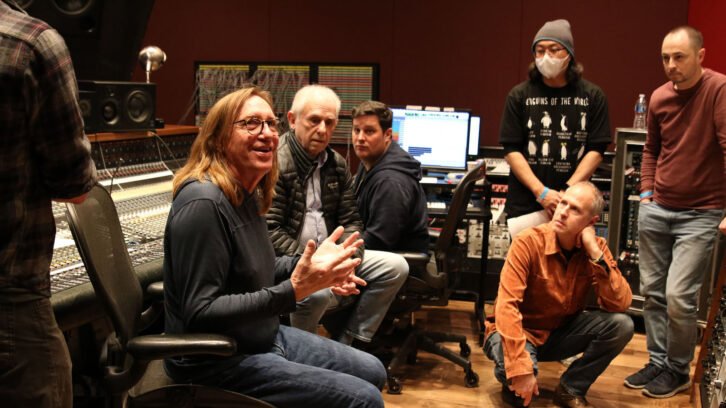
In Studio D, engineers Chuck Ainlay, left, and Elliot Scheiner flip away from the API console to speak to attendees.
The Music Engineering & Technology Alliance (METAlliance), a choose group of famous recording engineers/ producers who advise and seek the advice of on all issues audio, held a two-day weekend recording program at Blackbird Studios, Nashville, in late January.
Each day included two four-hour classes in a number of studios, every hosted by a unique engineer, with attendees in teams of not more than 10 individuals per session.
Sylvia Massy and Niko Bolas, Studio A
Day 1 began in Studio A with Sylvia Massy and Niko Bolas monitoring recording artist Sonia Leigh. Studio A’s completely restored Neve 8078 console simply dealt with the fully completely different approaches that the 2 engineer/producers took. Each described their mic selections and exact positioning: Bolas was meticulous out within the studio, “dialing-in” every mic, whereas Massy proved that she is a continuing experimenter, with each quirky mic selections and non-standard placement and processing.
Frank Filipetti and George Massenburg, Studio C
Studio C is a singular mixing room with fully diffusive ceiling and wall surfaces, designed again in 2004 by George Massenburg. He and Filipetti mentioned the variations between Dolby Atmos, Sony RA360 and Auro-3D as Studio C has calibrated monitoring for all three immersive codecs. Massenburg performed a few of his current work with Alicia Keys and Earth, Wind & Fire, whereas Filipetti performed immersive mixes from Korn and George Michael. This was an unbelievable expertise.
Chuck Ainlay and Elliot Scheiner, Studio D
Day 2 began in Studio D with Chuck Ainlay and Elliot Scheiner monitoring a few of Nashville’s best session gamers with producer Jon Randall, sitting at an 80-channel API console. Using the Nashville quantity system, they went by way of the delivery of a track, from demo to refining its association to vocal manufacturing to making a tough combine. Using parallel entrance ends, every engineer arrange his personal mics, so it was attainable to check two completely different drum equipment sounds, in addition to the variations in piano, acoustic guitar and electrical guitar.
Jimmy Douglass, Studio F
Jimmy Douglass confirmed his full Atmos mixing course of for Justin Timberlake’s The 20/20 Experience. He offered a one-of-a-kind peek inside his workflow, and talked about his discovery of sure limitations of Atmos and his early struggles with the format. He should have figured it out, because the Atmos combine was implausible!
Walter Becker and Donald Fagen of Steely Dan in 1977 Getty Images Chris Walter/WireImage
Steely Dan were famous for their meticulous approach to recording. While they earned armloads of plaudits and Grammys proving they were right in their rigor, it’s the sound of their records that really makes the point. To this day, their albums are held up as pinnacles of recording—and a prime example is their 1977 classic, Aja.
Released in September 1977, Aja found the duo of Walter Becker and Donald Fagen in top form, once again working with producer Gary Katz. Becoming their fastest seller to date, the album went on to go double Platinum and spawn three Top 40 hits with “Peg,” “Deacon Blues” and “Josie”—not bad for an album of only seven songs! Nominated for Album of the Year and Best Pop Performance at the 1978 Grammys, Aja ultimately brought home the trophy for Best Engineered Recording – Non-Classical—a triumph shared by engineers Roger Nichols, Bill Schnee and two members of the METAlliance, Al Schmitt and Elliot Scheiner. With that in mind, we sat down with Al and El to get their insights on recording the landmark collection. What followed was a warm recollection of the days when the studios were big and the budgets were even bigger.
How did you guys get involved with the project?
Elliot: I started on the album before, which was The Royal Scam, and we had a falling out during that project. We had a deal: “Come out to L.A. and we’ll do the record. We’ll be done in two months maximum.” … and I didn’t know enough about how they worked.
I stayed in the Beverly Hills Hotel, Donald got me a Mercedes-Benz sports car and it seemed good, but we only recorded maybe once or twice a week. We started at one studio and moved to Village Recorder. After month or two of that, I got really fed up, and wouldn’t you know it, I got a call on the last day of that week and they said, “We’re not working today.” We hung up, I packed my bags, I left and never said anything. I just got out.
We didn’t talk again until a year or more later. Gary called me and said, “Do you want to mix this record?” I was just in New York at A&R Studios, and it was a great opportunity for me to be back with those guys. We were friends before any of that started—I’d known them since the late ’60s when they were the backup band for Jay and the Americans—so I took it.
Steely Dan’s “Aja” went Double Platinum and spawned three Top 40 singles.
Before Al came in, I was mixing the entire record. Bill Schnee had recorded “Aja” and “Black Cow,” and everything else was recorded by Roger Nichols. The only thing that was recorded at A&R was “Peg”—we ended up recording it in one night. I think they actually came up with the song that night and decided to record. It was so much sick s— that happened during that time period. At some point, we finished. I thought.
I had mixed everything on [the title track] “Aja,” but they came back because there was so much leakage in the room on some of the things. Most everything was on one 24-track tape, and in some cases it had three or four things on a single track and they each had to be mixed differently—verse by verse, chorus and bridge all had separate setups. When you got finished with a verse, you now had a guitar on a percussion track. It kept moving around like that, so you had to change panning, EQ, everything—and the whole song was like that, just trying to get the thing together before we even edited. We did that, and about three weeks after, they said there’s no bass in a lot of the mix.
I said, “That’s impossible.” I thought about everything that went into that and the last thing I wanted to do was do it again, but at some point, I thought to myself in the night, is it possible that I didn’t switch it on when it had to be muted? There was no automation—it was all manual, right? They were coming back on a Monday, so I came in early and put the whole mix up, listening to the original. There were notes for EQ and not really as much for level setting. I recalled the whole mix, and put it down with the bass really loud. [laughs]
They came in, and Donald and Walter looked at each other, thinking, “Wow, this is really f—-d up. There was no bass on this.” I started to laugh and they knew instantly what happened. They said, “Okay, so you put it in today. Let’s start the whole mix again.” We did and that was the only thing that got redone by me. Then I didn’t hear until the record came out that Al had mixed two songs.
Al: I got a call while at Sound Labs Studio 2 [in Hollywood]. We used to do a lot of work there at that time, and I said yes. They came over to bring their tape and brought five or six 1176 limiters—I don’t know what the hell they wanted me to use them on, but they did. They dropped the tape off and left.
I put the tape up and it’s “Peg.” I get a mix on it and it sounds pretty good. I know there’s going to be a lot of things that have to be done, but I get the mix up—and then I turn the monitor off, and I hit the playback. I’m watching the meters on the Quad 8 board to see how the meters are reacting and everything. Then I turn the monitor back up, so here’s this mix coming out of the speakers. And little did I know, they had come into the room [while the monitor was off]. They were standing behind me and Gary said, “F—–g Al, he can mix without even hearing this s—!” [Laughs]
Elliot: They told that story to anybody who would come in the room, that Al was capable of mixing without speakers. I remember saying to Gary, how is that possible? Gary, in his wisdom, said, “He looks at the meters!” [Laughs]
Al: Anyway, it was such a complicated mix that we were all mixing the record. I was at the board, Donald and Walter were doing something with echo and something else, and Gary was doing something else—and we were there for 12 hours. I had never worked that long on a mix in my life. I’d get it right, but maybe Donald would say, “I missed the echo. I didn’t get in the right spot,” and so we had to keep doing it over and over and over. Every time we ran it down, it was a performance, because we were all performing, right?
The 1977 Grammy Award for Best Engineered Recording (Non-Classical) went to Al Schmitt, Roger Nichols, Elliot Scheiner and Bill Schnee for Steely Dan’s “Aja”
I mixed another one, “Deacon Blues,” and then at that same time, they were doing “FM (No Static at All),” [the theme song to] the movie FM, and they asked me to record. Although they had a track done, we got Johnny Mandel in to do the arrangement. We did that at Capitol in Studio A and Johnny said to me, “These guys know what they’re doing?” I said, “Absolutely.” At one point, he was running things down and Donald hit the talkback and said, “Johnny, there’s something wrong in the violas.” And sure enough there was—and that turned Mandel right around. That’s when he really knew that they had ears—they could hear and they knew what they were doing. Then I mixed it back at Sound Labs. The funny thing about that single? I got this Best Engineer [Grammy] award for that, and that was the first and last time that ever happened.
The story you always hear is that they would record a track a number of times with a number of players to get it right.
Elliot: Yeah—I remember on [the follow-up album] Gaucho, they would record songs five, six, seven times, and with completely different bands. With Aja, I only recorded “Peg,” and that was one band. Rick Marotta, Chuck Rainey, Don Grolnick, Paul Griffin and Steve Kahn. I would only do the tracks and then Roger would do all the overdubs. [Legendary session drummer] Steve Gadd played on “Black Cow” and “Aja,” and when we finished mixing “Aja” the first time, they said, “Why don’t you bring Gadd in?” He came in and was really f—-d up. He started listening to the drum solo and was nodding like, “This is incredible!” And at the end of the song, he said, “Who’s playing drums?” [Laughs]
Elliot Scheiner was initially only going to mix the album, but soon recorded the hit “Peg” as well.
There’s that old adage that when people listen to something they worked on a while back, they hear something they’d want to go back and change. You guys don’t seem to have that affliction.
Elliot: For me personally, when it’s done, it’s done. But if I hear it a year later? Oh. My. Gosh.
Al: I’m exactly the same—I hear it a year later, I say, “Oh, why didn’t I do that? How did I miss that?” That’s the perfectionist in us. Somebody asked me recently, am I happy with anything I’ve ever done? I said, “To be honest with you, no matter what record it was, I can always take something and make it a little better.”
Is that something about how you’ve changed since then? Is it that you learn something on a subsequent session, or perhaps you grow as people or grow as engineers—or do you think there was actually something that you probably knew but you just missed it?
Elliot: I think it was a case of missing for me. Here’s an example: The dynamic between Donald, Walker and Gary was such that when we were actually doing the cut “Aja,” Gary wasn’t in the room. He would come in to start the session and then drift out. Nobody knew where the f— he went, but after three days of mixing, Roger was doing the two-track edits when we finished. We played it back and thought it really sounded great.
Gary came in and was on the other side of the console, standing with his ears in between the speakers. After it finished, he looked at Donald and Walter and said, “There’s not enough cymbals.” [Laughs] Walter looked at me and said, “You know, wherever you are, get the f— out of here and go back there.”
This article originally appeared in the August 2020 issue of Pro Sound News. METAlliance Report is a monthly column in which members of the METAlliance discuss topics of interest to audio professionals.
Cambridge, UK (May 5, 2020)—Launched last year at AES, the dCS (Data Conversion Systems, Ltd.) Legends Award campaign has acknowledged the efforts of recording, mixing, and mastering engineers who have strived throughout their careers to deliver a quality music listening experience possible. Since then, the Legends Award has been bestowed upon Bob Ludwig, Al Schmitt, Tony Faulkner and Chuck Ainlay. Now dCS has announced the next round of honorees.
In the coming months, the dCS Legends Award campaign will highlight Frank Filipetti, James Guthrie, Leslie Ann Jones, George Massenburg, John Newton, Elliot Scheiner, Mark Wilder and the late Ed Cherney, who dCS also honored with a contribution to the COVID-19 Relief Fund established by the Recording Academy and MusiCares.
While honoring noted engineers, the program is also intended to underscore the growing industry trend toward ‘studio quality’ high-resolution streaming services. “We are overwhelmed by the positive response that our Legends Award campaign has received from both music professionals and enthusiasts alike,” said David J. Steven, managing director. “We have been working closely with the Recording Academy Producers & Engineers Wing to identify and tell the incredible stories behind a diverse group of legendary engineers, and we plan to continue this effort through the remainder of this year.”