Tag Archives: Interconnects

AudioQuest Dragon Interconnect

I rarely write about cables because I rarely encounter one that inspires me to review it. This isn’t to say that cables are unimportant, only that I find other product categories more interesting. But after hearing AudioQuest’s new top-of-the-line Dragon interconnect, I immediately knew that I wanted to share my impressions with you. To spill the beans in the first paragraph, the Dragon is the most significant advance in interconnect performance I’ve encountered in 33 years of full-time reviewing.

Although AudioQuest has been developing proprietary cable materials and techniques for 42 years, the company embarked on its new “Mythical Creatures” series of interconnects with a fresh mind. Rather than create a more advanced implementation of existing technologies, AudioQuest approached its new reference series by starting from first principles. It would call on proven technologies but not be bound by them. The result is a fascinating amalgam of fresh thinking and AudioQuest’s established designs. I’ve broken out the unique technologies of these interconnects in the sidebar.

Dragon is the top model in the three-product Mythical Creatures series. It is priced at $9500 for a meter pair terminated with RCA plugs, or $11,900 for balanced connection with XLR connectors. FireBird is $5500/$6900-per-meter pair (RCA/XLR), and ThunderBird comes in at $2900/$3900 (RCA/XLR). All three share the same design approach but differ in the level of execution. As a tremendous bonus, the interconnects are extremely flexible and easy to install and swap.

Listening

AudioQuest initially sent me a single one-meter run of balanced Dragon that I installed between the CH Precision P1 phonostage (with X1 power supply) and the CH Precision L10 four-chassis linestage. After replacing my existing cable with Dragon and listening to the first record, I was beyond surprised, not only at the magnitude of the improvement but also at the ways in which the sound was better. I had simply never heard this kind of wholesale effect from any cable. Dragon wasn’t just different; it was better in every possible way. Comparing cables is often a matter of trading one set of virtues and drawbacks for a different set of virtues and drawbacks. You pick the cable that happens to have the tradeoffs that best suit your system and tastes. Dragon wasn’t like that. Rather, it elevated the musical experience to an entirely new level of involvement and expression.

Some months later, I was able to replace the entire line-level signal path with Dragon, including the 37′ run from the linestage behind the listening couch to the front of the room where the CH Precision M10 amplifiers are located. This run made the most significant difference in my system, and the improvements it rendered combined with the advances heard with Dragon in the phono path and from the Wadax Reference DAC to the CH Precision L10 linestage.

Although Dragon does everything you’d expect from a top-level interconnect at this price, it goes above and beyond the cliches of greater transparency, smoother textures, and a bigger soundstage. Judged simply by the traditional criteria for evaluating cables, Dragon excelled in all the audiophile parameters. But this interconnect did things I’ve never heard from a cable—or more precisely, Dragon allowed my system to reveal previously hidden qualities. For example, the midrange was simply luscious, liquid, and stunningly present and vivid. Vocals were completely untethered to the speakers and projected against an absolutely silent background. This had the effect of increasing the sense of presence and fostering the startling impression of the vocalist being in the room. Dragon made the midrange sound eerily like that of a full-range planar speaker, with the unmistakable palpability and realism that comes so easily to full-range electrostatics and ribbons. I’m not saying that Dragon will make any box speaker sounds like a Magnepan MG30.7 or a MartinLogan CLX, only that Dragon moves the system in a sonic and musical direction that is reminiscent of the best full-range dipoles. Listen, for example, to Melody Gardot’s beautiful singing on her new album Sunset in the Blue (Qobuz 96/24). Switching to Dragon (from an already reference-level interconnect, AudioQuest’s WEL Signature) heightened the sensation of her singing directly to me. Incidentally, I heard this album on Magnepan MG30.7s the same week I installed Dragon in my system. Dragon has a vividness that is startling, but in an entirely musical rather than a hi-fi-hype way.

Another aspect of Dragon that is unique is that it conveys more richly saturated tone color. From the lowest bass to the top treble, the sound simply had denser timbre, greater body, and better tonal weight. Timbres not only had more color; they also had a greater sense that there was energy and substance behind them. I don’t mean dynamically (although Dragon is superb in this regard), but rather in the impression of solidity and tangibility of instrumental textures. Consequently, images took a step toward the way we hear instruments in life, rich in vivid color and body and less like an ethereal simulacrum. It was as though Dragon stripped away a very slight grey patina overlaying timbres, allowing their full color to bloom. This was true no matter the instrument or the register in which it was playing. From the most delicately played passages on solo violin (Hilary Hahn’s Retrospective, direct-to-disc on Deutsche Grammophon) to the fff brass tuttis on John Williams at the Movies (Reference Recordings, 176/24 download), Dragon allowed the system to express the palpable physicality of instrumental timbres more realistically. Dragon was the antithesis of threadbare and lightweight. It made other interconnects, even great ones, sound a bit thin and bleached by comparison, like a slightly underexposed photograph. I was struck by the unique quality of this improvement, the magnitude of the difference, and the profound effect it had on musical realism and my immersion in the experience.

Dragon’s density of texture was also apparent in the bass—warm, rich, and full without being plummy or thick. Textural resolution in the bottom end was superb; there was simply more detail resolved in the timbres of acoustic and electric bass, left-hand piano lines, bass clarinet, contrabassoon, and low brass, for examples. I love the sound of bass clarinet, with its dark and rich color. Dragon allowed my system to portray that instrument with greater realism—try Bob Mintzer’s fabulous and extended bass clarinet solo on the 13-minute piece “El Faqir” from guitarist Steve Khan’s Borrowed Time. 

This quality extended beyond timbre to the way Dragon allowed the system to portray dynamics, both in the startling suddenness of transient impact, but also in the way an instrument’s dynamic envelope expands into the air around it. The bloom around an instrumental outline, static during held notes, modulates with the instrument’s dynamics, a quality Jonathan Valin has called “action.” It’s the bloom around an instrumental outline expanding outward with the dynamic envelope of the note. With Dragon, this “action” seemed to have more force and power behind it, and more tangibility, further adding to the lifelike rendering. Dragon also better revealed the space between instruments in an ensemble. A vivid example is The Zappa Album, a performance of Zappa compositions performed by the Finnish new-music group Ensemble Ambrosius on Baroque instruments. I know it sounds weird, but it works, presenting these brilliant compositions in an entirely new light. Dragon more realistically conveyed the unique timbres of the period instruments as well as the space in which they were played. Indeed, Dragon opened new vistas in soundstage depth and transparency. The presentation was more three-dimensional, with superb resolution of the size and character of the acoustic surrounding the images, further adding to the overall organic and lifelike sound.

Last, and certainly not least, Dragon’s treble was simply stunning in its combination of openness and resolution on one hand, and smoothness and refinement on the other. One of my “go-to” evaluation tracks is “Ain’t Misbehavin’” performed by Bob James on the trio album Espresso (one of the best-sounding piano trio recordings I know of). On the intricate and subtle ride-cymbal work at the beginning of the bass solo, I heard a newfound delicacy, richness of detail, and treble purity. The treble was exquisitely detailed and finely filigreed, with no hint of hardness. The combination of high resolution and textural smoothness was extremely compelling, and greatly contributed to the musical involvement and overall ease of the presentation. If you audition Dragon, listen to how sibilance is less intrusive on an album like Diana Krall’s Turn Up the Quiet. The sibilance is still there, but it doesn’t have objectionable “ssss” component. This very fine resolution of treble detail was also apparent on “Beckus the Dandipratt” from The Arnold Overtures (Reference Recordings 176/24), particularly during a passage in which an unaccompanied snare drum is played at a barely perceptible volume. After installing Dragon, I could more clearly hear the inner detail and texture of the drum despite the vanishingly low signal level.

Conclusion

AudioQuest’s new Dragon is not only the most transparent and revealing interconnect I’ve heard, it’s also the most musically rewarding. The things that it does so well are all aligned toward fostering a powerful feeling of connection to the music and the expression of the musicians rather than just filling in boxes on an audiophile checklist.

It’s important to note that the qualities I’ve described here are not intrinsic to Dragon. Rather, they are qualities of my system that Dragon is simply revealing better than any other interconnect I’ve heard. There must be some distortion mechanism in other cables that Dragon somehow avoids, allowing the true quality of the rest of my system to be revealed.

Dragon is expensive, but in the context of a reference-quality system, it is indispensable.

Specs & Pricing

Terminations: RCA or XLR
Price: $9500 1m RCA; $11,900 1m XLR

AUDIOQUEST
2621 White Road
Irvine, CA 92614
(949) 790-6000
audioquest.com

Associated Equipment
Analog source: Basis Audio A.J. Conti Transcendence turntable with SuperArm 12.5 tonearm; Air Tight Opus cartridge; CH Precision P1 phonostage with X1 power supply; DS Audio ST-50 stylus cleaner, Levin record brush, Degritter ultrasonic LP cleaner
Digital source: Wadax Reference DAC, Wadax Reference Server, Wadax Akasa optical interface, UpTone Audio EtherREGEN Ethernet switch
Amplification: CH Precision L10 Dual Monaural linestage; CH Precision M10 Dual Monaural power amplifiers
AC Power: Shunyata Everest 8000 conditioner, Omega and Sigma NR V2 power cords; Shunyata AC outlets, five dedicated 20A lines wired with identical length 10AWG
Support: Critical Mass Systems Olympus equipment racks and Olympus amplifier stands; CenterStage2 isolation, Ayra Audio RevOpods isolation
Cables: AudioQuest Dragon Zero and Dragon Bass loudspeaker cables
Accessories: The Chord Company GroundArray noise reduction
Acoustics: Acoustic Geometry Pro Room Pack 12, ASC 16″ Round Tube Traps
Room: Purpose-built; Acoustic Sciences Corporation Iso-Wall System

The post AudioQuest Dragon Interconnect appeared first on The Absolute Sound.
Shunyata Research Sigma V2 Cables

Shunyata Research is known mostly for its power cords and power conditioners (or “power distributors,” as the company prefers to call them). The firm started out as a power-products manufacturer in the late 90s, so it is entirely understandable that “power gear” is the primary subject most audio folk have filed under “Shunyata” in their mental catalog entry. I hope this review helps to expand those entries to include the company’s signal cables as more than mere “also makes.” In my opinion, to pass over Shunyata’s signal cables is to miss out on some excellent products.

Background

I reviewed the original Sigma cables in 2018 and have been using them as my references ever since. The current Sigma v2 represents a significant performance advancement over the originals, much more of an advancement than the simple “v2” designation might lead you to assume. The subject of this review is the Sigma v2 interconnects ($4000/one-meter RCA) and Sigma v2 speaker cables ($9950/two-meters).

Listening

If I were to distill my overall impression of Sigma v2 into a word, it would be immediate. By this, I mean the cables help my system deliver a listening experience of directness and responsiveness. The music has a straightforward liveliness and sounds less electronically processed. Indeed, my stereo’s sound quality has reached a level that I thought would only be possible in a much more expensive system, with the sort of top-of-the line gear one hears at trade shows or in dedicated rooms in a well-heeled audiophile’s home. While my setup is not exactly a starter kit, it certainly would not be characterized as “upper level” by most audiophiles. (Please see the Associated Equipment section.) And yet, I hear the kind of continuousness, dynamics, low-level detail, and tonal complexity that I normally expect from super-systems. Some of the sonic smearing that very good electronics ameliorate can also be cleared up by cables, and the Sigma v2 offerings are a case in point. If you already have a Goldilocks set of electronics and speakers but want to explore ways to wring more performance from them, consider some new cables before you buy new equipment and include Sigma v2 on your short list, even if you can spring for more expensive wires.

That immediacy I mentioned comes across as the ability of the system to closely track quick and subtle changes in a way that is much closer to how you hear them in real life. The absence of fuzziness on dynamic sequences allows hard transients, in particular, to emerge more directly, more intact as they unfold moment to moment. Much of what I used to consider “electronic noise” I am beginning to think has a lot to do with the improper timing of music’s constituent parts. I don’t understand, at a technical level, the cause of what could be referred to as this “timing smear,” but I can hear it when it happens and, more easily, when it is greatly reduced. And I believe others can, too. In a parallel sense, the quote attributed to Supreme Court Justice Potter Stewart about pornography (“[I can’t define it], but I know it when I see it.”) applies to what I attribute to “timing disruption” (i.e., I can’t define it but I can hear it when it is meaningfully reduced). This “temporal confusion” can be more readily heard on upper-frequency hard transients and on instruments with unusual harmonic characteristics, like cymbals and saxophones when they are played with some oomph. There is a slight blurring of the sequence of dynamic events on the loud transients (cymbal crashes) and an irritating hardening on loud saxophones. Clarinets, flutes, and violins don’t make me unconsciously cringe when they are played loudly in the same way that cymbals and saxophones do. Has anyone else noticed how many sax players’ volume levels at concerts and on some recordings are set too high for the instrument’s sonic characteristics? It can be painful. (I have nothing against sax players. I admire all accomplished musicians.) Systems that more closely track the timing of these sounds don’t add their own layer of “confusion,” and so they sound less harsh. [It’s worth noting that the saxophone has the most complex harmonic structure of any instrument. —RH]

Our auditory systems are very sensitive to minute differences in the timing of sounds. (This is probably because we need to know the location of certain sounds so that we can flee or pursue things, depending on the situation.) The very small differences in the arrival of the sound waves on the fairly small contours of our ears (and the distance between our ears) cause our auditory system to convert those differences into a probable sound-source location. (I suspect that accurate timing in audio is actually as important as flat frequency response—possibly more so—provided frequency response is not grossly distorted, of course.) I might be misguided, here, but I think Shunyata is addressing the temporal domain as vigorously as it is other key areas, such as frequency response, noise-reduction, and clean signal and power transmission, etc. What I hear from the Sigma v2 is a clear, revealing, dynamically vibrant presentation without a hint of any part of the sound being forced or hyped up. Music just sounds more real and more alive. More immediate.

The Sigma v2’s tonal balance is neutral, as far as I can tell in the context of my system. The interconnect sounds a bit fuller in the bass than the speaker cable, but that does not mean the speaker cable is thin or zippy in anyway. Frequency extension is very wide. Bass is particularly robust. In my earlier review of the v1, I recommended the speaker cable—mostly because of its HARP technology—over the interconnects, if someone could only acquire either one or the other (because of budget constraints, for example). I no longer believe the speaker-cable advantage applies. Shunyata has advanced the v2 interconnects’ performance to a level that closely matches that of the v2 speaker cable. 

Sigma v2 helps my system’s soundscape expand in all three dimensions, especially depth, which is the trickiest of the three—especially when using all solid-state amplification, as I do. Soundstage width was already excellent with the v1, but the v2 extends it out even more. Height also extends a bit higher. But the depth rendering of v2 is really the most rewarding difference. To use a visual analogy, going to Sigma v2 is akin to peering into a tide pool after it has been exposed at low tide for some time, and the water has mostly drained out or evaporated. The 3D contours of the pool’s bowl and its contents of starfish, sea anemones, and other features are more readily apparent. When filled with water, you can see the starfish and anemones in the pool, but their contours usually appear to be rather flat and not distinctly full, 3-D shapes. The Sigma v2 allows my system to render images and soundscape depth with greater overall verisimilitude, more like the pool at low tide. Mind you, the v1 was already a very good imaging cable. Only in direct comparison to the v2 would I say the v1 is rather like a tide pool with a quarter of the water still remaining at the bottom.

It almost goes without saying that cables which can respond very well to subtle timing phenomena and recreate believable soundscapes and convey compelling musical information would likely also have very good resolution of fine details. This is, indeed, the case with Sigma v2. I could have just summarized this entire review with something like, “The Sigma v2 signal cables are masters of resolution. No tonal balance problems. Great dynamics and imaging. The end.” (Some folks may have preferred that!) Joking aside, the level of resolution of detail here is astonishing. I heard individual voices more distinctly in the chorus, as well as more air and hall space, in Ariel Ramirez’s Misa Criolla [Philips]. I heard better defined textures and low-level effects in the piano and electronic background tracks of Billie Eilish’s “Listen Before I Go” on When We All Fall Asleep, Where Do We Go? [Darkroom/Interscope]. Both singers’ voices (José Carreras and Billie Eilish O’Connell) were resolved so well that I could more easily “understand” how they were singing…using their mouths, their breath control, etc. The Sigma v2 allows my system to reveal more of the music not by skewing its frequency response to enhance detail, but by lowering the interfering noise and making dynamic behavior sound more lifelike. The result is a more musically interesting, revealing, exciting and, simultaneously, calmer listening experience. 

Conclusion

Shunyata has really improved its signal cables with the new v2. The performance advances in both the Sigma v2 interconnect and speaker cable over the already-very-good v1 are substantial, especially in areas such as overall resolution, dynamic agility, and soundstaging and imaging. The sonic improvements wrought by the Sigma v2 cables in my system are closer to what one would expect from a major electronics upgrade, rather than from new cables alone. 

Building upon the original Sigma’s technologies and construction, Caelin Gabriel and his team at Shunyata have brought to market some truly fine signal cables that, while fairly expensive, are not priced anywhere near the upper end of the market. I highly recommend Sigma v2 cables, even if you can afford the more expensive stuff.

Specs & Pricing

Pricing: Interconnect, RCA $4000/1m ($80 per additional 0.25m), XLR $4500/1.0m ($100 per additional 0.25m); speaker cable, spade or banana $9950/2.0m ($420 per additional 0.25m)

SHUNYATA RESEARCH
26273 Twelve Trees Lane NW
Poulsbo, WA 98370
(360) 598-9935
shunyata.com

Associated Equipment
Analog source: Basis Debut V turntable & Vector 4 tonearm, Benz-Micro LP-S MR cartridge
Phonostage: Simaudio Moon 610LP
Digital sources: Hegel Mohican CDP, HP Envy 15t running JRiver MC-20, Hegel HD30 DAC
Linestages: Ayre K-1xe, Hegel P30
Integrated amplifier: Hegel H390
Power amplifiers: Gamut M250i, Hegel H30
Speakers: YG Acoustics Sonja 2.2, Dynaudio Confidence C1 Signature
Cables: Shunyata Sigma v1 and v2 signal cables, Shunyata Sigma USB, Shunyata Alpha S/PDIF and AES/EBU, Shunyata Sigma v2 NR, Omega XC and QR power cords
A/C Power: Two 20-amp dedicated lines, Shunyata SR-Z1 receptacles, Shunyata Everest 8000 and Typhon power conditioners
Accessories: PrimeAcoustic Z-foam panels and DIY panels, Stillpoints Ultra SS

The post Shunyata Research Sigma V2 Cables appeared first on The Absolute Sound.

Tellurium Q Black II

How do I find yet another jokey way of describing a Tellurium Q cable without ever being able to mention anything about what it’s made of? Geoff Merrigan, CEO of Tellurium Q, is famously taciturn about the inner recesses of the company’s cables, preferring instead to give different families of cables different names to denote their place in the TQ hierarchy known as the ‘Matrix System’. Blue is the entry-level, then Black, then Silver. Then it repeats itself with Blue Diamond, Black Diamond and finally Silver Diamond at the pinnacle of Tellurium Q performance.

After that, things got a little confusing as ‘Ultra’ grade cables began appearing; Ultra Blue was better than Blue but not quite as good as Black, but Ultra Black was better than Silver and Blue Diamond. And then there was Reference, which knocked Silver Diamond off the top slot. And now, the Blue, Black, Silver and Ultra versions of each are getting their second outing in Mk II status, replacing the original six lines. At least there are fewer product lines in the interconnect cables. For now.

New and improved

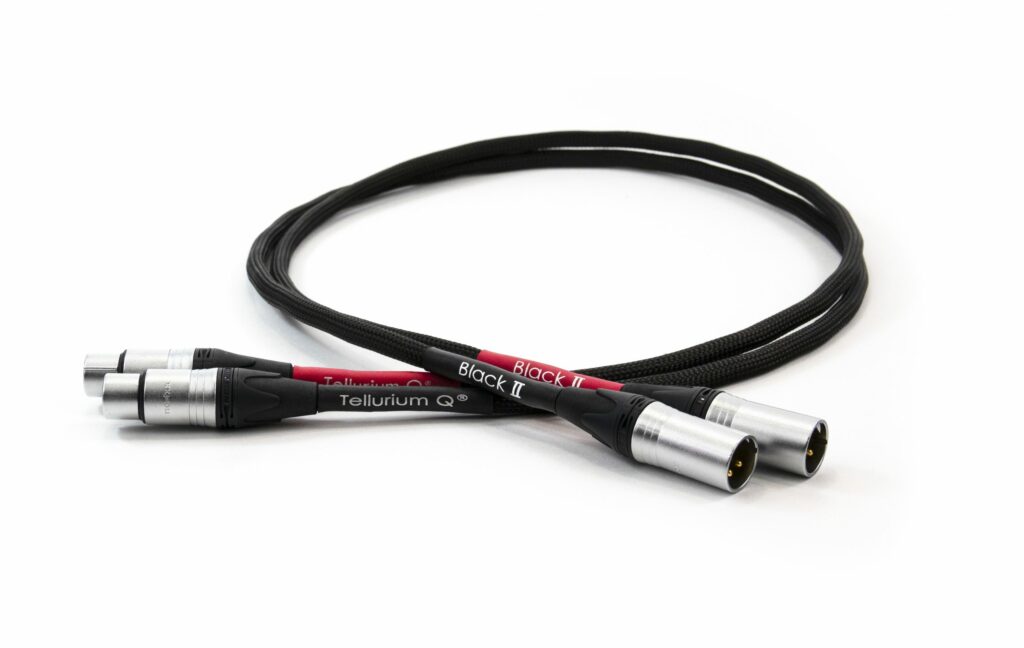
The new and improved Black II interconnects are available in single-ended RCA and balanced XLR form (I tried both). The improvements are not disclosed in physical terms; they would be academic anyway as they weren’t disclosed in Black, and the assumption is it’s either more – or less – of the same in Black II. The product lines have distinct characteristics, reflecting their potential place in a system. For example, Blue is designed to be exceptionally forgiving of the hard and brash top end one might find from inexpensive audio components.

On the other hand, once you get to Silver II and beyond, the cables become increasingly detailed and revealing because they are more likely to sit in with some very expensive audio equipment that demands revealing interconnects. As for Black and Black II, it has that difficult balancing act to deal with; neutral and transparent enough to bring out the best in good middleweight audio, but neither so open as to highlight any potential shortcomings in the system nor so shut in as to limit such systems potential to fly!

In a way, I agree with Geoff’s reluctance to discuss design, geometry and materials in any Tellurium Q cable because they can so easily sway listeners. We all make assumptions about the sound of specific materials or layouts and absent that information, we are ultimately tasked with listening to draw our conclusions. That being said, Tellurium Q does emphasise reducing what it refers to as ‘relative phase transient distortion’ and the Black II is geared toward maintaining phase coherence above all.

Not disclosed

How it works with phase is, of course, not disclosed. If it were simply the more ‘out there’ claims that Tellurium Q went all gnomic about, I’d argue that these claims were a little wild. But as Tellurium Q gives the same silent treatment about what metals it uses in its conductors as it does about ‘relative phase transient distortion’, I have to give the company the benefit of the doubt.

Tellurium Q Black was the great polariser in audio. Some loved it for its smooth and refined sound. Some hated it because they wanted a more lithe and bouncy-sounding cable. Even those with the same products in their systems were polarised by TQ Black, with some claiming it ‘tamed’ a system and others finding it ‘flattened the life’ out of a similar system.

Tellurium Q Black II XLR

Black II is more universal, covering both the need for refinement and the requirement for some additional rhythmic precision and energy. I still maintain that it goes more toward ‘refinement’ than it does ‘bounce’ with fast transients and a good sense of rhythm, but it has become a more egalitarian sound.

Sonically, Tellurium Q is on to something here. The sound is more focused and coherent than I expected; detailed without being overattentive toward detail, and precise without being prissy, but most of all, the sound is coherent and communicative. This holds as much when playing the sophisticated modern string quartet work ‘Entr’acte’ from Orange [Caroline Shaw/Attacca Quartet, Nonesuch] as it does when dealing with the retro 70s sound of the title track from Lady In Gold by Swedish rockers Blues Pills [Nuclear Blast Records].

She can cut it

The latter is especially telling; singer Elin Larsson has a powerful soul-rock voice; she’s no Janis Joplin but can still cut it. The track is almost poised on a knife-edge; any upsets in the system, and it loses its way after the middle eight, but Black II helps keep your attention on her and the rest of the band, and you get just a few glimpses of a modern Big Brother and the Holding Company. It hangs together because the Black II helps keep it together in those good, honest systems that cost a couple of grand, give or take.

The cable has its limits. Black II remains on the smooth side, and those with either very smooth sounding systems or – paradoxically – those after a more rough and ready sound may look elsewhere. Citing that Blues Pills track again, Black II just about keeps to the correct line making the sound very full and 70s.  Sometimes I’d want more graunch from those guitars.  And, if your system is on a fast trajectory to high-end superstardom, Black II will only go so far, and more revealing cables – including more revealing cables from Tellurium Q – beckon.

While I have no idea what Tellurium Q Black II is doing, what it’s doing that the original Black wasn’t doing, and why. But when Black II does what the cables are supposed to do – play music – those empty musings fade away. It doesn’t matter why Black II works; what’s important is that it does work. I can see the cable in various outstanding value systems. making them sound smooth, inviting, rhythmic, and musically engaging. It’s a cable to enjoy music by!

Price and Contact Details

  • Price: £370/m XLR; £285/m RCA

Manufacturer:


Tellurium Q

telluriumq.com

UK Distributor:


Kog Audio

kogaudio.com

+44(0)24 7722 0650


Back to Reviews

The post Tellurium Q Black II appeared first on Hi-Fi+.

Nordost Odin 2 Tonearm Cable +

The tonearm cable is the most critical and sensitive cable in any system. Obviously, that only relates to vinyl-based systems, but as a turntable is basically an extremely sensitive backwards seismograph, the signal it generates is both exceptionally delicate and relatively small. If any cable can make a difference to performance, it’s the phono cable, and Nordost’s Odin 2 Tonearm Cable + makes one hell of a difference! The new grounding systems that went into the Tonearm Cable + line meant Odin 2’s existing phono cable needed a boost.

It took more than a year to finally arrive, but Nordost’s Odin 2 Tonearm Cable + consists of four, silver-plated, solid core 99.999999% oxygen-free copper conductors, wrapped in Nordost’s own Dual Mono-Filament suspension. This last element is claimed to dramatically increase signal speed and reduces insulation contact by 85%. The conductors are then individually shielded using Nordost’s unique Total Signal Control (TSC) technology, which is said to provide 100% coverage as well as protection from external pollution (such as radio frequency and electromagnetic interference) and crosstalk.

Noise is an issue

Irrespective of cable construction, noise is always going to be a significant issue with tonearm cables because of grounding issues. While the lone earthing tag is a good basic solution, complete grounding is beyond such prosaic implementations, especially as providing a complete grounding solution relies on different grounding requirements depending on arm, cartridge, internal wiring of the arm and the phono stage itself. While this doesn’t require hundreds of different grounding options, the right grounding is required for high-end vinyl.

Nordost’s Odin 2 Tonearm Cable + takes on grounding in two ways. First, the cable sports a fully-isolated bond ground through the length of the cable, which connects the chassis of turntable to phono stage in the conventional manner. Going beyond this, the cable is supplied with two detachable, silver-plated ground whips that connect to the shielding of the cable itself, to further reduce noise during signal transfer. To determine the correct use of these silver-plated, Dual Mono-Filament wires, first, play some music without any of the Detachable Ground Wires attached and see how it sounds. Then try inserting one of the Detachable Ground Wires to the cable on the end closest to the turntable. Connect the spade of the Detachable Ground Wire to the ground post on the turntable.

Next, if there is a ground option on the phono stage end, disconnect the Detachable Ground Wire from the turntable end of the tonearm cable, and insert it into the phono stage end instead. Connect the spade of the Detachable Ground Wire to the phono stage ground and listen again. Finally, if applicable, insert both Detachable Ground Wires to both ends of the cable, connect them to the ground on the turntable and the phono stage, and listen one last time. Then, configure whichever set-up had the least noise in that system. This is not simply ‘Your Mileage May Vary’ but more that no two vinyl replay systems are alike and this degree of fine-tuning will bring the best out of the widest range of turntable systems. Regardless, keep this experimentation in mind, because any subsequent changes to your replay system (such as swapping out the cartridge) might be enough to alter the system’s ground-wire configuration.

The heebie-jeebies

Frankly, all that configuration potentially gives reviewers the heebie-jeebies. It gives the potential for you to get the sound of a thing dead wrong. In fact, the configuration process doesn’t undermine the basic Odin 2 sound, as it applies universally. But when it snaps into focus, you’ll hear it. The magic happens throughout, but the magic happens with chocolate sprinkles when you fall upon the right configuration. It’s not ‘no, no, yes, no’ and more like re-enacting that scene from When Harry Met Sally.

To use the best of British understatement, Odin 2 Tonearm Cable + ‘is a bit good.’ Configured to fit the demands of your vinyl replay chain it goes from being ‘quiet, detailed, dynamic, with good bass’ to ‘I need to force myself to pick up the notepad, but LPs are calling.’ Your records are not made anew; the surface noise and bumps and pops generated along the way are still there, but they rise and fall fast enough to step outside the music more than ever before. Instead of annoyances, they become little sonic tattoos of the life that album has led.

It’s the silence that first catches you out with Odin 2 Tonearm Cable +; the gentle rush of noise from a good phono stage and the sound of grooves are far less impactful than you know, and the cable helps show you that by presenting a surprising depth and stillness to the sound. Of course, when the faders are pushed on an analogue recording, tape hiss rises up, but that hiss is not joined by the rest of the signal chain, and it’s an ear-opening event.

However, as quickly as that absence of noise impresses, it’s added to by the sheer scale and detail of the performances played on LP. By rights, this veteran format should have long since faded from view, but Odin 2 Tonearm Cable + reminds us why that simply never happens, because despite its on-paper inferiority to digital, when listening to an album now, it has a sense of dynamic shading and time-sensitivity that makes all digital seem a lifeless affair. There is verve and lust for musical life in those grooves, and Odin 2 Tonearm Cable + will dig it out!

Unfolding bass

I don’t understand bass on Odin 2 Tonearm Cable +. Not because the bass is somehow wrong or out of step, just because there is so much to unfold and extract that simply doesn’t make it through the replay system otherwise. This is like your turntable just took a step into a larger, deeper, yet tauter and more rhythmic world. It’s uncanny.

I could go on for page after page, citing how Nordost Odin 2 Tonearm Cable + just extracts more information that’s normally lost in sacrifice to the Noise Gods of Vinyl. But it all amounts to the same thing… this is the best damn cable to hook a turntable to a phono stage. Ever, Yes, that price tag is one that requires taking a few practise runs before tackling, but like all of Nordost Odin 2 cable line, once you hear what it does, the numbers become meaningless. All that matters is the sound.

Price and Contact Details

  • Price: from £11,560 (depending on length and termination)

Manufacturer:

Nordost

URL: nordost.com

UK Distributor:

Renaissance Audio

URL: renaissanceaudio.co.uk

Tel: +44(0)131 555 3922

Back to Reviews

The post Nordost Odin 2 Tonearm Cable + appeared first on Hi-Fi+.

Audience frontRow Series Cables

One of the thrills and, on occasion, frustrations of high-end audio is that every change in your system causes you to reassess the sonic qualities and contributions of the rest of your chain. The nagging questions remain: “Am I hearing everything? Am I realizing the full potential that my gear is capable of?” Recently, in my case, I didn’t so much change one or two components in my reference system as shake things up by adding a second system in a larger room. Centered around Pass Labs electronics, a dCS Bartók front end, tri-amplified ATC SCM50 active loudspeakers, a pair of REL subwoofers, and Audience and Shunyata conditioning, it delivers a lot more extension and dynamic oomph than the compact, small-room systems I normally listen to.

But let’s back up for a moment. Audience cables have been a part of my reference systems in one iteration or another for years. When Audience’s top-flight Au24 SX cabling came along, I assessed its performance as “superb” and concluded that it “struck a fluid and natural balance of ease, articulation, and immersiveness.” Where could things possibly go from there, I wondered? Silly me. With Audience’s latest frontRow products, it turns out there was, indeed, room for improvement, even at already lofty levels of performance. The look remains quintessentially Audience. Unobtrusive, non-showy, and pliable. It has a little thicker jacketing than entry-level Ohno or SX (Issue 269). And compared with SX, it is significantly more expensive, too.

Audience frontRow employs conductors made from 6N Ohno Continuous Cast (OCC) copper. They use XLPE (a cross-linked polyethylene) dielectric material, chosen for its superior insulating properties and low microphonics. In the words of Audience’s John McDonald, “the unbalanced interconnect is a dual-concentric ribbon lay with the conductors wound in opposing directions. The loudspeaker cables possess the same geometry in a heavier gauge. The XLR geometry comprises two axial, spiral-wound ribbon conductors side by side in opposing directions, with a braided shield wrapped around the outside.” 

For the connectors, the RCA center pin is ultra-low mass and solderless tellurium. The ground pin is also ultra-low mass and solderless but made of beryllium. XLR male pins are ultra-low-mass tellurium, and the female pins are ultra-low-mass beryllium. Spades are gold-over-copper or optional rhodium-over-copper. Additionally, frontRow cables are treated with Audience’s EHVP Extreme High-Voltage Process—a technique said “to align the crystalline structure of the cable conductors to create more efficient ‘pathways’ for signals to travel through.” A double-cryo treatment is also standard. Every cable is tested and burned in for at least three days.

In sonic performance, Audience frontRow doesn’t have dramatic new superpowers per se, but it undoubtedly hones and polishes the assets that Audience has been tapping into for some time. Audience cables, and I’ve reviewed them across nearly all price ranges, have commonly boasted strict tonal neutrality, with a presentation that places midrange resolution front-row-center. Bass response has been formidable if not overpowering. All Audiences have mercifully steered clear of treble brightness and etchiness. Ultimately, I found earlier iterations just a hint forgiving dynamically, particularly in the midbass, and at moments a little shaded in the upper treble. 

Audience frontRow puts these minor shortcomings in the rearview mirror. The result is a more open and expressive cable, regardless of musical genre. What this meant during my evaluation was a lack of congestion, a sweep of dimensionality, and an ability to focus and layer a performance regardless of the scope of the ensemble or the venue. FrontRow’s more uptempo personality allowed Arturo Delmoni’s violin to sing a little more sweetly, brightly, and cleanly. The crisp brass of the Manhattan Jazz Quintet was also livelier and more driven, its transient edge-definition more piquant. In the same vein, FrontRow more cogently revealed the layers and voice placement of the chorus in Rutter’s Requiem.

Very little is missed by the probing gaze of frontRow. Still a master of imaging and ambience retrieval, it ups the keenness of its focus, picking up on acoustic cues and timbral details like a bloodhound. During pianist Evgeny Kissin’s performance of Mikhail Glinka’s “The Lark,” I heard broader and more immersive soundboard resonances and sustains from Kissin’s concert grand and greater resolution of quirky low-level minutiae, like the rustle of clothes and the creak of the piano stool. Then I cued up a favorite old track—Louis Armstrong’s “St James Infirmary Blues,” which can be goosebump-inducing even on a HomePod. However, add a top-notch, high-resolution system to the equation and equip it with frontRow, and the recording becomes one of those cuts where there is always something new to be discovered, as the system peels back layer after layer of veiling and more fully reveals Armstrong’s gritty vibrato, the ghostly backup singers, and the glittery expressiveness and shimmering decay of the ride cymbals. 

A key part of the frontRow experience was its very low distortion, which amplifies the sense of air and bloom—how music is projected into ambient space—so that the attack of a brushed snare, the flutter and resonance of the skin of a drumhead, the rattle of a tambourine, or the pristine glissando of the clarinet at the beginning of Gershwin’s Rhapsody in Blue are clarified. Interestingly, soundstage perspective was not literally “front row”—thankfully, says the concertgoer in me, who much prefers the perspective of mid-hall orchestra seating. Still, frontRow is ever so slightly more forward than Audience Au24 SX. But frontRow adds a new dimension of image clarity and immediacy at all distances, what is essentially a small change in its balance of immersion and definition.

I frequently wonder whether improvements in high-end audio amount to nothing more than the ability to portray finer and finer contrasts in dynamics, volume gradients, timbre, harmonics, and dimensionality. That’s what our ears are attuned to. Even some of most familiar music I listen to (the quirky “Sinkin’ Soon” from Norah Jones, the gospel blast of Tom Waits’ “Come On Up To The House,” or the prog-rock mega-hit “Owner of a Lonely Heart” by Yes) still has the power to surprise me. With Audience’s frontRow added to my system, these tracks spoke to me in a voice that was more micro-dynamically alive and immediate and at times even more explosive. FrontRow restored a sense of suspense to these familiar performances that caused me to wonder what the players would do with the next musical phrase.

Mobile Fidelity recently released in SACD a remastered version of The Eagles’ Desperado. It was the band’s second release and helmed by the inimitable talent of producer/engineer Glyn Johns (on full display in the recent streaming series Get Back on Disney+). Compared with today’s computerized recording techniques, this all-analog album of The Beatles’ last live concert was delightfully unprocessed, and that can be heard in the way every acoustic and electric instrument and vocal is faithful to and identifiable as what it was in life—naturalistic rather than electronically twisted into something nearly unrecognizable. The clean, unmanipulated quality of this kind of recording really benefited a band like The Eagles, where every member was a lead singer and could also sing harmony (listen to “Seven Bridges Road” for an example of their musicianship). 

With the ascendency of frontRow, its immediate predecessor, the terrific Au24 SX, now becomes an ex-flagship. Effortlessly musical and truthful, frontRow seems like the culmination of a journey that Audience embarked upon a long time ago. But far be it from me to say that the journey is over. High-end audio is always full of surprises. However, in the here and now, Audience’s new flagship is the best wire this company has ever produced. Which easily places it among the very best I’ve ever experienced.

AUDIENCE
120 N. Pacific St., K-9
San Marcos, CA 92069
(800) 565-4390
audience-av.com

Price: Audience front-Row interconnects, 1m RCA $3300, 1m balanced $3800; speaker cable, 2.5m $5500 

The post Audience frontRow Series Cables appeared first on The Absolute Sound.