Tag Archives: Logic Pro

Apple Announces Logic Pro for iPad

Apple Logic Pro for iPad

Cupertino, CA (May 10, 2023)—Apple has launched Logic Pro for iPad, accessible as a subscription for A12 Bionic chip iPad fashions or later which have iPadOS 16.4, beginning Tuesday, May 23 on the App Store.

Apple can also be releasing Final Cut Pro for iPad (suitable with M1 chip iPad fashions or later) on the identical day with the identical pricing plan.

According to Apple, Logic Pro for iPad helps roundtrip capabilities, making it straightforward to maneuver tasks between Logic Pro for Mac and iPad. iPad customers can export their completed songs in quite a lot of audio codecs, in addition to particular person audio observe stems, and may likewise import tasks created in GarageBand for iOS.

Auto-Bounce App Debuts for Logic Pro Users

With Multi-Touch gestures, music creators can play software program devices and work together naturally with controls, in addition to navigate advanced tasks with pinch-to-zoom and swipe-to-scroll, Apple says. Users can seize voice or instrument recordings with the built-in mics on iPad, “and with 5 studio-quality mics on iPad Pro, customers can flip nearly any house right into a recording studio,” in keeping with the announcement.

Logic Pro for iPad’s all-new sound browser shows all accessible instrument patches, audio patches, plug‑in presets, samples and loops in a single location. Users can faucet to audition any sound earlier than loading it right into a mission.
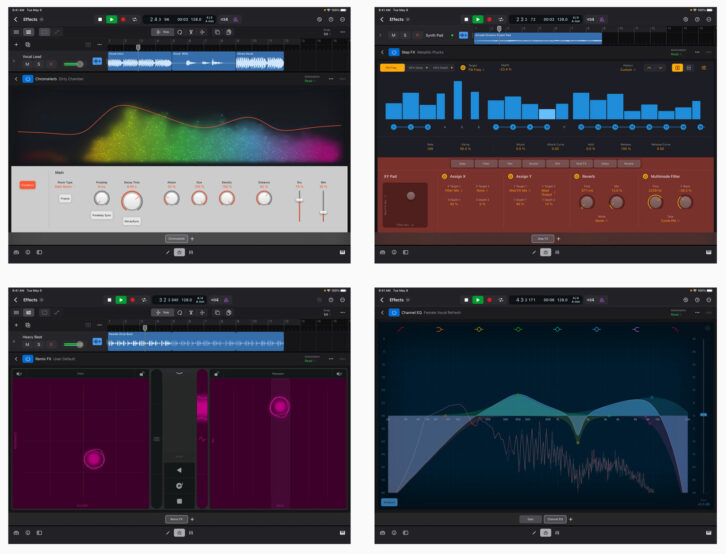
Apple Logic Pro for iPad EQs and Compressors.

Over 100 devices and results plug-ins embrace classic EQs, compressors and reverbs. With Multi-Touch, creators can play devices utilizing quite a lot of play surfaces. Logic Pro on iPad comes with a “huge assortment” of realistic-sounding devices and highly effective synths together with Sample Alchemy, a brand new pattern manipulation instrument that may rework any audio pattern with the faucet of a finger, Apple says.

Beat Breaker, a brand new time and pitch-morphing plug-in, lets music creators swipe and pinch to radically reshape and shuffle sounds. Quick Sampler can chop and rework audio samples into solely new playable devices. Step Sequencer lets customers program drum patterns, bass strains, and melodies, and even automate plug‑ins with just some faucets. Drum Machine Designer allows the creation of customized drum kits by making use of samples and distinctive plug‑ins to any drum pad. With Live Loops, customers can seize inspiration and rapidly construct preparations by mixing and matching musical loops.

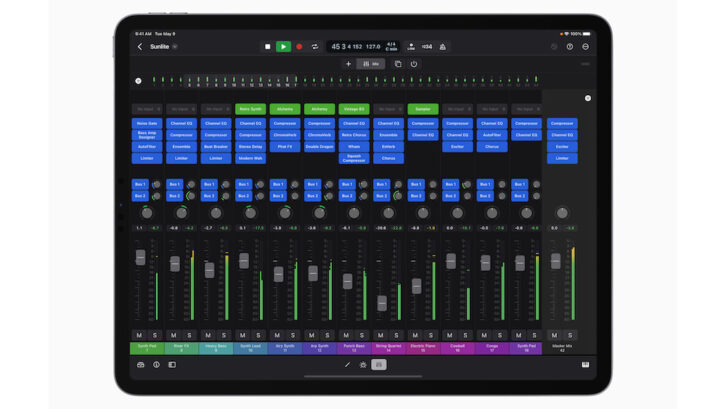
The app features a full-featured mixer, full with channel strips, quantity faders, pan controls, plug‑ins, sends and exact automation. Multi-Touch allows creators to combine intuitively and transfer a number of faders directly, Apple says, and the mixer meter bridge lets them rapidly navigate an summary of observe ranges, all from iPad.

Users could make precision edits and draw detailed observe automation with Apple Pencil and join a Smart Keyboard Folio or Magic Keyboard to make the most of key instructions.
Auto-Bounce App Debuts for Logic Pro Users

Auto-Bounce by Tom Salta
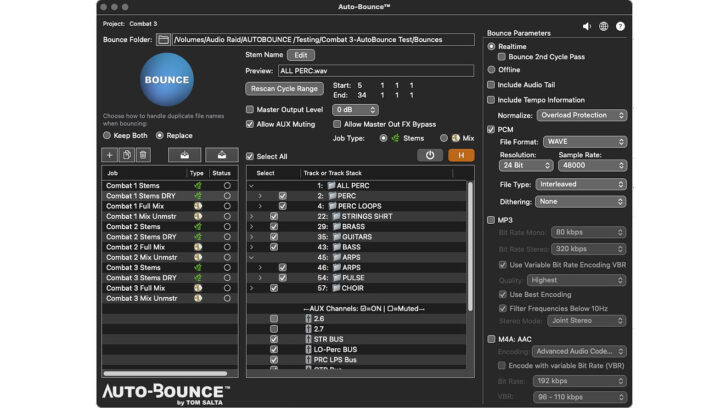
Auto-Bounce by Tom Salta.

New York, NY (March 27, 2023)—Auto-Bounce by Tom Salta is a brand new utility for Logic Pro customers that automates processing stems, multi-tracks and mixes.

Within Auto-Bounce, which runs alongside Logic Pro, customers can select any mixture of tracks, folder stacks, and summing stacks to bounce. They can bounce out completely different cycle ranges, mute AUX channels for working “dry” stems/mixes, and bypass FX plugins on the Master Out channel. Entire job units of bounces will also be saved for simple recall.

Additional options are deliberate for Auto-Bounce, and Salta plans to quickly introduce the power to “lock” tracks which might be included in each bounce; further methods to inform the person when stems are full; the power to mechanically create click on tracks; and likewise mechanically export to Movie.

Apple Goes Spatial – Part 1: What’s It All Mean?

To create the appliance, ASCAP-winning, BAFTA and MTV VMA-nominated composer/producer Tom Salta (Deathloop, Halo sequence, Tom Clancy Series, Prince Of Persia, Wolfenstein) teamed to develop it with award-winning digital instrument developer and engineer David Molnar (Renegade Soundplay, Moog Music, Line 6).

Auto-Bounce runs on Mac OS 11 (Big Sur) and better and requires Logic Pro model 10.7.4 or increased. Auto Bounce is accessible on the introductory worth of USD $199 and a 14-day free trial is accessible on the app’s web site. A portion of Auto Bounce proceeds will likely be donated to MusiCares, which offers important well being and welfare providers to the music group, together with psychological well being assets.

Making Waves: Will spatial audio revolutionise the electronic music industry?

Spatial audio is creating waves in the electronic music scene right now, particularly after Apple’s decision to adopt the format for its platform and Logic Pro adding spatial mixing to its list of native plug-ins. However, with Radiohead producer Nigel Godrich recently dismissing the format as “rubbish”, the jury is out on whether spatial audio can transform the scene in revolutionary new ways or whether it is just another gimmick destined to eventually be consigned to the scrapheap of technological fads.

In defining spatial audio we should perhaps make clear that the various guises and names it has gone under over the years are all the same thing. Whether we call it spatial audio, three-dimensional sound, binaural sound or even Dolby Atmos (the latter of which is in actual fact one particular brand’s name for it), we are effectively talking about a move away from traditional stereo recordings and into an immersive three dimensional sound experience that represents more realistically the impression of different instruments in a room or sound coming from different angles. The process essentially revolves around placing ‘objects’ (which we might think of as musical stems) virtually into different positions in the room thus recreating the experience of hearing a band with players in different positions and therefore adding an extra dimension of space.

While this sounds exciting it should be noted that it is not a particularly new concept. The electronic music scene is lagging behind other areas such as gaming where this technology is already widely used. As early as 2004 there were efforts to bring the technology to the scene but for some time it was felt that the sound could not translate to club environments. However, more recently the likes of Yousef and John Monkman have been involved in Dolby Atmos projects in various clubs. Add to this the work of Max Cooper (whose spatial experiments started as early as 2010) and who after releasing his seminal album ‘Emergence’ in Dolby Audio in 2016, has gone on to consistently deliver some of the most innovative live audio-visual and fully immersive sound experiences around. Whilst Cooper has always been on the cutting edge of spatial audio technology, working in collaboration with the Spatial Sound Institute, it is clear that the tide is now turning for the mainstream. Apple’s decision to only accept mixes with an accompanying spatial audio mix is driving change from the bottom up and consumer demand is growing as we seek ever more engaging immersive experiences. This along with healthy competition between companies on the cutting edge of technology has combined to propel the format forward. This progress has seen plug-in manufacturers and monitor makers scrambling to future-proof their systems by jumping on board the spatial audio bandwagon.

Nevertheless, the naysayers remain with some veteran producers dismissing the longevity of the format. To get a deeper insight into just how spatial audio may begin to permeate electronic music and the potential implications for the scene, I spoke to Bedrock producer Paul Nolan who has been working in a consultancy capacity with d&b audiotechnik. The German company have been pushing forward their own flexible spatial audio system targeted at a wide range of live environments and he recently sound tested their Soundscape rig at the Brixton Academy leg of Groove Armada’s recent tour. Having witnessed the impact of the Soundscape system on the audience Nolan is convinced by its potential to create a more engaging experience. “There was not one audience member on their mobile phone”, he grins. Having collaborated with the company since 2018 he says he has seen the technology mature recently as companies like d&b have focussed on making it work practically for music producers and performers.

“It is reminiscent of music production before midi when we have lots of different systems not necessarily speaking a common language” – Paul Nolan

He acknowledges that the tech has been around for some time (with clubs like Ministry having already had Dolby Atmos systems installed for years) but notes that d&b has cut pre-production times down from six weeks to zero making it now possible to just turn up and play a spatial audio gig. This opens up such systems as a tool for maximising emotional impact and dynamics on the dancefloor with the potential to envelope the crowd at certain key moments and play with the spatial mix on the fly. It seems that the spatial audio road test went down a storm with both the audience and DJs PBR Streetgang (who used the system for their set). However, Nolan is quick to point out that we are some way off the format completely taking over. “It is reminiscent of music production before midi when we have lots of different systems not necessarily speaking a common language” but predicts that within five years these issues will be ironed out and that we will see spatial seeping into all aspects of everyday life from music to facetime calls.

Nolan goes on to predict that all streaming platforms will soon follow the likes of Apple, Tidal and Amazon by offering spatial audio streaming and that the ramifications for music producers can already be felt. Plug-in and music tech companies are rapidly launching new product lines and he suggests this will bring “big changes not only in the way we mixdown but also in how we create music as we head towards being able to create music natively in these formats”.

“Technology should be seen as a powerful tool in the recovery of the live events industry” – Paul Nolan

While cost may be an issue right now for bedroom producers, the spatial audio wave is cascading across the music industry with venues from the Royal Albert Hall to Pacha already having d&b systems in place and the UK’s first permanent system due to launch in December. Nolan is buzzing about the impact the technology could have on the electronic music scene. He elaborates by saying that “technology should be seen as a powerful tool in the recovery of the live events industry” and that the “immersive experience” is the tonic needed to engage modern audiences. It’s hard to argue with his enthusiasm and whilst the jury may still be out on certain aspects of spatial audio, it seems that it could offer much-needed innovation in a scene that has threatened to stagnate over recent years. With any big change there is inevitably resistance but let’s just hope the format can help reignite the raw visceral experience that dance music once provided and drive people back onto the dancefloor and away from their addictions to mobile devices.

The post Making Waves: Will spatial audio revolutionise the electronic music industry? appeared first on Decoded Magazine.

Apple Music, Amazon Enter 3D, Lossless Streaming Fray

Apple introduced Spatial Audio this morning, bringing support for Dolby Atmos streaming at no extra cost to Apple Music subscribers
Apple introduced Spatial Audio this morning and announced a Logic Pro update that will accommodate the format. Amazon quickly responded.

Los Angeles, CA (May 17, 2021)—Apple introduced Spatial Audio this morning, bringing support for Dolby Atmos streaming at no extra cost to Apple Music subscribers — and less than an hour later, Amazon responding by making its Amazon Music HD catalog, including Dolby Atmos and Sony 360 Reality Audio tracks, available for free to eligible Amazon Music Unlimited subscribers.

Spatial Audio launches with “thousands of tracks” in Dolby Atmos, says Apple, and new songs in Dolby Atmos format will be constantly added to the catalog. According to the company, Apple Music will automatically play Dolby Atmos tracks on all AirPods and Beats headphones with an H1 or W1 chip, as well as on built-in speakers on the latest versions of iPhone, iPad and Mac.

For content creators, Apple is also building immersive music-authoring tools directly into Logic Pro. Later this year, Apple says, it will release an update to Logic Pro that will enable users to create and mix songs for Spatial Audio compatible with Apple Music.

Over at Amazon, the company announced that Amazon Music Unlimited subscribers in the U.S., U.K., Germany, Canada, France, Italy and Spain may now upgrade to Amazon Music HD, previously $5/month to Amazon Music Unlimited subscribers, at no additional charge.

The Amazon Music HD catalog represents over 70 million lossless tracks at CD-quality 44.1/16. Amazon has reportedly added more than five million songs to its Amazon Music Ultra HD catalog — offering tracks at 24 bits, 44.1 kHz to 192 kHz — since launching the streaming tier in 2019, including songs remixed in immersive formats such as Dolby Atmos and Sony 360RA.

Apple Audio Unit Plug-Ins — A Real-World Review

Apple Music additionally announced today that it’s making its 75-million-song catalog available in lossless audio using ALAC (Apple Lossless Audio Codec). Apple Music’s Lossless offerings, playable on any Apple device, are available in resolutions from 44.1 kHz/16-bit through 48 kHz/24-bit. For Hi-Resolution Lossless subscribers, music is available at resolutions up to 192 kHz/24-bit.

Because of the larger bandwidth requirements and file sizes, subscribers will need to opt-in to both Apple Music lossless tiers. Additional D-to-A converters are required for hi-res lossless listening.

Amazon forced competitors such as Deezer and Qobuz to lower the cost of their high-resolution streaming services to $14.99/month to match its new offering when the company launched Amazon Music HD in 2019. Tidal, the first company to get into high-res streaming, remains the exception and still charges subscribers $19.99/month for access to its Tidal HiFi service, which offers tracks in Dolby Atmos and Sony 360RA. Deezer HiFi and Nugs HiFi also offer Sony 360RA streaming.

Spotify, late to the high-res party, only announced in February a new Spotify HiFi tier that will offer “CD-quality, lossless” music. The launch date and monthly subscription cost have not been announced.

Apple • www.apple.com

Amazon • www.amazon.com