
Floating Points has released his new song “Someone Close”, and has announced a 12″ vinyl featuring his 2022 tracks coming out in December. “Someone …
Tag Archives: Pharoah Sanders
The 180-g black vinyl release is the latest title in Verve/Ume’s audiophile reissue series. Pharoah Sanders’ classic 1969 album Karma will be pressed …
The 180-g black vinyl release is the latest title in Verve/Ume’s audiophile reissue series. Pharoah Sanders’ classic 1969 album Karma will be pressed …
The 180-g black vinyl release is the latest title in Verve/Ume’s audiophile reissue series. Pharoah Sanders’ classic 1969 album Karma will be pressed …
The 180-g black vinyl release is the latest title in Verve/Ume’s audiophile reissue series. Pharoah Sanders’ classic 1969 album Karma will be pressed …
The 180-g black vinyl release is the latest title in Verve/Ume’s audiophile reissue series. Pharoah Sanders’ classic 1969 album Karma will be pressed …
The 180-g black vinyl release is the latest title in Verve/Ume’s audiophile reissue series. Pharoah Sanders’ classic 1969 album Karma will be pressed …
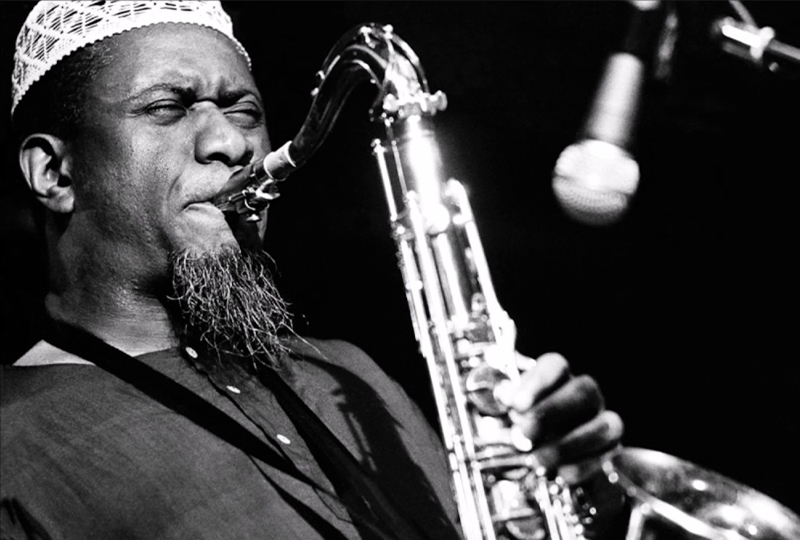
Sanders was a leader in the spiritual jazz movement.
Beloved saxophonist and jazz legend Pharoah Sanders has died, aged 81.
In an Instagram post, his label Luaka Bop announced that “he died peacefully surrounded by loving family and friends in Los Angeles”.
Sanders was born in 1940 in Little Rock, Arkansas. After moving to Oakland, California in 1961, he began his career professionally playing tenor saxophone and met collaborators Sun Ra and John Coltrane.
After performing and recording with Coltrane’s band, Sanders started producing his own recordings heavily inspired by free jazz and spiritual jazz. He released his debut, Pharoah’s First, in 1965 before signing with Impulse! in 1966. In 1971, after John Coltrane’s death, Sanders featured on Alice Coltrane’s essential album Journey in Satchidananda.
Throughout the ’70s and ’80s, Sanders had an extensive run of albums across the India Navigation, Arista and Theresa labels. He collaborated with the likes of Bill Laswell, Maleem Mahmoud Ghania and Jah Wobble in the ’90s.
Sanders’ final album was his 2021 collaboration with Floating Points and the London Symphony Orchestra. Promises was met with near-universal critical acclaim and reached number one on the UK independent charts.
For an exploration of Pharoah Sanders’ extensive career, listen to Música Macondo/Jazz FM’s Tim Garcia’s Pharoah Sanders’ mix below.

In conversation with the album and painting.
A new film exploring Julie Mehretu’s painting Congress, which adorns Floating Points, Pharoah Sanders & LSO’s new album Promises, is premiering this April via The Broad and the Whitney Museum of American Art.
Read more: Floating Points, Pharoah Sanders, and LSO collaborate on new album, Promises
During Promises’ composition process, Floating Points looked to Mehretu’s painting for reference, later noting its influence in the composition of the album.
“I wanted to perpetuate this idea of being centred in the middle of the painting with its details swirling around you and this film is an extrapolation of that idea, of being in the middle of this perfect storm which only slowly reveals itself,” he explains.
Titled Promises: Through Congress, the film was made by Trevor Tweeten in the winter of 2021 on location at The Broad.
“The trajectory of the film mirrors the shape of the music, ever expanding, slowly building momentum to points of reveal and release,” shares Tweeten.
Promises: Through Congress will premier on the 24th April via The Broad and Whitney Museum of American Art’s websites.
Head here to register.
Photo by: Eric Welles Nyström

As legendary saxophonist Pharoah Sanders celebrates his 80th Birthday, Shabaka Hutchings explores how the transcendent musician has influenced his life, through the lens of Sanders’ 1971 opus Black Unity.
Writing about Pharoah Sanders’ seminal album Black Unity started out innocently enough – a desire to express how this album has shaped me, an acknowledgement on this 80th birthday of the maestro himself of what he has done to mould my sense of musicality and form. However, as I put words to paper it feels like I’m regurgitating poetic sounding ideas that fulfil a myth that I’ve outgrown.
Such is the paradox of matters concerning spirituality, I guess, to understand something about your devotion to the light is to drift inadvertently towards a notion of infinity whereby one is in a constant state of wonder as to how far the depths can reach and how much there is to learn. So, I decided to start from scratch, and discover on listening to one of my favourite albums at this stage of my life – spiritually and professionally, though in truth the two worlds intersect continually – what it speaks to me about.
I find it difficult to regard Pharoah Sanders as an individual. I intuitively consider him as representational of a creative principle that centres communalism as the driving force from which spirit is manifested through sound. Spirit can be seen as the life-force that animates matter, that which provides the energy which activates our will to act. Linear conceptions of this music’s formation force us to imagine a hierarchical basis whereby one element or player is ahead of another in terms of contribution importance – this way of seeing must be rejected for the cyclical view which sees the prominence of individual players as transient but the group contribution as reaching for eternity.

The centring of spirit and negation of individualistic focus begets a cyclical construction whereby metaphysically there is no start or end to the music, this is furthered in the exclamations of the audience members at the sounding of the final note. A seemingly benign acknowledgement/participatory gesture for me signifies a furthering of the group’s energy. The baton is passed from performer to audience and within the spirit of reciprocity we at home – separated by time and space – are asked to join in the praise, to interpret the message however our intuitive knowledge guides us and to give back to the source of the energy that fuelled the players.
My understanding of Pharoah’s music has developed in tandem with a growing awareness of myself as the object of inquiry in relation to it. Prior to this paradigmatic shift, I considered myself as the subject, able to analyse and ‘know’ what was happening at any given stage of the sonic flow. This way of hearing is adequate for a surface level appreciation of the music, but Pharoah Sanders is deep!
So, more is required if the surface layer is to be breached, revealing the levels of meaning that constitute the whole spectrum of his musical vision. The ‘subject’ is often defined as the thinking/doing entity, as opposed to the ‘object’ which is the thing acted upon. Hence to objectify something or someone is to deny (or ignore) the existence of a consciousness outside the knowledge or comprehension of the subject and to assume a degree of control in relation to how the object can act on that same subject.
To see oneself as the object in relation to a piece of music is to prostrate oneself before it, to assume humility in assuming levels of depth that span further than potentially even the individual performer envisioned. This requires a muting of the mind, allowing visions and ideas to manifest themselves outside the scope of what is thought to be ‘known’ about the music. This is increasingly the only way I see fit to engage with the music of Pharoah Sanders. In this state, the concept of time reveals itself to be a construct that is very much societally engendered. After listening to this album, I remember trying to combine all the songs in my own sets, so that my music could be regarded as a singular presentation of an idea. The inadvertent effect of this on my perception of time while on stage was that moments became significant in terms of their overall drama and poetic power. I interpret this shift in focus to mean that the time itself was sacralised and allowing for the potential of transcendence. This space was unlocked by Black Unity.
The first time I saw Pharoah perform live I was struck by his poise, it seemed as though he was rooted to the ground and was able to draw power from throughout his whole body to be channeled through the saxophone. I hear this in the music of Black Unity. There is a feeling of the music being both of the sky and of the earth, as above as it is below. There is no way of me quantifying this statement, it is not to be rationalised in terms of logic. It is an intuitive reasoning, powerful for what it symbolises to the listener: that it is open to ancient concepts stretching back to the time of the kemetic civilisation.
My final reflection on the seminal album Black Unity is that the title is the answer to the question which hovered over the civil rights movement in America, that lurked in the underbelly of all the anti-colonial movements sweeping Africa during the ’70s and is still relevant today. How do we as Black people triumph over a system of white supremacy that has affected even our scope to define the parameters of the ‘real’? Pharaoh says it simply and best…..Black Unity!
Banner image courtesy of Impulse!
Additional photos by Christian Rose via Transversales Disques.
- 1
- 2