
World News
TEAC UD-701N streaming D/A preamplifier
TEAC UD-701N streaming D/A preamplifier
In Gramophone Dreams #88, I described the sound of TEAC’s VRDS-701T CD transport as "dense and exact in a method I had by no means beforehand heard from digital." I went on to clarify, "by ‘dense,’ I imply there was a tangible corporeality effected by seemingly infinite portions of small, tightly packed molecules of musical info."
What I observed most throughout the evaluate interval was the extraordinary quantity of information the 701T was vacuuming off these pits and lands and turning into music. As I’ve gotten to realize it higher, what I’ve observed most is how the 701T kinds and delivers all that knowledge in a way that makes each DAC I pair it with sound extra corporal and dynamic.
As I wrote that evaluate, I questioned how the 701T would carry out partnered with its matching UD-701N converter/streamer/preamplifier and the way the TEAC flagship DAC’s sound character would evaluate to flagship DACs from HoloAudio, Denafrips, and dCS.
Now I do know. These are my impressions.
Description
The TEAC UD-701N ($4299.99) is the guts of a trio of matching 700-series parts that features the VRDS-701T CD transport and the smart-looking AP-701 energy amplifier. The UD-701N is not only a DAC; it is also a completely balanced, two-input (RCA + XLR) line-level preamplifier and a two-output headphone amplifier (4-pin XLR and ¼" jack).
The DAC a part of the UD-701N is not simply one other chip DAC. TEAC explains: "Instead of utilizing a generic DAC [integrated circuit], we integrated a custom-developed TEAC ΔΣ (Delta Sigma) discrete DAC comprised of discrete circuitry that makes use of FPGA"field-programmable gate array"incorporating our authentic algorithms." See the block diagram beneath.
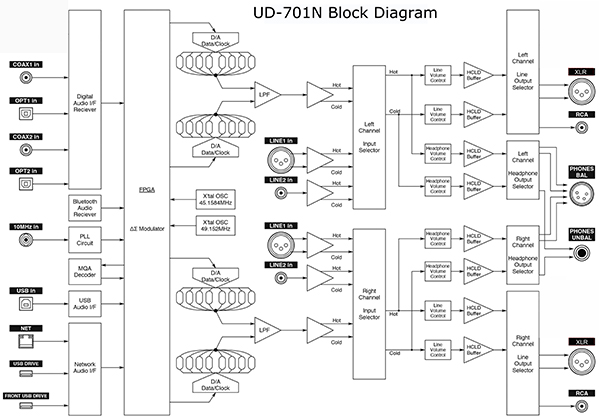
"DSD indicators are transmitted as is, whereas PCM indicators are transmitted after passing by means of a ΔΣ modulator and conversion to both 1-bit or multibit indicators, in response to the tip person’s selecting." Multibit is the default. "With the TEAC ΔΣ discrete DAC, playback of twenty-two.5MHz DSD and 384kHz/32-bit PCM is feasible." Up-conversion can be utilized with all digital inputs and is available in three powers: 2×, 4×, or 8×Fs. Users can even set the ΔΣ sampling frequency: 128×, 256×, or 512×Fs.
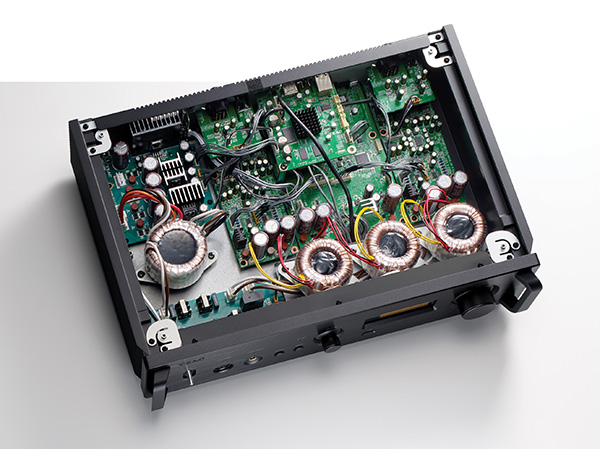
TEAC’s signature antivibration technique is evidenced by its 4 minimally connected "floating" toroidal energy transformers, one for every channel’s absolutely balanced high-current analog partthe 701N is actually dual-monoone for the community module, and one for the digital-control sections.
The 701N’s ft contribute additional to that low-vibration technique. "TEAC’s three pinpoint ft make the most of a brand new mechanism that gives safety on the underside panel to suppress vibrations that finally have an effect on audio high quality. Even the size of the aspect fins of the machine which can be for warmth dispersion have additionally been adjusted to stop sympathetic vibrations."
Most digital parts both ignore vibration-induced nonlinearities or throw mass and rigidity on the drawback. TEAC’s UD-701N and VRDS-701T go for a method I regard as extra elegant. It may be more practical.
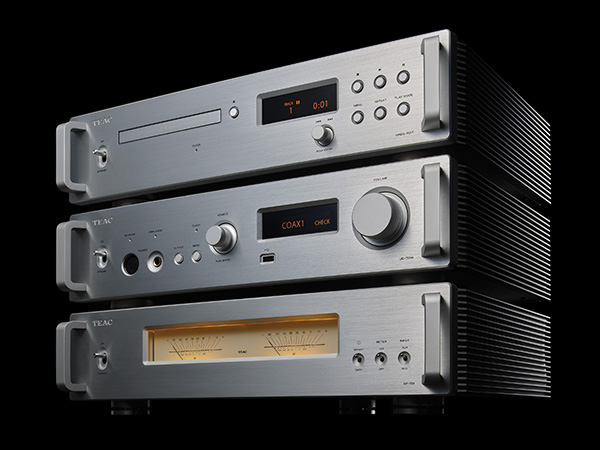
The 701N’s brushed-aluminum entrance panel matches that of the VRDS-701T transport and the AP-701 amplifier. It’s a timeless-looking facia that can work aesthetically in a severe audiophile rack, on a bureau prime in a luxurious dwelling, or in an expert recording studio. Its semifaux "rack handles" preserve the part from trying generic and contribute to the 701N’s skill to have a look at dwelling in various environments.
I loved the assurity of the entrance panel’s mechanical energy/standby swap. The really feel of the centrally positioned selector knob and much proper quantity knob scream luxurious and tight-tolerance manufacturing. In my room, the place I typically hear close to sufficient to achieve ahead and switch these knobs, the OLED show appeared simply the appropriate dimension and colour: discrete {and professional}, like an skilled waiter in a advantageous restaurant.
In use, the 701N displays a robust sense of drive, which TEAC attributes to its output-buffer circuits. "We used TEAC-HCLD2 circuits, that are improved variations of our TEAC-HCLD (TEAC High Current Line Driver) enhanced-current output buffer circuits. These increase the present transmission capabilities which can be vital in analog output circuits. Each channel has a constructive and unfavorable two-circuit construction with diamond buffer amplifiers, which have excessive present transmission capabilities, used as line drivers. Drive is differential for balanced output and parallel for unbalanced output. By growing the present provide skill, transmitting the dynamism of audio indicators with out loss turns into doable."
My suspicious nature urged me to e mail the never-sleeps public relations ball-of-fire Jaclyn Inglis of Jaclyn Inglis PR & Communications. She facilitated my TEAC DAC investigations by asking TEAC’s engineers to confirm that the analog enter indicators remained analog all through, together with to the headphone outputs.
"Yes, all analog inputs are all analog all through. The sign path doesn’t have any analog to digital conversion."
The quantity management is all-analog; TEAC describes it this fashion: "Our TEAC-QVCS (Quad Volume Control System) is a variable acquire amp quantity management (see block diagram) with 4 impartial circuits for left, proper, constructive, and unfavorable (L+, L, R+, and R)." During these auditions, the 701N offered ample acquire to drive all three of my amplifiers instantly. If you are utilizing it with a preamplifier, the quantity management could be bypassed and the fastened output set to both 2V or 4V.
The 701N presents Bluetooth together with the LDAC, LHDC, AAC, SBC, aptX, and aptXHD audio codecs; I did not use Bluetooth. It can be Roon Ready.
The 701N’s aluminum and plastic distant is easy to make use of and solidly constructed. There’s a {custom} utility for Windows and Mac computer systemsTEAC HR Audio Playerand an app for smartphones and tablets: TEAC HR Streamer, out there for iOS and Android. The Streamer app is naked bones however superb: straightforward to put in and intuitive to make use of. It’s out there for iOS and Android.

Listening by way of the analog enter
The first check recording I performed with the UD-701N DAC/Network participant was the LP Felt by Nils Frahm (Erased Tapes Records ERATPO33LP). I used this reverb-drenched up to date recording to evaluate how the 701N’s line-level enter handles transients and reverb tails and the way invisible the preamp part was. It was clear by the tip of the primary album aspect that notes from Frahm’s piano weren’t blurred or foreshortened. This completeness allowed the rigorously constructed house of Frahm’s recording to occupy my house with the identical stage of immediacy and transparency it did whereas taking part in this recording by means of the TEAC DAC into the HoloAudio Serene preamp. The solely discernable distinction between the TEAC alone and with the Serene between it and the First Watt SIT-4 amplifier was the standard of "end" on the sound vitality. Driving the SIT-4 instantly, the 701N put a pleasant semigloss on the sound. Signals popping out of the Serene exhibited an equally clear however extra satiny end.
When tube-fired analog indicatorslike these from PrimaLuna’s 10-tube EVO 100 phono stagego by means of HoloAudio’s stable state Serene preamp, they don’t come out sounding laborious or transistorized. Instead, they arrive out sounding nearly the identical as they do popping out of PrimaLuna’s eight-tube EVO 400 line-level preamp. The 400 pre provides a teaspoon of reverberant "juice" that wets the transparency, however in an off-the-cuff blind check, I doubt I might guess which preamp was taking part in. I’m fairly certain I might distinguish between these preamps and the 701N’s output. The UD-701N performs considerably extra firmly and forcefully than the Serene or the EVO 400. That forcefulness can be a robust inform.
In my system, the 701N’s analog stage performed LPs with unusually deep, completely tuned bass; a job that was probably assisted by First Watt’s new SIT-4 energy amplifier, which applies a just-right, never-too-tight grip on my Falcon’s woofers. No matter how we divvy up the credit score, with the 701N direct-driving the SIT-4, my Gold Badge LS3/5a‘s went decrease within the bass (presumably beneath 50Hz) and pushed it out more durable and tighter than I ever imagined doable. Bass was all of a sudden one thing I might observe and take note of. The listening affect of this deeper, tighter, extra forceful bass was fairly pronounced, and completely pleasant.

Listening by way of S/PDIF
With each DAC I attempted, the 701T was so impartial tonewise, so totally excavated data-wise, and so well-formed space-and contrast-wise that I made a decision it could be the right supply for evaluating DACs. After attempting all my reference DACs, I started my TEAC 701T + 701N auditions by spinning the best-sounding CD I personal: MA Recordings’ Serà una Noche: Otra Noche (MA092A). I figured if that source-combo sounds dry, or lower than ultra-vivid and super-3-D, this story would not finish nicely. I used to be anticipating Everest-level digital sound and, luckily, that’s what I heard.
The very first thing I observed was how these first dramatic notes at the beginning of monitor one, "Viejo Ciego," uncovered the entire quantity of the recording venue. The element and hyperclarity of Otra Noche‘s echo and reverb dominated the dramaas did the flawless vocal and instrumental tones. Santiago Segret’s bandoneon, Marcelo Moguilevsky’s clarinet, and Lidia Borda’s voice projected massive, clear, and terribly current in my room. This was precisely the sort of huge, well-drawn, lock-me-on sound I’m all the time hoping to search out.
Then once more, Otra Noche is the best digital recording I do know. It would sound shifting and three-dimensional popping out of a increase field. As certainly one of my previous friends used to say, "Your hi-fi is simply nearly as good as the way it performs your worst document." I can not consider a "worst" document, however I do have some CDs containing good music however with sound that’s off in a method that forestalls my full engagement. One of these is a 1997 assortment of American people music referred to as American Primitive Vol.1: Pre-war Gospel (19261936) (Revenant RVN 206).
Despite their classic, the largely electrical recordings on this properly mastered assortment sound crisp and clear and never muffled. Obviously, producer John Fahey noticed to it that their uncooked expression was not smothered by soul-crushing noise discount. Unfortunately, my Onkyo C-7030 CD participant blurred, dulled, and didn’t resolve many of the low-level background sounds that describe the recording website. This canceled any hope for audio verité and made moving into the songs tough. Fortunately, TEAC’s 701T transport + UD-701N DAC positioned all the info the Onkyo misplaced and put it in exactly ordered focus. The beats and rhythms and interior particulars of those recordings got here by means of in a way that was straightforward to note and recognize.
The best advantage of this TEAC combo was how completely different it allowed every singer’s voice to sound. It did this by laying out clearly their distinctive harmonic palettes and absolutely exposing the nuanced particles of tempo and inflection. I regard this as evidential proof of those parts’ accuracy.
TEAC’s VRDS-701T transport feeding TEAC’s UD-701N DAC-preamp by means of Kimber Kable’s D60 coaxial cable performed all my favourite CDs with what I at present regard as modern resolve.
HI-FI News
by way of Stereophile.com https://ift.tt/Lf4ijG3
December 5, 2024 at 06:05PM
-
Product on sale
 Audiophile Vinyl Records Cleaning BundleOriginal price was: €69.90.€59.90Current price is: €59.90. incl. VAT
-
Product on saleEasy Start Vinyl Records Cleaning KitOriginal price was: €69.90.€59.90Current price is: €59.90. incl. VAT
-
Vinyl Records Cleaner Easy Groove Concentrate€34.95 incl. VAT
-
Easy Groove Super Set€199.00 incl. VAT
-
Easy Groove Enzycaster – vinyl records prewash cleaner€34.95 incl. VAT
-
Easy Groove Extreme MK. II- vinyl records prewash cleaner€45.00 incl. VAT
-
Vinyl Records Cleaner – Easy Groove Virgin Concentrate€35.00 incl. VAT
-
Easy Groove Spray&Wipe vinyl records cleaner€34.95 incl. VAT


