
World News
Thrax Audio Siren loudspeaker
Thrax Audio Siren loudspeaker
Based in Bulgaria, European audio firm Thrax has been energetic since 2009. Their ingenious and different design approaches seen over a number of product traces have continued to intrigue me with their conceptual originality, innate musicality, and imaginative use of a broad spectrum of applied sciences. Their merchandise vary from valve (tube) amplification to digital audio and, extra lately, loudspeakers. There are 16 merchandise within the Thrax vary.
Thrax founder and chief engineer Rumen Artarski packs a capacious scientific kitbag. His love of music and high-quality sound replica is self-evident. In the disputes that typically happen between measuring and listening, Rumen says, selections made by the ear are closing.
Writing for HiFiCritic in 2012, I supported Chris Bryant’s analysis of the all-tube Thrax Spartacus, a 40Wpc triode-based energy amp. In 2014, Bryant examined the all-triode Orpheus phono preamp (footnote 1). You might say that weBryant and Ihave been each just about strong state diehards, despite the fact that we might each loved good experiences with tube designs over time. In each the 2012 and 2014 opinions, we described how we have been shaken up by these two thermionic designs, whose purist tube know-how had been finessed utilizing superior digital design ideas to ship a successful mixture of tonal accuracy and transparency with the dynamics and musicality of low-feedback triode circuitry. We knew then that Artarski’s Thrax was a power to be reckoned with. The vary of distinctive high-end electronics has continued to develop to incorporate a loudspeaker, the standmount Lyra, now joined by the smaller Siren ($13,600/pair), additionally a standmount and the topic of this Stereophile assessment.

Technology and engineering
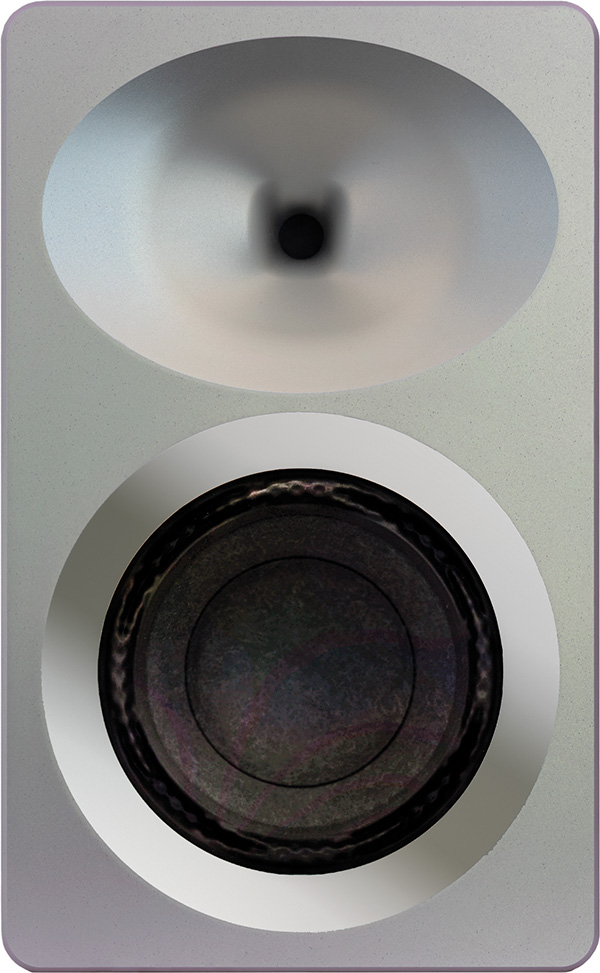
Weighing a considerable 44lb (20kg), this standmount two-way marries an unique, expensive 6.5" (170mm) midwoofer to an uncommon, semi-elliptical (biradial) horn of serious measurement. The horn "compression masses" a small, application-specific high-frequency driver, a 1" (25mm) ring-diaphragm design from professional audio specialist BMS.
Under the leather-covered central part, the development is birch plywood strengthened by a cross brace. The partitions of the 16 liter enclosure usually are not completely damped, however a knuckle rap is quickly dissipated. Those substantial entrance and rear sections are milled from strong billet aluminum alloy. Fourteen chrome steel socket head bolts connect the rear panel. A filling of pure sheep’s wool damps inner reflections. Artarski notes that the field/port system is tuned at 40Hz, with typical in-room extension to 33Hz at regular listening ranges. The port’s rear panel exit is mildly flared to cut back port noise at excessive air velocities.
Thrax prefers collection topology for its crossovers, which is a bit more awkward to implement than the extra generally used parallel type. In some designs, a collection crossover could supply higher acoustical mixing of the motive force outputs; simulation software program has made the design job simpler. As ever, crossover filter design is an interactive course of involving idea and measurement, and have to be partnered by meticulous listening.
Jantzen, a famous Danish producer of audiophile-grade elements, was chosen to produce the expensive Siren crossover elements together with three "zero saturation" wax-impregnated copper-foil, air-core inductors (no magnetic core to saturate!), plus a number of unique film-and-foil capacitors (footnote 2) in every channel. The capacitors within the tweeter feed are the "Silver" sort and luxuriate in pure silver lead-out wires. The entire crossover meeting is "sealed and potted" to damp vibrational disturbances from working drivers.
The horn could be very environment friendly and imparts an unusually excessive intrinsic enter impedance, which might in any other case add a hint of high-frequency extra with some tube amplifiers. So, an RC impedance-matching community positioned on the enter terminals helps keep tonal stability when the Siren is used with tube amplifiers with excessive output impedance.
The Siren is single-wired with Aeco gold-plated copper alloy binding posts with 4mm plug, spade, and bare-wire connectivity. The DC enter resistance measured exactly 4 ohms, a good estimate of the "nominal" amplifier loading.
The deep-profiled customized flare of the BMS tweeter’s horn was designed by Spherovox utilizing electroacoustic modeling software program. It blends seamlessly into the deeply milled strong alloy plate of the entrance baffle. The biradial transition is easily rendered and affords wider-than-usual horizontal directivity at larger frequencies. The driver aspect itself won’t ever have to work laborious, in view of its sensitivity: an exceptionally excessive 112dB/2.83V/m. That’s some 25dB larger than the sensitivity of the finished Siren system (specified as 87dB/2.83V/m). Worked so frivolously, it ought to stay free from compression overload in any respect smart sound powers. It must also show low distortion and superb subjective dynamics and be freed from dynamic sensitivity variations; some lower-sensitivity direct radiators, which draw extra energy, can compress attributable to thermal biking throughout loud passages.
Partnering that customized horn is a 170mm, 6.5" midwoofer sourced from European "new-tech" firm Purifi, affiliated with Bruno Putzeys of class-D amplifier and high-oversampling DAC fame. Purifi was based in Denmark in 2019 by Putzeys and Lars Risbo with long-established audio entrepreneur Peter Lyngdorf. They spent a number of years on main analysis. This Purifi driver has an uncommon and extremely distinctive cone design, with a circumferential brace and central reinforcement, whereas the meeting is supported on a particular, aggressive-looking, sectionally corrugated encompass (see Sidebar 1).
This long-throw design incorporates an ultralinear shifting coil motor system with deep tour. The cone is fitted with an enormous, subtle motor system constructed on a free-breathing die-cast alloy chassis. Purifi claims exceptionally low distortion, excellent energy dealing with, and a really low incidence of the standard menu of coloration-inducing mechanical misbehaviors. The driver’s linearity and distortion are claimed to measure extra like an excellent amplifier than a deep-excursion, spring powerrestricted, oscillating mechanical piston. It is straightforward to think about the Purifi staff planning their assault on the first shifting coil driver points, then relentlessly advancing on much less well-known issues, the method persevering with to a sensible vanishing level. Such complexity doesn’t come low cost, because the Purifi driver prices maybe 4 occasions as a lot as usually favored contenders.
The Purifi engineers have developed complete mathematical fashions to simulate the important thing elements of a drive-unit: the motor, internal suspension, cone, and encompass suspension. Close examination of the motor part led to new insights about coil and magnet geometry, the choice of ferromagnetic supplies, and their detailed configuration. Such complicated mechanico-acoustic fashions allowed the engineers to investigate and management points that beforehand have been inexorably intertwined, facilitating the optimization of every supply of error.
Purifi addressed distortion of all types arising from regular cone motion, together with tour limiting in order that the motive force can’t simply be overloaded within the bass. The encompass/suspension geometry is configured to radiate as little as potential, minimizing its undesirable (distorted) contribution. More delicate errors similar to hysteresis distortion have been suppressed. There isn’t any magic bullet however quite a scientific grinding down of well-known issues to a lowered baseline.
Typical shifting coil drive items undergo 0.25% to 0.5% distortion at common sound ranges, with higher examples aiming for 0.15%; Purifi is aiming for an enormous, 1020dB discount to only 0.05%, together with intermodulation merchandise. Over the vital midband, the doubtless whiney-sounding third harmonic reads simply 76dB0.015%, which is a exceptional achievement.
But how will this all match collectively? Overall sound high quality needs to be improved instantly. The most evident, quick profit could be an order of magnitude acquire in clear bass energy for drivers of this measurement.

Siren’s tune
After a couple of days’ warm-up following a deep chill throughout their cross-Europe transit, and following trials with stands and placement, the Sirens have been put to the take a look at. At first listening to they proved to be well-balanced frequency-wise and never too vital of place. As anticipated, the perfect stereo imaging was with the audio system positioned in a free-space location. Positioned about 6′ aside, 4′ to every sidewall, 4′ 6" from the entrance wall, and 4′ from my seat, they have been toed in simply sufficient that I might see down the internal sides of the enclosures. While optimum, this arrange was not exacting: The high-quality imaging and total high quality proved comparatively uncritical of their exact location.
At first, nothing specifically stood out; no particular character drew my consideration.
This was, in a way, very promising, suggesting that the first sound traits have been in stability. Gradually I grew to become conscious of one thing particular about them, firstly within the excessive frequency vary. What I heard right here didn’t sound like a tweeter of the standard type; certainly, it was not aurally identifiable as a working mechanism however quite an open window into recordings. It’s laborious to elucidate. It sounded as if the tweeter was not current as a distinguishable entity however quite a blended extension of the high-quality midrange.
Footnote 1: HiFiCritic: Spartacus: OctDecember 2014; Orpheus JanMar 2015 Vol.6 No.4.
Footnote 2: Not the standard metalized plastic movie.
HI-FI News
by way of InnerFidelity https://ift.tt/1T8axKs
March 22, 2024 at 03:19PM
-
Product on sale
 Audiophile Vinyl Records Cleaning BundleOriginal price was: €69.90.€59.90Current price is: €59.90. incl. VAT
-
Product on saleEasy Start Vinyl Records Cleaning KitOriginal price was: €69.90.€59.90Current price is: €59.90. incl. VAT
-
Vinyl Records Cleaner Easy Groove Concentrate€34.95 incl. VAT
-
Easy Groove Super Set€199.00 incl. VAT
-
Easy Groove Enzycaster – vinyl records prewash cleaner€34.95 incl. VAT
-
Easy Groove Extreme MK. II- vinyl records prewash cleaner€45.00 incl. VAT
-
Vinyl Records Cleaner – Easy Groove Virgin Concentrate€35.00 incl. VAT
-
Easy Groove Spray&Wipe vinyl records cleaner€34.95 incl. VAT


