
Audio News
Viva Solista
Viva Solista
https://ift.tt/E35XKVD
At the 2025 UK Audio Show Deluxe, one room drew me in with two things: the sweet, musical sound of a beautifully styled integrated valve amplifier driving a pair of horn speakers, and the music playing—a superb ECM album by Manu Katché. This was real music, unlike the unmusical crash-bang-wallop sonic fireworks assaulting my senses in some of the other rooms.
I made a mental note to get to know the amplifier better. The room belonged to High End by Oz, and the amplifier that had caught my attention was the Solista, a single-ended, pure Class A integrated valve amplifier from Italian brand Viva.
If you’re unfamiliar with Viva Audio, the company is based in Camisano, near Padua. Founded in 1996, it is run by brothers Amedeo and Giampietro Schembri.
A family affair
Amedeo Schembri has decades of experience in the audio industry and oversees every aspect of product development, with support from Viva’s chief engineer, Marco Peverati. Schembri says that when he founded Viva Audio, his aim was to deliver “an authentic sound that faithfully reproduces the original recording in its most natural state”.
Viva Audio makes a broad range of products, including integrated amplifiers, pre/power amps, headphone amplifiers, phono stages, a DAC and horn-loaded loudspeakers.
At £24,500 in the UK, the Solista is the company’s flagship integrated amplifier. Below it are the £18,000 Solistino single-ended model and the £19,000 single-ended Classico, which uses 300B output tubes and delivers 10W. Both models use 5U4G rectifier valves; the Solista, by contrast, uses 845s.
Single-minded
Every design decision Schembri made for the Solista was guided by his aim of achieving the best possible sound at its price. The amplifier is a single-ended Class A design, with a pair of PS Vane 845 triodes delivering 22W into 7 ohms. In a single-ended design, one tube handles the entire sine-wave signal—a topology widely regarded as offering excellent sound. In a push-pull design, two valves instead handle the positive and negative halves of the signal.
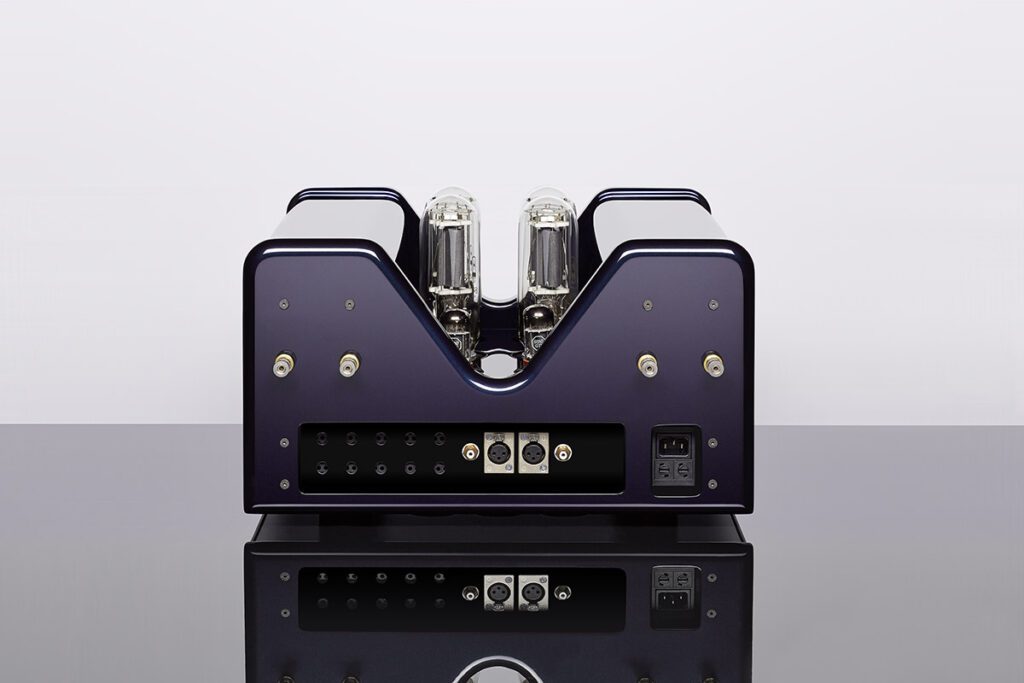
So why are there four 845 triodes? The Solista is indeed a pure single-ended design, not a push-pull model. The front pair of 845s serve as hybrid tube-rectified power supplies for the main 845 output tubes. The preamp and driver stages use one Sovtek 6C45Pi and one Tung-Sol 6SN7GT per channel.
Inside, the Solista uses point-to-point wiring rather than printed circuit boards, which Viva believes delivers the best sound quality. Schembri has also chosen to use no negative feedback in this amplifier or the other integrated models in the range. Although the subject is debated, many listeners believe negative feedback can adversely affect sound quality.
Chunky output
Out of sight, the Solista’s substantial output transformers are handmade in Italy to Schembri’s specifications. Copper wire is wound around an in-house core, and the secondary winding is soldered directly to the palladium-plated, solid-copper binding posts on the rear panel.
The Solista keeps things simple, as unnecessary features can compromise sound quality. Its solid, beautifully finished and sculpted front panel has just a central volume control, an input selector and an on/off/warm-up toggle switch. There are four line-level inputs and one direct input. Marked D on the selector, the direct input lets you connect a preamplifier to the Solista’s power-amp section.
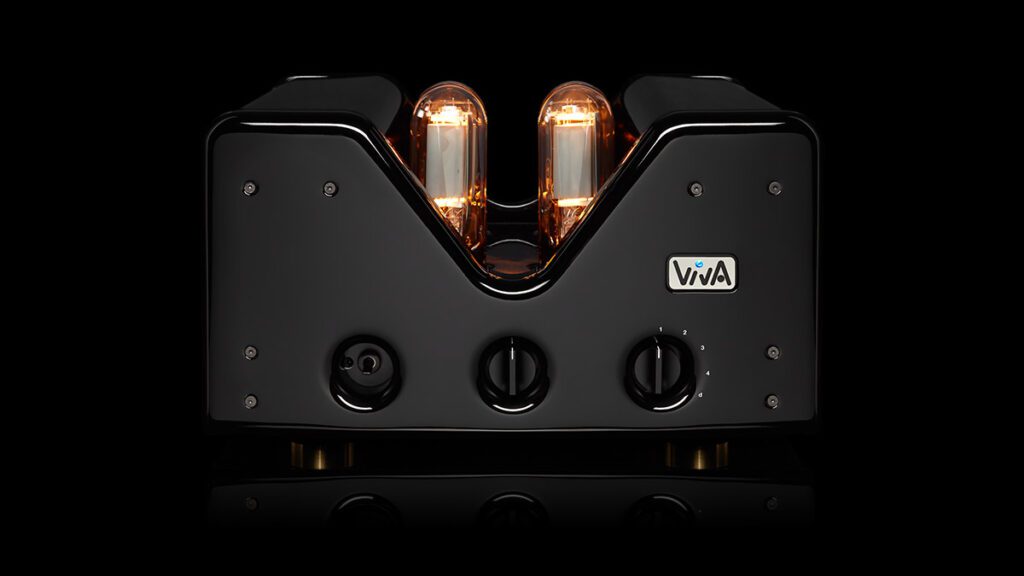
Italian products are renowned for their style, and the Solista is no exception. It looks beautiful, and Viva worked closely with design consultant Alessandro Constanzia di Costigliole of BlueArch Design Studio. Its elegant appearance is matched by an impressive sense of solidity and finish. In my view, the quality was second to none. The review sample had special dark-grey front and rear panels rather than the standard piano-black finish. Paired with the silver top covers, it looked particularly classy. The covers can be ordered in any automotive paint colour for an additional 10% of the price, while custom colours for the front and rear panels cost an extra £750.
Power and finesse
For my audition, I connected the Viva Solista to my home system: Fyne Audio Vintage 10 speakers with SuperTrax supertweeters and a REL S/850 subwoofer. The source was an Audio Note TT3/PSU3 turntable fitted with an AN Arm Two and Hana Umami Black cartridge. I tried several phono stages, including a Puresound P10 with an AN-S9 transformer and the new Music First Audio LP103 LCR. All the components were connected to a MusicWorks Reflex G5 mains distribution block using ReVive Ultra II mains leads.
During the time I spent with the Solista, I played plenty of familiar music. From the outset, though, I had a strong feeling I was going to enjoy it.
I began with ‘Night & Day’ from Jon Allen’s excellent Deep River album. The guitar sounded beautifully open, articulate and focused from the first notes, while Allen’s vocal was powerful, expressive, detailed and controlled. The amplifier conveyed his effortless vocal strength convincingly. When he pushed a note, the Solista let it soar without harshness or artifice—something that can be a problem with some amplifiers. The bass line was deep and tight, the string backing clearly separated, and the drums punchy and precise. It was an excellent rendition.
Natural and real
I recently discovered pianist and songwriter Fergus McCreadie, and was keen to hear the Solista with ‘Sun Pillars’ from his Stream album. From the opening bars, the piano sounded natural and lifelike, with openness and weight in the lower registers, and crisp dynamics in the upper. The Solista also handled the delicate, complex and nuanced drumming of Stephen Henderson with assurance. Subtle details were sharply defined, while the stronger hits had punch and impact. David Bowden’s wonderful acoustic bass line was weighty, fluid and nimble. His fleet-fingered playing drove the track’s hypnotic, staccato rhythms, while McCreadie’s fast-moving fingers were rendered with impressive clarity.
Going back in time, I couldn’t resist putting on one of my favourite albums: Bop City by pianist, singer and songwriter Ben Sidran. It’s a superb recording that still outshines much of what I buy today. On ‘It Didn’t All Come True’, Sidran’s vocals sounded remarkably open. The drums were outstanding, and when Peter Erskine really laid into them, the Solista captured the weight and impact. The bass line was deep, tuneful and fluid, with a satisfying leading-edge growl and excellent definition at the lowest notes. Sidran’s nimble piano playing was mesmerising. On fast runs, the amplifier conveyed the music with urgency, speed and control. It was a remarkable presentation of a wonderful track.
Energy
Next, I played ‘It’s Your Thing’ from bassist Christian McBride’s Conversations album, featuring singer Dee Dee Bridgewater. The track is just the two of them. The Solista captured the sound of McBride’s acoustic bass, as well as the energy, skill and movement in his playing. Each plucked note had a satisfying twang, and the resonating strings were rich in detail. Bridgewater’s vocal is superb and full of fun, and the Solista brought out every twist and turn of her sassy delivery.
The Solista is the kind of product that had me reaching for one record after another, eager to explore the musical insights it revealed. It is wonderfully dynamic and punchy without turning harsh, combining power with finesse. Despite its 22W rating, it drove every speaker I tried with ease. With the Fynes, the volume control rarely moved beyond 10 o’clock.
If you think valve amplifiers are too warm and easygoing, think again. The Solista conveys music with great subtlety and inner detail while delivering superb dynamics, power and excitement. Drums sound punchy and explosive; bass lines are deep, rhythmic and fluid.
The Solista is an exceptional amplifier, and I recommend it without hesitation. You owe it to yourself to hear it. It certainly put a smile on my face.
Technical specifications
- Type: Class A stereo integrated single-ended valve amplifier
- Tubes: 2 x Sovtek 6C45Pi; 2 x Tung-Sol 6SN7GT; 4 x Psvane 845
- Inputs: Five RCA line inputs, one direct (preamp in)
- Outputs: RCA preamp out
- Power output: 22W into 7 ohms
- Frequency response: 22Hz – 20kHz, +1/-1.5dB
- THD: 1% at 1kHz
- Signal-to-noise ratio: 85dB
- Power consumption: 450W
- Dimensions (WxHxD): 49 x 25 x 43cm
- Weight: 35kg
- Price: £24,500, €21,735, $31,500
Manufacturer
Viva Audio
The post Viva Solista appeared first on hi-fi+.
HI-FI News
via Articles Archive – hi-fi+ https://ift.tt/lLznKwq
November 17, 2026 at 02:19PM
-
Product on sale
 Audiophile Vinyl Records Cleaning BundleOriginal price was: €69.90.€59.90Current price is: €59.90. incl. VAT
-
Product on saleEasy Start Vinyl Records Cleaning KitOriginal price was: €69.90.€59.90Current price is: €59.90. incl. VAT
-
Vinyl Records Cleaner Easy Groove Concentrate€34.95 incl. VAT
-
Easy Groove Super Set€199.00 incl. VAT
-
Easy Groove Enzycaster – vinyl records prewash cleaner€34.95 incl. VAT
-
Easy Groove Extreme MK. II- vinyl records prewash cleaner€45.00 incl. VAT
-
Vinyl Records Cleaner – Easy Groove Virgin Concentrate€35.00 incl. VAT
-
Easy Groove Spray&Wipe vinyl records cleaner€34.95 incl. VAT







