
World News
Weiss Engineering Helios D/A processor
Weiss Engineering Helios D/A processor
When standalone digital/analog processors made an look a quarter-century in the past, they had been restricted to the CD medium’s 16 bits of decisionat finest. These days, virtually each DAC can course of at the very least 24 bits, and lots of fashions supply between 20 and 21 bits of real-world decision. Modern fashions from Benchmark, dCS, Merging, Mola Mola, Okto, and Weiss illustrate not simply the talent of the circuit designer but in addition that of the engineer who laid out the printed circuit board.
One of the primary digital processors I encountered that supplied 21 bits of decision was the Weiss DAC202, which Erick Lichte reviewed in January 2012. Subsequent processors from this Swiss firm have constantly carried out effectively, not simply on the check bench but in addition within the listening room.
This was notably true of the Weiss DAC502 I reviewed within the August 2020 subject (footnote 1). I concluded that evaluation by writing, "The Weiss DAC502 retrieves extra data from the digits than every other DAC I’ve auditioned, with the potential exceptions of the Chord DAVE and dCS Vivaldi, each of that are lengthy gone from my system and neither of which has both a headphone output or DSP features." Notably, that excellent transparency to the recorded knowledge was not accompanied by glare or exaggerated treble element. "To resort to an audio reviewer cliché," I wrote, "the DAC502 cleaned the window into the recorded soundstage to a formidable extent."
The DAC502 is at present priced at $10,995. The newest Weiss DAC, the Helios, which Jason Victor Serinus reported on on the 2023 High-End Munich present, is significantly dearer, at $21,995. Intrigued to search out out what the extra {dollars} get the proprietor, I requested for a evaluation pattern.
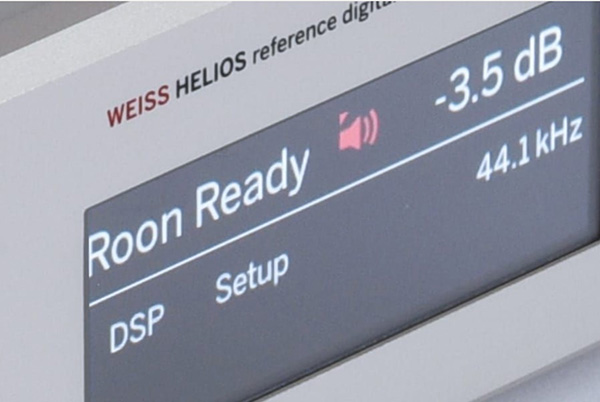
The Helios
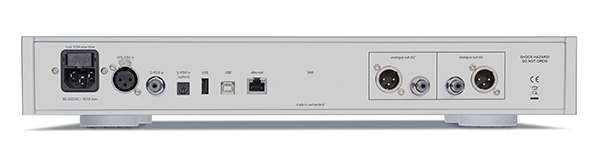
On the face of it, the Roon Ready Helios seems similar to the DAC502: a slim, anodized aluminum chassis, although now with a chrome steel inside body. There continues to be a management knob on the far proper of the entrance panel; a four-color touchscreen subsequent to it; AES3, optical and coaxial S/PDIF, USB Types A and B, and Ethernet digital inputs; and balanced and single-ended analog outputs. But on nearer inspection, the Helios lacks the sooner processor’s headphone jack. It can nonetheless be used with headphones, nevertheless: Using non-compulsory adapter cables ($495), the Helios can drive headphones from its balanced and unbalanced outputs. This is made potential by Weiss’s new, proprietary OP2-BP discrete operational amplifiers (beneath), used 4 per channel within the analog output stage. The output mode might be switched between Loudspeaker and Headphone, and the DSP choices now embrace settings to be used with headphones.
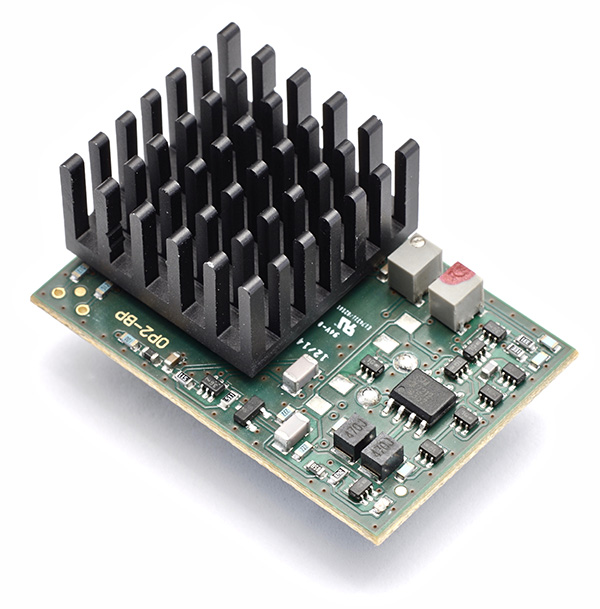
In addition to the brand new op-amps, the Helios provides an upgraded digital-to-analog stage. While it makes use of the identical eight-channel, 32-bit ESS Sabre ES9038PRO HyperStream II D/A converter chip, the Helios makes use of 4 of the DAC channels operated in parallel for every analog output. The DAC502 makes use of two DAC channels in parallel for the speaker feed and two for the headphone feed. The ES9038PRO will deal with PCM knowledge sampled as much as 768kHz and native DSD1024 knowledge; Weiss says that the Helios makes use of a "high-precision/low jitter clock generator for ultra-stable clocking of the D/A converter part."
The Helios provides the identical digital sign processing (DSP) features because the DAC502 (though the headphone-related DSP features had not but been applied once I auditioned the 502), realized with an Analog Devices SHARC chip. The following DSP algorithms are applied: Room EQ, which might apply high-shelf and peaking/notch filters to take care of low-frequency room modes; Creative EQ, which applies low, mid, and excessive enhance/minimize; DeEsser, which removes overly vivid sibilance from human voices; Dynamic Adaptation, a "social gathering mode" that normalizes loudness; Vinyl Emulation, stated to offer "that particular sonic character of a file participant primarily based playback chain"; Crosstalk Cancellation (XTC), which permits binaural recordings to be accurately performed again on loudspeakers; and Loudness Control, which equalizes the output to compensate for the ear-brain’s differing frequency sensitivity at completely different listening volumes. Once you’ve gotten chosen the parameters for every of those features, the settings might be saved as a snapshot and recalled on the contact of a button on the management webpage or the metallic distant management.
Setup
Like the DAC502, the Helios might be managed in 3 ways: with the touchscreen and rotary management; the aforementioned metallic IR distant management; or with an internet browser by getting into the deal with https://[helios-serial-number].native. The net and front-panel interfaces permit setting the quantity, stability, mute, and polarity inversion controls, these DSP settings, and a selection of most output ranges: "0dB," "4dB," "8dB," "12dB," "16dB," "20dB," "24dB," and "28dB." I set the processor’s output degree to "12dB," equal to a most degree of 4.1V balanced and a couple of.05V unbalanced.
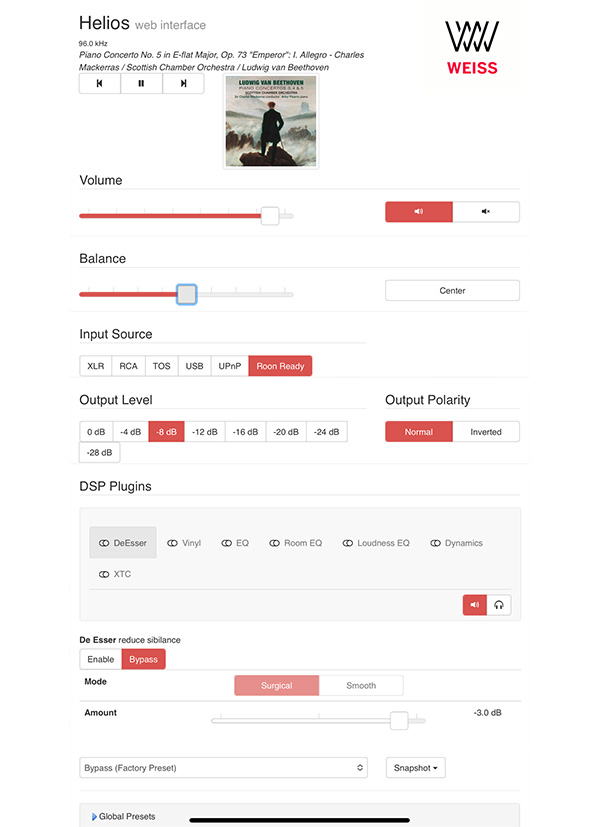
Once I had related the Helios to my community and opened the native webpage, I used to be capable of verify for any firmware updates. ("FW is updated," it instructed me; the evaluation pattern was operating v2.7.0 firmware, revision r3161, dated "2023-02-14.") The Roon app processor acknowledged the processor as "Weiss Helios," permitting Roon to regulate its quantity. The Roon quantity setting was instantly mirrored on the front-panel show and mirrored within the native webpage. The webpage duplicated Roon’s transport controls and displayed the paintings of any album chosen with Roon.
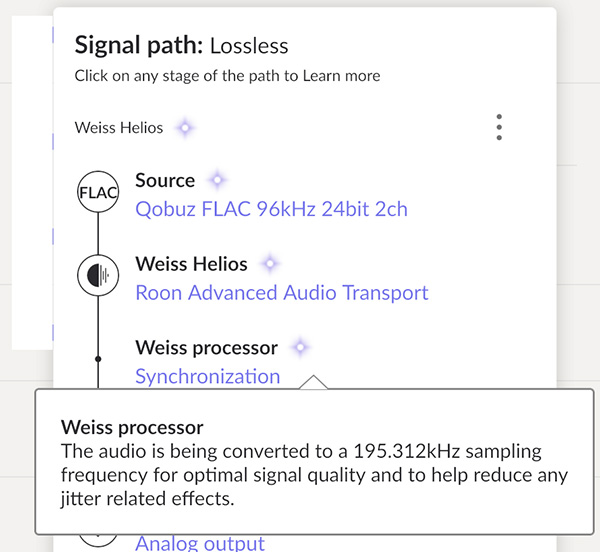
I famous one thing uncommon with Roon. With PCM knowledge sampled as much as 192kHz, clicking on "Weiss processor Synchronization" in Roon’s "Signal path" window gave the next message: "The audio is being transformed to a 195.312kHz sampling frequency for optimum sign high quality and to assist scale back any jitter associated results." The identical was true for DSD64 and DSD128 knowledge, each of which the Helios first transformed to 176.4kHz PCM earlier than resampling.
Listening
I began my auditioning with the Q Acoustics 5040 loudspeakers I reviewed within the January 2024 subject, pushed by a pair of Parasound Halo JC 1+ monoblocks. After the Q Acoustics audio system had been returned, I used my content material/kef-ls50-anniversary-model-loudspeaker">KEF LS50 minimonitors, then changed the Parasounds with the Audio Research I/50 built-in amplifier I final wrote about within the February 2024 subject. I subsequently changed the Audio Research with my NAD M10 built-in and the KEFs with Golden Ear BRXes. I ended the auditioning by returning to the Parasound monoblocks. I used Roon for all crucial listening.
I reported on the impact of the DSP features in my DAC502 evaluation, so I will not repeat my findings right here. Like the sooner Weiss DAC, the Helios’s parametric EQ was helpful in boosting and lengthening the low frequencies of the audio system I used for my auditioning. (I used a Low Shelf filter set to present a 3dB enhance beneath 100Hz with a Q of 1.40.)
Throughout the adjustments of amplifier and loudspeakers, the Helios echoed the DAC502’s extraordinary readability however with an enhanced sense of involvement with the music. I listened to the recordings I had used for my DAC502 evaluationeach my very own and people recorded by different engineerswith the Helios. It is honest to notice that I hadn’t had the sooner processor in my system for greater than three years, but when I needed to swear on the very first subject of Stereophile, this impression was constant all through my auditioning of the Helios.
Footnote 1: Jason Victor Serinus additionally reviewed the Weiss DAC502 in October 2020.
HI-FI News
by way of Stereophile.com https://ift.tt/KXRuaxD
February 23, 2024 at 09:31PM
-
Product on sale
 Audiophile Vinyl Records Cleaning BundleOriginal price was: €69.90.€59.90Current price is: €59.90. incl. VAT
-
Product on saleEasy Start Vinyl Records Cleaning KitOriginal price was: €69.90.€59.90Current price is: €59.90. incl. VAT
-
Vinyl Records Cleaner Easy Groove Concentrate€34.95 incl. VAT
-
Easy Groove Super Set€199.00 incl. VAT
-
Easy Groove Enzycaster – vinyl records prewash cleaner€34.95 incl. VAT
-
Easy Groove Extreme MK. II- vinyl records prewash cleaner€45.00 incl. VAT
-
Vinyl Records Cleaner – Easy Groove Virgin Concentrate€35.00 incl. VAT
-
Easy Groove Spray&Wipe vinyl records cleaner€34.95 incl. VAT







