Author Archives: Barbara Schultz

All The Eye Can See: Joe Henry Forges a New Path

Joe Henry. PHOTO: David McClister.

The Joe Henry music “The Yearling” begins, “I left behind all that I may, took what I’d want, walked myself into the wooden the place the mountains develop to seed. There, yearlings tumbled at my toes, rolling on their approach, again earlier than this all started and much past as we speak.”

The listener can guess that the yearlings on this poignant music—realized with evocative violin components by Tony Trundle interweaving with Henry’s guitar enjoying, Floriane Blancke on Celtic harp, and vocals by Henry and Lisa Hannigan— characterize purity and innocence discovered within the pure world, at the start of life.

Most of the tracks on the newest Joe Henry album, All the Eye Can See, are equally reflective. He wrote in his notes concerning the songs, “I hear them partially as springing out of our shared and traumatic experiences of the current previous, certain, in addition to our present-day responses to them; but when I’m sincere, I do know that I’ve by no means allowed myself to write down and launch songs as private as these now really feel to me.”

Henry had the opposite facet of most cancers remedy in his sights when the pandemic closed each door that he thought was about to open. Like many, he felt blindsided, and he took numerous solitary walks. Songs ultimately emerged from the quiet.

“This occurred 5, six, seven instances,” Henry explains. “I had a full music in my head primarily written. I’d stroll within the door and shortly scribble down the phrases that had been biking via my thoughts so I wouldn’t overlook them, after which I’d discover a guitar and work out the way to assist what I had simply been singing on my stroll. Then I’d instantly document my a part of it, making an attempt to maintain it as uncooked and rapid as I may.

“As quickly as I had a model of myself on acoustic guitar and vocals sketched out, I’d ship that to anyone, most notably my pricey buddy keyboard participant Patrick Warren, who was residing simply throughout city. And he wouldn’t solely ship again feedback but additionally he’d return the session recordsdata with contributions—perhaps a few cellos and a pump organ and an upright piano. Then I’d see who else wanted to get this music, and proceed to go it round to individuals.”

LEARNING TO RECORD

For a producer and musician who has all the time most well-liked the interaction of a stay band, this course of was born of necessity. “I knew that what I wanted was to not sulk at house,” Henry says, “however to throw myself into studying to document myself viably so I didn’t need to cease my inventive life or lose reference to the folks that I make music with, who’re additionally my closest pals. I instantly began to be taught Pro Tools.
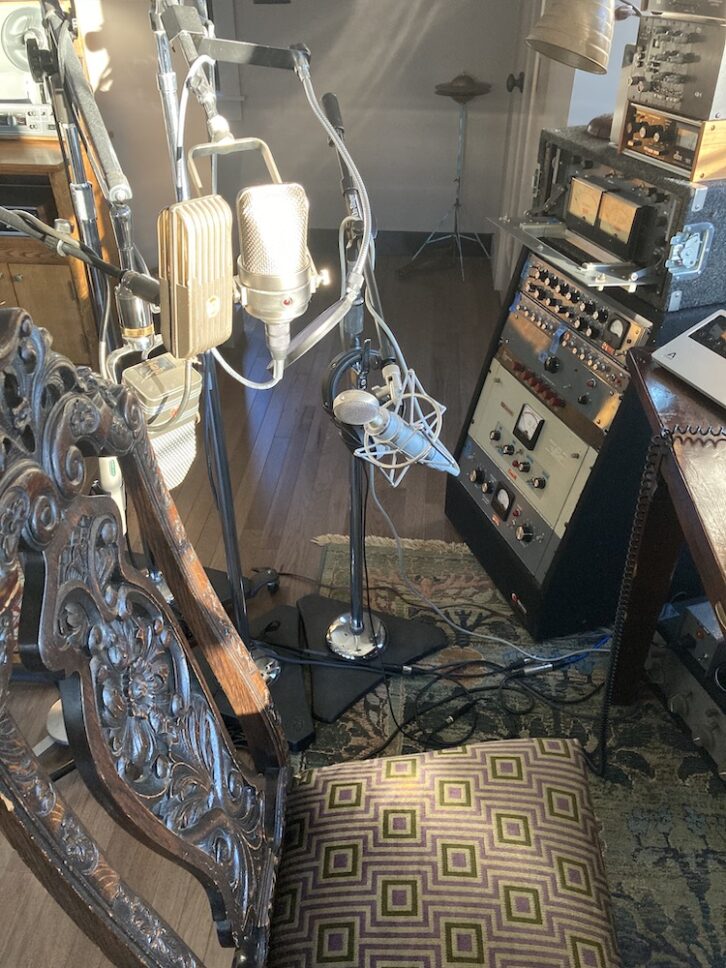
A glimpse inside Joe Henry's studio. PHOTO: Joe Henry.
A glimpse inside Henry’s studio. PHOTO: Joe Henry.

“In the previous, I’d all the time waited till I had a full album’s value of songs written earlier than giving thought to how I’d document them, how they may be articulated,” he continues, “however on this case, I used to be enthusiastic about studying to document and feeling an urgency round it as quickly as a brand new music would arrive. I used to be writing with a type of fury that I hadn’t skilled earlier than, and I used to be actually studying within the real-time of recording this document.”

Henry had the whole lot he wanted, after all. Over the years, he’d amassed a formidable assortment of kit for his Pasadena, Calif., studio, Garfield House. He was well-versed within the sound and capabilities of his gear, however beforehand he’d primarily saved his fingers free, to give attention to his accountability as a producer, whereas gifted engineers like his frequent studio companion Ryan Freeland had been there to seize it. But that was earlier than COVID.

“For the earliest songs on this document, I used my RCA BK-5B microphone [for vocals],” Henry says. “Later, I began utilizing an AEA A440 for vocals bit—one thing I discovered from Ryan Freeland, who incessantly will pair the A440 with an previous [Neumann] M 49. An M 49 might be my favourite go-to microphone; it offers me the readability of a tube mic plus numerous the textural traits of a ribbon. I even have a [Shure] SM7 that I take advantage of each time older or extra finicky mics don’t have perspective.

Guitars are racked up and at the ready in Henry's studio. PHOTO: Joe Henry.
Guitars are racked up and on the prepared in Henry’s studio. PHOTO: Joe Henry.

“All of my vocals and guitar occurred on the similar time,” he continues. “In the early days, once I was utilizing my RCA BK-5B, what I used to be utilizing on my guitar most was a Royer R-122. When I used to be utilizing an M 49 for vocals, I began utilizing the AEA A440 and an previous Gefell M7 tube mic [on guitar], with the AEA positioned somewhat in entrance of me in order that it was choosing up some vocal traits as effectively. Then I’d put the Gefell M7 decrease to get some bottom-end heat, in order that it wasn’t simply strings and assault I used to be listening to; I actually wish to hear the physique of the instrument.”

Henry is joined on the album by a lot of his frequent collaborators: drummer Jay Bellerose; bassist David Piltch; keyboardists Warren and Keefus Ciancia; guitarists Marc Ribot, John Smith and Bill Frisell; and his son Levon Henry on clarinet and sax. Also, the sky being the restrict to distant collaboration, visitors embody Daniel Lanois, Allison Russell, JT Nero, Madison Cunningham, Rose Cousins, Francesco Turrisi, the Milk Carton Kids, Tyler Chester, Tony Trundle, Floriane Blancke and Lisa Hannigan.

MIXING WITH OTHERS

Henry’s songs had been in numerous phases of completion when he acquired an electronic mail someday from North Carolina-based engineer Jason Richmond—only a pleasant check-in.

“I began telling Jason about this document,” Henry recollects. “I had toyed with the thought of blending it myself, simply within the spirit of doing extra alone, and I requested him if I may ship him a mixture for his sincere, essential ear. I despatched him one thing that I used to be actually assured about, and he wrote me again, ‘Since you’ve requested me to be sincere, the music is nice, the performances are nice, however as a mixture, this feels flat to me. I believe you’re shedding numerous your dynamics in the way you’re approaching this.’

“He very generously mentioned, ‘Send me the session recordsdata for that music, and I’m going to combine it and see if I can present you what I believe may be lacking from what you’re doing.’ When I bought that music again, I understood immediately that I’d not be mixing this document.”
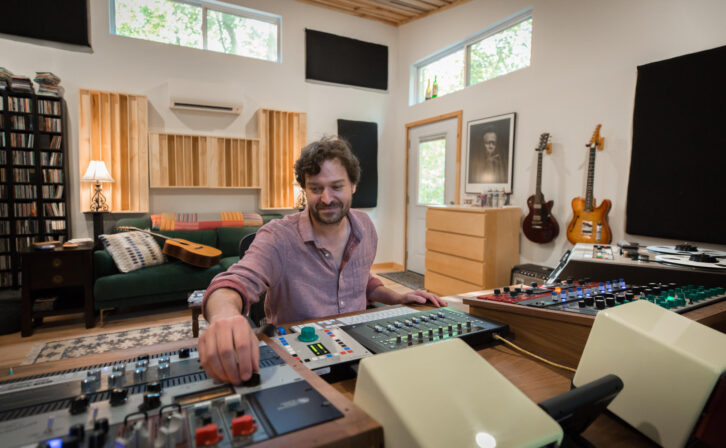
Mix engineer Jason Richmond. PHOTO: Teddy Denton.

“We determined I used to be doing the entire document at that time,” says Richmond. “I combine numerous house recordings, however this one was completely different within the sense that there’s so many various musicians, all recording in very completely different places. There had been very clear room tones on sure individuals’s devices, and it was my job to get the whole lot to take a seat collectively in a cohesive house.”

Richmond combined the Pro Tools periods in his private studio, which is supplied with Amphion One18 and ProAc 100 displays. He ran the whole lot via Pro Tools and Apogee Symphony converters, his Roll Music Folcrom summing mixer and BAE 1073 mic pres. “For probably the most half, the whole lot additionally ran via my 2-bus API 5500 and a D.W. Fearn VT-7 compressor. The VT7 is delicate, however it gave the document a little bit of glue,” Richmond says.

Also By Barbara Schultz:

In The Studio with Wilco for ‘Cruel Country’

Building ‘Home in This World:’ A Tribute to Woody Guthrie’s Dust Bowl Ballads

“I spotted, if a selected instrument had a extremely clear room tone on it, I in all probability wasn’t going to have the ability to eliminate it,” he continues. “So, as a substitute I’d push the whole lot else in that course. The music ‘Small Wonder’ was one the place Jay Bellerose’s drum sound is considerably uncooked, so I made the whole lot extra uncooked in a method to match that drum observe. Or on ‘Red Letter Day,’ there’s numerous environment that’s largely constructed round 4 or 5 completely different delays which might be processed with some modulation, so the whole lot sounds nearer collectively.”

Richmond’s go-to plug-ins on this undertaking included SoundToys Echo Boy, PrimalTap and Tremolator, plus a UAD Galaxy Echo plug-in. Hardware processing included Retro’s 2A3 (particularly on guitars and keys), Crane Song IBISwith Chandler LTD-2 (drums), and on lead vocals, an ADL 1700 parallel processor via LaChapell 583E and Chandler TG2 preamps.

BRINGING IT ALL TOGETHER

“A big a part of this document was constructed round completely different delays,” Richmond says. “I’d pile delays on and tuck them down, after which put a few of these delays via a reverb. I discovered that I may calculate and add these to the vocal or guitar components and sync the whole lot nearer to what the drums appeared like, for instance.

“To get Joe’s vocals to take a seat ahead within the combine, I used 1176 compressors operating parallel via tube pres just like the LaChapell,” the engineer continues. “Also, there have been a few instances when some tracks had been re-amped, and I’d tuck that beneath his authentic vocal. In some circumstances, there are a number of ranges of parallel processing below his vocal to pump it up with out it overriding the whole lot else.”

Richmond additionally mastered the album, this time working in The Kitchen Mastering, utilizing WaveLab in addition to Manley Variable MU, Terry Audio CEQ, Millennia NSEQ-2, Shadow Hills Mono Optograph and FabFilter processing.

Joe Henry's "All The Eye Can See"
The Joe Henry album “All The Eye Can See”

Amid all of the disparate components coming collectively, Henry made a change that he says was a very long time coming: He and his spouse packed up and moved from Pasadena to Maine. There’s that line from “The Yearling” once more: “I left behind all that I may, took what I’d want…”

Having grown up with 4 seasons, Henry says that in L.A., “I used to be all the time ready for this different factor to occur, which I discovered deeply romantic and necessary.” All the Eye Can See marks a transition for this artist/producer—one of many methods he has chosen to maneuver ahead.

“To borrow from Woody Guthrie, this prepare is sure for glory,” Henry writes in his notes concerning the album, “and I’ve come to be taught that that speaks—all the time and endlessly—to journey, not vacation spot.”
All The Eye Can See: Joe Henry Forges a New Path

Joe Henry. PHOTO: David McClister.

The Joe Henry song “The Yearling” begins, “I left behind all that I could, took what I might need, walked myself into the wood where the mountains grow to seed. There, yearlings tumbled at my feet, rolling on their way, back before this all began and far beyond today.”

The listener can guess that the yearlings in this poignant song—realized with evocative violin parts by Tony Trundle interweaving with Henry’s guitar playing, Floriane Blancke on Celtic harp, and vocals by Henry and Lisa Hannigan— represent purity and innocence found in the natural world, at the beginning of life.

Most of the tracks on the latest Joe Henry album, All the Eye Can See, are similarly reflective. He wrote in his notes about the songs, “I hear them in part as springing out of our shared and traumatic experiences of the recent past, sure, as well as our present-day responses to them; but if I am honest, I know that I have never allowed myself to write and release songs as personal as these now feel to me.”

Henry had the other side of cancer treatment in his sights when the pandemic closed every door that he thought was about to open. Like many, he felt blindsided, and he took a lot of solitary walks. Songs eventually emerged from the quiet.

“This happened five, six, seven times,” Henry explains. “I had a full song in my head essentially written. I would walk in the door and quickly scribble down the words that had been cycling through my mind so I wouldn’t forget them, and then I’d find a guitar and figure out how to support what I had just been singing on my walk. Then I would immediately record my part of it, trying to keep it as raw and immediate as I could.

“As soon as I had a version of myself on acoustic guitar and vocals sketched out, I would send that to somebody, most notably my dear friend keyboard player Patrick Warren, who was living just across town. And he would not only send back comments but also he’d return the session files with contributions—maybe a couple of cellos and a pump organ and an upright piano. Then I would see who else needed to get this song, and continue to pass it around to people.”

LEARNING TO RECORD

For a producer and musician who has always preferred the interplay of a live band, this process was born of necessity. “I knew that what I needed was not to sulk at home,” Henry says, “but to throw myself into learning to record myself viably so I didn’t have to stop my creative life or lose connection with the people that I make music with, who are also my closest friends. I immediately started to learn Pro Tools.

A glimpse inside Joe Henry's studio. PHOTO: Joe Henry.
A glimpse inside Henry’s studio. PHOTO: Joe Henry.

“In the past, I’d always waited until I had a full album’s worth of songs written before giving thought to how I might record them, how they might be articulated,” he continues, “but in this case, I was excited about learning to record and feeling an urgency around it as soon as a new song would arrive. I was writing with a sort of fury that I hadn’t experienced before, and I was really learning in the real-time of recording this record.”

Henry had everything he needed, of course. Over the years, he’d amassed an impressive collection of equipment for his Pasadena, Calif., studio, Garfield House. He was well-versed in the sound and capabilities of his gear, but previously he’d mainly kept his hands free, to focus on his responsibility as a producer, while talented engineers like his frequent studio partner Ryan Freeland were there to capture it. But that was before COVID.

“For the earliest songs on this record, I used my RCA BK-5B microphone [for vocals],” Henry says. “Later, I started using an AEA A440 for vocals a good bit—something I learned from Ryan Freeland, who frequently will pair the A440 with an old [Neumann] M 49. An M 49 is probably my favorite go-to microphone; it gives me the clarity of a tube mic plus a lot of the textural characteristics of a ribbon. I also have a [Shure] SM7 that I use whenever older or more finicky mics don’t have a good attitude.

Guitars are racked up and at the ready in Henry's studio. PHOTO: Joe Henry.
Guitars are racked up and at the ready in Henry’s studio. PHOTO: Joe Henry.

“All of my vocals and guitar happened at the same time,” he continues. “In the early days, when I was using my RCA BK-5B, what I was using on my guitar most was a Royer R-122. When I was using an M 49 for vocals, I started using the AEA A440 and an old Gefell M7 tube mic [on guitar], with the AEA placed a little in front of me so that it was picking up some vocal characteristics as well. Then I would put the Gefell M7 lower to get some bottom-end warmth, so that it wasn’t just strings and attack I was hearing; I really want to hear the body of the instrument.”

Henry is joined on the album by many of his frequent collaborators: drummer Jay Bellerose; bassist David Piltch; keyboardists Warren and Keefus Ciancia; guitarists Marc Ribot, John Smith and Bill Frisell; and his son Levon Henry on clarinet and sax. Also, the sky being the limit to remote collaboration, guests include Daniel Lanois, Allison Russell, JT Nero, Madison Cunningham, Rose Cousins, Francesco Turrisi, the Milk Carton Kids, Tyler Chester, Tony Trundle, Floriane Blancke and Lisa Hannigan.

MIXING WITH OTHERS

Henry’s songs were in various stages of completion when he received an email one day from North Carolina-based engineer Jason Richmond—just a friendly check-in.

“I started telling Jason about this record,” Henry recalls. “I had toyed with the idea of mixing it myself, just in the spirit of doing more on my own, and I asked him if I could send him a mix for his honest, critical ear. I sent him something that I was really confident about, and he wrote me back, ‘Since you’ve asked me to be honest, the song is great, the performances are great, but as a mix, this feels flat to me. I think you’re losing a lot of your dynamics in how you’re approaching this.’

“He very generously said, ‘Send me the session files for that song, and I’m going to mix it and see if I can show you what I think might be missing from what you’re doing.’ When I got that song back, I understood instantly that I would not be mixing this record.”

Mix engineer Jason Richmond. PHOTO: Teddy Denton.

“We decided I was doing the whole record at that point,” says Richmond. “I mix a lot of home recordings, but this one was different in the sense that there’s so many different musicians, all recording in very different locations. There were very clear room tones on certain people’s instruments, and it was my job to get everything to sit together in a cohesive space.”

Richmond mixed the Pro Tools sessions in his personal studio, which is equipped with Amphion One18 and ProAc 100 monitors. He ran everything through Pro Tools and Apogee Symphony converters, his Roll Music Folcrom summing mixer and BAE 1073 mic pres. “For the most part, everything also ran through my 2-bus API 5500 and a D.W. Fearn VT-7 compressor. The VT7 is subtle, but it gave the record a bit of glue,” Richmond says.

Also By Barbara Schultz:

In The Studio with Wilco for ‘Cruel Country’

Building ‘Home in This World:’ A Tribute to Woody Guthrie’s Dust Bowl Ballads

“I realized, if a specific instrument had a really clear room tone on it, I probably wasn’t going to be able to get rid of it,” he continues. “So, instead I would push everything else in that direction. The song ‘Small Wonder’ was one where Jay Bellerose’s drum sound is somewhat raw, so I made everything more raw in a way to fit that drum track. Or on ‘Red Letter Day,’ there’s a lot of atmosphere that is mostly built around four or five different delays that are processed with some modulation, so everything sounds closer together.”

Richmond’s go-to plug-ins on this project included SoundToys Echo Boy, PrimalTap and Tremolator, plus a UAD Galaxy Echo plug-in. Hardware processing included Retro’s 2A3 (especially on guitars and keys), Crane Song IBISwith Chandler LTD-2 (drums), and on lead vocals, an ADL 1700 parallel processor through LaChapell 583E and Chandler TG2 preamps.

BRINGING IT ALL TOGETHER

“A large part of this record was built around different delays,” Richmond says. “I would pile delays on and tuck them down, and then put some of those delays through a reverb. I found that I could calculate and add those to the vocal or guitar parts and sync everything closer to what the drums sounded like, for example.

“To get Joe’s vocals to sit forward in the mix, I used 1176 compressors running parallel through tube pres like the LaChapell,” the engineer continues. “Also, there were a couple of times when some tracks were re-amped, and I’d tuck that underneath his original vocal. In some cases, there are multiple levels of parallel processing under his vocal to pump it up without it overriding everything else.”

Richmond also mastered the album, this time working in The Kitchen Mastering, using WaveLab as well as Manley Variable MU, Terry Audio CEQ, Millennia NSEQ-2, Shadow Hills Mono Optograph and FabFilter processing.

Joe Henry's "All The Eye Can See"
The Joe Henry album “All The Eye Can See”

Amid all the disparate parts coming together, Henry made a change that he says was a long time coming: He and his wife packed up and moved from Pasadena to Maine. There’s that line from “The Yearling” again: “I left behind all that I could, took what I might need…”

Having grown up with four seasons, Henry says that in L.A., “I was always waiting for this other thing to happen, which I found deeply romantic and important.” All the Eye Can See marks a transition for this artist/producer—one of the ways he has chosen to move forward.

“To borrow from Woody Guthrie, this train is bound for glory,” Henry writes in his notes about the album, “and I’ve come to learn that that speaks—always and forever—to journey, not destination.”

‘Live Forever: A Tribute to Billy Joe Shaver’ Benefit Album Features Stars, Friends and Fans

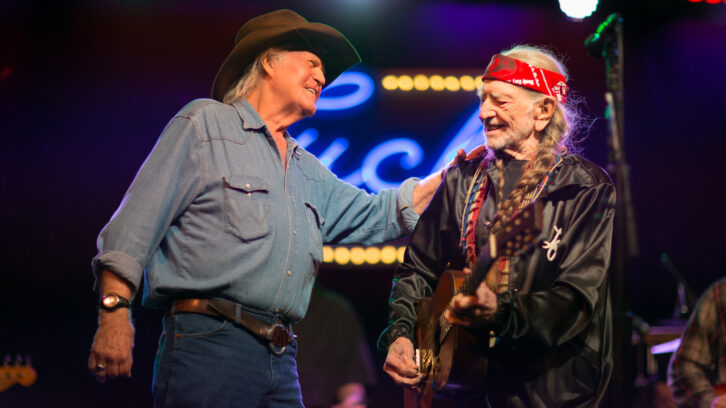
Billy Joe Shaver with longtime friend Willie Nelson. PHOTO: Cameron L. Gott

“Billy was a seriously spiritual person,” reflects producer/studio owner Freddy Fletcher. “He would whip your ass, but he would do it with the spirit in his heart!”

Fletcher was in high school when he met Billy Joe Shaver, and they became close friends. So, Fletcher has a lifetime of fond memories of Shaver in all his aspects: He was a country outlaw and a devout Christian who insisted that his songs were sent to him by the Lord. He was the writer behind soulful songs like “Live Forever,” but he was also the “Wacko from Waco” who “shot a man in the head, but can’t talk much about it….” He was a wonderful singer whose biggest hits were recorded by other artists, such as Waylon Jennings, Johnny Cash and John Anderson.

Following Shaver’s death in 2020, Fletcher was determined to honor his friend’s memory with a tribute album. “He asked me that if something happened to him, I would take care of his music and keep it alive, and I promised I would,” Fletcher says. “I didn’t know a better way to do it, and it’s been a real labor of love.”

Released this month on the New West label, Live Forever: A Tribute to Billy Joe Shaver is a varied collection of Shaver chestnuts and deep cuts, with all profits going to the Central Texas Food Bank.

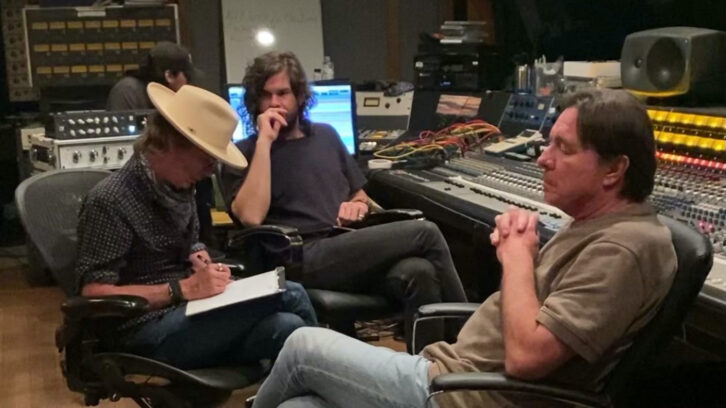
At Arlyn Studios, co-producers Charlie Sexton (left) and Freddy Fletcher (right) confer with chief engineer Jacob Sciba while engineer Joseph Holguin works in the background. PHOTO: Ellee Fletcher Durniak.

Among the artists appearing on Live Forever is guitarist Charlie Sexton, who also co-produced the album with Fletcher. The two of them put together a list of favorite Shaver songs and performers, and some pairings came together organically, such as Rodney Crowell’s track.

“I called him and he said, ‘Man, I love Billy Joe, and you know what? Before a show, I don’t warm up my voice with exercises; I sing ‘Old Five and Dimers,”’ and I said, ‘Well then that’s the song you’re going to do,’” Sexton says.

“Another obvious choice came from the ‘mountain high,’ and when I say the mountain high, I mean Willie,” Sexton continues. “He wanted ‘Live Forever,’ and, of course, it was also the perfect song for him. Miranda Lambert picked ‘I’m Just an Old Chunk of Coal.’ It’s not the first thing you think of when you think of Miranda, but she did such a cool version of that song.”

Other choices required a little more finesse. Nathaniel Rateliff asked to sing “Willy the Wandering Gypsy and Me,” but then so did George Strait. The producers went back to Rateliff, who kindly switched to “You Asked Me To,” a song that he performs as naturally as if it had been written for him.

TEXAS TRACKING

Strait’s track was the first one that came together at Arlyn Studios, the Austin facility that Fletcher and his wife, Lisa, own and operate. Sexton played guitar and ran the session, which included drummer Conrad Choucroun, bass player Glen Fukunaga, pedal steel player Ricky Ray Jackson, and fiddle player Warren Hood.

Behind the glass were Fletcher and his chief engineer, Jacob Sciba, who has been with Arlyn for more than 20 years. The setup he used was similar for all of the band tracks they made in Austin, give or take a keyboard or a string instrument.

On Sexton’s acoustic guitar, there was a Neumann U47, Tube-Tech CL1b, and Neve mic pre/EQ via the hybrid Neve/API console that Sciba helped the Fletchers rebuild several years ago. Electric guitars were overdubbed, with either a Royer 121 ribbon or a Neumann U87 on the amps.

Electric bass was DI, but Sciba always had a station set up for upright bass: “I line that mic up with the bridge, with the capsule tilted slightly up and 6 to 8 inches away,” he explains. “For me, upright is always a matter of trying to get articulation and a bit of that rubber band sound out of it.”

Amanda Shires’ version of “Honky Tonk Heroes” was one of pianist Bobbie Nelson’s last sessions. Pictured, from left, at Arlyn: engineers Joseph Holguin and Jacob Sciba, track producer Lawrence Rothman, Nelson, Shires and Freddy Fletcher. PHOTO: Ellee Fletcher Durniak.

On tracks that included piano, Sciba used a pair of Neumann KM86s, plus a U47 or M49 mono mic. “Normally, I like the right-hand 86 placed 8 to 12 inches above the hammers, and then the left-hand 86 is 6 inches above the strings but down on the bass board,” he says. “If the piano lid is open, I’ll put that mono mic by the curve of the body of the piano and about halfway between the lid and the soundboard. I always use our Neve 33609 compressor on pianos.”

On most sessions, drums, bass, Sexton’s acoustic and possibly a piano were live, with electric guitars, additional keys or strings, and finally vocals recorded later. On their first tracking day, they cut band tracks for Strait’s song, followed by Ryan Bingham’s “Ride Me Down Easy.”

“In some ways, that painted me into a corner because when we cut Ryan’s tracks, we were still playing a little too straight, no pun intended,” Sexton recalls. “What we were doing was right for George, but for Ryan, our shirts were maybe too neatly pressed, so I did a lot of work on that track after the fact to get a more raw vibe. One thing was, I got out an old ’30s Rickenbacker metal lap steel. Plus Nikki Lane added vocals on that one, and she did not disappoint!”

Billy Joe Shaver: Everybody’s Brother (Compadre)

On Willie Nelson’s “Live Forever,” Sexton cast a different mix of musicians, creating a complex and exotic interpretation of Shaver’s most beloved song.

“The drummer is Ramy Atoun, who has a drum company in Austin where he makes really unique-sounding drums,” Sexton says. “We built up the track from a three-piece with me, Rami, and Glen Fukunaga, and the sounds coming across, particularly on the drums, were definitely not your typical country side-stick hi-hat sound.”

Crowell’s “Old Five and Dimers’” was also recorded at Arlyn, but it was cut live, including Emily Gimble’s Wurlitzer, Kevin Smith on upright bass, and Crowell’s vocal, which was captured by a U67.

“The piano was in its own room, and Charlie was facing Rodney in the main room, with them both on acoustics, but baffled between,” Sciba says. “We have some 4-foot baffles, so your head can be above it, but the mic can be right up on the acoustic and still get enough isolation to track keeper vocals. I believe that’s how Edie [Brickell on ‘I Couldn’t Be Me Without You’] was tracked, too.”

Engineer Shani Gandhi records Miranda Lambert in Blackbird Studio A. PHOTO: Ellee Fletcher Durniak.

ON TO NASHVILLE

Meanwhile in Nashville and beyond, tracks came together on Rateliff, Amanda Shires with Jason Isbell (“Honky Tonk Heroes,”), Margo Price (“Ragged Old Truck”) and Lambert, who worked in Blackbird Studio A with producer Jon Randall, engineer Shani Gandhi, and a band comprising drummer Fred Eltringham, bassist Michael Rinne, Jimmy Wallace on piano, Bryan Sutton on National guitar and mandolin, and Jessi Alexander and Randall singing backup.

“JR hired the best of the best,” says Gandhi. “And Blackbird A is the best of the best, but JR didn’t want them to sound too clean and shiny. When I was doing my mic list—even though clean and shiny is kind of my bag—I always made sure to have a ribbon in the stereo pair, to make everything sound gushier.”

“Chunk of Coal” was tracked live, including Lambert’s vocal. “Miranda was singing in the booth just off the control room,” Gandhi says. “There’s a room with a grand piano in it, where Jimmy Wallace was along with Mike Rinne, though we didn’t amp the bass, so there was no bleed.

“We had Bryan Sutton in a smaller iso booth next to them, and in between was Fred on drums. He started on a standard kit, but apparently it seemed too clean and too square. He said, ‘No, I hate this,’ and suddenly I heard clankclankclank as he dragged the floor tom case across the floor. The kick sound that he ended up with was him stomping on that plastic case, and he was holding a shaker and playing snare with his left hand—sort of a one-man-band situation.

“I had several mics for the case because we were tracking live and I wanted to make sure something would work,” Gandhi continues. “We ended up with a U47 FET, getting the most intense low end you could imagine, and a KM54 at his foot to get the ‘beater’ sound, if you will. I also had an [AEA] R84 pointing at the ‘kick’ farther away.”

On Lambert’s vocal, Gandhi used an M49 through the pres in the studio’s Neve 8078 board, plus GML EQ and a Fairchild limiter. She obviously had the “best of the best” gear handy, but Randall made sure to inject enough grit to fit Shaver’s lyrics and style.

Live Forever: A Tribute to Billy Joe Shaver ends with Allison Russell’s bluesy, haunting “Tramp on Your Street,” about a young man walking 10 miles barefoot to see Hank Williams perform. It’s a story that resonates with every music fan who’s felt an intense emotional connection to an artist’s work.

“I’m so glad Allison wanted to do that song because she just kills it,” Fletcher says. “That song is a true story, and Billy was that kid. All his songs are true stories. He didn’t sit in an office and write; he lived them.”