Tag Archives: Miranda Lambert

‘Live Forever: A Tribute to Billy Joe Shaver’ Benefit Album Features Stars, Friends and Fans

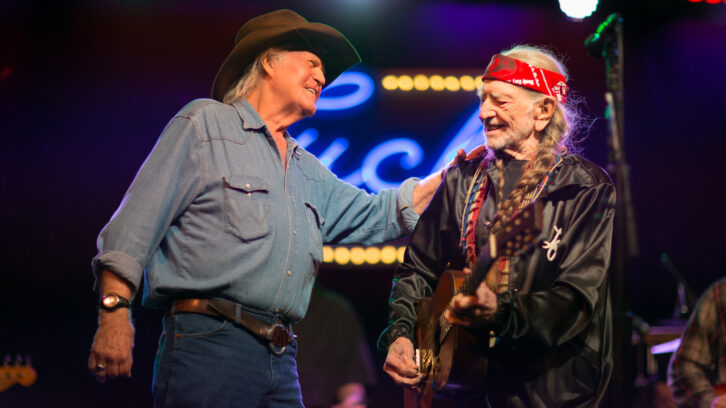
Billy Joe Shaver with longtime friend Willie Nelson. PHOTO: Cameron L. Gott

“Billy was a seriously spiritual person,” reflects producer/studio owner Freddy Fletcher. “He would whip your ass, but he would do it with the spirit in his heart!”

Fletcher was in high school when he met Billy Joe Shaver, and they became close friends. So, Fletcher has a lifetime of fond memories of Shaver in all his aspects: He was a country outlaw and a devout Christian who insisted that his songs were sent to him by the Lord. He was the writer behind soulful songs like “Live Forever,” but he was also the “Wacko from Waco” who “shot a man in the head, but can’t talk much about it….” He was a wonderful singer whose biggest hits were recorded by other artists, such as Waylon Jennings, Johnny Cash and John Anderson.

Following Shaver’s death in 2020, Fletcher was determined to honor his friend’s memory with a tribute album. “He asked me that if something happened to him, I would take care of his music and keep it alive, and I promised I would,” Fletcher says. “I didn’t know a better way to do it, and it’s been a real labor of love.”

Released this month on the New West label, Live Forever: A Tribute to Billy Joe Shaver is a varied collection of Shaver chestnuts and deep cuts, with all profits going to the Central Texas Food Bank.
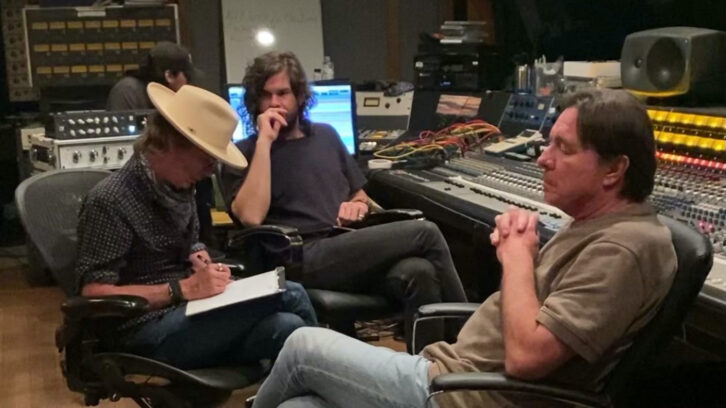
At Arlyn Studios, co-producers Charlie Sexton (left) and Freddy Fletcher (right) confer with chief engineer Jacob Sciba while engineer Joseph Holguin works in the background. PHOTO: Ellee Fletcher Durniak.

Among the artists appearing on Live Forever is guitarist Charlie Sexton, who also co-produced the album with Fletcher. The two of them put together a list of favorite Shaver songs and performers, and some pairings came together organically, such as Rodney Crowell’s track.

“I called him and he said, ‘Man, I love Billy Joe, and you know what? Before a show, I don’t warm up my voice with exercises; I sing ‘Old Five and Dimers,”’ and I said, ‘Well then that’s the song you’re going to do,’” Sexton says.

“Another obvious choice came from the ‘mountain high,’ and when I say the mountain high, I mean Willie,” Sexton continues. “He wanted ‘Live Forever,’ and, of course, it was also the perfect song for him. Miranda Lambert picked ‘I’m Just an Old Chunk of Coal.’ It’s not the first thing you think of when you think of Miranda, but she did such a cool version of that song.”

Other choices required a little more finesse. Nathaniel Rateliff asked to sing “Willy the Wandering Gypsy and Me,” but then so did George Strait. The producers went back to Rateliff, who kindly switched to “You Asked Me To,” a song that he performs as naturally as if it had been written for him.

TEXAS TRACKING

Strait’s track was the first one that came together at Arlyn Studios, the Austin facility that Fletcher and his wife, Lisa, own and operate. Sexton played guitar and ran the session, which included drummer Conrad Choucroun, bass player Glen Fukunaga, pedal steel player Ricky Ray Jackson, and fiddle player Warren Hood.

Behind the glass were Fletcher and his chief engineer, Jacob Sciba, who has been with Arlyn for more than 20 years. The setup he used was similar for all of the band tracks they made in Austin, give or take a keyboard or a string instrument.

On Sexton’s acoustic guitar, there was a Neumann U47, Tube-Tech CL1b, and Neve mic pre/EQ via the hybrid Neve/API console that Sciba helped the Fletchers rebuild several years ago. Electric guitars were overdubbed, with either a Royer 121 ribbon or a Neumann U87 on the amps.

Electric bass was DI, but Sciba always had a station set up for upright bass: “I line that mic up with the bridge, with the capsule tilted slightly up and 6 to 8 inches away,” he explains. “For me, upright is always a matter of trying to get articulation and a bit of that rubber band sound out of it.”
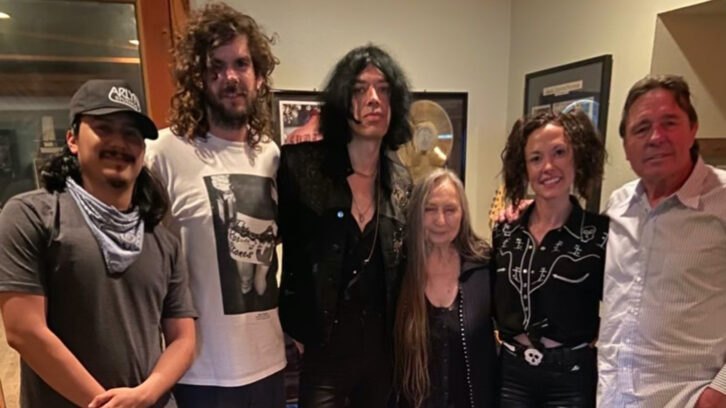
Amanda Shires’ version of “Honky Tonk Heroes” was one of pianist Bobbie Nelson’s last sessions. Pictured, from left, at Arlyn: engineers Joseph Holguin and Jacob Sciba, track producer Lawrence Rothman, Nelson, Shires and Freddy Fletcher. PHOTO: Ellee Fletcher Durniak.

On tracks that included piano, Sciba used a pair of Neumann KM86s, plus a U47 or M49 mono mic. “Normally, I like the right-hand 86 placed 8 to 12 inches above the hammers, and then the left-hand 86 is 6 inches above the strings but down on the bass board,” he says. “If the piano lid is open, I’ll put that mono mic by the curve of the body of the piano and about halfway between the lid and the soundboard. I always use our Neve 33609 compressor on pianos.”

On most sessions, drums, bass, Sexton’s acoustic and possibly a piano were live, with electric guitars, additional keys or strings, and finally vocals recorded later. On their first tracking day, they cut band tracks for Strait’s song, followed by Ryan Bingham’s “Ride Me Down Easy.”

“In some ways, that painted me into a corner because when we cut Ryan’s tracks, we were still playing a little too straight, no pun intended,” Sexton recalls. “What we were doing was right for George, but for Ryan, our shirts were maybe too neatly pressed, so I did a lot of work on that track after the fact to get a more raw vibe. One thing was, I got out an old ’30s Rickenbacker metal lap steel. Plus Nikki Lane added vocals on that one, and she did not disappoint!”

Billy Joe Shaver: Everybody’s Brother (Compadre)

On Willie Nelson’s “Live Forever,” Sexton cast a different mix of musicians, creating a complex and exotic interpretation of Shaver’s most beloved song.

“The drummer is Ramy Atoun, who has a drum company in Austin where he makes really unique-sounding drums,” Sexton says. “We built up the track from a three-piece with me, Rami, and Glen Fukunaga, and the sounds coming across, particularly on the drums, were definitely not your typical country side-stick hi-hat sound.”

Crowell’s “Old Five and Dimers’” was also recorded at Arlyn, but it was cut live, including Emily Gimble’s Wurlitzer, Kevin Smith on upright bass, and Crowell’s vocal, which was captured by a U67.

“The piano was in its own room, and Charlie was facing Rodney in the main room, with them both on acoustics, but baffled between,” Sciba says. “We have some 4-foot baffles, so your head can be above it, but the mic can be right up on the acoustic and still get enough isolation to track keeper vocals. I believe that’s how Edie [Brickell on ‘I Couldn’t Be Me Without You’] was tracked, too.”
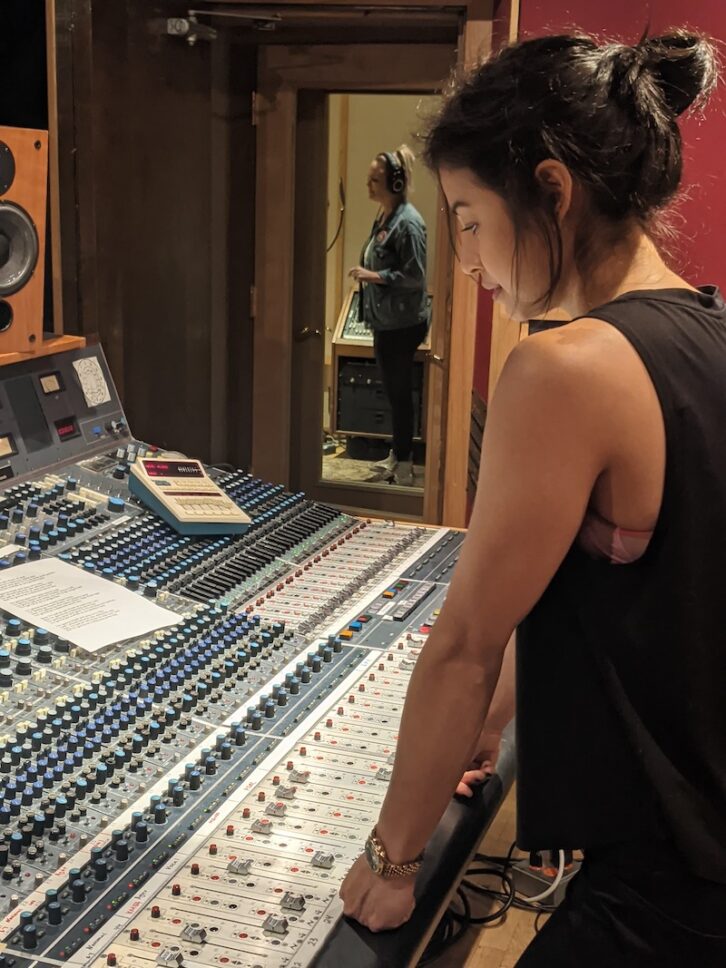
Engineer Shani Gandhi records Miranda Lambert in Blackbird Studio A. PHOTO: Ellee Fletcher Durniak.

ON TO NASHVILLE

Meanwhile in Nashville and beyond, tracks came together on Rateliff, Amanda Shires with Jason Isbell (“Honky Tonk Heroes,”), Margo Price (“Ragged Old Truck”) and Lambert, who worked in Blackbird Studio A with producer Jon Randall, engineer Shani Gandhi, and a band comprising drummer Fred Eltringham, bassist Michael Rinne, Jimmy Wallace on piano, Bryan Sutton on National guitar and mandolin, and Jessi Alexander and Randall singing backup.

“JR hired the best of the best,” says Gandhi. “And Blackbird A is the best of the best, but JR didn’t want them to sound too clean and shiny. When I was doing my mic list—even though clean and shiny is kind of my bag—I always made sure to have a ribbon in the stereo pair, to make everything sound gushier.”

“Chunk of Coal” was tracked live, including Lambert’s vocal. “Miranda was singing in the booth just off the control room,” Gandhi says. “There’s a room with a grand piano in it, where Jimmy Wallace was along with Mike Rinne, though we didn’t amp the bass, so there was no bleed.

“We had Bryan Sutton in a smaller iso booth next to them, and in between was Fred on drums. He started on a standard kit, but apparently it seemed too clean and too square. He said, ‘No, I hate this,’ and suddenly I heard clankclankclank as he dragged the floor tom case across the floor. The kick sound that he ended up with was him stomping on that plastic case, and he was holding a shaker and playing snare with his left hand—sort of a one-man-band situation.

“I had several mics for the case because we were tracking live and I wanted to make sure something would work,” Gandhi continues. “We ended up with a U47 FET, getting the most intense low end you could imagine, and a KM54 at his foot to get the ‘beater’ sound, if you will. I also had an [AEA] R84 pointing at the ‘kick’ farther away.”

On Lambert’s vocal, Gandhi used an M49 through the pres in the studio’s Neve 8078 board, plus GML EQ and a Fairchild limiter. She obviously had the “best of the best” gear handy, but Randall made sure to inject enough grit to fit Shaver’s lyrics and style.

Live Forever: A Tribute to Billy Joe Shaver ends with Allison Russell’s bluesy, haunting “Tramp on Your Street,” about a young man walking 10 miles barefoot to see Hank Williams perform. It’s a story that resonates with every music fan who’s felt an intense emotional connection to an artist’s work.

“I’m so glad Allison wanted to do that song because she just kills it,” Fletcher says. “That song is a true story, and Billy was that kid. All his songs are true stories. He didn’t sit in an office and write; he lived them.”

‘Live Forever: A Tribute to Billy Joe Shaver’ Benefit Album Features Stars, Friends and Fans

Billy Joe Shaver with longtime friend Willie Nelson. PHOTO: Cameron L. Gott

“Billy was a seriously spiritual person,” reflects producer/studio owner Freddy Fletcher. “He would whip your ass, but he would do it with the spirit in his heart!”

Fletcher was in high school when he met Billy Joe Shaver, and they became close friends. So, Fletcher has a lifetime of fond memories of Shaver in all his aspects: He was a country outlaw and a devout Christian who insisted that his songs were sent to him by the Lord. He was the writer behind soulful songs like “Live Forever,” but he was also the “Wacko from Waco” who “shot a man in the head, but can’t talk much about it….” He was a wonderful singer whose biggest hits were recorded by other artists, such as Waylon Jennings, Johnny Cash and John Anderson.

Following Shaver’s death in 2020, Fletcher was determined to honor his friend’s memory with a tribute album. “He asked me that if something happened to him, I would take care of his music and keep it alive, and I promised I would,” Fletcher says. “I didn’t know a better way to do it, and it’s been a real labor of love.”

Released this month on the New West label, Live Forever: A Tribute to Billy Joe Shaver is a varied collection of Shaver chestnuts and deep cuts, with all profits going to the Central Texas Food Bank.

At Arlyn Studios, co-producers Charlie Sexton (left) and Freddy Fletcher (right) confer with chief engineer Jacob Sciba while engineer Joseph Holguin works in the background. PHOTO: Ellee Fletcher Durniak.

Among the artists appearing on Live Forever is guitarist Charlie Sexton, who also co-produced the album with Fletcher. The two of them put together a list of favorite Shaver songs and performers, and some pairings came together organically, such as Rodney Crowell’s track.

“I called him and he said, ‘Man, I love Billy Joe, and you know what? Before a show, I don’t warm up my voice with exercises; I sing ‘Old Five and Dimers,”’ and I said, ‘Well then that’s the song you’re going to do,’” Sexton says.

“Another obvious choice came from the ‘mountain high,’ and when I say the mountain high, I mean Willie,” Sexton continues. “He wanted ‘Live Forever,’ and, of course, it was also the perfect song for him. Miranda Lambert picked ‘I’m Just an Old Chunk of Coal.’ It’s not the first thing you think of when you think of Miranda, but she did such a cool version of that song.”

Other choices required a little more finesse. Nathaniel Rateliff asked to sing “Willy the Wandering Gypsy and Me,” but then so did George Strait. The producers went back to Rateliff, who kindly switched to “You Asked Me To,” a song that he performs as naturally as if it had been written for him.

TEXAS TRACKING

Strait’s track was the first one that came together at Arlyn Studios, the Austin facility that Fletcher and his wife, Lisa, own and operate. Sexton played guitar and ran the session, which included drummer Conrad Choucroun, bass player Glen Fukunaga, pedal steel player Ricky Ray Jackson, and fiddle player Warren Hood.

Behind the glass were Fletcher and his chief engineer, Jacob Sciba, who has been with Arlyn for more than 20 years. The setup he used was similar for all of the band tracks they made in Austin, give or take a keyboard or a string instrument.

On Sexton’s acoustic guitar, there was a Neumann U47, Tube-Tech CL1b, and Neve mic pre/EQ via the hybrid Neve/API console that Sciba helped the Fletchers rebuild several years ago. Electric guitars were overdubbed, with either a Royer 121 ribbon or a Neumann U87 on the amps.

Electric bass was DI, but Sciba always had a station set up for upright bass: “I line that mic up with the bridge, with the capsule tilted slightly up and 6 to 8 inches away,” he explains. “For me, upright is always a matter of trying to get articulation and a bit of that rubber band sound out of it.”

Amanda Shires’ version of “Honky Tonk Heroes” was one of pianist Bobbie Nelson’s last sessions. Pictured, from left, at Arlyn: engineers Joseph Holguin and Jacob Sciba, track producer Lawrence Rothman, Nelson, Shires and Freddy Fletcher. PHOTO: Ellee Fletcher Durniak.

On tracks that included piano, Sciba used a pair of Neumann KM86s, plus a U47 or M49 mono mic. “Normally, I like the right-hand 86 placed 8 to 12 inches above the hammers, and then the left-hand 86 is 6 inches above the strings but down on the bass board,” he says. “If the piano lid is open, I’ll put that mono mic by the curve of the body of the piano and about halfway between the lid and the soundboard. I always use our Neve 33609 compressor on pianos.”

On most sessions, drums, bass, Sexton’s acoustic and possibly a piano were live, with electric guitars, additional keys or strings, and finally vocals recorded later. On their first tracking day, they cut band tracks for Strait’s song, followed by Ryan Bingham’s “Ride Me Down Easy.”

“In some ways, that painted me into a corner because when we cut Ryan’s tracks, we were still playing a little too straight, no pun intended,” Sexton recalls. “What we were doing was right for George, but for Ryan, our shirts were maybe too neatly pressed, so I did a lot of work on that track after the fact to get a more raw vibe. One thing was, I got out an old ’30s Rickenbacker metal lap steel. Plus Nikki Lane added vocals on that one, and she did not disappoint!”

Billy Joe Shaver: Everybody’s Brother (Compadre)

On Willie Nelson’s “Live Forever,” Sexton cast a different mix of musicians, creating a complex and exotic interpretation of Shaver’s most beloved song.

“The drummer is Ramy Atoun, who has a drum company in Austin where he makes really unique-sounding drums,” Sexton says. “We built up the track from a three-piece with me, Rami, and Glen Fukunaga, and the sounds coming across, particularly on the drums, were definitely not your typical country side-stick hi-hat sound.”

Crowell’s “Old Five and Dimers’” was also recorded at Arlyn, but it was cut live, including Emily Gimble’s Wurlitzer, Kevin Smith on upright bass, and Crowell’s vocal, which was captured by a U67.

“The piano was in its own room, and Charlie was facing Rodney in the main room, with them both on acoustics, but baffled between,” Sciba says. “We have some 4-foot baffles, so your head can be above it, but the mic can be right up on the acoustic and still get enough isolation to track keeper vocals. I believe that’s how Edie [Brickell on ‘I Couldn’t Be Me Without You’] was tracked, too.”

Engineer Shani Gandhi records Miranda Lambert in Blackbird Studio A. PHOTO: Ellee Fletcher Durniak.

ON TO NASHVILLE

Meanwhile in Nashville and beyond, tracks came together on Rateliff, Amanda Shires with Jason Isbell (“Honky Tonk Heroes,”), Margo Price (“Ragged Old Truck”) and Lambert, who worked in Blackbird Studio A with producer Jon Randall, engineer Shani Gandhi, and a band comprising drummer Fred Eltringham, bassist Michael Rinne, Jimmy Wallace on piano, Bryan Sutton on National guitar and mandolin, and Jessi Alexander and Randall singing backup.

“JR hired the best of the best,” says Gandhi. “And Blackbird A is the best of the best, but JR didn’t want them to sound too clean and shiny. When I was doing my mic list—even though clean and shiny is kind of my bag—I always made sure to have a ribbon in the stereo pair, to make everything sound gushier.”

“Chunk of Coal” was tracked live, including Lambert’s vocal. “Miranda was singing in the booth just off the control room,” Gandhi says. “There’s a room with a grand piano in it, where Jimmy Wallace was along with Mike Rinne, though we didn’t amp the bass, so there was no bleed.

“We had Bryan Sutton in a smaller iso booth next to them, and in between was Fred on drums. He started on a standard kit, but apparently it seemed too clean and too square. He said, ‘No, I hate this,’ and suddenly I heard clankclankclank as he dragged the floor tom case across the floor. The kick sound that he ended up with was him stomping on that plastic case, and he was holding a shaker and playing snare with his left hand—sort of a one-man-band situation.

“I had several mics for the case because we were tracking live and I wanted to make sure something would work,” Gandhi continues. “We ended up with a U47 FET, getting the most intense low end you could imagine, and a KM54 at his foot to get the ‘beater’ sound, if you will. I also had an [AEA] R84 pointing at the ‘kick’ farther away.”

On Lambert’s vocal, Gandhi used an M49 through the pres in the studio’s Neve 8078 board, plus GML EQ and a Fairchild limiter. She obviously had the “best of the best” gear handy, but Randall made sure to inject enough grit to fit Shaver’s lyrics and style.

Live Forever: A Tribute to Billy Joe Shaver ends with Allison Russell’s bluesy, haunting “Tramp on Your Street,” about a young man walking 10 miles barefoot to see Hank Williams perform. It’s a story that resonates with every music fan who’s felt an intense emotional connection to an artist’s work.

“I’m so glad Allison wanted to do that song because she just kills it,” Fletcher says. “That song is a true story, and Billy was that kid. All his songs are true stories. He didn’t sit in an office and write; he lived them.”

Capturing a Grammy Awards Like No Other

Typically held in Los Angeles’ Staples Center arena, this year’s Grammy Awards show was largely pre-taped on sets next door at the Los Angeles Convention Center.
Typically held in Los Angeles’ Staples Center arena, this year’s Grammy Awards show was largely pre-taped on sets next door at the Los Angeles Convention Center. Getty Images for The Recording Academy

Los Angeles, CA—With pandemic protocols still in place and a new producer at the helm, the 63rd Grammy Awards show was very different from previous years. For the veteran audio team behind the annual television event, that meant throwing away the old playbook and starting virtually from scratch.

With no possibility of getting 20,000 people together in the Staples Center, the event’s longtime home, producers moved this year’s awards show next door to the Los Angeles Convention Center. In media interviews ahead of the broadcast, new producer Ben Winston challenged viewers to guess what was live and what was pre-recorded. The answer was actually simple—only the award presentations were live on the night.

COVID-19 protocols put a stamp on the entire proceedings, says Michael Abbott, who has been the show’s audio coordinator for more than three decades. For one thing, he says, “I was in an office by myself,” in the middle of the outdoor “truck farm” alongside the Denali broadcast remote trucks, M3 music mixing trucks and other temporary offices.

“Two Gelcos were also provided for the Pro Tools operators, JP Velasco and Aaron Walk,” says Abbott. “Adjacent to that was our file transfer room with Glenn Lorbecki, who managed the artist approvals. We also had a mixer, Paul Wittman, who was monitoring and QCing audio for the participants on Zoom.”

Production mixer Mikael Stewart managed the outdoor live award presentations and other elements on a DiGiCo SD10.
Production mixer Mikael Stewart managed the outdoor live award presentations and other elements on a DiGiCo SD10. Getty Images for The Recording Academy

Inside, one of the convention center’s massive halls was outfitted with a set comprising an entranceway—a giant gramophone horn—and five stages facing each other, with adjoining isolated artist holding areas. Adjacent to the set was an audio area crewed by socially distanced PA mixer Jim Ebdon, at a DiGiCo SD12, Michael Parker and Andres Arango at monitors on a pair of SD5s, and Ian Guitierrez, at an SD21, monitoring the RF microphone signals. On the night, production mixer Mikael Stewart managed the outdoor live award presentations and other elements on a DiGiCo SD10.

“For the most part, we maintained the same workflow as usual,” says Abbott, except that artists’ teams were not allowed into the M3 trucks to advise on the mixes due to protocols. Instead, engineers and producers sat at listening stations in the hall with headphones and a video screen to monitor their artist’s performance. A hands-free intercom footswitch enabled real-time interaction with M3 music mixers John Harris or Eric Schilling.

Miranda Lambert’s appearance was part of a three-song show opening all shot in one pass.
Miranda Lambert’s appearance was part of a three-song show opening all shot in one pass. Getty Images for The Recording Academy

The 22 artists and groups visited the set in the days leading up to the Sunday broadcast to capture their performances individually, with some exceptions. “The cold open walk-in to the hall and the three back-to-back performances was a pre-tape that we did in one pass,” says Abbott. “And Mickey Guyton, Miranda Lambert and Maren Morris were all done in one pass. The In Memoriam segment was done on multiple days and pieced together. It requires a lot of attention to detail to make sure you’re not painting yourself into a corner for the edit, or else the sequencing and segues won’t match.”

BTS, unable to travel due to coronavirus restrictions, filmed their performance on a duplicate set in Seoul, S. Korea.

Grammy Awards Show Begins Transition to AoIP

With no audience for the performances, there was no need for a PA—well, almost. To ensure that there would be some energy in the room for performers to feed off, production provider ATK ground deployed some of its C6 speaker boxes due to weight constraints of the convention center’s grid and positioned a pair of JBL subs at the corners of the five stages. “We took a music stem and a vocal stem from the M3 trucks. Jim Ebdon did a PA mix with those stems, audio and video playbacks, host mics and a variety of other elements,” says Abbott.

The novel production setup added significantly to the workload, he says. “I had said for a couple of months that if we’re going to pre-tape, we’re going to end up re-mixing. I tallied them up, because I was so exhausted the day after the Broadcast—we did 75 remixes, sent and approved, on the Friday before the show.”