Author Archives: Ken Micallef

Acoustic Signature’s Maximus NEO Turntable Is Max Quiet With a Clean Soundstage and Excellent Dynamics

Some turntables can be true objects of art. Indeed, some ’tables can even look downright exotic or even somewhat otherworldly in the photos we see of them — but in person and in practice, they actually look quite beautiful, and work really well. Fact is, regardless of any turntable’s looks, bells, and whistles, at the end of the day, it all comes down to solid and experienced engineering, whether it be by adding mass to deaden resonances or adapting the light-as-a-feather frame approach for ultimate PRaT (a.k.a. Pace, Rhythm, and Timing).

Such were my initial impressions of all the NEO series turntables I had seen from the German manufacturer Acoustic Signature. When looking at the photos of their top-of-the-line ’tables here on AnalogPlanet and elsewhere, they can appear as if they’d been designed for emperors with Versailles or intergalactic travel on their mind.

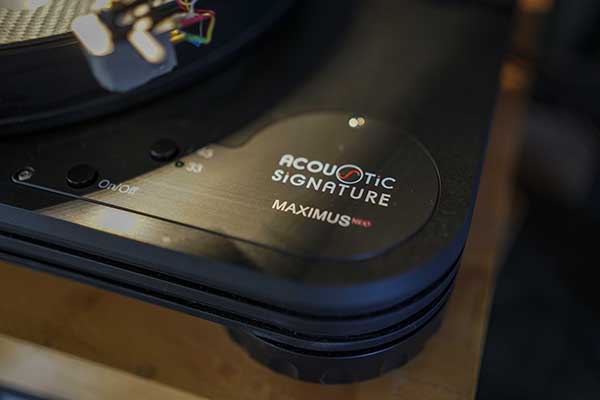
All that said, I wanted to get one of these turntables in hand to see (and hear) for myself, and when I unboxed the subject of this particular review — the Acoustic Signature Maximus NEO turntable — from its form-fitting, custom foam-rubber packaging inside its very solid cardboard box, I was floored by its looks, its performance capability, and its extremely smart and well-considered design. Granted, the name “Maximus NEO” sounds like an unholy alliance of Roman gladiator bloodletting and ’80s-era New Wave fashion, but make no mistake — the Maximus NEO is an exceptional turntable.

And well it should be, you might say, for the asking price of the version I reviewed here comes in as follows: the Maximus NEO turntable itself has an SRP of $4,995; the TA-1000 NEO tonearm is $2,495; and the Maximus MCX3 moving coil cartridge is $1,695. (Yes, you can order the Max NEO with less-expensive options, but still.) At close to $9,200 all-in, the Maximus NEO packages punches well above its class.

 0117apturntablereview.AS.DSC03523.JPG

Specs & Features

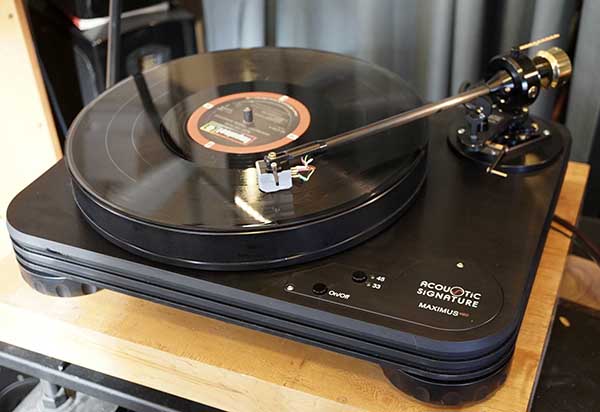
Handmade in Germany, the Maximus NEO — successor to the manufacturer’s still popular Maximus turntable — features an AC motor with external “super-stable multi-voltage power supply” and integrated digital motor controller; Acoustic Signature’s AVC (Automatic Vibration Control) technology; an “Ultraprecise, extremely rigid and robust DTD [Dura Turn Diamond] Bearing with diamond-coated spindle”; a resonance-reducing, aluminum alloy chassis; an aluminum platter; gel-damped adjustable feet; and a five-year warranty (with registration).

In short, Acoustic Signature ’tables, from the top-of-the-line $200K Invictus NEO to the lower-tier Maximus NEO, are overbuilt, beautifully designed, feature innovative technology, and are destined for heirloom status. As with most serious hi-fi manufacturers, lower-tier products often benefit from trickle-down technology, and the Maximus NEO gives you a taste of the company’s top-tier goods via the mostly aforementioned Dura Turn Diamond Bearing, Automatic Vibration Control, and Constraint Layer Damping feature set.

According to the company’s site, “The Dura Turn Diamond Bearing is a super-rigid and virtually ‘indestructible’ bearing that creates the best possible conditions for absolute high-end sound and sets a new benchmark in terms of maintenance, low noise and service life — backed by a 15-year warranty. The DTD Bearing is manufactured for each turntable in the Acoustic Signature NEO series in an individual version adapted to the respective turntable.”

Additionally, the site describes the AVC Automatic Vibration Control as thus: “Every rotating motor generates vibrations [that are] transmitted to the chassis and platter and have a negative effect on the sonic performance of a turntable. Accordingly, it is important to effectively reduce undesired vibrations or even better prevent them from occurring in the first place — so much for the theory. All AC synchronous motors show production-related tolerances that prevent its internal poles and coils from being positioned one hundred percent correctly. Our AVC technology measures the resulting distortions in real time. Based on those measurements, AVC adjusts the phase shifts to the motor signals — also in real time and fully automatic! These digitally monitored corrective measures ensure a drastic reduction of the vibrations — an extra effective benefit for turntables driven by a multi-motor concept.”

Finally, the AS site tells us, “Constraint Layer Damping (CLD) is a mechanical engineering method for the absorption or minimization of vibrations. Our tests led to an optimized material combination consisting of two layers of a special aluminum alloy and an intermediate brass layer. A rigid, yet energy-absorbing chassis based on finite element design principles, and our new CLD approach creates unbeatable units in terms of resonance behavior.”
 0117apturntablereview.AS.DSC03527.JPG

The gimbal-style TA-1000 NEO tonearm comes with high-quality Mogami cabling, features a dual-layer carbon armtube and a low-resonance, rigid tube design using precision miniature ball bearings and a stainless-steel tonearm bearing housing. The tonearm is supplied with an AudioQuest 5-pin copper phono cable (RCA), a brass counterweight, adjustable VTA and azimuth, an anti-skating weight, both Rega- and SME-type mounts, and it comes with a five-year warranty.

Built by Ortofon to Acoustic Signature’s specs, the Acoustic Signature MCX3 moving-coil cartridge features a nude fine-line stylus for exceptional detail retrieval, high-purity copper coils, and a CNC-milled and resonance-optimized chassis.

 0117apturntablereview.AS.DSC03566.JPG

All of this results in one of quietest turntables I’ve ever heard, making my Thorens TD-124 sound like a truck rumbling over cobblestone streets, in terms of noise. The Max NEO produces exceptionally black backgrounds, a large soundstage, excellent dynamics and detail retrieval, fine tonal shading and instrumental layering, and an overall level of quality that befits its admittedly hefty price tag.

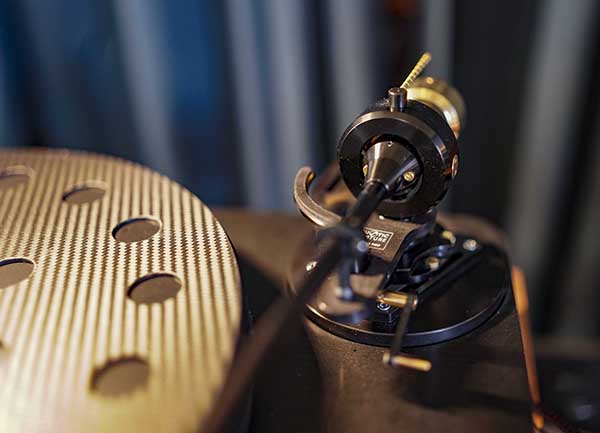
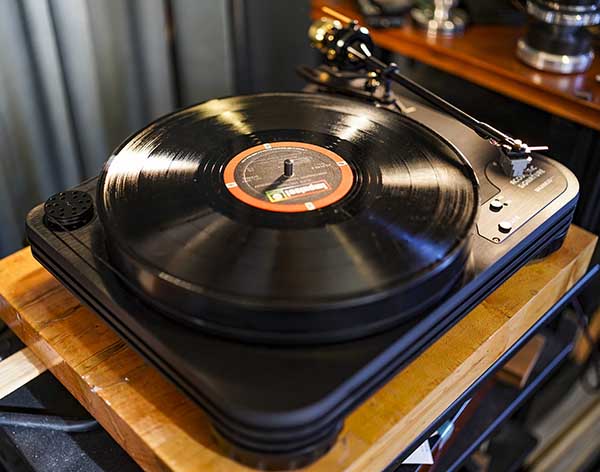
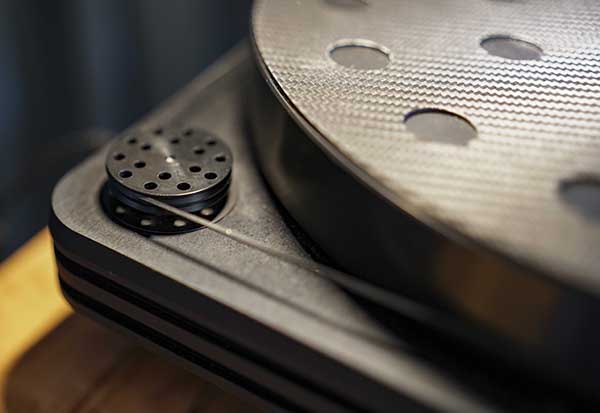
The two-speed, belt-driven Maximus NEO uses an aluminum alloy in its plinth and footers. Aluminum is also used in the turntable’s large, 12.8lb platter. The spindle is made of plasma-coated stainless steel to achieve a super-hard surface. The NEO’s belt is made of precision-grinded rubber, attached to a drive pulley made of POM-C (copolymer acetal) plastic. The included mat, with evenly spaced holes, is made of carbon fiber and seems partially designed to dampen resonances. It has a textured, linen-type feel.

According to AS sales manager Robert Hagemann, the Maximus NEO turntable was voiced using “different setups in the demo room, electronics from Accuphase, McIntosh, Burmester, Mark Levinson, and VAC, [and the] speakers are from JBL, Dynaudio, B&W, and Wilson Audio.”

Not only was this turntable nicely/tightly packaged in form-fitting, PE (polyethylene closed-cell) foam rubber, Acoustic Signature provides helpful YouTube videos on unboxing and setting up the turntable and tonearm (see below). Acoustic Signature makes the process of assembling one of their turntables a satisfying, assuring experience. Needless to say, the manuals were also state of the art, with numbered parts, clear language, and — hold on — illustrations!

Setup

AS includes their own metal alignment tool, but, as always, I used my Feickert Universal protractor. Tracking force of 2.3g was dialed in with a Riverstone Audio gauge. (I’ve found cheap digital gauges are available, as online ones are prone to error.) The supplied counterweight had to be pushed so far back on the tonearm to achieve the correct tracking force that I inverted the weight, so the internal screws would have something to affix to.

For this review, I connected the Maximus NEO to my Tavish Design Adagio phono stage attached to a Mastersound Compact 845 or PrimaLuna EVO 400 integrated amplifier, with a pair of Shindo interconnects affixing phono stage to amp. The amp powered a pair of either DeVore Fidelity O/96, Volti Audio Razz, or MoFi SourcePoint 10 speakers. Analysis Plus speaker cables completed the sonic loop, as it were. I compared the Maximus NEO with the aforementioned Tavish Design Adagio phono stage ($1,895) combo to my Kuzma Stabi R turntable ($8,879), Kuzma 4Point tonearm ($5,696), and Clearaudio Jubilee Panzerholz cartridge ($6,600) setup through a Pathos In The Groove phono stage ($1,895).

A small button turns on the Max NEO, with choice of 33 or 45rpm playback. Once the button is depressed, it takes a solid 6 seconds to attain the correct speed.
 0117apturntablereview.AS.DSC03550.JPG

Listening Sessions

What first amazed me about the Max NEO was its dead silence. I currently own two turntables — 1) a Thorens TD 124 with Jelco 350 S tonearm and EMT TSD 15 N MC cart, and 2) the previously mentioned Kuzma Stabi R combo. Both of those ’tables weigh more than the Max NEO. There was an absolute improvement in clarity, soundstaging, and noise reduction playing the Max NEO vs. the Thorens (even though the Thorens has been upgraded with new springs and lowered motor). The difference wasn’t subtle. The Kuzma is an entirely different beast requiring two sumo wrestlers to move, and it’s as silent as a deep space telescope. Its soundstage is like diving into the Grand Canyon. While the Max NEO is closer in performance to the Thorens, it wiped the floor with the Swiss legacy product regarding noise-free — or, should I say, rumble-free playback, and black-silent soundstage depth. When the noise floor drops, well, it’s a whole new ballgame.

While the Max NEO didn’t match the Thorens for bolting-out-of-the-gate drive, energy, and power, it did produce a larger, cleaner soundstage with a more balanced frequency range, cleaner bass and highs, and a sweeter overall sound. The EMT, like the Denon DL 103, is a dynamics and texture king, while the AS MCX3 cart is sweeter overall, a mite more laid-back, perhaps more conservative. But it rendered detail, in all styles of music, in more holistic fashion, and was more relaxed.
 0117apturntablereview.AS.DSC03563.JPG

I played three LPs for comparisons and evaluation here: 1) Ben Sidran’s The Cat and the Hat (1979; Horizon (3) – SP-741); 2) Charlie Haden’s The Golden Number (1977; Horizon (3) – SP-727); and 3) Björk’s Utopia (2017; One Little Indian – tplp1381).

Most cognoscenti agree drummer Steve Gadd’s greatest solo is on Steely Dan’s “Aja.” [Myself included!—MM] I would add to that his speedball-driven, mania-inducing, super-slamming and equally dance-like drum solo from Ben Sidran’s The Cat and the Hat version of Miles Davis and Victor Feldman’s “Seven Steps to Heaven.” Featuring a crack studio lineup, the song burns through Afro-Cuban and straight-ahead sections culminating in Gadd’s ferocious solo. The Kuzma/Clearaudio/Pathos rig put Gadd in my room, with his Yamaha Custom Recording series drums before me. His snare and bass drum had Iron Mike-like slam and attack, in huge images. Gadd is menacing here, and this rig dropped a bomb on me, the music being immediate, visceral, and powerful.

The Max NEO/Tavish rig couldn’t match that slam and attack per se, but it actually bettered the way more expensive rig in terms of 1) tone, which was sweeter; 2) naturalism, which let me relax into the music; and 3) a less dynamic top-end, which was lighter but perhaps more natural, if recessed.

Moving on to Charlie Haden’s “Out of Focus,” which features double-tracked acoustic bass and trumpet, Haden plays strummed chords over long arco notes and individual string plucking on his bass, which is soon joined by Don Cherry’s pocket trumpet. The Kuzma rig made a meaty meal of Charlie with huge, deep-toned rhythms and large images. The Kuzma plays everything with titanic force, Charlie’s basswork filling my room with stentorian gravitas.

The Max NEO pulled the same trick as with the Sidran LP, playing the music with less weight but perhaps more natural flow in smaller images that were perhaps clearer, especially in the long arco notes. Trumpet was less scalding and powerful, but a little creamier and lighter on the ear. The Pathos phono stage works well with the Max NEO, adding tube bloom, tone, and flow. (The Tavish is my choice in general over the Pathos, which is why I paired the weaker stage with the more expensive ’table.)

Finally, Björk’s “Utopia,” from the album of the same name, is a unique combination of Björk’s always stirring vocals, orchestral sounds that replicate Amazon rainforest creatures, and an ominous flash of rushing, rustling low notes that intimate a goliath sea creature flying through the netherworld. It’s like Stravinsky writing for The Jungle Book, with the Glinda the Good Witch of the North as our guide.

The Kuzma played Björk in my room, turning it into Lincoln Center — or perhaps The Metropolitan Opera — so humungous and convincing. But with its added tube sound, the Max NEO had arguably sweeter tone and inarguably clearer low bass.

The Acoustic Signature Maximus NEO bettered my Thorens TD-124 in terms of dead-silent sound and black backgrounds, but couldn’t match its kick-ass dynamo-hum party power. And while it couldn’t raise its game to match my Kuzma’s awesome power, Atlas-worthy weight, and giant images, the Max NEO acted like David to its Goliath, playing with sweeter tone, more natural flow, and a cleaner, if lighter low-end.

Conclusions

Coming in at the $9,200 turntable ballpark complete with tonearm and cartridge included, the Acoustic Signature Maximus NEO combo as reviewed here goes up against the following: 1) J.Sikora Initial ($9,495 without tonearm or cart); 2) Kuzma Stabi R with one arm wing ($8,845, and no tonearm or cart); 3) Rega Planar 10 ($6,375, sans cartridge); 4) Thorens TD 124 DD ($11,999 w/TP 124 tonearm but no cart); and 5) SME Model 6 ($8,995 with SME M2-9 tonearm).

That’s some tall cotton to be measured against, to be sure. But the Acoustic Signature Maximus NEO turntable juts out its chin and demands an audition. It’s a well-built machine that’s dead-quiet, fast off the mark, super-resolving, and uber-lively. In short, it’s a maximally great turntable well worth checking out. Gut gemacht!
 0117apturntablereview.AS.DSC03528.JPG

For more information about all the Acoustic Signature NEO series offerings, go here.

If you want to find distributor info, go here — and follow the menu prompts to locate one in your region of the world at large.

Author bio: Former musician, former artist, and former legal wastrel Ken Micallef has written numerous hi-fi equipment reviews for Stereophile and AnalogPlanet, and his byline has also appeared within Mojo, Electronic Musician, and The Grammys. You can also find him at YouTube (Ken Micallef Jazz Vinyl Audiophile).

 0117apturntablereview.AS.DSC03524.JPG

Melissa Aldana

Bassist Ron Carter, world-renowned musician and most-recorded jazz bassist of all time, said in an interview for Stereophile‘s Musicians as Audiophiles that he sees himself not just as a bassist but also as a scientist, forever striving to understand and perfect the sound of his recordings. Chile-born saxophonist Melissa Aldana, a stunningly expressive jazz musician, shows similar dedication to her art, studiously investigating the century-long history of the genre.

Melissa Aldana

Photos by Eduardo Pavez Goye.


Bassist Ron Carter, world-renowned musician and most-recorded jazz bassist of all time, said in an interview for Stereophile‘s Musicians as Audiophiles that he sees himself not just as a bassist but also as a scientist, forever striving to understand and perfect the sound of his recordings. Chile-born saxophonist Melissa Aldana, a stunningly expressive jazz musician, shows similar dedication to her art, studiously investigating the century-long history of the genre.


Aldana started saxophone lessons at age 6 under the tutelage of her father, Marcos Aldana. Her technique and musicality progressed steadily, influenced by a pantheon of great alto and tenor saxophonists, Sonny Rollins in particular. She went on to study at Boston’s Berklee College of Music, graduating in 2009. Just four years later, she won the prestigious Thelonious Monk international jazz saxophone competition—the first female musician and the first South American to win that competition. (Marcos Aldana was a semifinalist, in 1991.) The prize: a $25,000 scholarship to the Monk Institute and a recording contract with Concord Jazz. In 2020, she joined the New England Conservatory’s Jazz Studies faculty.


Videos posted to her Instagram feed (melissaaldanasax) hint at the breadth of her mastery: She is heard maneuvering through slow, calm passages and blurringly fast sequences, from high-pitched birdcalls to deep, low rumbles. One also hears an ease of flow, precision, and clarity, and an occasional, unexpected softness.


When I heard her in concert at The Jazz Gallery in New York City, presenting material from her Blue Note release 12 Stars, Aldana and her ensemble—guitarist Mike Moreno, acoustic bassist Pablo Menares, pianist Sullivan Fortner, and drummer Kush Abadey—performed as a single organism, soaring through the graceful, often complex material with frenetic ease.


123aldana.12StarsCover


12 Stars, her sixth album as leader and her first on the Blue Note label, was released in 2022. It was recorded and mixed by James Farber at Samurai Hotel Studio in Astoria, Queens, and Sear Sound in New York City, and mastered by Mark Wilder. Vinyl was cut by Ian Sefchick at Elysian Masters in Los Angeles.


On 12 Stars, Aldana and her bandmates roam the precipitous slopes of a dreamscape. “Falling” conjures bliss weighed by a sense of foreboding as soothing cascades of golden iridescence from guitarist Lage Lund and pianist Fortner are punctuated by Aldana’s dark squalls and turbulent rhythms. A bolero rhythm underpins the regal, adventurous “Intuition.” Quavering, spectral “Emilia” sounds surreal and spooky. Inspired by Toni Morrison’s first novel, “The Bluest Eye” projects disquietude, like a descent from a vertiginous peak. Effortlessly pulsing, “The Fool” has the mood of a Michael Brecker composition from his Impulse! period, Aldana dancing and swerving. “Los Ojos de Chile” swells and surges, Aldana’s quartet passing around and juggling. The title track closes the album with a tremble, a fading dream slowly giving way to consciousness. The whole album, even the more frenetic passages, is permeated by a sense of calm control.


123aldana.AndCrashTrioCover


Aldana’s previous album, Visions, was a tribute to the life and work of Mexican painter Frida Kahlo. Other albums in her discography include Free Fall (Inner Circle), Second Cycle (Inner Circle), Melissa Aldana & Crash Trio (Concord Jazz), and Back Home (Wommusic). Aldana has also performed as part of the all-female jazz supergroup Artemis, with Anat Cohen, Ingrid Jensen, Allison Miller, Renee Rosnes, Cécile McLorin Salvant, and Noriko Ueda; their debut was released on Blue Note in September 2020. Aldana also played on Cécile McClorin Salvant’s Grammy Award–winning album, The Window. (Salvant designed the cover art for both Visions and 12 Stars.)


123aldana.BackHomeCover


My interview with Aldana began with a discussion of tarot, a practice she’s been studying. The interview was edited for concision and style.


Ken Micallef: How was today’s tarot reading?


Melissa Aldana: It was quite interesting. A new thing for me. It felt very natural even though it was unique. My tarot reader mostly described a healing process. I come from an interesting family background. I’m healing from a lot of things. It’s a deep process, and it’s very related to music. He reminded me that I should nurture myself as a person too, not just as a musician. It was beautiful.


Micallef: Your music has a mystical and spiritual quality, the way you and your band glide and twist: It’s like a single organism.


Aldana: I don’t have lyrics to tell you what I’m thinking or feeling, and that is something that I always struggle with. Because I’m feeling a lot of things, and I want to express them in a way that connects with people, through harmony that moves people and tells a story. When you hear Caetano Veloso, you don’t understand the lyrics, but the movement of the harmony tells you the story. My compositions, in an abstract way, are related to that. The way I think about solos is the same. I’m thinking about the bigger picture. I’m not thinking moment to moment. It’s like an out-of-body experience, being able to see the bigger picture of how we all tell stories together.


Micallef: Your recent album, 12 Stars, sounds as if it were composed as a suite, each tune fusing into the next. Your playing is very fluid, complementing that.


123aldana.Aldana-1


Aldana: I wrote the album during the pandemic. I went through a huge crisis. It was a deep, personal crisis. It taught me a lot about myself, about my musical process as well. It helped me to identify the things that I connect through music but that I never applied to my personal life. I’m happy, actually. I’m very happy that it happened because I was trying to make sense out of my own process. I went on a spiritual path, which I’ve always felt but never began. I studied tarot to learn something different.


It’s not necessarily about card divination but about the personal process. I saw the relationship of that with my musical process. I’m a perfectionist. The fluidity you hear comes from hours of practice, every single day. I’ve spent years transcribing one musician, trying to figure out how the person sounds. It’s not the notes; it’s how the musician sounds. It’s important for me to understand where I’m coming from as a saxophone player, meaning that I understand the history from Coleman Hawkins to Mark Turner. And it’s been really hard to let it go because it makes me feel in a safe place.


When I’m playing, I have to be in the moment, and I have to be okay with sometimes falling apart. I have to allow myself to go through that process in order to find who I am. During the pandemic, I basically collapsed. Everything fell down, and I came through the process with much more acceptance of who I am and understanding of my place and the things I need to work on. Music helped me grow through that process, as did the meanings and tenets of the tarot.


123aldana.Aldana-5


Micallef: You went through a marital breakup.


Aldana: Yes, but more than that. It was an accumulation of things, about dealing with my boundaries about who I am. We connect with people through our struggles. We all come from the same place at the end of the day but with different stories. My struggle began at childhood, and it showed up in my relationship with friends and relatives. It was so tough that I had to focus on myself and go inside. I became a hermit, which is also one of the cards of the tarot. It talks about this being a part of the process of life, when you go inside to achieve certain things. I found comfort in the tarot. It has to do with trusting and maturing and getting to know yourself.


Micallef: Over your last few albums, your saxophone sound has become softer but more dynamic. Your sound is more contained and quieter, but it is more powerful.


Aldana: That comes from practicing consistency of tone. Every day, two hours of long tones. Even when I practice the fundamentals, I practice in a way that makes me aware of my plot on the instrument. Aesthetics mean a lot to me. To me, sound is aesthetic. Now that I have my own apartment, I really care about aesthetics and the way things are put together. The details. In the same way, it’s not just about good sound; it’s also about the detail behind the sound. I work a lot on detail. I have a WhisperRoom sound booth where I practice, so nobody can hear me. That way I hear the sound is coming from me, but not from outside. I usually wear headphones, and I can tell every frequency of the sound and I can completely relate in the way whether I like the sound or not. I spend all these hours just trying to figure out one little thing, another little thing, another little thing, and after two years, they add up. That’s the idea of the albums.

Posted in Uncategorized

Pathos InPol Remix MkII integrated amplifier

Sometimes when the world shouts too loudly, I immerse myself in other sounds: in music. I escape the cacophony by diving into my stash of vinyl records (not literally, although that’s a fun image) and reveling in the soundwaves they release. The soundwaves liberated from those physical grooves, combined with impressions stored deep in my hippocampus, never fail to soothe, energize, fascinate, excite.


Reviewing new analog equipment allows me to explore this sonic corporeality and gives me a chance to hear my cherished vinyl discs anew, with a different focus. Sound patterns and song lines are reanimated.


A well-made tube amplifier represents, to me, the pinnacle of sound reproduction—including certain hybrid designs. I have yet to hear a solid state amplifier reproduce the natural tone, realistic timbre, liquidity, physicality, and pure embodiment of recorded musicians that a fine tube amplifier achieves.


Tube amplifiers that have enchanted me over the years include the magnificent E.A.T. E-Glo I integrated amplifier, the tightly focused Luxman SQ-N150 integrated amplifier, the harmonically adept Zesto Leto Ultra II preamplifier, the neuron-altering Komuro 845, the atmospheric Audio Note Ongaku, and of course my Shindo Laboratory Allegro dual-body preamplifier and Shindo Haut-Brion power amplifier.


123pathos.1


But what about hybrid amps—amplifiers that include both tubes and solid state devices? How do they stack up against solid state amps? Against pure tube amps? My answer: It depends.


So when I was asked to review the Italian-made Pathos InPoL Remix MkII integrated amplifier ($5395), which uses both tubes and transistors in an innovative circuit, I dove in ears first.


On the outside
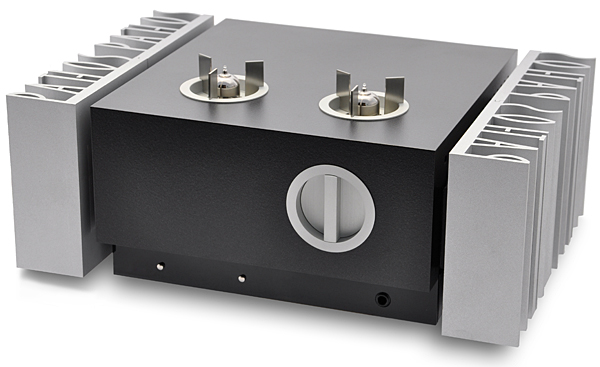
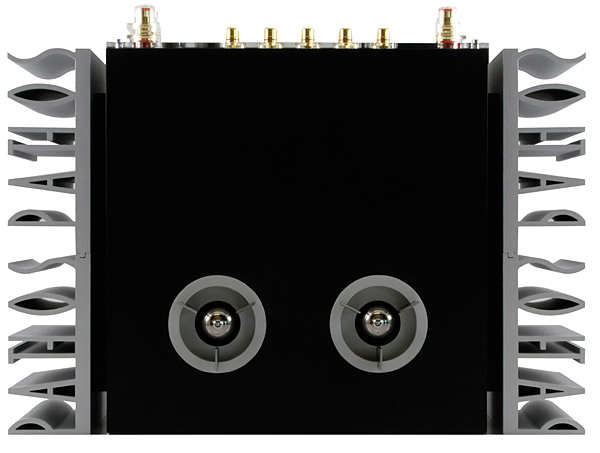
Manufactured in Vicenza and perhaps inspired by the city’s architecture, Pathos amplifiers are visually arresting, with bold lines and a solid stance. The Remix is a fine example, with its contrasting colors, sleek anodized-aluminum volume control knob, and stout, curvaceous, powder-coated heatsinks of extruded aluminum, shaped cleverly to spell out the company name. The amplifier’s bold, industrial exterior exhibits pride in its materials: The top panel is of varnished iron, the bottom plate, cabinet, and internal plates of powder-coated iron. The twin, top-mounted tube rings are aluminum, and the tube fins are stainless steel. All the metal parts are connected with a thermal compound to ensure thermal continuity, Pathos says.


123pathos.bac


“Pathos Acoustics was founded in 1994 by three Italian pioneers, Gaetano Zanini, Gianni Borinato and Paolo Andriolo, in … Vicenza, a sophisticated city in northern Italy famous for its great monuments designed by architect Andrea Palladio,” the Pathos website says. “The tradition of making something outstanding has continued since the days of Palladio.”


The Remix may be small, but, standing on four stubby aluminum feet and weighing 34.2lb, it’s heavier than it looks. On a narrow, recessed panel below a large, matte black fascia, a control panel bears a small silver on/off button; hold it down for standby. To the right are an IR sensor; a red LED, which confirms standby mode; and a three-digit display showing volume level, selected input, brightness, and phase settings. Another small silver button engages analog or digital inputs. There’s also a ¼” headphone jack, which turns off the speaker taps when headphones are plugged in. Above, the big main panel is an expanse of color—black, red, or white—and features just a big volume wheel. Dual ElectroHarmonix E88CC tubes stand sentry atop. A lovely, laser-engraved remote parallels the front panel functions.


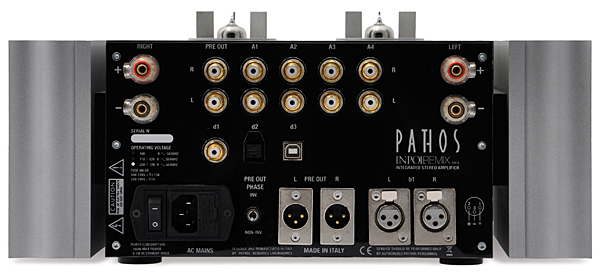
The Remix’s all-business back end consists of speaker terminals, four well-spaced RCA input jacks, one set of XLR (balanced) inputs, a pair of pre-out jacks on RCA, an IEC receptacle, and two pairs of pre-out jacks, one RCA, one XLR. The robust, Taiwan-made RCA jacks are gold-plated. USB, S/PDIF, and TosLink inputs for the optional HiDac Mk2 D/A converter (not included in the review sample), which adds $675 to the price, round out the back-panel features.


123pathos.2


On the inside
The Remix uses transformers from KK Omori Seisakusho from Japan and Costruzioni Elettromeccaniche Taddei from Italy. The power supply is a switching supply: a Mean Well 150W. “The capacitors we choose are high-quality,” said Damiano Zanini, Pathos’s director of research and development, in an email. “Some of them are by Nichicon or Wima, others are by Lelon, a high-quality Chinese brand. Capacitors are all [rated to perform at] 105°C.” Internal wiring is shielded cable by Tasker, an Italian company.


Pathos employs a proprietary, patented design—InPoL, for Inseguitore Pompa Lineare, or Linear Pump Follower—in several of its amplifiers, including the Remix; other Pathos InPoL models include the Heritage, InPower, and Adrenalin (footnote 1). InPoL is Pathos’s technology for providing ample current to a loudspeaker without global negative feedback but with “limited” distortion and an acceptable damping factor. It’s a particular solid state, class-A output-stage topology that uses N-channel transistors—specifically, IRFP240 MOSFETs by Vishay—and mimics the incoming voltage 1:1 so that, Pathos says, it does not change the signal’s harmonic content. “To put it a little more technically, it is a MOSFET running in pure class-A that’s used in a follower configuration”—following those Electro-Harmonix ECC88 tubes, which have already bumped up the voltage—”with a ‘passthrough’ voltage gain of 1, and a high current gain.” That quote is from a document shared with Stereophile by Upscale Distribution, the US Pathos distributor.


Footnote 1: Apparently discontinued but still available.

Posted in Uncategorized