
The build, the finish, the specification and, most importantly of all, the performance all go to make the Debut Pro one of the very best …
Author Archives: Simon Lucas
The build, the finish, the specification and, most importantly of all, the performance all go to make the Debut Pro one of the very best …
The build, the finish, the specification and, most importantly of all, the performance all go to make the Debut Pro one of the very best …
Uncategorized
Cyrus i9-XR
Just as you’re unlikely to mistake a Vivienne Westwood design for anyone else’s work, it seems doubtful you’d ever confuse a Cyrus product with any other brand’s output. Even if it didn’t realise it at the time, the company has been all over the ‘lifestyle’ market since the off, thanks to the distinctive half-width chassis into which it’s squeezed pretty much every product that isn’t a loudspeaker since 1984’s ‘One’ amplifier.
Demands on and expectations of the integrated stereo amplifier have increased more than somewhat in the four decades since the ‘One’ established Cyrus as a bright young thing of British hi-fi, of course. Which brings us, far from coincidentally, to this: the Cyrus i9-XR integrated stereo amplifier.
Start from scratch
At a glance you wouldn’t know it, but with its new ‘XR’ range of electronics Cyrus has pretty much started from scratch. Yes, it looks only and always like a Cyrus product – but the i9-XR features plenty of fresh engineering as well as some ergonomic upgrades, all intended to bring Cyrus into line with some (arguably) higher-profile rivals.
The real headline (as far as real-world consumers are concerned, at least) is the appearance of five digital inputs (two S/PDIF via RCA, two optical via Toslink, and one USB input, all leading to the second generation of Cyrus’ QXR DAC) alongside four line-level analogue inputs and a moving-magnet phono input. The USB-B is capable of handling digital audio files up to 32bit/384kHz and DSD up to 512, while the other four digital inputs are useful up to 24bit/192kHz. So high-resolution digital audio is just as firmly on the menu as is the analogue equivalent.
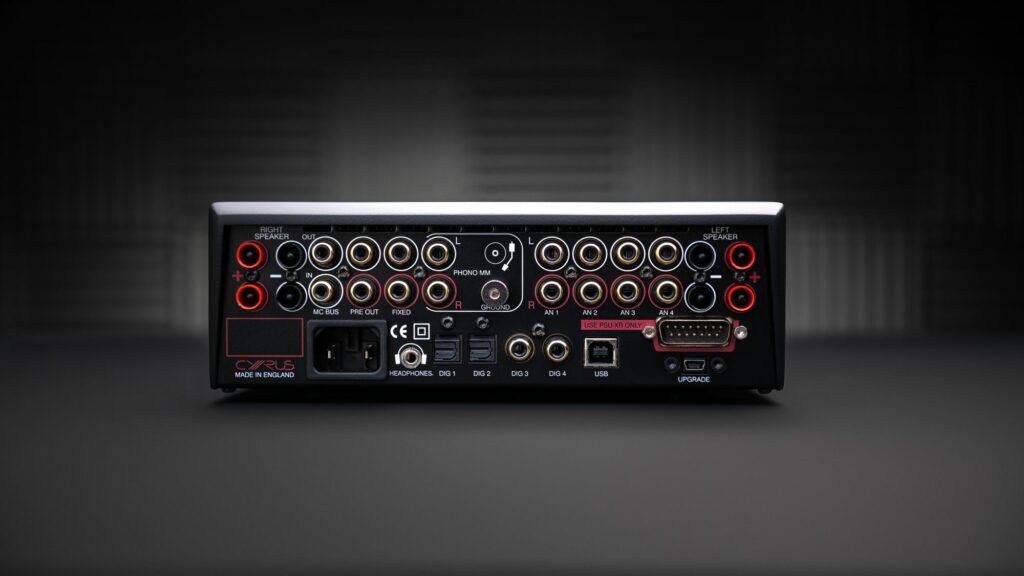
As well as these nine inputs, the (unsurprisingly crowded) rear panel also hosts connections for two pairs of speakers, two pairs of RCA stereo outputs (one in case you wish to deploy a power amp, the other for use with a recording device) and for Cyrus’ eminently capable PSU-XR power supply. Then there’s MC-Bus in/out connections, in case you’d like to daisy-chain your Cyrus equipment together so that it all functions via one remote control (the i9-XR is supplied with the iR14 full-system remote control that’s this close to being coherent – a big step on for the brand) and, of course, a socket for mains power. And in a move that’s almost the exact opposite of ergonomic good sense, the rear panel is also where you find a 3.5mm headphone output.
I’m speculating here, but if you run cables to all nine inputs, both pairs of speaker terminals, a PSU-XR power supply, a recording device and a pair of headphones, you’ll probably need to weigh the front of your i9-XR down to keep it flat on the shelf.
Twist and Push
At the front of the little box, meanwhile, there’s a monochrome display that’s strongly dependent on being viewed on-axis. In conjunction with a positive-feeling twist-and-push control dial, where you select volume level and so on. It also allows access to seven different digital filter alignments that can alter the way the digital inputs sound. There are a smattering of physical controls here, too – ‘power on/off’, ‘input selection’ and what-have-you. They’re both touch-sensitive and responsive – neither of which could be said about the physical controls on previous Cyrus amplifiers.
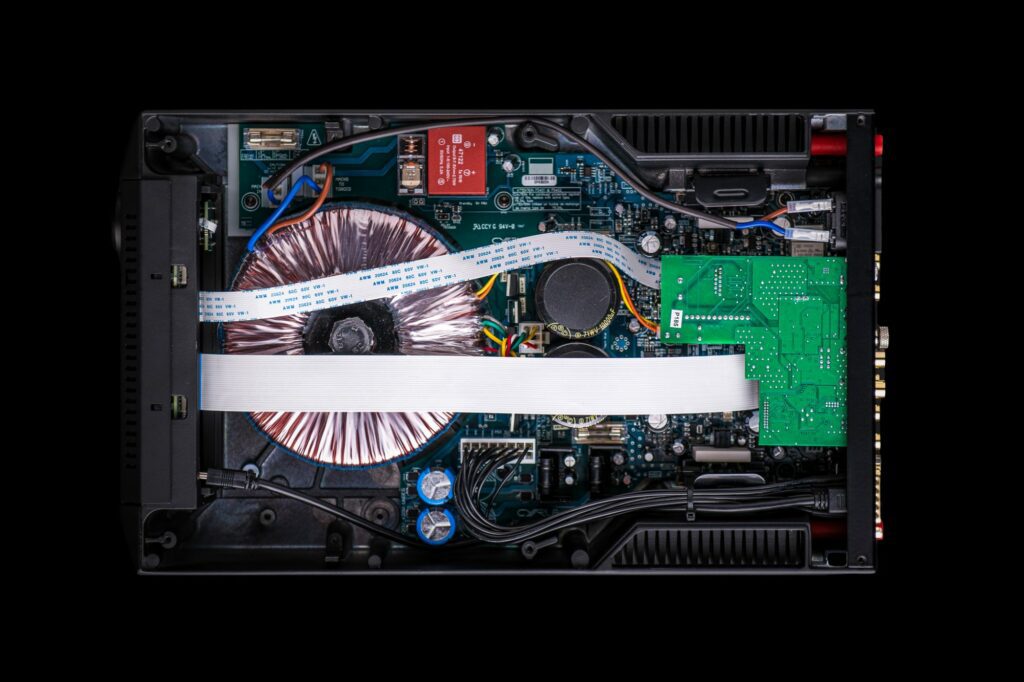
On the inside, things have similarly advanced. There’s a new high-speed analogue buffer at the DAC input stage. The analogue pre-amp is a short-path design featuring relay input selection and an overspecified gain stage derived from the new Pre-XR preamplifier. The power amplification section (which generates either 89 or 91 watts of power per channel, depending on which bit of the Cyrus literature you read) is responsive beyond 100kHz – ample dynamic headroom and basically flat frequency response are the aims here.
All of which looks impressive – laudable, even – when written down. But get some music playing (the i9-XR is attached to an Apple MacBook Air via its USB-B input, a Cyrus CDt-XR using an Atlas Voyager digital coaxial cable and a Clearaudio Concept turntable using a pair of QED Reference Audio Evolution analogue interconnects, and then to a pair of Acoustic Energy AE1 Reference Series mkIII loudspeakers on Atacama Moseco 6 stands using QED XT-400 speaker cable) and it quickly becomes apparent that not everything has changed in Cyrus-land.
With a CD-borne copy of Pharoah Sanders’ Thembi [Impulse!] delivered to the i9-XR digitally, the resulting sound is not simply Cyrus-like; it’s unmistakably Cyrus-y. Anyone with a passing acquaintance with the brand at any point in its history will be primed to expect a lean, detailed sound – and the alacrity with which the i9-XR serves up the recording is definitive in its Cyrus-ness. It’s the antithesis of ‘meaty’ sounding but that doesn’t mean the i9-XR is in any way short of punch or low-end presence. It’s just that it draws such straight edges at the attack and decay of individual bass notes, allowing absolutely no overhang, that its speed and momentum might initially be confused with a lack of substance. Dialling through the available filter options delivers some very mild changes in emphasis (‘steep/linear’, gentle/linear’ and ‘brick wall’ are probably the most overt in their influence on the sound you hear), but I doubt the digital filter has been invented that can make a Cyrus amplifier sound anything but the audio equivalent of a well-trained greyhound.
Switching to a vinyl copy of PJ Harvey’s To Bring You My Love [Island] only makes the point more forcefully. If it’s rapidity you want, along with great big fistfuls of detail and the sort of deep-breathing dynamic ability that can make the harmonic variations in an analogue keyboard just as apparent as the switch from ‘whisper’ to ‘scream’, the i9-XR could be just the ticket. Its ability to pick apart a recording in order to make every individual strand available for inspection, without in any way affecting its unity or sense of performance, is rare at any price.
Throughout the frequency range, nothing is overstated and nothing is under-represented. Tonality is equally well-judged – the line between ‘crisp’ and ‘hard’ where treble sounds are concerned can often be wafer-thin, but the i9-XR treads it confidently. And in the midrange, Polly Jean’s voice is eloquent, characterful and explicit in its motivations – so when she piles on the malevolence (as she is never far from doing on this album) it can provoke an involuntary physical response.
Thrilling
A FLAC file of serpentwithfeet’s Bless Ur Heart [Secretly Canadian] proves further vindication of the decision to fit as capable and accessible a DAC as possible to the Cyrus. The alacrity and manoeuvrability demonstrated by the i9-XR’s other inputs is present and correct via the USB-B, and the level of straightforward immediacy given to the vocal is little short of thrilling. Those low piano notes and the dry kick-drum might seem to lack a little on first acquaintance, but never fear – it’s just the Cyrus doing its ‘float like a butterfly, sting like a bee’ thing.
At its heart, then, the i9-XR is just like every other Cyrus integrated amp since day one’s One. Which is not meant as any kind of criticism or put-down, you understand – at this sort of money, the i9-XR is spectacularly short of alternatives that can rival its level of insight, its well-controlled perkiness or its out-and-out fidelity. The addition of all those digital inputs is a fine and sensible idea, and the quality of its phono stage is not up for question.
Admittedly, being ‘better than previous Cyrus amps’ where ergonomics are concerned is definitively not the same as ‘having good ergonomics’ – but I guess we should applaud Cyrus for making some progress on that score. And anyway, the last thing anyone wants is Cyrus turning into a ‘me too!’ brand of convenience and simplicity. Far better it sticks to what it’s known for, both aurally and visually – because the up-sides outweigh the downs to a significant degree.
TECHNICAL SPECIFICATIONS
- Type: Integrated stereo amplifier with high-resolution DAC
- Analogue inputs: Four single-ended line‑level inputs (via RCA), single-ended MM phono input (via RCA)
- Digital inputs: Two S/PDIF inputs (via RCA), two digital optical inputs (via Toslink), USB-B input
- Analogue outputs: Line-level pre‑out (via RCA), fixed-level output (via RCA), PSU-XR, 3.5mm headphone output
- Input impedance: 40 kΩ
- Power Output: 89wpc @ 6Ω
- Bandwidth: not specified
- Distortion: THD < 0.002%
- Signal to Noise Ratio: 105dB
- Dimensions (H×W×D): 75 × 215 × 365mm
- Weight: 5.9kg
- Price: £3295
Manufacturer:
Cyrus Audio
Tel: +44(0)1480 410900
URL: cyrusaudio.com
The post Cyrus i9-XR appeared first on Hi-Fi+.
Just as you’re unlikely to mistake a Vivienne Westwood design for anyone else’s work, it seems doubtful you’d ever confuse a Cyrus product with any other brand’s output. Even if it didn’t realise it at the time, the company has been all over the ‘lifestyle’ market since the off, thanks to the distinctive half-width chassis into which it’s squeezed pretty much every product that isn’t a loudspeaker since 1984’s ‘One’ amplifier.
Demands on and expectations of the integrated stereo amplifier have increased more than somewhat in the four decades since the ‘One’ established Cyrus as a bright young thing of British hi-fi, of course. Which brings us, far from coincidentally, to this: the Cyrus i9-XR integrated stereo amplifier.
Start from scratch
At a glance you wouldn’t know it, but with its new ‘XR’ range of electronics Cyrus has pretty much started from scratch. Yes, it looks only and always like a Cyrus product – but the i9-XR features plenty of fresh engineering as well as some ergonomic upgrades, all intended to bring Cyrus into line with some (arguably) higher-profile rivals.
The real headline (as far as real-world consumers are concerned, at least) is the appearance of five digital inputs (two S/PDIF via RCA, two optical via Toslink, and one USB input, all leading to the second generation of Cyrus’ QXR DAC) alongside four line-level analogue inputs and a moving-magnet phono input. The USB-B is capable of handling digital audio files up to 32bit/384kHz and DSD up to 512, while the other four digital inputs are useful up to 24bit/192kHz. So high-resolution digital audio is just as firmly on the menu as is the analogue equivalent.
As well as these nine inputs, the (unsurprisingly crowded) rear panel also hosts connections for two pairs of speakers, two pairs of RCA stereo outputs (one in case you wish to deploy a power amp, the other for use with a recording device) and for Cyrus’ eminently capable PSU-XR power supply. Then there’s MC-Bus in/out connections, in case you’d like to daisy-chain your Cyrus equipment together so that it all functions via one remote control (the i9-XR is supplied with the iR14 full-system remote control that’s this close to being coherent – a big step on for the brand) and, of course, a socket for mains power. And in a move that’s almost the exact opposite of ergonomic good sense, the rear panel is also where you find a 3.5mm headphone output.
I’m speculating here, but if you run cables to all nine inputs, both pairs of speaker terminals, a PSU-XR power supply, a recording device and a pair of headphones, you’ll probably need to weigh the front of your i9-XR down to keep it flat on the shelf.
Twist and Push
At the front of the little box, meanwhile, there’s a monochrome display that’s strongly dependent on being viewed on-axis. In conjunction with a positive-feeling twist-and-push control dial, where you select volume level and so on. It also allows access to seven different digital filter alignments that can alter the way the digital inputs sound. There are a smattering of physical controls here, too – ‘power on/off’, ‘input selection’ and what-have-you. They’re both touch-sensitive and responsive – neither of which could be said about the physical controls on previous Cyrus amplifiers.
On the inside, things have similarly advanced. There’s a new high-speed analogue buffer at the DAC input stage. The analogue pre-amp is a short-path design featuring relay input selection and an overspecified gain stage derived from the new Pre-XR preamplifier. The power amplification section (which generates either 89 or 91 watts of power per channel, depending on which bit of the Cyrus literature you read) is responsive beyond 100kHz – ample dynamic headroom and basically flat frequency response are the aims here.
All of which looks impressive – laudable, even – when written down. But get some music playing (the i9-XR is attached to an Apple MacBook Air via its USB-B input, a Cyrus CDt-XR using an Atlas Voyager digital coaxial cable and a Clearaudio Concept turntable using a pair of QED Reference Audio Evolution analogue interconnects, and then to a pair of Acoustic Energy AE1 Reference Series mkIII loudspeakers on Atacama Moseco 6 stands using QED XT-400 speaker cable) and it quickly becomes apparent that not everything has changed in Cyrus-land.
With a CD-borne copy of Pharoah Sanders’ Thembi [Impulse!] delivered to the i9-XR digitally, the resulting sound is not simply Cyrus-like; it’s unmistakably Cyrus-y. Anyone with a passing acquaintance with the brand at any point in its history will be primed to expect a lean, detailed sound – and the alacrity with which the i9-XR serves up the recording is definitive in its Cyrus-ness. It’s the antithesis of ‘meaty’ sounding but that doesn’t mean the i9-XR is in any way short of punch or low-end presence. It’s just that it draws such straight edges at the attack and decay of individual bass notes, allowing absolutely no overhang, that its speed and momentum might initially be confused with a lack of substance. Dialling through the available filter options delivers some very mild changes in emphasis (‘steep/linear’, gentle/linear’ and ‘brick wall’ are probably the most overt in their influence on the sound you hear), but I doubt the digital filter has been invented that can make a Cyrus amplifier sound anything but the audio equivalent of a well-trained greyhound.
Switching to a vinyl copy of PJ Harvey’s To Bring You My Love [Island] only makes the point more forcefully. If it’s rapidity you want, along with great big fistfuls of detail and the sort of deep-breathing dynamic ability that can make the harmonic variations in an analogue keyboard just as apparent as the switch from ‘whisper’ to ‘scream’, the i9-XR could be just the ticket. Its ability to pick apart a recording in order to make every individual strand available for inspection, without in any way affecting its unity or sense of performance, is rare at any price.
Throughout the frequency range, nothing is overstated and nothing is under-represented. Tonality is equally well-judged – the line between ‘crisp’ and ‘hard’ where treble sounds are concerned can often be wafer-thin, but the i9-XR treads it confidently. And in the midrange, Polly Jean’s voice is eloquent, characterful and explicit in its motivations – so when she piles on the malevolence (as she is never far from doing on this album) it can provoke an involuntary physical response.
Thrilling
A FLAC file of serpentwithfeet’s Bless Ur Heart [Secretly Canadian] proves further vindication of the decision to fit as capable and accessible a DAC as possible to the Cyrus. The alacrity and manoeuvrability demonstrated by the i9-XR’s other inputs is present and correct via the USB-B, and the level of straightforward immediacy given to the vocal is little short of thrilling. Those low piano notes and the dry kick-drum might seem to lack a little on first acquaintance, but never fear – it’s just the Cyrus doing its ‘float like a butterfly, sting like a bee’ thing.
At its heart, then, the i9-XR is just like every other Cyrus integrated amp since day one’s One. Which is not meant as any kind of criticism or put-down, you understand – at this sort of money, the i9-XR is spectacularly short of alternatives that can rival its level of insight, its well-controlled perkiness or its out-and-out fidelity. The addition of all those digital inputs is a fine and sensible idea, and the quality of its phono stage is not up for question.
Admittedly, being ‘better than previous Cyrus amps’ where ergonomics are concerned is definitively not the same as ‘having good ergonomics’ – but I guess we should applaud Cyrus for making some progress on that score. And anyway, the last thing anyone wants is Cyrus turning into a ‘me too!’ brand of convenience and simplicity. Far better it sticks to what it’s known for, both aurally and visually – because the up-sides outweigh the downs to a significant degree.
TECHNICAL SPECIFICATIONS
- Type: Integrated stereo amplifier with high-resolution DAC
- Analogue inputs: Four single-ended line‑level inputs (via RCA), single-ended MM phono input (via RCA)
- Digital inputs: Two S/PDIF inputs (via RCA), two digital optical inputs (via Toslink), USB-B input
- Analogue outputs: Line-level pre‑out (via RCA), fixed-level output (via RCA), PSU-XR, 3.5mm headphone output
- Input impedance: 40 kΩ
- Power Output: 89wpc @ 6Ω
- Bandwidth: not specified
- Distortion: THD < 0.002%
- Signal to Noise Ratio: 105dB
- Dimensions (H×W×D): 75 × 215 × 365mm
- Weight: 5.9kg
- Price: £2995
Manufacturer:
Cyrus Audio
Tel: +44(0)1480 410900
URL: cyrusaudio.com
The post Cyrus i9-XR appeared first on Hi-Fi+.
Uncategorized
Astell & Kern A&ultima SP2000T
I don’t care what it is, if it costs £2,000 I want it in a wooden presentation box. Or, because I’m writing for Hi-Fi+ (which knows a pricey product when it sees one), I should really say “if it’s smaller than a paperback book and it costs £2,000, then I want it in a wooden presentation box’.
Astell & Kern, of course, is no stranger to the ‘small but pricey’ area of electronics. As the ‘anglicised for nervous Westerners’ arm of South Korea’s iRiver brand, Astell & Kern has been delivering increasingly expensive, increasingly extravagantly specified media players since 2013. And while the A&ultima SP2000T (don’t ask me – it’s a fool who looks for logic in Astell & Kern’s model-naming choices) isn’t the company’s most expensive portable music player (that honour currently belongs to the £3,399 SP2000 – see model-naming comment above), at a fraction under two grand it’s nevertheless pricey.
Mind you, if it’s ‘extravagantly specified’ you want, you’ve come to the right place. The SP2000T may be on the chunky side (141 × 78 × 18mm, hwd), but when you consider the sheer amount of ‘stuff’ that’s involved here it’s slightly surprising it’s not the size of a backpack.
Attention-grabbing
The most attention-grabbing feature here is almost certainly the Tr‑Amp system. As well as Astell & Kern’s more usual op-amp amplification, the SP2000T is also fitted with dual-triode KORG Nutube 6P1 amplification – because nothing says ‘high-resolution digital modernity’ like a valve amp, right? And by way of an encore, it’s possible to select ‘Hybrid Amp’ mode – which seeks to combine the ‘clarity and dynamism’ of the OP amp with the ‘uniquely warm and musical’ anode grid filament tube amp sound. And in the SP2000T’s (necessarily lengthy) ‘settings’ menus, there are five degrees of, um, hybridness – so in grand total the Astell & Kern has seven individual emphases where amplification is concerned. A fabulous prize (subject to non-availability) to the first reader who gets in touch with a credible reason why this isn’t enough.

Before your digital audio signal gets anywhere near your own personal amplification choices, it gets a thorough seeing-to from the SP2000T’s four (count ‘em!) ESS Sabre ES9068AS DACs. Deploying two DACs per channel (especially 32bit/DSD512-capable DACs such as these) in an effort to achieve the most detailed and balanced sound possible is a bold move, and one that’s to be applauded. And at the business end, the SP2000T features three headphone outputs: balanced 2.5mm and 4.4mm sockets, plus a 3.5mm unbalanced alternative.
In light of this thoroughgoing headline specification, it probably won’t come as all that much of a surprise to find the SP2000T’s engineering is equally purposeful in every other respect. Wireless connectivity, for example, is achievable via dual-band wi-fi or Bluetooth 5.0 with compatibility with SBC, AAC, aptX-HD and LDAC codecs. All popular file types (and quite a lot of unpopular ones too) are catered for, including FLAC, WAV, DSF and MQA. Life from the 4200mAh Li‑Polymer battery is around nine hours (as long as you haven’t ticked all the most esoteric options where file-type, wireless connection and what-have-you goes) and it can be charged from flat to full in around three hours. The capacitive display is a big five inches and a crisp 1920 × 1080 Full HD resolution.
On and on…
We could go on, but there seems no need to (further) labour this particular point. The Astell & Kern A&ultima SP2000T is a lavishly specified portable music player.
Which is all well and good, of course, but the enjoyment that comes from reading such a fulsome spec-sheet can only ever be fleeting – the proof of the pudding etc and so on. So in an effort to get a proper flavour of the Astell & Kern, some of its 256GB of internal memory (which can be expanded using a microSD card of up to 1TB) is loaded with content in sizes ranging from 320bit and 16bit/44.1kHz MP3 through 24bit/192kHz FLAC to 2.8Mhz DSF and MQA. And then it’s connected to a domestic wireless network where it has access to a similarly wide selection of file types and sizes. The option of wireless headphones is taken up by Grado GT220 and Bang & Olufsen HX, and a wired connection is made using Sennheiser IE900 in-ear monitors and Montblanc’s startlingly capable MB-01.
First things first, though – and that’s deciding on the sort of sonic characteristics you like your amplification to have. And while it would be unfair to suggest I don’t appreciate all the efforts Astell & Kern has gone to when it comes the the amplification deployed here, or its supposed flexibility where different types of music are concerned, there’s no denying that (for me, at least) there’s one setting on the SP2000T’s amp settings that works best. And it works best no matter if you’re listening to the ramshackle indie-pop stylings of Car Seat Headrest’s Teens of Denial [Matador] as a 16bit/44.1kHz MP3 file, Stevie Wonder’s immortal Innervisions [Tamla] as a 2.8Mhz DSF or Can’s Live in Brighton 1975 [Mute] as a 24bit/96kHz FLAC. In the ‘AMP’ section in the ‘Settings’ menu, select the ‘Hybrid’ option dialled two stops away from the pure ‘Tube’ setting. Any other position will be subtly, but to my mind unarguably, inferior.
Staggeringly informative
There’s no two ways about it: the Astell & Kern A&ultima SP2000T is a staggeringly informative, thrillingly musical and thoroughly entertaining listen. I’m not sure of the exact number times I’ve listened to Stevie Wonder’s ‘Higher Ground’, though obviously it’s up in the hundreds – and yet there is nuance previously unheard, harmonic variation previously unnoticed and space between sounds previously unobserved, all revealed by the SP2000T. Its attention to detail is getting on for fanatical – every slur of a drumstick across a drum-skin is distinct from every other, and every off-mic ‘wooh’ is an audibly individual event. If the most transient, fleeting aspects of a recording interest you as much as the entirety of a performance, this is the small-ish, chunky-ish portable music player for you.

The song is presented on a wide, authoritatively organised sound-stage with tremendous width and no little depth. Despite the fairly busy mix and the multiple instrumental strands scrapping for primacy in there, the way they’re separated and isolated makes them very easy to follow right down to their most minor dynamic variations. And don’t let the word ‘isolation’ give the impression that the Astell & Kern is anything other than superbly integrated and unified on an almost molecular level – it is.
The warm analogue tonality of the recording is carried over intact, with everything from clavinet to horns bathing in that early-70s high-end hi-fi sheen – this song fairly glows in the SP2000T’s hands. The top of the frequency range features a winning balance between bite and shine, with the sibilance of the percussion always just about on the right side of the line. And in between, there’s a directness and an immediacy about the vocal performance that is only partly explained by the fact the singer sounds like he’s mic’d from mere nanometres away from his mouth. The Astell & Kern hands over every last shred of information, and as a consequence Wonder’s timbre, his technique, his commitment and his level of engagement are utterly apparent – and literally hair-raising as a result.
Festival of pointy corners
It almost goes without saying that a product like this is not for everyone. It’s relatively big and heavy (309g), for starters, and Astell & Kern’s long-established aesthetic means the chassis is a festival of pointy corners. Then there’s the price, of course – unless you take your portable audio experience deeply seriously, is there really so much to be gained by spending a couple of grand on a device that only does something your smartphone can do already?
Well yes, actually. If you have the wherewithal, and if you have money for similarly talented headphones, and if you find yourself in transit a lot of the time, it’s hard to know how you might better spend this not-inconsiderable sum. The amount of enjoyment the Astell & Kern offers is prodigious, as is its capacity to reveal facets of recording you might previously have imagined yourself familiar with. It manages to balance a borderline-forensic analysis of a recording with a deep understanding of the same recording’s primary purpose as a piece of entertainment.
And it’s not like you have to take the wooden box along for the ride.
TECHNICAL SPECIFICATIONS
- Type: Solid-state portable music player with expandable storage
- Storage: 256GB integrated, expandable by up to 1TB via microSD
- Analogue Inputs: n/a
- Digital Inputs: USB-C (charging only)
- DAC Resolution/Supported Digital Formats: PCM: 8kHz–384kHz (8/16/24/32bit); DSD Native: DSD64 (1bit/2.8MHz)/DSD128 (1bit/5.6MHz)/DSD256 (1bit/11.2MHz)/DSD512 (1bit/22.4MHz); WAV, FLAC, WMA, MP3, OGG, APE, AAC, ALAC, AIFF, DFF, DSF, MQA
- Analogue Outputs: Unbalanced out (3.5mm)/Balanced out (2.5mm, only 4-pole supported) Balanced out (4.4m, only 5-pole supported)
- Digital Outputs: Optical out (3.5mm)
- Frequency Response: ±0.024dB (Condition: 20Hz~20kHz) Unbalanced / ±0.038dB (Condition: 20Hz~20kHz) Balanced ±0.027dB (Condition: 20Hz~70kHz) Unbalanced / ±0.052dB (Condition: 20Hz~70kHz) Balanced
- Distortion (THD + Noise): 0.0003% @ 1kHz, Unbalanced/0.0003% @ 1kHz, Balanced
- User Interface: 5in 1920 × 1080 touch display
- Other Features: Bluetooth V5.0 (A2DP, AVRCP, Qualcomm® aptX
 HD, LDAC)
- Dimensions (H×W×D): 141 × 78 × 18mm
- Weight: 309g
- Price: £1,999 (price correct at time of review)
 HD, LDAC)
Manufacturer: Astell & Kern
URL: astellnkern.com
Distributor: Armour Home Electronics
URL: armourhome.co.uk
Tel: +44 (0) 1279 501111
The post Astell & Kern A&ultima SP2000T appeared first on Hi-Fi+.
I don’t care what it is, if it costs £2,000 I want it in a wooden presentation box. Or, because I’m writing for Hi-Fi+ (which knows a pricey product when it sees one), I should really say “if it’s smaller than a paperback book and it costs £2,000, then I want it in a wooden presentation box’.
Astell & Kern, of course, is no stranger to the ‘small but pricey’ area of electronics. As the ‘anglicised for nervous Westerners’ arm of South Korea’s iRiver brand, Astell & Kern has been delivering increasingly expensive, increasingly extravagantly specified media players since 2013. And while the A&ultima SP2000T (don’t ask me – it’s a fool who looks for logic in Astell & Kern’s model-naming choices) isn’t the company’s most expensive portable music player (that honour currently belongs to the £3,399 SP2000 – see model-naming comment above), at a fraction under two grand it’s nevertheless pricey.
Mind you, if it’s ‘extravagantly specified’ you want, you’ve come to the right place. The SP2000T may be on the chunky side (141 × 78 × 18mm, hwd), but when you consider the sheer amount of ‘stuff’ that’s involved here it’s slightly surprising it’s not the size of a backpack.
Attention-grabbing
The most attention-grabbing feature here is almost certainly the Tr‑Amp system. As well as Astell & Kern’s more usual op-amp amplification, the SP2000T is also fitted with dual-triode KORG Nutube 6P1 amplification – because nothing says ‘high-resolution digital modernity’ like a valve amp, right? And by way of an encore, it’s possible to select ‘Hybrid Amp’ mode – which seeks to combine the ‘clarity and dynamism’ of the OP amp with the ‘uniquely warm and musical’ anode grid filament tube amp sound. And in the SP2000T’s (necessarily lengthy) ‘settings’ menus, there are five degrees of, um, hybridness – so in grand total the Astell & Kern has seven individual emphases where amplification is concerned. A fabulous prize (subject to non-availability) to the first reader who gets in touch with a credible reason why this isn’t enough.
Before your digital audio signal gets anywhere near your own personal amplification choices, it gets a thorough seeing-to from the SP2000T’s four (count ‘em!) ESS Sabre ES9068AS DACs. Deploying two DACs per channel (especially 32bit/DSD512-capable DACs such as these) in an effort to achieve the most detailed and balanced sound possible is a bold move, and one that’s to be applauded. And at the business end, the SP2000T features three headphone outputs: balanced 2.5mm and 4.4mm sockets, plus a 3.5mm unbalanced alternative.
In light of this thoroughgoing headline specification, it probably won’t come as all that much of a surprise to find the SP2000T’s engineering is equally purposeful in every other respect. Wireless connectivity, for example, is achievable via dual-band wi-fi or Bluetooth 5.0 with compatibility with SBC, AAC, aptX-HD and LDAC codecs. All popular file types (and quite a lot of unpopular ones too) are catered for, including FLAC, WAV, DSF and MQA. Life from the 4200mAh Li‑Polymer battery is around nine hours (as long as you haven’t ticked all the most esoteric options where file-type, wireless connection and what-have-you goes) and it can be charged from flat to full in around three hours. The capacitive display is a big five inches and a crisp 1920 × 1080 Full HD resolution.
On and on…
We could go on, but there seems no need to (further) labour this particular point. The Astell & Kern A&ultima SP2000T is a lavishly specified portable music player.
Which is all well and good, of course, but the enjoyment that comes from reading such a fulsome spec-sheet can only ever be fleeting – the proof of the pudding etc and so on. So in an effort to get a proper flavour of the Astell & Kern, some of its 256GB of internal memory (which can be expanded using a microSD card of up to 1TB) is loaded with content in sizes ranging from 320bit and 16bit/44.1kHz MP3 through 24bit/192kHz FLAC to 2.8Mhz DSF and MQA. And then it’s connected to a domestic wireless network where it has access to a similarly wide selection of file types and sizes. The option of wireless headphones is taken up by Grado GT220 and Bang & Olufsen HX, and a wired connection is made using Sennheiser IE900 in-ear monitors and Montblanc’s startlingly capable MB-01.
First things first, though – and that’s deciding on the sort of sonic characteristics you like your amplification to have. And while it would be unfair to suggest I don’t appreciate all the efforts Astell & Kern has gone to when it comes the the amplification deployed here, or its supposed flexibility where different types of music are concerned, there’s no denying that (for me, at least) there’s one setting on the SP2000T’s amp settings that works best. And it works best no matter if you’re listening to the ramshackle indie-pop stylings of Car Seat Headrest’s Teens of Denial [Matador] as a 16bit/44.1kHz MP3 file, Stevie Wonder’s immortal Innervisions [Tamla] as a 2.8Mhz DSF or Can’s Live in Brighton 1975 [Mute] as a 24bit/96kHz FLAC. In the ‘AMP’ section in the ‘Settings’ menu, select the ‘Hybrid’ option dialled two stops away from the pure ‘Tube’ setting. Any other position will be subtly, but to my mind unarguably, inferior.
Staggeringly informative
There’s no two ways about it: the Astell & Kern A&ultima SP2000T is a staggeringly informative, thrillingly musical and thoroughly entertaining listen. I’m not sure of the exact number times I’ve listened to Stevie Wonder’s ‘Higher Ground’, though obviously it’s up in the hundreds – and yet there is nuance previously unheard, harmonic variation previously unnoticed and space between sounds previously unobserved, all revealed by the SP2000T. Its attention to detail is getting on for fanatical – every slur of a drumstick across a drum-skin is distinct from every other, and every off-mic ‘wooh’ is an audibly individual event. If the most transient, fleeting aspects of a recording interest you as much as the entirety of a performance, this is the small-ish, chunky-ish portable music player for you.
The song is presented on a wide, authoritatively organised sound-stage with tremendous width and no little depth. Despite the fairly busy mix and the multiple instrumental strands scrapping for primacy in there, the way they’re separated and isolated makes them very easy to follow right down to their most minor dynamic variations. And don’t let the word ‘isolation’ give the impression that the Astell & Kern is anything other than superbly integrated and unified on an almost molecular level – it is.
The warm analogue tonality of the recording is carried over intact, with everything from clavinet to horns bathing in that early-70s high-end hi-fi sheen – this song fairly glows in the SP2000T’s hands. The top of the frequency range features a winning balance between bite and shine, with the sibilance of the percussion always just about on the right side of the line. And in between, there’s a directness and an immediacy about the vocal performance that is only partly explained by the fact the singer sounds like he’s mic’d from mere nanometres away from his mouth. The Astell & Kern hands over every last shred of information, and as a consequence Wonder’s timbre, his technique, his commitment and his level of engagement are utterly apparent – and literally hair-raising as a result.
Festival of pointy corners
It almost goes without saying that a product like this is not for everyone. It’s relatively big and heavy (309g), for starters, and Astell & Kern’s long-established aesthetic means the chassis is a festival of pointy corners. Then there’s the price, of course – unless you take your portable audio experience deeply seriously, is there really so much to be gained by spending a couple of grand on a device that only does something your smartphone can do already?
Well yes, actually. If you have the wherewithal, and if you have money for similarly talented headphones, and if you find yourself in transit a lot of the time, it’s hard to know how you might better spend this not-inconsiderable sum. The amount of enjoyment the Astell & Kern offers is prodigious, as is its capacity to reveal facets of recording you might previously have imagined yourself familiar with. It manages to balance a borderline-forensic analysis of a recording with a deep understanding of the same recording’s primary purpose as a piece of entertainment.
And it’s not like you have to take the wooden box along for the ride.
TECHNICAL SPECIFICATIONS
- Type: Solid-state portable music player with expandable storage
- Storage: 256GB integrated, expandable by up to 1TB via microSD
- Analogue Inputs: n/a
- Digital Inputs: USB-C (charging only)
- DAC Resolution/Supported Digital Formats: PCM: 8kHz–384kHz (8/16/24/32bit); DSD Native: DSD64 (1bit/2.8MHz)/DSD128 (1bit/5.6MHz)/DSD256 (1bit/11.2MHz)/DSD512 (1bit/22.4MHz); WAV, FLAC, WMA, MP3, OGG, APE, AAC, ALAC, AIFF, DFF, DSF, MQA
- Analogue Outputs: Unbalanced out (3.5mm)/Balanced out (2.5mm, only 4-pole supported) Balanced out (4.4m, only 5-pole supported)
- Digital Outputs: Optical out (3.5mm)
- Frequency Response: ±0.024dB (Condition: 20Hz~20kHz) Unbalanced / ±0.038dB (Condition: 20Hz~20kHz) Balanced ±0.027dB (Condition: 20Hz~70kHz) Unbalanced / ±0.052dB (Condition: 20Hz~70kHz) Balanced
- Distortion (THD + Noise): 0.0003% @ 1kHz, Unbalanced/0.0003% @ 1kHz, Balanced
- User Interface: 5in 1920 × 1080 touch display
- Other Features: Bluetooth V5.0 (A2DP, AVRCP, Qualcomm® aptX HD, LDAC)
- Dimensions (H×W×D): 141 × 78 × 18mm
- Weight: 309g
- Price: £1,999 (price correct at time of review)
Manufacturer: Astell & Kern
URL: astellnkern.com
Distributor: Armour Home Electronics
URL: armourhome.co.uk
Tel: +44 (0) 1279 501111
The post Astell & Kern A&ultima SP2000T appeared first on Hi-Fi+.
Uncategorized
ELAC Solano BS 283
If nothing else, you’ve got to admire how concise ELAC’s Solano range of loudspeakers is. One floorstander (FS 287), one centre channel (CC 281) and one stand-mounter (this BS 283) – and that’s your lot. None of your ‘slightly larger cabinet/a few more drivers’ padding until a range comprises six or seven models nonsense. The brevity of the Solano line-up speaks of confidence. So does the binary choice of high-gloss black or high-gloss white as finishes. Can’t build a suitably great-sounding stereo pair or home theatre surround-sound system from these three models? ELAC, I’m pretty sure, thinks the problem is with you rather than the other way around.
At £1,449 per pair, the Solano BS 283 are far from the priciest product in ELAC’s catalogue. But despite selling for what is a relatively modest amount, the company hasn’t made an overt attempt to economise. Certainly no one seems to have had budget uppermost in their minds when they specified the complement of drivers. ELAC’s widely celebrated, visually dramatic and wantonly high-performance JET5 concertinaed foil membrane tweeter sits above a 150mm mid/bass driver of the company’s preferred ‘aluminium sandwich’ type – both are hand-crafted and assembled in Kiel, Germany. The former has a claimed frequency response of 50kHz (which puts any potenital uneveness way beyond human ears), while the latter seeks to combine its metal’s torsional rigidity with the transient capabilities of a cellulose alternative. Crossover between the two occurs at the quotidian figure of 2.4kHz.
Suitably Chunky
Aluminium baskets hold the drivers in a rounded-off rectangle of a cabinet that’s a combination of MDF and lustrous, beautifully applied lacquer. At the rear are biwire binding posts of suitably chunky dimensions, while the bottom of the cabinet is raised a few millimetres above a metal plinth (to give the downward-facing bass reflex port space to do its thing). At 331 × 190 × 248mm (hwd) the BS 283 is a workaday, and consequently quite manageable, size – and its configuration promises an easy-going nature as far as positioning is concerned. With sensitivity of 85dB and nominal 4 ohm impedance, it doesn’t threaten to be all that troublesome, either.

Of course, JET5 tweeter aside, there are any number of similarly specified, similarly priced and similarly sized stand-mounting speakers vying for your attention. Many companies have a shiny, well-turned out dog in this particular fight. Really, the only meaningful way in which ELAC can expect the Solano BS 283 to stand out from the crowd is with the quality of its sound.
For the purposes of this test, the ELACs are given a fighting chance by being a) positioned securely on top of a pair of Atacama Moseco 6 stands and b) attached to a Naim NAP100 power amp via a couple of lengths of QED XT400 speaker cable with Airloc Forte plugs at either end. Sources into the amp include the matching UnitiQute 2 streamer/pre-amp accessing Buffalo network-attached storage, a Cambridge Audio Alva TT turntable (attached via both its always-on phono stage and aptX Bluetooth) and a Cyrus i9 XR CD player. QED Reference Audio 40 is used for both analogue connections into the pre-amp and also from pre-amp to power amp.
A Japanese pressing of Paul Simon’s There Goes Rhymin’ Simon [CBS/Sony] using a hard connection from turntable to pre-amp ought to be a gimme for a pair of speakers with the BS 283’s aspirations – and, to no small extent, that’s how it proves. Certainly the ELAC absolutely lap up the painstaking, detail-drenched recording, happily identifying even the finest harmonic variances and reporting back on them in full. Rhythmic expression is very satisfying too – the ELAC understand the polite, knowingly inhibited grooves and syncopations of the album and can describe their motivations eloquently. This is a very-little-expense-spared state-of-the-analogue-art recording that even at fifty years’ distance sounds upmarket and sophisticated – and it sounds no less luxurious for being delivered by the BS 238.
Absence of Silence
High-end response is, unsurprisingly, deeply impressive. Treble sounds are crisply rendered, detail-heavy and informative on every level. We may not be able to hear to the top of the tweeter’s claimed extension, but that peculiar ‘absence of silence’ sensation whenever a sound is played at a frequency above the range of hearing is evident from time to time. And at the opposite end of the frequency range, there’s control, straight-edged precision and, again, a level of information served up regarding texture that borders on the torrential.
In between, Simon’s vocal – recorded (or so it sounds) from no distance whatsoever, and with his disinclination to raise his voice even slightly more apparent than perhaps at any other time in his career – communicates in spades. All of the details of technique are apparent (both of his and his recording engineer’s), as are his quirks of diction.
There’s precious little temperature in the Solanos’ delivery, however. This LP should be the sonic equivalent of a nice relaxing bath – but the ELAC’s precision and neutrality makes listening to this album less of a tranquil soak. ‘Neutrality’ is all well and good in a loudspeaker, as is a desire to stick one’s oar in as little as possible. But the BS 283 is so ‘honest’; how you react to such neutrality is a bit like thinking about Switzerland; do you summon up visions of watches, banks and chocolates, or start recalling the ‘Cuckoo Clock’ speech from The Third Man?

Admirably, the ELACs don’t alter their stance one iota. A switch to a 24bit/96kHz file of Public Enemy’s By the Time I Get to Arizona [Def Jam] ups the dynamism quotient considerably, along with the brittleness and scuzziness count at the same time. The ELACs peer deep into the relatively rough and chaotic mix, and return with all kinds of worthwhile insights. They preserve the implacable attack of the rhythm track, avoiding lumpiness and instead giving proper expression to the gimpy momentum that’s intended. And yes, they serve all this good stuff up without any overt displays of emotion. It’s not every loudspeaker that can cut through the ruckus to make Public Enemy sound like master craftsmen, but then it’s becoming increasingly obvious the ELAC BS 238 are not every loudspeaker.
Any Music You Like
Try any music you like, from any source you like – and during the course of this testing we ran through a reasonably wide selection, from a 180g vinyl reissue of Scott Walker’s Scott 2 [UMG] through a compact disc copy of Patti Smith Group’s Easter [Arista] to a 24bit/192kHz stream of Giant Swan’s punishing Bring Back Fives [Howling Owl] – and you won’t get the ELACs to amend their position even a little. If you want a sort of sonic equivalent of verbatim reportage, an examination of a recording down to an almost molecular level, you won’t go wrong here. And if you like this sort of behaviour with a big serving of rhythmic positivity and surefootedness, that’s even better. The ELAC BS 238 make a mighty strong case for themselves – and in the process they do a fine job of differentiating themselves from the multitude.
No one is ever going to ‘plunge’ into ELAC Solano BS 238 ownership because these loudspeakers are not made for such people who act on impulse. Instead, they appeal to your less base instincts. This is the perfect choice for the studied listener. The ELACs simply do what they do with utmost precision and accuracy and the BS 238 make their attitude obvious right from the off. If you share this ‘detail and accuracy are paramount’ approach, the cerebral ELAC Solano BS 238 is the logical loudspeaker choice.
TECHNICAL SPECIFICATIONS
- Type: two-way; bass reflex port
- Driver complement: 1 × JET5 tweeter;
1 × 150mm mid/bass driver - Frequency response: 41Hz–50kHz
- Crossover frequency: 2400Hz
- Impedance: 4 Ohms nominal
(3.2 Ohms minimum) - Sensitivity: 85dB/W/m
- Dimensions (H×W×D): 331 × 190 × 248mm
- Weight: 8 kg/each
- Finishes: High gloss white; high gloss black
- Price: £1,449/pair
Manufacturer: ELAC Electroacustic
URL: elac.com
UK Distributor: Hi-Fi Network
URL: hifi-network.com
Tel: +44(0)1285 643088
The post ELAC Solano BS 283 appeared first on Hi-Fi+.
If nothing else, you’ve got to admire how concise ELAC’s Solano range of loudspeakers is. One floorstander (FS 287), one centre channel (CC 281) and one stand-mounter (this BS 283) – and that’s your lot. None of your ‘slightly larger cabinet/a few more drivers’ padding until a range comprises six or seven models nonsense. The brevity of the Solano line-up speaks of confidence. So does the binary choice of high-gloss black or high-gloss white as finishes. Can’t build a suitably great-sounding stereo pair or home theatre surround-sound system from these three models? ELAC, I’m pretty sure, thinks the problem is with you rather than the other way around.
At £1,449 per pair, the Solano BS 283 are far from the priciest product in ELAC’s catalogue. But despite selling for what is a relatively modest amount, the company hasn’t made an overt attempt to economise. Certainly no one seems to have had budget uppermost in their minds when they specified the complement of drivers. ELAC’s widely celebrated, visually dramatic and wantonly high-performance JET5 concertinaed foil membrane tweeter sits above a 150mm mid/bass driver of the company’s preferred ‘aluminium sandwich’ type – both are hand-crafted and assembled in Kiel, Germany. The former has a claimed frequency response of 50kHz (which puts any potenital uneveness way beyond human ears), while the latter seeks to combine its metal’s torsional rigidity with the transient capabilities of a cellulose alternative. Crossover between the two occurs at the quotidian figure of 2.4kHz.
Suitably Chunky
Aluminium baskets hold the drivers in a rounded-off rectangle of a cabinet that’s a combination of MDF and lustrous, beautifully applied lacquer. At the rear are biwire binding posts of suitably chunky dimensions, while the bottom of the cabinet is raised a few millimetres above a metal plinth (to give the downward-facing bass reflex port space to do its thing). At 331 × 190 × 248mm (hwd) the BS 283 is a workaday, and consequently quite manageable, size – and its configuration promises an easy-going nature as far as positioning is concerned. With sensitivity of 85dB and nominal 4 ohm impedance, it doesn’t threaten to be all that troublesome, either.
Of course, JET5 tweeter aside, there are any number of similarly specified, similarly priced and similarly sized stand-mounting speakers vying for your attention. Many companies have a shiny, well-turned out dog in this particular fight. Really, the only meaningful way in which ELAC can expect the Solano BS 283 to stand out from the crowd is with the quality of its sound.
For the purposes of this test, the ELACs are given a fighting chance by being a) positioned securely on top of a pair of Atacama Moseco 6 stands and b) attached to a Naim NAP100 power amp via a couple of lengths of QED XT400 speaker cable with Airloc Forte plugs at either end. Sources into the amp include the matching UnitiQute 2 streamer/pre-amp accessing Buffalo network-attached storage, a Cambridge Audio Alva TT turntable (attached via both its always-on phono stage and aptX Bluetooth) and a Cyrus i9 XR CD player. QED Reference Audio 40 is used for both analogue connections into the pre-amp and also from pre-amp to power amp.
A Japanese pressing of Paul Simon’s There Goes Rhymin’ Simon [CBS/Sony] using a hard connection from turntable to pre-amp ought to be a gimme for a pair of speakers with the BS 283’s aspirations – and, to no small extent, that’s how it proves. Certainly the ELAC absolutely lap up the painstaking, detail-drenched recording, happily identifying even the finest harmonic variances and reporting back on them in full. Rhythmic expression is very satisfying too – the ELAC understand the polite, knowingly inhibited grooves and syncopations of the album and can describe their motivations eloquently. This is a very-little-expense-spared state-of-the-analogue-art recording that even at fifty years’ distance sounds upmarket and sophisticated – and it sounds no less luxurious for being delivered by the BS 238.
Absence of Silence
High-end response is, unsurprisingly, deeply impressive. Treble sounds are crisply rendered, detail-heavy and informative on every level. We may not be able to hear to the top of the tweeter’s claimed extension, but that peculiar ‘absence of silence’ sensation whenever a sound is played at a frequency above the range of hearing is evident from time to time. And at the opposite end of the frequency range, there’s control, straight-edged precision and, again, a level of information served up regarding texture that borders on the torrential.
In between, Simon’s vocal – recorded (or so it sounds) from no distance whatsoever, and with his disinclination to raise his voice even slightly more apparent than perhaps at any other time in his career – communicates in spades. All of the details of technique are apparent (both of his and his recording engineer’s), as are his quirks of diction.
There’s precious little temperature in the Solanos’ delivery, however. This LP should be the sonic equivalent of a nice relaxing bath – but the ELAC’s precision and neutrality makes listening to this album less of a tranquil soak. ‘Neutrality’ is all well and good in a loudspeaker, as is a desire to stick one’s oar in as little as possible. But the BS 283 is so ‘honest’; how you react to such neutrality is a bit like thinking about Switzerland; do you summon up visions of watches, banks and chocolates, or start recalling the ‘Cuckoo Clock’ speech from The Third Man?
Admirably, the ELACs don’t alter their stance one iota. A switch to a 24bit/96kHz file of Public Enemy’s By the Time I Get to Arizona [Def Jam] ups the dynamism quotient considerably, along with the brittleness and scuzziness count at the same time. The ELACs peer deep into the relatively rough and chaotic mix, and return with all kinds of worthwhile insights. They preserve the implacable attack of the rhythm track, avoiding lumpiness and instead giving proper expression to the gimpy momentum that’s intended. And yes, they serve all this good stuff up without any overt displays of emotion. It’s not every loudspeaker that can cut through the ruckus to make Public Enemy sound like master craftsmen, but then it’s becoming increasingly obvious the ELAC BS 238 are not every loudspeaker.
Any Music You Like
Try any music you like, from any source you like – and during the course of this testing we ran through a reasonably wide selection, from a 180g vinyl reissue of Scott Walker’s Scott 2 [UMG] through a compact disc copy of Patti Smith Group’s Easter [Arista] to a 24bit/192kHz stream of Giant Swan’s punishing Bring Back Fives [Howling Owl] – and you won’t get the ELACs to amend their position even a little. If you want a sort of sonic equivalent of verbatim reportage, an examination of a recording down to an almost molecular level, you won’t go wrong here. And if you like this sort of behaviour with a big serving of rhythmic positivity and surefootedness, that’s even better. The ELAC BS 238 make a mighty strong case for themselves – and in the process they do a fine job of differentiating themselves from the multitude.
No one is ever going to ‘plunge’ into ELAC Solano BS 238 ownership because these loudspeakers are not made for such people who act on impulse. Instead, they appeal to your less base instincts. This is the perfect choice for the studied listener. The ELACs simply do what they do with utmost precision and accuracy and the BS 238 make their attitude obvious right from the off. If you share this ‘detail and accuracy are paramount’ approach, the cerebral ELAC Solano BS 238 is the logical loudspeaker choice.
TECHNICAL SPECIFICATIONS
- Type: two-way; bass reflex port
- Driver complement: 1 × JET5 tweeter;
1 × 150mm mid/bass driver - Frequency response: 41Hz–50kHz
- Crossover frequency: 2400Hz
- Impedance: 4 Ohms nominal
(3.2 Ohms minimum) - Sensitivity: 85dB/W/m
- Dimensions (H×W×D): 331 × 190 × 248mm
- Weight: 8 kg/each
- Finishes: High gloss white; high gloss black
- Price: £1,449/pair
Manufacturer: ELAC Electroacustic
URL: elac.com
UK Distributor: Hi-Fi Network
URL: hifi-network.com
Tel: +44(0)1285 643088
The post ELAC Solano BS 283 appeared first on Hi-Fi+.
It’s a likeable product in many ways, and has some impressive aspects to its sound – but the Fluance RT85N can be bettered by quite a few …