Tag Archives: integrated amplifier

Lindemann Audio Musicbook Combo

Trying to foretell the long run is not possible. The lack of lottery wins, flying vehicles, or dystopian post-apocalyptic hellscapes is a little bit of a giveaway. But, in relation to audio, predicting the close to future is feasible, and a giant chunk of tomorrow’s audio is probably going Lindemann Musicbook Combo formed!

The Musicbook Combo addresses a niche in trendy audio; the small, high-performance built-in amplifier with an excellent audio streamer. The audio world wants a small field to take a seat on a bookshelf relatively than a devoted stand. It additionally requires a product that’s simple to put in and function. And it must sound good. The Lindemann Musicbook Combo does all these issues.

Does all of it

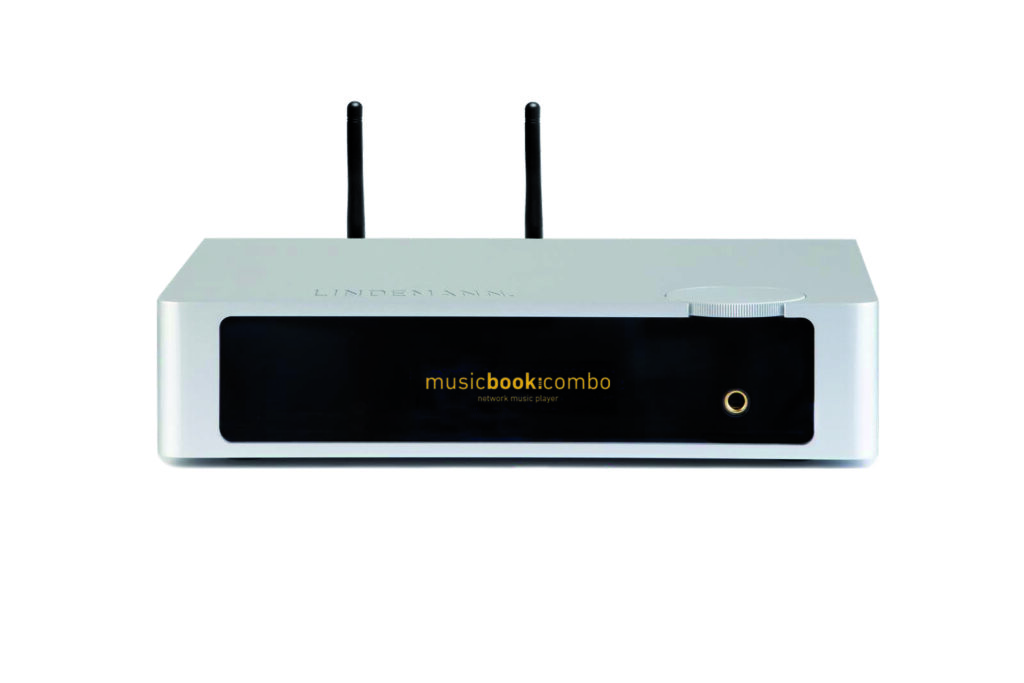
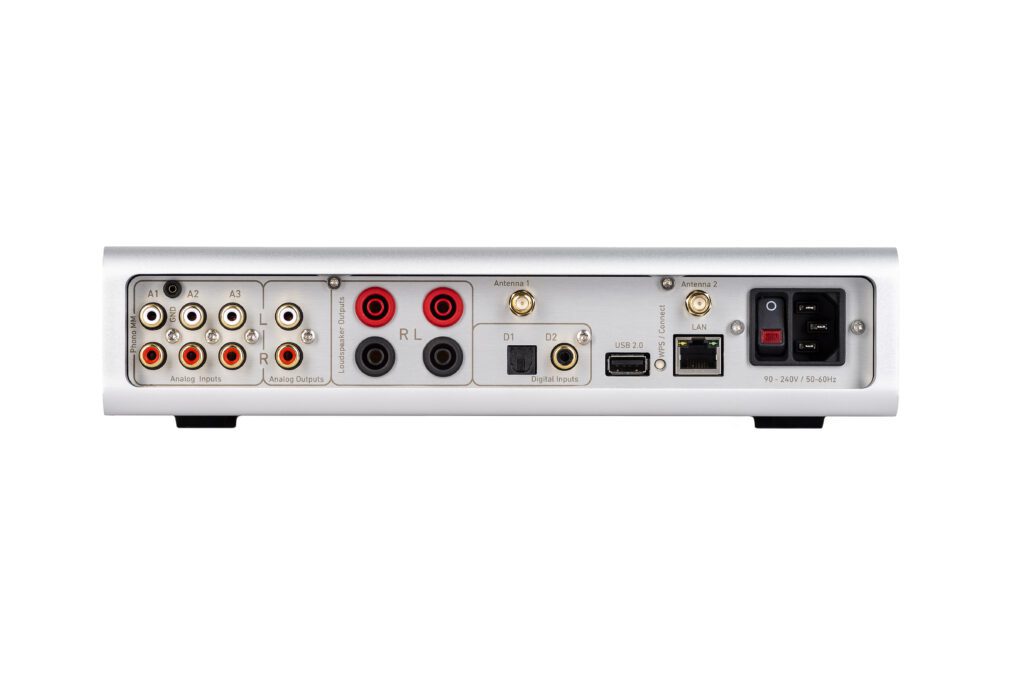
Lindemann’s elegant little field is a deceptively highly effective and versatile machine. Delivering a wholesome 70W into eight ohms, the amp features a community participant, DAC, MM phono stage, and two line-level analogue inputs. You can join it to A2DP-compatible Bluetooth gadgets, native networks, and on-line streaming providers through a router. You can play thumb drives or CDs from a CD-ROM drive inserted into the rear USB connector. There’s a good-quality headphone socket.
Lindemann Audio Combo

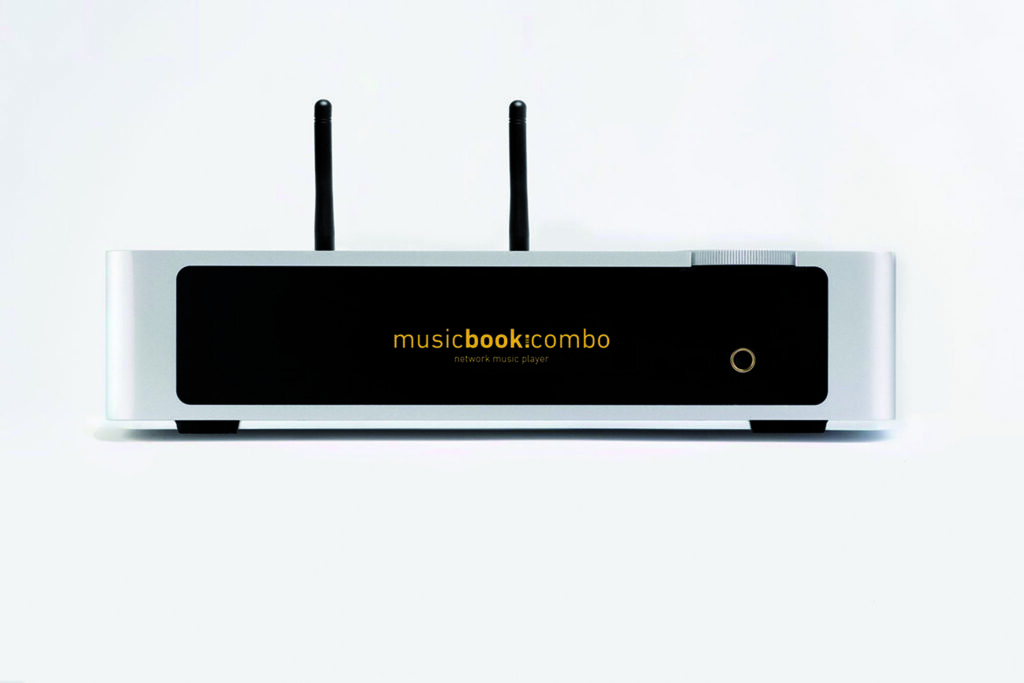
Everything is pushed from Lindemann’s iOS or Android app, and there’s a healthily sized yellow OLED read-out on the entrance panel. The amp’s management is minimal, only a energy button and a jog wheel, however this final double up as quantity and supply selector. There can also be a mini-remote with track-handling performance, however contemplate this an adjunct to the app.

Once you go deeper, you start to see why the Musicbook Combo is so highly effective. First, it upconverts any PCM sign to DSD as customary (utilizing an AK4137 upsampler), however this may be deactivated, and any PCM alerts are stored bit-perfect to the dual AK4493 DACs and synchronised towards an ultraprecise MEMS-Femtoclock. It could be run wired or wirelessly (inside 10m from a wi-fi router) into your Local Area Network. It’s solely Roon Ready and works with Tidal Connect, Qobuz, High Res Audio.com, Spotify Connect, Deezer and extra. If you just like the pitter-patter of tiny Lindemanns round the home, there’s additionally a multi-room characteristic.

Appiness is a heat iPad

While it’s notionally doable to function the Musicbook Combo and not using a smartphone or pill, it’s like asking a ballet dancer to bounce Swan Lake in leg irons. The absolute pleasure of the Lindemann design and why it justifies that ‘it’s the long run’ epithet is how effectively it really works with its app (and apps like Roon). This is one thing we sometimes wrestle to reconcile; a product just like the Musicbook Combo should stay in that app-based ecosystem at this time.

Sadly, too many audio firms appear to be extra about ‘pivoting’ towards the place Lindemann already occupies. The business is probably universally responsible of being behind the curve right here; we, as audio writers, are extra wrapped up within the {hardware} than within the interplay between that {hardware} and the app. In the actual world, individuals care extra about how that app works and the way the product interacts with the app. In our defence, the app is commonly nonetheless a piece in progress when the product will get into our palms, however once more in the actual world, such a midway home is indefensible. Rant mode: disengaged.
Lindemann Audio Combo

Fortunately, the Lindemann app is a pleasure to make use of. It’s simply the correct steadiness of ‘informative’ with out being ‘busy’, and it responds rapidly. Once arrange (no huge deal), the Combo additionally handshakes with different apps like Tidal or Roon, which means they do all of the heavy lifting, and the Combo reacts appropriately. I’d put this on a par with the higher company-made apps on the market; it’s not as intuitive as Sonos (few are), however it’s actually simple to navigate and extremely reactive.

Wired or wi-fi

I attempted connecting the Lindemann Musicbook Combo in each wired and wi-fi LAN settings, however in equity, my wi-fi router is simply about 1.5m from the Combo’s twin aerials. This means I may detect no sound high quality or latency variations between wired and wi-fi connections. If pressed, I’d go for the wired connection, however that’s extra to do with private choice than noticed variations. The Combo appears to make no distinctions both means.

Running Lindemann’s personal Streaming 4.0 platform and app, the Combo labored like a appeal. The app gently guides you to constructing playlists in a extra thought-about means than monitor aggregation, however solely as a result of I discovered playlist creation is extra on reflection and produced from the last-played choice. I want this extra reflective method; it acts a bit of extra like Roon. Streaming 4.0 and Roon work very properly collectively, and I discovered myself in that Roon area so much right here.
Lindemann Audio Combo

The sound of the Combo is clear and clear, chopping a fragile steadiness and all the time staying on the correct facet of ‘scientific’. Perhaps most noticeable is that this ‘spring water’ sound applies universally; there’s no level the place the sound warms up or blurs throughout the board. While which may sound like it will deter valve-amp customers and their seeming love of euphony, I believe they want the readability and focus of that Lindemann sound.

Go-to albums

My go-to albums for testing midrange readability and bass – Stella di Napoli by Joyce DiDonato [Erato] and The Last Resort by Trentemøller [Poker Flat] – highlighted exactly what the Lindemann Musicbook Combo does so effectively, as they delivered all of the element and perception required to make the previous album come alive and all of the precision and drive wanted to make the latter sound scary. But, in equity, what the Combo did proper, it did proper universally.

There’s a motive we use these discs time and again. While massively pleasing to listen to, I’m not going to extract review-grade info from a Half Man Half Biscuit album, however Achtung Bono [Probe Plus] wants one thing correct to serve up the lyrics of ‘Joy Division Oven Gloves’ with out it sounding too spikey and uncooked whereas retaining the fantastic belt-fed surrealist sarcasm dripping from each line. And Lindemann’s Combo makes brief work of traces like ‘Nero fiddles whereas Gordon Burns/In his Joy Division Oven Gloves.’

Everything I performed was given a good listening to by the Lindemann Musicbook Combo, which is extraordinarily uncommon at this degree. The clear, exact sound makes the Lindemann so musically versatile. I went from operetta to electro to sarky post-punk from the Wirral after which to Bach innovations, again through Dylan’s Desire [Capitol], over to some basic early Nineteen Nineties Acid Jazz, and so it went on.

Class act

Getting that a lot from a small field with out it going into melt-down mode can solely imply one factor – Class D energy amp operation. And this can trigger some audiophiles to press the ejector seat on precept. More idiot them; they’re lacking a exact, correct, musically centered, detailed, articulate and extremely dynamic sound, particularly when the goal loudspeaker viewers is taken into account.
Lindemann Audio Combo

With spiralling gas payments which means the working prices of a pure Class A amplifier start to get a bit of noticeable, the good sound and funky working Lindemann makes a sturdy case for itself. I really feel what’s contained in the field is functionally unimportant so long as it really works effectively; the way it sounds and operates issues.

Don’t diss

So, are there any downsides to the Musicbook Combo? Surprisingly few, until you’re within the behavior of ‘dissing’ issues for being one thing they weren’t supposed to be. It’s not meant to drive £300,000 tower loudspeakers with an impedance plot that eats amplifiers, however I used the Combo with KEF’s LS50 Meta, and the 2 labored collectively so effectively, so I felt no must look additional. I would like transferring coil compatibility alongside transferring magnet, however not if it sacrifices the efficiency of the MM stage because it stands. I’d additionally want if its Bluetooth connection included aptX HD (which may help as much as 24bit, 48kHz PCM) alongside A2DP, however that is removed from a deal-breaker. And realistically, that’s about it!

The Lindemann Musicbook Combo is among the methods good audio reaches these it can not. It’s sufficiently small to be domestically acceptable. It’s highly effective sufficient to drive the loudspeakers it can probably accomplice with and sounds good. It’s made to be app-chummy and stay fortunately in that area, and the app works exceptionally effectively. If that is the face of audio’s future, it’s shiny and rosy!


Technical specs

  • Type streaming built-in amplifier
  • Power output 2×130W into 4Ω, 2× 70W into 8Ω
  • Analogue inputs MM cartridge (RCA), two line-level (RCA)
  • Analogue outputs one line-level (RCA), 6.35mm headphone jack, 2× BFA speaker terminals
  • MM specs 47kΩ, 150pF, 40dB achieve
  • Digital inputs Coaxial and optical S/PDIF, USB 2.0, 100Mbits/s RJ45 LAN, 2× antenna (Bluetooth, WLAN)
  • Bluetooth 4.2, A2DP
  • DAC decision as much as 768kHz, 32bit PCM and DSD 512
  • Supported codecs WAV, FLAC, AIFF, ALAC, MP3, AAC, Ogg Vorbis, WMA, DSD
  • Network UPnP and DLNA help
  • Dimensions (W×H×D) 28 × 22 × 6.3cm
  • Weight 3kg
  • Price £4,490

Manufacturer

Lindemann Audio

lindemann-audio.de

UK Distributor

Signature Audio Systems

signaturesystems.co.uk 

+44(0)7738 007776

Back to Reviews

The put up Lindemann Audio Musicbook Combo appeared first on Hi-Fi+.
Lindemann Audio Musicbook Combo

Trying to foretell the long run is inconceivable. The lack of lottery wins, flying automobiles, or dystopian post-apocalyptic hellscapes is a little bit of a giveaway. But, relating to audio, predicting the close to future is feasible, and a giant chunk of tomorrow’s audio is probably going Lindemann Musicbook Combo formed!

The Musicbook Combo addresses a niche in fashionable audio; the small, high-performance built-in amplifier with audio streamer. The audio world wants a small field to sit down on a bookshelf fairly than a devoted stand. It additionally requires a product that’s simple to put in and function. And it must sound good. The Lindemann Musicbook Combo does all these issues.

Does all of it

Lindemann’s elegant little field is a deceptively highly effective and versatile machine. Delivering a wholesome 70W into eight ohms, the amp features a community participant, DAC, MM phono stage, and two line-level analogue inputs. You can join it to A2DP-compatible Bluetooth gadgets, native networks, and on-line streaming companies by way of a router. You can play thumb drives or CDs from a CD-ROM drive inserted into the rear USB connector. There’s a good-quality headphone socket.

Lindemann Audio Combo

Everything is pushed from Lindemann’s iOS or Android app, and there’s a healthily sized yellow OLED read-out on the entrance panel. The amp’s management is minimal, only a energy button and a jog wheel, however this final double up as quantity and supply selector. There can also be a mini-remote with track-handling performance, however take into account this an adjunct to the app.

Once you go deeper, you start to see why the Musicbook Combo is so highly effective. First, it upconverts any PCM sign to DSD as customary (utilizing an AK4137 upsampler), however this may be deactivated, and any PCM alerts are saved bit-perfect to the dual AK4493 DACs and synchronised in opposition to an ultraprecise MEMS-Femtoclock. It might be run wired or wirelessly (inside 10m from a wi-fi router) into your Local Area Network. It’s fully Roon Ready and works with Tidal Connect, Qobuz, High Res Audio.com, Spotify Connect, Deezer and extra. If you just like the pitter-patter of tiny Lindemanns round the home, there may be additionally a multi-room characteristic.

Appiness is a heat iPad

While it’s notionally potential to function the Musicbook Combo with no smartphone or pill, it’s like asking a ballet dancer to bounce Swan Lake in leg irons. The absolute pleasure of the Lindemann design and why it justifies that ‘it’s the long run’ epithet is how nicely it really works with its app (and apps like Roon). This is one thing we sometimes battle to reconcile; a product just like the Musicbook Combo should dwell in that app-based ecosystem at present.

Sadly, too many audio corporations appear to be extra about ‘pivoting’ towards the place Lindemann already occupies. The trade is maybe universally responsible of being behind the curve right here; we, as audio writers, are extra wrapped up within the {hardware} than within the interplay between that {hardware} and the app. In the actual world, individuals care extra about how that app works and the way the product interacts with the app. In our defence, the app is usually nonetheless a piece in progress when the product will get into our fingers, however once more in the actual world, such a midway home is indefensible. Rant mode: disengaged.

Lindemann Audio Combo

Fortunately, the Lindemann app is a pleasure to make use of. It’s simply the appropriate steadiness of ‘informative’ with out being ‘busy’, and it responds shortly. Once arrange (no massive deal), the Combo additionally handshakes with different apps like Tidal or Roon, which means they do all of the heavy lifting, and the Combo reacts appropriately. I’d put this on a par with the higher company-made apps on the market; it’s not as intuitive as Sonos (few are), however it’s actually simple to navigate and extremely reactive.

Wired or wi-fi

I attempted connecting the Lindemann Musicbook Combo in each wired and wi-fi LAN settings, however in equity, my wi-fi router is simply about 1.5m from the Combo’s twin aerials. This means I may detect no sound high quality or latency variations between wired and wi-fi connections. If pressed, I’d go for the wired connection, however that’s extra to do with private desire than noticed variations. The Combo appears to make no distinctions both means.

Running Lindemann’s personal Streaming 4.0 platform and app, the Combo labored like a allure. The app gently guides you to constructing playlists in a extra thought-about means than monitor aggregation, however solely as a result of I discovered playlist creation is extra on reflection and made out of the last-played possibility. I favor this extra reflective strategy; it acts a bit extra like Roon. Streaming 4.0 and Roon work very properly collectively, and I discovered myself in that Roon area rather a lot right here.

Lindemann Audio Combo

The sound of the Combo is clear and clear, slicing a fragile steadiness and at all times staying on the appropriate aspect of ‘scientific’. Perhaps most noticeable is that this ‘spring water’ sound applies universally; there’s no level the place the sound warms up or blurs throughout the board. While that may sound like it might deter valve-amp customers and their seeming love of euphony, I believe they want the readability and focus of that Lindemann sound.

Go-to albums

My go-to albums for testing midrange readability and bass – Stella di Napoli by Joyce DiDonato [Erato] and The Last Resort by Trentemøller [Poker Flat] – highlighted exactly what the Lindemann Musicbook Combo does so nicely, as they delivered all of the element and perception required to make the previous album come alive and all of the precision and drive wanted to make the latter sound scary. But, in equity, what the Combo did proper, it did proper universally.

There’s a purpose we use these discs again and again. While vastly pleasant to listen to, I’m not going to extract review-grade data from a Half Man Half Biscuit album, however Achtung Bono [Probe Plus] wants one thing correct to serve up the lyrics of ‘Joy Division Oven Gloves’ with out it sounding too spikey and uncooked whereas retaining the fantastic belt-fed surrealist sarcasm dripping from each line. And Lindemann’s Combo makes quick work of strains like ‘Nero fiddles whereas Gordon Burns/In his Joy Division Oven Gloves.’

Everything I performed was given a good listening to by the Lindemann Musicbook Combo, which is extraordinarily uncommon at this degree. The clear, exact sound makes the Lindemann so musically versatile. I went from operetta to electro to sarky post-punk from the Wirral after which to Bach innovations, again by way of Dylan’s Desire [Capitol], over to some basic early Nineties Acid Jazz, and so it went on.

Class act

Getting that a lot from a small field with out it going into melt-down mode can solely imply one factor – Class D energy amp operation. And it will trigger some audiophiles to press the ejector seat on precept. More idiot them; they’re lacking a exact, correct, musically targeted, detailed, articulate and extremely dynamic sound, particularly when the goal loudspeaker viewers is taken into account.

Lindemann Audio Combo

With spiralling gas payments which means the working prices of a pure Class A amplifier start to get a bit noticeable, the good sound and funky working Lindemann makes a sturdy case for itself. I really feel what’s contained in the field is functionally unimportant so long as it really works nicely; the way it sounds and operates issues.

Don’t diss

So, are there any downsides to the Musicbook Combo? Surprisingly few, except you might be within the behavior of ‘dissing’ issues for being one thing they weren’t meant to be. It’s not meant to drive £300,000 tower loudspeakers with an impedance plot that eats amplifiers, however I used the Combo with KEF’s LS50 Meta, and the 2 labored collectively so nicely, so I felt no must look additional. I need shifting coil compatibility alongside shifting magnet, however not if it sacrifices the efficiency of the MM stage because it stands. I’d additionally favor if its Bluetooth connection included aptX HD (which may help as much as 24bit, 48kHz PCM) alongside A2DP, however that is removed from a deal-breaker. And realistically, that’s about it!

The Lindemann Musicbook Combo is among the methods good audio reaches these it can not. It’s sufficiently small to be domestically acceptable. It’s highly effective sufficient to drive the loudspeakers it can almost certainly companion with and sounds good. It’s made to be app-chummy and dwell fortunately in that area, and the app works exceptionally nicely. If that is the face of audio’s future, it’s vibrant and rosy!


Technical specs

  • Type streaming built-in amplifier
  • Power output 2×130W into 4Ω, 2× 70W into 8Ω
  • Analogue inputs MM cartridge (RCA), two line-level (RCA)
  • Analogue outputs one line-level (RCA), 6.35mm headphone jack, 2× BFA speaker terminals
  • MM specs 47kΩ, 150pF, 40dB acquire
  • Digital inputs Coaxial and optical S/PDIF, USB 2.0, 100Mbits/s RJ45 LAN, 2× antenna (Bluetooth, WLAN)
  • Bluetooth 4.2, A2DP
  • DAC decision as much as 768kHz, 32bit PCM and DSD 512
  • Supported codecs WAV, FLAC, AIFF, ALAC, MP3, AAC, Ogg Vorbis, WMA, DSD
  • Network UPnP and DLNA help
  • Dimensions (W×H×D) 28 × 22 × 6.3cm
  • Weight 3kg
  • Price £4,490

Manufacturer

Lindemann Audio

lindemann-audio.de

UK Distributor

Signature Audio Systems

signaturesystems.co.uk 

+44(0)7738 007776

Back to Reviews

The put up Lindemann Audio Musicbook Combo appeared first on Hi-Fi+.
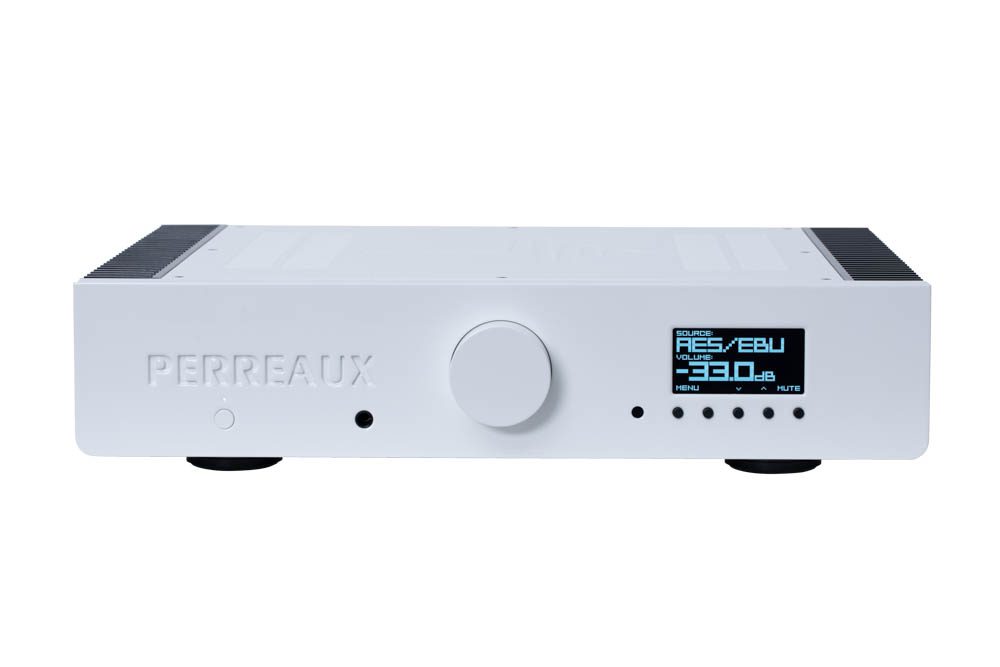
Perreaux 200iX

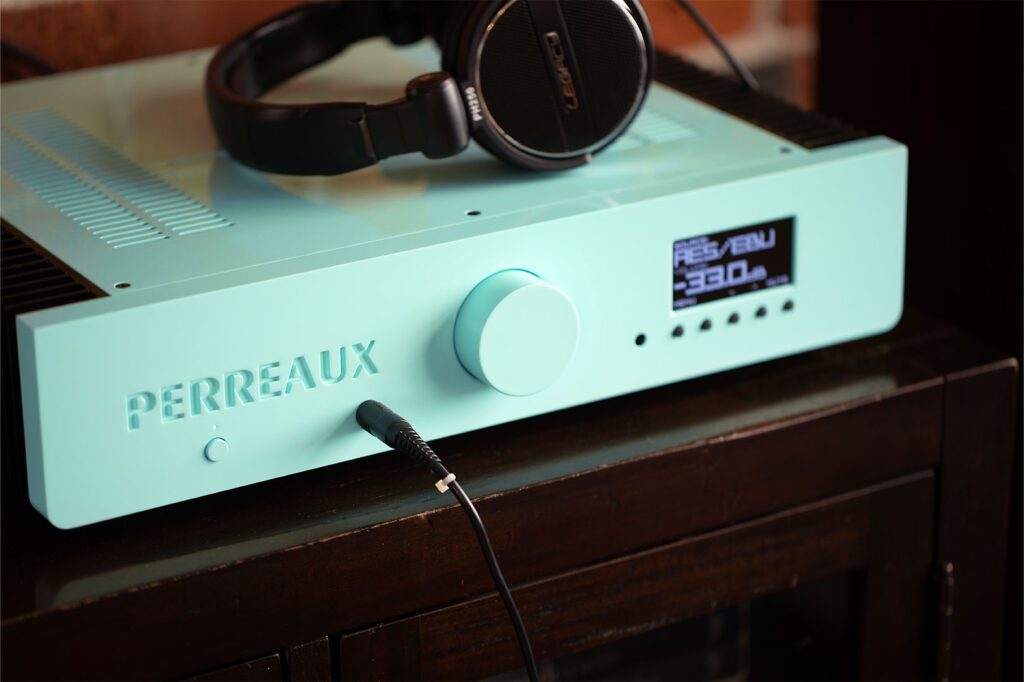
Perreaux hails from New Zealand. The firm relies in Mosgiel – 15km west of Dunedin – on NZ’s South Island. Formed in 1974 by Peter Perreaux, it’s modified fingers twice, and is now owned by electronics whizz Edwin Nieman, founder and proprietor of Kamahi Electronics.

The Perreaux 200iX is a compact microprocessor-controlled integrated-amplifier delivering 230W into 8 Ohm hundreds, and about 400W into 4 Ohms. Despite its trim measurement, the amp provides luggage of energy and a surprisingly complete array of options and amenities.

First FET

You get a built-in DAC, an MM/MC phono stage, plus a balanced line enter. A 6.5cm x 3.5cm LCD enables you to to navigate the various options and choices accessible. Historically, Perreaux have been among the many first to make use of Hitachi MOSFET output transistors when nonetheless fairly new, again in 1974.

Perreaux 200iX

The custom continues to today with the 200iX/300iX built-in amps. MOSFETs have helpful advantages over standard bi-polar transistors. Subjectively, they provide one thing of the sleek open sweetness related to tubes, however minus their foibles and shortcomings.

MOSFETs are additionally very secure and go ‘open-circuit’ in the event that they fail. Bi-polar transistors short-circuit once they fail, which normally sends sufficient voltage to your loudspeakers to fry the woofers. The most important draw back with MOSFETs is worth. The gadgets themselves are comparatively costly.

Perreaux 200iX

They’re additionally extra pricey to implement. Extra circuitry and higher energy provides are wanted earlier than MOSFETs can fulfil their most potential. But whereas all that is frightfully attention-grabbing, essentially the most noteworthy factor in regards to the 200iX is, after all, the large selection of colors accessible…

She Comes In Colours

Most hi-fi is both black or silver, with perhaps a little bit of gold bling thrown in. Not the Perreaux 200iX; it may be had in a large vary of customized colors and can attraction to anybody interested in svelte trendy design. Fortunately, underneath the bonnet, there additionally occurs to be an excellent amplifier/DAC.

Perreaux 200iX

An infra-red distant management is included, however there’s additionally a Perreaux App that permits you to function primary features like quantity up/down and enter choice out of your IOS/Android smartphone. The quantity management is digital with a complete vary of 127.5dB (from -96dB to +31.5dB) in 0.5dB increments.

This permits exact superb repeatable quantity adjustment. The most stage will be capped to keep away from speaker injury and the show modifications to giant numbers when quantity is adjusted, making it simpler to see at a distance. The quantity knob spins repeatedly, with gentle indent factors to provide it ‘really feel’.

Perreaux 200iX

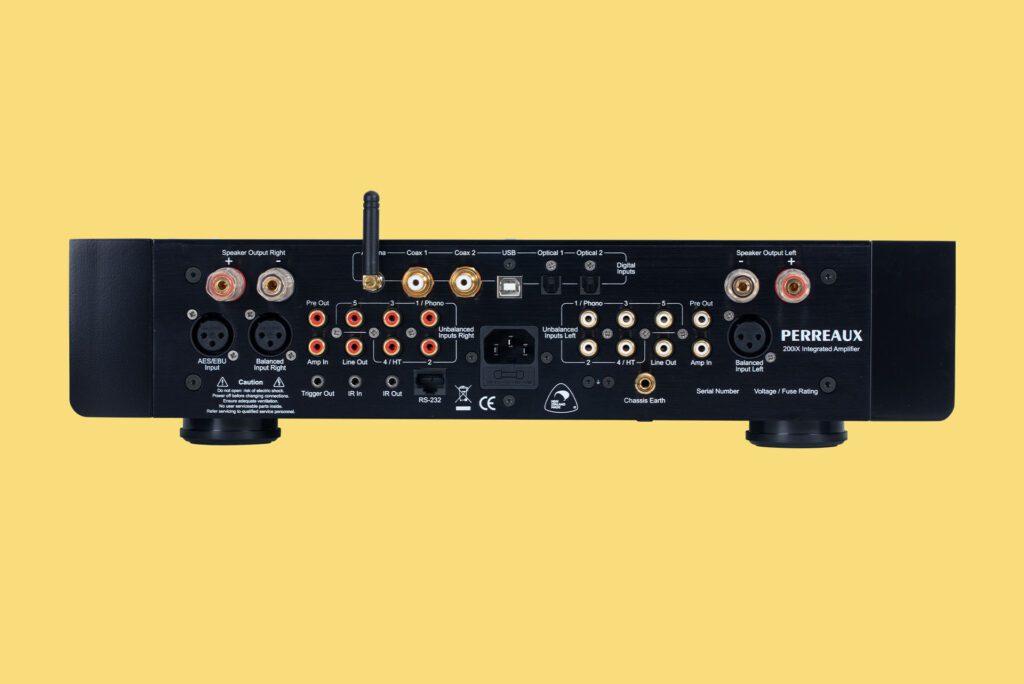
There are three unbalanced line-level analogue inputs, a single balanced enter (XLR), an enter for turntable with MM/MC cartridge, plus an HT Bypass enter for Home Theatre use. You can stream hi-res information from a pill or cellphone through Bluetooth. The USB is asynchronous and Galvanically remoted.

The built-in DAC employs an ES 9038 Pro Sabre chip. This has sampling charges from 32kHz to 384kHz at 24bit decision (coaxial or optical S/PDIF) and 32bit (USB). DSD (62, 128, and 256) can also be provided. Digital inputs embrace two S/PDIF coaxial (RCA) and two optical (Toslink), with one AES EBU (XLR).

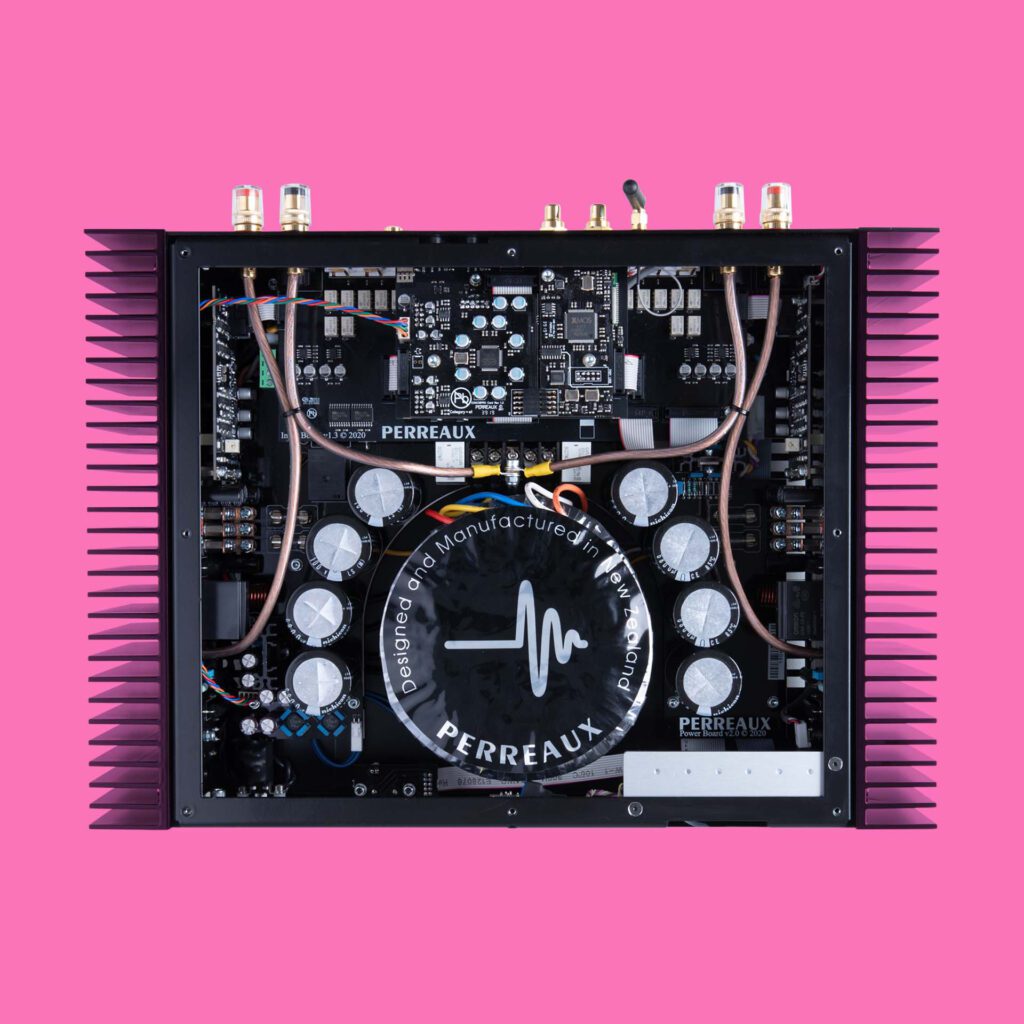
Despite its fairly seems and diminutive measurement (simply 426 × 344 × 149mm) the 200iX weighs in at a hefty 19kg – that’s 42Ilbs in outdated cash. An enormous torroid transformer ensures a beefy energy provide, and takes up a great portion of the innards. The 200iX feels stable and constructed to final…

Perreaux 200iX

My (early) pattern had a really faint buzzing simply audible from the transformer, however this has been fastened within the newest manufacturing run of fashions. During prolonged use the amp will get mildly heat – round 35C. I partnered the 200iX with 102dB environment friendly Klipsch Cornwall IVs, so by no means actually needed to push the amp that arduous.

The 200iX has a complicated microprocessor-controlled safety system that displays issues like the ability provide whereas checking for excess-current, temperature, DC offset, inner AC provide and DC fuse. The safety is non-invasive and doesn’t degrade the audio sign path.

For headphone followers, Perreaux have geared up the 200iX with their extremely regarded SXH2 Class A headphone amp to make sure wonderful outcomes. This even has its personal separate heatsinks, as an ideal indicator of simply how severely Perreaux takes headphone listening.

Perreaux 200iX

Prior to correct severe analysis, I spent per week or so simply listening to the Perreaux for pleasure. I favored what I heard however needed to put the 200iX to 1 facet as a result of a pair extra amplifiers (Audia Flight’s FLS9 and the Jadis I70) arrived for evaluate with a urgent deadline.

Both the Audia Flight and Jadis price significantly greater than the Perreaux. Once the evaluations of each amps have been accomplished, I returned to the 200iX. But, having simply loved two merchandise of such exalted sonic efficiency, would possibly the Perreaux show one thing of an anti-climax?

Epiphany…

Fortunately, the 200iX held its personal in opposition to its more-expensive rivals. Okay, there wasn’t fairly the identical sense of scale or tonal opulence, however general the sound was superb. Then – after a day or so – I had a wierd epiphany; I realised I used to be actually relatively having fun with listening to the 200iX.

The 200iX’ has a really clean clear snug supply. Clear and detailed with out seeming pushy or aggressive, the sound is pure, effortlessly-open with little or no tonal hardness. Your consideration is concentrated on the music, relatively than the sound of the music. It’s an vital distinction.

Perreaux 200iX

I observed this taking part in a jazz trio association of Bernstein’s West Side Story with Andre Previn, Red Mitchell, and Shelley Manne – a vinyl LP on Mobile Fidelity. The 1959 recording was rendered crisp, clear, candy, and totally unforced – detailed and brisk, with out being ahead or brash.

Art Pepper meets the Rhythm Section (recorded 1957) on Contemporary Records (Boplicity reissue urgent) had a lot the identical flowing-naturalness; a really clean open tonality with wonderful element. Only desiring to play a observe or two, I ended up listening to the entire facet…

The 200iX’s phono stage was wonderful too; relaxed but animated. Being choosy, on MC a small quantity of hum was current that might not be fully eradicated – it wasn’t an earth loop or a screening drawback. Once music performs, the hum can’t be heard. But I’d have most popular it gone…

For silver-disc, I used a Heed Obelisk CD transport into the 200iX’s DAC. Like vinyl, outcomes have been clear, refined, and simple to assimilate. While positively not a pointy brusque-sounding amplifier, the 200iX really ‘begins and stops’ in a short time. It’s very targeted…

The Wife speaks…

My pricey spouse not often feedback on the sound except I ask. But she spontaneously remarked on the Perreaux – twice! Interestingly, she discovered the 200iX’s unforced naturalness extra noteworthy than the FLS9’s element and scale, or the I70’s richness and tonal refinement.

Perreaux 200iX

I’d been impressed by the best way the Audia Flight FLS9 reproduced a jazz CD (New Blues by Barrie Norman and Friends). Could the 200iX match it? Up to a degree; however I might positively hear elevated dynamic-contrast and higher projection with the Audia Flight.

For instance, on ‘How Deep is the Ocean’, the sax solos projected extra strongly through the FLS9, making the slightest dynamic-inflections very audible. Yet whereas the 200iX didn’t fairly equal the vividness of the FLS9, it reproduced the music with barely extra cohesion and natural unity. Interesting!

The FLS9 was positively ‘higher’ when it comes to element and readability, however the 200iX simply appeared simpler to hearken to. It was easy and relaxed with out being soporific. Its musical presentation drew you in. I discovered myself sitting again, quietly entranced.

Some audio parts are like movie star actors; their sheer star high quality is massively spectacular. Yet on the identical time you by no means fairly overlook the actor taking part in an element. The Perreaux is extra like an understated actor who merely turns into the half they’re taking part in.

The portrayal is so pure and unobtrusive it feels actual; you consider you’re really seeing the individual they’re depicting. In that sense, the 200iX’s is extra Gary Oldman or Alec Guinness than Lawrence Olivier or Jeremy Irons.

Simpler, Plainer

While vivid-sounding hi-fi is thrilling and entertaining, a part which presents an easier, plainer rendition can typically (paradoxically) draw you into the music higher.

Perreaux 200iX

On first encounter, the Perreaux 200iX may not appear essentially the most thrilling or spectacular-sounding amplifier, however it delights and impresses the extra you hear. It’s exquisitely pure and musical. Over the long-term, it ought to show massively (albeit quietly) rewarding to live-with.

Its relaxed unobtrusiveness enables you to focus on the music. For myself, I appreciated the quiet allure of the 200iX the extra I listened to it. It beguiles, entails and educates. Given an opportunity, it wins you over. What extra might one ask for?

Technical specs

  • Type Integrated amplifier with DAC, phono enter and headphone amplifier
  • Analogue Inputs 4× single-ended RCA (together with MM/MC phono and HT move by means of). Balanced XLR enter, preamplifier in RCA, earth tag, set off enter
  • Analogue Outputs preamp output, line output for HT move by means of, all RCA, set off outputs, 6
  • Digital inputs 2× coaxial, 2× optical, 1× AES/EBU, 1× USB, 1× Bluetooth enter
  • Rated energy output per channel 200W/8Ω
  • Headphone amplifier SXH2 built-in module, pure class A operation, supporting 6-600Ω headphone impedances
  • Colour choices Many!
  • Dimensions (W×H×D) 42.6 × 15 × 34.4cm
  • Weight 19kg
  • Price £5,840

Manufacturer

Perreaux

www.perreaux.com

UK Distributor

Elite Audio UK

 www.eliteaudiouk.com

+44(0)800 464 7274

Back to Reviews

The submit Perreaux 200iX appeared first on Hi-Fi+.
Jadis I70

Jadis is a French audio electronics producer based mostly in Villedubert, simply to the east of Carcassonne in Southern France. It specialises in valve-based audio and as such has a powerful concentrate on amplification. Next 12 months, the corporate will likely be celebrating its fortieth 12 months, and if it makes one thing higher than the I70 built-in amplifier to have a good time that anniversary, it’s going to be probably the greatest merchandise on the planet as a result of this tidy one-box, line-level 50W amplifier is already probably the greatest within the enterprise!

Jadis famously doesn’t change its merchandise steadily. In reality, there are nonetheless fashions from its early days on the books, the place the one modifications to the design are improved manufacturing management strategies and minor element modifications caused as a result of not each firm makes the identical units they did 39 years in the past. An enormous a part of the explanation for such consistency is that Jadis may nearly be regarded as a transformer firm that additionally makes amplifiers. The design and high quality of transformers is pivotal within the efficiency of a product and as Jadis makes its personal output ‘traffos’ it might management the lifespan of a product.

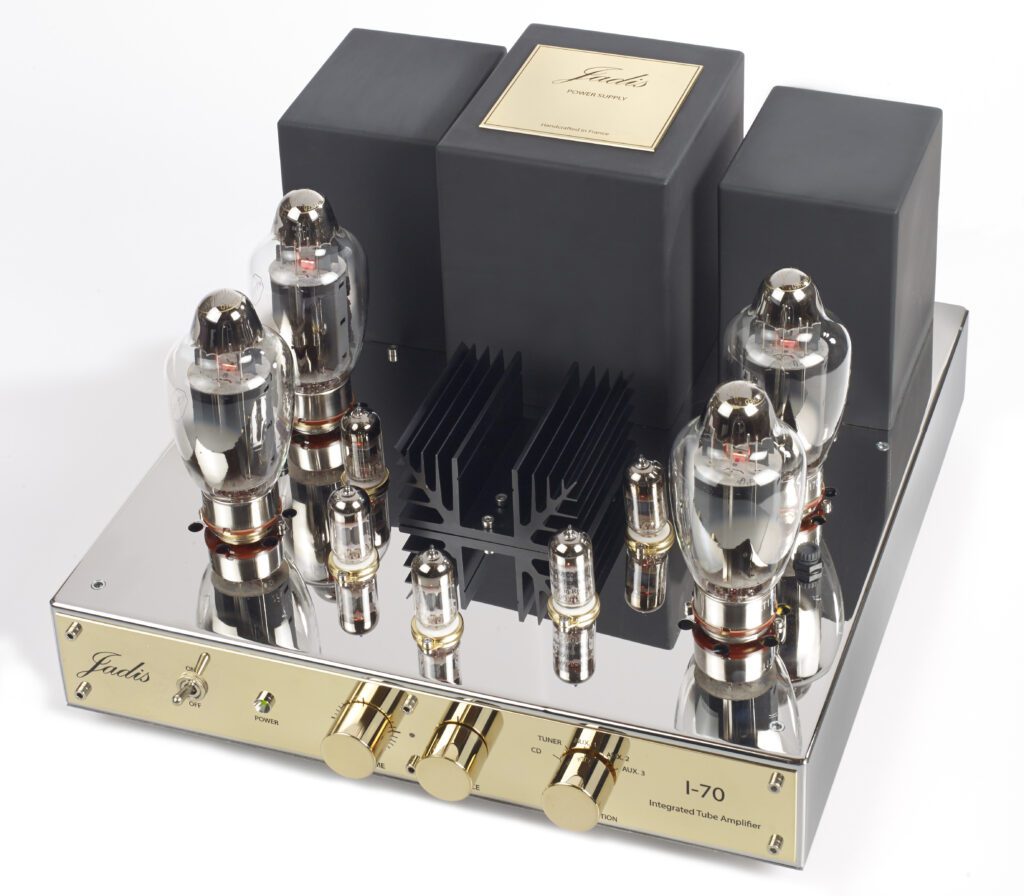
Rolling its personal transformers additionally provides Jadis a bonus on the subject of new valve designs. The new KT170 is an ideal instance; the I70 makes use of 4 of them, with two ECC83s and three ECC82s, with an computerized bias circuit for the paired KT170s used for every channel. This circuit is able to delivering a wholesome 50W in Class A.

Those KT170 are a power to be reckoned with, however they’re a brand new power at that; Jadis labored with the valve-designers to provide an output transformer that completely fits the traits of the valves, and the I70 is the end result, and it’s one of many first designs to make use of the valve. Other manufacturers will invariably look to the KT170 because the output energy valve of alternative, however will in the end have to attend till their transformer makers design a unit that fits the KT170, or go for an off-the-shelf kludge.

Jadis I70

Of course, reverse-engineering the transformers from a Jadis amp isn’t really helpful, as they’re sealed in potting compound resin; this isn’t an anti-piracy measure, nonetheless; the corporate does this to scale back the potential for transformer hum and maintain the amplifier as thermally secure as doable. This turns into particularly necessary with Jadis’ bigger energy amplifiers, lots of that are a financial institution of hot-running valves, however even with the ability valves of the I70, the extra thermal management you get, the higher.

Timeless seems to be

One of the opposite key components of a Jadis amplifier is there’s a commonality of design, and that design has remained unchanged for the reason that earliest days of the model. The I70 follows a long-standing Jadis custom of point-to-point circuits on the within and a chrome-finish chrome steel chassis, with 24ct gold-plated brass fixtures and panels and deep crackle-black squared-off transformer cans on the surface. In much less cautious palms, this might add as much as a complete lot of ‘bling’, however there’s one thing timeless and proper concerning the Jadis look. It’s not ‘understated’, however the I70 manages to look costly with out trying garish within the course of. Jadis additionally usually options some uncovered components, comparable to tall capacitors poking by means of the highest of the chassis, however right here it’s simply a big heatsink.

Heat is a really actual factor with the I70. I like to think about it because the Jadis providing you with a style of its homeland; the Languedoc area of France has lengthy, dry, baking sizzling summers, and you can be reminded of such summertime warmth each time you activate the I70. It isn’t working particularly sizzling, simply these KT170 output tubes pump out a whole lot of warmth.

That a lot warmth means two issues; a valve cage and a thirsty amplifier that sucks juice from the wall. In equity, within the latter case, Jadis quote an influence consumption of 500VA, which by a really back-of-a-beermat calculation works out at roughly 15p in your gas invoice for each hour of music performed. In all honesty, if you happen to can afford almost eleven and a half grand on an amplifier, you possibly can run to lower than £1 for a night’s listening session to feed it.

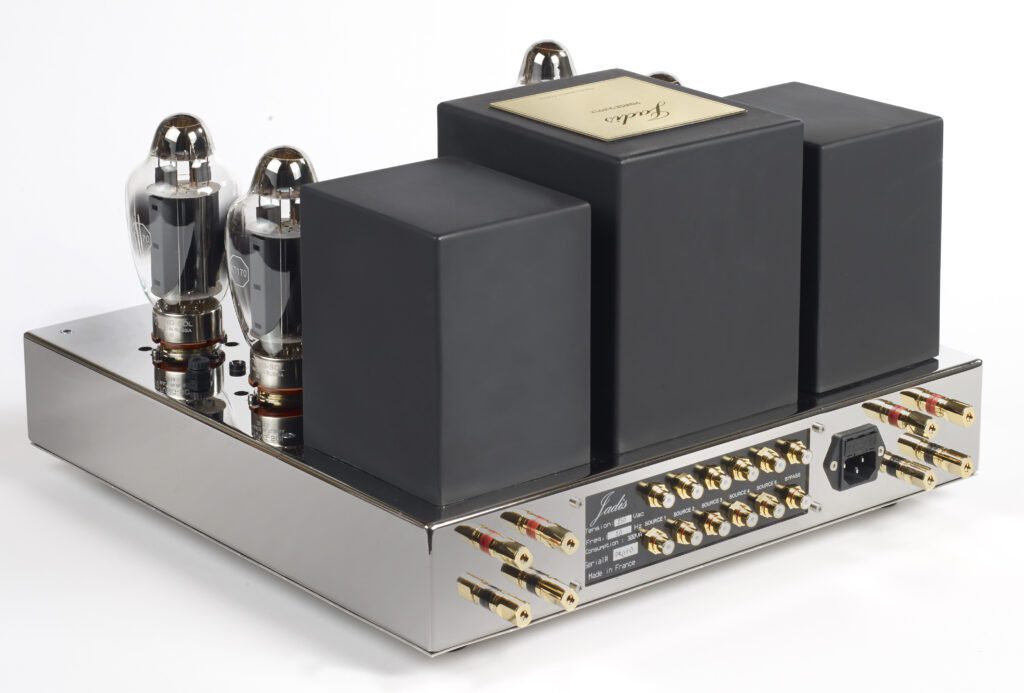
The amplifier is a straightforward pleasure to make use of. At the entrance, there’s an on-off toggle swap with a inexperienced LED to indicate energy standing (if the glowing tubes and the warmth aren’t sufficient clue for you). Then there’s a quantity management, a steadiness management and a supply selector dial. At the rear there’s an IEC energy cable inlet, 5 RCA stereo pairs for single-ended, line degree inputs, one output/throughput for recording or house cinema and two units of speaker terminals. Where some valve amps use totally different faucets from the transformer to connect with loudspeakers of various impedances, these are merely two units of terminals for simple bi-wiring. There’s no want for separate impedance faucets as a result of… you recognize, Jadis makes its personal transformers.

Jadis’ I70 can be extraordinarily effectively constructed. I’d say nothing strikes round contained in the case (that needs to be a given, nevertheless it’s a shock simply what number of valve amps appear to have a rattle someplace) nevertheless it’s very tough to find out this anyway as a result of the amp weighs in at a super-healthy 40kg. That’s ‘muscular’ for an built-in amplifier, no matter kind of output units it makes use of. That weight can be comparatively erratically distributed towards the rear of the amp. It’s a two-person raise (or a one-person hernia). That shouldn’t come as an excessive amount of of a shock because the amplifier is huge and is available in a really huge, very heavy field, however we nonetheless don’t anticipate our built-in amps to be that ‘husky’.

That’s all you get!

Hot and heavy. That’s it. That’s the closest we’re going to get to criticism right here. Because any criticism of the Jadis I70 sound high quality is met with incredulity from the listener at greatest; at worst it’s like telling a proud mother or father their child is ugly. To take heed to the I70 is to fall in love with music over again, and even constructive criticism of that keenness will probably finish badly for the critic. And let’s face it; the a part of France the place Jadis comes from was the scene of the sticky finish of the Cathars and Knights Templar by the hands of the Inquisition. They aren’t the type of people that take criticism squarely on the chin.

Fortunately, I’ve no want to carry again on criticism as a result of there’s nothing however good right here. This is an excellent sounding built-in amplifier, a near-perfect mix of perception into the system and into the music itself. It doesn’t lay both naked, however neither does it throw the gear or the music into gentle focus. There’s a way of rightness about all the things from the imaging to the dynamic vary to the vividness of these dwelling souls that appear to look in entrance of you at any time when the I70 is taking part in. Whether the Jadis is tasked with taking part in essentially the most saccharine of Mozart confections or some heads down bangin’ Techno, whether or not it’s the main target of a string quartet or a uncooked and raucous Seventies proto-punk band simply being offended for a couple of minutes, the I70 handles that music like a conservator; simply letting the music be itself for some time. It doesn’t fall into that heat and softly spoken sound we affiliate with valve amps and it doesn’t sound sluggish, stentorian and statesman-like; it’s quick, resolving and most of all enjoyable.

Yeah, not a lot to criticise right here.

The observe that sealed the deal for me was ‘Piece of My Heart’ from Cheap Thrills by Big Brother and the Holding Company; the place Janis Joplin’s mesmerising vocal energy simply steamrollers you. It’s a simple observe to get improper, both making all of it about her vocal assault in your ears, or making her voice extra managed and constrained. She wants to have the ability to sing at full throat and the sheer dynamism and vitality of the I70, coupled with its excellent velocity made that occur so completely, it was a kind of “let’s simply play that once more” repeat moments.

Another, resolutely no audiophile observe that I play for the sheer enjoyment is Louis Armstrong’s ‘West End Blues’ (from the Hot Fives and Sevens compilation). From the fanfare at first to the sluggish fade, the intervening 96 years for the reason that recording simply fade away, however they fade loads simpler if the system is de facto speaking the vitality of the music and never merely some textbook accuracy.

I’m making this sound just like the I70 is just good for dynamic, highly effective musical performances, however that’s completely not the case. I fed so many alternative items of music by means of this amplifier only for the enjoyable of it. That I did this throughout the peak of summer season which made for a sweltering expertise at occasions was merely the value I paid for the enjoyment. The undeniable fact that earlier I dismissed a whole lot of Mozart as ‘saccharine’ suggests I’m not a giant fan, however I performed his Horn Concerto No 4 and totally loved it in a method I hardly ever do (OK, I didn’t ‘air canter’ across the room at first of the final motion, however I used to be tempted).

Jadis I70

It’s not simply the soundstaging, or the dynamic vary, or the element or the articulation (all of that are excellent). It’s not concerning the micro-dynamics and filigree bits of music which are communicated so effectively right here. It’s not even about that excellent modern precision and velocity. It’s how all these issues mix in an natural method to make so satisfying a musical expertise you simply need extra.

We’re very a lot into the entire ‘metropolitan’ expertise right here. We need to have the ability to squeeze that quart right into a pint pot; the flexibility to make the sound you may get from giant loudspeakers and multiple-box amplifiers in a package deal that somebody may be capable of use in a typical New York house or Parisian pied-à-terre. And in that gentle, the I70 is nigh on excellent!

Isn’t She Lovely?

In taking part in the Jadis, I realised that I’d unconsciously ignored all my regular check recordings. This wasn’t some sort of Freudian avoidance approach, however I simply didn’t really feel the necessity to attain for them, partly as a result of music that hadn’t been warn right down to the nub by means of infinite analysis was so uppermost in my listening periods. Instead, a number of the outdated classics got here out, performed after sufficient fallow time to make them musically impressed in addition to helpful for audio testing. Stevie Wonder does characteristic strongly in these tracks of their fallow seasons (as do Pink Floyd and even Simon and Garfunkel, however let’s not go there). And it dawned on me that ‘Isn’t She Lovely?’ from Songs In The Key of Life fitted the invoice completely. The music is joyous, the sound it makes is joyous, and the way in which that sound is reproduced by means of the Jadis I70 is fairly rattling joyous too. It all suits. Isn’t She Lovely? If an amplifier is a ‘she’… completely!

Jadis I70 rear

OK, so ‘sizzling and heavy’ in all probability isn’t me doing my job to its fullest extent, however all the things I put within the notepad was so unusually upbeat and optimistic, it’s tough to search out these downsides, particularly while you put the I70 into some sort of context. As advised earlier, this can be a metropolitan amplifier, and dragging out the full-range huge weapons is pointless right here; nobody goes to hook the I70 to a pair of Wilson Chronosonic XVX, in any case. Personally, I think the I70 would acquit itself effectively beneath these circumstances, however having to power a product effectively out of its consolation zone to search out criticism isn’t actually honest. Neither is criticising a 50W amp for not being a 1kW amp. In its context, with loudspeakers like my Audiovector R1 Arreté stand-mounts and even the discontinued Wilson Audio Duette 2s that I can not half with, the sound is luxurious as it’s exact. In reality, the one statement made throughout the listening course of is that the Jadis I70 may not stay as much as preconceived notions of what a valve amplifier is meant to sound like, just because it doesn’t do this gentle and soggy, sugar-coated interpretation of music. Instead, it simply makes music the way in which you at all times anticipated it may sound when performed by means of rattling effective audio gear; with panache, vitality, velocity, precision, element, scale and dynamic vary. Cor!

I’ve usually joked that the most well liked amplifiers arrive within the peak of summer season and throughout the coldest months of winter, all you get to overview is Class D ice-boxes. That is actually true of the Jadis I70; it rocked up because the temperature began to rise, and I didn’t give a rattling. The sound it makes is so beguiling, so pleasurable and so musically ‘proper’ that I merely couldn’t assist pay attention it doesn’t matter what the ambient temperature. This is kind of merely probably the greatest sounding amplifiers I’ve ever heard.

Technical specs

  • Type Integrated Amplifier with distant management
  • Inputs/outputs 5x stereo RCA, 1× bypass stereo RCA, 2× loudspeaker outputs
  • Tube/valve complement 2× ECC83, 3× ECC82, 4× KT170 (computerized bias)
  • Power Output 50W
  • Frequency Response 10Hz–36kHz
  • Sensitivity 150mV
  • Dimensions (W×D×H) 40 × 40 × 25.5cm
  • Weight 40kg
  • Price £11,498

Manufacturer

Jadis

www.jadis-electronics.com

UK Distributor

Absolute Sounds

www.absolutesounds.com

+44(0)208 971 3909

Back to Reviews

The publish Jadis I70 appeared first on Hi-Fi+.

Octave V70 Class A

On paper at least, Class A has everything going for it; very low distortion that’s limited to second order harmonics, incredible transparency and fabulous speed. The only drawback is power; as Class A circuits are always on, they use a lot of energy and produce a lot of waste heat… but not a lot of output. It makes one wonder if their warm, natural sound isn’t directly related to the temperature they run at. This is true of solid-state and valve powered examples although the technology was originally developed for thermionic devices in glass tubes and that remains its true home.

Octave is that rare thing; a German company that builds valve amplifiers in Germany. The vast majority of valve amps come from the far east, (often mainland China) and while that doesn’t indicate lower quality per se the ‘Made In Germany’ badge has a lot going for it. In today’s climate it also means that supplies haven’t dried up even if energy supplies themselves aren’t as secure as they used to be.

The V70 Class A is not inexpensive but neither is it Octave’s most ambitious integrated offering; that honour goes to the rather similar looking V80SE with its 150 Watts per channel when using KT150 output valves. The V70 Class A can be used with a few different types of output valve but is supplied with chunky KT120 pentodes in a push-pull arrangement that’s specified to deliver 50 Watts a side with a peak output of 70W (when using the optional external power supply) and importantly as the name suggests these are Class A Watts or so it says. Octave’s Andreas Hoffman developed what he calls Dynamic Bias Control which he describes as a means of providing “Class-A virtues over the entire frequency response up to maximum modulation”. To the non-engineering eye this looks a bit like the way that a vinyl master can be made with a certain dynamic range, but by gain riding you can increase or decrease its sensitivity according to available power. Essentially Octave have found a way of moving the Class A power band to suit the signal: cunning stuff!

On the lowdown

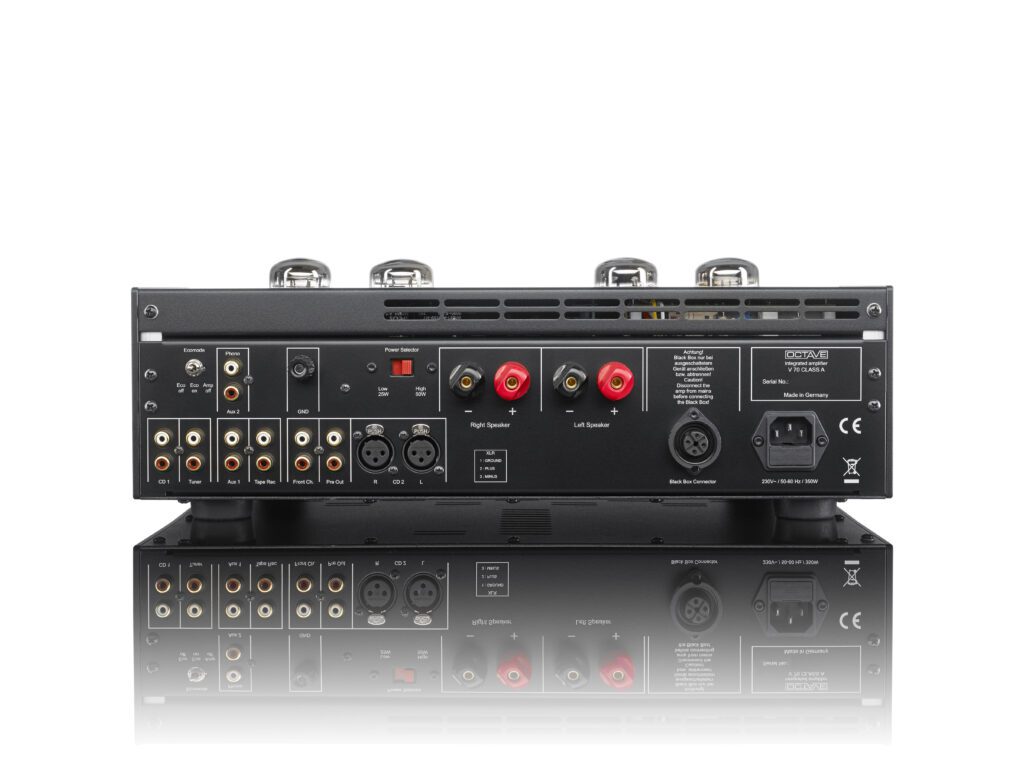
The V70 Class A has a switch on the back that’s marked ‘Low’ and ‘High’; this isn’t to suit your preferred listening level but to accommodate different output valves. ‘Low’ is for 25W output with KT88, 6550, KT90 and KT100 valves while ‘High’ allows up to 50W from KT120 and KT150 valves. Another unusual switch on this amplifier is marked ‘Ecomode’, when switched on this is a signal controlled means of having the amp go into a form of standby if no signal is detected for seven minutes. It’s not a full standby because certain sections of the amp remain powered up. This saves energy and extends valve life and it takes 20 to 30 seconds to power up once a signal is detected, which is also the case at switch on because of the soft-start system that is likewise designed to extend valve life. The third function of this switch is to turn the power amplifier section of the V70 Class A off so that the unit can be used as a preamplifier only.

Octave V70 Class A

The connection array on this amplifier consists of three RCA line inputs plus a fourth that can be supplied as a phono stage (MM or MC), a tape output and a balanced input. There also an RCA input marked Front Channel which is essentially a bypass for multichannel systems where the processor controls volume and uses the power amp section of the V70 Class A to drive the front channels. Unlike many valve amplifiers there are no alternative transformer tappings to suit four or eight Ohm loudspeakers, just a single hot connector as per transistor designs. Those wishing to upgrade the potential of this amplifier have the option to add one of Octave’s outboard Black Box power supplies using a dedicated multipin socket on the rear.

While this Octave’s display is marked for bias this is a self-biasing amplifier. There is no means to adjust the quiescent current sent to the valves for optimum operation. The display serves as a means to indicate the health of the valves and let the user know when they need replacing. Octave suggests that the output valves on this amplifier should last for three to five years with the driver valves being good for ten years or more.

Possibly the best thing about Octave amplifiers, apart from their sound, is the remote handset. This is a chunky but hand size lump with only two buttons on it and beautifully soft to the touch they are too, requiring the gentlest of squeezes to elicit a change in volume.

Wind it up

Unlike the Melody AN300B Max reviewed last month, which had triodes in a Class B push-pull arrangement the V70 Class A requires the volume to be wound up high in order to deliver the goods through PMC twenty5.26i (86dB sensitivity) loudspeakers. On most material the dial was around the three o’clock position, with quieter recordings I got to five o’clock. It’s safe to say that those after high playback levels will need more sensitive loudspeakers or smallish rooms to get their fix. But at medium to high levels this is a very engaging even addictive amplifier with an ability to get right down to the nitty gritty in everything you play through it.

The balance is more even handed than triode amplifiers, leading-edge definition is a bit stronger and there’s emphasis on detail that when combined with a fast paced delivery really draws you in. It does this regardless of whether you are paying attention or not by virtue of the coherence it brings to the party. Nothing seems to phase this amplifier and as a result it delivers the signal in a precise yet fluent fashion that serves the music extremely well. The bass lacks the grip found with solid state alternatives but makes a good case for its relatively natural presentation, essentially suggesting that if you get a strong sense of control that is a characteristic of the amplifier and not necessarily part of the original signal. The bass is certainly fulsome and powerful but speakers need less boundary reinforcement or, to put it another way, more space behind them.

Octave V70 Class A

This Octave treads the fine line between control and musicality extremely well. It avoids the bloom of less powerful valve amplifiers and likewise delivers mid and treble without the fine grain found with many transistor designs. Its glasses are not rose tinted but it has an immediacy and insight that is highly gratifying. Image scale is not exaggerated either, everything remains tightly in focus unless sounds are deliberately placed outside the speakers as in Radiohead’s ‘All I Need’ [In Rainbows], which seems a bit small scale until the special effects kick in.

Feel the tone

As is usually the case with valves analogue sources sound particularly appealing, the synth on Phi-Sonics’ The Cradle being a case in point. Up until hearing it on the Octave this had sounded good, but now it was tonally richer and more real. Ditto the sax on the same album which now had a tonetasticness to it that was far more appealing than usual. I mean, I don’t even like sax most of the time, which probably says as much about the way transistor amps handle them as anything. This Octave really likes live recordings too; it pulls out a lot of the quieter details that make it clear you are hearing a real event rather than a studio production. This was apparent with Ryan Adams and the Cardinals’ ‘Magnolia Mountain’ where the balance of power and ease brought the performance into the room. And perhaps more so with Rymden’s live version of ‘Pitter Patter’ which had me almost unconsciously nudging the volume as this trio built up the tension with some crucial double bass from Dan Berglund before Bugge Wesseltoft lets rip on the Rhodes keyboard, taking the intensity up several notches to the next level and beyond.

There are many ways to build a valve amplifier but not many of them result in sufficient power to drive lower sensitivity loudspeakers to full immersion levels, not necessarily high but totally involving in an emotional and rhythmic sense. The styling on the V70 Class A gives little indication of the colour and excitement it can deliver in the music, but the amp’s restrained appearance reflects its character which is very much about getting the music to the speakers as cleanly and coherently as possible.

Technical specifications

  • Type 2-channel integrated valve amplifier with optional phono stage
  • Analogue inputs Five single-ended line-level inputs (via RCA jacks), one balanced input (via XLR connectors)
  • Digital inputs N/A
  • Analogue outputs One pre output (via RCA jacks), one tape out (via RCA jacks)
  • Input impedance 50kOhm/RCA, 25kOhm/XLR
  • Output impedance (preamp) 240 Ohms
  • Power Output 50Wpc @ 4 Ohms
  • Bandwidth Not specified
  • Distortion THD < 0,1% @ 10 W into 4 Ohm
  • Signal to Noise Ratio – 100 dB/50 W
  • Dimensions (H×W×D) 175 × 451 × 405mm
  • Weight 23Kg
  • Price £9,350

Manufacturer

Octave Audio

www.octave.de

UK Distributor

Elite Audio

 www.eliteaudiouk.com

+44(0)1334 570 666

Back to Reviews

The post Octave V70 Class A appeared first on Hi-Fi+.
Roksan Attessa Streaming Amplifier

Rok’san Roll, Baby

Not long ago, the appeal of integrated amps was, shall we say, low. The segment had become “same old, same old,” lacking innovation and the latest features. Part of its decline in popularity was the lure of home theater, 4K streaming video, and multichannel, which moved buyers into the AV receiver/processor wing of electronics. But as the expression goes, what goes around comes around. Ultimately the high end found its way. Demographics were changing; empty nesters were downsizing into smaller homes, as well as smaller-footprint audio systems. The very definition of the integrated amplifier was also evolving. And once high-resolution streaming went from novelty to mainstream, a new segment of integrated was born. DACs, often bundled with network/streaming capability, found their way into the chassis. That, coupled with vinyl’s comeback and the explosion in personal listening, have made today’s integrated amps cooler and more practical than ever. They are one-box solutions like never before.

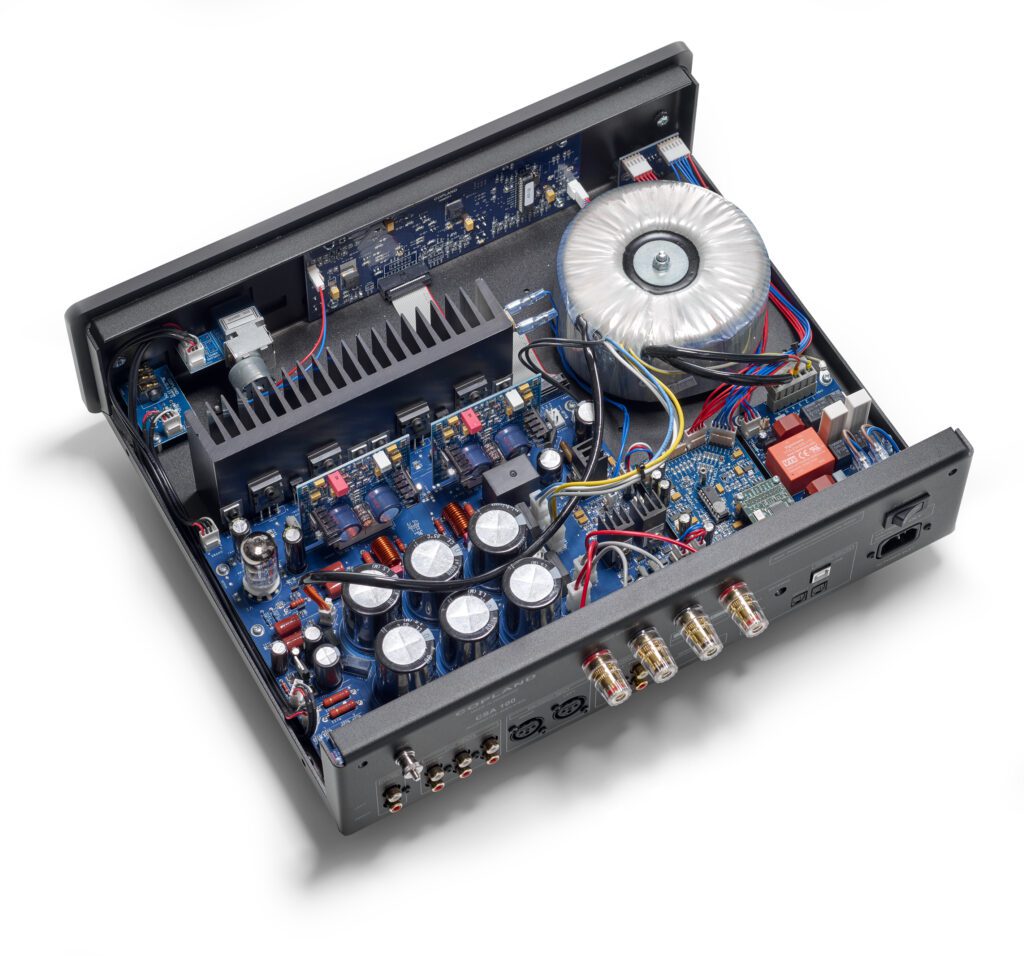
Which brings me to the Roksan Attessa streaming amplifier—an 80Wpc amp that fully embodies where today’s marketplace lives and, at $3199, is almost thrifty by today’s inflationary standards. Attessa is an all-new in-house design, Roksan’s first with integrated DAC plus network/streaming capability. Handsome but discreetly so, its low-slung front panel makes it an easy fit in even modestly sized dens. It features robust plate-steel and aluminum construction, and a machined anodized-aluminum front panel. A large circular volume/input control dominates the center of that front panel, where there are no obvious pushbuttons. For those who long for the old-timey, analog feel of knobs, toggles, and rocker switches, well, you’re out of luck. In their place is an illuminated, horizontal, orange LED strip (reminiscent of a MacBook Pro’s touchbar) that runs across the center of the panel and indicates input sources on the left and volume increments on the right. Personally, given a choice, I’d have preferred an illuminated numerical scale to indicate volume rather than a fader-style graphic, but I’m probably in the minority. At the right end of the facia is a 3.5mm stereo mini-jack headphone socket, whose 7.5Vrms output is suitable for all but the most finicky headgear.

Stepping around to the back panel, there’s a sufficient variety of digital and analog connections, with two optical and two coaxial digital inputs, provisions for two USB thumb drives, a pair of analog inputs, plus a moving-magnet phonostage. The phono setting is a standard 47k ohm/56pf, and there are three gain settings to accommodate cartridges with outputs from 3–12mV. The in-house designed DAC section resolves to 24-bit/192kHz for the coax inputs and 24-bit/96kHz for optical. The SPDIF inputs will decode MQA-encoded PCM streams, including MQA CDs played back by the optional companion Attessa CD transport. It supports most of the familiar high-res streaming-audio formats and services.

Embrace the App

Setup was just a free and downloadable app away—in this case, MaestroUnite, a set-up app that partners with Roksan’s other components, connects to the local Wi-Fi network, and allows the owner to configure the amp with its companion CD transport to operate as a single unit. Further, there’s on-the-fly control of Roksan’s built-in features like input configuration, headphone sensitivity, analog input gain, balance, and low-power standby (as well as over-the-air updates).

For day-to-day use the recommended smartphone-based, BluOS controller app was, indeed, the way to go, especially if you do a lot of streaming from any one of the major high-resolution streaming services. (I’m looking at you Tidal and Qobuz.) That includes a shared music library, USB drives, Internet radio stations, and podcasts. It’s an easy app to navigate, and fairly intuitive after a few minutes of familiarization. Guided by its graphical interface and haptic feedback, selecting my listening volume and input source soon became second nature. Conveniently, there are three BluOS presets directly available from the inputs list for easy accessibility. As a streaming jukebox, the BluOS app was more than up to the task. However, I was still glad to have the handheld remote control near at hand for common functions like raising or lowering volume and mute.

In an amplifier segment where three-figure power ratings are more often the norm, Attessa’s 80Wpc rating is not an especially high number. But tell that to my 83dB sensitive ATC SCM20s. They couldn’t have been happier being driven by Attessa. Believe me, they are known to get a bit cranky when not fed sufficient high-quality power. But wattage ratings, as many of us know, are really only part of the story. Amps with significantly higher ratings than Attessa will not necessarily sound better or even as good—they only “read” more powerful on the page. Like the line goes, not all watts are created equal.


This is all a roundabout way of saying that Attessa is one rocking amp with high capabilities. Throughout this evaluation it was a fully formed performer and a glitch-free workhorse in my system, with no new-amp “teething” problems to speak of, especially commendable in a freshly minted design. In sonic performance, it registered high scores across all genres of music with most every recording it encountered. It was grain-free and non-edgy and wasn’t apt to shade or spotlight particular frequency bands or overcook harmonics or treble information. Baritone or soprano, each sounded exactly the way nature intended. It maintained a ripe and natural midrange, a firm and controlled bass, and a smooth if slightly drier treble. I wouldn’t characterize the sound of Attessa as laid-back, nor was it overly cool or clinical. There was a spotless clarity to every note. Listen to Mary Travers’ wistful vocal during “500 Miles” from PP&M’s eponymous album Peter, Paul & Mary, and you’ll know what I mean. There was orchestral warmth, sometimes in abundance, but only when it was present on the recording. I’m particularly sensitive to the presence of low-level noise clinging like contrails to delicate and decaying piano notes and harmonics. Attessa was remarkably free of this artifact. What it couldn’t fully convey was the rosy blush of harmonic detail and air of an upper tier, tube-hybrid integrated like Aesthetix’s Mimas.

The Attessa was especially impressive imparting dynamic energy in both the macro and micro senses; transient information never grew weak-kneed in the face of large dynamic swings. A less noteworthy amp will flatten and smooth these transitions, as if acting like a recording-studio compressor and limiter. This doesn’t happen in the acoustic of the concert hall; every instrument from the triangle to the tuba is reproduced in full voice, as it should be.

Given that my LP rig was “offline” for most of this evaluation period due to a factory restoration of my SME Series V tonearm, I didn’t have a much time to spend with the Attessa’s phonostage input, but the time I did spend was more than worthwhile. It has selectable gain and performed quietly and with balance and conviction. The Clearaudio Charisma V2 I was using has a fairly easing going 3.6mV output, so noise was not a problem. But the familiar Charisma sound was reproduced in abundance. On a track like “Someone in a Tree” from Stephen Sondheim’s Pacific Overtures, there were the familiar hints of warmth, zero etch or grain, and superior imaging and placement of the singers arrayed across the stage. Channel separation was very good, too. Imaging was not especially dimensional, however. On a track like Rutter’s “Lux Aeterna,” there’s not a lot of depth on the soprano, and the depth and acoustic of the hall seemed a bit shortened—a generalized soundstage compared with a top-notch reference integrated like the Aesthetix.

For digital performance, I threw one Tidal playlist after another at the Attessa, waiting to trip it up, to find its weakness. I even sent the digital signal from my dCS Puccini to let the Attessa’s DAC take the reins. That trip-up never happened. The Roksan’s DAC section is uh, Rok-solid. Comparing my reference Lumin S1 media player to the Attessa DAC, there was little in the way of a sonic letdown. The Lumin owned the soundstage and three-dimensionality from the outset. Its warmer, analog-like character contrasted with Attessa’s drier, less airy personality. But when it came down to imaging precision, tonal balance, and textural complexity, the contest was a lot closer. With the Lumin more than triple the price of an entire Attessa kaboodle, this close competition should make any Roksan owner satisfied with a savvy buying decision.

An interesting side note. Roksan was founded in 1985 and acquired by British loudspeaker manufacturer Monitor Audio Ltd in 2016. The Attessa Series components are post-acquisition developments, and Roksan has stated that it will be revising and refining current products and developing new products. These developments, along with Monitor Audio’s fine reputation in loudspeakers, should augur well for forthcoming system-wide synergy that audiophiles can truly look forward to. Indeed, the Roksan Attessa turned out to be a real sleeper. Looks, ergonomics, and performance—a lot of pieces must fall into place to successfully bring together digital and analog sections, sophisticated software, plus Wi-Fi and network capability. It’s no small task, but with Attessa Roksan has fully met the challenge and then some. At $3199 all-in, the Attessa is likely the one to beat in a hotly competitive division. Highly recommended.

Specs & Pricing

Power: 80Wpc into 8 ohms, 130Wpc into 4 ohms
Digital inputs: 2 optical, up to 96kHz/24bit; 2 coax SPDIF up to 32-bit/192kHz
Analog inputs: 2 RCA, MM phono
Outputs: 1pr RCA analogue (Pre-out/SUB)
Supported audio formats: MP3, AAC, WMA, OGG, WMA-L, ALAC, OPUS
MQA, FLAC, WAV, AIFF, Supports converted DSD playback via the BluOS desktop app (only) up to 24 bit/192kHz
Dimensions: 17** x 3** x 14.75**
Weight: 23 lbs.
Price: $3199

KEVRO INTERNATIONAL
902 McKay Road, Unit #4
Pickering, ON L1W 3X8
(800) 667-6065
kevro.com

The post Roksan Attessa Streaming Amplifier appeared first on The Absolute Sound.

Aavik U-280 Integrated Amplifier/DAC | REVIEW

In the interest of full disclosure, I reviewed the Aavik U-280 integrated amplifier and DAC ($18,000 USD) in a full Audio Group Denmark system that included the Aavik S-280 streamer ($12,000), the Ansuz Mainz8 D-TC3 […]

Copland CSA 100

Back in issue 194, Chris Thomas got to grips with the then-new CSA 150 integrated amplifier from Copland. The Copland hybrid amp project wasn’t simply one amp; there are three in the range. The CSA 100 is the middle model, and it might just be in the sweet spot of the trio.

You see, the Copland CSA 150 is the big hitter, delivering – as the name suggests – a hefty 150W into eight ohms, and standing at 164mm high is quite a big beastie on the shelf. The CSA 100 – also as the name suggests – delivers a still impressive 100W into eight ohms, but cutting some 29mm off the height, shedding a kilo of shipping weight and shaving a grand from the asking price makes a surprisingly big difference. When you consider that the last represents a one-fifth drop in the total price of the amplifier and that many CSA100 amps will be used in systems that never get close to using all of its 100W in reality, you can see why these differences might just make all the difference.

Hybrid Listening

Having recently covered the CSA 100’s bigger brother in the magazine, I am mindful of not going over old ground. However, it’s important to show just how similar these amplifiers are in specification terms, because they share a lot in common in musical terms as a result. Copland started life some 30 years ago in Denmark. The founder Ole Møller remains at the helm to this day. From the outset, Copland amplifiers feature valves (either all-valve or hybrid designs) and sported the clean lines that the brand has retained to this day. The original Copland models were not available in black if I recall correctly, but in all other areas, the strength of the design is you could put an early 1990s Copland amp next to a 2022 model and see no striking differences in product design. While some might argue that suggests lazy industrial design and everything needs a revamp sooner or later, the other side is if something has classic appeal, leave it untouched. But it’s a sign of just how strong and long-lasting Copland’s industrial design remains that where 30 years ago, those distinctive knobs were called ‘Cello-like’, the bespoke Cello amplifiers made by Matthew James today look ‘Copland-esque’ today.

Copland CSA 100

 Like the CSA 150 that preceded it, the CSA 100 features a built-in quad mono DAC built around the Sabre ES 9018 Reference DAC chip from ESS Technology on its digital input board. This can be equipped with an aptX Bluetooth module. This connects to the digital universe through USB, as well as to conventional digital audio devices using a coaxial S/PDIF and two Toslink optical digital connections. It supports both PCM and DSD files, although (in my mind, correctly), Copland steps away from the digital arms race; preferring to stick with DSD128 and 32bit, 384kHz PCM. As ever, Linux and Mac users get to connect to the hi-res side of things without a problem, but Windows users need to download a device driver. There will doubtless be those who start stamping their feet and decrying ‘dealbreaker’ because the CSA 100 won’t play that single DSD512 or 768kHz PCM file they have. To them, I say… “get a life!” Sadly, we’ve been in the thrall to those obsessed by this numbers game for years and for no good reason. I would rather have a system that copes with already high-resolution audio files with aplomb than I would something that chases zeitgeisty super high resolution and falls flat sonically as a result. These files are often of dubious provenance and of questionable sonic benefit over their less lofty brethren. Rant mode disengaged!

Healthy Oomph

Alongside the DAC, there is also a neat moving magnet RIAA phono stage on board and a headphone socket. You can also turn the CSA 100 into a preamplifier in its own right, although this is simply through judicious use of phono plugs on the rear panel rather than turning off the parts of the amp no longer in use. Power it up and it takes 45 seconds or so to spring to life, warming up the lone 6922 that sits in the gain stage of the preamp section. A healthy 100W of MOSFET power is then on offer, and a sign of the degree of ‘oomph’ this amplifier has it that it almost doubles that figure as you slip from an eight to a four-ohm loudspeaker load, pumping out an impressive 180W per channel.

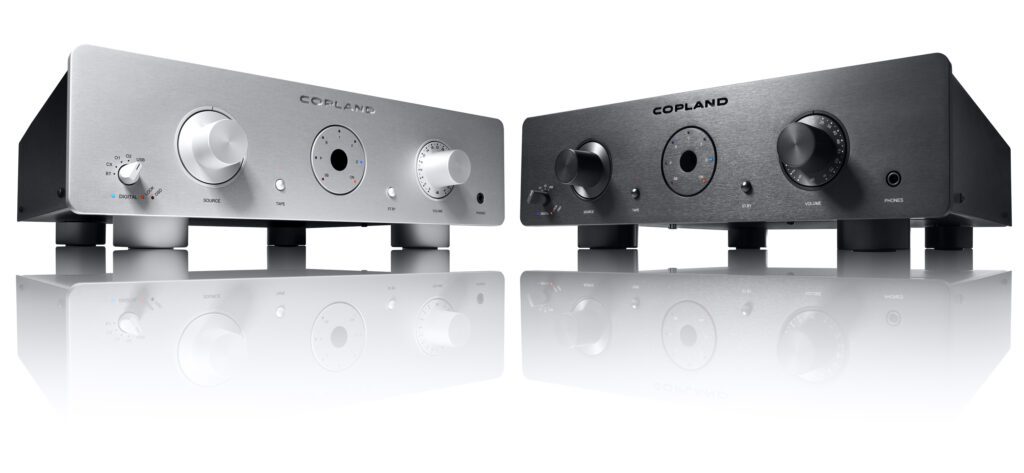
Operation is simplicity itself. There’s a rotary selector to direct the amp to your source component, which is signified by one of the LEDs in a circle in the middle of the front, alongside power on, standby and whether you have switched to the phono input or the digital circuit. The digital option has a little manual dial to select source, making it a bit of a hub. With just two RCA and one XLR analogue stereo line inputs, the CSA 100 doesn’t exactly bristle with inputs, but it has a tape input and output which is both rare and refreshing today. There’s a remote eye in the middle of that central wheel of LEDs.

All of this (apart from the 100W power output) is exactly the same spec and options as the bigger CSA 150. As described earlier, the CSA 100 is a shorter, slightly lighter and cheaper prospect than the CSA 150, but in all other respects is identical in approach. What’s the point of that?

In fact, these two amps speak to two very different clientele. The CSA 150 is ideal for a system with big ideas; that extra power makes it a perfect partner for the likes of Wilson Audio SabrinaX or even Magico A5 loudspeakers. On the other hand, the CSA 100 is more about giving a taste of the high-end to those with loudspeakers at a similar price point to the amp. In a way, that makes it even more important than the CSA 150.

Here’s why? For many, the Copland CSA 100 will be the gateway into the high-end. They will have a good system that makes nice sounds, but have only scratched the surface of the grace, power and sophistication that high-end audio can offer. Get it right and that prospective high-ender has a life-long passion. Get it wrong and they’ll wonder what all the fuss is about. This is the crucial moment when a music lover can identify with the passion that drives high-end designers, or the point when they dismiss the whole shooting match as just so much bling for people with more money than sense!

Fortunately, Copland gets it very right indeed. It’s a tidy, dexterous sound, coupling the grace and finesse of a good valve amp with the drive and slam of a well-engineered solid-state device. It’s also expressively dynamic without the sort of unrestrained dynamic range that high-end speakers love, but can sound ‘edgy’ on speakers you might typically find in commensurately priced systems.

Copland CSA100 rear

What it does so well is communicate that ‘holographic’ soundstaging that draws so many to good audio. The Copland CSA 100 has that in spades, creating a three-dimensional space in front of the listener that you feel is almost possible to reach out and touch. Any of those demonstration-quality ECM recordings are perfect partners here; all that oud-noodling (oudling?) by Anouar Brahem on albums like Blue Maqams or The Astounding Eyes of Rita is mesmerising here, filling the room with a North African/Middle Eastern vibe.

Clearly better

While that staging is what hooks you into the Copland’s sound, it’s the clarity and detail that are the real insights. The CSA 100 gives you a close look into the recording studio or venue; not in a brutishly hard analytical manner, but with the sort of detail and insight that just communicates the music extremely well. Audiophiles often have something of an obsession with finger noise on stringed instruments because it shows how good a device is in picking up very low-level information. Playing ‘May You Never’ by John Martyn {Solid Air, Island] gives excellent insight into the musician’s playing style and all those finger noises (often masked by his percussive playing style) come through well. The flip-side to this – The Glenn Gould/Keith Jarrett Sing-A-Long Hour – is also well resolved, but where some of the more aggressively detailed make Gould’s little snorts and hums irritating to the point they detract from his masterful playing, here they sit well in the Bach piece [Goldberg Variations, Sony]. And while that clarity is somewhat cool and collected, more cerebral than ‘shut up and dance’, few can match the CSA 100’s ability to communicate at the price.

There is good consistency across the inputs too, with no shifts in tone or character as you move from turntable to line input to digital. I’d argue that the RCA line inputs are mildly superior to XLR, that coaxial S/PDIF is marginally superior to Toslink optical and both are a hair better than USB, but unless you are playing the same track back to back through all these inputs, the difference are slight.

The headphone listening experience is one of the few places that requires qualification. While the likes of Sennheiser’s HD 25 II closed-back headphones sounded as clear as a bell and extremely detailed (they are popular with field recordists for a reason), the same did not apply with a pair of the late, lamented AudioQuest NightHawks I use for night-time listening, which sounded ‘peaky’ through the CSA 100.

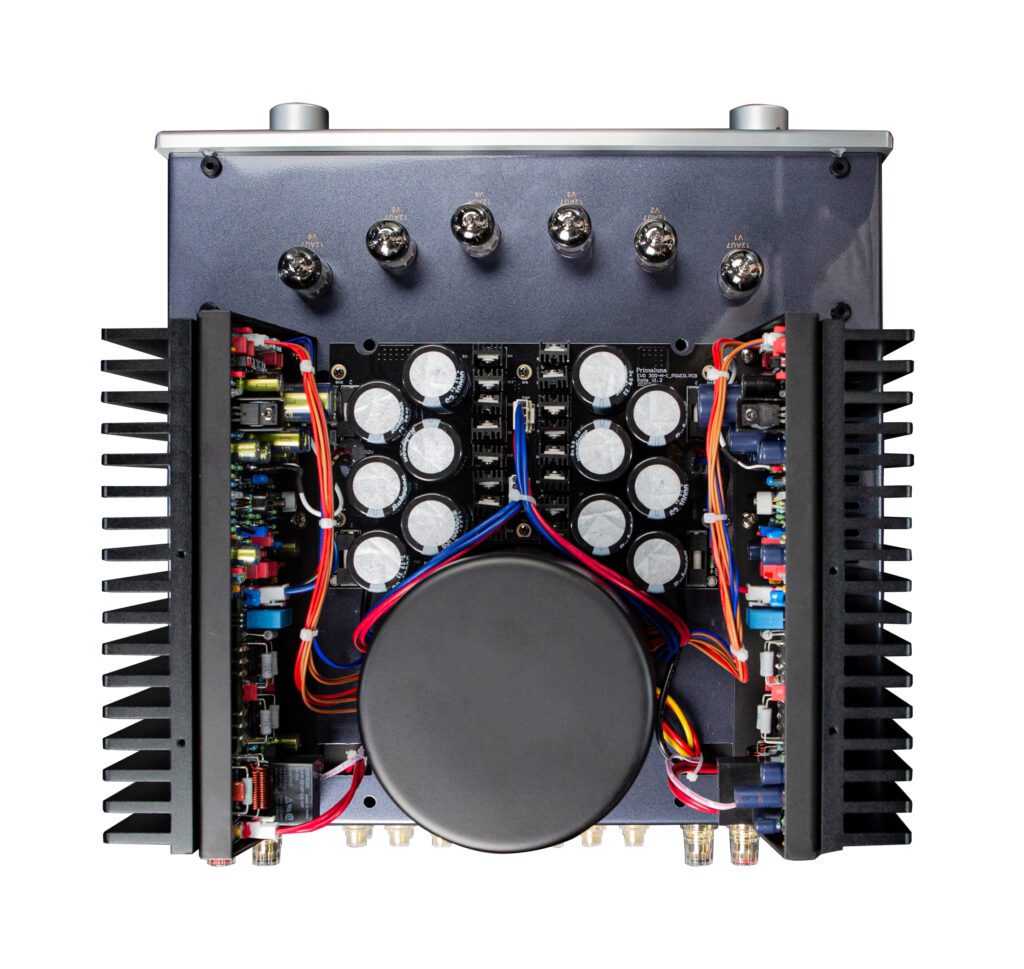
I’ve been privy to two very different sounding hybrids in successive months, both of which come from the same Absolute Sounds stable. The £6,498 PrimaLuna EVO300 Hybrid is also a 100W integrated amplifier design, albeit one without a phono stage, a headphone amp or a DAC. It also uses six 12AU7 valves. The difference between the two is striking; the PrimaLuna is ‘punchy’ and yet ‘refined’ where the Copland is ‘detailed’ and ‘elegant’ sounding. The EVO300 Hybrid has more of a sonic imprint on the music, but that imprint is very attractive to some listeners.

Copland CSA100

I’m often reluctant to put together combinations in print unless they absolutely sing together, but hooking the Copland CSA 100 to a pair of KEF LS50 Meta loudspeakers is one of those matches made in sonic heaven. Factor in your turntable of choice (I think EAT, Pro-Ject or Vertere would be a great visual and sonic match, but the built-in phono stage is a flexible friend), a good digital source and a cable system that brings out the best of both and in a small to medium sized listening room, that Copland/KEF combo is extremely hard to beat, giving you an extremely detailed and open sounding performance with outstanding soundstaging, boundless energy and a smoothness and satisfaction to the sound that is just… polished.

Metropolitan chic

I have banging on about ‘metropolitan’ high-end audio recently, and the Copland CSA 100 is perhaps the epitome of that concept. The amplifier’s size, features, abilities and classic design make it the kind of device that is made for chic city-dwelling living spaces rather than the dedicated listening rooms of those ‘estate’ listeners (for UK readers, that’s ‘estate’ in the ‘rambling country seat’ sense, and not a cheaply-built tower block in Thamesmead). So, where earlier I said – and still hold – that the CSA 100 is a gateway into high-end audio, it is also sufficiently good in its own right to be that high-end centrepiece in your London flat or your New York apartment.

It’s these last two elements that make the Copland CSA 100 so important in today’s audio world; it sounds sublime with real-world audio devices, showing just what good high-end audio is capable of, and does so in a package that’s as refined as its sound. That gives the amplifier a wider audience than just traditional audiophiles going through a spot of ‘electronics churn’. I suspect all three amps in this series will have universal appeal but the CSA 100 doesn’t suffer from ‘middle child syndrome’; it’s just possibly in the Goldilocks spot where everything just fits well.

Technical specifications

  • Type Integrated amplifier with DAC and phono stage
  • Power 2 × 100 watts into 8 ohms
  • Analogue Inputs 1 × balanced (XLR),
  • 3 × unbalanced (RCA)
  • Digital Inputs 1 × coaxial S/PDIF, 2 × optical S/PDIF, 1 × USB, 1 × aptX HD Bluetooth (optional)
  • Line Output 1 × unbalanced (RCA), 1 × pre-out unbalanced variable (RCA)
  • Phono Input Impedance 47K ohms (MM)
  • Frequency Response 10 Hz- 150 kHz -3dB
  • THD Better than 0.06%
  • Signal/Noise (IHF-A) Better than 90dB
  • Headphone Amp Gain 22 dB @ 100 ohm load impedance
  • Headphone output impedance 40Ω
  • Vacuum Tubes 1 × 6922
  • Remote Yes
  • Dimensions (H×W×D) 135 × 435 × 370mm
  • Shipping Weight 14 Kg
  • Finishes Available Silver or Black
  • Price £3,988
  • Bluetooth Module £198

Manufacturer

Copland

copland.dk

UK Distributor

Absolute Sounds

absolutesounds.com

+44(0)20 8971 3909

Back to Reviews

The post Copland CSA 100 appeared first on Hi-Fi+.
Luxman L-507z Integrated Amplifier

I’ve reviewed the new Luxman L-507z integrated amplifier on the TAS YouTube channel. Here are my show notes for this episode for those of you who are intrigued by this integrated amp:

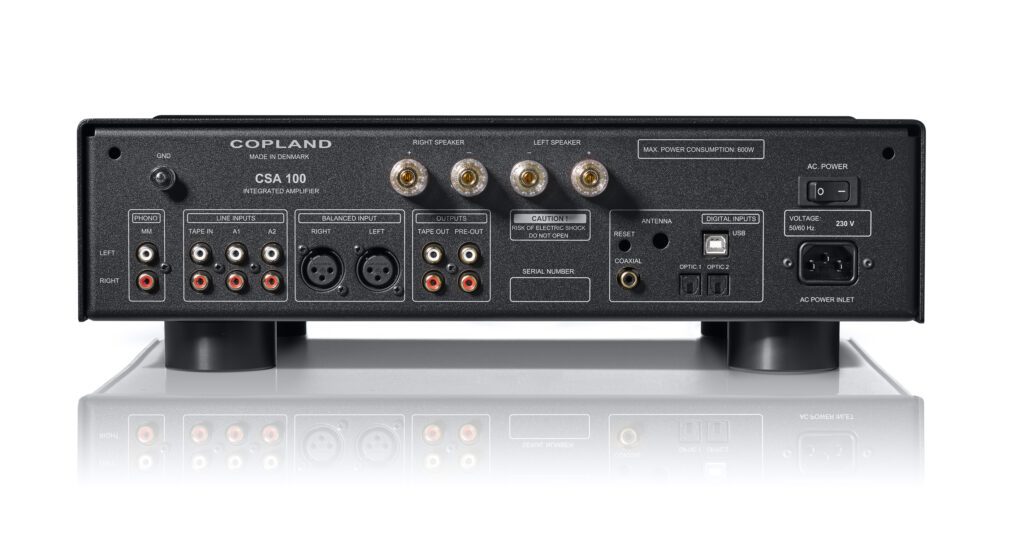
Superpower(s): The L-507z presents music with an uncommonly pure, low-grain tonality that isn’t compromised by frequency response or dynamic trickery. No trickery? Well, the frequency balance of the L-507z is very even-handed and the dynamics are outstandingly realistic, and those are the two standard “cheats” that make some instruments sound natural in a tonal sense, but not when you listen longer. This combination of purity, balance and dynamics is hard to find at any price and makes the L-507z an especially good value. $9k may not seem like good value for those who measure value by the pound, but for those with ears, let them listen and judge. I think you’ll like what you hear if you have medium or high-efficiency speakers (88db – 93db or thereabouts) in a medium to small room (under 2000 cu. ft).

Special features: LIFES 1.0 distortion-cancelling feedback engine. Is this why the L-507z has such a beautiful, grainless sound? Well, I think it is absurd for reviewers to tie sonic elements to features, but Luxman seems to think it is a big deal. They emphasize that “extensive computer simulations” were used, along with repeated trials of different components and listening to prototypes. This R&D is part of why products like the L-507z seem somewhat expensive “for what you get”. You are paying for intellectual property, not only parts.

Price & Specs

Price: $8995 (U.S.A)

Power: 110 watts per channel (8 ohms) or 210 watts per channel (4 ohms)

Dimensions: 17.3” wide x 7.0” high x 17.9” deep

Weight: 56 lb.

Tone controls: bass, treble, loudness contour

Phono preamp: yes, with MM and MC inputs

Balanced inputs: yes, 2, for line only

Headphone output: yes, both single-ended and Pentaconn balanced

Remote: yes, IR

Associated equipment:

  • dCS Lina DAC and Master Clock
  • Tidal and Qobuz streaming
  • Magnepan LRX+ speakers
  • Golden Ear BRX speakers
  • Sanus speaker stands
  • Audioquest interconnects
  • Audioquest speaker cables
  • Shunyata power cables
  • Shunyata power director
  • Audio Research Ref 6 preamp
  • Legacy Wavelet DAC/Preamp
  • Bryston 3b Cubed amplifier
  • Orchard Audio Starkrimson amplifier
  • Oppo BCD-105 CD player/transport
  • Vicoustic diffusors
  • RPG bass traps

The post Luxman L-507z Integrated Amplifier appeared first on The Absolute Sound.

PrimaLuna EVO 300 Hybrid

PrimaLuna’s mission to deliver high-end valves without the high-end price tag continues unabated, but when it came to hybrid designs, the company was famously silent on the subject. Not any more… with the EVO 300 Hybrid integrated amplifier, PrimaLuna hasn’t just grasped the hybrid nettle, it’s pulled up the nettle and brewed up a delicious concoction as a result.

But why go hybrid at all? While all-valve designs are frequently wonderful, sometimes more power is more, er,  wonderful-er. It’s possible to make high-power all-valve designs, but generally it’s extremely difficult to produce such products without a lot of transformer iron and a plethora of output valves. That makes them expensive, and even more expensive to do properly. This puts high-power, all-valve designs outside of PrimaLuna’s core ethos. The problem then becomes how to do hybrid ‘right’ and while there are many hybrid successes there are many examples of hybrid designs falling short in one or more aspect of performance.

Floyd makes an entrance

The ‘Floyd Design’ on the PrimaLuna EVO 300 Hybrid’s front panel isn’t just there as a sop to audio’s obsession with Dark Side of the Moon; Floyd Design is an independent company run by ex-Sphinx engineer Jan de Groot. In the background, de Groot has been PrimaLuna’s go-to solid-state engineer for its digital devices for the last 20 years, so he knows the PrimaLuna sound well. Recently, de Groot has teamed up with tube-amp virtuoso Marcel Croese (formerly of Goldmund fame), Kevin Deal of Durob Audio and PrimaLuna’s Herman van de Dungen to create a handy brains-trust/listening team in order to build a device that leverages Jan de Groot’s expertise with JFET power amplifiers without sacrificing what PrimaLuna stands for and how it sounds.

PrimaLuna EVO 300 Hybrid

Looking past the ‘Hybrid’ part of the name gives you some clues about the amp itself. The ‘EVO 300’ part is there because this is effectively almost all of an all-valve EVO 300 preamplifier that has grown into an integrated design by virtue of a JFET/MOSFET power amplifier capable of delivering a healthy 100W per channel into eight ohms and 150W per channel into four ohms. To mix these two amplifiers into one chassis, the EVO 300 preamplifier stage loses its valve rectification and choke-regulated power supply, but it retains its sextet of selected, double-triode 12AU7 valves, with two valves used for driver, cathode-follower and gain stages. These then meet high-performance Linear Systems JFETs and custom-built MOSFETs in a dual-mono Class AB power amp layout.

From the exterior, however, you could be forgiven for mistaking the Floyd as one of PrimaLuna’s preamplifiers. The classic PrimaLuna rolled valve cage and basic two dial layout (complete with 6.35mm headphone jack) remains the same. It’s only the absence of bigger power valves beneath the cage and the presence of two pairs of decent WBT terminals at the rear suggest anything out of the ordinary. Oh, and the weight; knocking in at a healthy 31kg, this matches the EL34 powered EVO 400 power amp in the heavy lifting category.

In all other areas this is classic PrimaLuna fare and one of the nice touches from the EVO range shared here is that switched headphone socket; where most autodetect the presence of a headphone jack inserted to the socket, PrimaLuna has a switch on the side that moves its operation from loudspeakers to headphones. This is because the PrimaLuna doesn’t just use a standard headphone amp circuit and believes in sonic purity to such an extent that the inclusion of that detection circuit is something else to undermine the sound of an amp. While this may cause a few ‘choice’ words if that switch is thrown without your knowledge, I think this is a good way of making a great sounding amplifier, both in loudspeaker and headphone terms.

Sound Quality

This amplifier did take a little while to come on song; as it bedded in, the soundstage seemed to increase its width and depth slightly every day and then suddenly grew some height information. Around the same time, the treble – already well integrated with the mid and bass – just suddenly shifted gears and became the perfect partner for the rest of the tonal range. It just ties together better after a few days of settling down.

PrimaLuna EVO 300 Hybrid

Like most reviewers, I have my go-to recordings that are used to pick out aspects of performance, but they quickly came and went. I was enjoying what I heard from them and so much more. I will point to one new inclusion in the roster, there for a specific reason; ‘Rejection’ from Lady In Gold by Blues Pills [Nuclear Blast]. This album is almost a perfect inversion of an ‘audiophile’ recording because it tends to sound worse the better the system; lively yet warm like a pastiche of an early 70s rock album on cheaper equipment, the better the system, the more ‘lively yet warm’ gets pushed to the back while ‘pastiche’ becomes uppermost. Here, however, it achieves a fine balance; the album is still shut in and sibilant sounding, but not so flat and uninspiring as it so often sounds on good equipment. Given what the PrimaLuna EVO 300 Hybrid was doing elsewhere with other recordings, it was the amplifiers clarity and grain-free detail that shone through.

Like other PrimaLuna amplifiers, the EVO 300 Hybrid isn’t ‘tubey’; it’s not overly lush or warm sounding. There is a spot of warmth to the sound, but the overall performance is one that’s clean, detailed, dynamic and musically insightful. I couldn’t resist playing some Pink Floyd through an amplifier from ‘Floyd Design’, but I managed to hold it in check enough to make it ‘Money’ from The Flaming Lips and Stardeath and White Dwarfs with Henry Rollins and Peaches Doing Dark Side of the Moon [Warner Brothers]… and ‘Comfortably Numb’ from Pink Floyd’s The Wall [Harvest]. The Floyd took on all the malevolent angry whispered vocals and slightly crazed sounds of the former with aplomb, and gave all the size, space, and shape needed to play the latter beautifully. In fact, ‘Money’ said more about the Floyd’s (the amp, not the band) sound; the shift from 7/8 time to 4/4 time is deliberately buried in this version, but is easy to detect, thanks to the amp’s unswerving dedication to timing, soundstage spacing and good top-end detail without harshness (other amps will never get past the robotic spring-reverb noises).

Under-described

I think one of the most under-described parts of a good sounding amplifier is how it can affect you beyond the strictly audible. Listen to something emotive and you get goosebumps or even get misty eyed. Play something soulful and you feel compelled to tap your feet. Play the soundtrack to The Wicker Man and you’ll start sacrificing Scottish policemen to the corn gods. That kind of thing. The PrimaLuna EVO 300 Hybrid excels at putting your autonomous nervous system on notice. When you get goosebumps listening to ‘Hurricane’ by Bob Dylan [Desire, CBS] or ‘Kashmir’ by Led Zeppelin [Physical Graffiti, Swan Song] – despite playing those tracks for the millionth time – you know this amp is doing something special. A lot of that ‘special’ is down to the Floyd’s soundstaging, the detail without brash and harsh edges, its richness of tone, overall balance and control over the bass, that is at once deep and rhythmically enjoyable. Yet, that also sums up many amplifiers, and the PrimaLuna EVO 300 Hybrid has something more up its sleeve.

PrimaLuna EVO 300 Hybrid

Neologisms are often ugly little beasts, and my newly minted one is no different; punchifinement. It’s a portmanteau word describing that rare ability the PrimaLuna EVO 300 Hybrid has of combining dynamic ‘punch’ with a satisfying sense of extraordinary ‘refinement’ and I feel this both defines the sound of this amplifier and is its most unique feature. It’s unique because it reads like a contradiction in terms; something described in terms best used for boxing isn’t necessarily a good match with terms found in discussing lace. But it works; not like Ali’s poetry outside the ring, but when he really did ‘float like a butterfly, sting like a bee’.

Rachmaninov’s Symphonic Dances [Zinman, Telarc] are a perfect example of this neologism in action: the music has energy, dynamism and ‘punch’ and to undermine this turns this powerful piece into something flat and pallid, but it’s also refined and at times mannered and to undermine that refinement turns the piece into something with nothing more than fireworks. To portray both at once asks much of the system, and typically leaves it sounding a little wanting. The PrimaLuna EVO 300 Hybrid takes this difficult track in its stride, never once pulling back from the visceral sound it requires but always portraying that gutsy performance with all the legato filigree detail refined and intact. And once you unlock that combination in your head, you discover just how rare it is outside of the stereo stratosphere.

Low-level joy

There’s another little joy to this amplifier; it sounds great at low levels. I need to temper this slightly by saying the volume control can get extremely sensitive at these lower points on the volume dial, so you need to be a bit of a safe-cracker in setting the perfect volume setting, but you are rewarded with the same tonal balance and combination of richness, speed, dynamics and punchiness the Floyd does so well. Interestingly, and I’m not sure why this happens, it sounds perceptually ‘louder’ than most amps when played quietly for late-night listening. This is not actually ‘more volume’, just that its dynamic range is so uncompromised at those lower volume levels, it seems like you are playing louder… but the tried and trusted combination of test protocols (checking with an SPL meter and detecting no whining sounds from a unfreshly awakened wife) confirmed that it was the same volume range.

Even the headphone amplifier – which is so often a bit of an afterthought in high-end amplifier circles – sounds great. It’s got the same broad characteristics as the amplifier driving a pair of loudspeakers (although the soundstaging isn’t quite as broad, but this is more down to the nature of headphone listening than the amp per se), and had that aforementioned ‘punchifinement’ I heard throughout to a similar degree.

PrimaLuna EVO 300 Hybrid

The PrimaLuna EVO 300 Hybrid isn’t beyond criticism, but those criticisms are minor in the extreme. Sure, if you are using the EVO 300 Hybrid with a truly amp-crushing loudspeaker at ear-bending levels, you are going to need something even more powerful. And more powerful integrated amplifiers that also sound good do exist, albeit generally at a price above that of the EVO 300 Hybrid, and the Krell K-300i springs to mind. Staying with that integrated amp also shows two other observations; the absence of a built-in DAC or balanced inputs. In truth, I’d rather not have either of these included just to tick a couple of boxes and I’d rather a sweet-singing single-ended design like the Floyd than an amp that sounded less good but came with built-in DAC and included some XLRs. But to get an amp that covers all these minor downsides and sounds as good as the PrimaLuna EVO 300 Hybrid, you are talking a major uptick in pricing. Often, you’ll pay more and get less… that’s long been the beauty of PrimaLuna products in general and it certainly is the case here.

Conclusion

I’d love to take claim for this, but the news is already out about how damn good the PrimaLuna EVO 300 Hybrid sounds. I was supposed to get one of these amps at the tail end of 2021, but the first batch sold out as they were being made. And so did the second, and it looks as if that trend is set to continue. It’s not hard to see why though; a lot of those EVO 300 Hybrids go to distributors, dealers, and everyone else who gets to listen to them before they make it to the public. Everyone’s trying on a few new excuses not to give the amp back once heard and I’m going with distractions and subject changes. I’ve even tried a few old homework excuses, but no one believes that I left the amp on the back seat of the bus. I don’t know how long that will last but I am really reluctant to part company with this excellent sounding amplifier.

Technical specifications

  • Type Integrated hybrid amplifier
  • Inputs 5× RCA stereo pairs, 1× home theatre pass through RCA stereo pair
  • Outputs 1× RCA stereo pair tape outputs, 2× subwoofer outputs RCA (stereo or dual mono), 6.35mm headphone jack, loudspeaker terminals
  • Power output >100W per channel (typically 115W) into 8Ω, >150W per channel (typically 170W) into 4Ω
  • Tube Complement 6× 12AU7
  • Frequency Response 10Hz–80kHz ±3dB
  • Damping factor 160 (1kHz)
  • THD <0.2% 100W @ 8Ω
  • S/N Ratio -105dB (A weighted)
  • Input impedance 30kΩ
  • Input sensitivity 415mV
  • Total Gain (Pre+Power amp) 37.2dB (7dB+30.2db)
  • Finish Black, brushed aluminium
  • Dimension (L×W×H) 40.5 × 38.5 × 20.5cm
  • Weight 31kg
  • Price £6,498

Manufacturer

PrimaLuna

URL: primaluna.nl

UK Distributor

Absolute Sounds

Tel: +44(0)20 8971 3909

URL: absolutesounds.com

Back to Reviews

The post PrimaLuna EVO 300 Hybrid appeared first on Hi-Fi+.