Tag Archives: integrated amplifier

Lavardin ITx20

Lavardin is a small French amplifier company that had a hit with its Model IT integrated amp a couple of decades ago and followed that some years later with the ITx… and the ITx 20 is the spiffy version of the latter that celebrates the former. The ITx 20 receives a series of upgrades to the circuit design and power supply over the ITx. But unlike almost every other company you could mention, this isn’t a ‘beefing up’ process; the ITx 20 retains the same 55W per channel power output and same four inputs of the ITx, which remains on the order books. They even look very similar from the outside. So similar, in fact, that only the back panel gives a clue to whether you are using an ITx or an ITx 20. So why is the standard ITx £6,900 and the ITx 20 £11,500? And why, if you were comparing the two side-by-side, would you immediately opt for the ITx 20?

As the name suggests, the ITx 20 is a celebration of 20 years of that original Model IT integrated amplifier. The Model IT was a quiet revolution in audio, due to it being the platform that gave us Lavardin’s ‘Memory Free’ technology. Lavardin suggests it has found a form of solid-state distortion it calls ‘memory distortion’; most measurement of audio amplifiers is performed using either an impulse or a steady-state waveform like a sine wave, but – argues Lavardin – this completely ignores real-world conditions, where music happens.


The Time Element

By not factoring in the time element in measurement and subsequently amplifier design, audio electronics can sound shrill and mechanical due to distortion due to prior electron flow patterns in silicon. This also suggests why people like the sound of valve designs because the electron flow is through a vacuum and therefore not subject to this ‘memory distortion’. By developing a solid-state circuit that compensates for and reduces this memory effect, the result is an amplifier with all the objective benefits of solid-state designs with the vivid, direct, less brash and more silky qualities normally the preserve of single-ended triode designs. Naturally, these are both proprietary technologies and the controversial nature of those ‘memory effect’ claims makes ‘Memory Free’ technology unique to Lavardin despite its suggestion that this is the biggest revelation in audio amplifier design in decades. However, Lavardin is also remarkably secretive about its circuit design, so it seems unlikely that we’ll see licensed versions of ‘Memory Free’ circuits elsewhere, and even extracting what’s changed between ITx and ITx 20 gets the ‘gnomic’ treatment. The changes are to the circuit and the power supply… what more do you need to know?
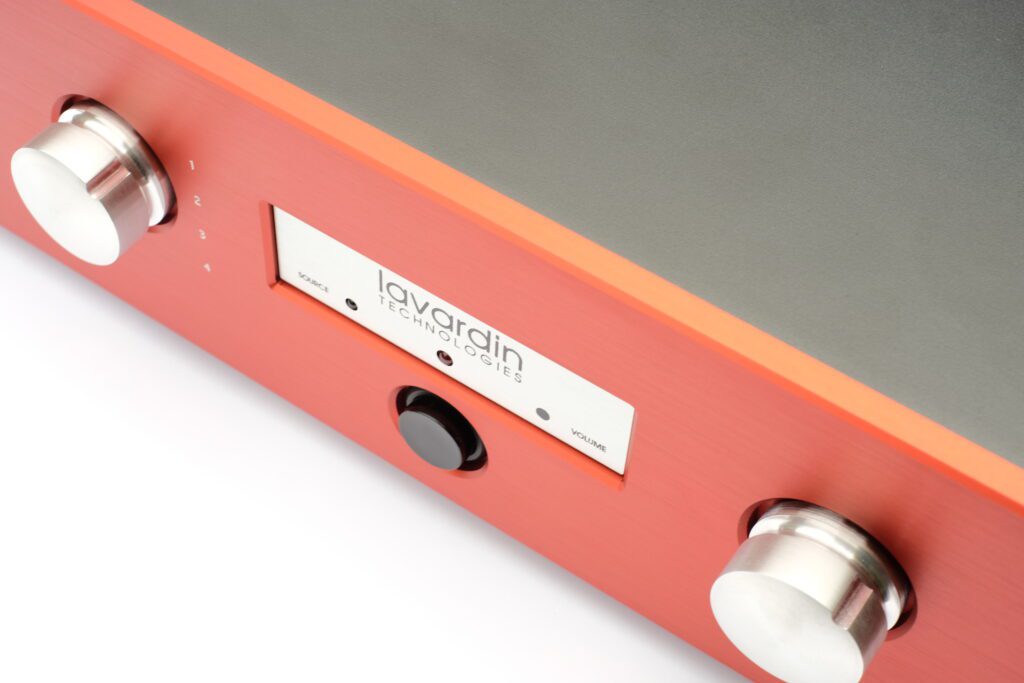
Lavadin ITx20

Think of it this way, the ITx 20 is effectively a ‘blueprinted’ version of the ITx; a no-compromise version of an amplifier already not big on compromise. Blueprinting is a way of race-tuning a car engine by building it to the exact design specifications and not the ‘wiggle room’ introduced to get a car on the road; it’s not simply double-checking the specifications. Blueprinting is popular with car companies competing in touring car and World Rally Car championships and was especially popular in the 1950s-1970s, when seemingly stock cars like Mini Coopers were capable of (at the time) insane performance due to incredibly carefully built engines. The changes between the ITx and ITx 20 are like the differences between driving a Mini Cooper S along the King’s Road in Swinging Sixties London, and Timo Mäkinen driving a Mini Cooper S to win the 1965 Monte Carlo Rally.

Given the sophisticated nature of the Memory Free technology deployed within both the ITx and ITx 20, that careful selection of components and power supply make a huge difference in the quality of the performance of the amplifier in ways that functionally define Lavardin’s sound.

Redefining terms

Lavardin amplifiers generally sound warm, smooth, and natural. This is no exception. In fact, what it does is redefine what those terms mean for solid-state audio electronics. I’d argue that the ITx 20 is less ‘warm’ sounding than its peers, and instead even more ‘natural’ sounding. This amplifier has frequency extension and treble drive; it’s not hiding the highs and not rolled off, it just doesn’t shout these frequencies until they need to be shouted about. The overall effect is supremely satisfying and entirely un-amp like (especially un-solid-state-like).

Stereo imaging is first rate, too. This is an amplifier that presents a sound far wider than the loudspeakers and very deep. You listen into a mix and on something like the Overture to The Pirates of Penzance [D’Oyly Carte, Decca], you are in a 3D recreation of a late 1950s theatre. OK, so this is a sublime Decca recording, but the Lavardin brings out the best from that album.

The ITx 20 plays at higher volumes well, but those wanting a home PA will either partner the Lavardin with super-efficient horns or look elsewhere. Strangely that isn’t a criticism when you listen, as the ITx 20 has a calming ability that moves you away from the ear-bending end of the volume dial, no matter your choice of music. Take ‘The Grudge’ from Tool’s outstanding Lateralus [Volcano]; this is a complex piece of progressive metal and is usually played loud. While the ITx 20 can play loud too, the Lavardin has this remarkable quality of presenting all the force and intensity of the track, but does so at listening levels that allow you to peel away more of the track than you can at ‘onslaught’ levels. It doesn’t change the metal-ness of the recording but invites questions about the track that just don’t get asked at higher levels. The result is even more admiration for Tool.

The ‘memory distortion’ thing is interesting. Lavardin has a very real point here. This isn’t an amplifier that ‘times’ well; it simply does that whole temporal thing like it’s the real world, with no imposition of timing or obvious sins of admission or commission on the sound. That will sit oddly with those who go looking for a beat in a system. Staying with Tool a while longer, this is a track that truly benefits from the Lavardin approach, steering clear of the aggressively bright sound that recording can sometimes produce in a system. I think this might be one of the key parts that separates the ITx 20 from its fellow Lavardin travellers; some models that do the ‘memory distortion’ thing can sound a touch laid-back rhythmically compared to the beat-masters, but here it’s like a whole raft of electronics between you and the music just got washed away. It’s extremely musically insightful.

Upside down

So, what are the downsides? The obvious one is the Lavardin ITx 20 is ultra-minimalist, although there are many who will see that as an ‘upside’. But having a remote control that simply raises and lowers the volume, having no balance control, home cinema pass-through, built-in DAC, and only four single-ended inputs makes for a sparse specification sheet for the money. Also, while those simple and functional loudspeaker terminals are likely there for a reason, we’re so used to beefier WBT-style connectors at this level you can’t help but notice them. The lack of clear identifier on the front panel will likely discourage those who want to show off a little, as aside from sonically and financially, the only real way you can tell the difference between the two ITx models is on the back panel… but I think if you are wanting to show off, Lavardin is probably not your first choice of amplifier anyway. This is for those who listen to a lot of music in live concerts and want to replicate that sound at home without all that brashly, bright, over-impressive zingy sound that doesn’t happen in the wild.
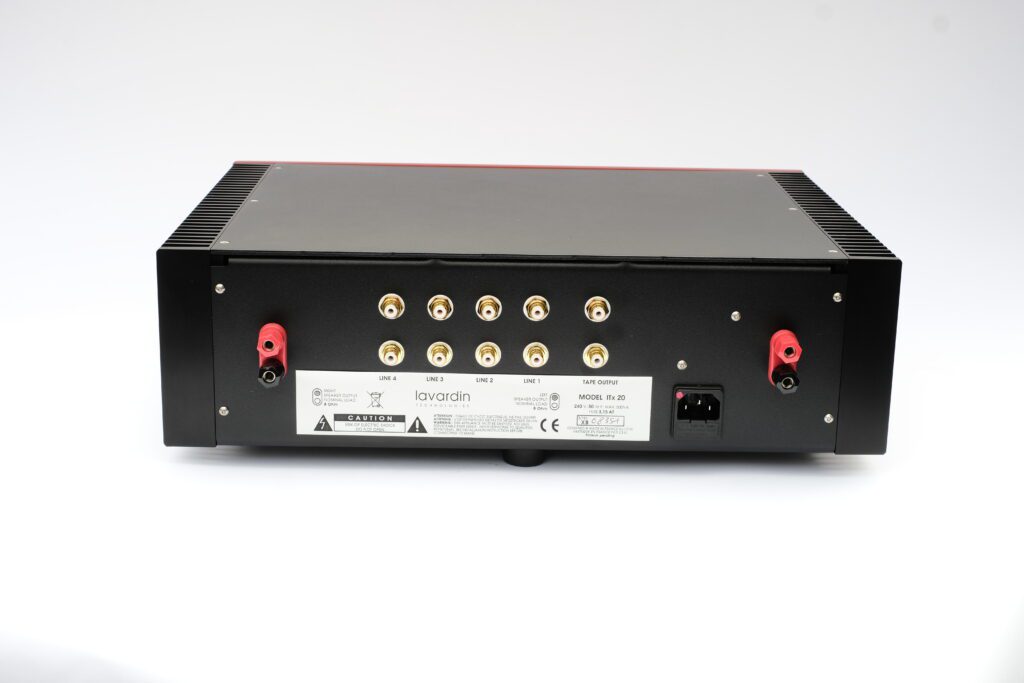
Lavardin ITx20 rear panel

Those who evaluate amplifiers like it’s a game of Top Trumps will never ‘grok’ Lavardin because a 55W, four-input amplifier that doesn’t even have a balance control doesn’t hit their spec buttons, and the presence of notionally the same product for thousands less will send them apoplectic. On the other hand, if you listen to the Lavardin ITx there is nothing remotely close to what it does… and the ITx 20 does it a lot better. If you want a valve amplifier but don’t want valves, listen to the Lavardin ITx. And if you like the ITx, only listen to the ITx 20 if you have that kind of money to hand. Because you just might not be satisfied with anything else.

Technical specifications

  • Type Two channel solid-state integrated amplifier
  • Inputs 4x RCA stereo single-ended pairs
  • Output 1x RCA stereo single-ended pair tape output, loudspeaker terminals
  • Input selection sealed relay, gold, silver and palladium alloy contacts
  • Power output 2× 55W into 8Ω
  • Output impedance Nominal 8Ω
  • Harmonic Distortion 0.001% @ maximum output
  • Finish Black or Red front panel
  • Dimensions (W×H×D) 43 × 34 × 13.5cm
  • Weight 12kg
  • Price £11,500

Manufacturer

Lavardin

lavardin.com

UK Distributor

Midland Audio Xchange

midlandaudiox-change.co.uk  

+44(0)1562 731100


Back to Reviews

The post Lavardin ITx20 appeared first on Hi-Fi+.
Cyrus i9-XR

Just as you’re unlikely to mistake a Vivienne Westwood design for anyone else’s work, it seems doubtful you’d ever confuse a Cyrus product with any other brand’s output. Even if it didn’t realise it at the time, the company has been all over the ‘lifestyle’ market since the off, thanks to the distinctive half-width chassis into which it’s squeezed pretty much every product that isn’t a loudspeaker since 1984’s ‘One’ amplifier.

Demands on and expectations of the integrated stereo amplifier have increased more than somewhat in the four decades since the ‘One’ established Cyrus as a bright young thing of British hi-fi, of course. Which brings us, far from coincidentally, to this: the Cyrus i9-XR integrated stereo amplifier.

Start from scratch

At a glance you wouldn’t know it, but with its new ‘XR’ range of electronics Cyrus has pretty much started from scratch. Yes, it looks only and always like a Cyrus product – but the i9-XR features plenty of fresh engineering as well as some ergonomic upgrades, all intended to bring Cyrus into line with some (arguably) higher-profile rivals.

The real headline (as far as real-world consumers are concerned, at least) is the appearance of five digital inputs (two S/PDIF via RCA, two optical via Toslink, and one USB input, all leading to the second generation of Cyrus’ QXR DAC) alongside four line-level analogue inputs and a moving-magnet phono input. The USB-B is capable of handling digital audio files up to 32bit/384kHz and DSD up to 512, while the other four digital inputs are useful up to 24bit/192kHz. So high-resolution digital audio is just as firmly on the menu as is the analogue equivalent.

Cyrus i9 XR internal

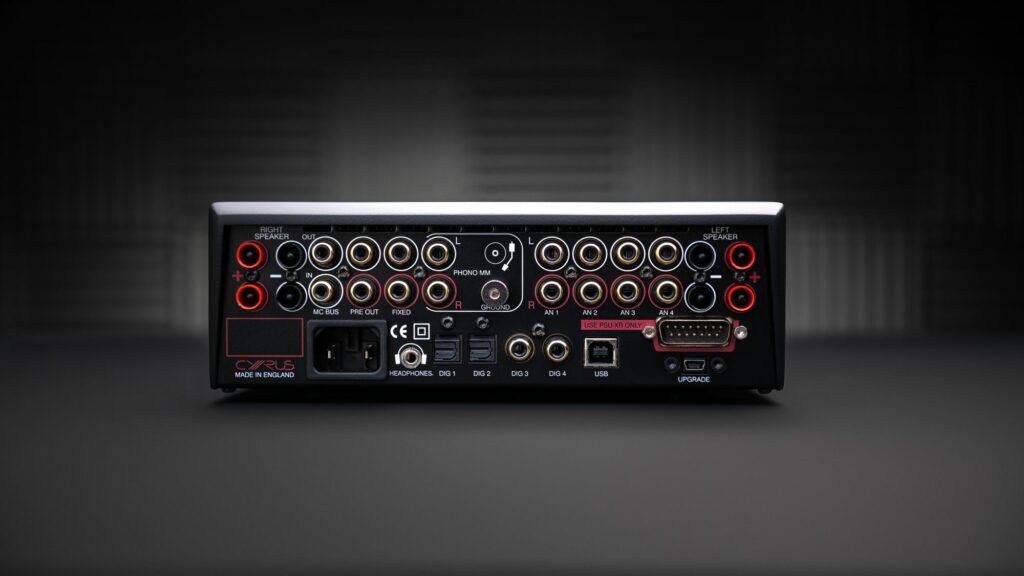
As well as these nine inputs, the (unsurprisingly crowded) rear panel also hosts connections for two pairs of speakers, two pairs of RCA stereo outputs (one in case you wish to deploy a power amp, the other for use with a recording device) and for Cyrus’ eminently capable PSU-XR power supply. Then there’s MC-Bus in/out connections, in case you’d like to daisy-chain your Cyrus equipment together so that it all functions via one remote control (the i9-XR is supplied with the iR14 full-system remote control that’s this close to being coherent – a big step on for the brand) and, of course, a socket for mains power. And in a move that’s almost the exact opposite of ergonomic good sense, the rear panel is also where you find a 3.5mm headphone output.

I’m speculating here, but if you run cables to all nine inputs, both pairs of speaker terminals, a PSU-XR power supply, a recording device and a pair of headphones, you’ll probably need to weigh the front of your i9-XR down to keep it flat on the shelf.

Twist and Push

At the front of the little box, meanwhile, there’s a monochrome display that’s strongly dependent on being viewed on-axis. In conjunction with a positive-feeling twist-and-push control dial, where you select volume level and so on. It also allows access to seven different digital filter alignments that can alter the way the digital inputs sound. There are a smattering of physical controls here, too – ‘power on/off’, ‘input selection’ and what-have-you. They’re both touch-sensitive and responsive – neither of which could be said about the physical controls on previous Cyrus amplifiers.

On the inside, things have similarly advanced. There’s a new high-speed analogue buffer at the DAC input stage. The analogue pre-amp is a short-path design featuring relay input selection and an overspecified gain stage derived from the new Pre-XR preamplifier. The power amplification section (which generates either 89 or 91 watts of power per channel, depending on which bit of the Cyrus literature you read) is responsive beyond 100kHz – ample dynamic headroom and basically flat frequency response are the aims here.

All of which looks impressive – laudable, even – when written down. But get some music playing (the i9-XR is attached to an Apple MacBook Air via its USB-B input, a Cyrus CDt-XR using an Atlas Voyager digital coaxial cable and a Clearaudio Concept turntable using a pair of QED Reference Audio Evolution analogue interconnects, and then to a pair of Acoustic Energy AE1 Reference Series mkIII loudspeakers on Atacama Moseco 6 stands using QED XT-400 speaker cable) and it quickly becomes apparent that not everything has changed in Cyrus-land.

With a CD-borne copy of Pharoah Sanders’ Thembi [Impulse!] delivered to the i9-XR digitally, the resulting sound is not simply Cyrus-like; it’s unmistakably Cyrus-y. Anyone with a passing acquaintance with the brand at any point in its history will be primed to expect a lean, detailed sound – and the alacrity with which the i9-XR serves up the recording is definitive in its Cyrus-ness. It’s the antithesis of ‘meaty’ sounding but that doesn’t mean the i9-XR is in any way short of punch or low-end presence. It’s just that it draws such straight edges at the attack and decay of individual bass notes, allowing absolutely no overhang, that its speed and momentum might initially be confused with a lack of substance. Dialling through the available filter options delivers some very mild changes in emphasis (‘steep/linear’, gentle/linear’ and ‘brick wall’ are probably the most overt in their influence on the sound you hear), but I doubt the digital filter has been invented that can make a Cyrus amplifier sound anything but the audio equivalent of a well-trained greyhound.

Switching to a vinyl copy of PJ Harvey’s To Bring You My Love [Island] only makes the point more forcefully. If it’s rapidity you want, along with great big fistfuls of detail and the sort of deep-breathing dynamic ability that can make the harmonic variations in an analogue keyboard just as apparent as the switch from ‘whisper’ to ‘scream’, the i9-XR could be just the ticket. Its ability to pick apart a recording in order to make every individual strand available for inspection, without in any way affecting its unity or sense of performance, is rare at any price.

Throughout the frequency range, nothing is overstated and nothing is under-represented. Tonality is equally well-judged – the line between ‘crisp’ and ‘hard’ where treble sounds are concerned can often be wafer-thin, but the i9-XR treads it confidently. And in the midrange, Polly Jean’s voice is eloquent, characterful and explicit in its motivations – so when she piles on the malevolence (as she is never far from doing on this album) it can provoke an involuntary physical response.

Thrilling

A FLAC file of serpentwithfeet’s Bless Ur Heart [Secretly Canadian] proves further vindication of the decision to fit as capable and accessible a DAC as possible to the Cyrus. The alacrity and manoeuvrability demonstrated by the i9-XR’s other inputs is present and correct via the USB-B, and the level of straightforward immediacy given to the vocal is little short of thrilling. Those low piano notes and the dry kick-drum might seem to lack a little on first acquaintance, but never fear – it’s just the Cyrus doing its ‘float like a butterfly, sting like a bee’ thing.

Cyrus i9 XR rear

At its heart, then, the i9-XR is just like every other Cyrus integrated amp since day one’s One. Which is not meant as any kind of criticism or put-down, you understand – at this sort of money, the i9-XR is spectacularly short of alternatives that can rival its level of insight, its well-controlled perkiness or its out-and-out fidelity. The addition of all those digital inputs is a fine and sensible idea, and the quality of its phono stage is not up for question.

Admittedly, being ‘better than previous Cyrus amps’ where ergonomics are concerned is definitively not the same as ‘having good ergonomics’ – but I guess we should applaud Cyrus for making some progress on that score. And anyway, the last thing anyone wants is Cyrus turning into a ‘me too!’ brand of convenience and simplicity. Far better it sticks to what it’s known for, both aurally and visually – because the up-sides outweigh the downs to a significant degree.

TECHNICAL SPECIFICATIONS

  • Type: Integrated stereo amplifier with high-resolution DAC
  • Analogue inputs: Four single-ended line‑level inputs (via RCA), single-ended MM phono input (via RCA)
  • Digital inputs: Two S/PDIF inputs (via RCA), two digital optical inputs (via Toslink), USB-B input
  • Analogue outputs: Line-level pre‑out (via RCA), fixed-level output (via RCA), PSU-XR, 3.5mm headphone output
  • Input impedance: 40 kΩ
  • Power Output: 89wpc @ 6Ω
  • Bandwidth: not specified
  • Distortion: THD < 0.002%
  • Signal to Noise Ratio: 105dB
  • Dimensions (H×W×D): 75 × 215 × 365mm
  • Weight: 5.9kg
  • Price: £2995


Manufacturer:

Cyrus Audio

Tel: +44(0)1480 410900

URL: cyrusaudio.com

Back to Reviews

The post Cyrus i9-XR appeared first on Hi-Fi+.

Aavik Acoustics I-580

In our ongoing survey of the Danish Power Trio – Aavik, Ansuz, and Børresen – we finally come to the heart of the Aavik Acoustics I-580 integrated amplifier. The 580 line is the top of Aavik Acoustic’s tree (with the I-180 and I-280 below it). We still have a phono stage and a streamer in the 580 line to cover, but this is the significant link in the chain; if the amplifier isn’t up to scratch, the quality of front-ends, speakers, cables and everything in between can never catch up, and the sound quality suffers as a result.

The Aavik Acoustics I-580 integrated amplifier is always going to court controversy twice over. First, it’s a Class D amplifier, which in and of itself is often ‘dismissed’ by some audiophiles (‘dismissed’ being the polite term for ‘angry mob with pitchforks and burning torches’). Despite many high-end ‘wins’ – Bel Canto, Jeff Rowland, Merrill, Mola Mola and Primare being notable contenders – many enthusiasts reject Class D out of hand, often for vague notions of something intangible ‘wrong’ or ‘missing’ from the sound, compared to larger, older and less efficient designs.

Pascal power

Regardless, for its Class D engines, Aavik uses the Danish-designed UMAC amplifier modules from Pascal throughout. Pascal’s devices are relatively uncommon in the audiophile world. Still, they are gaining traction in Public Address systems, where their combination of high power, good loudspeaker compatibility and low distortion at higher frequencies make UMAC an increasingly popular choice for concert halls, churches and touring rock bands.

Why are they gaining ground against other Class D modules? Unlike traditional switching amplifiers that generate their PWM (Pulse Width Modulation) signal against a square wave, UMAC modules use sine waves instead; this makes for less high-frequency noise and requires less filtration at the output as a result. This has a knock-on effect of lowering the inductance of the output and giving the amplifier both a higher damping factor and provision to double its output as you move from eight Ohm to four Ohm loads. In other words, it drives loudspeakers with more authority, an early criticism of Class D designs.

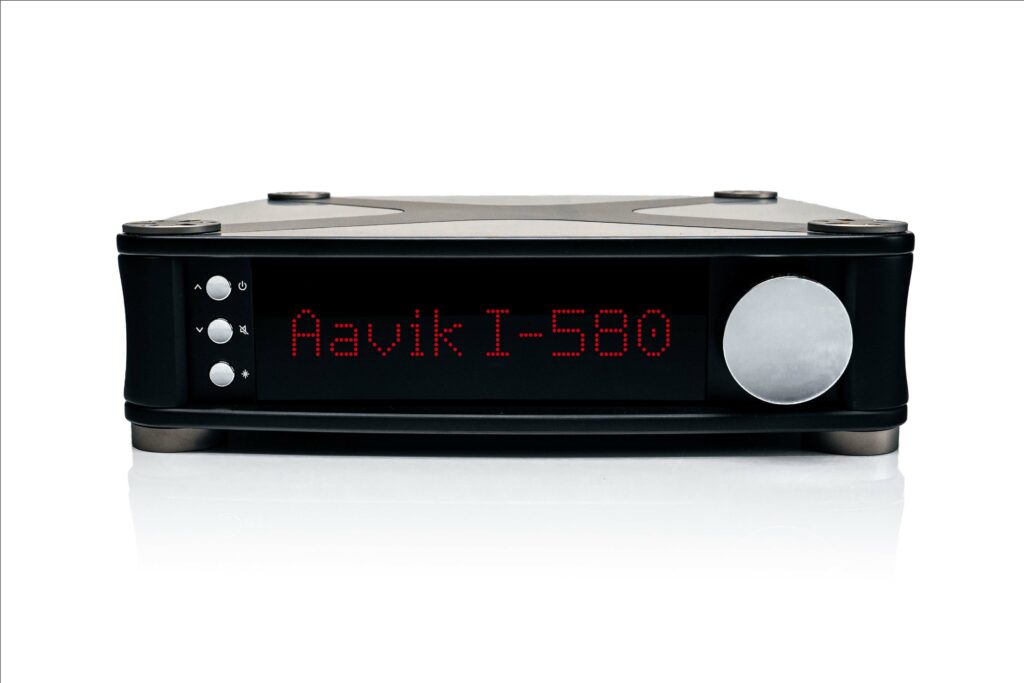
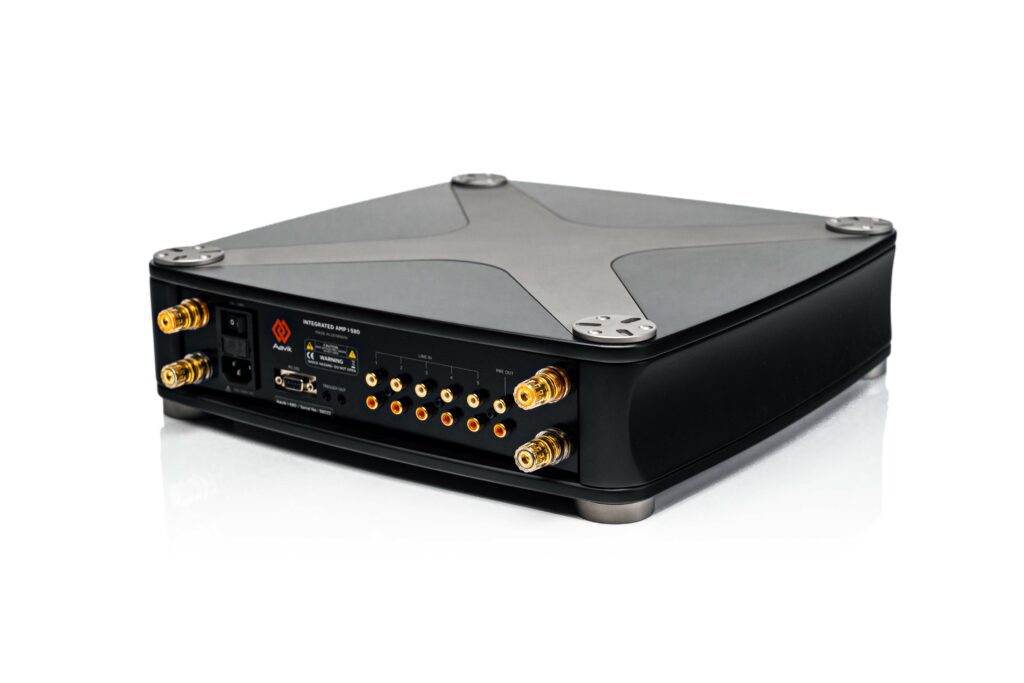
Aavik Acoustics I-580

This is an inherently low noise design, but Aavik reduces that noise floor further by using ultra-low noise regulators to supply power to the amplifier’s circuitry. Aavik claims these regulators offer significantly lower noise than conventional regulators. The I-580s line stages also feature an inverted, virtual ground topology for greater stability and low signal-to-noise ratio irrespective of volume level. This last is seldom discussed, but often the signal-to-noise ratio is a snapshot of the amp’s performance that doesn’t take very high or very low volume levels into account. Many amps might sound dynamic, expressive, and accurate at normal listening levels (where they are measured), but things fall apart at very high or very low volumes.

As above, not so below

The other part of the I-580 controversy relates to how it justifies its place relative to the I-180 and I-280 below. An on-paper basic audit of the specifications of the three amplifiers shows them to use the same basic layout and amplifier module roll-out. They are all 300W amplifiers capable of delivering 600W into four-ohm loads, they are all single-ended only amplifiers with the same number of inputs and outputs, the same large multi-LED front panel and on surface inspection, a similar case. Looks can be deceptive, however, because the I-580 includes a copper inner chassis and titanium resonance control plates in the case that are not included in the other models.

However, perhaps the most significant change is the sheer number of Ansuz Active Tesla Coils in each device; for example, where the I-180 uses 132 such coils, the I-580 uses 348 (240 of which are the company’s square coils). Factor in more than double the amount of Aavik’s dither modules (five in the I-280, 11 in the I-580) and four of the company’s Anti Aerial Resonance Coils, and the I-580 is about as RF and EM interference-free as it is possible to make currently. Those who get hot under the collar about whether RF and EM interference is a blight on audio will grind off some tooth enamel at the thought of so much treatment.

Finally, and common to all models in the Aavik line, the I-580 has built Darkz-ready bases into the top and bottom plates allowing Ansuz’s clever mechanical vibration system to help eliminate yet another potential source of interference. Given the low heat output and the shielding of the amplifier, it’s perfectly acceptable to stack 580-series models on top of one another using a quartet of Darkz to separate each level.

Rest after moving

The amplifier itself does need some time to bed in. This isn’t so much ‘running in’ as ‘needing a bit of a rest after moving about’. I also found that cycling the power several times after changing loudspeakers or loudspeaker cables did seem to make the system more of a ‘match’. But regardless, after a few hours of amplifier pampering, it’s ready to fly!

I’ve heard several iterations of the Aavik amplifier now, from the hulking great U-380 Unity metal version with the large central dial and built-in DAC to the smaller but equally impressive U-150 Unity and now the I-580. With each iteration, they have got lighter in weight and better in sound. The difference in sound quality is not profound – more evolution than revolution, to harness the cliché – but it is better. The previous generations always had a deep, muscular bass and an extremely dynamic and transparent presentation, albeit with a small amount of soundstage limitation and some dry, slightly laid-back sound typical to Class D.

The I-580 expands that soundstage a lot while making that signature dryness less of a feature and more of just a Class D accent. The leading edges speed through this amplifier significantly, giving it a remarkable sense of ‘thereness’ that is hard to beat. Out came ‘Clara’ by Jarvis Cocker and Chilly Gonzales [Room 29, DG], and the combination of piano and slightly broken voice in a hotel suite was like you had been transported into the live event.

Volume sensitivity

This also showed up the volume sensitivity of the amplifier; I’ve been used to hearing some amps – especially Class D designs – have a distinct ‘goldilocks’ point on the dial, where ‘too much’ gets too hard and dry sounding and ‘too little’ breaks up the authenticity and integrity of the sound. Any such changes will be easy to hear because there’s no hiding place. But with the I-580, you could play whisper quiet or very loud with no sense of change in tonality at all.

The I-580 should silence the Class D naysayers because that flat, artificial, electronicky sound associated with the technology had all but disappeared back when the U-380 first dropped (sadly, literally; my sample ended up falling out of its box and narrowly missed flattening my foot). It’s gone now; the sound is still slightly dry and precise, but this is more like a focused sound than a musical desert.

Soundstaging is broader and deeper than I expected; the I-580 doesn’t have the lush imaging of the best valve amplifiers. However, one could argue the best valve amplifiers don’t have the ‘snap’ and imaging precision of the I-580. Couple that with almost no background hash or noise, and sounds are portrayed with near-textbook detail and accuracy, powerful dynamics, outstanding bass and an accurate, zing-and-sting-free top-end.

Aavik Acoustics I-580

This made me want to explore all of Ma Rainey’s Black Bottom [Branford Marsalis, Sony], from the 1920s recreations like ‘Those Dogs of Mine’ to the atmospheric ‘Levee Confronts God’. And it all worked brilliantly. Even without the need for double entendre. And you know you are on to a good thing when you can play anything from Liszt to Led Zep in a single sitting and enjoy it all equally well.

While the inevitable and seemingly endless car analogies used in audio are now almost painfully overused, there is a surprisingly strong parallel between the audio and motoring world when it comes to damn good amplifiers; both fields are in that transition point between an old and a new technology (moving from petrol to electric in cars, Class A and AB to Class D in audio).

Perception shift

Just as driving a high-performance electric car requires a few slight tweaks on the driver’s part to accommodate and genuinely understand how an electric car performs, we are at a point where listeners are starting to shift their perceptions about how recorded music sounds through amplification. All of which means this amplifier is very likely the Tesla Model S Plaid of the audio world!

On the face of it, the fact the Aavik Acoustics I-180, I-280 and I-580 look similar and share a similar essential performance would make it seem that the big boy is a poor proposition. However, the proof is in the listening, and this is one of the best Class D amps out there, and one of the best amps irrespective of amp design. While understandably at its best in the sublime company of its Ansuz and Børresen peers, it’s both a remarkable performer and a perfect gateway into the company’s ethos… and probably many products from these companies.

TECHNICAL SPECIFICATIONS

  • Type: Integrated Class D amplifier
  • Inputs: 5× RCA stereo pairs
  • Outputs: 1× RCA stereo pair, speaker terminals
  • Volume Control: 76×1dB steps
  • Power output: 2x 300/8Ω, 2x 600/4Ω
  • THD+N: < 0.006% (1-100W, 1kHz, 8Ω)
  • IMD: < 0.002% (1x100W, 4Ω)
  • TIM: < 0.008% (1-100W, 4Ω)
  • Aavik Noise Reduction systems included (see text)
  • Dimensions(W×H×D): 40 × 10.2 × 38.4cm
  • Weight: 10.7kg
  • Price: £20,000

Manufacturer:

Aavik Acoustics

URL: audiogroupdenmark.com

Tel: +45 40 51 14 31

Back to Reviews

The post Aavik Acoustics I-580 appeared first on Hi-Fi+.

Musical Fidelity M8xi

I recall that at some point in the dim and distant past Musical Fidelity founder Anthony Michaelson decided that the world needed educating about real world power requirements. To get this message across, he produced a cardboard calculator on which you dialled in the sensitivity of the loudspeaker next to the power output of your amplifier and this gave you a quality rating based on potential SPL (sound pressure level). Equating level with quality is a bit dubious but it did reveal that you need an awful lot of power to get high levels out of even a reasonably high sensitivity loudspeaker like the B&W 802D (listed on the back among other popular models). 200 Watts was required to get it into the ‘high quality’ zone and produce 106dB but to push it to the 110dB peak called for 500W. Which even today is a lot of power. It does explain however why Musical Fidelity has been building substantial integrated amplifiers since 1990 when the M8xi’s A1000 ancestor was released.

I imagine that it was nearly as heavy as the M8xi that takes its place in the company’s line up today as the biggest integrated in the catalogue. At 46kg the M8xi has the scale of a serious power amplifier and the specs to match; these are quoted as 550W into eight ohms and 870W into four with a peak offering of 1.2kW, so clearly ‘high quality’. But there is of course more to amplifier quality than sheer power; if it was that easy then the M8xi would probably be using Class D amps which deliver the most Watts per pound (sterling and avoirdupois) you can get.

A Class (AB) Act

Instead, the M8xi is very much a Class AB amplifier. Or should that be ‘amplifiers’, as this large but not excessive chassis houses a pair of monoblock power amplifiers and a preamplifier and each has its own transformer and power supply, hence the high mass. Each of the heat sinks that flank the chassis are dedicated to a channel and serve to keep a dozen bipolar transistors at a steady operating temperature, one that rises pretty high if the temperature on the outside is any indication. This is not like the legendary heat sinking atop a Musical Fidelity A1 Class A amp, which was hot enough to grill a burger. This is perhaps a reflection of the fact that this is a low feedback design with a Class A driver stage, but more likely because of the sheer quantity of power on offer.

The preamplifier circuitry has been placed right at the back of the box next to the input sockets, a move that keeps signal paths about as short as is possible. Inputs are both traditional analogue and contemporary digital, with the former in both balanced and single ended forms and the latter including USB and S/PDIF types in sufficient quantity to satisfy most system set-ups. Unusually, the Musical Fidelity has a wide range of outputs in both digital and analogue form; it seems unlikely that it would be used as a preamplifier but I guess it’s possible to bi-amp with a power amplifier if you have particularly insensitive speakers and a thirst for volume. Digital outputs can be used for a headphone amp/DAC of course, something that the M8xi doesn’t accommodate in its roster of features.

Musical Fidelity M8xi

The DAC also has its own power supply, and while its hi-res figures are not particularly impressive (it maxes out at 24-bit/192kHz with no DSD or MQA support) they are at least realistic in the context of widely-available music files. All incoming data is upsampled and reclocked to reduce jitter.

Inputs are selected via a suitably large controller on the front panel or more often with the remote control, a rather heavily festooned example of the art that surprisingly does not offer up a power button. This it seems is one thing you can’t do from the sofa. It’s not hard to locate the volume buttons though, and I appreciated the fact that you can adjust level in half-decibel steps; steps that are reflected in the M8xi’s central display alongside the chosen input. I was a little surprised that it’s not possible to change the input names given the flexibility of the display, but this does mean that outside of the DAC there is little in the way of processing power onboard to corrupt the sound.

A Sense of Headroom

In the first instance I hooked this Musical Fidelity up to Bowers & Wilkins’ new 802 D4 loudspeakers, noting along the way that it has the lesser spotted C18 IEC power inlet and two sets of speaker terminals per channel for easy bi‑wiring. Initially I used the USB digital input on the amp and connected a Melco N10 streaming drive via Network Acoustics cable. London Grammar’s ‘Stay Awake’ revealed that those Watts count for something, producing a sense of headroom that you rarely encounter and which translates into prodigious bass when it’s on the recording, and on this one it certainly is. This is not bludgeoning power either, it’s articulate and able to respond to the nuances of the material with remarkable speed. High power and serious immediacy are not often found in combination even at this price yet the M8xi is very capable in both departments. Particularly with things like the synth powered vibes of Leifur James’ ‘Mumma Don’t Tell’ where the gradations in the bass come through superbly and the overall ease of delivery encourages you to push the volume.

Meshell Ndegeocello’s take on ‘Who Is He (And What Is He To You)?’ is underpinned by a dark chewy bass line that is positively sinuous in the M8xi’s hands, the tune flows with a powerful ease and the plushness of its production is brought to the fore. It brought to mind the possibly apocryphal story about Anthony Michaelson talking to Tim de Paravicini in the early days of Musical Fidelity where the latter is said to have scribbled down circuit details on the back of a cigarette packet, ideas that are probably still to be found in the company’s amplifiers today. How will the designer’s of today pass on their ideas in the touch screen age one wonders?

Imaging is good too, the soundstage reflecting the various recordings well with plenty of scale and energy, the Grateful Dead’s ‘Cumberland Blues’ being delivered in a less timely way than usual but with excellent flow. I also rather enjoyed an old Fleetwood Mac tune from Kiln House called ‘Station Man’, where Jeremy Spencer’s guitar playing is top notch and not unlike that of Paul Koss (Free). This band may not have hit the big time in 1970 but they were hot stuff and the Musical Fidelity lets you hear as much. Switching to a separate DAC and using one of the amplifier’s single ended line inputs produced a clear improvement in timing and solidity of stereo image. This combined with the power and sometimes startling ability to turn on a dime made for an even more enthralling experience. The sheer dynamic range on offer revealing that many amplifiers, even high power ones, are still reining in the potential of better recordings.

Timing and muscle

Switching to a fairly new pair of PMC twenty5.26i loudspeakers which have a lower sensitivity than the 802s but offer an easier load the sound initially seemed a little dry from a tonal perspective. After a few tunes this characteristic took a back seat to the spectacular combination of timing and muscle on offer from the M8xi, with track after track offering up oodles of detail in a very coherent and engaging manner. Even an orchestral Schubert piece was delivered with the tempo in full effect, this didn’t take precedence over the dynamics however which were delivered with gusto yet without any discomfort in crescendos. All that power really counts when you are trying to reproduce a ‘big band’ with real world loudspeakers, and it matters with smaller stuff too. Somewhat controversially I put on Nils Lofgren’s rather overplayed dem favourite ‘Keith Don’t Go’, just for old times sake you understand, and heard a fabulous acoustic guitar, a croaky voice and the energy of a live event in surprisingly convincing virtual reality.

Power does not equate too directly with quality unless it is clean, controlled and able to make a speaker do exactly what’s required when it’s required. The Musical Fidelity M8xi does that with knobs on, and rather nice knobs they are too.

TECHNICAL SPECIFICATIONS

  • Type: Solid-state, 2-channel integrated amplifier with built-in DAC
  • Analogue inputs: Four single-ended line-level inputs (via RCA jacks), two balanced inputs (via XLR connectors)
  • Digital inputs: Four S/PDIF (two coaxial, two optical), one USB port
  • Analogue outputs: One single-ended line-level fixed (via RCA jacks), one single-ended line-level variable (via RCA jacks), one balanced variable (via XLR connectors)
  • Digital outputs: Two S/PDIF (one coaxial, one optical)
  • Supported sample rates: up to 24-bit, 192kHz
  • Input impedance: High-level: 25kOhms single ended, 50 kOhms balanced
  • Output impedance (preamp): Not specified
  • Headphone Loads: N/A
  • Power Output: 550Wpc @ 8 Ohms
  • Bandwidth: Not specified
  • Distortion: THD+N < 0.004% typical, 20Hz to 20 kHz (XLR)
  • Signal to Noise Ratio: > 86dB A-weighted (XLR)
  • Dimensions (H×W×D): 185 × 485 × 510mm
  • Weight: 46kg
  • Price: £5,649

Manufacturer: Musical Fidelity

URL: musicalfidelity.com

UK Distributor: Henley Audio Ltd

Tel: +44(0)1235 511 166

URL: henleyaudio.co.uk

Back to Reviews

The post Musical Fidelity M8xi appeared first on Hi-Fi+.

Marantz SACD 30n and Model 30

It’s the start of 2022 when writing this, and CD and SACD are supposedly ‘dead’ formats. So it might seem strange for Marantz to launch a new silver disc player. But the 30n is more than that; it’s also a streamer and hub, and thus hugely versatile. Marantz describes its new creation like this:

“The Marantz SACD 30n marries a classic premium SA‑CD / CD player with a modern digital source’s hub/preamp. It plays hi-resolution files including FLAC HD and DSD from your home network, local USB storage, and online sources such as streaming services and Internet radio.

“It features HEOS streaming, voice and multi-room support, and DAC functionality, as well as Apple AirPlay 2 and Bluetooth integration. The SACD 30n is future-proofed, accepting file formats all the way up to 11.2Mhz quad-DSD and 384kHz/32-bit PCM via USB-B/USD-DAC.”


Skin in the game

Speaking as someone with skin in the game (I’m currently in the market for a streamer and looking at various acronym-led options) a product like the 30n that features a CD/SACD player and Streamer interests me greatly – providing the performance on silver discs is outstanding.

To partner the SACD 30n, Marantz offer the matching Model 30 integrated amplifier. This is a compact 100W Class D design featuring tone and balance controls and an MM/MC phono stage. The UK price of both of the 30 components is £2,899 each.

Marantz Model 30

Both the Model 30 and SACD 30n have a quilted front panel, with a raised central section that’s back-lit from the sides. It looks very unusual – both classy and nicely understated. Pictures of the items don’t always make this clear – you have to see them to appreciate the styling.

I began with the SACD 30n, and it quickly became obvious that it’s a very capable CD/SACD player. I’d been enjoying the Denon DCD A110 player very much, and the 30n matched it for clarity and detail, while delivering a slightly more immediate and assertive sound.

On both standard Red Book CD and SACD, the 30n produced an impressively-clean and focused sound that had great presence and dynamic range. Given that the SACD 30n costs £100 less than the Denon, and features a built-in streamer/hub, it’s excellent value.

Compared to many other silver disc players, CDs on the SACD 30n had a nice depth and weight that made them sound more like SACDs. SACDs sounded better still – solid, weighty, and clean, with bite and clarity, plus a nice unexaggerated naturalness.

Playing Copland Orchestral works Vol 1 SACD [Chandos CHSA 5164] the bass drum on ‘Fanfare for the Common Man’ had truly awesome heft and depth – real floor-shaking bass, but only if your speakers are capable of reproducing low frequencies below 25Hz.

Superior build?

I’d say the Denon DCD-A110 and matching PMA-A110 amplifier offer superior build quality over the Marantz items, but not by much. The Denon items are heavier and more solidly-made, but the quality of finish is about equal and the Marantz certainly looks classy and attractive.

Marantz’s HEOS app works well, and allows you to stream from subscription platforms such as Spotify, Tidal, Deezer, Napster, Amazon music, Soundcloud, etc. At the time of writing (June 2021) the SACD 30n does not support MQA files on Tidal, but this is a future possibility.

Marantz SACD30n

Marantz tell me MQA support could be added in a future firmware update, should they decide to go for it. So, if you’re a Tidal user, lack of MQA might be a deciding factor, but maybe not for long. The 30n sounded very good with Tidal, but MQA files via Arcam’s ST60 were generally better. Some MQA files are only 44.1kHz and deliver CD quality, while others are 96kHz and sound superior. Playing ‘Come Together’ from the Beatles Abbey Road album [Apple], the MQA version (via the Arcam) sounded more dynamic and better separated.

The non-MQA file sounded ‘flatter’ and voices/instruments did not project out from the speaker enclosures. The MQA file had more depth and space, and the placement of voices and instruments in the stereo soundstage was more holographic and real-sounding. However, comparing the 30n against the ST60 on Tidal with non-MQA files, I’d actually put the Marantz slightly ahead of the Arcam for clarity and separation.

Given the range of options offered, the SACD 30n is simple and straightforward to use. A small rotary control selects functions, and runs HEOS Favourites (subscription needed), Internet Radio, Music Servers, USB Music, Bluetooth, CD/SACD, USB-DAC, Co-Axial, Optical 1 and 1, and Set-Up.

You can select most of these options from the supplied remote handset. The display on the SACD 30n is clear and easy to read, but – unlike many current streamers – you don’t get a representation of the album cover when streaming.

I used the SACD 30n via USB with a hard-drive containing downloaded music. For some reason, the SACD 30n didn’t always read the file name. Many of these I’ve created myself, usually with the composer’s surname at the first item. But sometimes the SACD 30n chose to read hidden metadata.

All of which means that instead of an item coming under (say) B for Beethoven or Brahms (as per the file name) it’s found under S – S for Sir John Barbirolli… Maybe there’s a way around this – I’m not sure. But interestingly, the Arcam ST60 did not do this.

HEOS Man

Marantz’ HEOS app is a lot better than Arcam’s MusicLife app, though hopefully the latter will soon have a significant upgrade that sorts out its problems. I could navigate files on my USB hard drive connected to the SACD 30n using HEOS, unlike the Arcam/MusicLife.

Given all the exciting headline features of the SACD 30n, the Model 30 amplifier could easily be overlooked. I went over to it from my £8k Musical Fidelity NuVista 800 and was impressed by the clarity and focus of the Marantz. Class D seems to deliver a sound of great solidity and precision.

I typically find Class D amps a little ‘dark’ in terms of tonal balance. There’s a slightly lack of ‘sparkle’ and brilliance perhaps, but overall the presentation itself strikes me as very natural and truthful. I like the effortless focus and clarity of the Marantz Model 30. It’s an exceptional amplifier.

To draw an analogy, the Marantz Model 30 is a bit like freshly-squeezed orange juice compared to fizzy orange squash. It offers a purer, truer flavour without false excitement or drama, yet delivers the music with great integrity that involves and moves the listener.

Marantz Model30

I’d be intrigued to hear it in a variety of situations, driving other loudspeakers, but in my set-up it works extremely well – to the point where I’d be very happy to live with it full-time. I even liked the ‘sound’ of the tone controls; the way they let you boost/cut the extreme bass and treble.

Go Direct

That said, I preferred to use the amp on its ‘direct’ setting, which by-passes the tone controls and balance control. The built-in phono stage was very good too, and I liked the visual readout of volume level in decibels.

Being Class D, the Model 30 amplifier operates very efficiently and draws very little power. It gets very slightly warm during extended use, but runs cooler than a typical Class A/B amp. The SACD 30n is shown standing on the Model 30, and you could do that without overheating problems.

Opinions seem polarised when it comes to a CD/SACD player that incorporates a streamer and USB DAC. Those who prefer downloads and streamed music may well regard silver disc as obsolete. So a product that combines CD/SACD playback with streaming might seem a ludicrous combination.

Others, like myself, may still prefer CD/SACD as their main source, but require a good streamer. Given how good the SACD 30n is playing silver discs, it’s likely to be an upgrade on older CD players. For those with Hybrid SACDs but no dedicated SACD player, something like the 30n is worth considering.

True, it’s more than double the price of a Streamer such as Arcam’s ST60, but I’d argue it represents very good value. For someone like myself, with a big collection of CDs and SACDs, the Marantz is arguably a better option over a dedicated streamer.

Neat and Compact

Then there’s the matching Model 30 amplifier. It’s neat and compact, yet delivers music with impressive clarity and precision. I like it’s focus and ability to deliver detail without seeming splashy or edgy. But, is there a slightly lack of sparkle at the top end?

Maybe; but possibly it’s more a lack of control and a slight added emphasis with other amps. I sometimes wonder if there’s a slight lack of top-end openness with Class D, but at the same time I love the ‘nothing added, nothing taken away’ clarity of the sound.

I find both Marantz 30 models especially good at low dynamic levels. The music retains focus and solidity, and never gets smeared. All told, the Marantz SACD 30n and Model 30 is a very impressive combination that sounds really great and offers outstanding value. Go hear it!

TECHNICAL SPECIFICATIONS

Model 30

  • Type: Integrated amplifier
  • Inputs: five line-level stereo RCA pairs, one MM/MC phono input, exterior preamp input, remote control bus terminal
  • Outputs: 1× RCA stereo pair record output, 1× RCA stereo pair preamplifier output, ¼” headphone jack
  • Power output: 100W/8Ω, 200W/4Ω
  • Frequency Range: 5Hz–50kHz
  • THD: 0.005% (1kHz, 8Ω)
  • Signal to noise ratio: 88dB (MM), 75dB (MC), 107dB (line)
  • Dimensions (W×H×D): 44.3 × 13 × 43.1cm
  • Weight 14.6kg
  • Price: £2,899

SACD 30n

  • Type: SACD/CD player featuring network audio streaming and DAC Mode
  • Inputs: 1× coaxial S/PDIF, 1× optical S/PDIF, 1× USB Type A, 1× USB Type B, built in dual-band Wi-Fi and Bluetooth
  • Outputs: 1× RCA stereo pair (fixed), 1× RCA stereo pair (variable), ¼” headphone jack
  • Sampling/File support: PCM files up to 32-bit/384kHz and DSD files up to 11.2 MHz, Gapless playback of FLAC, WAV, AIFF, and ALAC files up to 24-bit/192kHz (DSD files up to 5.6 MHz)
  • Frequency Response: 2Hz–50kHz
  • THD: 0.0008%
  • Dynamic Range: 109dB
  • Dimensions (W×H×D): 44.3 × 13 × 42.4cm
  • Weight: 13.5kg
  • Price: £2,899

Manufacturer: Marantz

URL: marantz.com

Tel: +44 (0)2081034770

Back to Reviews

The post Marantz SACD 30n and Model 30 appeared first on Hi-Fi+.

PrimaLuna Evo 400 integrated amplifier

At first glance, you could be forgiven for thinking that PrimaLuna is an Italian brand, after all, it means “first moon” in Italian. In fact, the brand hails from the Netherlands, launched in 2003, its founder and Director being Herman van den Dungen. This integrated amplifier is actually built in China like so many brands these days, and occupies the “my first valve amplifier” segment of the thermionic market. Chinese manufacture enables audio companies to offer more for less, and in this case quite a bit more.

The Evo 400 amplifier sports something called ‘Adaptive Auto-bias’; this simply means that the amplifier biases itself virtually instantly, which avoids the hassle of a monthly tube check that can be easily forgotten, and is kinder to the valves in the early stages of warm up, after the amplifier is switched on. The biasing system (Bad Tube Indicator) will also spot a defective tube before it can take the amplifier with it, and anyone who has made frequent visits to a repairer for this reason will no doubt appreciate this hugely. I have on more than one occasion had to spend hours driving across London to repair a valve amplifier taken down by a failed tube, and this type of protection takes the hassle out of valves. There are also protection mechanisms to safeguard the output transformer should the temperature rise too high or from high-voltage transients. It is the top of the range of integrated amplifiers, with Evos 100, 200, and 300 sitting below in the offering.

The amplifier comes furnished with eight EL34 valves, and six 12AU7’s as driver/preamp valves, it will put out 70 Wpc in Ultra-Linear mode and 38 Wpc in the purer sounding Triode mode, achievable by handset control.

There is a switch on the right hand side of the amp which enables the user to change over KT88’s, or indeed KT120’s. On the rear panel there are six RCA inputs, one for a fixed level tape output, three line-level inputs, two XLR inputs as well as a home theatre bypass which avoids the preamp section altogether, with a choice of both 4 and 8ohm speaker taps. On the front panel, there are two rotary switches, one for choice of input, the other a high-quality motorised Alps pot for volume. The amplifier is denser to pick up than the sort of amp of this size I’ve picked up in the past, it weighs in at just under 24Kg, which whilst being shocking, is also an indicator of quality. The output transformers on a valve amplifier are always the thing that foretell quality, these transformers are made in-house, custom-wound toroidal, and together with DuRoch tinfoil capacitors, Takman resistors from Japan, this is an amplifier which cuts no corners!

A solid aluminium remote-control unit is included. There’s also a removable cage for protection against children and dogs supplied, which probably doesn’t do much for the sonics of the amplifier. So, for the purposes of listening, I removed it… and no dogs or children were harmed.

I began by listening to Sir Simon Rattle conducting the Berlin Philharmonic in Haydn’s 88th Symphony, on my B&W 802d3’s, with a PS10 power regenerator and Townshend F1 Fractal speaker cables, I’m fascinated by the triode/ultralinear switch, and the ability to make virtually instantaneous comparisons. I have had amplifiers which do both, but rarely so effortlessly. It is really enlightening to be able to see two totally different musical personalities existing in the same space. Listening initially to the ultralinear configuration, I am impressed by the quality of the overall sound, and in particular how the amplifier is producing bass. It reminds me of a more expensive Audio Research amplifier of the last decade, or even a good transistor amplifier. There is a grippiness to the sound, fast, immediate and immaculately timed. The sound stage isn’t as cavernous as I normally hear on my (considerably more expensive) VAC Phi’s, but it sounds more impressive than the equivalently priced transistor amplifier I’ve recently come into contact with. The orchestra sounds dynamic, weighty and the musical intention of the phrasing in this Haydn Symphony is crystal clear. The midrange isn’t the sweetest I’ve heard: my VAC’s are much more liquid in the midrange, but it falls somewhere liquidity-wise between a good transistor amplifier and my VAC reference amps.

To change from ultralinear to triode can only be done with the help of the handset, and once the transformation is done, the red light (default when powering up and representing ultralinear) changes to green to show it’s in triode mode. The changes range from subtle to pronounced, depending on the music you’re listening to. On the same Haydn Symphony, the bass is slightly looser, but more generous in this case. The soundstage is deeper and more extensive, and the violins sound quite a bit sweeter. The sound is less grippy, less transistor and more the way of traditional valve sound, but the amp is capturing all the detail of this wittily written work, the interplay between instruments, the micro phrasing, and the emotion of the performance. The manual says the maximum power is roughly half as much in triode mode, though this isn’t really that obvious.

The post PrimaLuna Evo 400 integrated amplifier appeared first on Hi-Fi+.

Manley Labs Stingray II integrated amplifier

The history of hi-fi in movies is not a long one but there have been some notable examples; the Nakamichi cassette deck seductively spinning a tape on 9 ½ Weeks, the TEAC reel to reel that steals the scene in Pulp Fiction and – most recently – the appearance of a Manley Stingray II amplifier in Another Round, winner of the Best International feature film Oscar in April this year. It’s not hard to see why director Thomas Vinterberg would have chosen it, on style terms alone the Stingray is a distinctive piece of kit even before the glass starts to glow. I was struck by the way that the front of the amp, where the controls are, appears to be floating with the only visible legs being at either end of the diamond-shaped chassis. This is achieved by having the weight of the mains and output transformers at the back on the other two legs which counterbalances the front.

Manley Stingray II

The Stingray II is an integrated amplifier with four EL84 output tubes per channel that can be run in triode or ultra-linear modes, the former specced at 20 Watts and the latter push-pull arrangement doubling the output. This tube is not found in many amplifiers today but made its name in one of the classic tube amplifiers of yore; the Leak Stereo 20 where a single pair of EL84s per channel delivered a sound that continues to charm listeners to this day. The Stingray II is more powerful and has a significantly wider range of features including inputs and outputs on the flanks either side of the controls. One of these is a minijack input for smartphones and computers and the other a 1/4” headphone jack. This last connects to the output from the output transformers and is a fine headphone amplifier, especially in triode mode.

A processor under the bonnet allows the Stingray II to be controlled remotely by either RF or IR commands, the walkie-talkie style handset can be run in either mode and allows operation from another room should the urge take you. Despite (or because of) its substantial size, this handset is quite nice to use, one of the few that’s designed for those with less than dainty digits, and if you look hard you’ll find most of the controls you need. Unlike many modern tube amps the Stingray II doesn’t have an auto bias system, instead there is a multi-meter and screwdriver in the box alongside clear instructions on how to set the current going through each tube. I gave this a go and found that the bias was close to the required 250mV on each, fine tweaking of each allowed it to be set precisely and quickly.

One of the quirks of the Stingray II chassis shape is that the socketry is on the back of either flank, which means that cables stick out at 45 degrees and those for left and right channels are quite far apart. If your interconnects aren’t attached to one another that’s not really a problem, but it does make for a more cable rich appearance that some might find an aesthetic challenge. There are three line inputs on RCA only alongside a record loop which effectively forms a fourth input and can be selected with the arcanely marked ‘insert’ button on the remote. The minijack on the front forms another input of course. The way this amp looks can be changed by altering the display which can be dimmed permanently or timed out after a specified duration, you can even select ‘starlight’ mode where you can choose how many of the LEDs twinkle “in a (mostly) random sequence”. Cool.

The post Manley Labs Stingray II integrated amplifier appeared first on Hi-Fi+.

Enleum AMP-23R integrated amplifier

When it comes to amplifiers power is cheap, especially if you are looking at transistors. You can get 100 Watt amps for sums that don’t break the bank… and that’s your classic Class A/B types; if you go for Class D, prices are significantly lower. But there was a time when modest power outputs were the norm for solid-state amplifiers and 50 Watts was considered more than sufficient for the average system. Indeed, there used to be a school of thought that considered high power to be a bad thing, quite possibly a philosophy emanating from a certain Salisbury based company where 100 Watts used to be considered so excessive as to be vulgar.

Enleum is very much in favour of low power amplifiers and has been making them under the Bakoon name for 12 years now. Its biggest AMP-51R is specified to produce 100W but it costs nearly twenty thousand dollars. By contrast, its debut product from 2009 – the AMP-31 – offered 15W for approximately the same price as the Enleum AMP-23R. The new AMP-23R is a 25 Watter and a rather distinctive beast with three large and asymmetrically placed feet under a small but perfectly formed enclosure. An amp that is more minimalist than most, its maker Soo In Chae has taken the less is more philosophy to heart and extended it to the power output and size of this amplifier. Specifically in the way that the signal paths are much shorter than usual and the circuit was designed to be quieter and more efficient than most.

Enleum AMP-23R
The tall feet make the diminutive AMP-23R stand tall

The AMP-23R is an integrated amplifier with only two controls, a button that switches it on or off that also doubles as an input selector, and a volume control. The headphone output shares exactly the same circuits all the way to the output section, and the output relay is switched and selects to output to the headphone jack when a headphone is inserted. But that’s it. There is barely anything in the way of lighting either, just tiny LEDs to indicate input. The volume knob, which is actually a stepped attenuator, has a delightful mechanical display where a white indicator moves behind the pierced holes that surround the knob, so this is pretty much invisible in low light. The design of the case alone make the Enleum a cult product, but things are a bit different around the back as well.

Two of the AMP-23R’s inputs are on conventional RCA phono connections but the third pair are on BNC connectors, the type used to make a proper 75 Ohm link between a digital source and DAC. The RCA phonos are marked ‘voltage’ the BNCs have Enlink beneath them and provide a proprietary current based connection for forthcoming Enleum source components. Prior to the fire at AKM which eliminated a key supplier of audio chips Soo In had planned to release a phono stage and a DAC with Enlink outputs, these are now expected “later next year”. The only other elements on the back of the AMP-23R are a pair of good quality five-way binding posts for speaker cables and a power inlet, there really isn’t the space for anything else.

The post Enleum AMP-23R integrated amplifier appeared first on Hi-Fi+.

NAD M10/PSB Alpha T20/Bluesound Pulse Mini 2i multiroom system

As with the majority of brave new worlds, establishing a wireless multiroom audio system initially required quite serious compromises. Though there were minor compromises to be accommodated where ergonomics and operability were concerned, the most significant compromises centred around sound quality – and consequently multiroom audio was deemed a non-starter by anyone who fancied themselves an audiophile.

Happily, the simple convenience and arousing modernity of wireless multiroom audio proved an irresistible lure to many a consumer – and as result the wireless multiroom audio sector can confidently be characterised as ‘oversubscribed’. Any number of electronics brands, from the venerable to the no-profile, from the long-established hi-fi stalwarts to vendors of beard-trimmers and toothbrushes, are ready to help you into the brave new(ish) world of simple, straightforward wireless multiroom audio. And it’s true: some of them deliver extremely acceptable sound while they’re doing it.

Bluesound was far from first out of the blocks with its range of wireless multiroom audio products. But it understood both the lure and the shortcomings of the already-ubiquitous Sonos streaming system – rock-solid stability, ease of use and entirely humdrum sound – and with its own extensive range of products attempted to replicate the Sonos strengths while addressing its weaknesses. The Bluesound ecosystem remains the only one able to support uncompressed 24bit/192kHz digital audio files on every player in a wireless system – and that’s true even if you’re running 64 players on the same network. Which is extremely good news for boutique hoteliers if no one else.

Bluesound uses a bespoke operating system called BluOS to control its products. And, as Bluesound is a part of Canada’s Lenbrook International (a wholly owned subsidiary of the Lenbook Group), other Lenbrook-owned companies like NAD Electronics (as well as an increasing number of non-Lenbrook brands like DALI) can be grouped, administered and otherwise controlled using BluOS too.

The importance of the user interface where wireless multiroom audio is concerned can’t really be overstated. It needs to be stable, logical, ergonomically impeccable and easy to operate – and, as anyone who’s ever used a control app from a company without the necessary development resources knows, that’s not especially easy to achieve. One of the reasons ‘Sonos’ is well on its way to becoming a generic term in wireless multiroom audio is because of its absolutely flawless, completely reliable and stunningly straightforward user interface. So while Bluesound products have the audio capability to make them a pretty compelling option, if BluOS doesn’t measure up then Bluesound’s sonic prowess becomes an irrelevance.

Building a modest wireless multiroom system using Lenbrook International brands couldn’t be more straightforward. And I use the word ‘modest’ only to describe the extensiveness of the set-up – there’s nothing modest about the way the system assembled here performs.

The post NAD M10/PSB Alpha T20/Bluesound Pulse Mini 2i multiroom system appeared first on Hi-Fi+.

Vinnie Rossi Brama Collection

From the Vinni Rossi press release:

Worcester, Massachusetts | In a world filled with the ordinary and conventional, Vinnie Rossi has been driven by a passion for engineering the finest sounding two-channel audio components marked by truly innovative design. After 17 years of honing his craft with a series of commercially successful and critically acclaimed products, Vinnie Rossi is proud to introduce the Brama Collection [In Italian, the word “Brama” means a strong craving or desire].

After an arduous 2-year research and development process, Rossi states “Brama opens a new chapter for our brand and demonstrates to the world our strong commitment to designing and manufacturing innovative, reference-grade audio components at the highest level.”

For the Brama Collection (Integrated Amplifier, Preamplifier, and Stereo Power Amplifier), Rossi teamed with Montreal-based industrial designer Olivier Raymond (Porsche Design, Mercedes-Benz) to achieve what Raymond describes as “a timeless design statement that is positively unadorned and sheltered from passing trends – redefining indulgence in the most elegant and enduring fashion.”

Mark Sossa, Director of Sales and Marketing for Vinnie Rossi, adds “With Brama, we are confident that we will compete with the finest home audio products on the market. It has taken our team significant time and resources to get where we currently are, and Brama will pave our path forward for many years to come. We are very proud of what we have accomplished and can’t wait to share it with the world.”

Features

  • Independent, Class A, 300B directly-heated triode and solid-state linestage sections, with the ability to switch between them via a press of a button on the Brama Remote.
  • 350Wrms per channel into 4-ohm (Brama Integrated Amplifier). 500Wrms per channel into 4-ohm (Brama Stereo Power Amplifier).
  • 100-step precision resistor ladder volume control, fully balanced input/outputs, home-theater bypass, as well as memory inputs that save independent settings for each input, including Gain, Triode %, Balance, Phase, and Stereo/Mono listening mode
  • Brama Remote, which offers an intuitive menu structure, high-resolution display with adjustable backlighting, Bluetooth communication, ambient light sensing, accelerometer, USB-C connectivity for battery charging and firmware updates, and a body machined from a solid block of aluminium
  • Bespoke analogue gauges with precision air core movements, machined aluminium hands, and adjustable backlighting. Sapphire glass and highly-polished stainless steel bezels seamlessly integrate the gauges to the front panel
  • Swiss-made, precision-stepped rotary switches that give manual control an incredibly satisfying feel
  • Custom designed 1750VA, shielded power supply transformer with dual secondary windings that feed independent, dual-mono linear power supply PCBs for both the preamplifier and power amplifier sections. Ultrafast soft recovery diodes, massive filter capacitors, and super-regulated outputs deliver vanishingly low noise and superb dynamics
  • Protection against over-voltage, under-voltage, over-temperature, and over-current on all outputs. Diagnostics are sent to the Brama Remote for easy viewing
  • Chassis is machined from solid aluminum-6063R billet that is finely bead-blasted, anodized and laser engraved for a spectacular finish that feels as premium as it looks

Availability and Pricing

All three Brama components will be available for order November 2021, and will begin to ship to authorized Vinnie Rossi distributors and dealers late 2021 / early 2022.

  • Brama Integrated Amplifier – $38,995
  • Brama Preamplifier – $33,995
  • Brama Stereo Power Amplifier – $33,995

Manufacturer: Vinnie Rossi

URL: vinnierossi.com

Back to News

The post Vinnie Rossi Brama Collection appeared first on Hi-Fi+.