
To get the most out of vinyl records, you need a good record player!
The post Best Turntables Under $500 – ‘Round and ‘Round They Go first appeared on HomeTheaterReview and is written by William Kanner

To get the most out of vinyl records, you need a good record player!
The post Best Turntables Under $500 – ‘Round and ‘Round They Go first appeared on HomeTheaterReview and is written by William Kanner
To get the most out of vinyl records, you need a good record player!
The post Best Turntables Under $500 – ‘Round and ‘Round They Go first appeared on HomeTheaterReview and is written by William Kanner

The boom in vinyl sales has brought with it an explosion of interest in phono cartridges. Here’s what you need to know if you’re buying your first turntable.
The post A Beginner's Guide to Phono Cartridges first appeared on HomeTheaterReview and is written by William Kanner

Understanding that audio technology — and to some degree quality — varies over time, I wanted to see what a low-priced AV receiver offered in 2021. So, I used my powers of persuasion to convince Yamaha to loan me their new RX-V4A — at $440 suggested retail ($439 at BestBuy), the company’s lowest-priced home theater receiver incorporating MusicCast wireless multiroom streaming capabilities.
For more than two decades, the heart and brain of my home theater system was Yamaha’s behemoth DSP-A1. The 5/7-channel amp was a versatile workhorse delivering an honest 110 watts to each of five channels and an additional 35 each to front effects speakers. The amp was almost infinitely adjustable, with volume and delay variables for each channel. It incorporated a selection of 42 — yes, 42 — DSP settings, nearly half created by sampling actual venues. And each could be adjusted to suit the room and user’s taste. I loved the plain look of its black front panel, relatively large display, and few visible controls for input selection and volume. A fold-down panel revealed a group of lesser-used controls. The remote, widely ridiculed when the A1 was introduced, was designed with the same philosophy. Power, input selection, and volume were all clearly visible and easy to identify. But the face of the remote folded back to reveal a startling array of programs and adjustments — all tweakable from the listening position.
The DSP-A1 was a wondrous 50 lb. beast, with a heavyweight amp section, and a heavyweight price tag of $2,600, or about $4,200 today.
The RX-V4A, by comparison, is — in addition to being significantly cheaper — much lighter, easier to set up and operate, comes with a built-in AM/FM tuner as well as the aforementioned MusicCast functionality, and is Bluetooth capable. It’s also understandably less brawny than the DSP-A1, delivering 80 watts per channel from 20 Hz to 20 kHz, 0.06% THD, into 8 ohms. In other words, features have supplanted amplifier output. Over the years I’ve learned that despite technology advances, time, and volume sales, having attended hundreds of press events and hosted more than a few, there is no such thing as a free lunch. It’s an illusion, like perpetual motion and tax ‘refunds.
It should also be noted that, in this era of object-based surround sound, the RX-V4A is a 5.1-channel AV receiver, with no accommodation for height channels. For that, you’ll need to step up to the $600 RX-V6A (reviewed here), which adds two more amplified channels, a bit more power per channel, and an enhanced version of Yamaha’s YPAO room correction system.
But the real question is: in your living room or home theater, how much difference does the relative dearth of the latest advancements in object based surround and high-powered amplification make when compared to the benefits of price and convenience?

For those of us used to a front panel of buttons and broad display window, think again. The RX-V4A, as well as its more expensive brethren, sports a “cycloptic” look with a big rotary volume knob in the center of its front panel. To the right of the volume control is a smallish display window that provides specific setting information (more about that later).
While some aspects of the RX-V4A feel strange and unfamiliar, others are as well worn as a favorite pair of slippers. Many of the DSP settings, familiar and enjoyed with the DSP-A1, are back on the budget model. Indeed, some date back to Yamaha’s original foray into recreating the acoustic personalities of actual venues, the DSP-1. For music lovers, Philharmonie in Munich and Vienna’s Herkulesaal provide a more than pleasing ambience for orchestral or large-scale works. New York’s Bottom Line and Village Gate recreate those famous jazz venues. And LA’s Roxy Theatre sets the proper atmosphere for rock performances.
Another 10 DSP settings immerse the user in a variety of sound environments suitable for game playing or realizing a movie sound editor’s aural vision. The RX-V4A’s DSP processing provides a recognizably different sound field for gaming than you get when you set it to Action.
As for movies, the RX-V4A offers half a dozen different sound fields, from one that’s designed for older movies and mono soundtracks to those engineered to simulate the most sophisticated theaters playing the kind of sizzling, exploding, roaring sound that excites viewers — and wins awards for their creators. Suggestively labeled: Standard, Spectacle, Sci-Fi, Adventure and Drama, these settings are good places to start the exploration of the receiver’s sound, suppleness, and subtlety.

The V4A’s back panel features an array of black/red coded 5-way binding posts. While some may find these disappointing, I find them more than adequate for convenient and secure connections, and these are spaced to fit dual-banana plugs, which allows for a neater wire-nest behind the unit. Standard RCA jacks will accommodate two subwoofers, although I only used one. The RX-V4A can handle a multiplicity of input sources. A nicely spaced quartet of HDMI inputs at the top of the panel makes connections easy. All support HDCP 2.3 and are technically capable of receiving 4K120AB and 8K60B signals, although they suffer from the same bug that’s plaguing all current 8K-capable HDMI chipsets, and support for higher resolutions and refresh rates will be added via firmware once these issues are sorted out. A fifth HDMI jack provides a direct ARC/eARC connection to a similarly equipped TV. Beneath the HDMI array are three stereo RCA audio inputs, as well as optical and coaxial digital ins.
The RX-V4A has a pair of wireless antennas to connect the receiver with a wireless network and Bluetooth devices. It also has the familiar FM antenna sitting side-by-side with the venerable AM-tuned version.
While the RX-V4A can be operated wirelessly via phone or other Internet device, I chose to utilize the stick-type remote control.
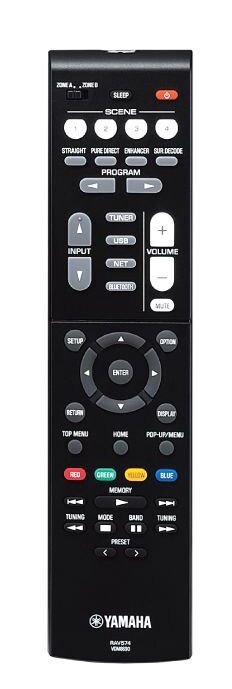
Since I was operating only a single zone, I set the top switch to “Zone A” and pushed the power switch. Simple enough. The next thing I did was to select the input source I wanted from the Tuner, USB, Net and Bluetooth button options. In addition, the input selection up/down buttons allow for cycling through the various rear panel inputs. Now comes the part I liked the best — automatic setup and speaker balancing. Press setup and the RX-V4A senses the speaker configuration. Yamaha provides a microphone that gets plugged into the receiver. Place the mic at your ear position, press “Test,” and the receiver will automatically adjust the volume and delay of all speakers in the system for optimum effect, as well as applying parametric equalization. Find you need a bit more or less volume from one speaker or another? They can be adjusted independently after auto-setup.
Once I had the basic connections and settings in place, I was ready to pop a disc into my DVD player and begin listening. Since I use the same player for music and video programming, Yamaha’s provision for remembering playback settings for different programs or types of programs is a very useful feature. The company provides four “Scene” buttons that deliver instant access to previously input settings.
As noted in other reviews, I have a stable of commercially available music and videos I use to evaluate gear performance. First up, video concerts, three rock and one classical. I pulled my copy of the Eagles’ Hell Freezes Over off my shelf and, as expected, found myself immersed, first in the backstage goings-on and then in the performance itself. The concert portion of the disc is close-miked and mostly features the five Eagles seated on chairs at the front of the stage. In the more distant shots with the whole band, clear directionality is maintained, with voices and instruments positioned as I saw them on the screen. The concert starts with “Hotel California,” usually not one of my favorite songs, but it proved to be a comfortable and respectable start. As I went through “Tequila Sunrise,” “Heart of the Matter,” “Take it Easy” — with Don Henley returning to the drum kit — and, finally, “Desperado,” I felt myself first smiling and then grinning like a drunk. My room had expanded — maybe not to the proportions of the actual venue, but it was definitely a different experience than I had been used to — and it was better.

Next up, another DTS presentation, the Roy Orbison Black and White Night concert featuring Orbison and a host of luminaries including Jackson Browne, T-Bone Burnett, Elvis Costello, k.d. lang, Bonnie Raitt, J.D. Souther, Bruce Springsteen, Tom Waits, and Jennifer Warnes. The concert was held at the Ambassador Hotel’s famed Coconut Grove in 1987. Orbison would die a year later and the hotel would close a year after that.
The musicians were clearly in the zone — and I was just as clearly in the room that September night.
Orbison’s unique voice sings out “Only the Lonely.” And then Roy and Bruce share a microphone and lead singing duties on “Dream Baby.” The concert clusters and mixes its talent and stars, building to a finale of “Pretty Woman” with Orbison, Souther, Costello, and James Burton riffing and challenging each other for several magical minutes. It was an exhilarating evening and the engineers and Yamaha’s receiver made me forget that I could not ask a passing waiter for another round.

Hoping for a sonic explosion, I grabbed the Rolling Stones 4-DVD set, The Biggest Bang. The set chronicles the Stones’ Bigger Bang tour of 2005-2006 and was released in 2007. The first three discs provide concert performances from Zilker Park, Austin, TX (Disc 1); Copacabana Beach, Rio de Janeiro (Disc 2); and Saitama Super Arena, Japan and Shanghai Grand Stage, China (Disc 3). Disc 4 is a documentary about the tour itself.
One of the many fun things about a Stones concert is that it becomes a sing-along. “Honky Tonk Women” in Rio (it was also on the Austin program) proved to be an interesting test of recording, encoding, and the RX-V4A’s playback. Mick’s voice and the guitar work of Ronnie Wood and Keith Richards were clearly up front, but in an open-air setting, the audience became a part of the performance and envelopes the viewer. And the excitement and sense of participation builds through “You Can’t Always Get What You Want” and crescendos with “Satisfaction.” In contrast, “Wild Horses,” from earlier on the same disc, provides a much more focused soundfield. While it still has a sense of space, the action is in front.
Turning to the tried-and-true two-channel CD to see if the new unit provides the same sense of concert hall space Yamaha became famous for with its first DSP units more than 30 years ago, I loaded up Leonard Bernstein’s famous (or infamous) performance recording of Beethoven’s Symphony No. 9. Running 78 minutes in total, Bernstein’s performance is one of the slowest on record. However, it is carefully wrought, dramatically taut, and emotionally fraught. This recording is one of the most emotionally charged classical discs I know.
The performance itself was in the Schauspielhaus (Konzerthaus since 1994), in what was then East Berlin. It was originally built as a theater around 1820 and converted into a music space after World War II. While the structure is elaborate architecturally and still ornate in décor, the bones of the auditorium make it a relatively conventional box. While the RX-V4A does not have its acoustics modeled in its arsenal, I chose its Vienna concert hall setting as the most pleasing in my space. As soon as the music started, my room expanded. Although definitely focused in front of me, the music also fully swathed me. As I am sure Beethoven intended, the music caressed me at times and at others virtually assaulted me. The final movement, the Choral section, left me wrung out. Beethoven, Bernstein, the moment — and Yamaha’s RX-V4A — had all done their work.
But you are not reading Concert Hall Review, are you? This is Home Theater Review, so to give the RX-V4A a proper test with movies, I loaded up Saving Private Ryan. I’ve seen this film at least four times, once theatrically and the rest in home theaters, but this viewing was the most dramatic and affecting I’ve experienced. The long D-Day landing scene has been talked about since the movie was released. For the first time, I felt its chaos and its power. Sound was coming from all over. It was loud. It was deadly. It was chaotic. It was everything you would hope the experience of this film would be.

Maybe I am an old codger, but the onscreen display for the RX-V4A is a bit too small to be effective at any reasonable seating distance. Also, I fall into a camp that is perhaps familiar to many consumers looking to purchase an AV receiver at this price point, in that I’m familiar with AV technology and I know how the thigh bone connects to the knee bone, but I could use a bit more information about the latest connectivity standards and other features. As such, it’s disappointing that the Yamaha only comes with a downloadable user manual, not a printed copy.
If you don’t need the latest and greatest in terms of HDMI connectivity, one alternative you might consider is Denon’s AVR-S750H ($549.00). While it’s a 2019 model, it’s a 7.2-channel receiver delivering 75 watts per channel with 2 channels driven. It features Dolby Atmos and DTS:X, Audyssey room calibration software, Bluetooth, Apple AirPlay2, and Alexa compatibility.
You might, on the other hand, want to read Dennis Burger’s review of the Yamaha RX-V6A, MSRP $600 (the big brother of the RX-V4A reviewed here). As mentioned in the intro, it delivers quite a bit of bang for not a whole lot more buck, including Atmos and DTS:X support (including Dolby Atmos Height Channel Virtualization via a firmware update). It also has a beefier amp section, and its room correction is more advanced than that of the RX-V4A.
Despite living in the shadow of its bigger brother, the Yamaha RX-V4A still delivers incredible performance for its price, and it could be that it offers all of the features you want or need, especially if you have no interest in installing speakers in your ceiling. This is everything that affordable hi-fi should be.
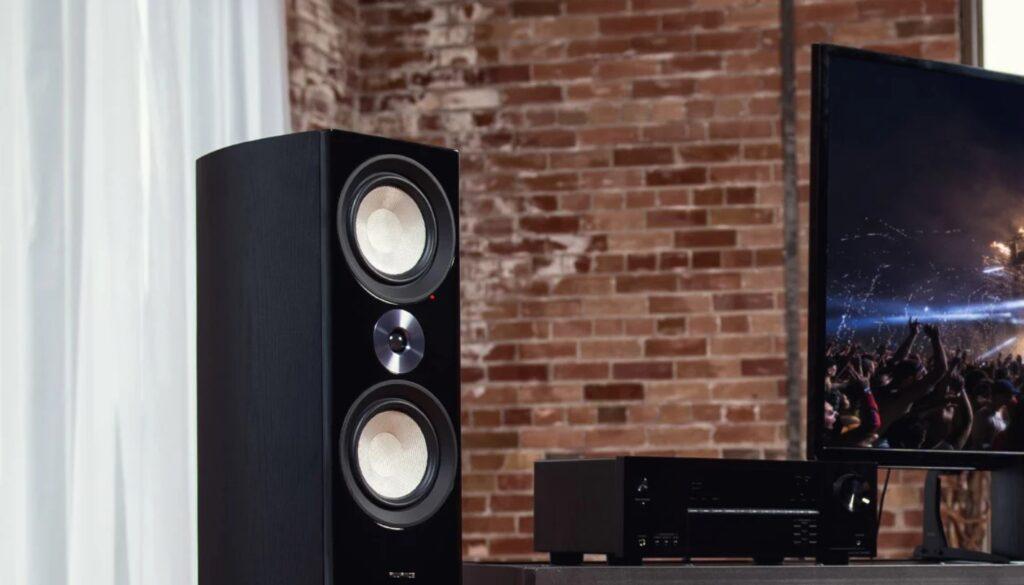
It was with trepidation and excitement that I opened the sarcophagus-like cartons containing the new Fluance Reference Tower speakers, designated XL8F. The speakers are the flagship of Fluance’s line and serve as the left/right duo in a full Reference Series home theater system or, as my use here, to provide the voice in a music-only system.
The trepidation was because the cartons arrived significantly damaged and I was concerned that the damage extended to the contents as well as the cardboard. The excitement was due to my hope that the Reference Towers, at $599/pair, would challenge and perhaps exceed my reference models that have been in my living room for decades with an inflation-adjusted price tag approaching $2,000 for the pair. An engineer long since departed created those and they wear the brand of a company long defunct. The other components in that system bear the Yamaha logo. The AX-900 integrated amplifier, delivering 130 watts/channel RMS 20-20,000 Hz, with 0.005% THD into 8 ohms; the CDX-1110 disc player; and the PF-1000 turntable with Ortofon’s 540 moving magnet cartridge installed.
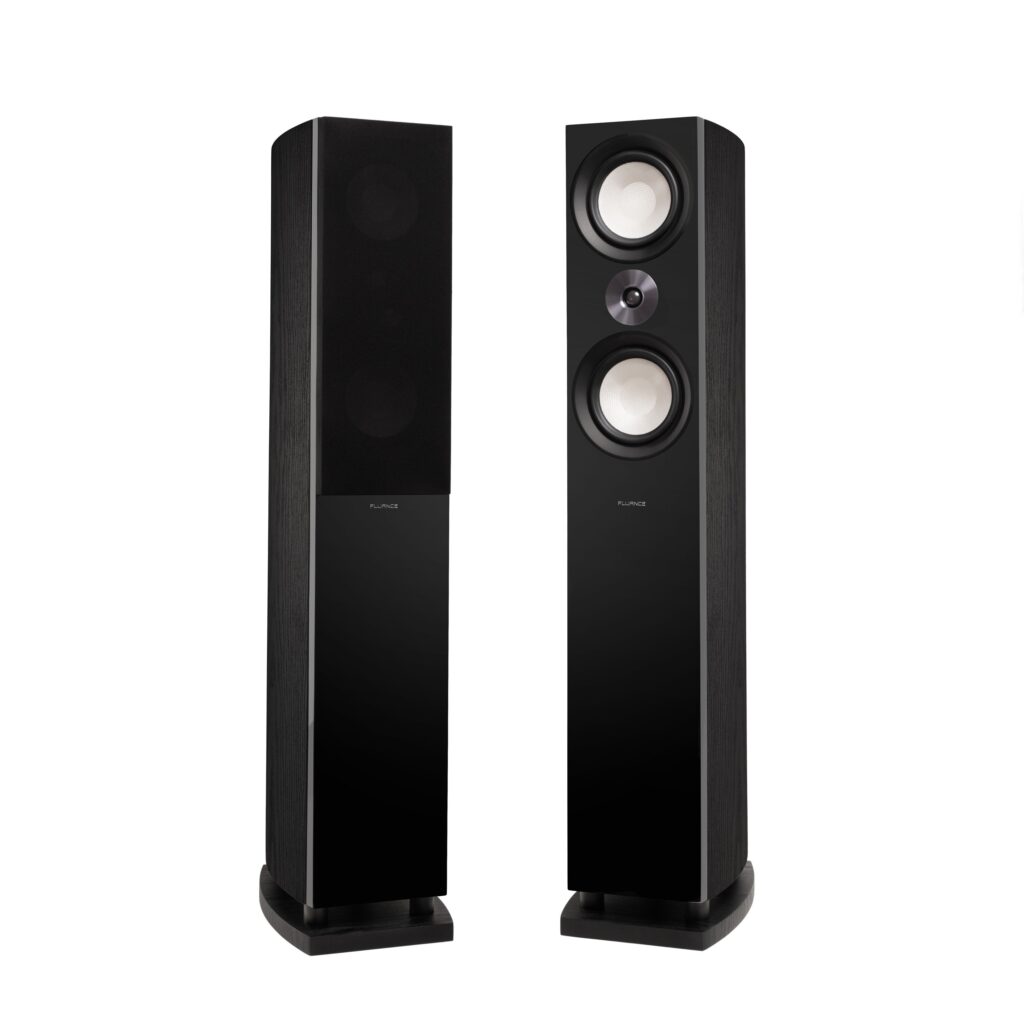
The trepidation was unjustified, the excitement – as you shall see – was. Fluance wraps its precious cargo in an inner box with thick, form fitting polystyrene foam and then an outer box. Only the outer box was damaged. Once removed from their boxes and inner wrappings, I spontaneously send one of my HTR bosses a pic with the comment, “Ain’t they purty?”
The Towers stand nearly 46 inches high x 9-1/4 x 13. They are a stacked, box-on-box three-way reflex design with the front a handsome black lacquer and the “bowed out” sides and flat back a wood grained, matte black veneer. The top section houses two 6.5-inch glass fiber midrange drivers with a 1-inch silk dome tweeter between the two. The black fabric grille is held in place by magnets and is easily removed to display the drivers mounted on the lacquered panel. The bottom portion is devoted to a down-firing 8-inch high excursion driver.
With the description out of the way, we can get on to the fun stuff. How do these towers sound? In short, the new Fluance Reference Towers sound amazingly good. I, like many reviewers, have a standard group of recordings that get pulled off the shelves when a new pair of speakers comes in. They consist of both vinyl and CD discs and over the years, I have added to the pile. Somehow, I rarely delete one. So, let’s get to the listening.
While my selections are in no particular order other than my mood or desire for comparison or contrast, the recordings, hopefully, highlight a particular quality – or failing of the speaker being reviewed. However, I started, as I usually do, with an oldie, Carly Simon’s title track, Anticipation. It properly expresses my mood, and it shows off mid-frequencies and transient response. Andy Newmark’s percussion work is varied and definitive. Next, I auditioned Linda Ronstadt’s version of It Doesn’t Matter Anymore from the first volume of her Greatest Hits. (For those not old enough to have been in love with her – or had the misfortune of loving someone who was – catch the Sound of My Voice 2019 documentary on her.)
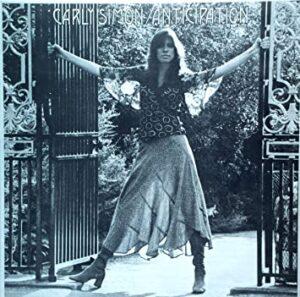
Both selections were on vinyl and the Fluance Towers responded crisply to the percussion attacks with no lingering aftertaste. The low end was clearly there, but in a very controlled way, no soggy bass here. The vocals were pronounced, clear, natural sounding and clearly out front of the other players.
Sticking with female vocalists, I went to my CDs. First, Jennifer Warnes’s Way Down Deep from her album, The Hunter, and then Janis Ian’s This Train Still Runs, from Breaking Silence. (I must confess I first heard these two at an audio show – demonstrating speakers. I am not above stealing a good idea.) Again, transients were crisp and percussion attacks were well defined. Imaging was extraordinary as backgrounds moved left and right and the voices anchored to the center.
Moving to some classical selections, I put the Telarc Saint-Saens Third Symphony, often called the Organ Symphony, into the CD drawer. Again, imaging was spot on and the sound was crisp. The organ, though not intimidating, was clear and smooth. This was confirmed with the Philips CD of Bach works played by Daniel Chorzempa.
Music has more than transients and attacks and reproduction is more than placing an instrument or voice along a wall. If a loudspeaker is only able to deliver the frequencies and not the feel, to me, it becomes a technical exercise and not a visceral experience. So, I turned to the Beethoven ‘Cello/Piano Sonatas, specifically the Harrell/Ashkenazy CD on London. While I currently own several different versions of the music, I went to this one for its recording clarity and because of the sense of kinship it seems to possess and for the warmth, profundity and passion the artists display. Would those qualities be evident to me when heard via the Fluance Towers?
The answer was, to a great degree and within the limits of their componentry, yes! The warmth and the passion were clearly there – and in abundance enough to provoke smiles and tears. In Sonata #3, Op. 69, the players provided the passion, warmth, clarity and balance that make the piece one of the glories of classical music.
As I hope you’ve figured out, the Fluance Towers impressed me. So much so that I did what I am always reluctant to do. I did a head-to-head comparison with my reference speakers. The speakers were similar in design both are three-way reflex models. The Fluance utilizes four drivers and my reference speakers are equipped with 8 – 2 10-inch woofers (one active and one passive), a single 5-inch mid-range, 2 cone tweeters, 2 dome tweeters, and 1 piezoelectric tweeter.
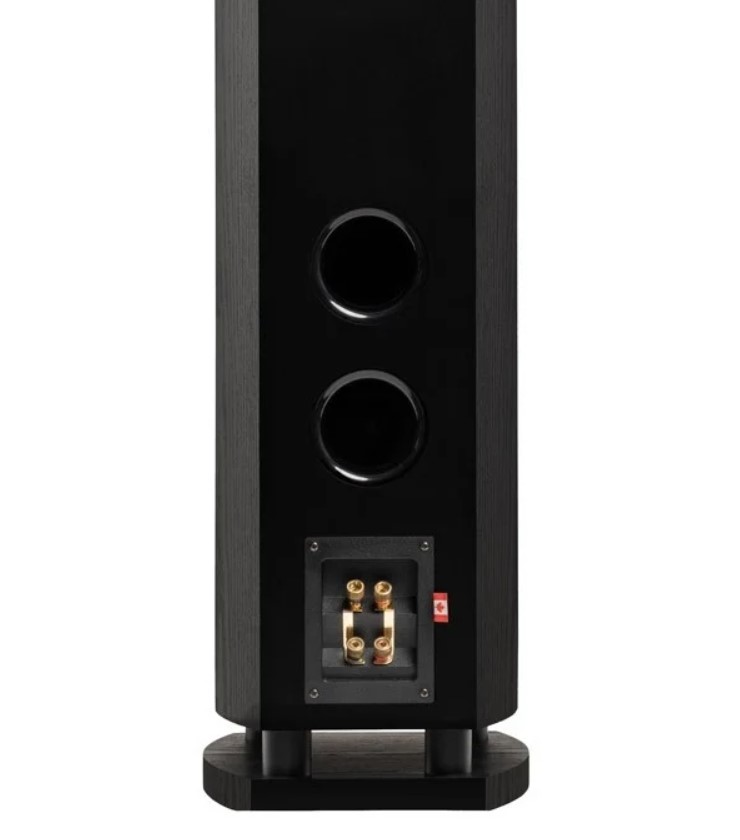
Admittedly, not a fair comparison. My comparative listening was the Chorzempa disc and the Beethoven, both cited above. My conclusions were that the bigger and more expensive – by more than a factor of 3! – delivered a more dramatic organ and that in addition to the string playing on the Beethoven, I heard the resonance of the wood.
Final Thoughts
Taken on the basis of what they are rather than what they are not (which is, I believe a reviewer’s task), the Fluance Towers are extraordinary. They are as good to look at, as they are a revelation to hear. I could happily live with these speakers for a long, long time. If your budget puts you in the $600 range for speakers, these are a “must hear.” If your budget goes beyond that figure, I urge you to consider them.
Since the Towers are part of an integrated home theater system, I look forward to putting the additional units together and hearing if the promise of these Towers is kept by the other models in the Fluance Reference series. In the realm of fantasy, I would love to hear what Fluance’s designers could do with a larger woofer.
High Points
Low Points
How does the Fluance Reference Tower compare to the competition?
Klipsch’s R-610F, available at Crutchfield and other dealers for $289 each, provides a similar option. The two-way tower forms the pillars of a 5.1 surround ensemble or can be bought separately for use in a two-channel system or matched with other speakers. Another approach might be ELAC’s Debut 2.0 F5.2 Floorstanding 3-Way Speaker. At $349 each, they offer a 1″ cloth dome tweeter, a 5.25″ woven aramid-fiber cone mid-woofer, and two 5.25″ woven aramid-fiber cone woofers.
Additional Resources
Fluance website provides details and prices of the company’s entire line. For those interested in learning about bi-amping or bi-wiring, this AudioAdvice article should be helpful.
ZVOX says its AV157 soundbar enhances dialogue clarity. Bill Kanner puts that claim to the test in our in-depth review.
A great score can be the glue that holds a film together and makes it memorable, unifying and accenting the story. Such was the gift of composer Ennio Morricone and other masters of the field.