World News
Goldmund Telos 590 Nextgen II Integrated Amplifier
Let me be honest. Right up until this very review I haven’t been much of a fan of integrated amplifiers. Cramming a preamp, a power amp, and, nowadays, a digital source component into a single box just never seemed like the wisest engineering choice to me. Not only does doing so greatly increase the risk of electro-mechanical interactions among the three different circuits; it also makes coping with the vastly different power-supply, shielding, and grounding requirements of each component section a much tougher proposition. There are sound reasons (excuse the pun) why most of the manufacturers who make integrated amplifiers also make large stereo and monoblock amplifiers, preamps with outboard (physically and electronically isolated) power supplies, and stand-alone DACs and phonostages (many of them also with outboard power supplies).
Thus, my review of the Goldmund Telos 590 Nextgen II—a 215Wpc (into 8 ohms) Class A/B integrated with built-in 384k/32-bit DAC (no phonostage, alas)—is something of an experiment. Having read in these pages about the strides made in integrated amplification—and having a genuine curiosity about the sonic merits of today’s finest compact components (polar opposites of my sonically incomparable, but also incomparably large, complex, and expensive MBL system)—I decided to take the plunge with a company whose products I’m familiar with and like.
To say that I’m glad I did this would be, perhaps, one of the bigger understatements I’ve committed to print. As you will see, the Telos 590 Nextgen II is a standard-setter. This isn’t to say that I have no reservations about Goldmund’s integrated (I will come to them in due course). What I am saying is that in direct comparison with first-rate separates that, collectively, cost more than four times what the $29,750 Telos 590 Nextgen II costs, the Goldmund unit didn’t just hold its own; it excelled, particularly in the bass and power range (but also, in some respects, in the mids and treble). And it did so without provoking the big reservations about soundstage dimensions, dynamic range and impact, detail retrieval, and noise levels that, in the not-too-distant past, inevitably popped up in reviews of integrated amplifiers.

On the outside, the Telos 590 Nextgen II looks identical to its predecessor, the highly praised Nextgen I—a stout, 45-pound, rectangular aluminum-and-steel box with an LED display in the center of its front panel. The display reads out exactly three metrics: on the left, the number of the input that has been selected (ranging from “1” through “8,” and all stops in between); on the right, the volume level (ranging from “00” to “99”); and dead center, the power status of the unit (a lighted pair of horizontal bars confirms that power is on and the integrated is ready to make music). There are metal knobs on either side of the LED display (two total). Rotating the one on the left changes the input; rotating the one on the right changes the volume. The knobs are relatively lightweight for a unit of this price, and show next-to-no resistance when turned.
Though input and volume adjustments can be made directly via the two front-panel controls, Goldmund also includes a small metal remote, which allows you to do these same things (and several others) via pushbuttons. In addition to changing input and volume level, the remote allows you to mute the preamp (which also turns off the volume light on the right side of the LED panel) or to put the unit in standby mode (which also dims the entire display).
On the back of the Telos 590 Nextgen II are eight inputs and exactly one set of output binding posts for the amp’s left and right channels. Though these posts are said, by Goldmund, to have been structurally improved, they are the first of my very few reservations about the Nextgen II.
The post Goldmund Telos 590 Nextgen II Integrated Amplifier appeared first on The Absolute Sound.
-
Product on sale
 Audiophile Vinyl Records Cleaning BundleOriginal price was: €69.90.€59.90Current price is: €59.90. excl. VAT
-
Product on saleEasy Start Vinyl Records Cleaning KitOriginal price was: €69.90.€59.90Current price is: €59.90. excl. VAT
-
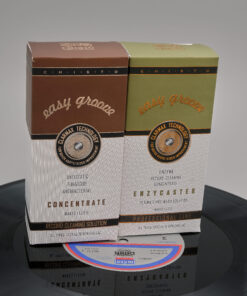
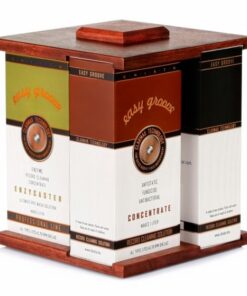
Vinyl Records Cleaner Easy Groove Concentrate€34.95 excl. VAT
-
Easy Groove Super Set€199.00 excl. VAT
-
Easy Groove Enzycaster – vinyl records prewash cleaner€34.95 excl. VAT
-
Easy Groove Extreme MK. II- vinyl records prewash cleaner€45.00 excl. VAT
-
Vinyl Records Cleaner – Easy Groove Virgin Concentrate€35.00 excl. VAT
-
Easy Groove Spray&Wipe vinyl records cleaner€34.95 excl. VAT