Tag Archives: AC power cords

Siltech Royal Double Crown Interconnects and Loudspeaker Cables

Siltech is positioned within the Netherlands, the place it started manufacturing audio merchandise in 1983. They embody the Siltech SAGA System amplification, which was reviewed by Jonathan Valin in 2014, and the mighty Symphony loudspeaker, launched in 2021. But the corporate might be finest identified for its interconnects and speaker cables, each for his or her hefty worth and stellar efficiency. Its chief designer, Edwin van der Kley Rynveld, who invented a novel silver-gold alloy in 1997, enjoys a excessive status within the audio trade. When Rich Maez, previously of Boulder Amplifiers now the American distributor for Siltech, recommended that I overview its new line of cables, I used to be greater than sport.

The packaging for the Royal Double Crown Series that I acquired, one step from the very high of the road, might hardly have been extra putting—the darkish blue packing containers containing these gems have been festooned with giant golden royal crowns. The aristocrat of cables? After prying the packing containers open, I found a passel of pretty hefty-looking interconnects, speaker cables, and energy cords, whose building seemed to be meticulous. The cables are properly shielded—a dual-layer insulation of DuPont Kapton and Teflon coupled with a Hexagon air insulation is meant to decrease inductance and capacitance. Nestled inside all this shielding are Siltech’s S10 monocrystal silver-wire conductors. The connectors are constructed from pure silver, as properly. The build-quality seems to be impeccable.

What did the cables sound like? Abandon all preconceptions about silver cables being harsh or rebarbative or vibrant. Fiddlesticks. Those days appear to be long gone with regards to the highest audio producers, who make use of silver for its velocity and purity. Whatever annealing course of Siltech is using—and it’s clearly a superb one—proper out of the field the cables sounded darned good. Indeed, the Royal Crown cables produced a lustrous sound that was troublesome to neglect. Instruments emerged from about as black a background as I’ve ever heard. Forget that. It was obsidian. Take the Scottish Fantasy by Max Bruch performed by Joshua Bell with the venerable Academy of St. Martin-in-the-Fields, a fascinating orchestral work that I’ve been listening to fairly a bit. Through the Wilson WAMM loudspeakers and darTZeel NHB-468 amplifiers, it was a supremely velvety sound. Not just like the notorious “Dockers” time period that my new colleague Michael Fremer likes to make use of as a disparaging phrase for gear that’s too relaxed and mellow, this was one thing else altogether—refined, wealthy, and rewarding. The first motion, which is predicated on the track “Through the Wood Laddie,” was an actual pleasure to pay attention by the Siltech cables. They conveyed the sonority and sheen of the string part with marvelous constancy, permitting Bell’s rubatos to emerge with tender poignancy. Throughout, there was no trace of any stridency within the treble. Instead, there was a lifelike high quality to the sound. It was nearly just like the internal glow of tubes, besides that there was (gulp) nary a tube within the system.

The soothing character of the Siltech was all to the nice on “hotter” recordings reminiscent of Count Basie’s basic Chairman of the Board, launched in 1959. This kick-ass recording was one of many late David Wilson’s favorites–a showstopper, loaded with nifty numbers reminiscent of “H.R.H.” and “Segue in C” which are assured to spotlight the spectacular qualities of a very good full-range stereo. One of the enjoyable issues about this recording is that the songs usually start with Count Basie plunking away, quietly accompanied by a bass, then the remainder of the orchestra joins in, one after the other, till the joint actually is leaping. Such is the case on “Segue in C”; the Siltech cables simply dealt with the great dynamic surge on this quantity. Also spectacular was the panache with which the cables locked down the varied sections of the orchestra, starting from the muted trumpets on the far proper to trombones on the left. All nuances and particulars have been totally obvious, together with these within the bass line. Indeed, I’d be remiss if I didn’t single out the bass efficiency of the Siltech cables for particular commendation.

Siltech Royal Double Crown Power Connector

Put bluntly, they laid down the regulation proper from the second I inserted them. John Giolas of DAC producer dCS in Great Britain not too long ago visited me to take heed to the brand new Vivaldi Apex CD/SACD gear in my system and launched me to James Blake’s album Friends That Break Your Heart. Giolas and the album didn’t. Nor did the playback on “Famous Last Words.” Right from the outset, the Siltech cables nearly appeared to plunge into the sonic depths, delivering a sort of deep propulsive character to the synthesized bass. Immediately obvious, as properly, was the creamy sound of the treble. Blake’s falsetto sounded ethereal, and feminine vocals have been only a trace extra detailed than I’m accustomed to by way of the WAMM.

Adding within the Siltech energy cable solely intensified these attributes. On the Proprius recording Cantate Domino, I used to be taken by the deep bass these cables helped to supply on the track “O Helga natt.” The sound grew to become even hotter and extra fulsome. The sense of refinement and palpability additionally went up one other notch. They additionally go deep into the corridor—on “Silent Night” on the Proprius recording, the cavernous sound of the church was overwhelming. If I needed to describe the cables in plain stereo gear phrases, it might be as a single-ended-triode sound.

The composure and tranquility of the Double Crown cables in all probability gained’t enchantment to listeners on the lookout for extra razzle-dazzle or sizzle. These cables are in one other realm altogether. There is one thing greater than a bit of spooky in regards to the degree of element coupled to the refinement they provide. On Murray Perahia’s imaginative recording of Beethoven’s Moonlight Sonata for Deutsche Grammophon, for instance, the cables provided a sort of rhythmic stability that made it even simpler to observe his use of the piano pedal. Ditto for a Rolf Smedvig recording for Telarc with the Scottish Chamber Orchestra of Torelli’s Trumpet Concerto. Once once more, I heard the uncanny rhythmic solidity of trumpet and orchestra with unprecedented accuracy. There was no sense of slippage. The notes popped out of the piccolo trumpet. The transient assaults, in different phrases, have been useless on. On the Berlin Academy for Ancient Music’s recording of Bach’s Brandenburg Concertos for Harmonia Mundi, the precision of the rhythm rendered the accents of the string devices immediately understandable, once more to a level that I’m undecided I’ve hitherto skilled. It gave the much-beloved third concerto, as an illustration, an pressing character that swept alongside all the things in its path with whole musical conviction.

The absence of grain together with the superior bass management and picture solidity of the Royal Double Crown be certain that it ranks among the many aristocrats of high-end cables. It could not have the identical supersonic velocity because the Nordost Odin 2 or the heft of the Transparent Magnum Opus, but it surely brings its personal set of virtues to the desk. Nothing is brummagem in regards to the efficiency of the Double Crown. Quite the opposite. These cables deserve each accolade that will get showered upon them. Anyone on the lookout for efficiency match for a king would do properly to think about them.

Specs & Pricing

Royal Double Crown interconnect: $18,100/1 meter
Royal Double Crown loudspeaker cable: $37,500/2 meter
Royal Double Crown energy wire: $15,300/2 meter

MONARCH SYSTEMS LTD. (U.S. Distributor)
16 Inverness Place E, Building B
Englewood, CO 80122
(720) 399-0072
monarch-systems.com

The put up Siltech Royal Double Crown Interconnects and Loudspeaker Cables appeared first on The Absolute Sound.

VooDoo Cable Air Phoenix, Air Dragon V, Air Tesla AC Power Cords

Reviewing energy cords is analogous in some ways to reviewing crew socks. We want them, and we don’t take into consideration them. One pair does pretty much as good a job of stopping the footwear from rubbing towards our toes as one other, and that’s about it. Then once more, you might want tube or heeled. You might have them for jogging or for snowboarding. Cotton or wool? You might want ankle-high, or calf-, or probably even knee-length. Many insist socks are socks, whereas others gained’t accept something apart from forest-green, calf-high crew socks constituted of the hair of Tibetan llamas shorn on the sixth cycle of a crimson moon.

Where am I going with this? Ah, energy cords….. Yes, the unimportant connection. Power is energy, and energy cords are the concentrated extract of high-end snake oil. Those who agree, please cease studying now and spend your time productively purchasing on-line for white-cotton, crew tube socks.

Ok. Are they gone? Then allow us to speak about some rattling good energy cables, folks!

May I reduce to the chase? With probably the best names in energy cords right now, the VooDoo Cable Air Phoenix, Air Dragon V, and Air Tesla jumped into my system like a bull right into a China store. They have been there and made rattling certain I knew they have been there. Yet, they bombastically introduced their presence in probably the most uncommon of the way—by astonishingly turning my programs efficiency as much as 11, whereas hiding behind the bushes guffawing at my dumbfounded expression. Boy, have been they there! But in addition they weren’t there in any respect. Stage wider, bass deeper, timbre extra pure, harmonics extra advanced, dynamics extra wow, engagement extra “Oh, my.” They did what my earlier energy cables did, ramping it as much as ludicrous. Hyperbole? Absolutely. But well-earned hyperbole.

Fabricated like a advantageous British tailor would customized make a swimsuit for his royal shopper, they arrive in hard-shell circumstances and are offered to their new proprietor as should you have been being handed the keys to your new Bentley. VooDoo energy cords usually are not the product of mass-production factories and cable mills. They are what Bruce Richardson, proprietor and designer, perceives as a bespoke resolution for these able to expertise all that their system has the capability to convey.

VooDoo Air Phoenix

What did Bruce ship me, you ask? A little bit of this, a touch of that. Five energy cables and a USB cable (to which I cannot commit an infinite period of time apart from to say that it outperformed what I had, and what I had was superb. But it is a energy wire evaluate, and I’ve already put an excessive amount of inside these parentheses). Five energy cords to fulfill my system’s wants. Five cords to rule all of them. An Air Phoenix, fabricated from what gave the impression to be Unicorn hair, took on the duty of powering my DAC, two Air Tesla energy cords with large rectangular modules of their facilities supplied electrons to my dual-mono stereo amplifier. And two Air Dragon V cables supplied the juice for my music server and preamp.

Bruce defined that “just like the acoustic resonance of a finely made stringed instrument, the supplies used and the development of {an electrical} conductor are the ingredient that attenuate and improve the resonance of the electrons passing via that conductor. The designs of the Air Dragon V, Air Tesla and Air Phoenix are fairly distinct from one another but are primarily based upon related design rules. Each energy wire is a composite of conductors fabricated from choose high-purity silver, copper, and proprietary alloys which are cryogenically handled in our deep-immersion cryo course of. We make use of numerous ranges of line-capacitance- and velocity-matched dielectric energy within the induction discipline to create the signature resonance for every energy wire. But the outcomes of every design usually are not achieved by bench measurements. Trial-and-error listening and testing with numerous audio parts are equally if no more necessary to the event of our energy cords.”

So how about some tech specs? Cryogenically handled, Air Phoenix, designed for analog or digital sources, makes use of pure-silver, single-crystal, continuous-cast, Ohno eight-gauge conductors and rhodium-plated-over-tellurium copper connectors, individually insulated with velocity-matched Teflon dielectrics and closely braided silver-plated copper shielding, lined with woven static-resistant Nomex mesh. Also cryogenically handled, Air Tesla, designed for high-current energy amps and conditioners, makes use of six-gauge alloy conductors which are individually insulated with velocity-matched Teflon dielectrics, and a inflexible buss-bar “reservoir” that “holds present within the type of line capacitance.” It is roofed with woven static-resistant Nylon mesh and has rhodium-plated-over-tellurium copper connectors. Once once more cryogenically handled, Air Dragon V, designed to extract probably the most from any part, makes use of six-gauge silver and single-crystal copper conductors lined with individually insulated, velocity-matched Teflon dielectrics lined by woven static-resistant Teflon mesh. Connectors are, as soon as once more, constituted of rhodium-plated-over-tellurium copper.

The VooDoo energy cords have been stiffer than the Shunyata Z-Tron Sigma NR V1 loom they changed, however not by lots. I used to be simply in a position to join them securely to my gear and the wall. My system has a devoted circuit panel fed straight from the road, a devoted grounding rod, and 10-gauge braided-copper wiring from the panel to my wall retailers (Furutech GTX-D-NCF Rhodium, cryo-treated retailers with carbon-fiber plates). I make the most of Environmental Protections’ EP-2750 floor filters on every devoted circuit (one breaker for every outlet) and a single EP-2050 surge-protection/waveform-correction unit on the panel. My energy is clear and clear, and after I progressed to a sure stage of energy wire, I discovered that including conditioning had diminishing returns. So, I run all my gear straight into my Furutech retailers. That stated, I’d nonetheless like to check out a Stromtank battery system, if given the chance.

VooDoo Air Tesla

Bruce was variety sufficient to ship me pre-broken-in energy cords, and I used to be in a position to begin listening after a 2–3 day settling interval. I started my classes intensely within the temper for Natalie Merchant’s “Peppery Man,” difficult the brand new energy cables with a style of these great deep Fairfield Four vocals and Ms. Merchant’s sultry singing, mixed with a twangy guitar, Shawshank harmonica, and baritone sax and tuba oompah. There was instantly extra breath within the vocals and extra textural complexity to the brass. An general naturalness gave the impression to be there that was not there earlier than. A fast flip of the finger, and “The Blind Man and The Elephant” changed Mr. Peppery Man. If you may have by no means heard this monitor, hit your streamer of selection up and take a pay attention. It’s an incredible tune and a cute anecdote. It begins out with this nice, low-note baritone sax after which treats the listener to simply the fitting mixture of clarinet, metal guitar, percussion, and storytelling. The clarinet will get fairly Klezmer-like with a contact of Bavarian and blues. The result’s a tune of the very best diploma—and a newly skilled expression of the best type. These energy cords washed away a proton-thick layer of “you’ll be able to’t have that” and freed my system to challenge a efficiency with the “I’m there”-knob turned up 15-20%.

Let us attempt Mussorgsky’s Dance of the Persian Slaves. The decision and separation of devices have been immediately obvious. As I listened longer, I started to equate the enhancements, partly, to a lowered noise ground and improved conveyance of pace and articulation. In addition, my electronics appeared to get a lift in channel separation. Take your fingers and maintain them collectively in entrance of you, arms absolutely prolonged. Now unfold them aside shortly as large as you’ll be able to whereas saying out loud, “Fwuahhhh.” That’s what occurred to my soundstage.

“Down within the Hole” by John Campell is a good monitor with a mix of rhythmic bass guitar, haunting reverb, and John’s deep, phlegmy voice. That expansive stage was nearly intoxicating. The improved sense of resonance and timbre within the backside finish clearly comes from that lowered noise ground along side what I detected to be an enchancment in section coherence—which I can neither perceive nor clarify however swear was there to be heard. At no time did I detect the music was enjoying louder, nevertheless it unquestionably had extra dynamics and authority. The air between devices appeared extra current, and the general aura of the stage was simply extra current.

I contemplate it true serendipity that I used to be requested to evaluate this loom, as I used to be fairly proud of what I had and thought of that portion of my system performed and performed. Clearly, it was not. This expertise leaves me questioning what the astronomically costly energy cables can supply. I don’t assume I need to know.

In the tip, I used to be so impressed with the build-quality and efficiency of the VooDoo energy cords, and the adjustments they produced in my system, that I advised Bruce to ship me an bill quite than return delivery labels. I’m not keen to surrender what these deliver to the desk. To say that the VooDoo energy cables resulted in a profound enchancment in nearly each side of my system is flat truth—incontrovertible and astounding—regardless that what they changed had bettered something I had heard in my room to that time. The VooDoo cables are dearer and make the most of dearer supplies than the Shunyata NR Sigma I had been utilizing, which have been the older V1 variations. I believe the Omega collection of energy cords can be a fairer comparability. I work with and luxuriate in what I’m supplied to evaluate, and I pay for what I maintain. (I put my cash the place my reviewing mouth is.) All I can say is, give the VooDoos a attempt. In my opinion they’re a no brainer step ahead on our path to absolutely the sound. Is “no-brainer advisable” increased than “extremely advisable”? I believe it’s.

Now I want to determine why I’ve an intense need to go sock purchasing.

Specs & Pricing

Air Phoenix: $4700
Air Dragon V: $3250
Air Tesla: $2900 (all costs 6′ size)

VooDoo Cable LLC
2020 Dennison Street, Suite 113
Oakland CA 94606-5242
(510) 535-9464
voodoocable.internet

The publish VooDoo Cable Air Phoenix, Air Dragon V, Air Tesla AC Power Cords appeared first on The Absolute Sound.
Synergistic Research SRX Speaker Cables, Interconnects, and Power Cords

Better than a decade-and-a-half ago, Synergistic Research’s chief cook and bottle washer, Ted Denney, came out with a cable the likes of which I’d never seen or heard before. It was called the Galileo System. Physically, what set this wire apart was the use of strands of different metals (copper/silver alloy, pure silver, pure gold, and pure platinum) that weren’t twisted or bundled together, as they are in every other brand of wire I’m familiar with, but separated into what Denney called “air strings.” In part because these individually jacketed strands of wire weren’t interwoven into massive braids, crosstalk was reduced, capacitance and inductance lowered, skin effects diminished, and transparency to sources greatly increased. The sonic superiority of its unique materials and geometry made the Galileo System a benchmark. It was the best wire I’d heard at that time and remains one of the most innovative products I’ve reviewed.

Synergistic Research’s new top-line SRX cable is the latest descendant of Denney’s extraordinary original, and it, too, is very special. Like Galileo, each SRX speaker cable uses thin, individually jacketed air strings (two made from a monocrystal silver-copper alloy, four from 14AWG silver, and four from mono-filament silver), that are separated from one another by perforations in an evenly spaced series of carbon-fiber discs, through which the strands run without physically contacting each other (or walls, shelves, and flooring). Where the air strings in Galileo cable were routed, via LEMO connectors, into and out of free-standing electromagnetic power-conditioning/active-shielding junction boxes (called “Active Mini EM Cells”) that themselves were plugged into “quantum tunneled” Mini Power Coupler power supplies (wall-wart-like devices that provided the DC current for the active shielding and EM power conditioning of the cells and the precious-metal “strings” attached to them), the SRXes are, blessedly, simpler in construction. Their air strings run out of and into a pair of barrel-shaped carbon-fiber tuning modules—passive devices which, in addition to providing conditioning and shielding, have two plugs (one each for the positive and negative legs of the cable) that allow you to attach cylindrical gold and silver “tuning bullets” to further voice the system. This provision for voicing, which is very nearly unique to Synergistic Research products, unquestionably works—and works in the ways that SR claims it does, with the gold bullets adding warmth and body to the sound and the silver bullets resolution and extension. For anyone with a difficult room or picky componentry or a marked preference for acoustic or electric music, SRX’s “tuneability” can be a blessing.

Like the speaker cable, SRX interconnect uses thin, individually jacketed air strings (one of 10AWG monocrystal silver-copper and five of monocrystal silver), each separated from the others by perforated carbon-fiber discs. In addition to a provision for attaching tuning “bullets,” the interconnects have another set of wires that can be plugged into Synergistic’s active Galileo SX Ground Block—to improve shielding and further lower noise.

The only item in the SRX lineup that superficially resembles products from other manufacturers’ cable lines is the power cord, though even here looks are deceiving. Though it does not make use of “air strings,” each cord comprises a nine-gauge composite of silver conductors for hot and neutral runs, including a long, flat, silver-ribbon EM (electromagnetic) cell and two folded EM cells for what SR claims amounts to a “pure-silver line conditioner in an AC cable format.” Like the cable and interconnect, the power cords can be voiced via Synergistic’s tuning “bullets,” and like the interconnect it can be connected to an SX Ground Block for lower noise and better shielding.

A few months ago, I reviewed Crystal Cable’s very pricey, top-of-the-line Art Series Da Vinci cable, interconnect, and power cords, which for me set new standards of fidelity. Since then, I’ve been able to audition a complete loom of SRX in my upstairs MBL reference system, and while the Crystal and the Synergistic aren’t sonically identical, they do sound an awful lot alike, clearly sharing a property that is key to their excellence. To wit, they are both extremely low in noise (and high in resolution).

As Robert and I have said in print (and Alan Taffel talks about in his Metronome DSC review in this issue), the lowering of noise is, across the board, the chief improvement in today’s high-end offerings. For examples, the elimination of RF in DS Audio’s optical cartridges, the lowering of jitter, phase, and quantization errors in DACs from Wadax, MSB, Soulution, Berkeley Audio, etc., the reduction of EMI, IM, TIM, and THD in high-bandwidth solid-state electronics from Soulution, CH Precision, darTZeel, etc., the use of aluminum, carbon-fiber, stone, acrylics, and other non-resonant materials in speaker cabinets from companies like Magico, Stenheim, Estelon, Rockport, YG, etc., and the application of carbon fiber, synthetic diamond, ceramic, and other low-resonance/high-stiffness substances in dynamic-driver diaphragms have, independently and together, reduced distortions and colorations that we simply took for granted in the old days, elevating what I’ve called “completeness” and “neutrality” to new heights.

This does not mean that pieces of high-end gear are without sonic “characters” of their own—i.e., that all of today’s components sound alike. What it does mean is that the differences in sonics among the best high-end products are, for the most part, less marked than they once were and that rather than reflecting unique distortion profiles they are the results of deliberate decisions about parts, materials, layout, manufacture, and voicing. As similar in sound as they are in many ways, the presentations of amps from Soulution, CH Precision, and Constellation are still easily distinguishable from each other, but that is not because one or the other of the trio has more (or less) THD.

This same paradigm holds true for Da Vinci and SRX cabling. Where Crystal’s top-of-the-line achieved its astonishing vanishing act primarily through metallurgical advances, Synergistic SRX earns its laurels primarily through the unique geometries I’ve discussed above. This is not to say that either cable shortchanges the other’s areas of strengths, just that their designers’ foci are slightly different, including their respective ideas about what best constitutes a replica of the absolute sound. Crystal’s Edwin Rynveld has what I would call a “fidelity to sources” (or accuracy-first) mindset. For him, the object is to lower noises that alter and obscure the original signal, and measurable differences are his primary standards of comparison. Synergistic’s Ted Denney has more of an “as you like it” (or “musicality-first”) slant. As his provisions for markedly different voicings show, his intent is to provide the listener with a sound that can accommodate individual tastes, rooms, and ancillary gear. Ironically, perhaps, both approaches end up in the same sonic ballpark, which, to reiterate, means that Da Vinci and SRX sound more alike than different—especially on an initial audition. Over time, however, each reveals its own character. Which of them you’ll prefer may be more a matter of taste (and pocketbook) than across-the-board sonic superiority.

For example, Da Vinci has a density of tone, particularly through the low end, midbass, and power range, that I simply   haven’t heard to the same lifelike extent from any other wire. Like Soulution amplification, there is a timbral richness and three-dimensional solidity to its bottom octaves that is quite natural and appealing. I should note, however, that (as with Soulution electronics) this exceptional low-end color and weight tend to give Da Vinci a slightly “bottom-up” tonal balance, a bit of a “darker” overall character (though, as you will see, nothing is scanted in the midband or on top).

Though voicing with gold bullets can bring the SRX quite a bit closer to Crystal’s darker, more granitic presentation, the Synergistic wire is fundamentally less bottom-up in character than the Crystal Cable offering. This is not to say that SRX is anything like “thin” sounding; it is not. Indeed, its bass and power-range timbre are downright gorgeous; its focus and grip in the bottom octaves may even be very slightly higher than that of the Crystal Cable. As a result, details about Fender guitar performance-technique—picking, fingering, plucking, and slapping—are (sometimes) a bit clearer.

There is an irony to this, actually, because up until Denney’s last generation of Galileo from several years back, Synergistic cable, too, had a “bottom-up” tonal balance, a slightly “dark” overall character. Not anymore. Indeed, “unvoiced” (without bullets) it is the most neutral wire that Denney has yet produced—and certainly, as noted, the lowest in noise and coloration and highest in resolution. I’m not going to claim that it outdoes Da Vinci in this last regard, but it is, as I’ve said, a bit more tightly focused, which (minus the somewhat fuller power-range/bass weight of Da Vinci) tends to clarify transient detail.

In the midband there is little to choose between these two remarkable wires. They are both exceedingly realistic sounding, capable (with the best sources) of fooling you into thinking you are in the presence of actual musicians. Not only do they reproduce timbre with lifelike density; they also reproduce the dynamic/harmonic envelope (from starting transient through steady-state tone to decay) with lifelike duration, without adding, for instance, “zip” or ringing to hard transients, sibilance to frictatives of higher pitch or amplitude, or smearing to decays. This is the very essence of “completeness”—and the reason why you can not just readily visualize singers like Sinatra on Sinatra at the Sands through both wires; you can also tell the way he is using his mic (like that geisha fan he compared it to) to shape, punctuate, and convey the emotional power of his delivery.

On top, the Synergistic and the Crystal Cable are, once again, very similar. With the best sources, both are extremely finely nuanced. When two things come this close to identity, it’s hard to distinguish one from the other. Having said this, I would guess that Da Vinci (or Crystal’s also superior Ultimate Dream) is just a smidgeon softer and sweeter at the very top, and that Synergistic’s SRX is just a bit airier and more extended.

Both are superb imagers and soundstagers; both reproduce the dynamic range of recordings with high accuracy; both are astonishingly realistic sounding with great tapes, LPs, and streams; and both lower noises and colorations to unprecedented levels.

So…where does that leave you?

Well, to begin with you’ve got to be rich to afford either one of these extraordinary looms of wire. However, for what it is worth, SRX is a good deal less expensive than Da Vinci (e.g., an eight-foot pair of SRX speaker cable costs $29,995; a two-meter pair of Da Vinci speaker cable is a staggering $46,500). If a $16.5k difference means anything to you (and if it doesn’t, my congratulations), then I’d certainly opt for the SRX. If, on the other hand, you’re rolling in dough and have a near-psychotic lack of self-control when it comes to spending it, well…Da Vinci is a hair richer in the bass and power range.

One difference that isn’t a matter of taste or guesswork is convenience. Because of its simpler geometry and lighter weight, Da Vinci is easier to set up and use (and less space-consuming) than SRX. There are no voicing bullets on Da Vinci, no grounding plugs, no multiple strands, no perforated carbon-fiber discs. It is what it is, with no provisions to adjust its sound.

Which brings us to a crux. As I’ve already noted, Edwin Rynveld perfects his products by measurement. The lower the calculable noise floor, the more he feels he’s succeeded. Though he also tests his creations extensively (see the interview to the left), Ted Denney makes his products for real-world users, whose varied systems and musical tastes he attempts to accommodate with voicing options. It’s kind of like the difference between a Soulution amplifier and an amplifier from CH Precision. The former comes with no provision for changing its sound; the latter can be “tuned” to taste via adjustments in feedback, gain, and other variables. Depending on your room, gear, and musical preferences, SRX’s tuneability (which, ideally, requires the assistance of a knowledgeable dealer for setup) may be a real plus.

Assuming you’ve got the moolah (and a spouse without a power of attorney), I can’t tell you which of these sonically similar but physically and functionally different cables to buy. Both Synergistic Research SRX and Crystal Cable Da Vinci are honest-to-God great—along with Crystal’s Ultimate Dream (which the Da Vincis replaced), the best wires I’ve heard. What I can say is this: Denney has long claimed to be able to build cables, interconnects, and power cords that will equal or exceed those of the competition for half the money. In this instance, he has proven his point. Co-winner of TAS’ Cable of the Year Award in 2022, Synergistic Research’s SRX is one of my references—and a worthy successor to Denney’s original, standard-setting Galileo.

Specs & Pricing

Synergistic SRX
Speaker Cable: $29,995 per 8′ pair
Interconnect: $12,995 per meter pair
Power cable: $10,000 per 6′

SYNERGISTIC RESEARCH
synergisticresearch.com

JV’s Reference System
Loudspeakers: MBL 101 X-treme, Stenheim Alumine Five SE, Estelon X Diamond Mk II, Magico M3, Voxativ 9.87, Avantgarde Zero 1, Magnepan LRS+, MG 1.7, and MG 30.7
Subwoofers: JL Audio Gotham (pair)
Linestage preamps: Soulution 725, MBL 6010 D, Siltech SAGA System C1, Air Tight ATE-2001 Reference
Phonostage preamps: Soulution 755, Constellation Audio Perseus, DS Audio Grand Master
Power amplifiers: Soulution 711, MBL 9008 A, Aavik P-580, Air Tight 3211, Air Tight ATM-2001, Zanden Audio Systems Model 9600, Siltech SAGA System V1/P1, Odyssey Audio Stratos, Voxativ Integrated 805
Analog source: Clearaudio Master Innovation, Acoustic Signature Invictus Jr./T-9000, Walker Audio Proscenium Black Diamond Mk V, TW Acustic Black Knight/TW Raven 10.5, AMG Viella 12
Tape deck: Metaxas & Sins Tourbillon T-RX, United Home Audio Ultimate 4 OPS
Phono cartridges: DS Audio Grandmaster, DS Audio Master1, DS Audio DS-003 Clearaudio Goldfinger Statement, Air Tight Opus 1, Ortofon MC Anna, Ortofon MC A90
Digital source: MSB Reference DAC, Soulution 760, Berkeley Alpha DAC 2
Cable and interconnect: CrystalConnect Art Series Da Vinci, Crystal Cable Ultimate Dream, Synergistic Research SRX, Ansuz Acoustics Diamond
Power cords: CrystalConnect Art Series Da Vinci, Crystal Cable Ultimate Dream, Synergistic Research SRX, Ansuz Acoustics Diamond
Power conditioner: AudioQuest Niagara 5000 (two), Synergistic Research Galileo UEF, Ansuz Acoustics DTC, Technical Brain
Support systems: Critical Mass Systems MAXXUM and QXK equipment racks and amp stands and CenterStage2M footers
Room treatments: Stein Music H2 Harmonizer system, Synergistic Research UEF Acoustic Panels/Atmosphere XL4/UEF Acoustic Dot system, Synergistic Research ART system, Shakti Hallographs (6), Zanden Acoustic panels, A/V Room Services Metu acoustic panels and traps, ASC Tube Traps
Accessories: DS Audio ION-001, SteinMusic Pi Carbon Signature record mat, Symposium Isis and Ultra equipment platforms, Symposium Rollerblocks and Fat Padz, Walker Prologue Reference equipment and amp stands, Walker Valid Points and Resonance Control discs, Clearaudio Double Matrix Professional Sonic record cleaner, Synergistic Research RED Quantum fuses, HiFi-Tuning silver/gold fuses

The post Synergistic Research SRX Speaker Cables, Interconnects, and Power Cords appeared first on The Absolute Sound.

2022 Golden Ear: VooDoo Power Cables

VooDoo Power Cables

$2900/$3450/$4700

While I am still in the middle of my review listening period, I am so impressed with these power cords that I’m awarding them a Golden Ear before the proverbial pen has hit paper. With Air Dragon on the server, Air Phoenix on DAC and preamp, and a double dose of Air Tesla on my dual-mono amplifier I am attaining improved levels of resolution, better 3-D rendering of instruments/vocals, and a boost in dynamics and presence over my previous reference Shunyata Sigma power loom. The quality of the products is Fabergé level, and they are enormously flexible, which can be a huge issue with reference power cables due to their volume and mass. Stay tuned for the full review.

The post 2022 Golden Ear: VooDoo Power Cables appeared first on The Absolute Sound.

RSX Technologies Prime

Brands come and go in this industry and nowhere more so than in the tempting world of cable. From the outside, nothing looks easier than starting a cable brand, buying some wire of the reel, putting fancy plugs on and marketing the bejeezus out of it until it sells. With plenty of well-established companies in the market, dealers are – perhaps understandably – reluctant to stock dozens of cable brands.

One of those cable companies is XLO, which Roger Skoff started in 1991. XLO’s distinctive green and lavender-coloured cables were very well-regarded, and in 2003 Skoff sold the brand to a Canadian company and left the industry. His absence lasted longer than most, but last year, he returned with a new brand called RSX technologies.

Maximum neutrality

RSX Technologies reasoning for why its cables are the best is that they aim for maximum neutrality. The company accepts that a cable should do nothing more than transmitting the signal from one device to another without adding or detracting from it along the way. In short, the wire shouldn’t change anything, which is admirable but hardly ground-breaking. RSX states that capacitance and inductance are affected by geometry but doesn’t go into any detail about the geometry it employs in its power cables. Skoff says that they use braided, bi-metallic shielding. Also, the dielectrics used always include fluoropolymer materials (PTFE variants), at least for the primary wires, with other low dielectric constant, high dump-rate but less exotic materials employed in other internal applications. The Max series uses more fluoropolymers and less other materials. Meanwhile, the Beyond Series dielectrics are entirely fluoropolymer-based, using multiple Teflon-variant materials throughout and no other dielectric materials at all. The Prime is a 13+ AWG cable. The MAX is 11+ AWG (the lower the AWG gauge, the more metal there is in the wire). And the Beyond is a 9+ AWG, cable. This last contains about 2.5x times the metal of the Prime, which, itself, has about 25% more copper than ordinary power cords.

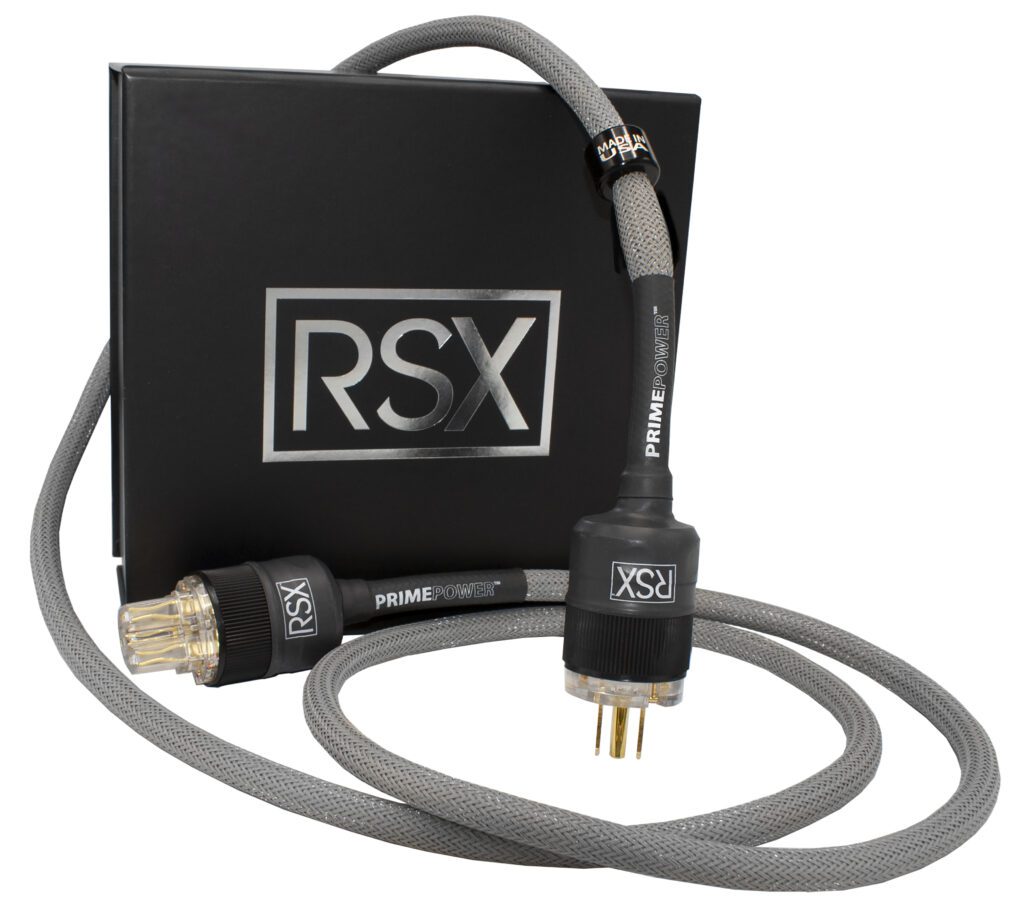
The Prime power cords are RSX’s entry-level model and consist of a reasonably flexible 11mm diameter cable terminated in high-quality Furutech style plugs with gold plated, high purity copper connectors at both ends. The conductors concealed within are described as ultra-pure, ultra-long-crystal ‘Laboratory Grade’ copper, while the dielectric is air and ‘advanced’ fluoropolymer. You can get Prime power cords in six (1.8m) and four-foot (1.2m) lengths, and I tested these on several components.

Juice up

First up was a Métronome Le DAC, which usually gets its juice from a length of rather more modestly priced Isotek Premier (£150/1.5m), so I had high expectations; I was not disappointed. Pretty well, everything improved from the power, texture and shape of a kick drum to the sense of air and spaciousness in the presentation; both attack and decay were better defined. RSX Prime increased the intensity of a drum and trumpet break to the point of air drumming, something I try my best to resist. Moving on to an AURALiC ARIES G2.1 streamer, things got tighter and a little drier; notes stopping and starting with more enthusiasm and with higher levels of detail from the quieter elements in the mix. Tautness, tempo and information all seemed to be improved, and these helped to solidify the imaging on better recordings, allowing instruments to stand in the room. This is due to care taken with the cable’s capacitive discharge effect, which means low-level details are easier to appreciate. Those details combine to create a strong sense of presence.

RSX Prime power cord

Moving onto vinyl, I started with a Rega Aria phono stage where there was a marked increase in contrast that allowed voices to stand out and the deliberate distortions of electric guitar to become more apparent on an older recording. Encouraged by this, I added another RSX Prime lead to the power supply for the Rega P10 turntable and put on Terry Callier’s Candy Man [The Best of Terry Callier on Cadet, Charly]. Once again, I went from the Isotek Premier to RSX Prime; this time, there was a dramatic increase in fine detail resolution, especially in the voice on this simple track. Yet, the tune’s rhythmic aspect also became more sophisticated, thanks to an overall increase in clarity. Touraj Moghaddam of Vertere thinks that the power cable to the turntable power supply is the most important in any vinyl replay system, and this result confirmed as much, with bells on. It even seemed to increase dynamic range on what does not at first appear to be a very sophisticated recording, which, however, is the joy of vinyl; it’s always got more to give.

Inspiration

The result inspired me to try the RSX with a Tom Evans Groove SRX phono stage. Once again, things got better; this time, the timing became tighter and perkier, now there was a spring in Jaco Pastorius’ step on Joni Mitchell’s ‘Drycleaner from Des Moines’ [Mingus, Asylum]. Here, the whole band sounding as though it had woken up but without the addition of forwardness or glare. The next step was to try Prime on my Moor Amps Angel 6 power amplifier, and I don’t know why I left this till last as it’s the most power-hungry component in the system but hey, sue me. I’m glad I did because although the effect was less immediate, it soon became clear that the RSX cable transformed the power amp’s depth and physicality of imaging almost to the extent that it sounded flat with the regular power cable. I tried several other power cables to see if they could match it in this respect. Still, while some got close, even the more expensive alternatives couldn’t compete with the RSX when it came to the three-dimensional sound presentation.

All that remains to be said is that anyone with a revealing system should give these cables a try. The price is not excessive by high-end power cable standards, and the result, in many cases, equalled a component upgrade.

PRICE AND CONTACT DETAILS

  • Type: Power cable with 13A and IEC connections
  • Price: 6ft £1,275, 4ft £950

Manufacturer: RSX Technologies

Homepage: https://rsxtech.com

Product: https://rsxtech.com/rsx-ac-power-cords/

Where to buy: https://rsxtech.com/international-distributors/

UK Distributor: Wollaton Audio

Tel: +44(0) 115 958 4404

URL: wollatonaudio.com

Back to Reviews

The post RSX Technologies Prime appeared first on Hi-Fi+.