Tag Archives: Blog

Prototype Tape Machine That Captured Clapton Classic ‘Layla’ Goes to Auction

The prototype MCI JH-16 tape machine that recorded Clapton classic "Layla" will be among the pro-audio items hitting the auction block this month at Julian's Auctions' annual Music Icons event.
The prototype MCI JH-16 tape machine that recorded Eric Clapton / Derek and the Domino’s traditional “Layla” can be among the many pro-audio gadgets hitting the public sale block this month at Julian’s Auctions’ annual Music Icons occasion, happening at New York City’s Hard Rock Cafe.

New York, NY (May 3, 2023)—In the annals of traditional rock, few Nineteen Seventies guitar albums are as revered as Derek and the Dominos’ Layla and Other Assorted Love Songs. Recorded at Miami’s Criteria Studios in 1970, it’s thought of one of many profession highpoints for Eric Clapton; now the prototype MCI JH-16 tape machine that captured the album goes to public sale later this month, together with loads of different pro-audio gear related to musical heroes.

The annual Music Icons public sale held by Julian’s Auctions could also be serving up famed guitars, stage costumes, lyric sheets, awards, autographed gadgets and extra from household-name artists, however for the pro-audio crowd, the MCI machine is simply one of many extra intriguing gear choices within the public sale, which can be held at New York City’s Hard Rock Café and on-line May 19-20, 2023.

Miami’s Criteria Studios Refreshes Studio D

Throughout the late Sixties and Nineteen Seventies, Criteria was the beta-test web site for a lot of of Fort Lauderdale-based MCI’s newest technological improvements, and the JH-16 was among the many merchandise that put the corporate on the map. MCI founder Jeep Harned designed and constructed the prototype, which grew to become generally known as “Dumbo,” and the machine was delivered to Criteria’s Studio B within the Summer of 1970, simply previous to producer Tom Dowd reserving the ability to document Clapton and his new band between August and October that 12 months.

In Mix’s August, 1980 concern, Bee Gees producer Karl Richardson recalled recording the classes a decade earlier as a Criteria workers engineer, spending days placing Clapton, Duane Allman and the remaining on to tape:

“I keep in mind I walked in on Labor Day—I’d been out driving my bike—and I simply stopped by to see what was happening. There was no person there besides Tommy and the band. So Tommy says, ‘Ah, simply the individual I needed to see.  Sit down!’ So he walked out within the studio and mentioned ‘roll it’. Everything was reside, and it was all uncooked power. They’d labored up all of the songs, so that they’d play one take, hearken to it, then say ‘We can beat that,’ and exit and do it even higher.”

The prototype JH-16 shortly grew to become a part of the studio’s workflow and captured quite a few high-profile recordings in Studio B between 1970 and 1974. With the prototype a hit, MCI went on to mass-produce a whole collection of JH-16 tape machines between 1971 and 1979 (the JH stood for Harned’s spouse, Joyce Harned), along with its different studio merchandise, similar to the primary mass-produced consoles with VCAs. By the late Nineteen Seventies, the producer had 250 workers and annual revenues estimated on the time to be $20 million; MCI was finally acquired by Sony in 1982.

For those that don’t have room for a prototype tape machine, there’s another pro-audio choices on the docket for the Music Icons public sale, together with:

    • John Lennon’s JVC RC-M70 Boombox, used to document demos of songs that wound up on 1980’s Double Fantasy.
    • Phil Spector’s Sony DAT Player and Tascam DA-88, together with reels, observe sheets, cassettes and extra from his work with John Lennon, Celine Dion, The Ramones and others.
    • Jimi Hendrix’s 1968 Fender Dual Showman 2×15 speaker cupboard with JBL audio system, bought for and used on his 1968 U.S. tour.
    • Bette Midler’s private gold-plated Shure UHF-R Wireless Mic, used all through her Las Vegas residency between 2008-2010.
    • Guns N’ Roses singer Axl Rose’s Shure Beta 58A / ULX2 wi-fi mic from the band’s 2006 tour.
    • Numerous classic guitar amps, tape recorders, keyboards and extra from King Crimson and Foreigner multi-instrumentalist, Ian McDonald.
Mix’s Top 20 Articles of 2022, Part 4

Mix’s Top 20 Articles of 2022, Part 4

New York, NY (December 22, 2022)—Join us as we look back at our most popular articles of 2022, according to Google Analytics. The Mix Top 20 of 2022 lists our most-read news stories, reviews, blog posts, profiles and interviews of the year, so this Top 20 was chosen by YOU, our readers (Don’t miss Part 1, Part 2 and Part 3)! We’ll see you tomorrow with the conclusion — Mix’s Top 20 Articles of 2022, Part 5!

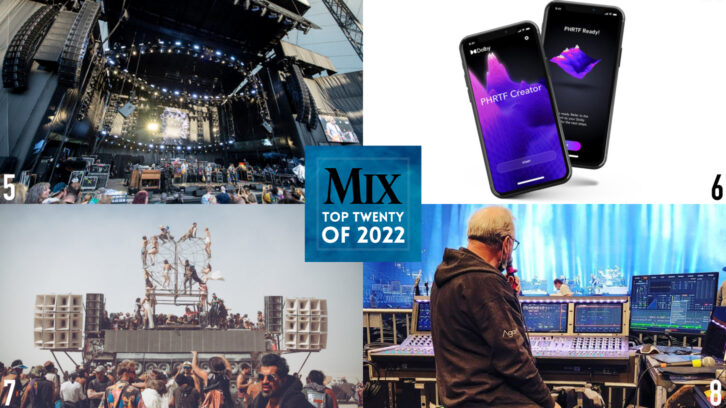
8. Genesis Live: Turn It On Again…One Last Time (1/18/22)

By Clive Young. After announcing a farewell tour in March, 2020, Genesis finally hit the U.S. in the fall of 2021…and then Covid struck the audio team.


7. Burning Man’s Robot Heart Gets A Transplant (4/22/22)

By Clive Young. Burning Man’s jaw-dropping Robot Heart sound-system bus headed to New York’s Central Park to party this year—and reinvent itself in the process.


6. Dolby Atmos Personalized Rendering Enters Public Beta (3/16/22)

By Tom Kenny. Dolby Atmos Personalized Rendering, for pros creating Atmos content while headphone monitoring, entered public beta.


5. Dead & Company Debut PANTHER on Tour (6/27/22)

UltraSound fielded a giant stadium system comprised of 72 Meyer Sound PANTHER Loudspeakers for Dead & Company.

Blog: Did You Read That?

Tom Kenny
Tom Kenny

I am an avid reader, and I have been since age 4. I read headlines, news stories, magazine articles, plaques on the trail in National Parks, those little descriptors next to artwork on a wall, short stories, literature, the instructions on a ticket machine, nonfiction works on the making of the railroad, long novels, crime thrillers and a healthy dose of sci fi-fantasy when I need a break from the day-to-day.

The thing I most like about reading is the element of surprise. Like a film I’ve been wanting to see, a new album about to be released or an exhibit set to open at the Oakland Museum of California, the anticipation of a good story, whatever the medium, is half of the magic. As I got older, I learned that the other half of the magic comes in the aftermath, in the days following my consumption of a particularly good book (or film, or song), when that story makes me think. The best pieces of art linger, whether you know of them in advance or they come to you by way of chance.

I remember a column by the sportswriter Bill Simmons from years ago, where he wrote of waking up on the day of Game 7 of the Stanley Cup Finals, then throughout the day sharing the chills, excitement and anxiety with his 7-year-old daughter before they headed to Staples Center to cheer on their beloved L.A. Kings. He went on to describe the pain of loss, and how he attempted to mollify his heartbroken daughter, then circled back to the original joy they experienced together. It wasn’t about the win or the loss, he concluded, it was about that spirit and excitement of waking up and thinking, “It’s Game 7, and here we are. We are in the game.”

Likewise, I recall a column by Al Martinez in the Oakland Tribune called “Get the Kid His Peaches,” which, after I read it, altered my sense of journalism in a meaningful way. It still does today. (Google it; you won’t be disappointed.)

It’s the same for David Foster Wallace’s famous commencement speech at Kenyon College in 2005, dubbed “This Is Water,” which I’ve played back countless times since a friend first sent it my way. Every May, I forward an unnamed link to my daughters, to remind them about the importance of leading a compassionate life. They sometimes respond with the electronic equivalent of an eye roll, with the note “DFW, dad?” I’ll keep sending it because his address made me think; it keeps making me think. Molly and Jesse, I know, are thinkers, too. Deep down, I tell myself, they are glad that I keep sending it. It’s a world view we share, and it’s a piece we’ve come to treasure, as if we’ve made it our own story.

In my 30-plus years at Mix, I’ve read every single word that made its way to print. Some are here and gone, some stick with me and make me smile, some make me think for days or weeks or years. The subject doesn’t matter. It could be the introduction of a new product that I can tell will change the game, or it might be an obscure artist profile that makes me want to purchase the album, then go back and buy the collected works. It might be a trend story, harking back to the days of the transition from analog to digital. Often, the words come from a columnist.

In editing this month’s issue, I experienced a similar rush, one that started creeping into my head and building steam, a few days after reading Craig Anderton’s November column, “The Vast Wasteland of Artist Development.” While his comparison of the music industry to the film and television industries is not new, his connection to who is responsible for the lack of artist development got me thinking about recording and mix engineers. As we continue on this two-steps-forward-one-step-back approach in transitioning from a left-right world into an immersive one, who is looking out for the audio engineer? Who is helping them with education and support?

It’s not the labels, who have been known to offer minimum wage for an Atmos remix of a platinum-selling record. It’s not the streaming services, which seem to gladly take on the role of record store and radio station at the same time, raking in the profits of distribution without the costs of development. And it’s not Big Tech, which seems to have said, “Sorry, music industry, you’re on your own in figuring this out.”

When DTS debuted with the premiere of Jurassic Park, the company sent CD-ROM drives at half-price to every theater exhibitor showing the film, and representatives were on the dub stages while the re-recording mixers began learning 5.1. When Atmos first appeared in 2012, Dolby educated Hollywood by going into the machine room, sitting down with mixers, and subsidizing the additional mix costs in getting the first 100 or so titles out the door and into theaters.

That’s not happening in music, and I’ll be thinking about all the whys and wherefores in the weeks and months ahead. All because of something I read.