Tag Archives: Cartridges

Titanic Audio Model S

It’s a bold move for a new cartridge maker; calling your product line ‘Titanic Audio’, shaping the cartridge to look like the prow of the Titanic and imprinting something akin to the ornamentation on the balustrades on that fateful liner. But, as an off shoot of Titan Audio and based in Belfast near the Union foundry where the iron used in those balustrades was cast, the link is less tenuous than first seems. I still maintain allying your brand to 882 feet of mankind’s aquatic hubris is a challenging marketing position, but at least it gets you noticed!

However, there’s another take to the Titanic Audio Model S, the Mother Bear of the three-strong line of cartridges from the new brand; the fact it’s a new brand at all. The mere existence of the Model S is a function of new models of engineering and prototyping; it’s not that this range of cartridges couldn’t have existed 20 years ago, but the means whereby they happened would be beyond a small start-up. Also, such is the sustained interest in vinyl’s comeback that such products are viable enough for a start-up brand. Regardless of what you might think of Titanic Audio (as a brand) or the Model S (as a product), the very existence of both in 2022 says good things about audio in general.

S Class

Titanic Audio claims the Model S “is a neat balance of distinguished performance and affordability”. Each Model S body is manufactured using aerospace grade aluminium and finished in electroplated chrome. This material provides good resilience and durability by reducing vibrational interference. Both the entry level Model A and Model S make use of non-magnetic materials to remove any electronic interference throughout the cartridge.

Although the Model S is a physically large design, it’s very well-balanced with 50/50 weight distribution, which is claimed to help tracking. Its 0.02mm coils are wound using Ohno Continuous Cast copper wire. This gives the Model S a useful 0.36mV output, which is about average for a MC cartridge. However, the 150Ω load impedance is relatively high and this both reduces perceived output slightly and – unless your phono stage can modify its impedance setting – does make for a more pitched up treble and decreased bass responses. Each body is CNC machined using aerospace-grade aluminium to very high tolerances, which also helps weight distribution and rigidity.
Titanic Audio Model S

Titanic Audio claims the aluminium cantilever in its Model S cartridge, “was chosen for its exquisite musical characteristics.” However, I would prefer the increased stiffness at any given mass that comes from a boron, ruby, or sapphire cantilever (the top Model G uses boron). Similarly, the Model S features a nude elliptical stylus, which is also a low mass design (the Model G ups the ante with a micro ridge stylus, while the Model A features a conical stylus design on an aluminium cantilever). Interestingly, the lightweight body is built around a carbon fibre monocoque frame for dampening and structural support.

First fit the pointy bit

The cartridge mounting holes are set back on the Model S body and are threaded. Mounting the cartridge is relatively easy; although the front of the cartridge overhangs the stylus (and in many cases, the headshell itself), the fact it’s shaped like the prow of a boat means if you centre the pointy bit at the front of the cartridge body as a first-fit, you are well on the way to getting the alignment right. Where some might use a thin white line on the front face of the cartridge and others use, er, absolutely nothing, using the very body shape of the cartridge as a guide to installation is a unique feather in the Titanic Audio cap. I mounted it in the 3D printed unipivot arm of an original VPI Prime, and it sat happily there and tracked best at almost dead on the recommended applied 1.8g tracking force. It wasn’t a fussy cartridge in terms of VTA setting, which may be a function of that stylus profile.

As a complete package, the Model S works well. The cartridge sits in a very protective hexagonal display case, which itself sits in a larger, square aluminium ‘flight case’ about a handspan across. There are foam inserts for a mounting kit, which was still a work-in-progress at the time of review. The layers of protection don’t make it invulnerable to damage, especially as the top of the ‘flight case’ has been replaced with a clear plastic insert with the Titanic Audio logo embossed across the top. However, short of using it in a contact sport or playing the ‘throwing a box down a six-story fire-escape for fun’ game that couriers seem to enjoy, this is about as solid as it gets.

Titanic Audio Model S

As it comes in a standard MM/MC phono stage with minimal adjustment, the Model S does have a forward balance; but one that is closer to ‘clean’ than obviously ‘tilted’. Couple this with its fine ability to track record grooves well and not get too upset by those albums that are less than scrupulously clean and it becomes an obvious choice for those with a good classic album collection, rather than those wanting to add the latest and newest recordings. That being said, quality modern LPs – `Venice Bitch’ from Lana Del Rey’s Norman F***ing Rockwell! [Polydor/Interscope] for example – is articulate and detailed, and her breathy vocals are pitched perfectly. When the band kicks in, nothing is too deep anyway, but the bass, atmospheric synth and kick drum bop along with depth and elan.

It’s those classic albums where the Model S shines. I busted out a 1960s Decca recording of Handel’s Belshazzar (on the Turnabout label); this is an excellent and spatially wonderful recording that is a bit ‘crispy’ in terms of surface noise, but the Model S performed a good balance of information retrieval without being so unrelenting on highlighting the past life of the record. This recording is also rather dark-toned anyway, and that – combined with the directness of the Model S treble – makes for a very nice sound indeed. In particular, the Model S has an extremely natural and unforced dynamic range that comes across throughout.

Dialling in the correct impedance (I used a Primare R35; to change from 47kΩ to 150Ω required the flipping of four DIP switches on the rear panel) makes for a marked step in the right direction, though. The basses in the Handel opera (both vocal and bowed) take on a fuller, richer texture and depth. They are more spatially ‘placed’ in the soundstage and there is improved presence and articulation in those deeper tones. Meanwhile the treble reorients itself to be less forward sounding. While the tone of the Model S is never ‘lean’ the sound becomes more even and accurate.

Legato link

Out popped a few old favourites, including Zakir Hussain’s Making Music [ECM] and Van Morrison’s Moondance [Warner Bros]. In fact, these albums have a lot in common, as both the themes in the ECM album are as legato as Morrison’s distinctive vocal style. Any disconnect in tonal balance quickly irritates on both albums too, but especially the former; Jan Garbarek’s trademark soprano sax can quickly cut into Hariprasad Chaursia’s flute playing and even John McLauglin’s super-fast guitar lines, swamping them if the system is even remotely bright.

The difference in impedance setting was telling; the forward sound was just the right side to make Garbarek’s sax sound clean and direct without oversaturation, but with the impedance dialled in just so, the sax just sat better within the mix. Neither is ‘deal breaker’ but I found the adjustment worthwhile to the point where I would recommend using the Model S with a phono stage with that degree of flexibility.

In truth, the Titanic Audio Model S sits in among some very strong contenders with decades of reputation behind them. But for some, that reputation is as much based on past glories as it is for high-performance new models in this price sector. I think the main strength of the Model S is its balance, as it’s such a good tracker it seems to sideline surface noise while remaining a fluent and engaging sounding cartridge. It will probably never be the first choice for those seeking a soft and overly romanticised view of LP, but for those who want good, natural sounding dynamics and mid-to-treble transparency, send out a telegraph to Titanic Audio today!

Technical specifications

  • Type stereo moving coil cartridge
  • Body CNC Machined Aerospace-grade aluminium
  • Stylus Elliptical nude diamond
  • Cantilever Aluminium
  • Recommended Tracking Force 1.8g
  • Frequency Response 20Hz-20kHz ±1dB
  • Output Level 0.36mV (1kHz, 5cm/s)
  • Load Impedance ≥150Ω
  • Coil Impedance 10.5Ω
  • Height 17.5mm
  • Weight 10.5g
  • Price £3,500

Manufacturer

Titanic Audio

titanicaudio.co.uk

 Tel: +44(0)28 9072 6003

Back to Reviews

The post Titanic Audio Model S appeared first on Hi-Fi+.

Future TAS: Goldring Eroica HX Phono Cartridge

The Goldring Eroica HX high-output, high-performance cartridge makes upgrading from a moving-magnet to a moving-coil model straightforward. The Eroica HX delivers moving-coil-quality performance from a moving-magnet phono input, allowing turntable owners to enjoy the performance gains of an mc cartridge without the hassle of a system-wide upheaval. The Eroica HX is designed to work straight from the box, and to slot into an existing system with no fuss. Features include a new pure-iron cross-armature design for correct impedance matching and ultra-fine enameled-copper windings for higher output and low crosstalk. It’s equipped with Gyger II diamond stylus that can trace frequencies as high as 50kHz without distortion. The housing is made from a lightweight Pocan composite material, chosen for its low-coloration properties. Compatible with virtually all tonearms, it can be mounted using standard fixings, from above or below the headshell. 

Price: $899.

goldringusa.com

The post Future TAS: Goldring Eroica HX Phono Cartridge appeared first on The Absolute Sound.

2022 Golden Ear: Clearaudio Charisma V2 Cartridge

Clearaudio Charisma V2 Cartridge

$2000

Promoted as founder Peter Suchy’s “moving-magnet masterpiece,” the Charisma V2 confirms in the listening that this claim is no exaggeration. With a mass-loaded, low-resonance, ebony-wood body, Charisma employs top-notch features like the same boron cantilever and double-polished Gyger S stylus found in the legendary Goldfinger Statement mc. But it’s the raw musicality of Charisma that had me spinning LPs like a demented DJ. Naturalistic and detailed, Charisma offers up classic midrange bloom and image stability, plus a full palette of tonal colors, dynamic electricity, and top-end sweetness. As with its vaunted moving-coil brethren, it resolves even finer gradations of light and air in the upper octaves, all the while maintaining a neutral balance. There are no tonal dead spots, and tracking is unshakably excellent. Costly moving coils tend to grab all the headlines in high-end circles, but their low output generally requires pricey step-up devices, which means your wallet takes an additional hit. However, with its real-world output of 3.6mV, a Charisma means you’re likely good-to-go with an existing phonostage. Charisma…either you’ve got it or you don’t. This cartridge has got it.

The post 2022 Golden Ear: Clearaudio Charisma V2 Cartridge appeared first on The Absolute Sound.

Burmester 217

Given Burmester’s reputation as a manufacturer of complete audio systems, the 217 is only the company’s second turntable in the brand’s 45‑year history. That first turntable, the 175 from five years ago (reviewed here) is part of the company’s Reference Line and includes a built-in phono stage. The 217 – from Burmester’s Top Line – is the first product the company has ever made to take advantage of the awesome 100 Phono Preamp, that we reviewed way back in issue 77.

However, I want to extricate the review from a potential trap of its own making at the outset. The way I described the 217 makes it sound like it’s simply the record-spinning add-on to the Top Line electronics. The implication that it’s the turntable for Burmester completists rather than a good turntable in its own right. This is wrong. The 217 is a turntable, arm and cartridge combination designed as a turn-key vinyl ‘rig’ that works well at the head in many systems. The fact that I suspect it will be the turntable of choice for so many Burmester owners shouldn’t detract from its performance as a standalone package.

Easily fooled

As you unbox the 217, you would be forgiven for thinking it a direct-drive design. In fact, it features two belt-drive motors, the belts and pulleys of which are supplied pre-fitted. You can’t see them even in installation because the belts sit beneath the drive axle upon which the platter sits. It has one switch for power and two buttons for 33 and 45-rpm play. An indicator light flashes as it reaches the set speed and stays constant when it reaches that level. That’s the sum of its controls; no 78, no speed control, and no more extensive displays or strobes. That’s all you need.

This drive axle and motor arrangement are housed in a massive, low-resonance unibody housing of solid aluminium. This effectively makes the 217 a sealed unit, and even replacing the belts is beyond the listener’s scope. This is the Mercedes-Benz connection rubbing off on the brand (even putting coolant in the radiator is a service-level job today), but it does mean the product is functionally fuss-free once installed. The final links in the chain are the three adjustable feet the deck sits upon and a bituminised leather composite mat.

The turntable is matched with a straight, gimbal-mounted 9″ tonearm, which features an arm tube of ‘unidirectional fibre composite material’ (carbon fibre, to its friends) and an aluminium headshell and arm base. The cartridge is also housed in an aluminium body and is a moving coil design with a Shibata stylus profile. The arm exits to a standard five-pin SME tonearm cable connector, and a high-grade tonearm cable (exiting, in this case, to two XLRs for the 100 phono stage) is supplied, which fits in a recess on the back of the turntable.

Ready to roll

For such a high-grade turntable, it’s a remarkably ready-to-roll design. Burmester recommends professional installation, but much of that is more about lifting a relatively heavy turntable into place rather than a complex installation. Burmester sets up everything from speed control to cartridge alignment, even downforce and anti-skate are put in place in the Burmester factory. You plug and play.

While I said earlier that the Burmester 217 is not simply a front-end for the Top Line system, the company is not too forthcoming with resistive and capacitive load or the cartridge gain. This is not a problem for Burmester 100 owners because the system allows automatic set-up using the test LP provided with the phono stage. For the rest of the world… it’s guesswork time!

Build quality is off the charts. Normally, I’d preface that by saying, “Naturally, as a Burmester product…” but vinyl enthusiasts might not have had the same exposure to Burmester’s product line. They might assume it’s some shiny chrome bling thanks to that front panel. They would be assuming incorrectly. I’d say this is built like a tank, but that doesn’t go far enough. This is built to an uncompromising standard, putting the 217 among the shining stars of turntable construction like SME and Transrotor. It’s the consistency and attention to detail that will grab you; some of the best-loved and highest-end turntables have a ‘three-foot rule’; they look great from a metre or so away, but up close, there are some rough edges. You’d need to analyse every panel with an electron microscope to find a poorly finished edge. I guess when your products end up in the interior of a Maybach, ‘good enough’ isn’t in your vocabulary.

Seven Layer Army

That attention to detail extends to the packaging itself. Built across seven numbered layers, it allows you access to everything in a logical order, beginning with the manual, then the case candy with a pair of grey Burmester-logoed gloves and cleaning kit, then cables, then the platter and so on. I find it a little odd that the platter is the first part of the turntable out of the box (the other logical way is to place the platter underneath the main unit, so it comes out of the box and straight onto the installed turntable. However, the platter’s mass is such that if it is housed that close to the edges of the box, it could create undue stress on the packaging. Placing it in the middle of the unboxing (and to the left of the turntable) makes the load more evenly distributed and prevents any risk of an accident.

It might seem like a small touch, but Burmester has a clever way of installing the platter. It recommends installers use a double cup suction lifter, the sort of things glaziers have to move panes of glass around. Installers can place the heavy platter on the spindle and bearing housing. Given the only other way of placing this by hand involves either dropping the whole platter the last centimetre or so – or sacrificing a few fingertips to the Dark Gods of Vinyl – the use of a simple suction lifter is a neat trick. It’s absolutely going in my box of tricks for the next heavy platter lifting session. You could say I’m a sucker for this kind of thing.

Burmester 217 rear

There’s a commonality to Burmester source devices, be they CD players, music servers, or turntables. There is a clever combination of extraordinary refinement with a stentorian bass that takes the listener a little time to process. You are so overwhelmed by the information going on it takes two or three tracks to realise just how good the sound really is. Curiously enough, in finalising the review, I looked at my notes and compared them with the ones written for the 175 five years ago. Two things sprang out at me; my handwriting is worse than ever, and there were so many echoes between that review and this one. Yes, of course, the 175 is the bigger (and, especially, heavier) hitter and the process of re-educating your ears took a lot longer with the Reference Line turntable because there was so much more information to process. But the two are very much in lockstep sonically.

Shining naturalness

Back then, I wrote about ‘effortlessness’ and ‘naturalness’ to the 175’s sound, and those elements shine out in the 217 too. The deceptively simple lines of ‘Paper Tiger’ from Beck’s Sea Change [Mo Fi] require a turntable of both precision and absolute fidelity to get right, otherwise, it overstates the guitar sound or his close-mic’d vocals. Get it right (as happens here), and it’s at once fluid, morose, slightly creepy, and brilliant. Get it wrong, and it sounds like an out-take. That can only happen with a turntable with outstanding effortlessness and naturalness. Especially the latter; any hint of brightness is met badly.

The very natural sound of the 217 extends to its dynamic range, and it’s here where I think the newer model might even score over the 175 it’s clearly based upon. The Reference Line turntable is designed for similarly uncompromising systems. Its monumental sense of scale can be overpowering in some cases, and it’s in those cases where the 217 sounds right. That still means large full-range systems, but not those top-of-the-tree designs that require a barn of a room and leave you intellectually and emotionally drained after an hour or two of playing. In the 217, the ultra-dynamic recital by Alexander Toradze playing Prokofiev’s Piano Sonata No 7 in B flat [EMI/Angel] is portrayed with force and grace at once, but the same in a system befitting the 175 might make you run for cover.

Burmester 217 cartridge close up

Record playing through the 217 is both a voyage of rediscovery and a lithe and articulate performance, with the large-scale soundstage that’s a Burmester trait. Music is fully three-dimensional with excellent solidity of instrument images within that stage. Each of these instruments is right sized too. That ability scales well as you move from Dylan, a guitar and a harmonica through chimey PCM synthesisers that dominated 1980s recordings, back to well-recorded 1950s jazz and out to full-blown orchestral pieces. If each of these has its correct scale and shape, it’s clear the 217 is doing many right things, sonically.

Close harmony

Vocals are a strong point with the 217, whether they be the close harmonies of the Beatles singing ‘You Never Give Me Your Money’ [Abbey Road, EMI] or the truly beautiful folk voice of Nic Jones singing ‘Canadee-i-o’ [Penguin Eggs, Topic], the articulation and detail of the voices in both cases cut through the years.

Breaking down the sound of the Burmester 217 is ultimately self-defeating because it’s an extremely coherent sound. Going back to that Nic Jones album once more, his voice, guitar and fiddle playing demand a system that communicates music well, and that’s precisely what the 217 does so well. This album normally shows up a higher-mass turntable as being a bit ponderous and rhythmically challenged, but on the 217, it’s light, tight and beautifully ordered. Swap Nic Jones for Frank Sinatra singing ‘It Happened in Monterey’ [Songs For Swinging Lovers, Capitol] and the 217 nails it; both Nelson Riddle’s excellent scoring and Sinatra’s uncanny passing tones meld together exactly as you always knew they should.

My only real issue with the 217 is more ‘philosophical’ than ‘musical’. I’m still unsure if the high-end turntable market ‘gets’ the notion of a turn-key turntable like this. While there was a long hiatus when turntables were starting to be discussed in the past tense, audiophiles before and after the vinyl revival almost universally selected the turntable, arm, and cartridge from a selection rather than select them as a single entity. Even brands that provide all the links in the chain (Clearaudio, for example) don’t specify their high-end models as a turnkey solution.

All-in-one

However, I think the trend is more toward this kind of all-in-one solution, even if there is an implication of choice; Linn offers a range of decks, arms, and cartridges… but has them in three distinct packages that most listeners choose. In fact, I find this preset option to have great validity as it allows the manufacturer to make very nuanced decisions about the performance of all three turntable components as a complete unit. It also removes some of the difficulties of successful system matching and installation. Finally, it solves the ongoing problem of finding a demonstration facility willing to perform cartridge demonstrations.

Burmester 217 arm-base detail

The Burmester 217 is a formidable turntable like the 175 was before it. And yet, it is not a turntable that delivers a formidable sound. Instead, it makes the sort of sound that will keep you listening to vinyl for years and is built so well that it will still be doing the same for your great-grandchildren. In sound and build, it’s consistent and exacting. It’s the ideal partner for a Top Line Burmester system, and yet its standalone performance makes it a turn-key high-end turntable for almost any system. In short, it’s a stellar performer.

Technical specifications

  • Type Belt drive record player with arm and cartridge supplied and set
  • Speeds 33, 45 rpm
  • Motors Two AC motors with belts, no user access
  • Arm Aluminium and carbon fibre, 9”
  • Arm bearing system gimballed bearing
  • Cartridge type Moving coil
  • Stylus profile Shibata
  • Dimensions (W×H×D) 482 × 165 × 283mm
  • Weight 31.5kg
  • Price £18,700

Manufacturer

Burmester Audiosysteme GmbH

URL: burmester.de

Tel: +49 (0)30 78 79 68 0

Back to Reviews

The post Burmester 217 appeared first on Hi-Fi+.

2022 Golden Ear: Ortofon Verismo Cartridge

Ortofon Verismo Cartridge

$6999

Sitting squarely in the empty spot between the Windfeld Ti and the top-line MC Diamond cartridge in Ortofon’s Exclusive Series, the company’s newest offering, the Verismo, fills the gap comfortably. Using Ortofon’s Selective Layer Melting (SLM) process, the Verismo’s body is made (layer by layer) of titanium to form a dense and rigid structure with high internal damping. Equipped with Ortofon’s Replicant 100 stylus, Aucurum coils, low-magnetic armature, and field stabilizing element, the Verismo has the added advantage of an upgraded Wide-Range-Damping (WRD) system. (WRD consists of a platinum disc sandwiched between two dissimilar rubber/multiwall-carbon-nanotube absorbers.) The Verismo has also inherited the diamond cantilever formerly only available on its flagship MC cartridge. With the new rubber formulation, WRD provides optimal damping and improved tracking abilities. As a result, the new Verismo tracks and traces grooves effortlessly, while providing an exceptional amount of perceived realism. The Verismo offers up the most truthful evenhandedness and musical transparency that I can recall from this manufacturer, surpassing my previous most-preferred Ortofon, the MC A95. The new rubber compound and diamond cantilever have taken the Verismo to new heights.

The post 2022 Golden Ear: Ortofon Verismo Cartridge appeared first on The Absolute Sound.

Audio Technology Switzerland is Proud to Announce its First Ever Phono Cartridge

The following is a press release issued by Nagra.

November 2, 2022 – Swiss high-end audio firm, Nagra, announces the upcoming release of its first phono cartridge – the Nagra Reference MC cartridge. Initial units are scheduled to be delivered in December. 

The Nagra Reference MC cartridge is the product of a number of years of intense R&D supplemented by extensive listening tests. This moving coil cartridge will be available in 4 and 6 Ohm variants. Designed in parallel with the Nagra 70th Anniversary Reference turntable/tonearm system, it is an ideal companion component to complete the ultimate LP playback platform. 

The Reference MC cartridge features a number of significant and unique elements. While traditional moving coil transducers utilize a single layer coil body, the Nagra Reference MC cartridge employs a multi-layer transducer featuring a double layer coil body wound with hyper-pure silver windings. The 6 Ohm Reference outputs 0.45mV @ 5cm/S. The 4 Ohm Reference achieves an output of 0.30mV @ 5 cm/S. 

A stiff ruby cantilever is mated to a high strength titanium structure featuring a DLC (diamond-like carbon) coating. The titanium structure utilized in the coil body/cantilever interface addresses a traditional source of resonance and substantially reduces vibration unrelated to the musical signal. The stylus tip is a Swiss produced, Fritz Gyger S profile chosen for its wonderful combination of detail retrieval and musicality. 

Further evidence of the obsessive attention to detail in the cartridge’s design is found in the connector pins. Those employed in the Reference MC cartridge eliminate the commonly found connection joint between the pin and the coil. In the case of the Reference MC, the pin is a continuous single piece from its external end point to its internal point of contact with the coil, resulting in a welcomed lowering of inductance. 

In addition to the extensive focus on the generator system and groove/stylus/ cantilever interface, Nagra’s team of engineers and designers paid great attention to the Reference MC cartridge body. Substantial material science investigation lead the team to a unique, non-ferrous alloy called EXIUM AM. Born from aerospace materials research, EXIUM AM is the result of a collaboration between the CNES (the French equivalent of NASA), the Ecole de Mines de Paris and the French firm LBI Foundries. It was developed to address the need for an alloy with very high damping properties – a necessary attribute for a particular Mars mission whose purpose was to measure minute seismic activities on the red planet. Nagra engineers determined that this high damping characteristic alloy was perfect for use in audio applications where the elimination of unwanted vibrations and resonances is an extreme priority. As a result, the Reference cartridge utilizes an EXIUM AM inlay at the critical interface between cartridge generator and the cartridge body. (An examination of Nagra’s 70th Anniversary Reference turntable will reveal that the table’s platter features a precisely CNC machined ring of EXIUM AM.) Nagra’s use of EXIUM AM is exclusive. Nagra has secured the sole worldwide right to use EXIUM AM in audio products. In order to produce a cartridge of optimal weight for the Reference Anniversary tonearm, while maintaining high internal damping properties, a proprietary super magnesium alloy is utilized for the balance of the cartridge body. 

The Nagra Reference cartridge has exceptional tracking ability, resonance control and exemplary specifications. It will match most tonearms and phono stages but will reach its ultimate potential when paired with the Nagra Reference turntable/tonearm system and Nagra phono stages. 

As these highlights indicate, Nagra is committed to being a world leader in state of the art LP playback products. We look forward to the upcoming release of the Nagra Reference MC cartridge. We are anxious for serious vinyl lovers around the world to experience their collections like never before. 

Specifications 

Impedance 4 or 6 Ohms
Compliance 12 μm/mN
Ouput voltage 0.45 mV (6 Ohm) 0.3 mV (4 Ohm) @ 5 cm/S
Channel balance < 0.5 dB
Crosstalk > 30 dB
Weight 14.3 g
Stylus FGS
Cantilever Titanium / Ruby
Transducer Multi-Layer Core
Coil material Pure Silver
Tracking force 2 – 2.2 g 

The post Audio Technology Switzerland is Proud to Announce its First Ever Phono Cartridge appeared first on The Absolute Sound.

Nagra Reference MC Cartridge coming soon

Nagra Reference MC Cartridge Swiss high-end audio firm, Nagra, announces the upcoming release of its first phonocartridge–the Nagra Reference MC cartridge. Initial units are scheduled t o be delivered in December. The Nagra Reference MC cartridge is the product of a number of years of intense R&D  supplemented by extensive listening tests. This moving coil cartridge will be available in 4 and 6 Ohm variants. Designed in parallel with the Nagra 70th Anniversary Reference turntable/tonearm system, it is an ideal companion component to complete the ultimate LP playback platform.

The Reference MC cartridge features a number of significant and unique elements. While traditional moving coil transducers utilize a single layer coil body, the Nagra Reference MC cartridge employs a multi-layer transducer featuring a double layer coil body wound with hyper-pure silver windings. The 6 Ohm Reference outputs 0.45mV@5cm/S. The 4 Ohm Reference achieves an output of 0.30mV@5cm/S.

A stiff ruby cantilever is mated to a high strength titanium structure featuring a DLC(diamond-likecarbon) coating. The titanium structure utilized in the coil body/cantilever interface addresses a traditional source of resonance and substantially reduces vibration unrelated to the  musical signal. The stylus tip is a Swiss produced, Fritz Gyger S profile chosen for its wonderful combination of detail retrieval and musicality.

Further evidence of the obsessive attention to detail in the cartridge’s design is found in the connector pins. Those employed in the Reference MC cartridge eliminate the commonly found connection joint between the pin and the coil. In the case of the Reference MC, the  pin is a continuous single piece from its external endpoint to its internal point of contact with the coil, resulting in a welcomed lowering of inductance.

In addition to the extensive focus on the generator system and groove/stylus/cantilever interface, Nagra’s team of engineers and designers paid great attention to the Reference MC cartridge body. Substantial material science investigation lead the team to a unique, non-ferrous alloy called EXIUM AM. Born from aerospace materials research, EXIUM AM is the result of a collaboration between the CNES (the French equivalent of NASA), the Ecole de Mines de Paris and the French firm LBI Foundries. It was developed to address the need for an alloy with very high damping properties–a necessary attribute for a particular Mars mission whose purpose was to measure minute seismic activities on the red planet. Nagra engineers determined that this high damping characteristic alloy was perfect for use in audio applications where the elimination of unwanted vibrations and resonances is an extreme priority. As a result, the Reference cartridge utilizes an EXIUM AM in lay at the critical interface between cartridge generator and the cartridge body. (An examination of Nagra’s 70th Anniversary Reference turntable will reveal that the table’s platter features a precisely CNC machined ring of EXIUM AM.) Nagra’s use of EXIUM AM is exclusive. Nagra has secured the sole world wide right to use EXIUM AM in audio products. In order to produce a cartridge of optimal weight for the Reference Anniversary tonearm, while maintaining high internal damping properties, a proprietary supermagnesium alloy is utilized for the balance of the cartridge body.

The Nagra Reference cartridge has exceptional tracking ability, resonance control and exemplary specifications. It will match most tonearms and phonostages but will reach its ultimate potential when paired with the Nagra Reference turntable/tonearm system and Nagra phonostages.

As these highlights indicate, Nagra is committed to being a world leader in state of the art LP playback products. We look forward to the upcoming release of the Nagra Reference MC cartridge. We are anxious for serious vinyl lovers around the world to experience their collections like never before.

The post Nagra Reference MC Cartridge coming soon appeared first on Hi-Fi+.

Optical cartridge pioneer DS Audio replaces DS-W2 with the all-new third generation DS-W3

*From the DS Audio News Release

DS Audio’s inaugural optical cartridge, the ground-breaking DS-W1, was a genuine game changer when first launched in 2015. A year later, the brand announced the higher spec Master 1 and subsequently applied trickle-down technology to upgrade the ‘W’ model to the DS-W2. In 2020, a ‘third generation’ of optical cartridges was launched with the flagship Grand Master, from which trickle-down tech has again been applied to the ‘W’ model, to create the new DS-W3.

The DS-W3 optical cartridge sports a completely new design compared its predecessor and is very much an example of the brand’s ‘third generation’ technology first seen in the flagship Grand Master. Its optical system has been comprehensively re-engineered to deliver a number of benefits.

Independent LEDs and photo-detectors for the left and right channels deliver a significantly increased output voltage: now 70mV compared to the previous 40mV. This new independent design has also made it possible to eliminate crosstalk, greatly improving left and right channel separation. At the same time, the S/N ratio is much improved, resulting in an even lower noise floor.

DS Audio DS-W3

This new design also enables a smaller shading plate, which is reduced in both size and weight – from 1.56mg to 0.74mg – thanks to the use of 99.9% pure beryllium rather than the previous aluminium.

The DS-W3 combines a boron cantilever with a line contact stylus. The cartridge’s body is constructed from aluminum with a structure crafted for maximum rigidity, while the internal wiring is 1.6 times thicker than that of the earlier second generation model, thus reducing impedance.

Like all DS Audio optical cartridges, the DS-W3 requires its own equalizer / phono stage, which this new design also brings up to ‘third generation’ level. All internal components are optimized for third generation cartridge technology, the thickness of the circuit board has increased from 1.6mm to 2.0mm, and the thickness of the copper tracks have been doubled from 35µm to 70µm. The equalizer offers both unbalanced and balanced outputs with a choice of four different low-frequency roll-off points ensuring that the DS-W3 will partner seamlessly with any high-end hi-fi system.


Every DS Audio product is hand-made and quality assured, and every component part tested and evaluated, by the company’s own in-house team of technicians in Japan.

Technical specifications

DS-W3 optical cartridge

Body material Aluminium

Cantilever Boron

Stylus Line contact

Signal output Photo-electric conversion

Output signal level > 70mV

Channel separation > 27dB (@ 1kHz)

Weight 7.9g

DS-W3 phono stage/equalizer

Inputs RCA

Outputs RCA x 2, XLR x 2

Rated output voltage 500mV (@ 1kHz)

Output impedance RCA 120Ω, XLR 600Ω

Pre-amp input impedance > 10Ω

Dimensions 450 (w) x 120 (h) x 435 (d) mm

Weight 13.5kg

Pricing & availability

The DS Audio DS-W3 optical phono cartridge and phono stage/equalizer are available now, priced as follows (inc. VAT):

Cartridge and equalizer package price £12,995

Cartridge only £4,995

Equalizer only £9,495

DS Audio cartridges are fully compatible with any of the company’s accompanying phono stages/equalizers, allowing you to mix and match.

The post Optical cartridge pioneer DS Audio replaces DS-W2 with the all-new third generation DS-W3 appeared first on Hi-Fi+.

Phasemation PP-200

What is it with the Japanese and moving coil cartridges? There seem to be many companies in that part of the world that make this most precise of hi-fi components, certainly more per capita than anywhere else. I guess the reputation for attention to detail must be accurate as it would be very difficult to make cartridges if you hadn’t mastered this side of the equation. Then there’s the fact that a brand like Phasemation, whose history goes back to 1970, is virtually unknown on this side of the globe… what gives? Has the home market been saturated at last?

Phasemation didn’t start with that name. Its origins lie in Kyodo Denshi System, which specialised in electronic measurement devices before moving into magnetic testing. It wasn’t until the ‘90s that it got into the audio business, making MC step-up transformers and D/A and A/D converters on an OEM basis. How many companies have made both of those, I wonder? In 2002 it created the Phase Tech brand building the P-1 moving coil cartridge, adding a P-3 model two years later and branching out into equalizers and phono stages.

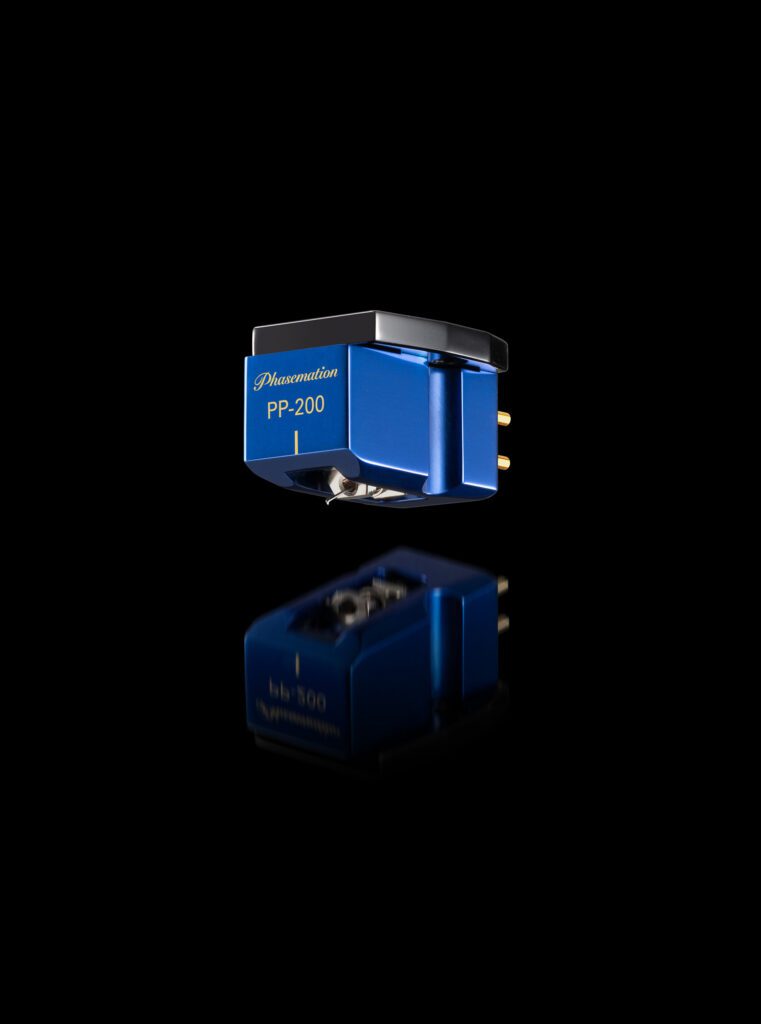
Phase Tech expanded into amplification and digital components, including one of the earliest USB DACs before changing its brand to Phasemation in 2010. Since then, the company has expanded the cartridge range but continues to build analogue electronics and step‑up devices, which have long been popular in Japan. The PP-200 is the most recent and least expensive stereo cartridge in the roster and can easily be differentiated by its blue finish, all the other models are Henry Ford’s favourite shade of very, very dark grey.

Range-topper

The PP-200 is said to be based on the PP-2000 range-topper and “contains its essence,” according to the company blurb. It’s built around a neodymium magnetic circuit which sits in a body shaped to control vibration and “achieve a direct sound quality”. Unusually for a cartridge at this price, it has a boron cantilever; as far as I’m aware, no one else makes a cartridge that has this compound of boron and aluminium performing the critical task of transmitting the vibrations that the stylus reads to the coils that sit inside the magnetic field within the cartridge at this price. Boron has several uses, including flatscreen TVs and neodymium magnets, but as a cantilever, it’s stiffer than most alternatives.

The boron rod used by Phasemation is only 0.26mm in diameter and has a line contact diamond tip on its visible end; visible, that is, if you get down and look at it from the side, you can’t see it from above, which would make lining it up a specific track difficult if there wasn’t a short vertical line on the front of the cartridge body. The body is extremely solid and made of machined Duralumin, an age-hardened aluminium alloy. In the PP-200, both the base and body are made of this material, contributing to an overall weight of 10.5g.

A recommended downforce range of 1.7–2g and medium compliance means this cartridge should be compatible with most modern tonearms. Being Japanese means you don’t get niceties such as threaded mounting holes. I’m not sure why this seems evident, and a convenient facility is not provided on many Japanese cartridges, but they don’t mind the extra fiddle factor involved with nuts and bolts. The PP-200 is supplied with black anodised aluminium fixings, but you get round collars with slots on either side rather than nuts. The bolts have a conventional hex head, but lord knows where you’d find a tool to hold the collars. They do look good, though, as does the leatherette case in which the cartridge is supplied, an appealing Japanese touch.

Low output impedance

This moving coil has an unusually low output impedance of four Ohms, so it theoretically requires a phono stage with a 40 Ohm load, which is far lower than can be found on any active amplifier. A step-up transformer from the Phasemation catalogue (they make four models) would presumably give the best results. I note that the entry-level T-320 is designed for output impedances from 1.5 to 40 Ohms. I have always struggled to get hum-free results with step-up, so I don’t have any in my armoury; instead, I set the mighty Tom Evans Groove+ SRX MkII MC phono stage’s loading to its 112 Ohm minimum and hoped for the best.

My faith was rewarded, but first I had to mount the PP-200 in the arm on my Rega Planar 10, a job which had me seeking a heavier counterweight because the Phasemation is near twice the weight of my usual Aphelion 2 MC. Anti-skate also required a significant increase related to the mass and stylus profile. I dialled in a downforce slightly higher than the midpoint in the range suggested and warmed up the cartridge over a few sides.

The result was impressively sophisticated for the asking price; the PP-200 gets a lot right in that it extracts vibrations from the groove and turns them into an electrical signal. Audible characteristics include a slight emphasis through the upper mid, which tends to bring up electric guitars, cymbals and many voices, plus a fullness in the low end that adds more welly to bass lines. This balance is easy to adjust for, and after a few records, it was less noticeable than at first. Climbing down from an MC at around three times the price will always be obvious, but it wasn’t a painful transition.

Phasemation PP-200

This is partly because the Phasemation has a smooth top end, you usually have to pay more to get treble extension without edginess, but perhaps because of the boron, there is nothing but clean, openness in the highs it delivers. Some might think it a little polite in the treble, which is often a trait of Japanese audio components, but unless you only listen to the finest recordings having a forgiving top end is nearly always a bonus. Partnering electronics will be a factor, and the Tom Evans is highly revealing, so smoothness is doubly appreciated. On Matthew Halsall’s latest live release [Salute to the Sun, Gondwana], his trumpet stands out as bold as er, brass, but doesn’t get in your face and is surrounded by the live atmosphere of the Hallé Hall in Manchester. Bass and percussion are strong, and the sax has a lovely tone; it’s reminiscent of Coltrane in his more soulful moments and stands firm in a remarkably three-dimensional soundstage between the Bowers and Wilkins 802 D4s.

Open and spacious

Dan Berkson’s Dialogues is more open and spacious; it’s not clear whether this is a natural or in-the-box effect, but it works very nicely. The piano sounds fresh but not flyaway, the lower notes ground it, and the tune is propelled by solid double bass with cymbals providing the ‘air’ for the sound to breathe. I challenged the Phasemation’s tracking skills by playing an ancient Atlantic red label copy of Déjà Vu (Crosby, Stills, Nash etc.). While it sounded a bit rough, there was no problem tracing the well-worn grooves and delivering the emotional power of ‘Carry On’. You try playing a scratched CD on anything, it will never give you this sense of time travel, assuming it will play at all.

This experience inspired me to try another oldie in ‘Can’t You Hear Me Knocking’ from the Rolling Stones’ Sticky Fingers [Rolling Stones, zipper cover], here the big-boned bass guitar and off-kilter beat from the late, great Charlie Watts served to enhance that glorious riff. The Phasemation’s controlled delivery keeps everything in its right place, as Radiohead say, though I doubt they were talking about the ‘Stones. The following track, ‘You Gotta Move’, has Jagger appropriating the culture of the bluesmen that inspired him to fabulous effect. This band were always about the blues, after all.

I noticed at one point while contrasting the PP-200 with digital that needle-talk is appealingly low. You don’t hear the vibrations from the groove being amplified by the cartridge body when the sound is muted, which is a good thing. The contrasts with ‘digital generally’ favoured this MC; the bass is a little rich and the highs a shade smooth, but there was no chance you’d rather play the disc or file when this Phasemation could be dropped into a vinyl groove. Select Audio has found a rather good addition to the ranks of Japanese cartridges in Phasemation, and this one looks like excellent value.

TECHNICAL SPECIFICATIONS

  • Type: Low output moving coil phono cartridge
  • Stylus/Cantilever: Line contact diamond tip with boron cantilever
  • Tracking Force: 1.7g–2g
  • Load: Not specified
  • Compliance: 8.5µ/mN [8.5 × 10⁻⁶cm/dyne]
  • Output (1kHz 50mm/s horizontal direction): 0.3 mv
  • Weight: 10.5g (without stylus cover)
  • Price: £895

Manufacturer:

Phasemation

URL: phasemation.com

UK Distributor:

Select Audio

Tel: +(0)1900 601954

URL: selectaudio.co.uk

Back to Reviews

The post Phasemation PP-200 appeared first on Hi-Fi+.