Tag Archives: Cartridges

Ortofon 2M Premounted lifts the expertise

Ortofon 2M premounted lifts the expertise

*From the Ortofon information launch

Ortofon broadcasts 2M Premounted. The Danish maker’s 2M Premounted is a sensible and chic answer for patrons who want direct and simple mounting and substitute on an S-shaped tonearm. The SH-4 headshell is sturdy and inflexible, but the design accentuates a slim kind issue. The sturdy, light-weight headshell has an ergonomic design with an extended finger elevate that’s simple to choose up.

The Ortofon 2M sequence builds on its maker’s philosophy of accuracy in sound: that is the right vary for individuals who desire a premium phono cartridge of the very best high quality, and the road can develop with the customers as they develop their programs.

2M Premounted sequence options:

· Mounted on our common SH-4 Black headshell

· Easy and direct mount on S-shaped tonearms with common mount

· Correct Baerwald alignment with tonearms with common mount

· Interchangeable stylus with the chance to improve

2M Red Premounted

Step into the music

Remember whenever you fell in love with music? The 2M Red will rekindle that flame and make music matter once more. From the second the diamond-tipped needle hits the groove, you are feeling it. The 2M Red options Ortofon’s invention, the break up pole pins, which offer you a splendidly exact sound. With the 2M Red, you’ll hear the music come to life by itself phrases. It is like taking a step into the music itself. The 2M Red is Ortofon’s entry-level cartridge within the sequence, however what an entrance.

Technical Specifications

Output voltage at 1 okayHz, 5 cm/sec. – 5.5 mV Tracking means at 315 Hz – 70 μm Compliance, dynamic, lateral – 18 μm/mN Stylus kind – Elliptical

Tracking pressure advisable – 1.8 g (18 mN) Load resistance – 47 kOhm

Load capacitance – 150 – 300 pF Weight, Cartridge – 7.2 g.

Weight, Premounted – 16.7 g

2M Blue Premounted

Next degree authenticity

Once you will have begun your quest for authenticity, it’s onerous to cease, and this is a superb subsequent step. The aim of any cartridge must be to breed the sound as near the artist’s imaginative and prescient as potential, and the 2M blue takes the listener nearer to this goal on this journey. Ortofon cuts the full-diamond stylus in an Elliptical form, and when it hits the groove, it’s like travelling again by means of time to the second of the recording. With the 2M Blue, you get severe about listening to vinyl.

Technical Specifications

Output voltage at 1 okayHz, 5 cm/sec. – 5.5 mV Tracking means at 315 Hz – 80 μm Compliance, dynamic, lateral – 18 μm/mN Stylus kind – Nude Elliptical

Tracking pressure advisable – 1.8 g (18 mN) Load resistance – 47 kOhm

Load capacitance – 150 – 300 pF Weight, Cartridge – 7.2 g.

Weight, Premounted – 16.7 g

2M Bronze Premounted

Bona fide precision

To Ortofon, hi-fi is greater than a elaborate label. High constancy is the aim of every part it does. The 2M Bronze incorporates a full-diamond stylus in a high-quality line minimize and a singular upgraded coil system with silver-plated copper wires that give the music a brand new dimension of precision. Listening to your records with the 2M Bronze is like listening to them once more for the primary time. You get to fall in love with the songs throughout. That is what hi-fi means to us and what you get with the 2M Bronze.

Technical Specifications

Output voltage at 1 okayHz, 5 cm/sec. – 5 mV Tracking means at 315 Hz – 80 μm Compliance, dynamic, lateral – 20 μm/mN Stylus kind – Nude Fine Line

Tracking pressure advisable – 1.5 g (15 mN) Load resistance – 47 kOhm

Load capacitance – 150 – 300 pF Weight, Cartridge – 7.2 g.

Weight, Premounted – 16.7 g

2M Black Premounted

True to the groove

The 2M Black is the sequence’ flagship. Ortofon cuts the full-diamond stylus in a Shibata form that offers it contact with the groove like nothing else. You hear each element within the music simply because the artist needed you to. For those that wish to sense the artist’s presence within the room after they take heed to their records, that is the best cartridge

Technical Specifications

Output voltage at 1 okayHz, 5 cm/sec. – 5 mV Tracking means at 315 Hz – 80 μm Compliance, dynamic, lateral – 20 μm/mN Stylus kind – Nude Shibata

Tracking pressure advisable – 1.5 g (15 mN) Load resistance – 47 kOhm

Load capacitance – 150 – 300 pF Weight, Cartridge – 7.2 g.

Weight, Premounted – 16.7 g

2M Black LVB 250 Premounted

Beyond wonderful

The 2M Black is a tremendous cartridge and is taken into account the final word in shifting magnets by many. So, why would we try and create one thing even higher? Because perfection runs in our blood. The 2M Black LVB 250 upgrades the wonderful construct of the 2M Black with a boron cantilever and our very personal Nano Tube suspension system. The result’s a sound so exact and so detailed that you simply really feel like you will have let the artist into your own home and have them enjoying proper in your front room.

Technical Specifications

Output voltage at 1 okayHz, 5 cm/sec. – 5 mV Tracking means at 315 Hz – 80 μm Compliance, dynamic, lateral – 22 μm/mN

Stylus kind – Nude Shibata

Tracking pressure advisable – 1.6 g (16 mN) Load resistance – 47 kOhm

Load capacitance – 150 – 300 pF Weight, Cartridge – 7.2 g.

Weight, Premounted – 16.7 g

Back to homepage

The submit Ortofon 2M Premounted lifts the expertise appeared first on Hi-Fi+.

Audio-Technica Celebrates 60 With the Explosive Sounding AT-MC2022

Originally publish on trackingangle.com

It’s no secret that the world’s two largest cartridge producers, Audio-Technica and Ortofon generate most of their cartridge earnings from cheap, mass-produced models, lots of which they provide OEM to turntable producers. Yet each lavish time, consideration, and monetary assets on the far smaller (it might be truthful to say “tiny”) high of the market, the place ultra-precision hand-built limited-edition fashions garner extra consideration than gross sales from audio fanatics. So why try this? Partly for the status, partly for the “trickle down” tech advantages and partly in all probability simply to push the envelope and see far it may possibly go and to the place it leads.

Back in 2016 Audio-Technica launched the ART 1000 cartridge, designed by the then retired Mitsuo Miyata alongside together with his younger successor then Product Development supervisor Yosuke Koizumi. Miyata’s dream, (some thirty years earlier!) had been to provide a cartridge with coils mounted immediately atop the stylus, so stylus motion would immediately translate to sign era, the advantages of which needs to be apparent to all studying this. The draw back is added mass immediately atop the stylus and an open structure that made the coils weak to wreck. But CDs received in the best way earlier than Miyata may notice his dream, so he turned his consideration to designing headphones.

Audio-Technica ART-1000 giant sized
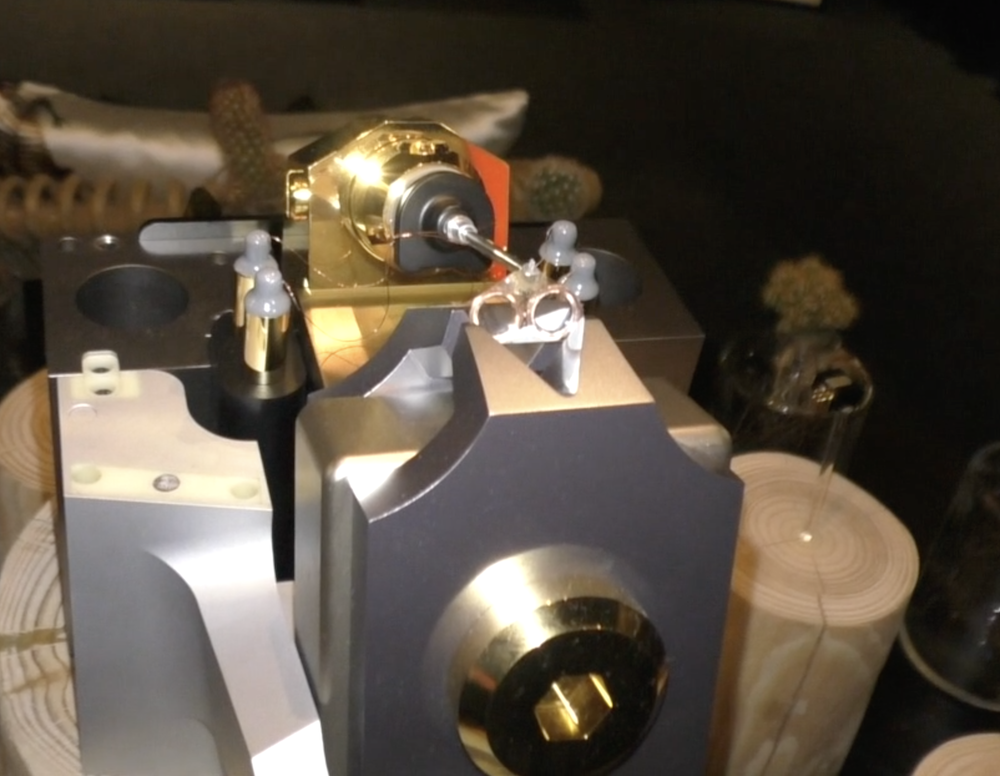
Giant sized ART-1000 at CES. Note coils bonded to high of cantilever

When Audio-Technica put into manufacturing the AT ART-1000 I flew to Tokyo to each watch it being constructed and to higher get to know the corporate. It was an eye fixed and ear opening journey. The ART-1000 remains to be obtainable from some sellers for $4,999.

While there I met younger Yosuke Koizuma, now listed as “Audio Technica cartridge engineer” who honored me by bringing to the manufacturing facility his tremendous 45rpm document assortment. Don’t skip this video!

Hideo Matsushita based Audio-Technica in 1962. At the time he had a tenured place curating an artwork museum. His long-term high-quality audio ardour bit, he stop to begin Audio-Technica, and shortly thereafter launched the AT-1 cartridge. The new MC2022 celebrates the corporate’s sixtieth anniversary. Today, the founder’s son Kazuo is Audio-Technica’s president.

Like the opposite massive scale cartridge producer, Audio-Technica’s line options orderly steps upward in sonic and technical high quality. As Ken Redmond identified in his wonderful ART20 assessment , to create the ART20, Audio-Technica took its $1500 AT-ART 9XI and changed its aluminum/plastic physique with an aluminum/titanium physique and elevated the magnet system’s yoke mass. The value elevated as effectively, from $1500 to $2900.

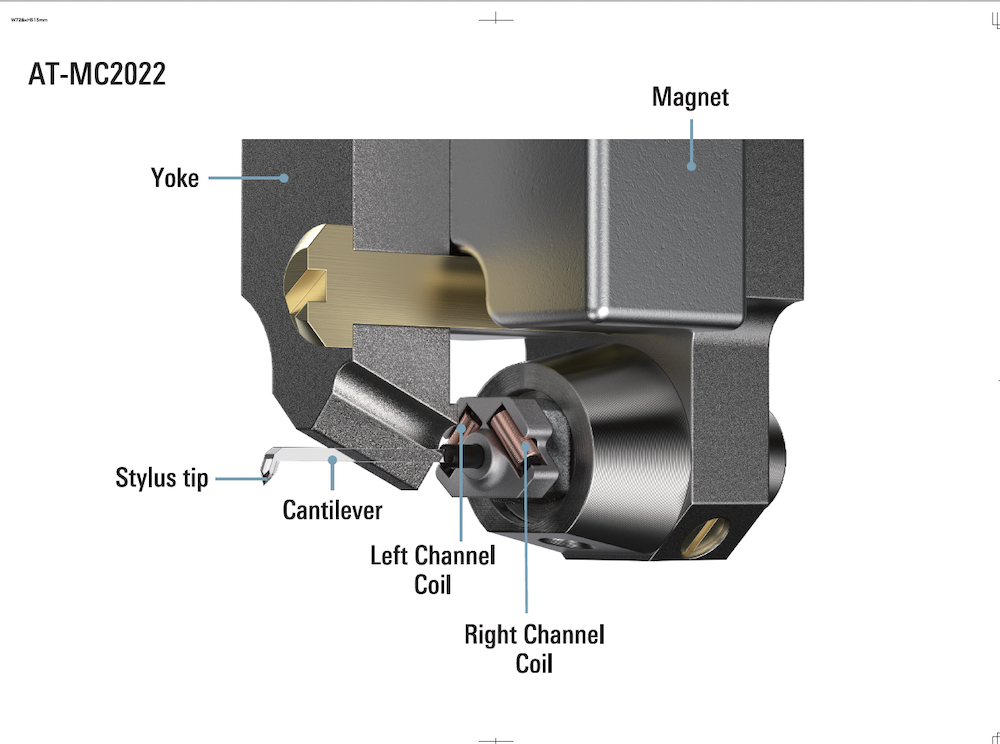
The new AT MC2022 prices $9000. Its electrical specs are an identical to the ART 20’s indicating that the “motor” might be an identical or very related. The static and dynamic compliance specs differ however not appreciably. The large distinction after all is the unified stylus-cantilever meeting, shaped from a single, lab-grown diamond utilizing chemical vapor deposition. This was beforehand achieved by Sony in its XL-88D cartridge circa 1980, which I’ve been instructed was “carved” from a naturally occurring diamond and price as a lot as Honda car (I’ve not been capable of verify that).

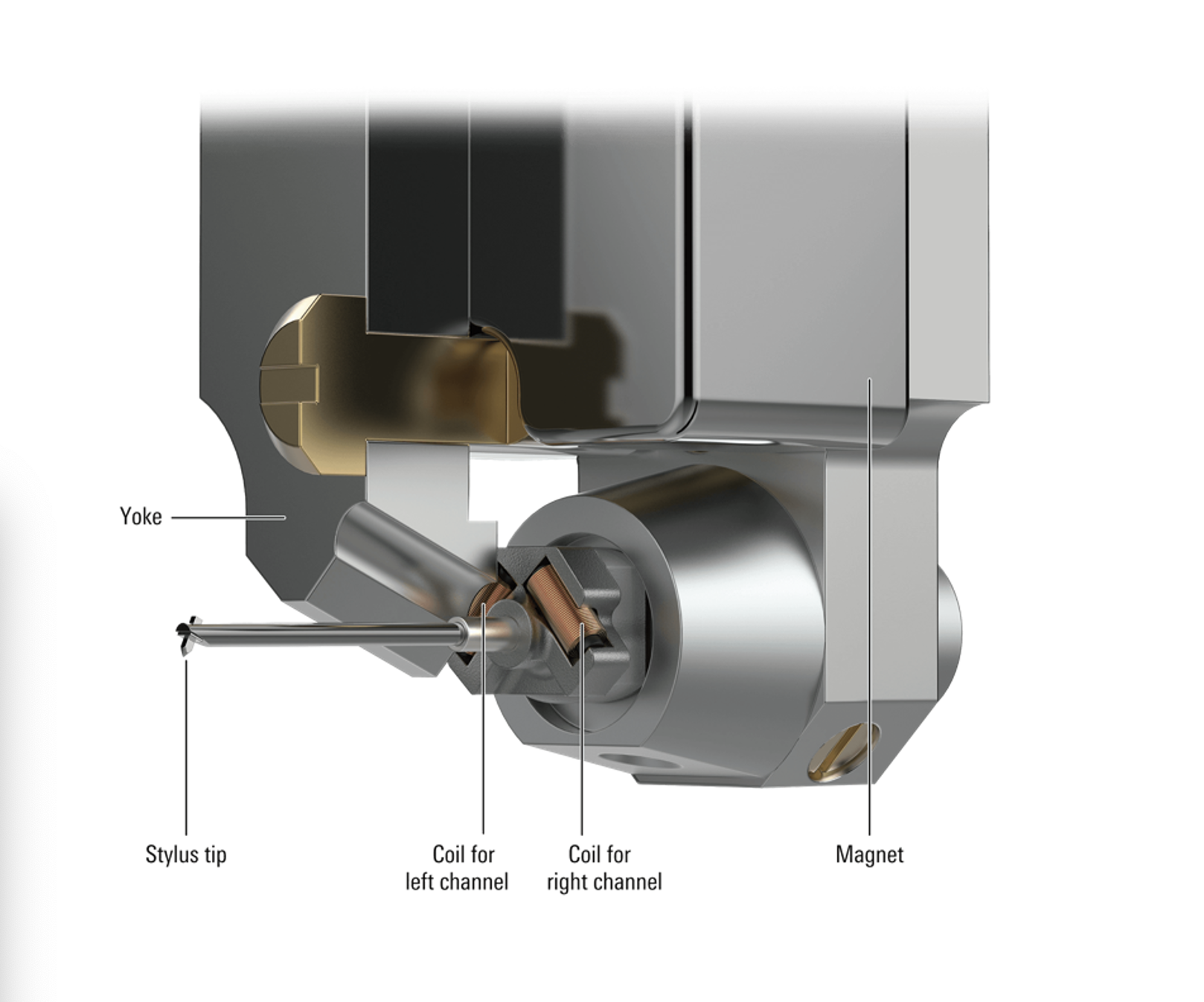
Audio Technica ART20
Audio Technica ART20 motor


AT-MC2022
Only obvious distinction is the unified cantilever/stylus meeting, however that’s a giant “solely”!

The MC2022’s sq. cantilever is 0.22mm (0.0087”) extensive, which could be very slim. The dimensions of the road contact diamond stylus shaped on the tip is 2.2 x 0.12 mil (or 56 x 3 µm) whereas the AT20’s is 1.5 x 0.28 mil (or 38 x 7 µm), which suggests the MC2022’s small radius is lower than half that of the AT20 so it’s a real line contact that in comparison with the AT 20 ought to produce better element.


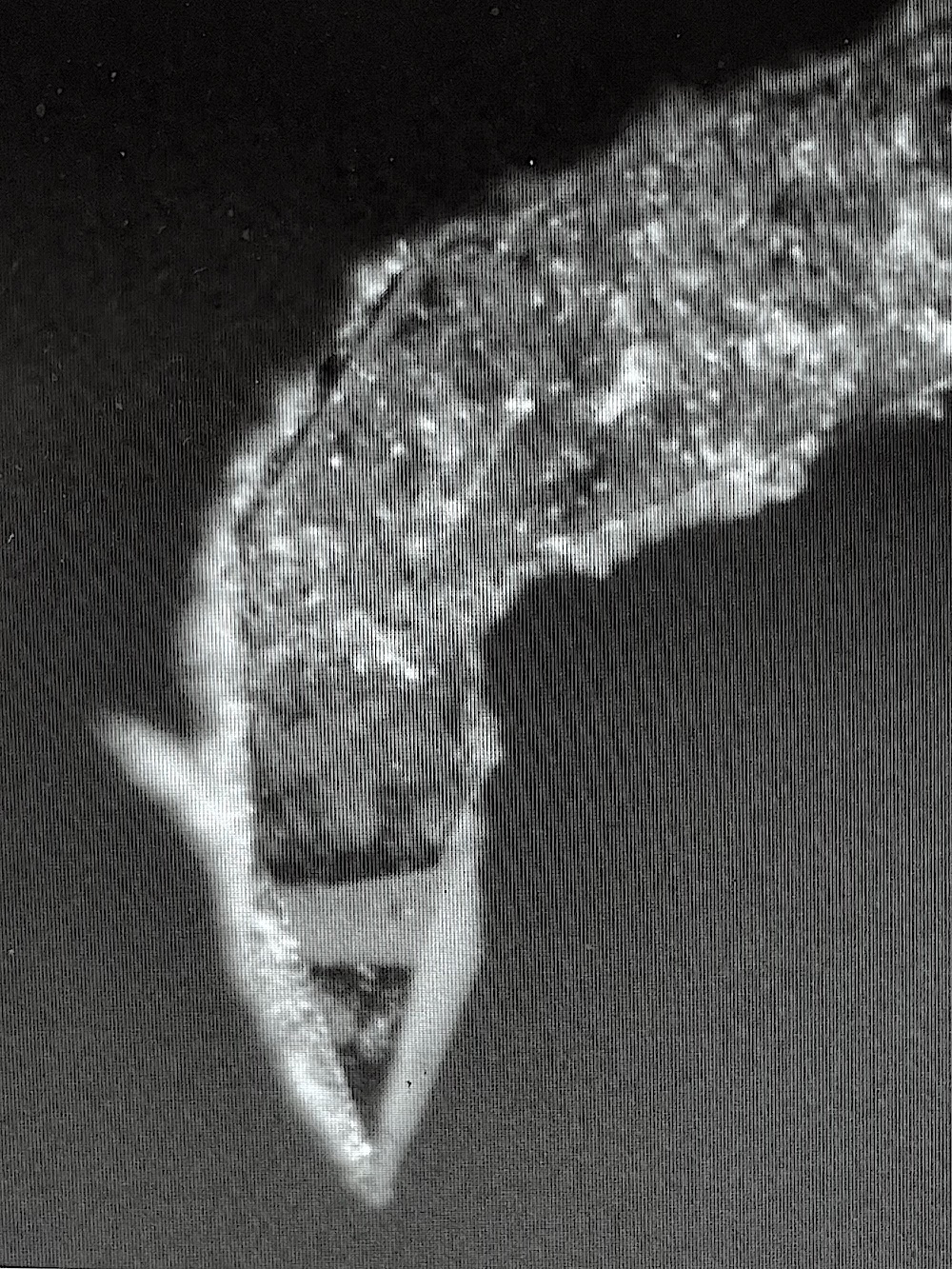
MC2022 stylus close up
Review pattern stylus, WallyScope picture

The physique can be similar to the ART 20’s (titanium and aluminum with an elastomer undercover), although with a better gleaming gold “bling” issue enhanced with black cartridge physique accents Audio-Technica says are impressed by conventional shippo enameling (Japanese cloisonné). It’s introduced in a deluxe wood enclosure.

Audio-Technica AT-MC2022But the true keys to the MC2022’s sonic efficiency are the cantilever materials itself and particularly the decrease tip mass produced by there being no stylus/cantilever joint requiring bonding or an insertion mechanism or mounting plate, and naturally this design can’t be bested by way of junction rigidity, as a result of there isn’t one. However, as you possibly can see within the microscope picture, the diamond makes a 90 diploma flip effectively above the precise stylus, in order that does add tip mass. Clearly the general advantages of this design conceptually outweigh that one minor unfavorable and although I can’t weigh it, I’d guess the tip mass right here remains to be equal to or decrease than on most if not all bonded and/or bonded and plate mounted styli.

Anyone studying this who’s changed the Ortofon 2M Red’s bonded stylus with the Blue’s far decrease mass nude stylus and heard the startling distinction that substitution produces in a $99 cartridge will want no convincing in regards to the sonic enchancment a one piece cantilever/stylus would possibly produce in a state-of-the-art design.

The first diamond cantilever cartridge I heard was the Transfiguration Proteus D from Immutable Music (when firm founder and cartridge designer Seiji Yoshioka, handed away, his household selected to nearer the enterprise, reasonably than promote it). I’d been effectively acquainted with the boron cantilevered Proteus, which was lots quick and “explosive” however I used to be unprepared for the main distinction between it and the Proteus D. The “D” model sounded altogether like a special cartridge, although the one distinction was the cantilever. The sound wasn’t “medical” or “skinny” however reasonably “quick” and “full bodied” with a really feel of a direct path between stylus and electrical sign propagation. Not for many who like issues “laid again”, or as Ken Redmond colorfully describes it: “mixing board” versus “viewers” perspective.

Audio-Technica takes the diamond cantilever to the following degree by laser chopping the stylus from the lab grown diamond’s tip. No glue, no fastening plate, nothing. Another good thing about this design is that until the laser operation goes awry (not going and even doable) there shall be no stylus rake angle or zenith angle “off spec” errors. As J.R. Boisclair’s analysis factors out, zenith angle error, even on expensive cartridges utilizing conventional development methodologies may be as excessive as 10± levels from line contact perpendicularity with the cantilever. Manufacturer accepted tolerances are as excessive as 5 levels. The unfavorable monitoring and sonic penalties, whereas minimized by some out of ignorance and/or vanity, are appreciable as Mr. Boisclair demonstrates within the Florida Expo video just lately revealed on the TrackingAngle YouTube channel.


Set Up

I first put in the cartridge on the OMA K3’s Schröder 12” arm, which has an efficient size of 280mm. To set SRA I used the WallyScope (proven right here throughout a DS Audio optical cartridge arrange for an upcoming assessment). Predictably, SRA was near 92 levels with the arm set parallel to the document. Oscilloscope measurements duplicated A-T’s separation and channel steadiness specs: 30dB@1kHz separation and .5dB channel steadiness. Often the precise separation measurements are larger than what the oscilloscope measures. The channel steadiness numbers are extra vital. The .5 L-R/R-L signifies near good azimuth setting as effectively.

WallyScope

The largest arrange concern was brought on by the stylus tip’s location tucked effectively behind the cartridge entrance and never really easy to see. The upside is it’s troublesome to by chance “bonk” and destroy.

While the beneficiant .55mV output and comparatively excessive 12 ohm coil impedance (in comparison with a few of at the moment’s tremendous low output/ultra-low inner impedance cartridges) would possibly make the MC2022 a lower than superb candidate for a transimpedance current-based phono preamplifier, I ran it into the CH Precision’s current-based enter, setting the acquire to +10dB in addition to into its MM/MC voltage acquire enter utilizing a Ypsilon MC-10L step up transformer that’s superb for a .55mV output cartridge. The load seen by the cartridge is 500 ohms. Audio-Technica recommends better than 100 ohms. I loaded down the secondary to get it to round 200 ohms however didn’t hear a big distinction. The outcomes have been equally good, although considerably totally different sounding run both approach. However, the variations aren’t price going into.

I set VTF on the really useful 1.8g and as soon as the cartridge had a while on it, I used the Ortofon take a look at document and located the MC2022 to be an impressive monitoring cartridge able to negotiating cleanly all however the 100µm lateral peak band and even on that one it tracked with only a slight buzz on one channel which may have been fixable with a minor anti-skating tweak nevertheless it was so in any other case effectively dialed in I left it as is. Some MCs simply slide off the document on that monitor—not that precise music is ever lower at that degree.

Listening

Let’s begin with the smallest image earlier than moving into the massive image and earlier than moving into the audiophile guidelines weeds. When you decrease the stylus down on the document and listen to that first “pop” impulse it may possibly typically write the complete assessment—or at the very least a big a part of it. if it’s a loud, long-lasting mid bass unfocused “blob” you possibly can often make sure the cartridge can have a heat mid bass signature that shall be heard on each document you play. The greatest cartridges land on the document like the perfect Olympic divers hit the water: there’s hardly a break within the water, virtually no sound and the diver disappears. When the MC2022 lands on the document there’s hardly a sound and what sound there’s, is a ‘pip’ not a “POP”. No sonic splash.

Not surprisingly then this cartridge, as solely a only a few in my expertise have managed, sounds nearly prefer it’s not there. In my world that’s the purpose. I don’t need to hear any character, which isn’t the identical as saying it “lacks soul” or is in need of “musicality” or another timbral, textural or transient high quality that’s an identifiably attribute given a optimistic euphemistic spin.

Some cartridges are meant to impart a selected pleasing character and that’s superb too if that’s what you want or if such a high quality enhances your system’s sound and also you’re trying to take it there. Other cartridges have a “pinch” of one thing expertly utilized —just like the wood bodied Analog Relax 1000 I reviewed a couple of years in the past, and that’s superb too. That’s a spectacular instance of the cartridge constructing artwork and the additive high quality so refined it just about disappears, although you’d hear it’s absence.

The authentic green-bodied Lyra Atlas undoubtedly delivered unprecedented element, at the very least in my expertise, primarily based upon appreciable effort at eliminating resonances, nevertheless it additionally had a medical, sharp edge. The Atlas Lambda restored misplaced textures with out shedding element and the mixed recipe produced an identical “not there” high quality, although as a reviewer, speaking the advance required writing in regards to the textures being “added”. That main sonic change was largely achieved with a brand new damping elastomer.

The consequence there and right here is that the much less identifiable the cartridge’s character is, the extra more true is the musical info that you just expertise, and the extra of it there’s to listen to. Of course, there are methods to explain what listening to music with the MC2022 is like. So right here goes.

The cartridge produces explosive, large-scale dynamics, and ultra-detailed micro-dynamics with exact in-between gradations—the type that produces a “reside” sensation on well-recorded music. That high quality is straight away obvious, and was the primary time I heard the cartridge reside at an audio present. The MC2022 excels at element decision, three-dimensional imaging, picture solidity, exact, quick assault, beneficiant maintain and long-tailed decay into black. All the diamond cantilevered cartridges I’ve heard exude this high quality to at least one diploma or one other together with transient precision minus a man-made “edge”, and an general effervescent, non-mechanical presentation that was additionally instantly apparent the primary time I heard that Proteus D. The MC2022’s one-piece diamond cantilever-stylus elevates all of this to a different degree of velocity whereas sustaining full-bodied supply.

The music’s scale didn’t have an effect on the cartridge’s dynamic efficiency. I’ve beforehand referenced the Mark Levinson 45rpm recording Elliot Fisk, Guitar (Mark Levinson, MAL 6). Fisk’s management over the musical dynamics is as exact as his finger work. The cartridge’s response to the recording’s low degree dynamic ebb and move was easy because it reported minute degree shifts that absolutely communicated the artist’s intentions. The supply of delicate transient textures was equally easy, serving to to create the feeling of a performer enjoying within the room between the audio system—sure I do know, you’ve learn that earlier than, and I’ve written it earlier than so let’s simply say this cartridge’s responsiveness produced an much more intense sensation of that. The guitar’s physique was additionally introduced cleanly and freed from the annoying element robbing additive “heat” lesser cartridges impart, but the instrument’s physique was clearly current. The consequence was a “tactile” expertise of fingers on strings; midrange textural magnificence with out additive sludge. Precision with out decapitated physique and largely a simple, non-mechanical presentation. Of course, that Mark Levinson recording can be phenomenal.

To take a look at the cartridge’s presentation on the different finish of the dynamic path, I performed John Williams’ “Liberty Fanfare” from Winds of War and Peace first launched in 1988 on Wilson Audiophile Recordings at 33 1/3 and extra just lately as a double 45 by Analogue Productions (APC-8823-45). The National Symphonic Winds consists of largely winds plus some brass and percussion. There’s not an excessive amount of bass coming from this ensemble apart from from the lone bassist and the enormous bass drum “thwacked” by what conductor Lowell Graham describes as “The Mallet of Death”. When that “thwack” first hit, the room shook with as deep and as tight a “thwack” as I’ve ever heard from the recording, adopted by a remarkably clear, long-lasting decay into silence. Residual groove noise was nearly non-existent, even on the well-played authentic. The MC2022 is as quiet a tracker as I’ve heard and presumably the quietest (apart from from optical cartridges that don’t “learn” deflections brought on by filth or bodily defects).

The observe up “thwacks” have been equally spectacular and never marred by additive mid-bass colorations some cartridges produce that soften the preliminary transient and muddy the maintain. The backside finish is all there and the way. If there’s no bass on a document, you’ll not hear any. That would possibly disappoint on some records with anemic bass (many rock records from the ‘60s and ‘70s) which may sound higher performed again utilizing a cartridge with additive resonance produced “heat”, however I’d reasonably have accuracy that interprets as deeper, tighter, extra acceptable bass minus additive “overhang” that additionally delivers textures and quick settling time. The MC2022 does all of that.

Resonant excesses eliminated virtually all the time reveals better midrange element, significantly on male vocals and piano—but in addition on feminine vocals that then tackle a freer, much less “chesty” sound. It takes some getting used to. I used to benefit from the room shaking “bass” on the U.Okay. urgent of Small Faces’ Ogden’s Nut Gone Flake (there’s none on the American authentic), significantly on “Lazy Sunday Afternoon” and on “Changes Circles Spinning” on Moby Grape’s ignored minor gem Truly Fine Citzen. The bass that shook the room on sure notes on each records was clearly produced by a resonance that swamped every little thing else. It was enjoyable—loads of enjoyable—however with the underside higher “tucked in”, satisfying particulars emerged on each records particularly from the vocals simply above the sonic “increase” (the MC2022 isn’t the one cartridge to enhance the sound of those records in {that a} regard, nevertheless it appeared to do it most successfully).

The MC2022 can be free from decrease mid-range resonances, which helps ship superb copy of male vocals and piano. Last night time I made a decision to play what I wished reasonably than what a assessment known as for and was I in for a shock. I performed the EMI Centennial version of “Hunky Dory”. I’ve performed that version and others for greater than fifty years! This was “Bowie within the room”. But not simply him. The dynamic presentation of the piano on Biff Rose’s “Fill Your Heart” startled me. I used to be not simply listening to a piano, I used to be listening to an individual enjoying it, bearing down on the keys in locations, shedding in others with a readability of objective I can’t recall ever earlier than listening to. All of those dynamic shifts, some refined however many actual “bangers”, have been new. The readability of the assault was additionally notable. The lead electrical guitar on the V.U. impressed “Queen Bitch” has by no means sounded so coherent and “spherical”. My psychological notes on simply this document may take up pages so I’ll cease.

Image measurement precision was one other indication of this cartridge’s distinctive efficiency. I performed only for enjoyable an authentic urgent of Otis Redding Live In Europe (Volt S-416). There hasn’t but been an excellent reissue. Despite being a lower than superb recording general it has some wonderful qualities together with “you’re there” transparency, although you’re “there” seemingly within the balcony with a top quality transportable recorder and the individuals sitting subsequent to you’re clapping actually loudly!

But Otis, approach down there sounds reside as a tiny spec of excessive vitality greatness. Until I heard Frank Sinatra sing “Try A Little Tenderness” I believed it had been written for Otis. It ends the present and as a reside live performance second it’s one of the crucial thrilling ever recorded. Otis goes loopy, the viewers much more so. This cartridge’s pinpoint picture of Otis was thoughts blowingly exact and with the correct distant perspective—and I’ve been enjoying this document since 1967—and his respiration and gesticulating by no means so effectively expressed. Last night time was a kind of “it’s two within the morning I’d higher cease and fall asleep” nights.

I may go on for paragraphs about how Small Faces, Small Faces, Small Faces (IMSP 008) sounded —one of many best rock records ever so far as I’m involved (I believe engineered by Glyn Johns) and one with parts of American soul, r&b, arduous rock, psychedelia, British “seaside”, baroque-pop ala “Lady Jane”, and many others.— and the way the sound so shocked me, however I’ll maintain it to some and describe it in order that even in the event you’ve by no means heard the document, you’ll get what I’m speaking about. The opener “(Tell Me) Have You Ever Seen Me” has about essentially the most anemic bass line I’ve ever heard on a document. It won’t even be a bass, nevertheless it often swamps the sound and overlays every little thing else. This play it stayed in an assigned house and truly stored time. It doesn’t usually try this. Ronnie Lane subsequent sings “Something I Want to Tell You” together with his lips nearly touching the microphone. It’s a very dry recording. He’s there within the room on the suitable channel. I’ve by no means heard it sounding so actual. I virtually felt like wiping off the speaker.


Small Faces, Small Faces, Small Faces (IMSP008)

The subsequent music “Feeling Lonely” has tambourine on the left channel however proper there within the heart hovering in house is a few form of temple bell as clear as a, effectively bell, that I’ve simply not heard earlier than at the very least not so clearly outlined and spherical. Finally let me inform you in regards to the raucous ending to the music “Tin Soldier” (not on the album however included on a effectively finished Castle Records reissue of the album). It jogged my memory of how Otis’s model of “Try A Little Tenderness” ended and searching on the late 1967 recording date, and given Steve Marriott’s love of r&b it’s fairly doable he was impressed by it (one other trace is that Marriott produces his share of “gottas” on the album!).

Here’s the ultimate monitor on the album performed incessantly since 1967!

One extra instance of this cartridge’s timbral and transient “rightness”. There’s an album known as The Video All-Stars play TV JAZZ THEMES (SF-8800) on Somerset Records. Yes, residence of the 101 Strings The tunes, are, sure, TV themes like “77 Sunset Strip”, “Peter Gunn” and many others.. I noticed this one within the $1 discount bin and notices the “audio combine” credit score went to Bill Putnam! So I grabbed it after which seen the gamers: Paul Horn, Gus Bivona, Red Mitchell, Frank Rosolino, and many others.—nice studio cats. The sound on this document is early stereo insane however often the frequency extremes are extreme: bass too heavy, high finish era-searing. The AT MC2022 tames each ends a appropriately delivers the center.

Before retiring final night, I performed a couple of sides of the sonically and musically astonishing British Decca manufacturing of Porgy and Bess with Lorin Maazel and the Cleveland Orchestra & Chorus (Decca SET 609-11) recorded in 1975 with leads Willard White and Leona Mitchell. It’s among the many greatest sounding recordings I personal and never too expensive on Discogs in both this or the identical London version OSA 13116). I all the time thought Kenneth Wilkinson engineered it and why not, it sounds ok to have been, however there aren’t any engineering credit so I don’t know who did, nor do I do know why I believed he’d engineered it).

The vocals, whether or not male or feminine, solo or massed refrain as reproduced by this cartridge have been as easy, pure and sensible sounding as I’ve ever heard them and you can also make a test listing of what meaning and I’d test off the entire listing in the event you introduced it to me. And they have been exactly sized on the stage. Even although the vocals are bathed in reverb, the voices stay clarified, and three-dimensional on the stage. Any lingering ideas in regards to the low bass efficiency could be disbursed with on the finish of aspect two’s single tympani thwack.

Last night time was a kind of evenings of listening pleasure, discovery and awe produced in nice half by the really exceptional Audio Technica AT-MC2022. The remainder of the system didn’t harm the expertise however I’d grown accustomed to most of it. This was a particular night.

Conclusion

With the AT-MC2022, if you would like “string sheen” it had higher be on the document. If you need deep bass or midbass heat from any instrument or voice it had higher be on the document. The cartridge is not going to produce it. If the document has cleanly outlined transients you’ll hear them reproduced with distinctive, unforced readability, freed from synthetic edge.

I personal many fantastic cartridges and there’ll quickly be a video exhibiting most of them. The Audio-Technica AT-MC2022 is true there on the very high together with only some others (although I’m positive there are others I’ve by no means heard): the Lyra Atlas Lambda SL, the Ortofon MC Diamond and the X-quisite ST. The X-quisite shares “one pieceness” with the AT-MC2022 in that it includes a distinctive one-piece ceramic cantilever coil former. The diamond stylus is inserted and bonded. Both these cartridges produce distinctive transient precision, velocity, and readability. I’m sure you’d acknowledge these qualities with out figuring out what you have been listening to, and also you’d hear in them distinctive and fascinating efficiency traits. The different two are additionally high performers for different causes.

The AT-MC2022 cartridge delivers, in my expertise, unprecedented transparency, timbral honesty, midband “palpability”, transient velocity and readability and a “wide-openness” I’ve not heard elsewhere. You undoubtedly pay lots for lots of “nothing” and “nothing” is what I would like from a phono cartridge, as a result of a phono cartridge that provides nothing provides you every little thing. You might produce other concepts. It’s not a cartridge you’d purchase to make use of to “tune” your system in some way. It received’t try this.

To get essentially the most from the AT-MC2022 solely the best, most inflexible tonearms and highest performing turntables needs to be used. The cartridge on the OMA K3 was spectacular because it was on an upcoming reviewed turntable fitted with the Kuzma Safir 9. It was not fairly nearly as good on the provided arm with that ‘desk however that’s one other story. If you’ve received $9000 for a cartridge, you’ve most certainly already received an arm and ‘desk as much as the job.

The AT-MC2022 is supposedly a limited-edition mannequin. To quote Acoustic Sounds Chad Kassem about distinctive and restricted document shopping for alternatives: “Buy now, or cry later”.

Specifications

Cartridge & Stylus

Frequency Response – 20 to 50,000 Hz

Channel Separation – 30 dB (1 okHz)

Vertical Tracking Angle – 20°

Vertical Tracking Force – 1.6 to 2.0 g (1.8 g customary)

Stylus Construction – Unified line contact (built-in cantilever kind)

Recommended Load Impedance – ≥ 100 ohms (when head amplifier related)

Coil Impedance – 12 ohms (1 okHz)

DC Resistance – 12 ohms

Coil Inductance – 25 μH (1 okHz)

Output Voltage – 0.55 mV (1 okHz, 5 cm/sec.)

Output Channel Balance – 0.5 dB (1 okHz)

Cantilever – 0.22 mm (0.0087″) sq. diamond

Static Compliance – 21 × 10-6 cm/dyne

Dynamic Compliance – 15 × 10-6 cm/dyne (100 Hz)

Cartridge Weight – 9.5 g (0.34 oz)

Dimensions – 17.3 mm (0.68”) × 17.7 mm (0.70”) × 26.7 mm (1.1”) (H × W × D)

Accessories Included – Non-magnetic screwdriver, Brush, Washer × 2 , Cartridge set up screws (M2.6) (5.0 mm (0.20”) × 2, 8.0 mm (0.31”) × 2, 10.0 mm (0.39”) × 2, 12.0 mm (0.47”) × 2), Protector, Case (wood field), Accessory pouch

Threaded Hole – M2.6 × 2

Stylus Curvature Radius – 2.2 × 0.12 mil

Manufacturer Information

Audio-Technica AT-MC2022 Product Page

The publish Audio-Technica Celebrates 60 With the Explosive Sounding AT-MC2022 appeared first on The Absolute Sound.

Hana Umami Blue Introduction

The following is a press launch issued by HANA.

March 2023 – The HANA-Umami Blue high-end transferring coil cartridge from Excel Sound’s Master cartridge designer Maseo Okada-san makes use of particular supplies, traditional Japanese methods, and fashionable audio engineering.

The HANA-Umami Blue cartridge follows within the Hana “Brilliant and Gorgeous” custom of offering the listener with elegant enjoyment. Embodying the true sense of synergy, the HANA-Umami Blue combines the important substances of the HANA-Umami Red with the ALNICO primarily based generator of the HANA ML.

The HANA-Umami Blue incorporates the Auricle™ physique design, distinctive and unique to our Umami sequence. CNC machined from Duraluminum, it makes use of a particular Melamine Thermosetting Process (MTP), enameling the physique with an excellent blue shiny end. Sharing different key Umami Red substances, together with the precision-cut Microline diamond stylus, Boron cantilever, and high-purity copper wires, the Umami Blue synergizes these specialised components with the ALNICO magnet-based generator used within the Hana ML.

Hana Umami Blue MC phono cartridge $2,500

  • “Auricle” open-air physique design machined from Duraluminum A7075
  • MTP enameled end with POM inlay
  • Microline stylus with Boron cantilever
  • ALNICO (aluminum / nickel / copper) magnet
  • Cross-coil core with excessive purity copper coils
  • 8Ω Coil impedance with .4mV output
  • Cryogenic therapy of key generator components and output pins

The put up Hana Umami Blue Introduction appeared first on The Absolute Sound.

2022 Golden Ear: Denon DL-103, DL-103R, and DLA220GS Phono Cartridges

Denon DL-103, DL-103R, and DLA220GS Phono Cartridges

$349, $499, $599

These are three completely different variations of the identical pickup. The DL-103 enjoys an extended life with out modification than every other phono cartridge within the historical past of audio, whereas additionally being probably the most beloved audio merchandise ever made. The base mannequin DL-103 is strictly the identical pickup, manufactured precisely the identical manner (by hand) since its introduction in 1962. Five paramount virtues account for its endurance: a pure, supremely musical tonal profile; the power to make recordings come dynamically, vibrantly, intoxicatingly alive; physique, dimensionality, and solidity leading to excellent decision of the sometimes-conflicting calls for of soundstaging and imaging; an impression of connectedness leading to a gripping sense of stream and drive; and a sample-to sample-consistency and reliability that needs to be the envy of the business. These pickups at the moment are amongst my high references. Only snobs will fret over the cut price pricing, whereas the remainder of us are rewarded with the peerless satisfaction supplied discriminating music lovers by this magnificent design for over six many years now.

The put up 2022 Golden Ear: Denon DL-103, DL-103R, and DLA220GS Phono Cartridges appeared first on The Absolute Sound.

2022 Golden Ear: Denon DL-103, DL-103R, and DLA220GS Phono Cartridges

Denon DL-103, DL-103R, and DLA220GS Phono Cartridges

$349, $499, $599

These are three completely different variations of the identical pickup. The DL-103 enjoys an extended life with out modification than every other phono cartridge within the historical past of audio, whereas additionally being one of the vital beloved audio merchandise ever made. The base mannequin DL-103 is precisely the identical pickup, manufactured precisely the identical approach (by hand) since its introduction in 1962. Five paramount virtues account for its endurance: a pure, supremely musical tonal profile; the power to make recordings come dynamically, vibrantly, intoxicatingly alive; physique, dimensionality, and solidity leading to excellent decision of the sometimes-conflicting calls for of soundstaging and imaging; an impression of connectedness leading to a gripping sense of move and drive; and a sample-to sample-consistency and reliability that ought to be the envy of the trade. These pickups at the moment are amongst my prime references. Only snobs will fret over the discount pricing, whereas the remainder of us are rewarded with the peerless satisfaction offered discriminating music lovers by this magnificent design for over six many years now.

The submit 2022 Golden Ear: Denon DL-103, DL-103R, and DLA220GS Phono Cartridges appeared first on The Absolute Sound.

Koetsu Coralstone

When it involves iconic hi-fi manufacturers, Koetsu is among the many elite. Audio Royalty no much less. The firm, based by Yoshiaki Sugano, produces beautiful transferring coil cartridges which have a near-mythic status for high quality. Coralstone is a good looking instance of Koetsu artisanship.

Coralstone could be very a lot an upper-echelon Koetsu, retailing at £8,498. Despite the hefty price ticket, it’s on no account the costliest mannequin within the Koetsu household. However, it’s undoubtedly among the many most stunning, because of its beautiful gemstone physique.

A look on the printed specs of varied Koetsu cartridges signifies extra similarities than variations between the varied fashions. Coralstone has a cantilever made out of boron, and coils wound from silver-plated copper, with an impedance of 5 Ohms. It weighs 12.5g.

The energy of platinum

The generator makes use of a platinum magnet – an alloy of the cobalt-platinum system, and one of the crucial highly effective everlasting magnet supplies identified. It may be machined, rolled, or drawn with out issue, and lends itself to the creation of magnets with advanced shapes or very small sizes.

The diamond tip is a proprietary fine-line sort designed by Sugano-San and manufactured by Ogura. A basic magnetic circuit is used with a conventional Yoke. Still, on account of the usage of a platinum magnet, the output drops barely to 0.3mV in comparison with 0.4mV for Koetsu’s utilizing neodymium magnets.

The gemstone physique, specifically chosen for its magnificence and pure grain, is carved from strong stone and polished to a gloss end. It seems extra like a bit of jewelry than an audio element! The considerably ‘blocky’ squared-off nature of the physique could be very a lot Koetsu’s signature form…

It’s simply been a decade or extra since I final had a Koetsu cartridge at dwelling. Would the wait be value it? Fortunately, Coralstone didn’t disappoint. Its sonic presentation was outstandingly cohesive and really detailed, but noticeably extra impartial and natural-sounding than anticipated.

I now search truthfulness and neutrality from vinyl replay. I need to really feel I’m listening to the unique grasp tape, slightly than a flawed piece of vinyl with a number of faux character added. The sound needs to be clear and detailed, with no background noise so far as attainable. Not a lot to ask for!

I fitted the Coralstone to an Origin Live Resolution turntable with an Illustrious arm and set the monitoring weight to the recommended higher restrict of 2g. Early impressions had been of a really pure open tonality that sounded clear, unobtrusively detailed, and deceptively unexaggerated.

Jumpin’ with a Shuffle

One of the primary LPs I performed was Jumpin with a Shuffle by the Jonah Jones Quartet on Capitol – a wonderful French-pressed reissue of the unique 1960 USA LP. In some methods, Capitol’s Full Dimensional Stereo recording seems not that formidable when it comes to vary – the sound is barely contained. Or is it?

I used to suppose this LP was not more than common however performed on an acceptable turntable/arm/cartridge, the recording opens out. The crisp breathy tones of Jonah Jones’ muted trumpet solos minimize like a sizzling knife via butter. And Jones’ crooning vocals are clean, but centered and current.

Coralstone reproduced this LP with unexaggerated naturalness, whereas on the similar time bringing out contrasts I hadn’t realised had been there. For instance, the trumpet solos had been immediately exhibiting rather more vital presence and projection than traditional.

Playing the Contemporary Records album West Side Story with Andre Previn and his Pals – the Mo-Fi urgent – the sound was crisp and really detailed. The slicing degree on this LP is a tad on the low facet, so pickup is required to tease out all of the element – which the Coralstone most assuredly did.

Using a Pro-Ject Phono-Box RS2 as my phono stage, I set the achieve to most and selected a capacitance of 200pf and a loading resistance of 600 Ohms. These settings weren’t ultra-critical however appeared to ship a wonderful general outcome.

In explicit, Red Mitchell’s bass line appeared barely cleaner and firmer at 200pf in comparison with greater capacitance values, whereas Previn’s piano sparkled and sang. As ever, in one other system, with a special tonal steadiness, another set of values is likely to be most well-liked.

Power and depth

Turning to the album Bass Desires by Marc Johnson on ECM, I used to be impressed by the sheer weight and heft of copy – the facility and depth of the decrease frequencies. The sound was strong and cohesive, unobtrusively detailed and wealthy.

Mine’s simply a regular ECM German urgent on regular vinyl, however – based mostly on what I used to be listening to – the LP nearly seemed like an audiophile remaster at 45rpm on 180g vinyl – it was that punchy. The backside finish was very centered and highly effective, and the sound had spectacular depth and vary.

In addition, the general copy sounded completely easy and superbly clear. Even within the louder extra densely-layered passages, the sound by no means grew congested. There was no battle or pressure. The music ‘occurred’ between the loudspeakers.

The floor noise was very low. Sugano-san Ogura stylus tip design all the time appeared to search out the quiet a part of the groove. On LPs that did have some floor noise – say, a steady background rustle of soppy ticks and pops – the noise subjectively appeared in a special airplane to the music.

It’s tough to clarify this in so many phrases, however by some means the noise was separate from the music. This meant you might extra simply filter it out and focus on voices and devices. Where low-level background noise was current, it was typically very muted.

Heat Damage

I’ve a number of LPs which have suffered long-term warmth injury inflicting the floor to grow to be mottled and uninteresting. This leads to floor noise – normally a muted swish and/or a steady mushy background rustling. Unfortunately, it’s not one thing that cleans off.

It’s attention-grabbing to play these broken LPs with totally different pickups as a result of some emphasise floor noise greater than others. Coralstone was fairly a bit better-than-average at delivering good quiet backgrounds, although some broken LPs remained noisy.

Koetsu Coralstone

Early Koetsu cartridges weren’t famous for glorious monitoring skill and might be susceptible to distortion and breakup throughout highly-modulated passages, particularly in the direction of facet ends. Fortunately, trendy Koetsu cartridges like Coralstone are excellent trackers.

Some months again, whereas rummaging via some containers of outdated LPs in my basement, I came across a pristine copy of Shure’s Era IV trackability check disc. Could Coralstone meet the problem? It most actually might –  and did!

Time for torture

The Era IV LP was designed as a torture check for pickups, with passages of music that includes flute, bells, and harp – both solo or together – at totally different modulation ranges. Aside from the flute and harp check (band one facet two), Coralstone performed each observe with out breakup. Impressive!

On the flute and harp check, there have been just a few transient moments of discomfort from the flute as the extent went from one to 5. Coralstone was okay as much as degree two, however then confirmed slight indicators of breakup at degree three. Another high-quality MC cartridge did a lot the identical factor…

Interestingly, when the solo flute performs the identical music (facet one, band 4), there have been no issues with mistracking. Shure declare that combining harp (quick fast plucked notes) with flute (lengthy steady notes) makes issues a lot more durable for the pickup.

For one other check of monitoring, I sampled a number of totally different recordings of Saint-Saens’ mighty third symphony. The finish of the piece incorporates a full orchestra, pipe organ, and percussion. It makes a scary grandiose noise, and – coming on the finish of the facet – could be a nightmare to trace.

I attempted a number of recordings, together with Barenboim and Karajan (each DG), with the latter (a bright-sounding early digital recording) being extremely demanding. Fortunately, Coralstone was totally unfazed by the onslaught and reproduced the music cleanly proper to the top.

Coralstone delivered glorious stereo separation and produced steady well-defined stereo photos that had been strong and centered. On the Jonah Jones LP, I used to be happy with the best way the piano is situated solidly in area as it might typically be barely ill-defined.

Built to final

Another factor I’ve all the time admired about Koetsu cartridges is their longevity. When you’re spending this kind of dosh on a pickup, you need it to final – you need the sound to maintain its pristine readability and dynamic separation for as a lot of its working life as attainable.

It’s tough to foretell the lifespan of a cartridge. Much is dependent upon how usually you employ it, and in addition on the cleanliness of your LPs. Based on one to 3 hours of use every day, I’d count on Coralstone to ship top-class outcomes for not less than three to 5 years, presumably (most likely) extra.

Nowadays, most hi-fi lovers could have different media like CDs or downloads they hearken to. Vinyl is only one of a number of sources. Speaking personally, I nonetheless hearken to LPs but additionally play CDs/SACDs, digital information, and stream music. There are so many sources and solely so many hours in a day…

Despite different more-convenient sources clamouring for consideration, many people nonetheless prefer to play LPs. For severe vinyl followers, a Koetsu Coralstone delivers exalted ranges of excellence which can be inimitable. Lucky homeowners can look ahead to having fun with superior report copy for a really very long time.

Expect a nice luxurious high quality of sound that transcends the sum of the components. If your ideally suited phono cartridge is one which makes LPs sound like grasp tapes, and you’ve got the money to spare, then the Koetsu Coralstone is a pickup it’s essential to audition.

Technical specs

  • Type Moving Coil Cartridge
  • Magnet materials Platinum
  • Cantilever materials Boron
  • Output 0.3mV
  • Recommended Tracking Force 1.8–2.0g
  • Recommended Load 75–500 ohms
  • Net Weight 12g
  • Price £8,498

Manufacturer

Koetsu

UK Distributor

Absolute Sounds

absolutesounds.com

+44(0)208 971 3909

Back to Reviews

The publish Koetsu Coralstone appeared first on Hi-Fi+.

2022 Golden Ear: Excel Sound Corporation Hana SL Cartridge

Excel Sound Corporation Hana SL Cartridge

$750

Around 5 years in the past, I stated that the Hana SL establishes a baseline of efficiency that any cartridge demanding the next value ought to exceed, with none steps backwards in different areas. This looks like it ought to be a easy matter, however the Hana SL makes it a tall order for some higher-priced cartridges, particularly the half about not stepping backwards. At that point, I additionally reported that the Hana SL had an even-handed response throughout the frequency spectrum, traces the grooves very properly (from low-to-high frequencies), and has a contact of colour that strikes it ever so barely to the nice and cozy facet of impartial. Today, the Hana SL continues to impress in system configurations that embrace higher-cost analog entrance ends. At its value level, it’s nonetheless a standout. This cartridge will permit the proprietor to get pleasure from his vinyl playback system whereas offering an anchor for future upgrades of tonearms, turntables, and phonostages. For a cartridge at any value, the Hana SL holds its personal towards the competitors, after which some. Over the years, it has been a straightforward advice, providing low distortion, excessive coherence, glorious soundstage depth and width, and an uncanny sense of togetherness. It’s nonetheless a keeper.

The submit 2022 Golden Ear: Excel Sound Corporation Hana SL Cartridge appeared first on The Absolute Sound.

Shure V15 Type VxMR Phono Cartridge

The Shure Corporation, founded in 1925 under the moniker “Shure Radio Parts Company,” by Sidney Shure in Chicago, Illinois, is one of the oldest and most successful American audio companies. It originally sold radio parts, then microphones, eventually diversifying into phono cartridges and tonearms, wireless microphones, and mixers, right up to the present day when it manufactures headphones, personal monitor systems, wireless microphone systems, conference systems, and digital signal processors. But for audiophiles of my generation and doubtless a few subsequent ones, the Shure name will always be synonymous with high-fidelity phono pickups, even though the company ceased manufacturing all phono products in the summer of 2018. Reasons given were reduced demand and the difficulty of maintaining quality standards owing to the disappearance of parts that “were not as good as they were at one time.” 

Shure began manufacturing phono pickups in 1933 and soon became an industry leader known for high performance, technological innovation, and great reliability. The 900MG, introduced in 1948, was the first pickup that could play both LPs and 78s. In 1954 the M12 Dynetic Phono Reproducer tonearm/cartridge combination was able to track records at the unprecedentedly low force of one gram. In 1958 there came the M3D, the first stereo moving-magnet pickup, designed in secret with CBS while the latter was developing its first stereo LPs. Shure pioneered the moving magnet, whereby a magnet vibrates within a stationary coil, which became the dominant way to generate a phono signal off a record for almost four decades after the advent of the LP era and continues to be in wide use today, along with moving-coil technology. While I have no hard figures to back this up, I don’t believe I’ll get into trouble suggesting that when I first cut my teeth in high-end audio over 50 years ago, there were more Shures in use in serious consumer audio and audiophile systems than cartridges from any other manufacturer, at least in America during the first two-and-a-half decades of the stereophonic era.

In 1964 Shure introduced the component that made audio history, immediately becoming a reference standard, eventually an icon and a legend: the Shure V15 (so named because the stylus angle replicated that of the cutting stylus). The significance of this product was two-fold: advancing the state of the art in several key areas of performance and in effect serving notice that Shure was going after the audiophile segment of the home-audio market that would settle for nothing less than the best in its pursuit of high fidelity. Shure even coined a word to highlight the most salient aspect of the new model’s performance: trackability—“the ability to maintain contact between the stylus tip and the record groove at all frequencies using a minimum tracking force.”

Over the next 33 years the company introduced seven more versions of the V15, each with significant, sometimes substantial improvements over previous models, covering such areas and items as flatter, more neutral frequency response; lower distortion; stylus, shank, and cantilever sizes, shapes, materials, geometries, and ways of attaching styli to shanks and cantilevers to pole pieces; new approaches for dealing with warps, resonances, and dust; protecting the stylus; and instituting a regiment of quality control procedures that set new standards for reliability, sample-to-sample uniformity, and longevity of phono pickups. It’s hardly a surprise that when fans of Shures get together, discussions are as lively as those from a bunch of LS3/5a groupies.

My own history with its products goes back to the summer of 1969, between graduating college and entering graduate school, when I bought my first serious audio system: Acoustic Research AR 5 speaker, AR integrated amplifier, and AR XA turntable. In those days we had no Absolute Sound or Stereophile, and I suspect readers with long memories will probably recognize these as components that garnered rave reviews in the pages of High Fidelity, HiFi/Stereo Review, and Audio, where measurements ruled and listening was relegated to a few relatively brief remarks at the ends of reviews. I’d have probably bought an AR pickup if the company had made one, but the Shure M91E, one down from the V15, got great reviews, word of mouth being that it came so close to the flagship as to constitute virtually no compromise at all, and the combination was endorsed by AR itself. My references, by the way, to HiFi/Stereo Review, etc. should by no means be taken as a disparagement of that first system of mine, which was by any standard truly excellent, one that brought me years of pleasure and that would have been well reviewed in any of the independent audiophile magazines that came later. (The XA/M91E combination remains one of the finest-tracking setups I’ve ever used, which is quite a number.)

Audiophiles of my generation will also remember that this system was firmly in what was called the “New England” camp, which is to say that frequency response, tonal neutrality, low noise and distortion, and reliability were the fundamental criteria by which the quality of an audio system was evaluated. This was because accuracy was the principal goal. The V15 and its iterations were Shure’s answer to that goal: pickups that would reproduce as faithfully as possible the signals cut into the grooves. It was so successful that despite serious competition by the likes of Stanton, ADC, Audio Technica, AKG, Bang & Olufsen, and others, Shure remained the industry leader, the latest V15 the reference standard, at least to the dawn of the digital era. Several years after I bought that AR XA, I upped my game with a Thorens TD125 II table and an SME 3009 II Improved arm, but I stuck with Shure and bought the V15 Type III, which set a new standard for flat frequency response, neutrality, and, of course, trackability.

To be sure, there were other voices, other technologies, including Grado, which used a moving iron, and Denon and Ortofon, which used moving coils. But mc’s occupied at best a fringe area of the American audiophile scene and were even disparaged—often unfairly because not even auditioned—by the mm crowd for having far from flat frequency response, requiring weighty tracking forces that allegedly damaged records and outputs so low as to need preamplifying devices like transformers and headamps (the latter typically prefaced by the adjective “noisy”).

Beginning in the early seventies, however, many audiophiles, thanks to the appearance of alternative magazines like The Stereophile, The Absolute Sound, and International Audio Review, began to hear the New England sound differently. Was low coloration, which the V15s certainly had in abundance, now maybe just a little “colorless”? Could instrumental tones, timbres, and textures be somewhat more saturated, voices have a little more flesh, blood, and character?  Was all that neutrality perhaps a tad uninvolving, dare we say even a bit dull? Could the overall presentation be a little more transparent, was there more detail to be excavated from those grooves? What about dynamic range—were we wrong to think the window could be opened wider? Did the high compliances that made all those low-tracking forces possible, not to mention the mass of the magnet itself, result in a certain loss of immediacy, of impact, of timing, of speed, vitality, life, and liveliness which the lower compliances and higher tracking forces, not to mention small coils vibrating between stationary magnets, might restore? 

By the time the eighties were in full swing moving coils dominated the pages of virtually all the alternative audio magazines and claimed the lions’ share of their reviewers’ and   readers’ attention. It was axiomatic that any really serious state-of-the-art record-playing setup used an mc, while moving magnets were relegated to entry-level, budget, or “value-driven” systems—not exactly disparaged, mind you, but second-class citizens all the same. It didn’t help that mc’s were typically much more expensive than mm’s. A lively give-and-take involving the V15 among three audio reviewers (including our own Anthony Cordesman and the recently returned Michael Fremer), culled together over a period of many years, that accurately reflects the dominant debate throughout the eighties, nineties, aughts, and beyond, can be found here: stereophile.
com/content/shure-v15-v-mr-phono-cartridge. Two of the reviewers conceded the Shure was awfully good for the money, but in high-end terms that’s a kiss of death: code for the component you settle for when you can’t afford the one you really want.

Ironically, while the high-end sector threw in all but uncritically with mc’s, there was a growing disconnect between it, on the one hand, and, on the other, the professional audio community and the consumer audio market at large. In the latter, that is, the large but somewhat amorphous sector of the home market made up of consumers who, though not high-enders (many not even audiophiles as such), know there is much better equipment to be had than the big-box, mass-market junk, Shures and other popular mm’s continued to sell like crazy, even among the non-high-end sector of the audiophile market.

As for the professional community, the late Doug Sax, for a long time the most highly respected mastering engineer in the world, always preferred mm’s (specifically Stantons) because they reproduced what he was mastering accurately. [Doug Sax once said to me, with tongue in cheek, “I like moving-coil cartridges—in someone else’s system.” —RH] Likewise, the gifted recordist Kavi Alexander of Water Lily records, who preferred a specific Audio Technica mm. When Shure finally discontinued the VxMR, the last remaining 30 were purchased by the Library of Congress (presumably because its superior tracking force at one gram protected valuable LP holdings more reliably than anything else), while Sony snapped several up for disc remastering.

Even some high-end reviewers broke ranks. In 1974 J. Gordon Holt, founder of Stereophile and never exactly a hot admirer of moving coils, pronounced the V15 Type III “one of the two best pickups available, and probably the best for most hi-fi perfectionists” (the other a Decca, which wasn’t an mc). (It was this review that persuaded me to buy the V15-III.) Five years later Holt wrote of the Type IV, “the person who merely (!) wants a cartridge that will reproduce what was originally inscribed on his discs may never again feel the need for a better cartridge than this one” and then related the story of how Stan Ricker, another distinguished mastering engineer, demonstrated to an audio reviewer whose publication had panned the Type IV that it was all but impossible to tell the difference between the mastertape and the record as played with the Shure. My colleague Robert E. Greene favors the same Audio Technica as Alexander, and Neil Gader, so far as I am aware, now mostly uses a Clearaudio mm.

Perhaps even more significant, not to mention massively ironic, after Shure stopped making the VxMR, it continued to be reviewed with great enthusiasm online, while several sites that take exacting and sophisticated measurements found in almost every instance the VxMR superior to any other pickups they’d ever tested. Meanwhile, quite a number of reviewers wrote they were glad they acquired one before it disappeared, including the redoubtable Ken Kessler, more knowledgeable about vintage gear than anyone else I know personally, who in a recent posting placed the Shure V15 first on a list of products he’d like to see resurrected.

To give you an idea of how thoroughly mc’s dominated, not to say indoctrinated, the high end, when I began reviewing equipment for TAS in the late nineties, there was a Shure V15 VxMR circulating among the pool of reviewers, none of whom wanted to review it—the box wasn’t even opened—until it landed at my door, courtesy of Harry Pearson, who suggested I give it a go. And I would have, except that shortly thereafter Shure announced it was discontinued. It seems the ultra-thin beryllium, used to make the shank substantially lower in mass than such commonly used materials as aluminum or boron, was carcinogenic. Actually, the real culprit was beryllium dust, not the rolled sheets from which Shure fashioned the shanks. All the same, the Environmental Protection Agency demanded the installation of a ventilation system so prohibitively expensive that Shure couldn’t begin to make the investment back on future sales. There was little choice but to give it the axe. (Shure had a large enough backlog of VxMR stylus assemblies to have kept selling the pickup for several more years. But to do so would have left consumers who had already invested in a VxMR without a replacement stylus should they need it, which would have gone against the company’s policy of offering replacement styli for five years after any given model was retired.)

That killed any review. As no one else at the magazine wanted the pickup and Shure never asked for it back, I put it in a drawer and promptly forgot about it. Like so many audiophiles of my generation, once I went “high end,” mc’s were all I wanted to hear. But chance, fate, or whatever other force in the universe to which you assign agency over our lives had other plans. Cruising through some websites where vintage gear is sold, I chanced across a new-in-the-box AR XA turntable. I must have been in a nostalgic mood, because I snapped it up without delay, not least because I realized I had the perfect pickup for it: that V15 VxMR languishing those several years in its unopened box. I wasted no time unboxing the AR and installing the Shure.

Sound and Performance

I’m not about to tell you that what I heard was revelatory. In fact, it came as a bit of surprise. Although in a general sense the sound bore a recognizable resemblance to what I remembered from some three decades before, gone was what at the time struck me as the unprecedented neutrality of that SME/V15-III combination, replaced by a distinctly warmer, fuller, and heavier tonal balance from the whole bottom end through the upper bass; outstandingly smooth and non-fatiguing in the midrange and presence regions (Shures are ever thus); but rolled off, even a bit dark up top. Given Shure’s QC, I didn’t think my VxMR was defective (it wasn’t).

More research turned up a statement in Shure’s promotional literature to the effect that the VxMR was “warmer and more musical than ever.” This was the first and only time I can find any company statement for the V15 series where flat frequency response, the lowest possible coloration, and tonal neutrality were not the featured, indeed the insisted-upon claims (along with trackability), and it left me wondering if the company weren’t paying mere obeisance to the audiophile community. So I consulted several reviews, online blogs, and other audiophile sites and found that both the critical and consumer reactions to this last Shure were rather mixed. Almost nobody actually disliked it, but even longtime loyalists missed the high neutrality of the Types III, IV, and early Vs, finding the bottom-end warmth tolerable or better, but far from happy with the apparently rolled off top end.

For myself, though I liked what I was hearing, my experience corroborated the descriptive truth of these assessments. The VxMR’s tonal profile was warm, smooth, mellow, relaxed, natural, even beautiful; but it was nevertheless rarely as detailed, vital, exciting, alive, transparent, or top-end extended as my favorite mc’s. As more and more turntables and arms came my way for review, I started using the xMR—the MR, by the way, stands for the Micro-Ridge stylus shape that mimics the shape of the cutting stylus—in other arms. Soon enough a rather different sonic personality began to emerge. To begin with, putting it in an arm other than the AR’s—at first an SME V, later the gimbal-bearing Jelco supplied with Luxman’s PD151 turntable (see my review in Issue 322), with the lowest-mass headshell I could find (a Rek-O-Kut)—immediately resulted in a more neutral tonal profile much closer to what I remembered from my III.

This was instantly apparent at the bottom end, where a lot of the bogus warmth—warmth not in the recordings—was eliminated, which in turn resulted in considerably more bass detail and definition. Indeed, definition and detail bottom to top was improved, as well as transparency, which began to approach that of mc’s. My conclusion was that the VxMR is not particularly well suited to the arm on the XA. The first two iterations of the V15 could be used successfully there, but my guess is that as compliance rose and body, cantilever, shank, and tip mass were reduced in subsequent models, that arm just wasn’t an optimal match (I suspect the AR’s bearings had too much friction—my experience suggests these later V15s like high-quality, captive, gimbal bearings). I’d also avoid very high-mass arms (e.g., Groovemasters) and stick with medium or lower. Another reason for these improvements is that I was careful to attend to capacitive loading (the phonostage in my McIntosh C53 preamplifier allows for a wide of choice of settings). Shures are not excessively sensitive to this, but you will not get the flattest response of which they are capable unless they see at least 275pF, and higher (up to 400pF) is at least theoretically better.

Then one day, disaster: a rare slip of the finger and the stylus assembly was annihilated. This was near the beginning of the pandemic, so back into the box went the Shure, and that was the end of that. Except not quite—the improved sound I heard in the other arms wouldn’t get out of my head. I knew there were replacement styli for Shure pickups, but I never paid them much mind, on the not entirely unreasonable assumption that no aftermarket part by a third party could ever be as good as the OEMs. Yet more research turned up comments by audiophiles who struck me as serious people, who had done considerable research, who listened very carefully, and who, unlike myself, had undamaged original stylus assemblies to which to compare the aftermarket replacements.

The supplier for these is a Japanese company named Jico, which offer a bewildering number of replacement styli for too many vintage mm’s for me even to count. Rome Castellanes, of LP Gear, was kind enough to lend me the Jico replacement for the xMR—or, rather, a Jico replacement since, in fact, Jico makes a total of six different styli for the xMR. Three of them have SAS styli (a further refinement of the Micro-Ridge from the original) with boron, sapphire, or ruby cantilevers; the other three, much less expensive, offer elliptical, hyper-elliptical, and Shibata styli. I opted for the boron because my experience suggests that, all other things equal, boron always sounds more neutral, less colored.

The sonic difference wrought by the replacement was again immediately apparent: neutrality even further improved, considerably so, but now with a top end in great evidence without being in the least too much so. With the caveat that owing to my ham-fistedness I am unable to conduct a direct comparison between the original stylus assembly and the Jico replacement, I am prepared to agree with those who claim the Jico boron is an improvement over the original (beryllium or no), notably in those areas of overall neutrality and high-frequency extension. But there are improvements in other areas as well. For one thing, there’s a greater impression of life and lifelikeness; I would even add “liveliness” so long as that is not interpreted to mean the excitement of spurious resonances and frequency response anomalies. Along with these go even greater improvements in transparency, clarity, control, and dynamics.

Allow me to put some of this in more specific terms. I’ve taken quite an interest lately in the Connoisseur Society recordings of the great sarodist Ali Akbar Khan. The sarod is an extremely complex instrument to reproduce well, especially when the going gets fast and furious, which it typically does in the second half of many ragas. The VxMR/Jico reproduced everything of his I threw at it with quite amazing precision, control, and clarity yet without ever sounding etched and overly analytical. The same is true for the three guitarists on Impex’s stunning new Saturday Night in San Francisco, one of whom is the stellar virtuoso John McLaughlin. Wow—absolutely no hint of smudging, smearing, or blunting attack, plucking, picking, sliding, and strumming. Following this I played A Handful of Beauty, with McLaughlin joining the Indian violinist Shanker. Again wow. I can imagine any number of setups coming a cropper on this or the Khan recordings, but the Shure kept the pace without breaking a sweat, missing nary step nor beat. Those who can sit through these recordings as played on this arm/table/pickup combination and complain about lack of involvement or actually be uninvolved either have axes to grind or should be examined for ADD; and those who can remain physically unengaged should have their blood pressure or at least their pulse checked.

The VxMR/Jico has imposing bass detail, articulation, control, and definition, as evidenced by the aplomb with which it dispatched Stokowski’s Rhapsodies album or how commandingly it reproduces pianos in all their strength, body, and tone (try the late James Boyk’s powerful recording of Prokofiev’s sixth sonata, or the stylish pianism of William Bolcom in his classic Gershwin recital on Nonesuch, where the piano seems to appear right in front of you between the speakers). As for soundstaging and imaging, in my trusty Bernstein Carmen (DG) the comings and goings of the singers and choral groups across and around the stage were reproduced with masterly verisimilitude.

When it comes to voices, in the absence of a litany of examples, the VxMR/Jico’s midrange is about a dead neutral as I’ve ever heard from a phono pickup and considerably more so than what most can manage. In other words, it is not rich, warm, refulgent, or luscious as such, but the overall tonal neutrality and musical naturalness make you feel as if you’re hearing them back through the recording chain to the venue as they actually are, especially with respect to vocal character and with excellent roundedness and dimensionality.

One of the most beautiful, i.e., truthful, recordings of orchestral strings I’ve ever heard is not from some audiophile label but from DG’s all-analog recording of Beethoven’s Opus 131 performed by Bernstein with the full complement of the Vienna Philharmonic strings: upper strings meltingly, caressingly, exquisitely beautiful, but fierce and forcible when called for in the climactic allegro; cellos and basses rich and warm with very impressive low-end extension, weight, body, and depth of tone. That is just how the VxMR/Jico reproduced them. Then there’s the Vegh recording (Valois) with string quartet as Beethoven originally wrote it—find the right level, close your eyes, and it’s no effort at all to “see” the four players arrayed before you. One thing I really like about this recording, which the VxMR/Jico nails, is that the Vegh’s is a from-the-ground-up sound, not a top-down one, so the cello is solidly present as foundation and humanizing voice. In many recordings of string quartets, the cello is a bit light because the miking is too close to capture the instrument’s fullness as it projects into space). Not here and certainly not as reproduced by these record-playing components.

As for the top end, it continues to strike me as a tad recessed on some recordings or simply non-interventionist (thus more real sounding?) on others. Most of the recordings I use to evaluate atmosphere are excellently reproduced, e.g., Joel Coen’s A Medieval Christmas (Nonesuch), recorded in Boston’s Museum of Fine Arts, where the resonant acoustics provide the appropriate church-like ambience, while the mike placement accords just enough focus and presence on the performers so that nothing is obscured.

It’s when it comes to upper percussion, notably in jazz with its cymbals, high hats, wire brushes, bells, etc., that some doubt arises. I miss some of that nice bite, ring, shimmer, definition, extension, and, yes, detail, not to mention surrounding air, that I get from my favorite mc’s and that I don’t hear to the same degree with the Shure. Are the mc’s exaggerating these effects a bit or is the VxMR/Jico softening them a bit and pushing them down? I don’t know. Since even small jazz venues typically use sound reinforcement with microphones, amplifiers, and PA-type speakers, who knows what these instruments really sound like? Then, of course, none of us was at the recording sessions. As I’m writing this, that still astounding state-of-the-art The Sheffield Drum Record direct-to-disc is playing and it sounds very real, not in the least hyped or oversold but still eye-poppingly present and accounted for. But I know that when I switch to one of my Denon 103s, a vintage Ortofon, or a new Ortofon, I will love even more the soupçon of tactile body, extra presence, and greater lifelikeness on offer from them. Maybe the best counsel is to set aside the debate and rejoice instead in the way each serves the music beautifully in its own way.

To summarize: no, the VxMR/Jico doesn’t exhibit quite the presence, color, tonal saturation, vitality, vividness, detail, transparency, snap and dynamism, and top-end extension of the best mc’s. But neither is it so deficient in those qualities as to undermine enjoyment or overshadow its several compensating virtues, which are mightily compelling in their own right. Among these are a seductively smooth, easy, completely relaxing and involving musical naturalness that, nevertheless, doesn’t sacrifice that much that’s essential in the way of drive, grip, excitement, and the rest of it. All of which is to say that when I press it into service, I do so eagerly and with great pleasure. I also do so regularly, which I am able to do quickly and conveniently now that I’ve given up the insanity of using arms with only fixed headshells. In other words, the Shure V15 VxMR/Jico boron is now one of my references.

Oh, almost forgot: haven’t said a word about tracking. The only serious flaw I find with Analog Spark’s fabulous remastering of the original Broadway West Side Story is the ridiculously overmodulated police whistle that brings the Prologue to its sudden stop. Only one pickup I have in house reproduces that whistle without any mistracking whatsoever: the Shure. My Denon 103 gets pretty close at three times the downward force. Let this example suffice to reaffirm that when it comes to trackability, the V15 after all these decades still reigns supreme. For that reason alone—though as I have tried to show, it’s not alone—it is assured (or should I say, “ashured”?)—a place in the pantheon of phono pickups.

Conclusion

Buying used gear, let alone long-discontinued vintage gear, is always risky, though most people I know who’ve done it, including myself, have had positive experiences. I have a good friend who loves vintage gear, easily has over two dozen phono pickups, almost every one of which he acquired through eBay or other second-hand sources, and plays them on several vintage setups that all sound perfectly, albeit differently marvelous. One nice thing in the Shure’s favor, as is not the case with most vintage pickups, is that thanks to Jico for the foreseeable future you don’t have to worry about stylus replacement. Occasionally people even sell bodies only, which banishes any worries about stylus condition—just add a Jico.

Bear in mind too that replacement styli are available from Jico for every V15 back at least to the Type III. I’m keeping my eye out for a Type IV, the one Holt raved about, as that’s the first model to sport the Dynamic Stabilizer (see sidebar) and also the one many V15 fans judge the most echt neutral. Prices? As I write this, three brand new VxMRs in factory-sealed boxes are listed for $888–$1099; typical prices for used ones in good or better condition range from $450–$700; and right now there’s a body only going for around $230. (These prices often exceed those of many past mc’s that got better reviews in the specialist magazines—make of that what you will.)

So, let’s say you buy that factory-sealed one for $900. What does this get you in today’s market? Well, there are a lot of really good current mm’s and mc’s, both high and low output, clustered at that price point, without even mentioning the Denon 103 still in production for $350, which’ll come close to the Shure for tonal neutrality and is certainly livelier and more dynamic, even if it doesn’t track quite as well. Comes to that, though, it tracks well enough, and mc’s in general have a come a long, long way in this respect since the sixties. And there are dozens and more preamps, integrated amps, and phonostages at reasonable prices that are lower in noise than those of decades past, so step-up noise isn’t much of an issue any longer. Why buy this old thing?

Perhaps better to answer the question in a different way. All things considered, I know of no other phono pickup, mc or mm, that offers quite the combination of features, completely non-fatiguing beautiful sound in the way tonal neutrality often guarantees, yet that is also engaging and involving and that tracks flawlessly. What’s more, there’s the cache of having an important piece of audio history that is far from irrelevant or left at the post in today’s world. I’m glad I have one and wouldn’t be without it.

Specs & Pricing

Jico SAS/B stylus
Price: $282

LP Gear
Henderson, NV 89052
lpgear.com
[email protected]

The post Shure V15 Type VxMR Phono Cartridge appeared first on The Absolute Sound.

2022 Golden Ear: DS Audio DS 003 Optical Phono Cartridge

DS Audio DS 003 Optical Phono Cartridge

$2500 ($6000 with matching equalizer)

After setting new standards of fidelity in the ultra-high end with his POY-winning $15,000 Grand Master optical cartridge (and $45k, two-box Grand Master equalizer), DS Audio’s ingenious Tetsuaki “Aki” Aoyagi has turned his attention to the rest of us.  The $2500 DS 003 ($6k with its matching DS 003 equalizer) is a “trickle-down” masterpiece. Using many of the technical innovations first found in the Grand Master (such as a dual-mono optical generator with independent LEDs and photo detectors for each channel and a beryllium “shading plate,” which reduces moving mass to 1/10th that of a typical moving-coil cartridge), the “third-generation” 003 sounds almost exactly like a slightly less finely detailed, slightly less spacious Grand Master. Every bit as standard-settingly quiet, explosively dynamic, and robustly rich in color as its big brother, the DS 003 makes opting (or optical’ing) for a new-tech oc a lot easier (and a lot less of a trade-off) than it once was. With channel separation measurably approaching 33dB in the midrange and tracking that is as smooth and glitch-free as that of the far pricier Grand Master, the DS 003 does not compromise soundstaging and trackability in the ways that earlier-gen, “affordable” DS Audios did. If you’ve longed to sample a top-line oc but haven’t had the moolah to do so, now’s your chance. The DS 003 opens the door—and opens it wide—to a new world of noise-free, tape-like playback, with bass response and treble sweetness and bloom that you could previously only get with reel-to-reel. Another sure-fire nominee for a 2022 TAS Product of the Year Award.

The post 2022 Golden Ear: DS Audio DS 003 Optical Phono Cartridge appeared first on The Absolute Sound.