Tag Archives: floorstanding loudspeakers

KEF Reference 5 Meta

I should know by now but like a few other things the meaning of the KEF acronym eluded me. So I looked it up; it’s not Kids Earth Fund nor is it Knights of the Eternal Flame (which is a pity perhaps), but Kent Engineering & Foundry. KEF is a loudspeaker company founded way back in 1961 in a Nissen hut in Tovil, Maidstone, that’s the bit that I can remember. I’m not sure if they still have the hut, but Tovil is where KEF makes its best loudspeakers including the Blade and Reference ranges, of which the shiny Reference 5

Meta is the top dog.

The Reference range has recently been revised and given the ‘Meta’ suffix to indicate a new way of treating energy coming off the back of the tweeter in the middle of the Uni-Q treble/midrange driver at the heart of these loudspeakers. Unlike other companies that have used tapered tubes and damped cavities to prevent the air behind the driver from bouncing back and distorting its behaviour KEF has developed a relatively shallow maze of channels to do the job. Taken on its own this MAT (Metamaterial Absorption Technology) looks like one of those toys that you have to tilt around in order to get a small ball down a labyrinthine path. But the length of each of the paths has been carefully chosen to absorb a narrow band of frequencies and when combined the 30 channels offer “almost 100% absorption across the spectrum above 620Hz”. And given that this is a tweeter it doesn’t operate at anywhere near that frequency, in fact it crosses over to the midrange at 2.1kHz.

KEF Reference 5 Meta

MAT was developed for and introduced in KEF’s popular LS50 model so it’s a rare example of technology trickling up the range and indicates that it’s not just a matter of spending more on the bigger speakers, but a ground up upgrade and one that has required other changes to the driver as a whole. For a start, the ‘tangerine’ waveguide that sits over the tweeter dome on the latest Uni-Q has been reinforced because MAT was causing a deformation in the surround support; this has been remedied with reinforcing ribs to the rear of this element.

Small spiders

KEF’s acoustic engineer Jack Oclee-Brown has also made changes to the midrange motor system in an effort to improve linearity. In fact, KEF is describing this as a complete ‘ground up’ design forced to some extent by the internal conical waveguide required for the MAT system. As you can imagine, the combination of two drivers on one axis is already a complex challenge and here it has a split top plate on the magnet system so that flux density does not reduce as the coil moves away from what would usually be the area of maximum flux. Something that equates to maximum control and minimum distortion. The driver suspension, its surround and spider, has also been upgraded. The spider is now smaller and thus lighter making it easier to place its resonant frequency out of the driver’s operational range. Also the surround, which forms part of the tweeter wave guide now has greater and importantly more linear excursion for reduced overall distortion.

KEF has also sought to reduce vibration from the front baffle that muddies the midrange but not by the usual method of putting a compliant ring under the chassis mounting and decoupling the whole driver as is found in a lot of designs. They argue that this method allows the whole driver chassis to move and thus removes the mechanical grounding that the cones need for low distortion operation. Instead KEF has decoupled the magnet assembly, which is the heaviest part of the driver chassis. Apparently the main benefit of this is that the chassis rim stays still and doesn’t radiate any sound itself.
KEF Reference 5 Meta

There is not a lot of detail about the four bass drivers which continue from the previous Reference series. They are 6.5 inch units with an alloy cone and a large aluminium voice coil in a “massive, vented magnet assembly” that is naturally designed to complement the latest iteration of the Uni-Q mid/treble in between.

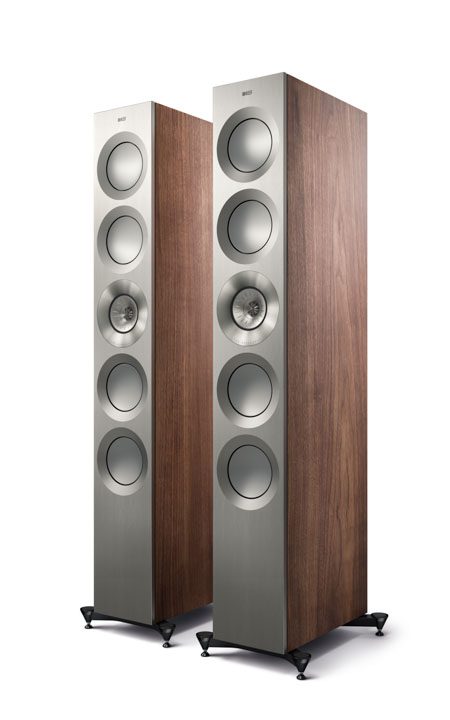
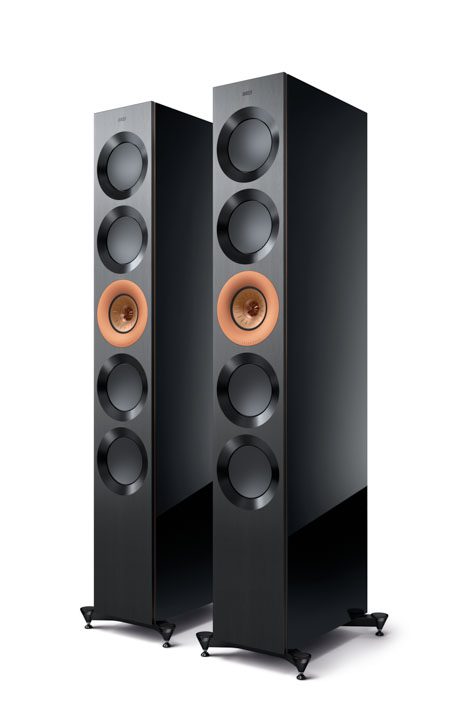
The cabinet is constructed using constrained layer damping for minimum vibration and is distinctly tall and handsome with a slim profile but plenty of depth, it looks very modern in its white livery with silver drivers. KEF offers a number of finish combinations in high gloss paintwork or book matched veneers alongside five driver finish options including copper and blue.

It looks straightforward, but caps on the back cover fixings hold the front baffle in place and explain why there aren’t any trim rings on the bass drivers. There are two ports on the back with removable inserts and the Reference 5 Metas are supplied with four shorter alternative ports. The idea being that in situations where the bass output is too much for a given room or speaker position these can be used to stop the bass from being overblown.

The Reference 5 Meta sits on a pair of outriggers that bolt onto the bottom and provide a wider footprint for stability. The spikes and their seats combine to form a cone shape that’s capped with a lightly domed top, the latter can be removed for easy height adjustment with an Allen key. The terminals look like they come from KEF’s biggest model (the Muon) with asymmetrical aluminium clamps for bi-wired connections to the amplifier. If you only want a single wired connection as I did, KEF have come up with a neat way of linking the bi-wire terminals internally rather than using a plate or jumper wires. Two adjusters screw in for single wiring or can be removed for bi-wired set ups.

All the work that the team in Maidstone has done on the latest Reference 5 Meta pays off almost immediately when you put a good record on the turntable, especially one with some emotional impact. These speakers seem particularly adept at delivering this critical facet of the music, arguably the most critical one given that emotional communication is what music is ultimately all about. I happened to play Ryley Walker’s Golden Sings that have been Sung [Dead Oceans]and the song ‘I Will Ask You Twice’, which sounded rather more heartfelt, deep and meaningful than usual. This is clearly a special loudspeaker, one that breaks down barriers between artist and listener in ways that you don’t often find.

Metaphysical

There sometimes seems to be an inverse law of communication abilities with regard to number of drivers, the more drivers a speaker has the harder it can be for it to get the message through. There are enough ‘technically excellent loudspeakers that leave you cold’ to make one that doesn’t stand out. Whether this is down to the Meta factor is hard to say but reducing midband distortion must help in this regard. These KEFs are not short on detail either, they are extremely revealing in an unhurried yet on the ball fashion. When the bass and drums of Patricia Barber’s version of ‘Yesterdays’ appear in front of your ears it seems almost magical, it’s partly because of the total silence that precedes the first notes but also because of the way that their presence takes up physical space in the room. It’s safe to say that these cabinets are not adding much if any coloration to the mix, especially in the bass which is both very well extended and powerful, more so than I had expected in truth. This is not a huge loudspeaker in terms of physical volume, yet it’s capable of providing the lowest octaves even in a fairly dry room. And this means that double bass and drums have both impact and body that makes for a very satisfying listening experience with a good recording.

I was struck by the image height that these KEFs produce and initially presumed that it’s because they are fairly tall speakers, but then it occurred to me that the mid and treble drivers are no higher than on a bookshelf speaker, and this is the source of much of the detail that goes into producing an image. It’s a result of KEF’s work in improving dispersion from the Uni-Q, but also a factor of better quality bass, subwoofers after all have the effect of creating more convincing imaging. I used the Reference 5 Metas with a Moor Amps Angel 6 power amplifier for much of the time and it had no trouble with their 88dB at four Ohms sensitivity which is to be expected of 150 Watts, what surprised me was that the Melody AN300B Max (also reviewed this month) managed to drive them without much difficulty. It’s hardly surprising that the bass lost some of its gravitas with this 21 Watt triode amplifier but the combination proved to be rather enjoyable, smooth and polished whilst delivering the body in the image. In fact the extra fluency that these tubes brought to the party proved rather enchanting, especially with the harmonies of Crosby, Stills and Nash singing ‘Helplessly Hoping’ at the peak of their vocal powers. It was very easy to hear that two voices shared the right channel while the third got the left, and it was no effort at all to be swept up in the beauty of the song.
KEF Reference 5 Meta

I also indulged in a bit of Massive Attack for contrast and found that there was enough power and control in the bass and impact through the mid to appreciate the darkness that their work explores in a more tuneful and clean fashion. An old blues compilation on vinyl was perhaps the perfect material for the tube powered KEFs, the recordings were probably made with tubes in the first place and the effect was almost like time travel, the years falling away so that despite the absence of stereo there was a palpable sense of musicians in the room.

Back with solid state power and the Weather Station’s mumblings on ‘Marsh’ and other tracks where it’s not clear what is exactly being said but the feelings behind it are transparent in the hands of these KEFs. With an older favourite in Talk Talk’s New Grass where the vocals are quiet but easy to follow and the nuances of the performance are clear thanks to the transparency on offer. These speakers are borderline explicit when it comes to detail resolution, they really drill down into whatever you put through them and deliver the musical treasure that other speakers fail to expose. It gets the micro dynamics, the differences between the volume of notes, spot on and this brings a variety and colour to subtle pieces that often gets lost. It does the macro too of course and I thoroughly enjoyed Led Zeppelin’s ‘Killing Floor’ where they managed to give the bass a thickness that Metallica would have killed for, and  were clearly attempting to emulate on the Black album.

Alternate ports

I didn’t need to use the alternate ports with the Reference 5 Metas because the bass remained clean and controlled with the Angel 6, in fact it sounded deeper and more substantial on some familiar tracks than is often the case. Radiohead’s ‘Desert Island Disk’ for instance usually washes over me in an ambient fashion but here there was a lot of detail at low levels and a substantial kick drum, which made the track more diverse and interesting.

Late in the day a CAAS EPre II preamplifier and Elysian 100 monoblocks turned up and had a spin with the KEFs. This amp’s first 20W are Class A which helped these speakers produce an even more polished and finely detailed result, one that was beautifully relaxed yet with excellent imaging.

Clearly the latest KEF Reference 5s are remarkable loudspeakers, how much the Meta treatment has added/taken away is hard to say but if the results I got are anything to go by they haven’t done any harm. The Reference 5 Meta is very revealing and a strong communicator of a key element of music, it gets to the heart of the performance in a way that makes you want to listen longer, and that is after all the point of a great sound system.


Technical specifications

  • Type: Three-way, six-driver, reflex loaded floorstanding speaker
  • Driver complement: One Uni-Q incorporating 25mm aluminium dome MAT tweeter and 125mm aluminium cone midrange; four 165mm aluminium cone bass drivers
  • Crossover frequencies: 450Hz, 2.1kHz
  • Frequency response: 32Hz–40kHz (long port), 35H –40kHz (short port)
  • Impedance: 4 Ohms
  • Sensitivity: 88dB/W/m
  • Dimensions (H×W×D): 402 × 205 × 462mm (inc grille, terminals and plinth)
  • Weight: 60kg/each
  • Finishes: Satin Walnut/Silver, High-Gloss White/Blue, High‑Gloss White/Champagne, High-Gloss Black/Grey, High-Gloss Black/Copper.
  • Price: £17,500/pair

Manufacturer

KEF

URL: www.kef.com

Back to Reviews

The post KEF Reference 5 Meta appeared first on Hi-Fi+.
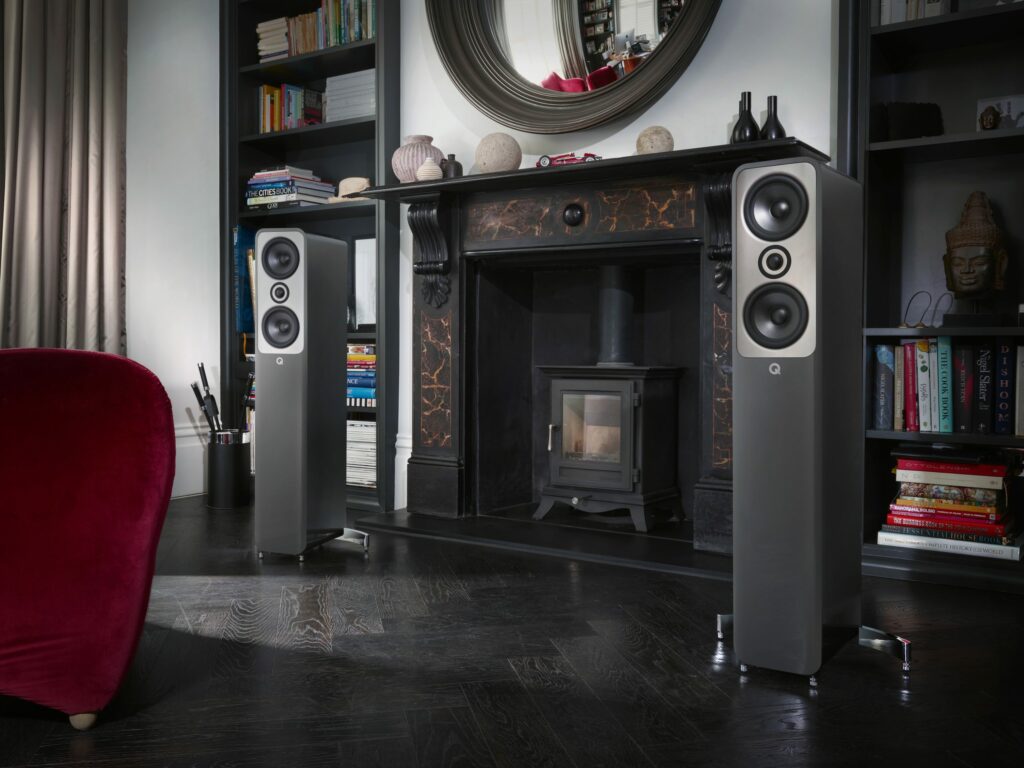
Q Acoustics Concept 50

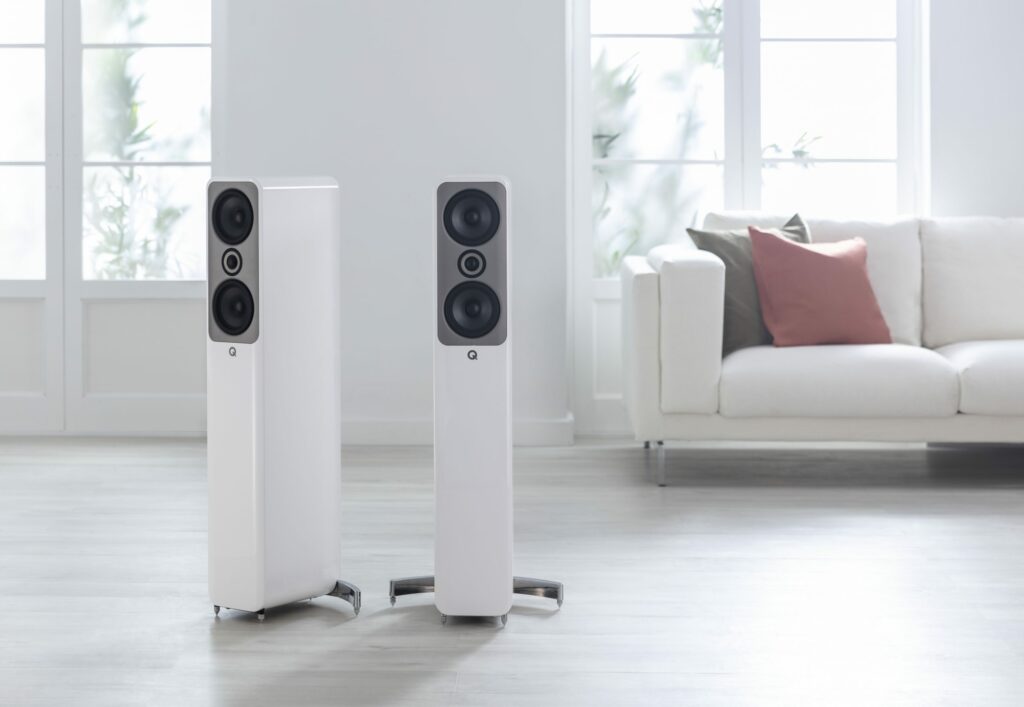
Q Acoustics is a UK‑designed brand that has been making a name for itself at the value end of the market, but its Concept line showed the world that an attainably-priced loudspeaker can have truly world-class innovation and sound. The Q Acoustics Concept 50 floorstander continues that trend.

The company’s statement of intent was the Concept 500 floorstander and Concept 300 stand-mount. Launched in 2017, these offered a genuinely new and fascinating way of designing a cabinet with extraordinarily low cabinet interaction. Those concepts have trickled down very effectively into the Q Acoustics Concept 50 floorstanding loudspeaker. A key part of this is the company’s Gelcore cabinet construction, which in the best way possible, is the ultimate expression of ‘inside every big loudspeaker, there’s a small loudspeaker trying to get out’; Concept 50 features an enclosure inside an enclosure, the two separated by what Q Acoustics calls ‘a non-setting gel’, which is a neat, not technical way of describing constrained layer damping. This helps dissipate high-frequency vibration from the moving drivers (that energy gets turned into heat in the adhesive gel).

Q Acoustics Concept 50

Having an enclosure enclosed in an enclosure should be rigid enough for most designs, but Q Acoustics trickled down its P2P (Point to Point) internal reinforcement system from its Concept 500 design. P2P is a bracing system applied to those parts of the inner cabinet most prone to low-frequency reverberation. To achieve this, Q Acoustics ran extensive laser interferometry testing and Finite Element Analysis (it claims down to microscopic levels) to examine the cabinet’s performance, and the amount and positioning of the internal bracing are applied accordingly, creating Goldilocks-style cabinet control as a result.

Under pressure

The fun continues inside the inner enclosure with two specially-designed Helmholtz Pressure Equaliser tubes to help mitigate internal reverberation and reduce standing waves. Vibration is further damped by both having the crossover sit in its own sprung isolation base plate and the way the drivers are mounted to the 3mm thick aluminium front baffle, using pre-tensioned studs. The drivers themselves are all unique to Q Acoustics, with a fully chambered, hermetically sealed 25mm fabric dome tweeter in a shallow waveguide that uses an oversized voice coil for greater power handling. This is coupled to a pair of 125mm mid/bass units in a vertical D’Appolito (Mid-Tweeter-Mid) layout.

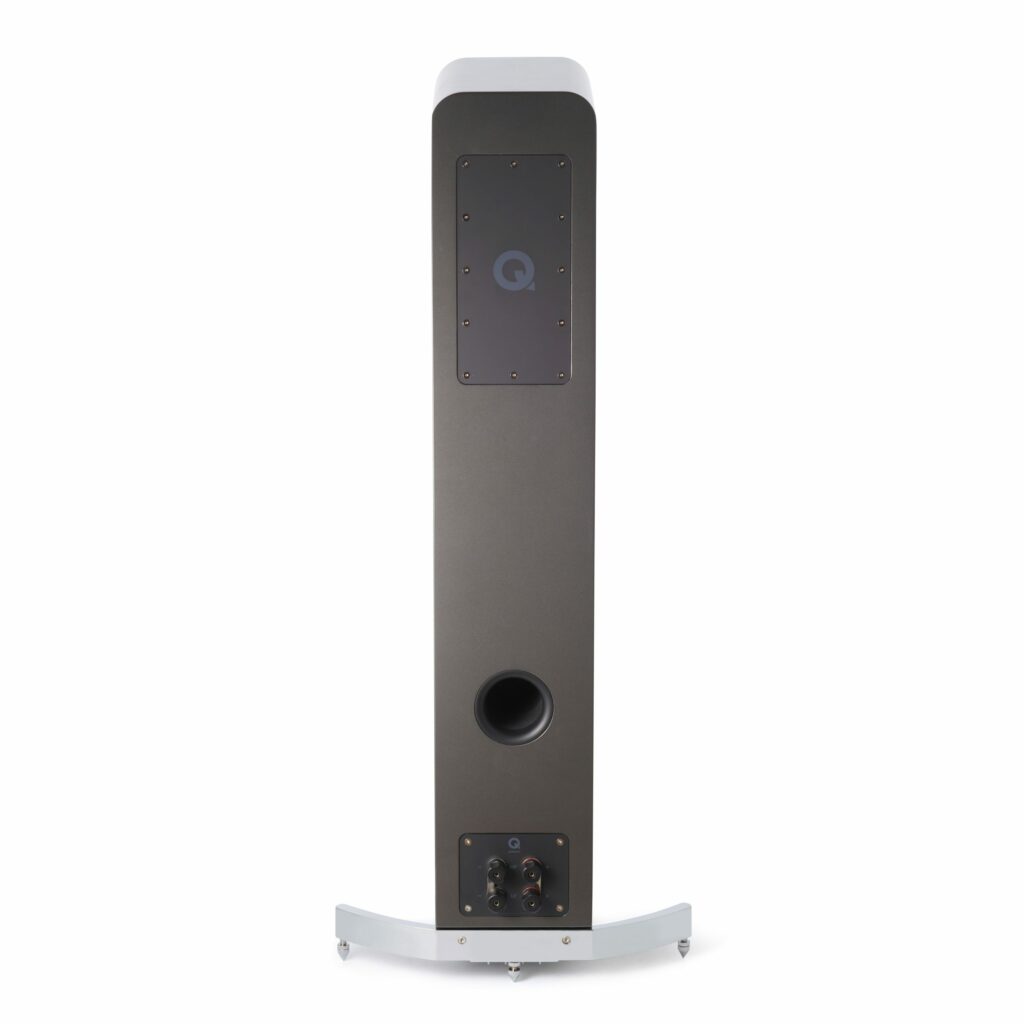
Q Acoustics Concept 50 features a large bass port and is supplied with foam bungs for use in smaller rooms or places where having speakers far from the rear wall isn’t practical. However, while these loudspeakers are relatively svelte by typical floorstander norms (standing just a shade over one metre tall and just 32cm wide), they still need a medium to large size room to shine; place them up against the wall in a box room, and the bass will dominate. However, with the bungs in place, even a foot or so from the rear wall gives a good balance.

Q Acoustics Concept 50 outrigger

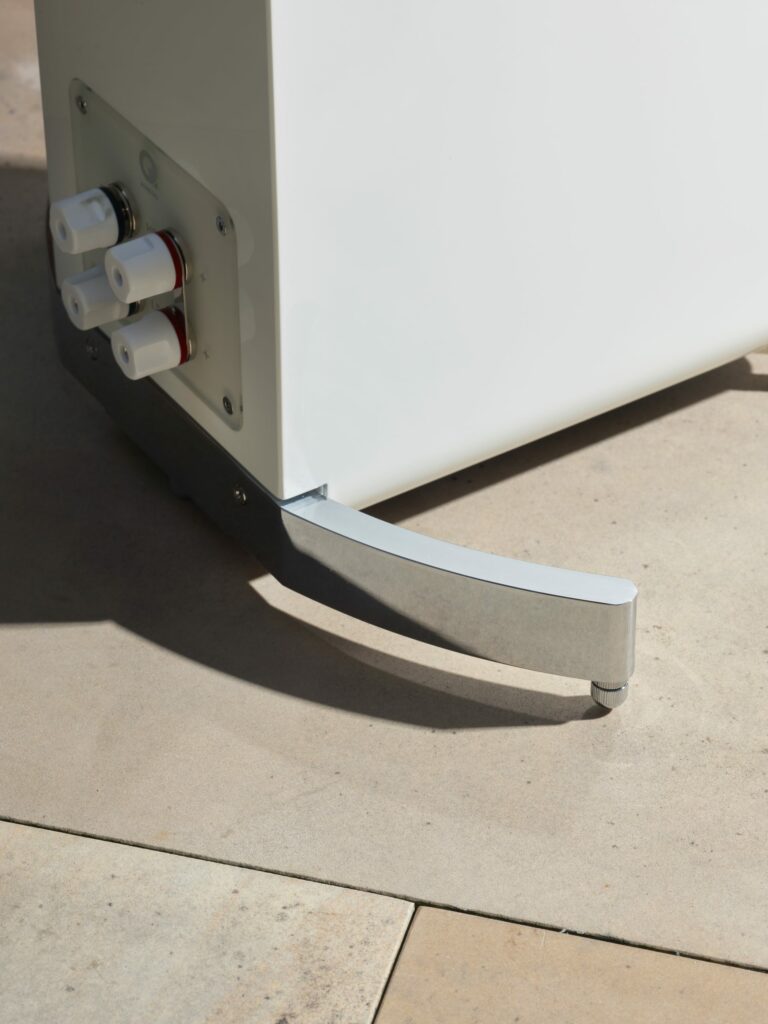
A thin, 23kg cabinet should be the stuff of tilt-test nightmares, but the Q Acoustics Concept 50 includes an outrigger to stabilise the speaker. In truth, I’m a little conflicted about the outrigger’s design; to its great credit, its rear brushed alloy bow shape is elegant and a lot less aesthetically gnarled than the usual ‘one extended arm per corner’ arrangement. The whole base also has deliberate ‘play’ factored in from that sprung isolation platform, and that makes it feel less rigid than most towers, but think of it like a mini Townshend platform. On the other hand, it does look a bit like it’s sitting on its tail, and the rear arms are longer than most. That all being said, I guarantee few people will notice this after about a day, and sitting just above the rear outrigger is a small bi-wire panel.

Care and feeding

Like other Q Acoustics models, the Concept 50 is not a difficult loudspeaker to drive, although it’s probably neither the first choice of two-watt triode fans nor those wanting kilowatt power to drive an in-room PA system. The choice of electronic partners is more quality than quantity, and it found safe havens in the arms of both Hegel and Primare integrated amplifiers. I’ve heard of the Concept 50s also sounding good on the end of similarly mid-range, mid‑powered, great-sounding amps, albeit often ones with a little more ‘zing’ to them. The review pair arrived with plenty of miles on the odometer so any running in happened long before I received them.

I must admit to some initial confusion here. Because I try to avoid too much fact-finding about the marketing of a product while listening, I thought Concept 50 was the replacement for the flagship Concept 500 rather than the top model in a new mid-priced product line. Which meant my initial assessment was thinking this was a £3,600 loudspeaker, not a £1,999 loudspeaker. What’s more, as I was extremely impressed by its performance as a £3,600 loudspeaker and potentially putting at or near the top of the pile for floorstanding loudspeakers at around £3,500–£4,000, when I discovered they cost half as much as I expected, ‘extremely impressed’ doesn’t begin even to cut it.

Q Acoustics Concept 50

The Q Acoustics Concept 50 may not look like a traditional pair of British loudspeakers, but they sure sound like them. There’s a size, weight, and richness of tone to these loudspeakers that belies their size; shut your eyes, and there’s a far wider baffle to each loudspeaker pointing at you. This is both alluring and pin-sharp precise, with instruments easy to pick out within an orchestra or string quartet. This last was especially notable; on ‘Entr’acte’ from Caroline Shaw’s Orange played by the Attacca Quartet [Nonesuch], there’s a palpable sense of musicians at play, and while this isn’t an audiophile-grade recording per se, that dimensionality and detail help add to these lively and impassioned pieces of, er, gardening set to music.

Its strongest suit is midrange; instruments and voices in this all-important register are extremely lithe, liquid and open sounding. ‘Keef’ Richards’ spoken ‘arpeggio/archipelago’ quip at the start of ‘Love In Vain’ [The Rolling Stones, Stripped, Virgin] is just far enough stage left that it can sound ‘phasey’, but here is clear and while diction is not his strong point, the Q Acoustics Concept 50 easily transcribes his distinctive drawl.

Q Acoustics Concept 50 rear

That earlier point about amps with some ‘zing’ is that the top-end is also a little ‘classic BBC’ like, soft and gentle… and very much at odds with the current zeitgeist among speaker designers. However, this more balanced approach reappears as you climb further up the high-end ladder, and the Q Acoustics Concept 50 is not rolled off, and it doesn’t fall down that dull BBC-speaker ‘pipe and slippers’ rabbit hole. Instead, that gentle extension into the upper registers is ultimately more satisfying and results in longer listening sessions. However, you might need some transitional steps; hence some put a bit of zing into that treble from the amplifier.

Enough chuff

I’m always very mindful of ports as they can often ‘chuff’ along with the music. My go-to test here is Trentemøller’s ‘Chameleon’ [The Last Resort, Poker Flat]; the fast, deep, almost square-wave low-end notes do not exist outside of synthesisers but give a perfect snapshot of how the bass performs, especially through a port. The Q Acoustics Concept 50 is a clever design, as it reduces that port chuffing to a bare minimum, and only when playing very loud do these speaker-challenging low notes begin to choke up the port. This is a sign of an exceptionally well-engineered loudspeaker; there are reflex-ported loudspeakers that cost ten, even twenty times that of Concept 50 and don’t have the same port-chuffing control. There’s a demonstrator’s trick played here… if you hear lots of organ music to highlight deep bass but never, ever hear anything with a fast, synth bass line, they might be hiding something. But that’s not something Concept 50 has to hide; unless you want to play a lot of loud, fast house and electronica (where the listening room is likely to be as much of a problem as the loudspeakers), Concept 50 passes with flying colours.

That last sentence is important as it describes the Q Acoustics Concept 50 perfectly; it passes every test with flying colours. It’s a £2,000 loudspeaker that sounds almost like a £4,000 loudspeaker. The design isn’t just ‘another box’ but nor are the innovations that go into the design merely there for their own sakes. A loudspeaker that is easy to drive and possessed of a classic sound yet isn’t so ‘classic’ as to be boring and isn’t undemanding of electronics in quality terms. With Concept 50, Q Acoustics more than earns a place at audio’s top table.

Technical specifications

  • Type two-way, three-driver bass reflex floorstanding loudspeaker
  • Drive units 1 × 25mm tweeter, 2 × 125mm mid/bass units
  • Frequency Response (-6dB) 42Hz–30kHz
  • Nominal impedance 6Ω
  • Minimum impedance 3.6Ω
  • Sensitivity (2.83V @ 1kHz) 90.5dB/W/m
  • Recommended amplifier power 25–150W
  • Crossover frequency 2.1kHz
  • Distortion (120Hz–20kHz, @ 2.83V) <0.2%
  • Effective volume 28.8 litres
  • Finishes Black, white, silver
  • Dimensions (H×W×D, including spikes and stabiliser)
    102.5 × 41.8 × 31.9cm
  • Weight 22.9kg per loudspeaker
  • Price £1,999 per pair

Manufacturer

Q Acoustics

qacoustics.co.uk

Back to Reviews

The post Q Acoustics Concept 50 appeared first on Hi-Fi+.

Bowers and Wilkins 802 D4

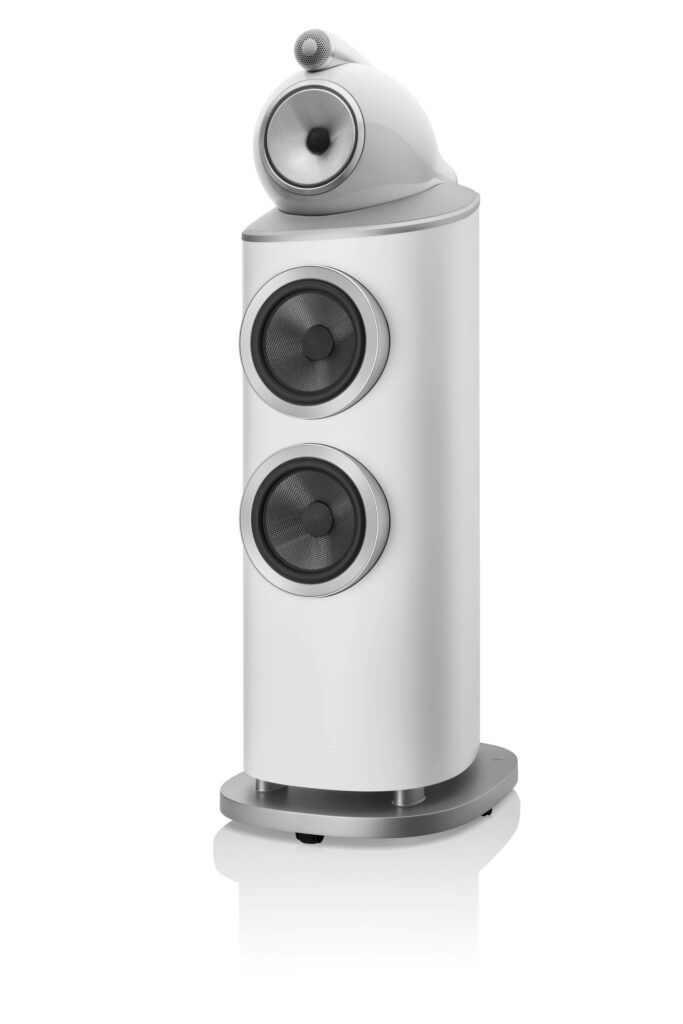
Abbey Road is about as iconic as British recording studios get. So it’s to Bowers & Wilkins credit that the company’s loudspeakers have been used there since 1980, when they were initially used for film scoring but also hit albums including Hounds of Love; maybe that’s why it’s my favourite in Kate Bush’s back catalogue. You can see the older models lining the corridors at Abbey Road; they clearly never throw anything away, but for the official launch of the new 4th generation 800 Diamond series a pair of the new 801 D4s had been hauled into the studio two control room so that visitors could listen to them. Presumably Bowers & Wilkins had no control over what was played otherwise they might have chosen something other than the Mary Poppins Returns soundtrack, but it made it clear that the company’s latest range topper is a very capable loudspeaker (even Emily Blunt didn’t sound that bad).

Bowers & Wilkins 802 D4 Satin Rosenut Angled Grille Off with reflection

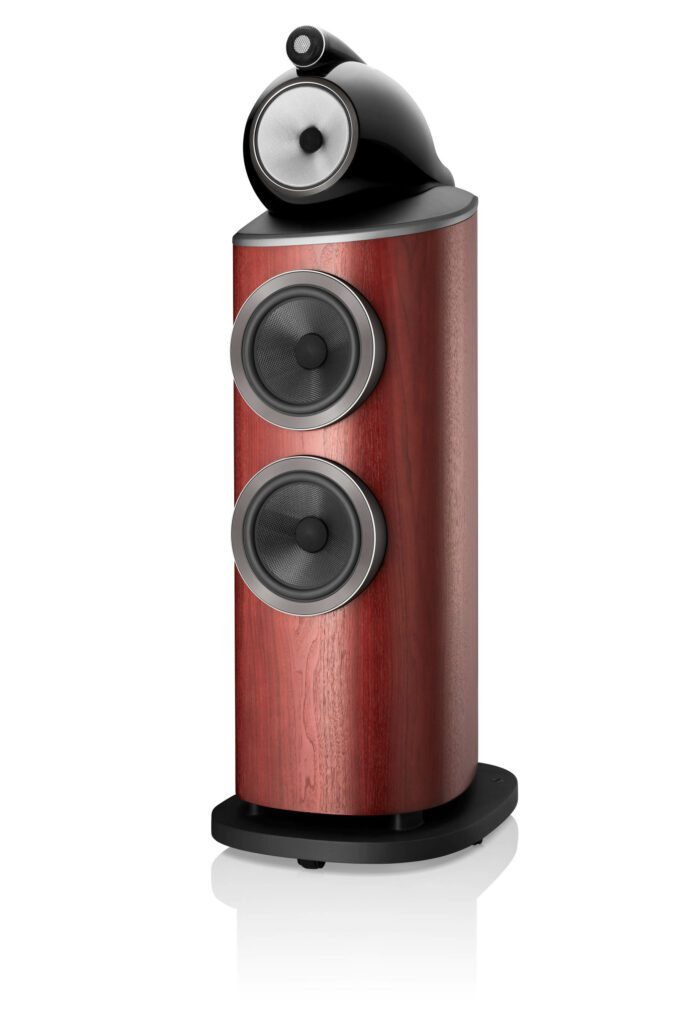
Bowers & Wilkins has been rolling out a new 800 Series every five years or so for the last couple of decades but it has not always been thus. The first example of the breed was the 801 in 1979 and that remained at the top of the tree until 1987 when the Matrix internal bracing structure was introduced. In 1998 the company decided to incorporate some of the ideas developed for the radical Nautilus speaker into the new 800 Series. This was when the distinctive midrange ‘head’ first appeared; its curves machined out of synthetic stone but finished in gloss black, which given the popularity of Corian in high-end kitchens seems an odd move, but then again kitchens are probably not what most high-end audio enthusiasts dream of. This series also employed bent ply cabinets – substantial ones at that – requiring significant tooling investment and providing an extremely stiff structure for the bass drivers to work in. The next move was the introduction of the diamond tweeter dome in 2005, a part which stayed with the following D2 series in 2010 and carried through to the D3 five years later, when the ply wrap was reversed and the iconic yellow Kevlar midrange was swapped for a Continuum cone.

Taken an extra year

The latest 800 Series has taken an extra year because of some pandemic thing. It retains the diamond tweeter dome but there have been big changes made to the rest of the high frequency system. The most obvious being that the housing is twice the weight and nearly three inches longer; this makes it stiffer and allows the tweeter to go down further in frequency without distortion. The magnet count has been reduced to two from three, which reduces compression behind the dome. Likewise, there are twice as many holes in the voice coil former for lightness and ease of movement. Equally important is the way that the tweeter housing is connected to the midrange or Turbine Head beneath it, there are now two rather than one silicone mounting that provide better decoupling than the previous system.

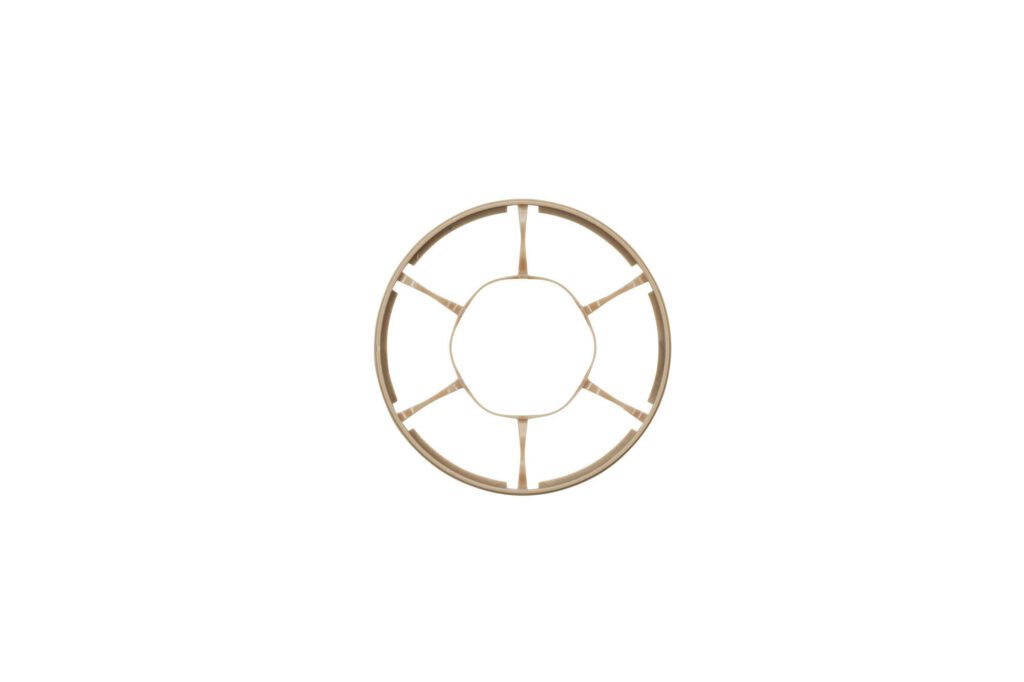
The midrange enclosure also sits on silicone decoupling with four points of contact. This enclosure transitioned from synthetic stone to aluminium in the D3 series but the tuned mass dampers within it have been ‘re-optimised,’ or ‘improved’ as it’s known, this time around. The biggest change to the midrange driver is in the spider that centres the coil former in the throat of the magnet. For what seems like millennia this job has been done by doped and corrugated fabric which is light and flexible enough to allow the cone to move but stiff enough to keep it centred. Bowers & Wilkins’ research elves have been working on a replacement for over a decade, which suggests that the new six leg, thermoplastic spider was not as easy to create as it looks. This looks deceptively simple, but it is very open compared to the normal variety and makes considerably less noise, 80dB less at 1kHz apparently, which sounds like a lot but presumably they weren’t that noisy in the first place. However, in the process of refining the midrange system, the speaker has become more revealing and transparent to such changes. This ‘Biomimetic Suspension’ will likely be rolled out across Bowers & Wilkins’ 600 and 700 series three-ways as it’s not intrinsically expensive, it just took a long time to get right.

Biomimetic Suspension Plan View

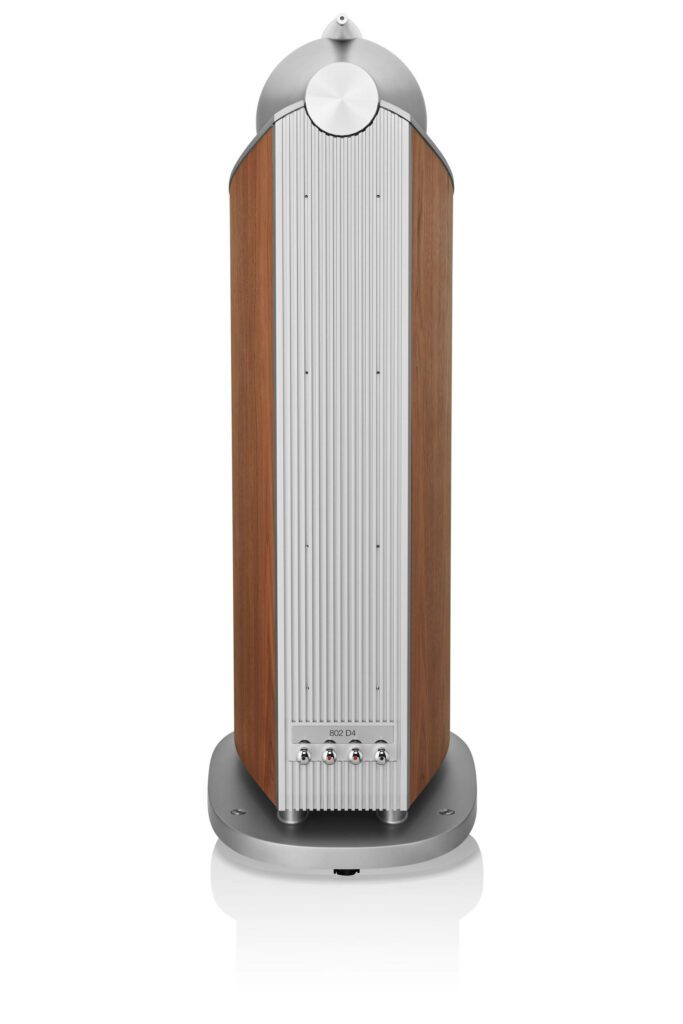
The bass cabinet continues to be made out of bent ply but now all the forming is done in the company’s Worthing facility in the UK where the entire 800 Series Diamond range is built. Formerly reserved for the largest models, it has rolled out this construction method across the 800 Series range and has had to add to the array of huge presses in the factory to accommodate this. What you can see has changed here is that the collar beneath the head is no longer wooden but made of a large aluminium casting that is finished in leather; this is said to be more accurate and stiff than the previous approach, it also provides a capping for the neat fluted metal back plate. Inside the box the matrix has been braced with aluminium that is glued and screwed in place. The bass drivers bolted to this solid structure are eight-inch Aerofoil cone types with a new foam anti-resonance plug, internally the metal elements of the motor structure have been upgraded to a steel with very low electrical conductivity and lower inductance, which has apparently reduced distortion over the previous system.

Tilt test

The support plinth is a larger aluminium casting than it was and has threaded holes at the back for tilt test compliance; the latest 802 being more top heavy than its forebear (as I found the first time I went to move them). There are four wheels beneath it; two of which rotate to make manoeuvring these substantial (88kg/194lb) beasts around a little easier, when the spikes are up that is. The spikes are also substantial and have locking collars that are rather like wingnuts so can be tightened without a tool; fortunately Bowers & Wilkins supply magnetic pucks for those of us who want to keep our flooring puncture free. Cable connections are made through plated copper terminals with spade-ended jumper cables provided to allow single wiring.

Steve Pearce, Chief Acoustic Engineer at Bowers & Wilkins’ SRE research centre, said that the acoustic team had worked on improving musicality and coherence when tuning the fourth generation Diamond series. If the last 802 D3 had a weakness that was it; they couldn’t be faulted in terms of detail resolution, imaging and perceived distortion but didn’t always deliver the most engaging result. Or to put it another way, you needed a very special amplifier to make them charming. The 802 has higher than average sensitivity of 90dB but controlling the bass requires power and combining power with speed in an amplifier is a difficult job. However the 802 D4 does indeed sound more musically compelling than its forerunner without any real change to the load so the many other changes to the system have clearly borne fruit.

802 D4 White Angle Grille Off with reflection

I started using the 802 D4s with Bryston 7B3 monoblock power amplifiers, genuinely mighty beasts with a specified 700 Watts with which to get any speaker to jump when they say so. These are not the most charming amps but they do allow this speaker to produce beautiful low end and superb imaging of the genuinely holographic variety. The sound produced is both rich in the small details that define the nature of the instruments, voices, recording method and production as well as the power that gives dynamics real impact. They do the micro and the macro with consummate ease and made Hania Rani’s Home [Gondwana] sound gorgeous even though it’s not the most polished of productions.

Switching to my regular power amplifier, the Moor Amps Angel 6 I was immediately impressed with the depth of image produced by the reverb on Dan Berkson’s Dialogues album [Freestyle], the sound wasn’t as incisive as with the Brystons but it timed almost as well. The 802 D4s reveal a mountain of detail with a good source like the Rega P10, there is so much going on in the track ‘Unity’ especially in the drums and percussion and it’s all clear and easy to follow, right down to the quietest parts. This is what you get when the speaker adds so little to the sound, the smallest sounds come through and reinforce their more substantial fundamentals to create a richer and more complete overall picture. I really enjoyed Patricia Barber’s Live: A Fortnight in France [Blue Note], an album that rarely seems to live up to expectations, something that’s easy to put down to weaknesses in the recording. But it seems that when the system and in particular the weakest part of the system, the speaker, is delivering more signal and less colouration it comes together.

On Haydn’s Quartets each instrument inhabits its own clear three dimensional space, the bump of the bows on strings placed clearly in front of the 802s gives you a real sense of realism, and (goose) bumps of your own, as well as lovely depth of tone. This loudspeaker has always been at its best when playing at higher levels, this brings up the midrange and adds to the precision of the imaging as well as the definition of the bass. The power and solidity they bring to Tom Waits’ ‘Shore Leave’ [Swordfishtrombones, Island] is excellent but such niceties fly out of the window when ‘16 Shells from a Thirty-ought-six’ comes on and there is no alternative but to cavort around the room with glee. If there’s energy on the record it comes out of these speakers with gusto, and yes that is a very good thing. Another energetic number that doesn’t always work is ‘Subway Station #5’ by Patricia Barber again, here the harmonics and atmosphere are superb with fabulous attack on the drums, the listener being drawn into the way that Barber builds up intensity with a repeated motif on the piano’s left hand keys while the rest of the band lay down the jam around this phenomenal rhythmic anchor. This piece proved to be totally mesmerising to an extent that it rarely does. These Bowers & Wilkins are powerful both emotionally and physically, they can move as much air as you like but remain calm under fire, seemingly never smearing the sound but letting it flow unfettered into the air.

Cerebral

With more cerebral material it’s the quality of imaging that becomes apparent, I love the way that they throw shapes in the air with sound. Laurie Anderson’s ‘Gravity’s Angel’ [Mister Heartbreak, Warner Bros] is good for this but the 802 D4s are better than most at getting the acoustic and synthetic sounds that she corrals to carve a space in the room. But that alone does not make a piece of music interesting for long, it has to make an emotional connection and this is where the 4th gen 802 Diamond has the edge over its predecessors. The same can be said for the bass which has always been a strongpoint of this loudspeaker but is now clearly better, it is supremely nuanced allowing the characteristics of each instrument or voice to be that little bit more expressive and interesting. Essentially there is less box and more original sound which means that the rumbles on the intro to Blade Runner do not blur with low synth notes, the fretless on Beck’s ‘Paper Tiger’ is clearly the same as that on Serge Gainsbourg’s ‘Melody Nelson’ and the fretless bass on Carla Bley’s  ‘Life Goes On’ is obviously Steve Swallow.

802 D4 Satin Walnut Rear with reflection

The Bowers & Wilkins 802 D4 is more expensive than its forebear but so is everything else around us, including the competition, which in all honesty struggles to compete. Bowers & Wilkins makes more high-end loudspeakers than anyone else in the world, 6,500 pairs of 800 series models a year in fact, and this gives them an economy of scale that means the 802 D4 costs half as much as its nearest serious competitor. It may not have the snob appeal of boutique brands but it has a phenomenal R&D dept that produces world-class loudspeakers, and the 802 D4 is certainly that.

TECHNICAL SPECIFICATIONS

  • Type: 3-way, four-driver, floorstanding speaker with reflex loaded enclosure.
  • Driver complement: One 25mm diamond dome tweeter; one 150mm Continuum cone midrange driver with FST surround; two 200mm Aerofoil cone bass drivers.
  • Frequency response: 17Hz – 28kHz (+/-3dB from reference axis)
  • Impedance: 8 Ohms (minimum 3.0Ω)
  • Sensitivity: 90dB/ 2.83Vrms at 1m
  • Dimensions (HxWxD):  1218 x 413 x 602mm
  • Weight: 88.1kg/each
  • Finishes: Cabinet: Gloss Black, White, Satin Rosenut, Satin Walnut Grille: Black, Grey
  • Price: £24,000/pair
  • Manufacturer:

Bowers & Wilkins

URL: bowerswilkins.com

Tel: 0800 232 1513 (UK only)

Back to Reviews

The post Bowers and Wilkins 802 D4 appeared first on Hi-Fi+.

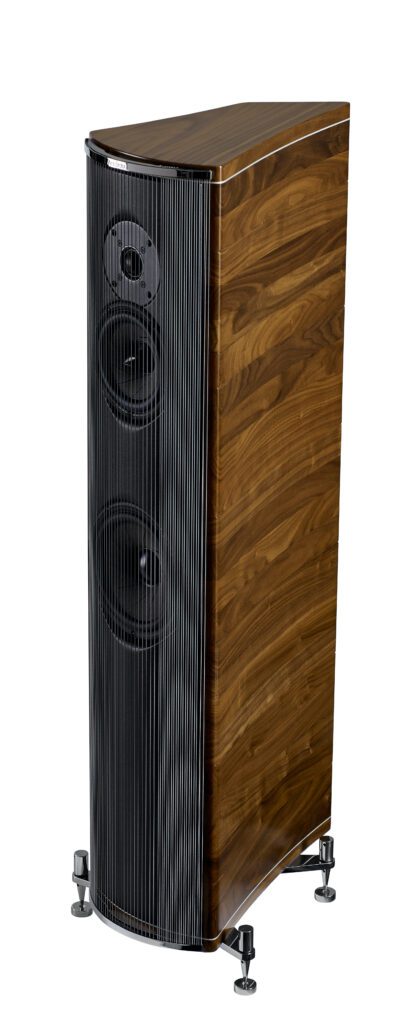
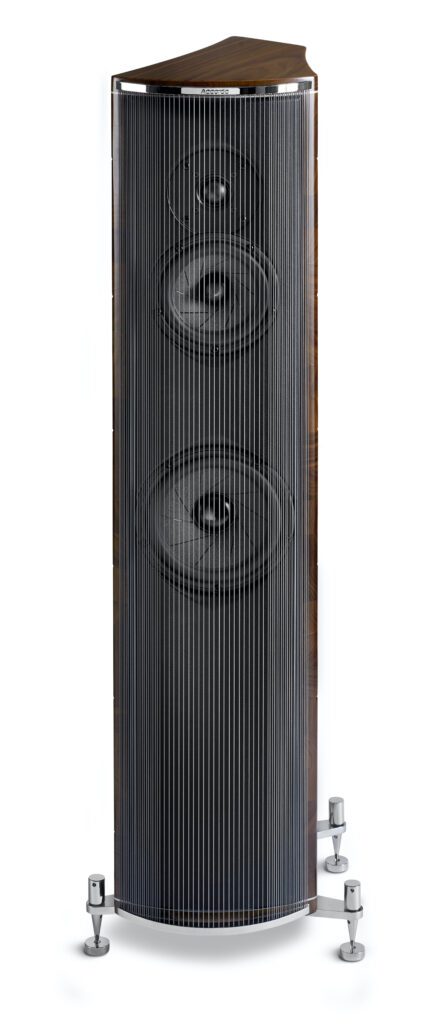
Franco Serblin Accordo Essence

Franco Serblin, (1939–2013) one of the great italian speaker designers devoted his life to making some of the world’s finest speakers, initially founding Sonus faber, and then selling the company in 2006 to start a ‘Serblin’ range of speakers under the company name Laboratorium.

 Alan Sircom recently reviewed the Accord stand-mount, and hot-on-the-heels of this Laboratorium has recently released the floorstanding version, designed by Massimiliano Favella, constructed in solid walnut, and finished with chrome. It is undoubtedly one of the most beautiful speakers to grace my listening room. Sonus faber, the previous enterprise of Serblin, borrowed the names of some of the great violin makers for their ranges, Stradivarius and Guarneri. It is interesting that just as the great Italian cities were famed for their take on pizza (Neapolitans are soft and thin based, Roman are more crispy etc.), the same is true of the centres of Violin making: Cremona, Milan, Venice, Brescia.


It’s a family affair

Each family of makers had distinctive sounds; Cremona’s most famous violin-making town was famed for the sound’s sweetness and power. The Venetian sound, by contrast, has a sense of liquidity to it, a sort of liquid mellowness as opposed to the naked Cremonese sweetness. I apologise for the digression, but I am lucky enough to play on a Venetian violin, made in 1710 by Matteo Gofriller. I see a remarkable similarity between the sound of the Accordo Essence, built just 45 minutes from Venice and the sound of the Venetian violin-making school. More of that later!

 The speaker sits on chrome spikes, which are adjustable and have small cups which rest on the floor. The Essences are a three-way ported design; a 29mm silk dome tweeter, designed by Ragnar Lian (founder of Scan-Speak), a 150mm mid-range microsphere-coned drive unit, and a 180mm woofer.

Franco Serblin Accordo Essence

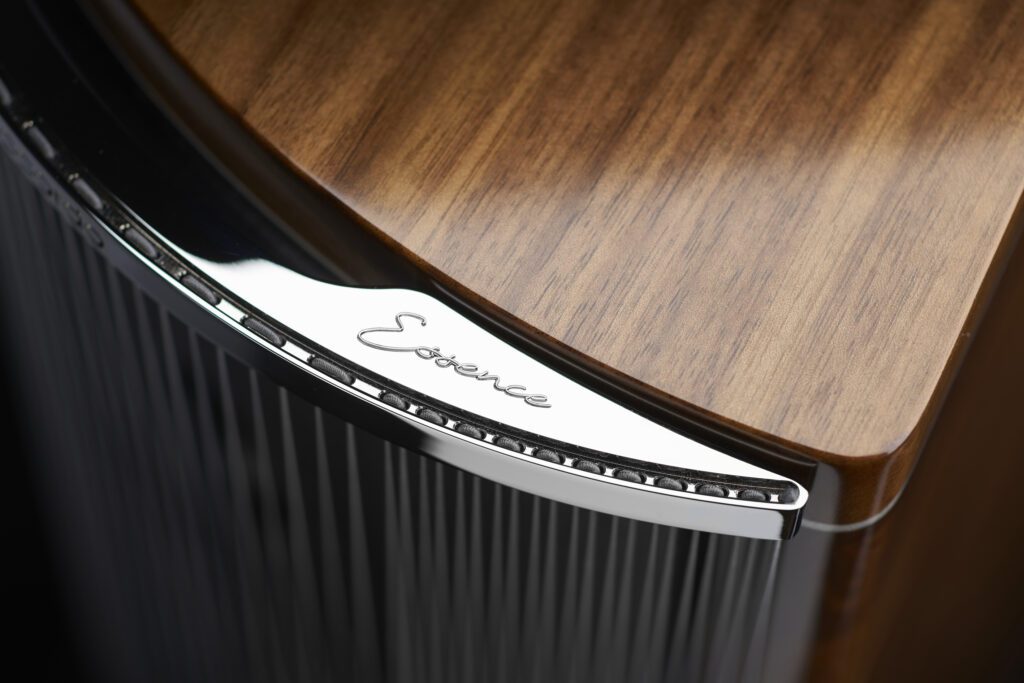
The speakers, like the stand-mounts, are handed and are a wonderfully curvaceous take on ‘rhomboid’. There are ports for both the midrange and woofers; ‘double ported’, I suppose I should say. The rear has high-quality binding posts, only a pair, and no bi-wiring tweakability here! The speakers are internally braced with aluminium and magnesium and weigh 30Kg each. Similar to the Sonus faber range, there are grills constructed with rubber strings. I couldn’t figure out if they were removable or not, but they created a floating effect, like harp strings, and I doubt they affected the sound in any discernible way. Overall, these are objects of incredible beauty and one of the highest scoring Wife Acceptance Factors of any product I’ve reviewed.


Minimum power

The spec suggests that the minimum power output for a suitable amplifier to drive this is 20 Watts. I’m using some 200 Watt VAC Phi’s, which have no problem driving them, but I suspect that 20 Watts isn’t going to be nearly enough to do them full justice with a sensitivity of 88dB.

Listening to them in my system with a dCS Bartok and Townshend Allegri Reference preamp, there is an initial familiarity with the sound. I think that the tweeters are reminiscent of the Scan-Speak tweeters on my Sonus faber Concertino’s, a smooth, mellow, warm sound, and very different to the diamond tweeters on my B&W 802d3’s, which have a stridency which can cause problems with the wrong matching. It’s a highly distinctive top end, rounded, gentle and quite sonorous.

Listening to Leif Ove Andsnes playing the rather extraordinary Beethoven Choral Fantasia [Sony], a piece whose first movement consists of a piano solo and which Beethoven hadn’t finished for the first performance, resulted in him sitting at the keyboard turning blank pages! The second movement, which was finished, has shades of the 9th Symphony, various woodwind/string moments, and a piano and a choir. Entirely off the wall!

The Accordo Essences provide a very alluring sound. That’s really first and foremost. Nothing ugly, shrill or out of place, just a sheer aesthetic beauty to the sound. The drive units show how well chosen they are, as there are no ‘sonic leaps’ between them, just one long mellow continuum of sound. The bass is articulate, clear, powerful, and goes down surprisingly deep for a speaker with a narrowish baffle. The piano texture is uniformly coherent, showing no lack of integration between the drive units. Each drive unit works its part in the overall sound in an even and balanced way. Three drive units, one instrument.

Enter the brass

When the brass enters to contradict the strings, the spatial image is good, deep and large; perhaps a little of the spatial information is not quite as present as it could be with the choice of the Scan-Speak tweeter, which prioritises beauty and smoothness above the last word in airy spaciousness. As each musical character takes their place in this bizarre piece, superbly recorded in High Resolution, the vocal soloists keep adding to the largesse of the texture. The Serblins cope admirably, producing a grand scale of sound effortlessly. Not holographic, but well spaced.

Franco Serblin Accordo Essence

Onto Bruckner’s 7th symphony, the epic slow movement, a tribute to Richard Wagner, Bernard Haitink conducting the Royal Concertgebouw Orchestra [re-released in High Resolution, on Decca] provides a powerful rendition of this magnificent work. The scale is reproduced effortlessly, never a rough sound and always beautiful; these speakers will appeal to listeners whose glass is half full. It provides the best orchestral texture you need to appreciate the music. It is at the opposite end of the scale to my B&W 802d3’s, which veer towards the concept of the ‘Monitor’, i.e. what they use in Abbey Road studios to hear the ‘warts’, to see the glass half empty.

I’m sure seasoned audiophiles find that they have the amount of water in their audio glasses that accords with their philosophy of listening. I make a few recordings of my quartet and various orchestras, and there are times when I need to hear the tiniest details, however bright and unpleasant they may sound. On the Serblins, these little eccentricities get minimised, and I was amazed, for example, at just how good the raw feed from the orchestral recording sounded. It wasn’t clear what I needed to do to equalise it because it just sounded good the way it was. Definitely speakers for the end listener and not for ‘Pro Audio’.

Playing some jazz, Art Farmer and Farmer’s Market on Qobuz, initially recorded in the mid-1950s (and remastered), the Serblins hit the nail on the head with that ‘old world’ jazz club sound. They provide toe-tapping rhythmic propulsion and timing magnificently and the rose-tinted approach they bring really works here brilliantly.


More valves!

Giving the Accordo Essences a spin with another valve amplifier I happened to have from a previous review, the Prima Luna Evo 400 integrated amplifier, which came furnished with EL34s, proved a good partnership. They are slightly less bright than my VAC Phi 200s, and EL34s are more airy and spacious than KT88s on the VACs, so in Triode mode, they seemed to complement the Serblin’s well.

Listening to Haydn’s Sinfonia Concertante, Sir Simon Rattle conducting the Berlin Philharmonic [Warner] really sounded lovely, full but with some extra space and air. Interestingly, the choice of valve makes such a critical difference here. I have to speculate whether a brighter transistor amplifier will work well; I’m not sure it would give the same airy quality that an EL34 brings to the party, but it would be worth a hearing.

Franco Serblin Accordo Essence

The Accordo Essence is a truly unique proposition. They look stunning, curvaceous and fabulously constructed in a natural wood that assures the most anti-audio partners! Their sound, as I discussed earlier, bares a striking audio resemblance to the violins made in the golden age of Venetian violin making; not bright and sharp, but liquid and smooth, not known for their vast power, but a pleasingly balanced and warm sound. They seem to extract the best from a piece of music without being overly analytical and appeal to the actual music lover who just wants to enjoy their music. Even if that music arrives in a romantic rose-tinted way. It is worth careful partnering with a suitable amplifier. Valves are a sure-fire winner, but EL34s work best in my system. In these dark times, who wouldn’t permit this marvellous sonic indulgence?

TECHNICAL SPECIFICATIONS

  •  Geometry: 3-way floorstanding vented box loudspeaker
  • Cabinet: Super – rigid, arch–shaped solid wood structure, decoupled with aluminium – magnesium parts to obtain resonance control.
  • Tweeter: 29mm silk – dome by Ragnar Lian, Mid–woofer: legendary, custom made,150 mm microspheres cone,
  • Woofer: 180 mm microspheres cone, aluminium dust cap.
  • Frequency response: 35Hz–22KHz
  • Nominal impedance: 4ohm
  • Sensitivity: 88dB/2.83V/1m
  • Minimum power amplifier: 20W/channel
  • Finish: Solid walnut – Metal parts of chrome and aluminium
  • Dimensions: 1100 × 230 × 430 (H×W×D)
  • Weight: 60 Kg /pair speaker unpacked 70 Kg /pair packed
  • Price: £12,998 per pair

Manufacturer: Laboratorium

URL: francoserblin.it

UK Distributor: Absolute Sounds

URL: absolutesounds.com

Tel: +44(0)208 971 3909

Back to Reviews

The post Franco Serblin Accordo Essence appeared first on Hi-Fi+.