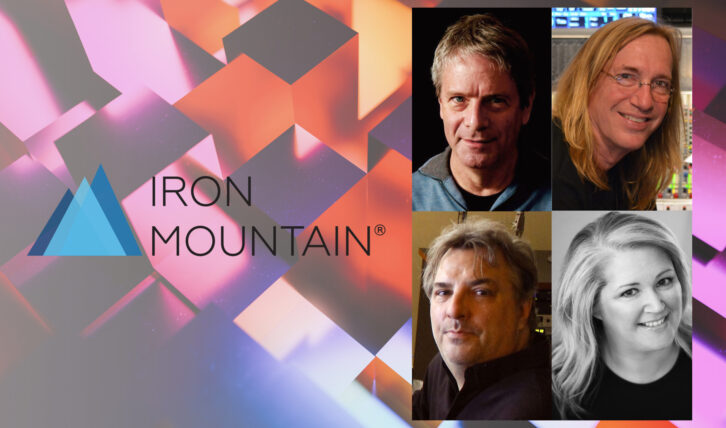
Pictured L-R, prime row: George Massenburg and Chuck Ainlay; backside row: Kelly Pribble and Sarah Jones.
Anaheim, CA (April 4, 2023)—Iron Mountain Entertainment Services (IMES) has introduced an all-star TEC Tracks panel, “Preserving and Future-Proofing Your Creative Content,” on the upcoming NAMM Show on the Anaheim Convention Center in Anaheim, CA on Friday, April 14, 2023.
The panel will happen within the Audio Room (202A) from 10:00 to 10:50 a.m. PDT on April 14. The all-star panel contains George Massenburg (multi-Grammy Award-winning producer, engineer, educator, inventor and designer), Chuck Ainlay (multi-Grammy, ACM, CMA, and TEC Award-winning producer/engineer) and Kelly Pribble (director of media restoration know-how at IMES). Sarah Jones (famous business journalist and committee member for the Recording Academy’s requirements doc Delivery Recommendations for Recorded Music Projects) will function moderator.
The announcement notes: “Whether your newest inventive work was recorded on analog tape or digitally to a tough drive, preserving your recordings is paramount for future playback. Analog tape has its personal issues, however we’re shifting into an age the place mainly each bit of data for the reason that Nineteen Nineties in the end lives someplace on laborious drives. And these laborious drives will, inevitably, fail.
“What this implies is there’s a sure chance that some or all of our info will basically evaporate and be misplaced ceaselessly. There is an actual concern that we are going to encounter what is known as a “digital black gap” of media from, say, the late Nineteen Nineties by way of the early 2010s, when extra creators grew to become wiser and fewer careless about their backup routine. This session will take a look at the sensible and technical issues for long-term archiving, numerous media storage strategies, finest practices and future catalog monetization.”
The new Paris operation is the primary Iron Mountain facility in France and the corporate’s seventeenth facility globally.
Paris, France (March 20, 2023)—Iron Mountain Entertainment Services (IMES) has introduced the opening of their new facility in Paris, the corporate’s first preservation facility in France.
With services within the U.S, Canada, the U.Okay. and Ireland, this marks their seventeenth world facility, which is able to present climate-controlled media storage (together with fridge storage and personal vaults) and asset preservation companies to worldwide media shoppers.
The new Pantin facility contains climate-controlled storage rooms and personal vaults. In addition to bodily asset storage, the ability additionally presents digital options starting from asset digitization and switch, metadata creation and enrichment, and digital preservation and distribution by way of their Smart Vault platform.
“We are thrilled to be opening our latest media storage facility in Paris at a time when our leisure shoppers are actively mining their content material archives for monetization alternatives,” says Hanna Balouka, head of shopper partnerships, France. “This storage facility is constructed to world-class sustainability requirements and can present the French market with a much-needed choice for premium, safe, climate-controlled media storage. The constructing options state-of-the-art power effectivity measures, in line with the Iron Mountain Entertainment Services dedication to fulfill bold net-zero targets. IMES additionally presents quantity and specialised digitization and digital storage, so now shoppers’ supplies don’t ever have to depart the security of the IMES setting.”
Trusted by greater than 3,500 organizations all over the world, a couple of notable French shoppers embody French broadcast powerhouse Canal+.
The new facility is positioned at Pantin Logistique at 110, bis Avenue du Général Leclerc – 93500 Pantin Entrepôt N°15, étage 2B.
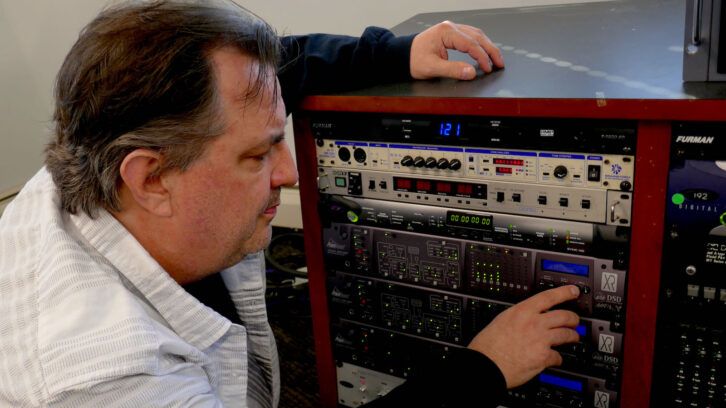
Kelly Pribble of Iron Mountain Entertainment Services captures legacy analog media through high-res Prism Sound ADA-8XR converters at 192 kHz, 24 bits. Photo: Kelly Pribble/Iron Mountain.
David Bowie, ever the visionary, made a smart move back in 1997, partnering with an investment firm to raise cash from his intellectual property—his catalog of songs—through Bowie Bonds. Ten years later, it became apparent that Bowie had made out like a bandit just as the record business was beginning to crash.
Fast-forward through the new millennium and there has been a Gold Rush over the past few years, as artists from The Beach Boys and The Killers to Genesis and Massive Attack—as well as Bowie’s estate—have cashed out their recording catalogs with a handful of investment firms.
Deal details are rarely disclosed, but some of the reported numbers are eye-popping: Bob Dylan, for instance, may have reaped upward of $600 million for his publishing and masters, while Bruce Springsteen is believed to have received $500 million for his songs and recordings.
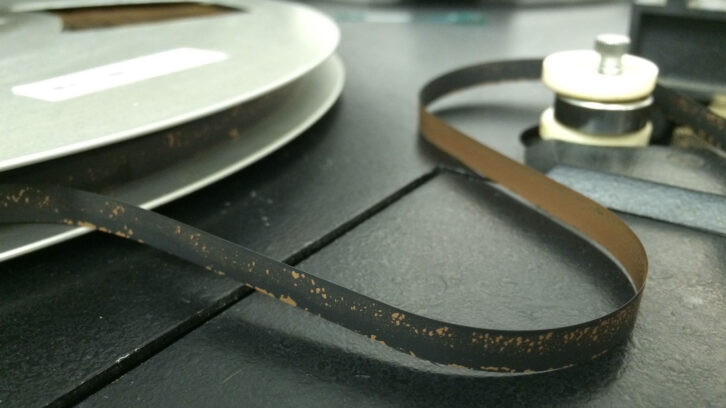
An example of tape adhesion from a recent project. Photo: Kelly Pribble/Iron Mountain.
For artists, these arrangements offer certain tax advantages while potentially relieving financial pressure for the rest of their lives and, for older musicians, enabling them to plan their estates. As for the catalog aggregators, they are banking on a healthy return on their investments through sync licensing for film, TV and commercials, record reissues, merchandising, and the like. But to realize any sort of return on their investments, the recordings, some of which may be many decades old, need to be in a playable condition.
Kelly Pribble, director of media recovery technology at Iron Mountain Entertainment Services, has a simple motto: “It’s only rock ‘n’ roll if you can play it.” IMES, which has three digital studios in the U.S. and two in Europe, offers secure physical and digital asset preservation and archiving services for the wider entertainment industry, not just the music business. Pribble, for his part, spends much of his time working with rights holders—whether that’s an artist or one of the new wave of investment companies—to help evaluate, organize and remediate their legacy music recordings, often also setting up a plan to migrate them as storage formats evolve.
Wait, hit the Pause button. Remediate?
DO NO HARM
Remediation is the act of stopping and even reversing harm caused by environmental factors. For music catalogs, there can be a host of such factors, from recordings being fixed in an obsolete format to damage due to storage issues to problems with any associated information— the metadata. It’s the work of Pribble and his IMES team to remediate those issues before archiving assets and their metadata for clients.
Even if they have been previously archived, decades-old original assets can only benefit from being transferred again using the latest technology. Currently, Pribble captures analog audio assets through Prism Sound ADA-8XR converters at 192 kHz, 24 bits.
“I use those Prism units because I just love them,” he says. “They don’t color the sound. As an archivist, I don’t want to color what’s on the tape when I make a digital file. If it’s digital, I go bit-for-bit so there’s no loss.”
Over the years, Pribble has seen it all (but due to strict confidentiality agreements is unable to name all but a few IMES clients). Issues with age-old tapes occur almost daily in his job. “They’re just so fragile. Any manipulation—sometimes even putting them on a machine and rewinding them in a very slow mode—and the tape just breaks,” he says.
One remediation project involved an archive of some of the oldest tapes he’s ever handled. “There were all these challenges that I hadn’t really seen that much because most of the time we don’t deal with 70-year-old tapes.”
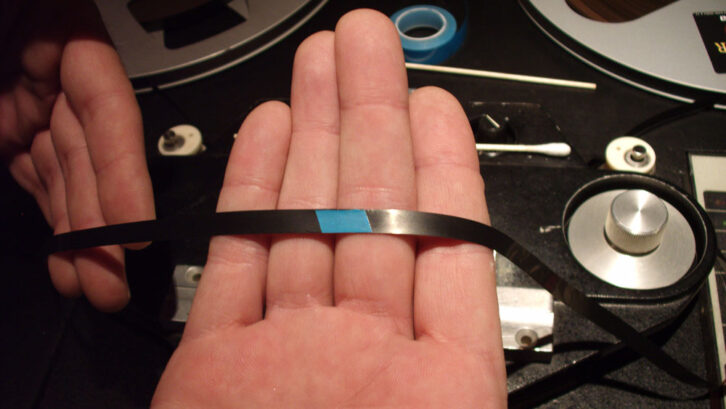
Repairing an edit splice on 2-track analog tape. Photo: Kelly Pribble/Iron Mountain.
Many of the splices between paper leader and tape, not just at the head and tail but between songs on album masters, proved challenging, with adhesive from the tape breaking down and oozing between layers. Pribble had to carefully peel everything apart without removing any oxide.
“The downbeat is right at that splice, and if one little bit is missing, you’re going to have a dropout,” he explains, noting that adhesive at the splices had also bound layers together. “As I was getting closer in a very slow rewind mode, I would stop and hand-wind to that point or I could damage the song.”
STICKY SHED AND ADHESION
You may be familiar with sticky-shed syndrome, which causes the magnetized coating on certain tapes to separate from the backing due to the deterioration of the binder—the glue—holding them together. At a Recording Academy presentation in late 2020, Pribble called attention to a new issue, which he called adhesion syndrome, which had affected the album masters of Bob Dylan’s Empire Burlesque, from 1985, and 1986’s Knocked Out Loaded. The records are part of a collection of more than 100,000 items—hours of audio and video, manuscripts, notebooks, photos and other assets—acquired by the George Kaiser Family Foundation and the University of Tulsa, some of them now on view at the Bob Dylan Center in Tulsa, Okla.
Pribble reported that the issue was first observed 10 years previously in South America (tape manufacturing formulations can vary by region) but had become a recent phenomenon in the U.S. “The edges are bound together, and as you unwind the tape, it rips the tape,” Pribble explained at the time. The condition can pull the oxide from the backing, creating pinholes.
“Altogether, there were 63 two-inch masters from Bob’s two records that we were able to safely unbind and transfer successfully,” he continued. “I didn’t have to do much once we were unbound and transferred; the audio was pretty good.”
SAVE YOUR DATA
These days, we think of metadata as information embedded with a digital audio file. For analog material, that metadata is typically the writing on the tape box. But if it’s missing and the producer, engineer or artist is no longer around, identifying a song, much less which take is which, may be problematic.
On one recent project, Pribble was rewinding a tape from a box with scant information on it when he caught something out of the corner of his eye. “Somebody at some point decided to write the name of the song and the artist on the leader tape. That was just so cool,” he says.
With no notes it might not even be obvious how many tracks are on a half-inch multitrack tape, Pribble says, and it doesn’t necessarily help to play it. For instance, a 3-track tape will play on a 4-track machine, and vice versa—just not correctly for archiving purposes. Happily, there’s a tool for that. “We have a magnetic viewer,” he says, noting that it makes the tracks visible.
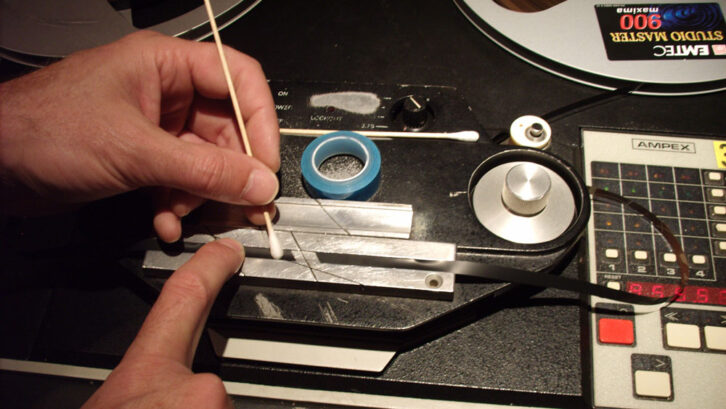
Cleaning the gum off an old analog splice. Photo: Kelly Pribble/Iron Mountain.
That said, previous archivists may have done a thorough job. Pribble reports seeing tape boxes noting defective tracks with directions to use a copy or even an alternate take from elsewhere in the collection, including for some very familiar rock ‘n’ roll classics.
“If we didn’t have this information, we might have used these versions and said, ‘This is not a great version.’ And we may have not known where the other good versions were or where to go look for them,” he says. An outtakes reel may include alternate takes that are practically indistinguishable from the familiar—but now unplayable—released master, which can save the day when a collection is reissued decades later.
WORKING MACHINES
As for obsolete recording formats, devices such as Sony’s PCM-1630 have since become difficult to source, but IMES saw the writing on the wall and has long since amassed a collection of vintage playback devices, analog and digital. Yet there can still be challenges even when a working playback machine exists.
Spotify requires tracks to be at a minimum 96 kHz sample rate. What if a project was archived to DAT? “DATs are at 44.1 or 48k,” Pribble points out. “As we archive today, DAT is probably one of the worst formats to have your storage on.”
On one recent reissue project, there was an issue with a master that he had only previously encountered with very old acetate tapes, where it starts to shrink as it breaks down and begins to curl within the reel as it unspools. When he played the tape, it would move in and out of contact with the head stack, he says: “I call it dancing. How do we fix that?”
Pribble, a former studio builder and owner who holds a U.S. patent for a method to remediate magnetic tape, is not one to shrink from a technical challenge. “It literally took us four or five days to come up with a fix. I’m an inventor; I never give up,” and neither does his IMES team, he says. In the end, a device made from a piece of foam and some medical tape held the tape against the head just enough, without affecting the speed, to make an archive copy.
“We think we’ve seen most of the problems until we see something like this, and then it’s a new challenge,” he says. “I love challenges, and my team loves the challenge, but we were able to fix it. I’m so very pleased and proud of them.”
Hollywood, CA (March 15, 2021)—Iron Mountain Entertainment Services (IMES) has recently made a number of hires that are intended to expand its business opportunities, particularly into the music industry. To that end, the company, which offers physical and digital asset preservation and archiving services for the wider entertainment industry and beyond, has appointed Rory Kaplan as senior business development executive, Music Industry.
Kaplan is well known to the pro audio community. Co-founder and former president of META (now the METAlliance), he’s held key positions at Auro Technologies, Microsoft, AMD and Intel, and was part of the DTS Inc. team that pioneered 5.1 music releases. Kaplan has cred beyond the boardroom, too, as he began in the business as a musician and has worked on more than 100 albums and 18 world tours.
IMES approached Kaplan to help the company connect with the untapped pool of people and companies in the music industry that have never considered, or not yet committed to, an asset management strategy. “I’m hoping to get a lot of engineers, studios and artists to look at saving their content and assets, whether it’s a ’57 Strat or the first tape they ever recorded,” says Kaplan. “Everything they have is equally important.”
He’s never considered himself a “sales guy,” he says. “Even though it falls under sales, I’m not selling people anything. But I can call my artist friends and say, ‘Here’s a solution.’”
IMES also recently hired Hillary Howell, an archivist formerly with Lionsgate. “We’re often asked to talk archivist-to-archivist, and are asked some really strategic questions about the best path forward, so we needed somebody who could be a partner with our clients,” explains Lance Podell, SVP and GM, of Howell’s appointment as director, Premium Archival Services.
“Similarly, we hired Beth Greve as head of Sales,” says Podell, noting that they previously worked together at YouTube. “Beth has a background in digital media, so she really understands the digital landscape and has a background in sports, including serving as global chief commercial officer at World Surf League. That’s a really good combination of skills for us.”
There’s a long list of reasons to consider preservation and archiving services. For one, storing assets in an attic or in public storage exposes them to myriad potential hazards. Old audio assets, from neglected tapes to hard drives that haven’t been spun up for years, are also in danger of becoming unplayable as they deteriorate. And it’s not just assets; artists age, too, and should think about estate planning to ensure their legacies and future revenue streams for their families.
IMES offers solutions for the preservation and archival process, from digitizing assets—and remediating problems affecting playback—to cataloging them and enabling search and retrieval. “We are in asset lifecycle management,” says Podell, ensuring that assets enjoy an extended lifecycle through digitizing physical assets, for instance, or migrating digital assets from one format to a newer format.
It’s not just about old audio tapes either. “It can be everything, from notes to lyrics written on a napkin to old concert tickets or posters. Think about doing a retrospective or a documentary,” says Podell. If everything is being held by IMES, “It’s all in one place, all digitized, all searchable.”
Few might take the time to rummage through boxes of unmarked tapes to find a bonus track for an upcoming release or that one early demo for a retrospective project. But once an asset is ingested into the IMES system, whether it’s a demo song or a photograph of an artist shaking hands with a U.S. President, it can be quickly found. Iron Mountain’s Digital Content Repository (DCR) provides a dashboard that enables an artist or team member to enter keywords and quickly surface an asset from the archive and direct it securely to its destination.
Indeed, IMES remains focused on security, maintaining an end-to-end “chain of custody” from the asset’s current location to one of the company’s many media storage and digitization facilities. As Kaplan explains, “An Iron Mountain-bonded guy picks this stuff up, notes the assets and transports them in an Iron Mountain truck. They’re checked in, logged and cataloged. It’s like a bank; it’s secure, and there’s never a third party involved.”