Tag Archives: Jazzed Up

Swingin’ with Casa Loma Orchestra

Casa Loma Orchestra set the highest standards for excellent musicianship, superb arranging, collective spirit, classy presentation, romanticism and hard-driving dance rhythms.  At the outset of the Swing Era, before 1936 and until the rise of Benny Goodman, Casa Loma was the premier popular orchestra playing hot jazz, sweet tunes, riff-based head arrangements and fully written scores.

A vanguard of the Swing Era, Casa Loma was one of the most danceable bands of all time and a rich source of original tunes.  It was a fierce competitor in the big band battles of the 1930s, making records for OKeh, Brunswick, Victor and Decca Record Companies or their subsidiaries and international affiliates and among the most prolific of the era.  They waxed nearly 450 sides between 1929-47.

Their distinctive and cohesive style jelled during 101 consecutive weeks of one-night stands in the Midwest during 1931-33.  On the road in the worst days of the Great Depression, they flourished, despite the rough and tumble of touring on hazardous roads, blizzards and enduring an incident in which the entire band was arrested on suspicion of bank robbery.

Introducing Casa Loma, Swing Low, Maniacs Ball, Limehouse Blues


At the Steel Pier, Atlantic City, New Jersey, September 1931. Towards the center are trombone players Pee Wee Hunt, Billy Rauch and premier soloist, clarinet player Clarence Hutchenrider. To the far right are Glen Gray (alto sax) and arranger Gene Gifford (banjo).

A Popular Dance Band

In his landmark book, Lost Chords: White Musicians and their Contribution to Jazz, 1915-1945 (Oxford, 1999), noted jazz writer, researcher and musician Dick Sudhalter concluded:

“No band of those years was more frequently discussed, more widely admired or emulated . . .  no other band of the day, whatever race, could rival it for popularity, precision and team spirit, or for the ability to bring dancers to the floor.”

Casa Loma Orchestra dominated the dance band field for the first half of the 1930s and was the topic of heated debates in the popular music press: Down Beat and Metronome magazines. It was a prolific source of delightful music and original tunes, particularly the deft arrangements of Gene Gifford who wrote their early hits and was succeeded by several talented scribes.

This was the first dance orchestra broadcasting regularly on network radio, launching the most popular showcase of Swing on radio. The premier broadcast of the of The Camel Caravan program on December 7, 1933 was a Casa Loma performance; they continued on the series until June 1936.

Casa Loma was unusual for being a group of white musicians who competed successfully with the black Jazz orchestras of Harlem for sheer drive and heat– one of the few Caucasian Swing bands admired by their African American competitors.  Yet it was popular with mainstream audiences for sweet and romantic music, appearing dressed elegantly in tuxedos.

Promotional photo, late 1930s.

‘Reeked with Class’

“This orchestra reeked with class . . . both crisp and precise . . .”wrote contemporary observer George Piersol who became the band historian.  He recalled his first impression in 1933:

“. . . the band programmed each set with versatility. They mixed such sentimental ballads as Kenny Sargent crooning ‘I Love You Truly,’ which brought squeals of delight from the female contingent in the crowd, to ending the set with a rousing ‘killer diller’ such as ‘Maniac’s Ball.’  When the program ended, we all filed out of the Steel Pier convinced that ‘Casa Loma Stomp’ had become the collegiate national anthem!”
Casa Loma Stomp – 1930

Future Casa Loma clarinet player Clarence Hutchenrider first heard the ensemble in its nascent form around 1929. He was impressed by their precise reading of intricately written charts and unity of sound, “it didn’t sound like any other band I’d ever heard . . . in a class by itself; something to remember.”

Their outstanding arranger Gene Gifford wrote both some of the hottest music of the 1930s and lushly romantic charts.  Sudhalter suggests that Gifford’s superlative skills generating ‘tone paintings’ show “an even greater flair for ballads, drawing on a varied palette of instrumental colors” as heard in the hypnotic “Blue Prelude” or typified by their radio theme song, “Smoke Rings.”

Smoke Rings – 1932


Blue Prelude – 1933


Natty gents in spats at Lido-Venice in Boston, MA c. 1930.

Origins

Casa Loma Orchestra arose from the remnants of The Orange Blossoms, one of several bands run by impresario Gene Goldkette out of his Detroit office.  Booked to play at a grand Toronto hotel called the Casa Loma, they were stranded when the hotel suddenly closed. To this day it remains unclear whether the band ever played the venue, if they played for a few days or weeks, or never performed there at all before the hotel failed as a commercial enterprise.

Stranded in Toronto, the musicians formed a collectively run corporation under the Casa Loma banner.  For years it was run as co-operative business: the musicians had an active say in band membership, management and finances.

Maturing into a tough, finely-honed outfit, they were widely admired by their colleagues and competitors, white or black.  The fact that there were no big stars in the ensemble strengthened its team spirit.  One writer of the day called it, “the band that’s organized like a corporation and run like a college fraternity.”

Hotel Origins, You Ain’t Been Livin’ Right, Who’s Sorry Now


The Casa Loma Castle.

The Castle

The Casa Loma Castle in Toronto, Ontario, Canada is a fascinating story in itself.  It was conceived and built by a Canadian insurance, real estate and industrial magnate, Sir Henry Pellatt. He spent five million dollars constructing a medieval manor on a hill above the city – Casa Loma meaning ‘house on a hill.’

The sprawling folly of gables, turrets and arches contained more than 100 rooms, 60 bathrooms, 5000 electrical lights, a shooting gallery, its own telephone system and the largest wine cellar in North America.  It was briefly operated as a hotel, but has been owned by the City of Toronto since 1930, remaining one of its most spectacular tourist attractions.

Arranging, Buji, Chant of the Jungle, Ol’ Man River

The post Swingin’ with Casa Loma Orchestra appeared first on Dagogo.

W.C. Handy Remembers

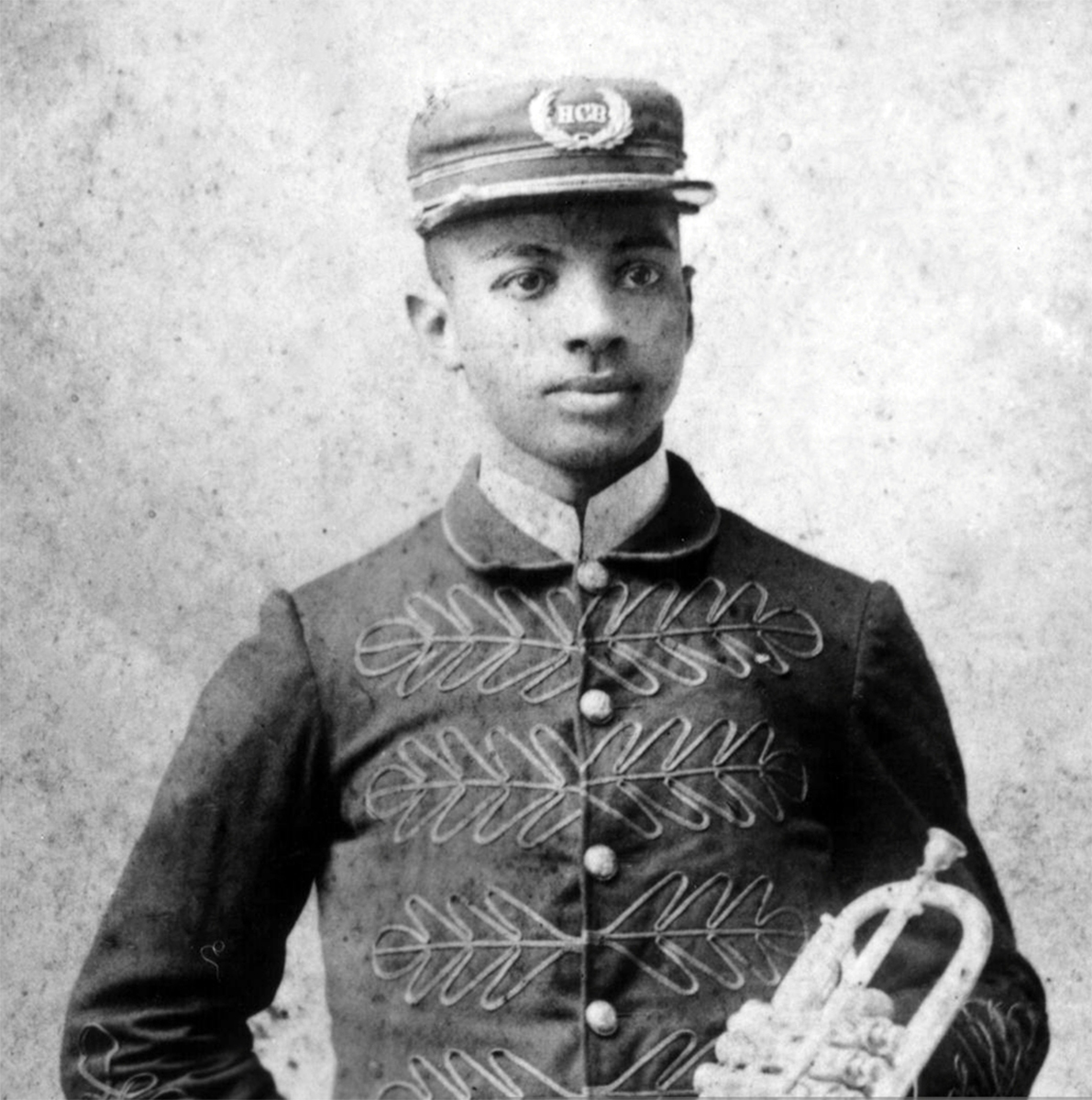
A rarely published portrait of Mr. Handy from sometime before 1900. Courtesy of W.C. Handy Home and Museum and Mister Handy’s Blues.

The music, words and voice of W.C. Handy reveal a passion for music, the Blues and African American culture.  He dedicated his life to the proposition that the Blues are a legitimate and vital musical form in an era when that idea was rejected or ridiculed.  And he was one of the earliest folklorists gathering and preserving the oral and aural folk-Blues, which he successfully incorporated into his songwriting.

This column and audio clips are based on the Gabriel Broadcast Award-winning radio program, W.C. Handy Remembers.  Wherever possible Handy’s words and voice have been used to convey his story.  Many of the photos are newly available courtesy of the W.C. Handy Museum and Home in Florence, Alabama and Joanne Fish, producer of the documentary, Mr. Handy’s Blues.

Whether they know it or not, most Americans know the music of William Christopher Handy (1873-1958). His lovely “Memphis Blues” and “Yellow Dog Blues” are still popular.  A touchstone of American culture, “St. Louis Blues” was the most recorded jazz composition in the early 20th Century.  He was variously a traveling minstrel, cornet player, bandleader, promoter, folklorist, composer, music publisher, campaigner for civil rights and cultural icon.

Handy developed a keen skill for creating great music by blending the lyrical fragments and folk idioms he collected with his own gift for composing.  His best-known songs like “Careless Love,” “Beale Street Blues” and “Atlanta Blues” were crafted from the raw folkloric elements he dedicated his life to compiling and interpreting.  In interviews, articles and his autobiography, Handy always acknowledged his mostly anonymous folk sources.

Introduction and Yellow Dog Blues


Handy on culture:

“When we take these things of our own and develop them till they are the fine things, I think that’s pure culture. You’ve got to appreciate the things that come from the heart of the negro and from the heart of the man farthest down.

The great European classics came from the peasantry of the countries in which these people lived.  It didn’t come from the kings and queens and the great theaters.  It came from the man who dug deep into the hearts of the people he had come up with and loved, the man farthest down.”

Young Mr. Handy became a roving musician. Photo by Michael Ochs Archives/Getty Images.

Early Years

Born to a former slave in Alabama less than a decade after the Civil War, William Christopher Handy was the son and grandson of Methodist (AME) ministers.  Overcoming resistance from his family and society, he gained a thorough musical education, making his living as a professional musician. During the 1890s, he was a wandering trumpet player (cornet,in the early days).

Handy eventually led his own ensembles, writing and arranging music and becoming a beloved bandleader in Memphis, Tennessee.  He started publishing his own songs and was probably the very first to make a livelihood printing and selling the Blues as sheet music, initiating his long struggle to legitimize the form. During decades of roaming, he collected fragments of lyrics, melodies, folk songs, spirituals and work songs, netting like rare butterflies what would otherwise surely have been lost.


Memphis Blues by Handy


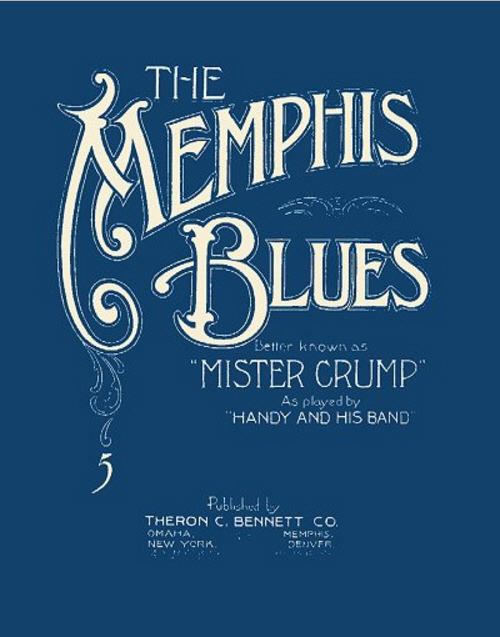
The Memphis Blues

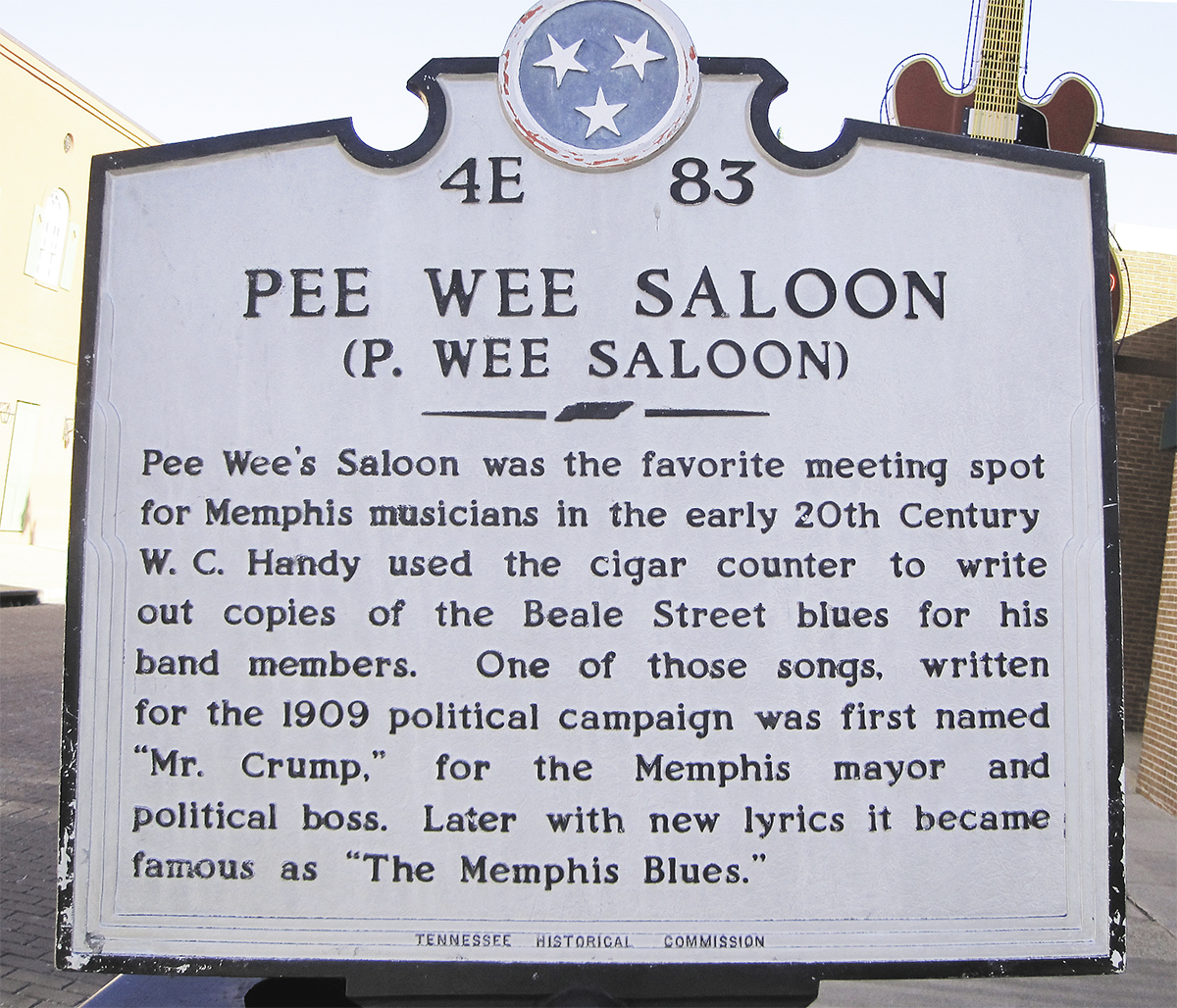
In 1909 his band was hired to play for the mayoral campaign of Memphis political boss, Edward H. Crump.  According to Handy, he won the election thanks in part to the popularity of his song known as “Mr. Crump.”  Though the politician ran on a reform platform opposing vice and corruption, once he was elected both flourished.

Three years later,Handy put it out as “The Memphis Blues” with new lyrics provided by Mr. George Norton.  It was among the very first published Blues songs and a big hit across the country, formally introducing his style of 12-bar blues.

The great success of “The Memphis Blues” in 1912 prompted Handy to form his own company, Pace & Handy Music Co. on Beale Avenue in Memphis.  From 1913 to 1918 they published his most popular songs including “St. Louis Blues,” “Yellow Dog Blues” and “The Beale Street Blues.”

W.C. Handy’s Memphis Orchestra, Handy is center rear, 1918.

Writing the Beale Street Blues:

“I like the life of Beale Street.  It was exciting.  So much so that I was two years trying to write a number called Beale Street, but I couldn’t find words for it. 

One night, after leaving my office, I passed by Pee Wee’s saloon.  Next to it was a barbershop.  This barbershop was open, say about 2:00 o’clock in the morning.  I said, ‘c’mon let’s go home.’  He says, ‘I haven’t closed up cause ain’t nobody got killed yet.’  And I struck myself and said that’s it, Beale Street Blues!  I went home and wrote the words to the Beale Street Blues that night.”

The Beale Street Blues

Memphis was a thriving transportation hub where the railroads met the Mississippi River.  Developing after the Civil War, the original Beale Avenue was a respectable, predominantly African American neighborhood of homes,churches and a grand opera house.

When Handy arrived around 1910, Memphis had sprouted the notorious Beale Street entertainment district, an infamous collection of taverns, pool rooms, dance and gambling halls, brothels and dives.  The lawless section was occupied by hustlers, pickpockets, lowlifes, pimps and prostitutes, attracting country rubes seeking thrills and workingmen, riverfront roustabouts, levee workers, cotton farmers and Pullman porters out spending their hard-earned pay.

Thriving in the rough nighttime traffic of the rowdy quarter, Handy was oddly fascinated, possibly even obsessed by Beale Street, observing razor fights, stabbings, ice pick killings, shootings and worse.

You’ll see pretty browns in beautiful gowns,
You’ll see tailor-mades and hand-me-downs,
You’ll meet honest men, and pick-pockets skilled,
You’ll find that business never ceases ’til somebody gets killed!

If Beale Street could talk, if Beale Street could talk,
Married men would have to take their beds and walk,
Except one or two who never drink booze,
And the blind man on the corner singing Beale Street Blues!

Beale St Blues, Yellow Dog


Yellow Dog Blues


The Yellow Dog Blues

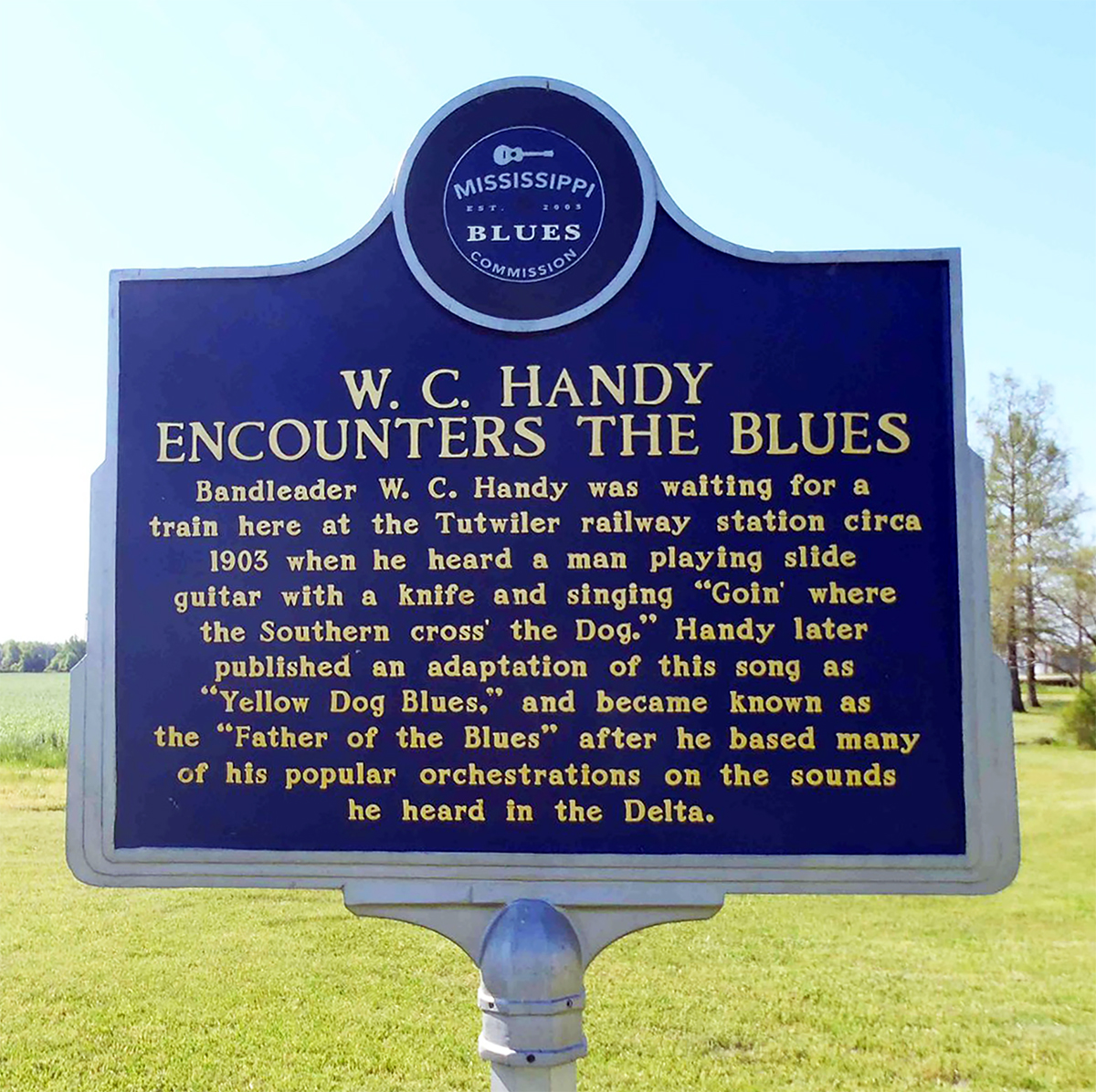
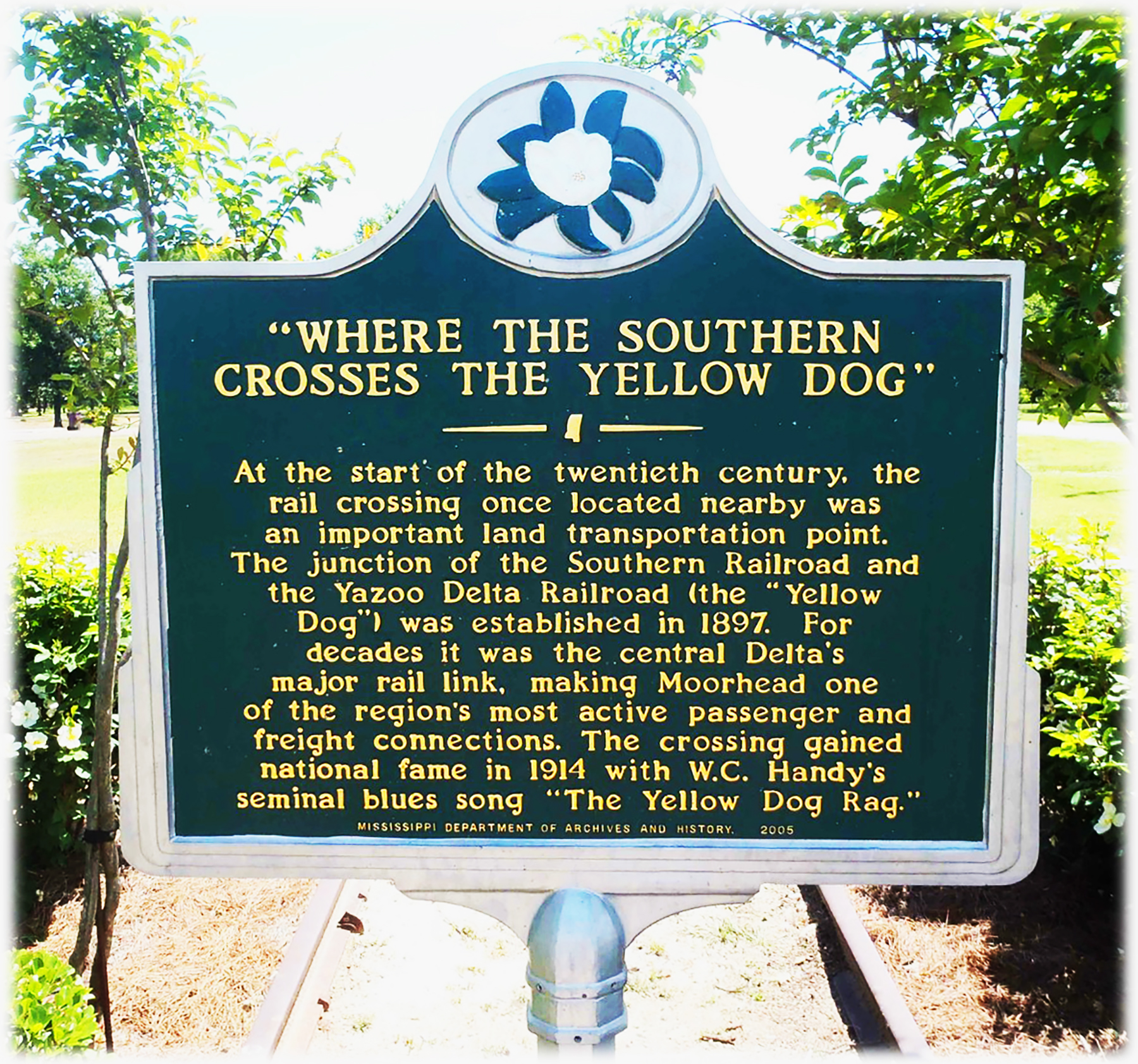
W. C. Handy published the “Yellow Dog Blues” to great success in 1914. One of his simplest and most enduring Blues, it highlights his remarkable skill at carving poetry from the vernacular. He had heard an itinerant singer playing it on a slide guitar a decade earlier in a rural railroad station– a galvanizing early encounter with the Blues.

The song tells the tale – real or imagined — of Miss Susie Johnson, who is lamenting that her“easy rider” (lover, pimp or gigolo) has runoff.  The frantic search elicits a letter informing her that he “struck this burg today,” but had left and gone to “where the Southern cross the Yellow Dog.”

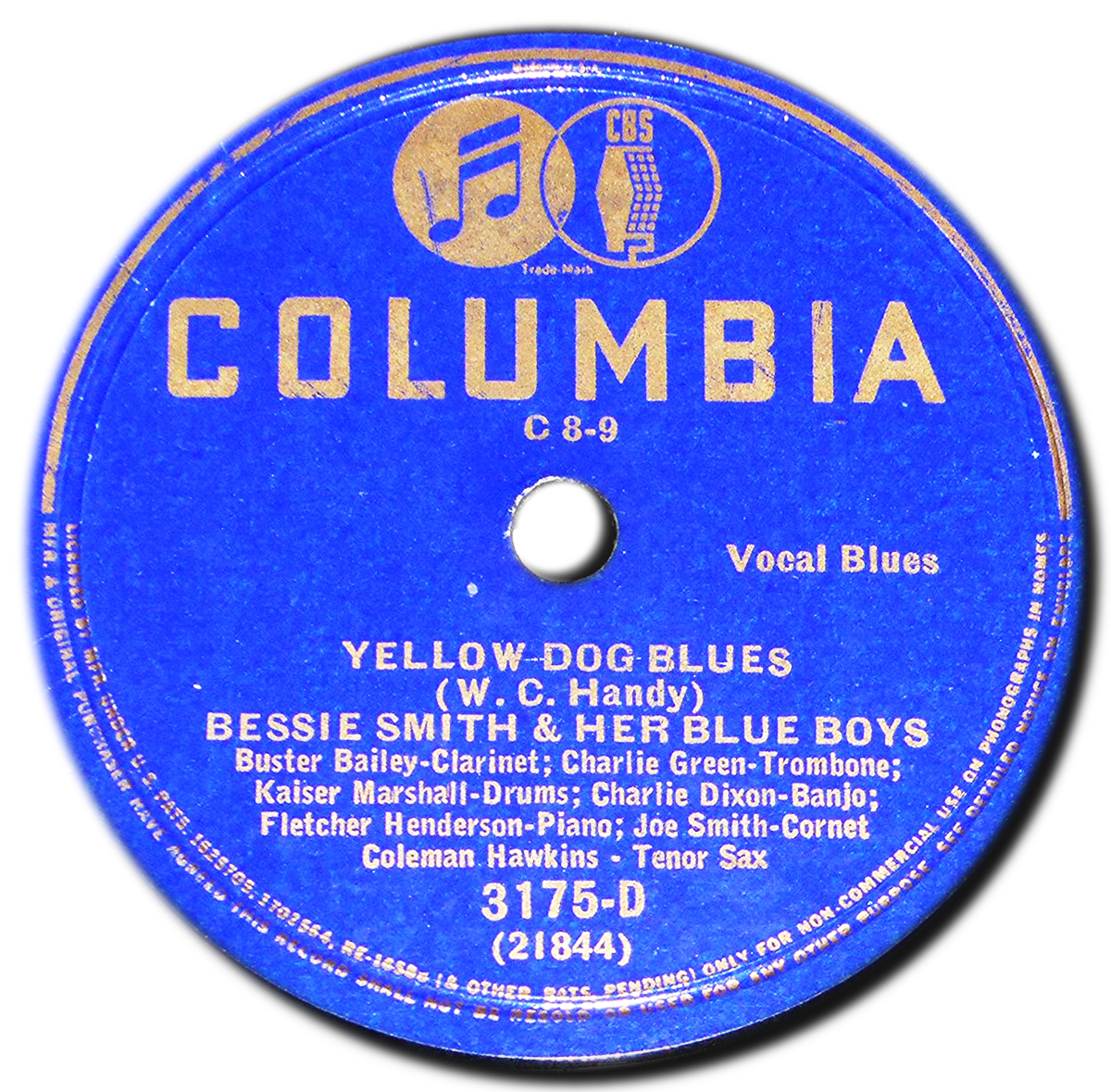
Yellow Dog Blues – Bessie Smith 1925

Commentary on Bessie Smith’s Yellow Dog Blues by Dan Radlauer

For a deeper look I’ve asked an accomplished musician, my brother Dan Radlauer, to assess the best-known rendition by Bessie Smith, accompanied by Henderson’s Hot Six (aka Bessie Smith and her Blue Boys) recorded in New York on May 6, 1925.

“The song starts with standard, predictable blues chord changes and evolves smoothly into some complex and rich variations on that chord progression.  After the truncated blues form intro, where everyone in the band except the singer is playing, we launch into a very simple accompaniment behind Bessie Smith.

Twelve-bar Blues has become the primary “Blues” form, and this song is no exception.  The hallmark of a Blues chord progression is the fifth measure.  Various things can happen before or after that spot, but at that point the defining moment is going to the “IV” chord.

Here the cornet plays subtle fills and long notes, keeping the style and mood.  The first two verses use the simplest of Blues Progressions.  No superfluous chord changes.  Just meat and potatoes Blues. Pretty much: I, IV, I, V, I, V.”

“But at the third verse, all bets are off.  Each subsequent verse gets more harmonically complex and sophisticated. The third verse uses a VERY unexpected chord at the 9th measure. I don’t think this would ever happen spontaneously.  Either it was rehearsed, or there was a written “chart” to help everyone stay on the same harmonic page.

On the YouTube link https://youtu.be/JVL24i38F2s of this song, at about 2:30, listen for a descending line.  This is a very distinctive moment and the band executes it beautifully.  If you listen really close at 2:45, another special moment happens.  The band has hit the important sign post of going to the IV chord in the fifth measure, but in the 6th measure, they switch that chord from a MAJOR chord, to a MINOR chord.  While not unheard of, this is a wonderful little surprise and would most likely be planned ahead of time.

The post W.C. Handy Remembers appeared first on Dagogo.