Tag Archives: Mono Block

Audio Note UK Empress Silver parallel single-ended triode monoblock amplifiers Review

Also read Audio Note UK M1 Phono preamp & Empress Silver parallel single-ended triode monoblocks Review


The Audio Note Empress Silver Monoblock amplifiers are parallel single-ended amplifiers using two 2a3 power tubes per channel and generating 7-8 watts per channel. Audio Note describes the Empress as follows:

  • Pure Class A operation
  • Zero Negative Feedback
  • Single Ended Output Stage
  • Valve Rectification
  • Directly Heated Triode operation

Audio Note sells three versions of the Empress monoblocks. The Empress Silver version under review here takes the entry version and adds Audio Note 1-watt Tantalum film resistors as well as IHiB C-Core transformers. The Silver Signature version adds 2-watt Tantalum film resistors and SHiB C-Core Transformers. For more information on these transformers, see the link provided: Audio Note UK transformers.

Single-ended triode (SET) amplifiers are largely the black sheep of the audiophile world. They have very little power, high Total Harmonic Distortion (THD), and do not measure particularly well against other tube amplifiers and certainly not against solid state amplifiers, including those selling for a fraction of the cost. What sort of nut would buy such things?

SET amplifiers have a kind of magic to them. They can sound clear, fast and engaging while delivering more ambiance, richness, and texture to vocals and instruments. The limitation is power. One must use speakers that are easy to drive in terms of a relatively flat impedance load and high sensitivity in order to play louder with fewer watts. If you are reading this review, you are probably well aware of these considerations in choosing your SET-amp friendly loudspeaker.

The well-made Empress Silver monoblocks weigh in at 20kg (44 lbs) each. They use two 2a3 power tubes per channel as well as one 6SN7 and one 5R4GY rectifier tube. I initially had an issue with mismatched gain with my Audio Note M3 preamplifier, but a quick fix at the dealer resolved both noise and high gain issues. The amplifiers since then have been astonishingly noise free during my two years of ownership. Audio Note does make a Low Gain version for very high sensitivity loudspeakers. I would advise auditioning the amplifiers with your particular preamp and speakers first to ensure that you will not have an issue.

The Empress Silvers are flat-out fantastic sounding amplification. They are clean, clear, fast, and, unlike many SET amplifiers, sound far bigger than their specifications suggest. And they can rock. My complaint with some ofthe more famous 300B tube amplifiers is that they tend to sound a little slow, perhaps trading verve for a more laid back “pretty” presentation. The Empress Silvers trade some of that pretty sound for a more raw and exciting upfront presentation. Note, however, you are making a trade-off here.

I have fielded a number of questions over the years as to which SET amplifier to buy. Audio Note offers several different SET amplifiers that I have auditioned over the years, including the Quest Silver, which uses 300B tubes offering the same 7-8 watts of power; the Paladin Stereo amplifier, which generates just 2 watts per channel from two 45 tubes; and the Vindicator 2a3 DHT, which is a 3.5-watt stereo power amplifier. I have also auditioned several of Audio Note’s larger and far more expensive amplifiers.

What I have found is each offers a different presentation and brings its own set of strengths. The Empress is a more powerful version of the Vindicator, which also uses 2a3 tubes. To me, the Vindicator, Paladin and Quest are less capable for rock and harder hitting music, but they have more of a valve sound in terms of ambiance.

The Paladin has a sort of beguiling presentation that is perhaps my favourite out of Audio Note’s lower power tube amps, but at 2 watts per channel, you are far more limited in speaker choice, room size, and music selection. Nevertheless, it has a gorgeous enveloping presentation and if your music collection is largely focused on Eva Cassidy and other smaller-scale music, this is a special amplifier, even with Audio Note’s own modestly sensitive speakers. You seem to hear more of the recording’s room, more decay, and a sense of space not captured to the same degree in the Empress or Quest amplifiers. The Empress sounds a bit leaner in these areas, going more for the big and grand sound.

My impression is that the Empress is the best all-round amplifier, giving you much of what is desirable about the Paladin, Vindicator and Quest while also bringing the verve and drive of more powerful solid state amplifiers. When I was auditioning the amplifiers, the note I made to myself was that if I could only have one, based on the music I listen to — which does include rock and pop —then the Empress Silver made the most sense to me. It sounds more neutral and offers the tight, fast bass response for modern electronic music that I enjoy. But as I noted, you do give up some of the beauty and richness of some of the other AN amplifiers; you may feel that the whole point of buying an SET amplifier is to get as much of that beauty and richness as humanly possible. Indeed, you might consider a Vindicator at about half the price of the Empress if cost is an issue.

The Empress Silver is easy to recommend as I bought a pair myself. However, I want to note that as good as they are, you really owe it to yourself to try and audition them against Audio Note’s other SET amplifiers, including those mentioned above as well as the new P3 Tonmeister. Audio Note offers several different amplifiers in the same general price range for a reason. You have to decide where you want your amp on the truth vs. beauty spectrum.

Note: I reviewed the Empress Silver monoblocks strictly with their stock tubes. Like most tube amplifiers, it may be possible to add more truth or more beauty with different tubes.


Copy editor: Dan Rubin

The post Audio Note UK Empress Silver parallel single-ended triode monoblock amplifiers Review appeared first on Dagogo.

Audio Note UK M1 Phono preamp & Empress Silver parallel single-ended triode monoblocks Review

Audio Note UK M1 Phono in Black Acrylic

One of my first reviews for Dagogo was back in 2008 when I covered the Audio Note OTO Phono SE single-ended pentode integrated amplifier. I had purchased the amplifier in 2003 and I still own it to this day. What makes the Audio Note OTO, along with their SORO and Meishu integrated amplifiers, different than most competing integrated amplifiers is that they are essentially Audio Note separate preamps and power amps units sharing one case. The OTO Phono SE integrated amplifier is a combination of the M1 phono preamplifier and the P1 SE single-ended pentode stereo power amplifier in one box with one power outlet to the wall.

The advantages to buying integrated amplifiers over separates include space savings and price. There are further advantages, such as a shorter wiring path and no requirement to purchase  interconnect cables to join the preamp to the power amp. The advantage to buying separates is that it allows you to make future upgrades or to let you use different power amplifiers or preamplifiers when the need or opportunity arises.

Audio Note probably has the widest range of audio products in the industry, and that can make things rather confusing for anyone who first researches this brand. The OTO integrated amplifier is one of eight integrated amplifiers listed on their website, but there are also eight versions of the OTO integrated alone. Thankfully, the M1 comes in only three options. The M1 Line (2,770 USD, sans phono stage), the M1 Phono, and the M1 RIAA (2,770 USD), which is only a phono stage. And you have a choice between Black Acrylic and Anodized Aluminium casework.

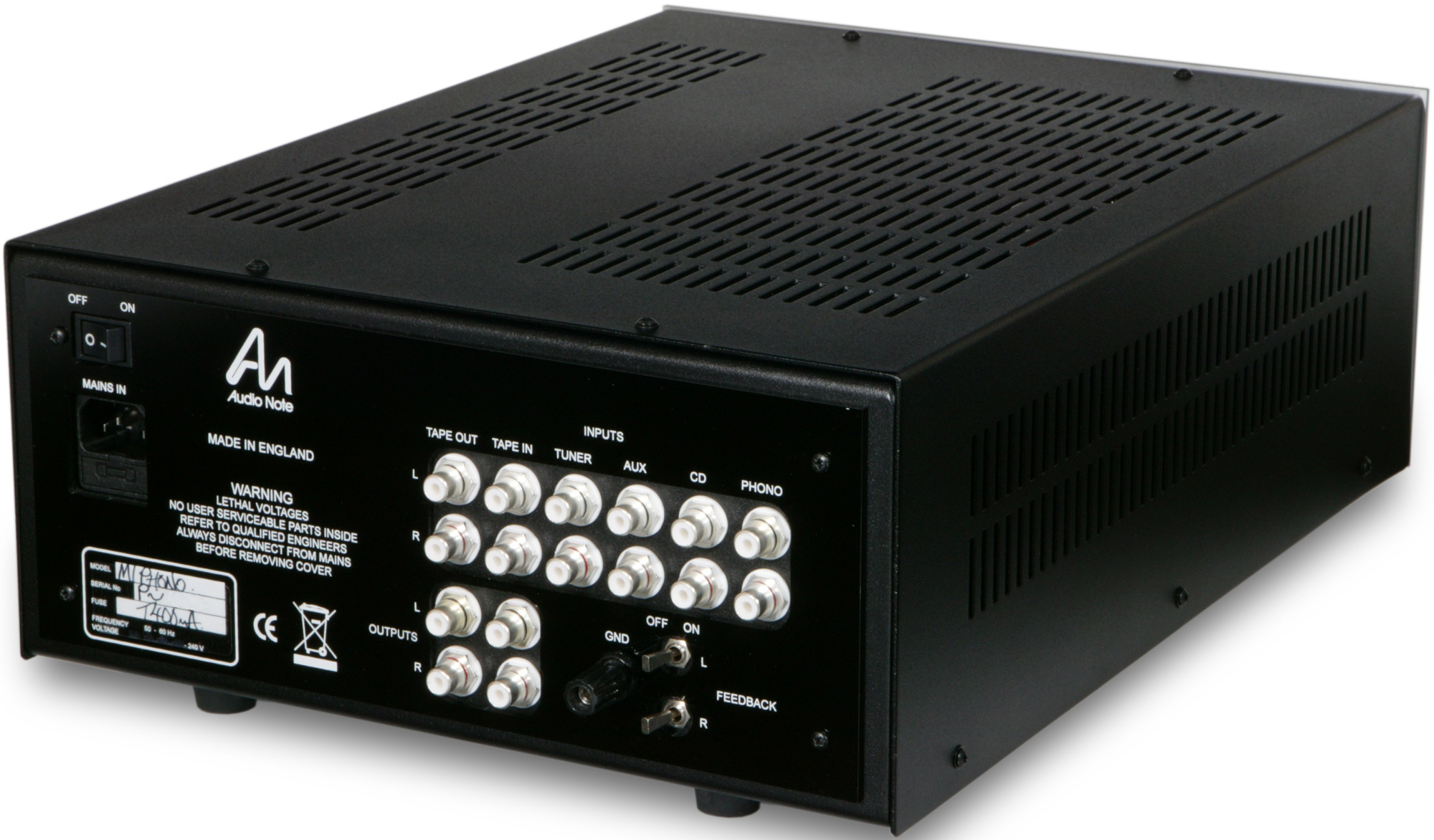
As you can probably gather, this preamplifier, along with the OTO, has been selling for quite a long time and, while they have been upgraded over the years, you are not going to find modern touches like an onboard DAC or home theatre pass through or subwoofer outputs or HDMI; indeed, it doesn’t even come with remote control. The M1 Phono comes with a MM valve Phono stage. You will need an SUT or step-up transformer if you use an MC cartridge. It has three line inputs and tape in/out for recording. On the back, there are also feedback switches near the ground loop connection that are used if you find the volume control too sensitive or you are using long runs to your power amplifiers. On the front, the M1 comes with four selector knobs for INPUT, SOURCE/TAPE, BALANCE, and VOLUME. It’s simple and straight to the point.

The M1 is nicely made and all the selector knobs feel solid in operation and of good quality. Compared to my former Line Magnetic 219IA integrated ($7,500) the M1 volume control is more solid and doesn’t have the wishy-washy feel when turning. To be fair, the 219IA offered remote control, so you are less likely to make physical contact with the volume knob. The same can be said for the wonderful Pure Audio One ($10,000) Integrated amplifier. That volume control felt lightweight as well but the remote control bypasses your touch points.

The more costly Audio Note M3 preamp and models above it use two stepped attenuators, one for each channel, and they have the most solid feel of all. The in-house-made Audio Note stepped attenuators are superb but they require more user attention to ensure setting both channels to the same volume level. And because they are stepped, they can become somewhat noisy if dust gets onto them when making volume adjustments. It does not affect sound quality mind you, but it will require some effort to keep the volume pots clean if you live in a dusty environment.

I had been using the M3 Phono as my reference preamp for a couple of years when I decided to upgrade to the M6. Audio Note largely builds to order with the higher-level items in their product range. With the pandemic, the wait time was to be around 5-6 months for the M6 Phono. My M3 was an older version that used twenty-three resistors while current versions use thirty-six steps. This, if you were wondering, is why I did not review the M3 as it is no longer a current model.

Placing the M1 into my system and firing it up after two years with the M3 was a shock, and not in a good way. The M1 sounded like a discombobulated mess in direct comparison. The M1 sounded lean and thin and somewhat bright. I left it on for about eight hours and used it for TV and movies for the rest of the week. Then I went back to listening to music. Things were considerably better the second week. The M1 still never captured the density of the presentation that the M3 possessed, the M1 always seeming brighter and lighter in tone. If you remember my OTO review, you will note that I said the OTO was on the darker side of the spectrum. But as a separate preamp, the M1 goes the other way with a neutral and more open presentation, although this may be attributable to the power amp and loudspeakers being used for this review.

The post Audio Note UK M1 Phono preamp & Empress Silver parallel single-ended triode monoblocks Review appeared first on Dagogo.

Pass Laboratories XA200.8 pure Class A monoblock amplifiers Review, Part 3 – Conclusion

Read Part 1 and Part 2

With premium program material

The greatest joy of an extreme system is not salvaging poor recordings, it is exulting in superb recordings. Experiencing “you are there” moments, as though planted in front of an artist, is one of the biggest thrills of the high-end experience. In design and execution of my room and system, my goal has been to create the environment of a recording studio such that all extraneous distractions from the outside world are banished. I wish to hear what the recording engineer hears, as though tapping into his mind. I want to envision looking through the glass at the artist performing their piece before the mic.

This system, with the XA200.8 pure Class A monoblocks and the Whisper DSW Clarity Edition speakers, more than any other, gives me the sensation of being right there in the studio. I hear Shelby Lynne’s “Don’t Even Believe in Love” and I think, “What a liar!” I can hear her self-talk not working, because it’s too earnest, too uncertain in her voice. She is getting older, and the spritely, bouncy character is leaving her. But her assurance is increasing. More than with other amp setups, the extra pinch of midrange magic is present with the XA200.8.

Marc Cohn’s Listening Booth is a masterful album, and all the tracks are meticulously recorded. I thrill to the immediacy of “After Midnight” as it is so palpable that you wonder if you could feel his breath; the sense of sitting so close is spooky. The scant percussion and drum work in the background hangs in the air like ornaments dangling around Cohn’s voice. The bass is particularly rich, and the bass solo rendered with a sense of restrained energy that other amps simply have not produced.

One of my favorite live performances is Ginny Owens’ Live from New Orleans, and my favorite song is “Let Love Rule.” The immediacy of the event makes it sacred, and as I have heard this track hundreds of times, the XA200.8 cultivated a distinct richness in her tonality that was lacking with many setups. Without resorting to several cable changes, attempts to tune opamps, or exchanging components, the XA200.8 brought success as Ginny’s every inflection, every intonation was evident, all without the slightest hint of effort.


Guilty pleasures

There is a fair bit of pressure in the industry to showcase systems using what might be termed “audiophile approved” music. Such music must be well recorded and must showcase vocals and acoustic instruments. Solo voice or instrument, symphonic, chamber music, and choral genres are typically approved. Not approved are poorly recorded pieces of any genre, and most rock music, including electric guitar, begins to be questionable. Disdained are pieces featuring synthesized music, which in the opinion of some is utterly worthless in assessment of an audio system. Country music is M.I.A., even though there is now a considerable amount of it that is well recorded. Consigned to the pit of hell are pieces recorded with dynamic compression. Snobbery that often accompanies such distinctions confirms that I am doing a good thing by incorporating both compressed and synthesized music in assessment of systems. Some people never figure out that the problem is their audio system.

I am reminded of an incident that occurred several years ago at a show. I entered a room where there was a pricey, but diminutive system. If I recall correctly, the floor-standing speakers were not four feet tall and had smallish bass drivers. The atmosphere of the room was cultivated to elicit the sense that the system was urbane. I asked to play a CD, and it was not an audiophile approved recording, but was Paul McCartney and the Wings’ “Live and Let Die.” As it played for a minute or two the elder company representative could not contain himself, as he strode over to the system and, removing the disc, declared, “this is garbage! Garbage!” However, the damage had been done— I heard enough in that minute or two to conclude that this was a vastly overpriced and underperforming system. I thought it curious that when I exited, the younger company rep caught my attention outside the room and told me the exact opposite, that the piece was a good selection for assessment. Why did I choose that selection? I was intentionally probing what I saw as weakness in the system, and the music revealed it quickly. I still regularly use that selection in assessment of systems; it was used during this review, and the XA200.8 rendered the song more proudly than any other amp I have used, including Class D amps that are supposed to have phenomenal resolution.

Industry members often keep their personal interest in music tucked away come show time or during reviews. Because they fear the disdain of the politically correct music crowd, they let on as though they are content with the approved musical genres, but in private they listen to their preferred music. It must be acknowledged that there is an advantage to having a fine recording of voices and instruments; I would not be without these for reviewing. Listening to choral pieces through the XA200.8 elevates my spirit. Conversely, putting on any of a dozen or so tracks from the Voices Only series of recordings draws me back down to the earthiness of human singing. More about that in a bit.

I respect the ardor and zeal in production and playback of beautifully performed and recorded music. However, nearly as much can be learned about a system from how it presents poor recordings, or pieces involving more obscure instruments, as long as the music is well known to the listener. I do not disdain approved musical genres; however, I do not spend the bulk of my time listening to them when I am relaxing.

I tend to push back against the expectations of a reviewer’s methods. I previously revealed I do not spend time on burn in. As an aside, some manufacturers know that I eschew that activity, and some do not. I neither advertise nor deny it. To their credit, not a single manufacturer has denied a review for that reason, and they almost universally enthuse that I understood and described the sound of their equipment well. Understandably, some of them, upon learning of my methods, have insisted upon burning in the review component before shipping. I never deny them the pleasure. There is currently a DAC being prepared for my perusal, and the manufacturer will get his two weeks of pummeling it with a signal before I ever see it. Do I think it would make a substantive difference in the outcome of the review? No, not at all, but I do not militate against the pre-review preparations of manufacturers.

A reviewer is supposed to listen over the longer term, i.e., weeks or months, to gain appreciation for what a system is supposed to do, but I don’t. I build more systems than average to gain a better grasp of performance. A reviewer is supposed to use audiophile approved music. Basically, I don’t. I select music in the genres I like that is well recorded. I have the approved music, and will use it, but I do not depend upon it. A critic might say it’s a wonder I can assess a piece of gear. My response is, it’s a wonder that others have such poor methods of assessing gear! I will go so far as to say that the genre of music is secondary as long as it is well recorded, and building more rigs is primary. I think most reviewers have their system assessment priorities backwards.

Last time I looked I had over 800 pieces of music used in reviewing. I have hundreds of fine pieces of music that are both enjoyable and appropriate for assessing systems. However, there are many more pieces of music that elicit joy and strong memories, but would not work the best for my reviewing work. I do so much listening for assessment of performance that I do not often get the opportunity to revisit my “guilty pleasures,” the non-audiophile approved music that I enjoyed decades ago. With the slowdown induced by the Covid-19 crisis I am less rushed to produce reviews and have more time to reminisce while listening. I am going to invite you into a corner of the private listening world of Doug Schroeder, to sit in with me on some of my oldest and fondest synthesized works.

Seriously, Synthesized? Am I trying to rile up the elitists? No, but I make no apologies. In terms of system development, to the same degree that acoustic music can be manipulated to achieve gratification, so also can synthesized music. I have been on the receiving end of the mockery, the dismissal of people who would never use synthesized music to assess an audio system. Well, good for them! As with so many other aspects of the hobby, I tend not to let peer expectations set my agenda. I chart my own path when it comes to the music used to review, or the music I turn to in order to reminisce and elicit strong emotions.

Speaking of strong emotions, synthesized music can do that very thing. You might be laughing now, but it is true. When I was a teen, I swore off popular music, as I discovered how it was rife with immoral lyrics. I turned entirely to instrumental music, and synthesized pieces were represented heavily. For years I had no vocals in my collection! Over time I realized that I was starved for hearing the human voice. Eventually, I applied what might be thought of as a “lyrics filter” to supplement my collection with vocals once again. (Hear hear. –Pub.)

I now turn to some music that I have in CD format up to 35 years old, and have ripped to file for playback. I grew up in the era of ELO, ELP, Pink Floyd, Moody Blues and other heavily experimental, theme album bands. I was selective, choosing to focus on particular selections on albums, and later, CDs that moved me. I was the person who could put on an album, hear my favorite cut or two, pull it off and put on another containing what I felt was an exceptional piece of music. I have no problem butchering an album’s continuity to hear the one or two pieces that I approve. My thought process was, “Why waste my life listening to something I don’t care about?” This makes me no less of an audiophile than the vacuous listener who puts on an album and listens through it, even though it is not redeeming musically or morally.

A short time ago an opinionated forum member attempted to correct me (three times) that very low frequency music (LF) is not worth paying attention to, is negligible in system development, and is likely not very audible. This after I had commented on the beauty of the LF in Pink Floyd’s “Welcome to the Machine.” I looked at his system listing and it featured speakers with loose specs that go down to 40Hz (probably no deeper than 45Hz +/-3dB). I thought, “No wonder this guy doesn’t get LF!” His speakers would be severely challenged to reproduce the bass I am speaking about in the sub 20Hz range, much less render it with fullness and beauty. Played back at a higher level it would be significantly distorted on his system. I can imagine such an audiophile using the approved music, thinking he has close to state-of-the-art sound. When the yardstick used to measure the system is short, it is easier for the rig to seem long on performance! Deficiencies in performance are revealed clearly by pushing rigs to the extreme. Anyone can have a “pretty” sounding system that is not very high performance.

That kind of perspective is endemic in the HiFi community. The truth that few want to acknowledge is that the vast majority of audiophile systems do not sound good with compressed and LF heavy music, and the reason why is that the systems can’t handle it. They are simply not that good. It takes a serious audio system to make such music sound good, and the more extreme the rig, the better it sounds.

The post Pass Laboratories XA200.8 pure Class A monoblock amplifiers Review, Part 3 – Conclusion appeared first on Dagogo.

Pass Laboratories XA200.8 pure Class A monoblock amplifiers Review, Part 2

Read Part 1

Critical importance of the amplifier to a system

I tried various configurations of equipment to gain an understanding of what the XA200.8 was contributing. Here is one example of a streamlined system intended to have the XA200.8 play a dominant role:

Small Green Computer AP i7 4T Roon Server ($2,855) and SONORE Signature Rendu SE optical ($3,445)

Clarity Cable Supernatural USB 1m (call for price)

Exogal Comet DAC with PLUS Power Supply

Schroeder Method (assembled double IC) Clarity Cable Organic XLR (2m) Interconnects using Audio Sensibility Statement SE OCC Silver XLR Splitter Cables (contact for price)

Pass Labs XA200.8 Mono Amplifiers ($42,000)

Clarity Cable Organic Speaker Cable bi-wired (call for price)

Tri-art audio B series 5 open speaker with crossover ($5,280)

All power cabling was Clarity Cable Vortex Power Cords (call for price)


The result with this system was very good; not the best I was able to achieve with these amps, but better than many systems in the past with dedicated preamps. In 2015 at the time of my review of the Pass Labs XP-20 Preamplifier and X600.5 monos, their total costs were $30,600, and yes, the setup of this review, where an $850 DAC is connected directly to the $42,000 pair of the XA200.8, exiting through $5.3K speakers, is much better. The results show that it is possible to achieve superb results with a highly price-imbalanced system and without a proper preamplifier. It is certainly not recommended as the best way to build a system, as will be seen below. However, it can be done if a person so chooses diligently.

The result also shows that the amplifier(s) have pervasive influence upon the system. Often in the past I have used the consistently appealing Exogal Comet (integrated) DAC and Plus Power Supply, along with the Clarity Cable umbilical, with a variety of amps, but none of those former combinations bested the Eastern Electric Minimax Tube DAC with the XA200.8. Before any reader misinterpret what I am saying, thinking that the Minimax is therefore a “giant killer” that will perform on the level of perhaps a $10K DAC, such as the COS Engineering D1 DAC + Pre-Amplifier, allow me to clarify; I am certainly not saying that the EE DAC is a category buster, or that it can be paired with any old amp and get a remarkable result. Rather, I am saying that the prodigious capabilities of the XA200.8 are such that even when paired with the most modest DAC on hand, the results are highly pervasive. Like a tide surge, the XA200.8 lifts all boats enormously, and fairly determines at what level a pair of speakers will play.

I had similarly wonderful results during my review of the nifty Kinki Studio EX-M1+ Integrated Amplifier, one that is valuable to anyone who wants a high degree of flexibility in system development, such that it could operate as a dedicated preamp, dedicated amp, or integrated amp. In all three modes it was recommendable on its own, although the preferred mode of its operation was as a dedicated preamplifier. I have little doubt that the reason is because in that mode it functioned as a preamp for the XA200.8. Here, then, were two very different products, both paired with the Pass Labs monos, and both products shone their brightest. Does that mean the XA200.8 will likewise cause your components to sound their best? To gain perspective on that the reader may wish to investigate the section of the Tri-Art Audio Series B 5 Open Speaker (and associate components) review, paying attention to its use with the XA200.8 monoblocks. The upshot is that these amps made the $5,300 speaker system sound mighty grand!


Comparision to the Sanders Magtech monos

The Sanders Sound Magetch Mono Amplifiers were a good product to compare to the XA200.8, as both are designed to be statement products that drive speakers with difficult impedance loads. Roger Sanders developed some novel, patented technologies that he claims allow his amp to operate without limitations of more traditional designs. More different specifications in regard to high-power, solid state amplifiers could hardly be found. The Magtech Mono is rated at 2,000wpc into 4 ohms versus the XA200.8’s unrated output into 4 Ohms. I suspect the XA200.8 doubles into 4 Ohms, as would be expected, but Pass Labs is typically conservative on such measurements.

So, what happened in the comparison between the Magtech, with its double take specifications, and the understated XA200.8 as they both drove the Kingsound King III electrostatic speakers? The difference, in terms of what one might expect of the dynamics based on specifications, was surprisingly inconsequential. The macrodynamics of both were excellent, and neither one clobbered the other when it came to the gross operations of powering the speaker.

However, the nuance, refinement, headroom and gorgeousness of the XA200.8 rendered it superior to the Magtech. In comparison the Magtech was like a behemoth Class D, while the XA200.8 was like a monstrous tube amp. When using either with the Exogal Comet directly, both pairs of monoblocks operated near the limit of their output for the gain of the Exogal was not as high as an active preamp. One would think that on paper the Magtech would have blown the doors off the XA200.8, but that did not happen. It was like a photo finish in terms of listening level and authority to drive the King III.

It was anything but a photo finish when it came to intangibles; the King III sounded more erudite and spacious with the XA200.8. Acoustic Alchemy’s “Notting Hill Two-Step” has a punchy bass line that with the Magtech sounded nice and rounded, until heard with the XA200.8. The sense of fullness of an amplifier is difficult to peg until a direct comparison is made. Both the Magtech and the XA200.8 produced the lowest frequencies, but there was less fullness to the notes with the Magtech. The Pass Labs amps also made the bass notes more resonant, versus being flatter notes. Add to this the capacity of the XA200.8 to reveal the extent of the soundstage more deeply, and the instrument, as well as the ambient field it occupied, became more tangible.

More telling are pieces of music such as “Blazin’” by David Dyson. Here, deep LF notes form the strata upon which the electric guitar dances. The Magtech produced these LF notes, but not with nearly as much 3-D character as the XA200.8, which not only had better weighting to the LF notes, but even some roundness of the sort that is usually descriptive of an upright bass. These are extreme examples, which focus on the very bottom frequencies, but the sense of roundedness and fullness via the Pass Labs is heard throughout the spectrum.

Many soprano voices are irritating to me, as they smack of the nasal, whining nature of pop singers. Some female artists have exquisite power, but the recordings are piercing, stabbing in nature, spitting out syllables like daggers, like those of Sarah Brightman. What can be done to help with enjoyment of such artists? My first recommendation is to avoid a Class D amplifier. As a lot, I find class D unable to soften and warm the soprano artists that I consider edgy. The Magtech does better, but it doesn’t quite finish the job. The XA200.8, on the other hand, “matures” these voices by adding copious warmth, while improving subtleties, to keep them from irritating like metal tines of a rake scratching a driveway.

The determinant factor, then, between these two powerhouse amps is not power; for such oddly disparate designs they sound uncannily similar in dynamics. The determinant factor tipping the scales in favor of the XA2008 is refinement. A lesson, then, for those enamored of impressive specs is that the extreme build of the classic Class A was superior. Two thousand watts per channel sells a lot of amps for less efficient speakers, but it was the XA200.8’s 200wpc that drove the King III just as well, and with the nuance of a state-of-the-art transducer.

Comparison to Kinki Studio EX-M1+

The performance of the aforementioned Kinki Studio EX-M1+ is also compelling, that is until it is compared to the XA200.8. To create as fair a comparison as possible, I used the least advantageous system configuration aforementioned for the XA200.8, the DAC-direct method with the cheapest DAC sans preamp, the EE Minimax Tube DAC Supreme, as compared to the EX-M1+ as an integrated amp. My rationale was that this is the least expensive of the optional XA200.8’s setups, and would tell me if there was an inherent differential in performance with the XA200.8 operating with one arm behind its back. The EX-M1+ is a class A/B design and has 215 wpc (versus 200wpc for the Pass). On paper the sound character of the EX-M1+ should be closer to the Pass Labs than the Magtech Monos.

In discussing this comparison, I will begin with an illustration. When my youngest son took possession of my Kawasaki Versys 650 (650CC), we went for a ride, he on the Versys and me on my new Yamaha FJ-09 at 850CC. The larger engine is chestier, deeper, more visceral —it sounds like it will be much more badass, and it most definitely rides more badass! In a similar fashion, upon startup it was immediately obvious that though the specs show the EX-M1+ as being slightly more powerful, it pales in comparison to the XA200.8. That is a good thing for Pass Labs, since the Pass mono amps are about seventeen times more expensive! It would be appalling if the XA200.8 performed like the EX-M1+!

The field of comparison had now shifted to the opposite end; whereas the Sanders Magtech Mono was dynamically powerful, the EX-M1+ was weaker, and while it was closer to the XA200.8 in terms of dynamics, there still remained a sizable gap. One of the most noticeable differences between the two amps pertained to the depth of field and extension of the sound stage. Images as heard through the EX-M1+ seemed relatively shrunken and shallow, lingering in the foreground. Conversely, the XA200.8 thrust back the boundaries of the acoustic space, filled it with more ambient information, and populated it with properly sized instruments and singers. As I have found in the best equipment, the scale of the performance is superior.

This comparison happened after the EX-M1+ had been upgraded through a concerted effort of discrete opamp rolling to bring it to top performance. Yet, the XA200.8 in its native form was dominant in every respect. The EX-M1+ is an intelligently designed integrated amp, but in comparison shows why it is so difficult for even a nifty design to compete well with the overbuilt and thorough design benefits of this .8 Series amplifier.

I may have once again opened myself up to criticism by the elites for pairing an affordable DAC with a megabuck Pass Labs amp. A DAC can lack a high enough output to take full advantage of an amplifier. That is a real concern, and it was the reason why I couldn’t drive the King III well enough to higher listening levels. While the EE DAC was in use, even with the XA200.8 I had to open up the attenuator nearly full when driving the King III speakers. There was some relief using the Exogal Comet; the digital readout during a typical listening session floated between the output level of 90 and 95. For the XA200.8 in use with more difficult to drive speakers an active preamp would surely be preferable. Pass Labs is preparing a preamplifier for review, and I suspect that will resolve all such issues.

A couple of things should be remembered, starting with the reminder that very inefficient speakers are the only ones that will potentially cause the XA200.8 to operate at its upper limits. Even then, there is no slouching, clipping, or sense of strain at all. It is composed and evenly powerful and relaxed as though it has no limits.

The second point to remember is that in my experience all speakers react well to an extremely powerful amplifier with a highly refined design. The easier to drive speakers I used with the XA200.8 benefitted in the same ways as the King III. The PureAudioProject Trio15 Horn1, with its 97dB sensitivity rating, when put through these same amplifier comparisons exhibited similar benefits and,critically, without any noise. All speakers benefit from a well-tempered, powerful amplifier like the XA200.8. Though I am not taking the time to elucidate the experiences of this combination, be assured that the outcome was in conformity with those reported for other speakers in this article: a new reference sound.

When it comes to system building, a shortened signal path with an iconic amp is very difficult to beat. It can be a daunting proposition to build a system using a super-amp without a preamplifier. Would you lay out money for an amp that was perhaps twice the cost you intended on spending, and cut your preamp budget to zero? See what I mean by daunting proposition? It seems a fool’s errand, but when the components are sitting in front of me confidence in the method is reinforced.

By the way, the Kinki Studio EX-M1+ has been billed as something of a wonder-component, as though it is a “giant killer.” Perhaps that is true in regard to some other components, but it is not true in regard to its use as a power amp compared to the XA200.8. The Pass Labs mono amps steamrolled it performance-wise. Were you to drop the XA200.8 onto the EX-M1+ from a great height, as sturdy as the Kinki integrated is, I suspect it would be a tough outcome.That’s basically what happened to it sonically when I “dropped” the XA200.8 on it. Yes, yes, budget audiophiles are absolutely correct, the price differential is extreme. However, the sonic variance was not small, and comparatively the EX-M1+ sound seemed fabricated rather than authentic.


Scary audio systems

Aside from installation and operational issues, there are three kinds of “scary” systems in audiophilia. The negative form of scary audio system is one that sounds so poor you desire to exit the room. Then, there are audio systems that hold you fast to your seat. Why would they be “scary”? I can think of a good reason — the price! It is exhilarating, but potentially scary, to contemplate an audio system that checks all the boxes for scintillating sound yet costs lightyears beyond one’s budget. One fear is that the performance of that system cannot be achieved without spending a small fortune. It was that kind of fear I had when as a postgraduate student I visited a high-end store and had opportunity to hear the Magnepan Tympani IV. I feared that anything so exorbitant would be far beyond my reach in life. I was convinced that if I listened to it, I would be spoiled forever. That was not an entirely unfounded fear, for the possibility of having one’s contentment ruined by an extravagant experience is a possibility. Our aesthetic expectations do not tend to scale down, but up. Experience teaches that it takes a significant amount of money to put up a stellar rig. The odds are vastly against getting a similar outcome on the cheap.

What follows sounds contradictory, but rarely (in my experience, about 1 in 25 systems) is true; the third type of scary system is one that defies convention and is substantially less expensive than might be expected. It often involves an alternative setup that does not follow convention, and thus is unknown to most hobbyists. Once in a while an alternative system is scary good.This has happened to me perhaps ten times in 13 years of reviewing and assembling hundreds of systems. The scary thing about such a system is the realization that many will spendso much more for mere incremental improvements in performance. Thrifty audiophiles desperately wish to have such a system, but they typically do not. The odds are greatly against anyone who does not build many, i.e. dozens, of systems achieving that kind of result.

Might you surmise that the Pass Labs XA200.8 Monoblock Amps are in such a scary system at the moment? Yes, you may. Here is the above system reconfigured to remove the Exogal Comet DAC and insert a dedicated DAC and dedicated preamplifier. The system is not as streamlined as above, however, it took a decided step forward in performance:

Small Green Computer AP i7 4T Roon Server ($2,855) and SONORE Signature Rendu SE optical ($3,445)

Clarity Cable Supernatural USB 1m (call for price)

Eastern Electric Minimax DAC Supreme with Burson V6 Vivid dual discrete opamps ($130/PR) and Sparkos Labs SS3601 single discrete opamps ($78/PR).

Schroeder Method (assembled double IC) Clarity Cable Organic RCA Interconnects (2m; contact company for pricing) using Audio Sensibility Statement SE OCC Silver RCA Splitter Cables ($139/PR)

Tri-art B Series preamplifier ($1,425) and B Series dc linear (tube buffered) power supply ($630)

Schroeder Method (assembled double IC) Clarity Cable Organic XLR (2m) Interconnects using Audio Sensibility Statement SE OCC Silver XLR Splitter Cables (contact for price)

Pass Labs XA200.8 Mono Amplifiers ($42,000)

Clarity Cable Organic Speaker Cable bi-wired (call for price)

Tri-art audio B series 5 open speaker with crossover ($5,280)

All power cabling wasClarity Cable Vortex Power Cords (call for price)


Perhaps as you perused the system listing you saw the “scary” part; the entirety of the system apart from amplification, including a generous estimate of the cabling prices, is approximately $30K, while the amplification is $47K. The amplification represents 61% of total system cost! An even more radical finding is that the preamplifier and tube buffer represent just 4.2% of the entire amplification scheme. The amps represent 95.8% of the amplification scheme!

How many of you are mentally scoffing, “That’s NOT HiFi!” Oh, yes, my friend, it is! When this obscure and obtuse system performs on a level with some of the most well-balanced and costly preamp/amp combinations I have used, it is high end. It is an extremely imbalanced system in terms of resource allocation, yet the performance is as fine as “balanced” setups involving more costly components I have reviewed.

You read that correctly, the preponderance of preamp and amp combos I have used did not achieve the quality of this system. How can that be when I am using a preamp and power supply costing a mere $2,055? Part of the answer has to do with devices called discrete opamps, which can be rolled into certain components with socketed opamps that are amenable to it. They confer a pervasive influence upon the component and offer a variety of ways to contour the sound. The Eastern Electric Minimax DAC Supreme is chock full of them. Read more about this at my most recent article on the subject, “Audio Blast: Return of the Opamp Roller,”and, if intrigued, follow my trail of articles back to 2011-2012 when I first wrote about it here at Dagogo.

Aside from this, there are two advantageous aspects to this system that cause it to leapfrog many traditional systems. One is that the Tri-Art Audio Series B Preamplifier with Linear Tube Power Supply is avant-garde, a passive design with very unusual methods employed in construction, including stripping the plastic from internal parts and stuffing it with lamb’s wool. Now, I’m not a touchy-feely guy in terms of design. I was not terribly impressed by the presence of Bybee products inside the Wells Audio Innamorata, and I won’t give you ten seconds of my interest for brass bowls and baubles to place around the room. Whatever tri-art is doing inside the Series B preamp and tube buffer is not Voodoo audio, it’s efficacious design. Somebody knows their craft, and the proof is revealed when it is paired with extreme amplification. I do expect this little wonder to be outclassed by the Pass Labs preamplifier when it arrives, and this should be no wonder.

Secondly, the amps are vastly overbuilt and ridiculously robust in terms of build, parts quality, and sound. Why should it be surprising, then, if a preamplifier benefits in the same way by association as the aforementioned DAC and speakers? These monoblocks represent not typical amplifier design but extreme amplifier design. Consider that circuit paths are shortened by fractions of inches to improve sound quality. The Pass Labs Supersymmetric circuit has been successful long term partly due shortening each channel’s signal path. Also, instead of being built to spec, the XA200.8 is built to a performance expectation. Subjective listening evaluation is given high priority, seemingly higher than in the past when the amps were largely the product of one designer’s volition. Kent English of Pass Labs shared that the .8 Series departs from the .5 Series in that the older models did not involve group listening evaluation, but the .8 Series does. Amps in the .8 Series were passed around to members of the evaluation team, and the impressions were used to tune the amps’ performance. That was a brilliant move on the part of Pass Labs.

As I intimate above, the result to my ear is markedly different than the .5 Series, which was admirable technically but lacked the warmth that is found in amps such as the Wells Audio Innamorata. I stated previously that the First Watt J2 was the most resplendent of the Pass products I had used. That is no longer true; I hear a beauty in the music with the XA200.8 that dare I say even supersedes that of the J2. Here is an amp that is formidable, and with a personality of the sweet, beguiling First Watt brand. I have never had in my room a solid-state amplifier with such seemingly disparate characteristics expressed in one design, brute force and fawning beauty, and it is captivating!

Welcome to the weird and wonderful world of audio! Would you consider it exhilarating or disturbing to find that one of the best sounds of a dozen rigs established with the Tri-Art Series B 5 Open Speaker was accomplished with the most mockable, lopsided combination of gear? I find it disturbing that I cannot predict such combinations, but I also find it exhilarating to explore the fringes of performance and discover rule-breaker systems. Of course, it is not the set of rules governing electronics theory that is violated, but rather the expectation, the received wisdom of how one is to go about setting up a system.

The shocker with this system was the voluptuous midrange. Beyond generous, more than ample, the rich and seductive midrange with the fabulous coherence of the 8” full range of the 5 Open are an irresistible combination. Evidence of this lay in my inability to advance tracks in conducting assessment of the sound. Normally I can listen to a minute or two of a recording, imprint the sonic character, and add it to the milieu of the playlist as a description of the component under review. Not with this system; the remote sat untouched for the entirety of all tracks.


Happy to be stuck with you

Thirty-four years ago, in more carefree times, Huey Lewis and the News sang, “Happy to be Stuck with You.” If ever there was a time when I was happy to be stuck at home, it is now, for (prepare to have immense pity for me, my friends!) I am “stuck” here doing a long review of the XA200.8 Monos! Pitiful me that I have to extend the listening and note taking time. What a shame! Can’t you sense my distress at this situation?

More like de-stress! When I hear the tried and true combination of the Legacy Audio Whisper DSW Clarity Edition Speakers with the supple, well-muscled XA200.8 it is the auditory equivalent of slipping into a hot tub to relax the muscles. As I listen, I relax, for the waves of sound caress my ears and sound so right.

The odd dance of the DACs was in full swing with this setup, for the very agreeable system featuring the Exogal Comet DAC and the Tri-Art Audio Series B Open 5 Speakers did not seem as “perfect” when I swapped out the speakers for the Whispers. Do not misunderstand me, the performance was quite elevated, with substantial increases in presence, dynamic power, headroom, bass extension, and midrange warmth, which is why you pay much more than the 5 Open, $24,750 for the Whisper XDS version. There was the expected broadening of the center image due to the quad of 7” mid-bass drivers of the Whispers, and the treble was delicate and diffuse due to the ribbon tweeters. It was a prominent move forward in terms of sound quality.

Even though the authority and subtleties of the XA200.8 were on display, I had a nagging feeling that the rig wasn’t fully tuned. Usually when I have a nagging sense of incompletion it is due to some aspect of system building that has been overlooked. It took me a week to recall a trick that had paid off in the past: doing a comparison between use of the software versus the hardware attenuation. Roon’s user interface allows playback with the software volume control set to “Fixed,” and I tend to use that setting when employing an integrated DAC like the Comet. When I switched over to the COS DAC D1+ Preamplifier, which is also integrated, I did not remember to compare the Roon software volume control with the DAC D1+’s internal volume control. I simply kept the setting at “Fixed” on the Roon software and used the D1+’s volume control.

What a mistake that was! After I swapped the controls, using the Roon software volume control and upping the output of the D1+ to max, it was as if a damn had burst! Phenomenal amounts of richness poured forth, the amps seemed to be taken off of conservative mode and put on “performance” mode. Remember the analogy of Toyota Camry vehicles? This was the ideal blend of luxury and performance! I had made this transit back and forth between attenuation devices before, but had never experienced as much of a “rock your world” impact when doing so. I urge those who are skeptical not to get stuck in the objection, “Bits are lost when you use the software volume control,” yada, yada, yada. Frankly, I don’t care if bits are lost or not, I care deeply whether the performance is superior, and I use that which is superior.

One of the first tracks I queued up was Bass Addiction’s “Metropolis,” and I was gratified to hear the Whispers attaining better LF in terms of power and cleanness than with any amp reviewed previously (feel free to look at the list). The results reminded me of when I add the Legacy XTREME XD Subs, each bearing twin 15” woofers, into the system with the Whisper DSW!

This is insanity, right? Wrong; this is unorthodox system building, and it is one way to discover fantastic performance. I went straightaway to vocals, starting with Mandy Moore’s “Forgiveness,” and all traces of the Brittany Spears wannabe had vanished. In its place was a gorgeous, husky-voiced alto with an attitude. This is what I have been after! Her honey-dripping vocals —even though condemning the offending party in song—were so sweet. No amp has ever paired so succulently with the Whispers. Descriptors such as “mature sound” and “fulfillment of ideal” charged through my brain.

I had gone down for a quick listen and it extended to over three hours. It had not culminated before I played the live recording of Lyle Lovett’s “North Dakota,” which had always been raspy and too sharp for my taste, but now held perfect tension between irritation and fascination. That is the way it went with track after track; all the “close but no cigar” singers who were my evidence of a system that had not been perfected were now… perfect. I couldn’t make anyone sound unlistenable, not Alyson Moyet‘s “Invisible,” nor Paul McCartney and the Wings’ “Live and Let Die,”and Simple Mind’s “7 Deadly Sins.” With most amps I am stuck with these songs rendered in an unfulfilled manner. Now, with the XA200.8 Monos and the Whispers, these enjoyable performances with awful recordings could be enjoyed without irritation.


NEXT: Part 3 – Conclusion


Copy editor: Dan Rubin


The post Pass Laboratories XA200.8 pure Class A monoblock amplifiers Review, Part 2 appeared first on Dagogo.

Pass Laboratories XA200.8 pure Class A monoblock amplifiers Review, Part 1

Why review the XA200.8

Two years ago, I made a decision that changed my audiophile life. I went to a big box home improvement store where I spied some furniture dollies, and a chill ran down my spine. I was ill prepared should I review some big, immensely heavy amplifiers, ones well past 100 pounds. But if I had some sturdy stands with casters, I could manage to move such amplifiers around and avoid strain on my back. The thought was especially pertinent as I build a lot of systems. My methodology in reviewing is not to wait for a predetermined period of time for a new component placed into a system to settle, or burn in, but rather to get right at it, and I build as many systems as I can over the review period to find out how the component interacts with other gear. I feel this is a superior means of assessing audio equipment versus waiting for something magical to happen. I will learn much more about a component by using it in five systems than I would by playing it for weeks and perhaps making one or two changes to the system.

Because of my methodology, I move all components and speakers regularly. I build new systems every few weeks, and many more discrete systems having slighter changes. It has amounted to hundreds of rigs over the past 13 years. To maintain that pace, I move amplifiers in and out of the system several times during the review period. I needed a way to handle beefy amps efficiently, much the way I determined to put casters on the Vapor Audio Joule White Speakers because they are quite heavy and would be a PITA to move regularly in and out of the listening room. That decision was serendipitous, as the speaker benefited from the approximately 2” lift in soundstage that was conferred by the addition of casters, bringing the speaker’s sound closer to the large towers I have used. In addition, I did not elevate the speakers evenly, but slightly raised the back of the speaker higher to tilt forward the front baffle, thus bringing the top module’s alignment closer to ear level, a maneuver that influences the intensity of midrange and treble relative to the bass output and improves the coherence of the speaker.

The furniture dollies were quite long, made of unpainted 1×4” hardwood, but they had solid, sizable casters. I must have presaged this review, because two years before I used them, I bought, cut down to size, painted and stored those “amp stands.” This is the review for which ambition was rewarded! I was originally going to do a review of the XA30.8, which, were I to move it about the room, is a manageable 88 pounds, but as we shall see destiny demanded that these homemade stands be put into service! As a point of fact, I do not believe in luck (and neither do gambling interests). I do believe the saying, “Luck is when preparedness meets opportunity.”

For those readers who are disgusted by the idea that I am reviewing Pass Laboratories’ largest XA Series Class A monoblocks on furniture casters, please feel free to contain your disdain. The rest of us, who understand that an amp’s sound is no more harmed by placement on cinder blocks or furniture dollies versus a $10K audiophile stand, are managing quite nicely. My informal testing over the years has shown funky furniture to be of little consequence to amps compared to what happens with the power and signal path. Besides, I know things about industry insiders (read manufacturers) who place components in the most bizarre ways but do not publicize it; by their actions they pay little attention to the foundation upon which their gear sits.

Another thing you should not expect me to discuss, much less endorse, is the controversial phenomenon of “burn in.” When I say it is controversial, I do not mean to challenge the idea that capacitors age, or that speaker drivers can have measurable differences over time. I am saying that the hand wringing about how long to burn in an audio component is a waste of time. I will not digress at length here, but feel free to read my Audio Blast: Thou Shalt Not Overemphasize Burn In, in which I put it to test and found it entirely lacking in merit. Few things in audio have failed my Law of Efficacy as spectacularly as burn in. If you feel that I cannot judge a Pass Labs amp without 100-200 hours of burn in time, please keep your excoriating comments to yourself, because I am not inclined to respond to you if you wish to make a stink about it. Now, to those who are more interested in a variety of systems being built to assess this amplifier’s performance, let’s proceed.

How did making homemade amp stands change my life? I wish I was not getting wussy, but at 57 I’m starting to think a lot more about the oversized stuff I’m hauling, first down, then up the basement stairs to and from the listening room. Weight of a component has become a variable I pay more attention to than ever before. I am reminded of Karl, a member of our church and a natural athlete with whom I played basketball for a number of years. When Karl was about 55, he pulled back from participation in the church basketball league. I ribbed him a lot about it, as I was 45 at the time and thought I would push on past that point. Humility comes with age, as does soreness! Four years ago, two years before Karl, my joints and general health dictated that I also quit. Humbled, I admitted to him that I could feel in my bones why his decision was made.

Just as I relish large speakers for their dominant sound, I still enjoy the incomparable headroom of an amplifier with classic design, and that usually means a lot of weight. Nevertheless, I spent the past two years relishing the diminutive First Watt J2 amplifiers. While purposing them for more suitable speakers in the review, I harbored the hope that two would be just enough to handle my beloved Kingsound King III electrostatic speakers. I revealed in my review of the J2 that I preferred it holistically to the beefier XA160.5 and the mighty X600.5 monos. Yet, the J2 did struggle with the King III. I had to push the amps to their limit, and every so often the circuit protection would activate, shutting a unit down. Thanks to First Watt’s robust quality, similar to Pass Labs amps, it never skipped a beat. A brief cooling period and cycling of the power unfailingly brought it back. I wonder if that point may be absent from the J2 review, as with time I pushed it more to its limits in an effort to achieve higher listening levels and better dynamics with the King III. Lately, my goal was to sneak in an article on the new .8 series, perhaps the XA30.8, to retain the tenderness and get a smidgen more power.

I have two members of the Pass Labs team to thank that this is not a review of the XA30.8.  At AXPONA 2018, I opined to Pass Labs President, Desmond Harrington, that I was in search of a bit more power, but without giving up the sweetness of the J2. Knowing my experience with the .5, he said the .8 series was different from the .5 Series, and that I likely would enjoy it much. He encouraged me to tackle the XA160.8, and I concurred. After all, I had some amp stands waiting in the basement. I would wait for the next set of XA160.8 to be made. When the appointed time came to check in on the progress and establish a delivery time, I was in conversation with another Pass Labs employee, Kent English, who said that the set of XA160.8 were slated to be sent to RMAF and would not be readily available. However, he noted, there was a set of XA200.8 monos boxed up with nowhere immediate to go. I balked – after all, they weigh 157 pounds each! He had some great stories to tell me, including how he had to move these amps up a flight of stairs alone and did so by walking them up the stairs, lifting them end over end. He said, “We’ll figure something out. There’s always a way…” I would like to publicly thank these men, as by their encouragement they have made me a most happy reviewer! Meaning no slighting of the XA30.8 or the XA160.8, I am glad that these amps are in my room!

I sound like such a wimp, especially since I still do an hour of cardio or weights six days a week. The big reason I am leery of heavy amps is that I have heard horror stories of guys my age and older screwing up their backs. I do not want to wrench my back and have troubles forevermore. You can’t blame me for such caution, as I know firefighters, mechanics, steamfitters—people who handled heavy stuff —whose backs are shot. I do not wish to be among them, especially from voluntary involvement with mongo amps. But Kent was right, I found a way, which I will explain shortly.


Hot topic

One potential challenge in ownership of such a hot build as the XA200.8 is the operating temperature, which is significant. I recall reading about enthusiasts with Class A amps who rotate them into the system as seasonal heating and cooling demands changed. I can understand the impulse; my room is very energy efficient. The truth is not stretched to say it is built like a vault for acoustic purposes, and is so solid that it only needs 1 supply vent and one return vent. It holds the air so completely that in the heat of summer I keep a polar fleece in the room to take the chill off the air that comes from the AC, and in the deepwinter I go down to the room in shorts and T-shirt, even if it is -20 degrees outside! In that environment, when the XA200.8 are on for 1.5 hours with the door shut, the room becomes toasty. My simple solution is to manage the air temperature by opening the door to the room, which allows the cooler basement air to filter in, allowing for longer listening sessions. Years ago, I used to chafe at the idea of listening with the door of the room open, but now, in an empty nest home, quiet is the norm. With age some things are no longer critical. If the XA200.8 demands room conditioning to hear it, the door stays open and I can listen as long as I wish.

Weight and heat are everyday realities that impinge on the audiophile’s idealism. The first thing I thought about when Kent prompted me to take the XA200.8 for review were those homemade amp stands with casters! Preparation came back to bless me in this review, especially since the XA200.8 has allowed me to push the envelope on system configuration in a way that has not occurred previously. Perhaps you, too, will overcome some shyness to lay hands on these brutal beauties.


Installation

Oh, what travails I have when reviewing (thanks for listening; you are a true friend)! Having unburdened myself, I will explain how I received and installed these amps practically by myself. I’m not supposed to have done this all alone, but Kent encouraged me to not be overwhelmed, as he had to find clever ways of moving the amps himself when help wasn’t available. If he could do it, then I would as well —after all, I have both a hand truck and a furniture dolly!

The thoroughly defensively packaged XA200.8 weighs the better part of 200 pounds, and thus they arrived unscathed from shipping. As with other heavy objects that are on the edge of my capability to move down the steps alone, I have my wife assist by steadying it at each step. She is well aware that were I to stumble it would likely crush her; what a trooper! There is no higher token of true love to an audiophile, but that a wife lay down her life for his listening enjoyment! A bungee cord tight around the thick cardboard outer box was sufficient to keep it pressed to the hand truck.

Once downstairs I kept the lettering on the side of the box upright, presuming that it would orient the amps correctly for removal by opening them up and turning the box over to release the amp. That presumption proved correct, and soon enough the amps were free. Moving them into the listening room required the hand truck, and this time I employed a trick that Kent shared with me. I placed two equally thick paperback books (I did not know paperback Bibles exist! –Pub.) toward the edges of the floor of the hand truck, creating a sizable gap between them. The thick protruding .5” thick ring of the amp’s faceplate meter sat between the protective books as I moved the amp face down on the hand truck, bottom to the outside —perfect! Make sure you have rubber padding on the front of the hand truck when doing such maneuvers or you risk marring the item you are moving. Adding to the elation, when I approached the positioned amp stands, I maneuvered the front thick rubber footers at the bottom of the hand truck directly onto the amp stands. In a slow-motion balancing act, I lowered the amps onto the stands, causing the stands to snap to attention, standing nearly vertical with the footers on the bottom wooden cross member. The large, non-slip footers gripped well enough that they held the amps in place as they were lowered onto the stands. The immense weight on the front casters caused them to sink into the thick Berber carpeting and underlay such that they held their position as the amps and the back of the stands were lowered together. The process was so smooth and relatively easy that I paused for a moment to admire the result, for all the variables lined up perfectly to make it painless. No strained back during this installation! Kent would have been proud of me!


Straightforward

Thankfully, Pass Labs and First Watt amps are among the most user-friendly devices in high end audio to operate, likely a factor in their popularity. Their complexity is internal, their simplicity in use makes ownership a snap, and their reliability is well documented. They are so robust that they can handle mishaps, such as a dead short, that would ruin many other amps.

The .8 series, like the .5 series, retains the clean, industrial façade and fearsome heat sink fins of classic high bias amps. I appreciate the large meter with the powder blue illumination, and although it is not a great departure from the former, I find the front more appealing than the .5 Series. The arguments online about the meters on Pass Labs products provide mild entertainment. If you want to see much ado about nothing, observe audiophiles bickering about meters. The meter on the XA200.8, according to the Owner’s Manual, “…reflects the bias current through the output stage.” For those worried that the meter does not sit in the correct position, the Manual explains that for the X series the wand sits around 10 o’clock, while in the XA series the wand sits around 12 o’clock. My prideful self considers my audio system flawless, because in the first half hour of use the wand migrates from 1:00 to high noon, and it never budges from there.

The consistency of the needle’s pointing northward is so reliable that it reminds me of Quartz Lock indicators on old receivers. When it comes to performance, I prefer a wan Pass wand to a vigorous needle of most brands. That is especially so given the rock-solid reliability of Pass products. A while back, perhaps two or three years ago, I was told confidentially of a different brand’s amplifier that looks like jewelry and sports an obnoxiously large, fancy meter with green illumination— it needed repair three times. You don’t hear of things like that happening to Pass and First Watt products. The most upscale gauge in the world will not redeem an amp that needs repair three times. Knowing the types of glitches that can happen to even high-profile manufacturers, I appreciate the motionless Pass Labs meter for what resides behind it!


Advancements over the .05 Series

If you want to see technological advancement in a seemingly negligible feature, then consider the binding posts of the XA200.8, which have a “wing” style protrusion for easier turning and a pressure release system. Similar to the snap of a car’s fuel tank to indicate that the cap has been closed fully, the binding posts, when cinched down, click and thereby release pressure on the assembly. The spade remains tightly cinched. With as much wrangling of wiring as I did during this review, the posts never loosened a smidgen. They score high marks for visibility and ergonomic efficiency.

There is a thorough discussion of the more formidable improvements in the .8 Series in the download “Point 8 Owner’s Manual” at the Pass Labs website. Here I share salient segments of that discussion. In brief summary, the following improvements are realized in the .8 Series, including larger hardware biased, “more deeply into the Class A operating region.” That means large Class A bias values and, “a higher level of single-ended Class A bias current applied to the output stage.” Consequently, the smaller models have more output devices, and necessarily larger heat sinks.

The “front end circuit” for each amp is unique, versus one shared front-end circuit for all .5 Series amps, as stated: “Each amplifier in the X.8 series has an individual characteristic depending on the number of devices, heat sinking, supply voltage and push-pull versus single-ended bias currents. The output stages of each model have individual transfer curves and it’s their favorite feedback figures which must be complemented by the front ends… The result is a front end with high stability, low distortion and noise. It has a very high input and is DC coupled. There are no compensation capacitors – in fact there are no capacitors in the amplifier circuit except across the shunt bias regulators and (obviously) the power supply. “

Finally, regarding the power supply, the smaller amps have one third more storage capacitance. All .8 models still use very large Plitron toroidal transformers, and have new On/Off switching and high current delay, allowing conformance with the stand-by draw of 1 Watt. The front-end circuits have larger power supply decoupling, “This coupled with interleaved layout techniques has reduced the output noise of the amplifiers by another 10 dB. The range between peak output and average noise floor is greater than 130 dB.”

Even in the vault-like room, the noise level of the XA200.8 through even higher efficiency speakers is to my ear nonexistent. Note that 130dB is in the range of Class D amps! The only time I heard a peep from these monoblock amps was sometimes, when warming up or cooling, a tine of the heatsink fins might ping once or twice, but not continuously. The quietness set the stage for music played at a moderately high listening level to explode from the coveted “black background”— an exciting experience!


Speaking of development: differential design

The owner of a new piece of equipment should carefully read the Owner’s Manual. How many audiophiles do you think follow that advice? Scan the following paragraphs from the XA200.8 Owner’s Manual and see if you can spot an unusual characteristic of the .8 Series design:

“You can hook this amplifier up to any normal loudspeaker without danger of damage. Note, however that both the (+) Red output connection and the (-) Black output connection are live. There is no ground reference at the speaker terminals. The black (-) speaker terminal must never be treated as ground.

This can be important when you are hooking up active sub-woofers to the output of the amp – if you need a signal ground connection then use the white ground terminal provided on the rear panel.”

Did you spot the unusual design feature? Both the Red output and the Black output connection are live; there is no ground at any of the speaker terminals. To the person who hooks up speakers in traditional configurations this would likely be a non-issue, but for the person who is tempted to try alternative wiring configurations, such activity could be disastrous.

Back when I was using a pair of the First Watt J2, Nelson Pass gave me a bit of help to boost performance with the Kingsound King III electrostatic speaker, a lot of speaker for the lower powered amps to handle. He suggested that I join the outputs on each of the J2 amps: “About the J2’s as mono, while the two channels share the supply, you want to keep in mind that Class A circuits like these draw pretty constant power, so technically there is very little difference between running the two channels versus just one. What you might find interesting with the electrostatics is running them in mono by paralleling the two channels, literally connecting the outputs together red-red, black-black and driving both inputs with the same signal.  This will give you twice the current, which is often appreciated at the top end of electrostats where the impedance drops.

The XA200.8 looks like a conventional Class A amplifier, and it has two pairs of outputs, so upon first glance I thought of paralleling the two channels as I did with the First Watt J2 Stereo Amplifier. Thankfully, in conversation with Pass Labs I asked about it and was given a warning not to do so. In other words, after four reviews of Pass amplifiers, I had become lazy and thought I was fully informed on their operation. Obviously not; the incident was a reminder of the onus being on the user to know the Owner’s Manual.


Never “bridge” a differential amp’s outputs

When I learned that the XA200.8 is a “differential” amplifier, I inquired of Pass Labs to provide explanation. Desmond explained succinctly, allowing a quick glance at the topology, “… the amp is effectively bridged inside. So, both terminals are hot (+/-), not unlike balanced cables. The advantages are distortion and noise cancelling, and more voltage swing.”

In the event that you glossed over the above section, do NOT try using both sets of outputs to power one pair of speaker posts with the XA200.8, or with any amplifier employing a dual differential design! You cannot safely sum channels with such an amp!

Nelson further explicated advantages of the design:

“The X and XA amplifiers would be referred to as balanced, as they have both differential inputs and outputs and amplify the signal as balanced, however they are set up so as to accept a single-ended input by simply treating ground as if it was the ‘-‘ balanced input.

There are numerous advantages.  First off, the two balanced halves see the same noise and fluctuations of the supply, and to the extent that the channels are matched, most of any issues caused by this appear the same at the output terminals and thus are not seen by the loudspeaker.

Second, any distortions which are asymmetric will also tend to be cancelled at the output. The feedback loops, if any, can concentrate on the symmetric distortion components.

Third, common mode input noise from the source and environment can be rejected at the balanced input.

Fourth, the high frequency slew rate is doubled, as each side of the amplifier only needs to deliver half of it.

Fifth, the voltages that can be delivered is doubled, so for a given supply voltage you can get 4 times the power. Very helpful when dealing with high power amplifiers and parts which are very high quality but limited in terms of reliability at high voltage.

The downside?  More hardware and cost. Also, black output terminal is not grounded.”

As a result of the enlightening discussion of the features and advantages of a balanced differential design, I feel vindicated for all the years of procuring stereo amps that could be bridged, and preferring to run them that way, as they sounded better when bridged. I also conclude that the differential design is a primary reason why the XA200.8 distances itself from the other amps discussed below.


A tale of two Camrys

Which segues flawlessly to a discussion of automobiles. The 2019 Toyota Camry LE that I drive is my fourth; I started with a dirty gold one, moved to white, then sand, and now a silver vehicle. I am starting to panic that they will run out of colors before I die. They were all outfitted with the same aftermarket features, namely pin striping, mud guards, auto-dimming rear view mirror, body side molding (to protect against door dings), and aftermarket wheels. I have used the same number of Pass family products over the 12 years as Camry LE vehicles.

The most fundamental difference between the 2014 Camry LE that my wife now drives and the 2019 Camry LE that I drive could be described as a shift, or two, away from comfort in the seat and responsiveness in the drivetrain to the opposite in the newer vehicle. The engine and drivetrain of the two vehicles are distinctly different. They are both 4-cylinder, but the 2014 is a 6-speed and the 2019 has an 8-speed transmission. Whenever I get in the older car and merge onto the adjacent highway the car lunges forward like I am exiting the pits at a racetrack. It is unintentional; it takes a few moments to adjust the need for much less foot pressure on the accelerator. The 2019 requires much more foot depression on the accelerator to wind up the transmission in the lower gears to get the vehicle moving, but once in gear for longer travel I appreciate the potential 46mpg versus mid-30mpg.

Pass Labs has traveled a different road than Toyota, as the models of amps through the years have become more subtle, more comfortable, more elegant. The “ride” of the Pass Labs amplifier is decidedly more upscale now than 12 years ago. The X600.5 and even the XA160.5 both were “sporty” in that they would appeal to younger ears itching to hear resolution over tonal suppleness. Now, with the advent of the .8 Series, the lagging tonal richness has been addressed in a convincing manner.


Copy editor: Dan Rubin


The post Pass Laboratories XA200.8 pure Class A monoblock amplifiers Review, Part 1 appeared first on Dagogo.