Tag Archives: mono power amplifiers

Trafomatic Audio Elysium

Beginning as a completely conventional review of a completely unconventional valve power amplifier, this view of the Trafomatic Audio Elysium mono amps quickly changed tack. In no small part because of the way it is distributed in the UK (which is very likely a feature in its own right) but also because these products don’t just challenge preconceptions about where the valve amp sits in the pantheon of good audio, it redraws the map of what is possible from every watt an amplifier puts out.

OK so, big valve amplifiers are always something of a statement piece. They are usually large towers of glowing heat, capable of delivering almost unbelievable amounts of power for ‘hollow state’ devices, and their physical characteristics necessitate a large room, often one with a reinforced floor. Even among such lofty company, the Trafomatic Audio Elysium stands out as a unique venture; both the giant Elysium mono power amps and the uncompromising £50,000 Tara30A preamplifier that drives them, in fact.

‘Huh’ moment

Engineer Saša Čokić designs these Serbian giants to be both the ultimate expression of his amplifier designs and the ultimate in valve amplification. While neither preamp nor power amplifier takes the conventional route (the Tara30 uses four single triode power-amp sized valves instead of the usual double triodes and is larger than most integrated valve amps… and if you ask nicely will also be the subject of a review later), the Elysium arguably has the more visible ‘huh?’ moments and those result in the aforementioned landscape-changing aspects of performance.
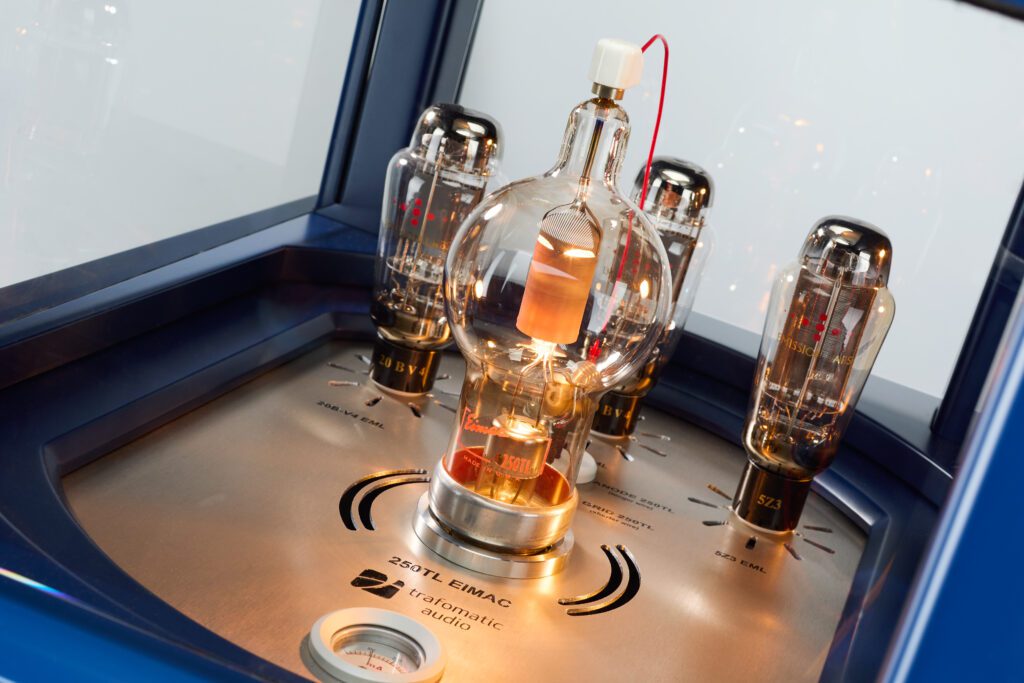
Trafomatic Audio Elysium valves

The Elysium is built around the Elmac 250TL direct heated triode power tube, initially designed for high-frequency transmission. High-end audio has been plundering the cinemas, fighter cockpits and radio stations from the 1930s-1950s to find sublime-sounding valves of high-performance for all kinds of use. It’s how we ended up with valves like the 845 and 211 that have come to dominate single-ended triode power amps from the early 1990s and the Audio Note Ongaku. But even by that heady mix of performance and relative obscurity, the Elmac 250TL is left-field. According to Saša Čokić it’s the most transparent amplifier device ever made. One of these elegant and large valves per chassis is flanked by a EML 20b-V4 direct-heated triode and a EML 5Z3 rectifier valve, both chosen for their linearity.

Of course, you don’t just place these valves into a normal amplifier chassis and power them up. This is the sort of DHT (directly heated triode) design that requires obsessive attention on the part of the designer; do you want an output transformer to match this device? No one makes such a thing, and the minimum order required would fill a warehouse with wire and iron for decades. That would make most manufacturers fall at the first hurdle; Trafomatic Audio instead buys up transformer winding machines, so it can make perfect prototypes and optimally designed units inside each Elysium. Similarly, when using a transmission valve designed to remain powered up for years, turning the thing on and off again will shorten the life of the Elmac 250TL. Again, the result is the sort of soft-start circuit Trafomatic Audio had to design would put off many of the less dedicated, but it’s all in a day’s obsessions!

The power of Ten

This now speaks to why the Trafomatic Audio Elysium is made for Ten Collection and not one of the many other distribution agencies or dealers/distributors in the UK. Ten is like a sort of ‘High-End Privée’, a small group of products that are so specialist and uncompromising that they require some understanding from the buyer as much as everyone else. These products are for the long hauler; the person who’s made their audio bones through years of trying the best products available and is prepared to put in the effort to extract that last scintilla of performance. The person who isn’t just a ‘throw a switch’ type, or someone who is content with either background sounds or sitting glued to their listening chair, but instead, they are for those who’ve earned the right to fill their rooms with a sound that is the real deal, driven by those who know just what it takes to get this close to the live event recreated at home.

The easiest way of describing Ten is by drawing a parallel with food. Some want to eat at the best restaurants they can. Others want to cook with the best ingredients possible in their high-end kitchens. Ten is for those who have got to the point where they have Michelin-starred chefs as friends and invite them over for dinner and a quick cooking masterclass!

This is not simply a price distinction, although inevitably, such uncompromised audio instruments are both hard to get and expensive to buy. None of the products in the Ten portfolio are the sort of things you buy… they are the sort of things you go on a waiting list to buy. And while that buys both exclusivity and bragging rights, it comes with its demands. This brings us back to Elysium.

At face value, Trafomatic Audio’s Elysium’s is single-ended a pure Class A/A1 mono power amplifier. It does have both phono and XLR inputs, but the circuit is inherently single-ended in operation. In Class A mode, the Elysium delivers just 20W, although that rises to 70W in Class A1. Clearly, this is no powerhouse amplifier… but that’s where the Elysium changes the game and redraws the map while shifting the goalposts. That shouldn’t be powerful enough to raise the roof when hooked to relatively demanding loads and is the kind of amplifier that should be crying out for high-efficiency, horn-loaded loudspeaker designs or similar. No one in their right mind would partner an amplifier with not that much power on tap with a loudspeaker like a Wilson Audio Chronomaster XVX or similar, would they? Put simply, the Elysium takes the impossible and makes it possible.

Phenomenally good

Not only can it work with a wider range of loudspeakers than you might expect, it makes a phenomenally good sound in harness this way. You will spend longer waiting for the soft start to gently power up the valves than you will conclude that this amplifier redefines a lot of what we take for granted about ‘neutrality’ and ‘transparency’ in audio devices. Saša Čokič’s bold claim about the Elmac 250TL being the most transparent amplifier device ever made doesn’t seem so ‘bold’… it’s practically self-evident.

Audio enthusiasts who have been around the block a few times often talk of the ‘first watt’; much of the sound of a system is encapsulated in the first few watts of power output, unless we are either ‘caning’ the system and driving it very hard or playing something so extremely dynamic that the swings from quiet to loud draw a lot of power. However, even in that last case, such power draw is instantaneous; an amplifier might notionally need huge reserves of power to cope with something like Rachmaninov’s ‘Symphonic Dances’ [Zinman, Telarc… with the composer’s name spelled ‘Rachmaninoff’], but for most of that piece it might never require much power at all. Moreover, where those brief swings of power demand power, the difference between a few dozen watts of unclipped power and small amounts of even-order harmonic distortion compare well to hundreds of watts with even the smallest amount of clipping and tiny levels of odd-order harmonic distortion, which is both easy to hear and nasty on the ear!
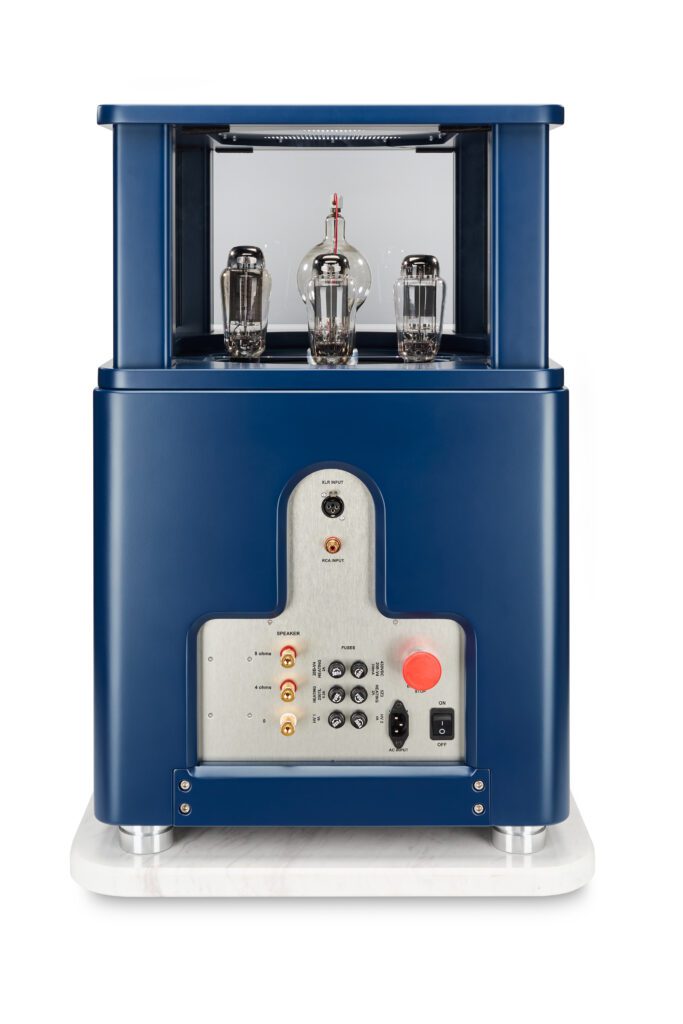
Trafomatic Audio Elysium rear

But we’re automatically doing what could be called ‘end-gaining’ instead of ‘means-whereby-ing’. Looking at this relatively rare case where vast swings of power are required, we overlook the performance when they aren’t. And given the Elysium is very good at covering the big dynamic swings and is totally without parallel in those first few watts, the means whereby most music happens in hi-fi is better than ends gained by focusing on the extremes. That might not make sense at first because we are so totally set on those extremes, but not every journey is a drag-race and the unadulterated realism you get from the Elysium and its super-transparent amplifier device makes you wonder if we’ve approached this all wrong!

Terra Incognita

You are probably thumping something and screaming “Yes, but how does it sound?” This highlights why the Elysium places us in terra incognita. This question also highlights why the Elysium – and in a wider context, the whole Ten concept – is not just for casual audio listening. That super-transparent amplifier device and the vast, beautifully made cabinet that wraps around it kills that question stone dead. How does it sound? It sounds like the cables its connected to, or the cartridge, the DAC, the loudspeakers, hell even the juice it’s being fed from the wall. It’s a fully blameless sound; a blank canvas upon which to draw your audio system’s performance. Get it right and it’s like a Kandinsky painting, an abstraction of music perfectly portrayed. Get it wrong and it’s a finger-painting by a drunk!

So, this isn’t and cannot be a conventional ‘review’, as the review process hits its end-stops long before the Elysium happens. Just in logistical terms, an amplifier that requires this degree of care and feeding does not lend itself to fast A/B tests… you’d be spending the better part of an hour in such a test just waiting for it to power up or power down without distress. But much more than that, it depends on the listener and the time they take to assemble a sufficiently qualified system to benefit from the Elysium’s inherent sonic invisibility.

Curiously – and this is the nearest this gets to being a ‘review’ in the normal sense – this need for ‘qualification’ does not apply to the records played through a system that uses the Elysium. No, it’s not forgiving of dynamically compressed and bright pop recordings that plagued the charts from the 1990s onwards, but neither is it brutally unforgiving of their crimes against ears. It presents the music as it was on the recording without exaggeration or masking. Once again holds to the notion of ultimate transparency from the amplifier; nothing is hidden from view, and nothing is exaggerated unless exaggerated elsewhere in the chain. More significantly, however, this works by letting you hear more of that music and hearing it more cogently.
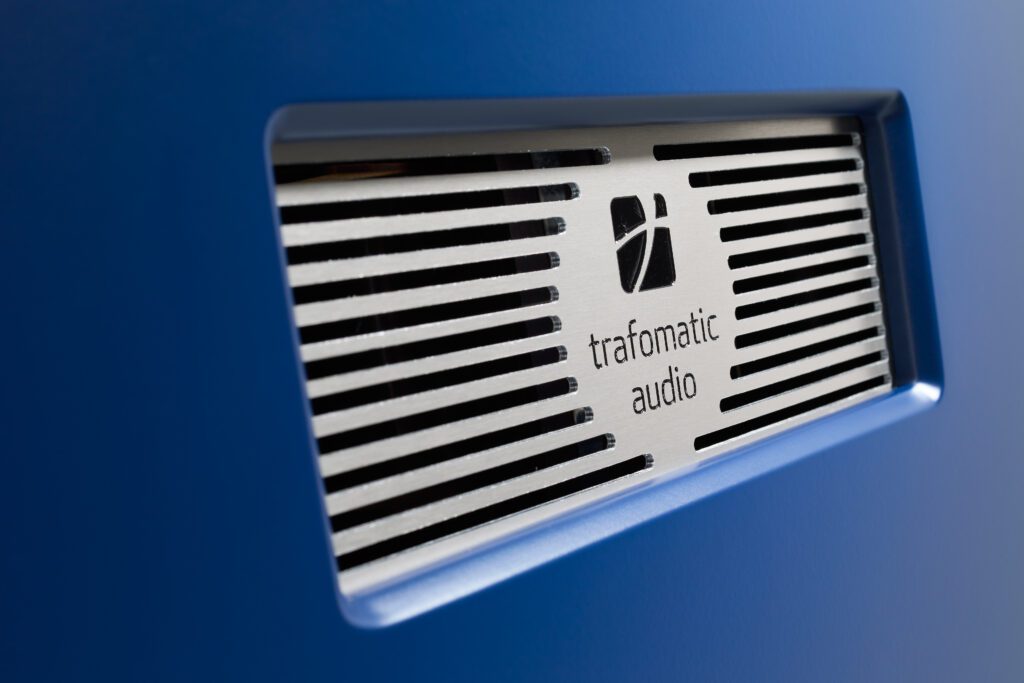
Trafomatic Audio Elysium grille

Many of the discs I use for testing have been played hundreds and hundreds of times, to the point where they are almost musically bankrupt, and a series of reference tones for checking specific aspects of a device or system performance. So, when new revelations are unearthed from those recordings it’s a treat. It’s rare if something new is found on one disc, so you realise this is not’ just another high-end’ amplifier when it happens on recording as it did with the Elysium. And when you move to less familiar recordings that aren’t used as test records but are things you play for fun and enjoyment, those aspects are maximised too.

Excitement

You might not get the same “I haven’t heard that before” revelations, but the excitement of listening to music you’ve not heard before swings into play, even with recordings you have heard many times. This is simply a new and better way of perceiving recorded music, one that’s more commonly associated with the live event… which is spectacular because neither Miles Davis nor Jimi Hendrix are touring these days, and Janis Joplin’s concert days are behind her now she’s dead.

 The Trafomatic Audio Elysium isn’t just for those who sit in front of a system for hours and hours on end and want to extract the last scintilla of performance and musical enjoyment from their systems. It’s for those for whom music is their lifeblood and want to feel that pumping through their veins. They won’t care that the product is so physically substantial that powering it up or down is more of an activity than an operation or that there’s a substantial waiting list, significant price notwithstanding. They’ll just want a pair. That’s what the Elysium does… it shows you what musical heaven on earth can be like!

TECHNICAL SPECIFICATIONS

  • Output power: 70W
  • Class of operation: Full DHT SE Class A 20W, Class A1 20–70W
  • Tubes complement: 2× 20B-V4 EML,
    1× 5Z3 EML , 1× 250TL EIMAC
  • Inputs: RCA/XLR
  • Tubes protection: Wood/glass cover
  • Outputs: 4 and 8 ohms
  • Input sensitivity: 3.5Vrms
  • THD %: 0.3% – 1W/1KHz, 4% – 70W/1KHz
  • Frequency bandwidth:10Hz(-2dB)-60KHz( -3dB)
  • S/N Ratio: 83dB
  • Input impedance: 47K
  • Power consumption: 500VA
  • Input voltage: 230V/50Hz
    (100-120-220-240V available on request)
  • Size (W×D×H): 620 × 520 × 800mm
  • Weight: 85kg per amplifier
  • Price: £58,000 per amplifier

Manufacturer: Trafomatic Audio

URL: trafomaticaudio.com

UK Distributor: Ten

URL: ten-collection.com

Tel: +44(0)208 971 3909


Back to Reviews

The post Trafomatic Audio Elysium appeared first on Hi-Fi+.
Karan Acoustics Master Collection POWERa Mono

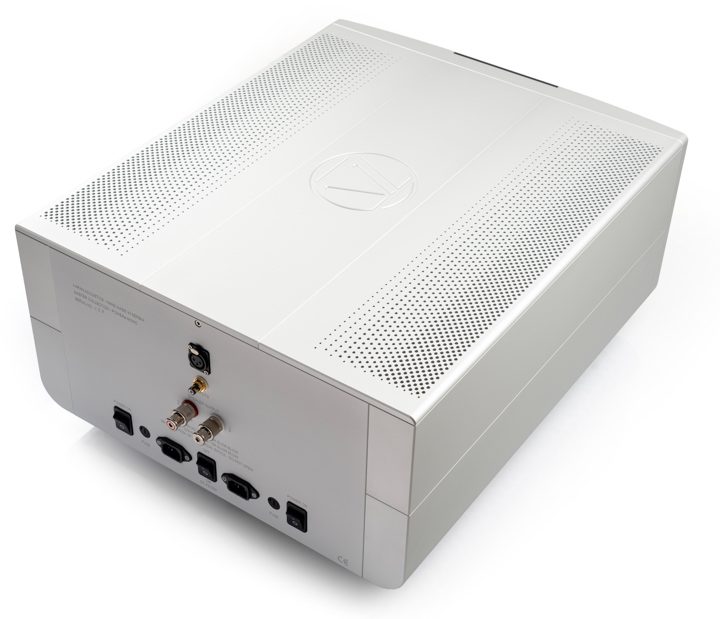
Milan Karan’s Master Collection portfolio of preamplifiers and power amplifiers is a step-change in the company’s design, leveraging decades of knowing how to make a good amplifier to produce the best product in the category. The first two out of the starting gates were the two box LINEa (reviewed in Issue 181) and single box LINEb (reviewed in Issue 191) preamplifiers, with the promise of stereo and mono power amplifiers and phono stages to follow. The Master Collection POWERa Mono amp is the first of this second wave of new electronics from the brand, and it more than lives up to the standards set by the preamps.

Oddly, although they are no strangers to the magazine, we have never formally looked at any of Karan Acoustics ‘big’ stereo or mono power amplifiers. Except for the ‘smaller’ KA M 650 monoblocks (reviewed in Issue 56), we only ever used them in the context of other reviews. It’s time to redress this error.

Both stereo and mono variants of the POWERa launched only a few months ago, and the big monoblocks were a natural choice for the first review. Leading the Karan range for almost two decades, the KA M 1200s and, lately, KA M 2000s mono amplifiers defined a standard of design and sonic performance that would never be easy to beat and outperform. So, to do so, Milan Karan has pulled out all the stops when designing the POWERa amplifiers.


From the ground up

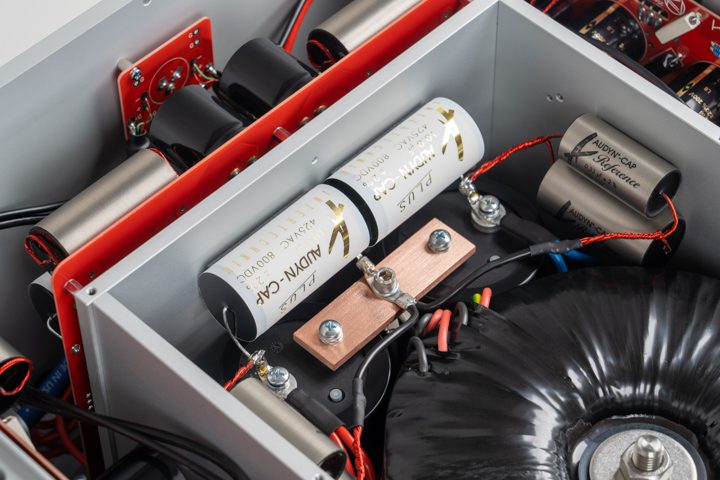
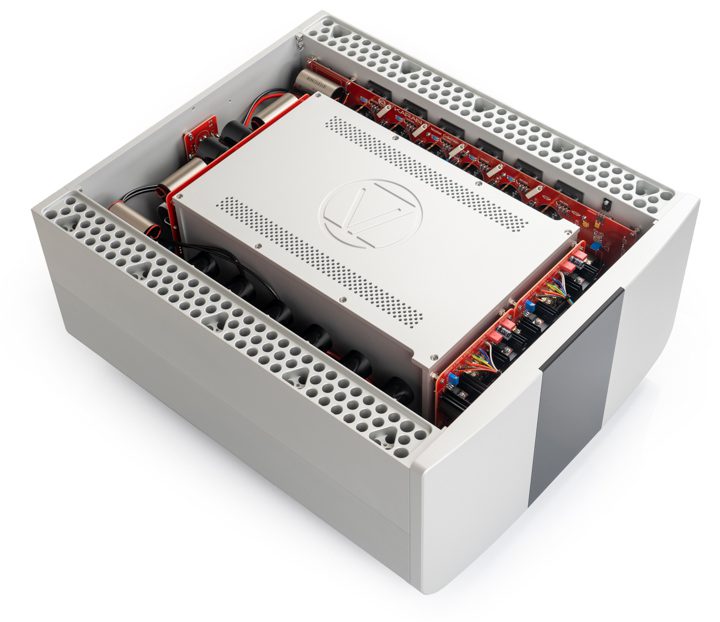
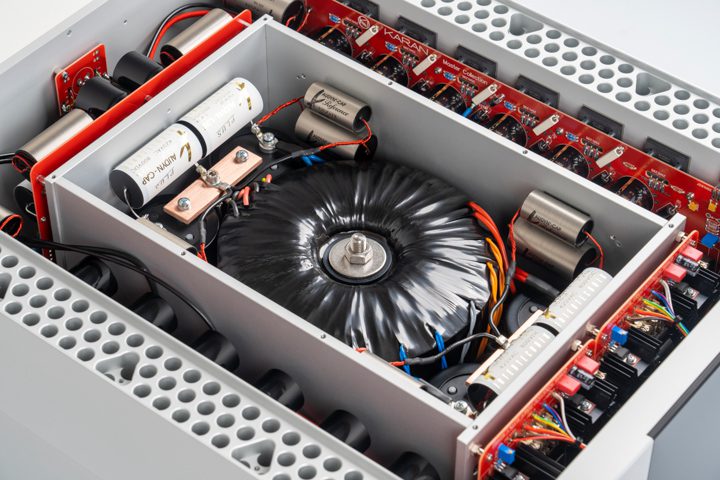
Everything inside the impressive genuine differential mono chassis shell is improved and redesigned from the ground up. While the output (power) circuits still implement the very best Sanken bipolar output devices, the power supplies and their accompanying audio infrastructure have been extensively reworked. The same applies to the input (driver) stages, with high-grade Audyn and superior, proprietary Karan Acoustics capacitors used throughout. The component list of greats includes Vishay and Roederstein resistors and Cardas Audio’s highest quality chassis wire. That, however, is not all. As with all Karan mono amplifiers, each ‘polarity half’ of each audio channel (i.e. amplifier) has its independent mains transformer and accompanying power supply; this also means we need two mains cables for each amplifier!

Karan Acoustics Master Collection POWERa Mono

For the POWERa amplifiers, Karan developed new, much bigger, more powerful, and mechanically quieter toroidal transformers. That resulted in a proportionally enlarged battery of power supply reservoir capacitors of equally high-grade specifications, giving the circuits an even greater reserve of power and current and ultra-quickly available from stock. As before, speaker terminals and RCA inputs stem from WBT, while Neutrik caters for the XLR input interface.

This amplifier’s power output is impressive even by the brute-force standards of some of the biggest big hitters. It puts out an impressive 2,150W into eight ohms and pulls up to 6kW into two ohms, and you can see why it needs two power cables per chassis. In use, that doesn’t just mean it can make a wall sing if you give it some speaker terminals; it means the amps will deliver the signal’s total bandwidth and dynamic headroom into any loudspeaker load while delivering the potential for excellent transient speed and extremely silent circuit operation.

The innards of the new Master Collection power amplifiers hide another new feature; in the main chassis of all POWER models is an advanced mains (line) conditioner with the primary goal of dealing with and eliminating as much (if not all) of the unwanted DC related by-products of our electricity supply! The amplifier has a switch on the back panel allowing you to hear the sound with or without the conditioner/DC filter in use or not. You can even do this while the amplifier is switched on and playing music! While there are few categories in audio as contended as the line conditioner/DC filter market, I’d like to see this offered as a separate, universal product within the Karan Acoustics product range.


Ask Milan

When asked about this part of the design, Milan Karan said, “I believe that having our own design and solution for the treatment of unwanted DC artefacts from the mains supply is at least as important as all other circuit innovations within the Master Collection POWER amplifiers. What would be the point of having huge and capable mains transformers and other power components (which often contribute to the ultimate sound of any amplifier than the actual audio circuits) if the electricity entering the amplifier were not to be of the same, high standard?

“To make something complex sound as simple as possible, let us say that any supply of electricity also includes various ‘unwanted’ elements. Let’s just consider how many domestic electrical appliances and/or consumers tend to be powered through the electricity supply network at all times. They generate a huge number of spurious by-products as a consequence of how poorly their own power supplies may have been designed. And, for as long as they remain powered up, those ‘dirty’ components are fed back into the network and, consequently, into all other consumers, equally so switched on! Not just high-end audio components, everything! The most parasitic pollution is of a DC (direct current) nature. This, quite damaging for audio components in particular, part of our electricity, reflects itself as a DC voltage that can be either positive or negative, and has an amplitude of up to several Volts!

Karan Acoustics Master Collection POWERa Mono

“The higher this DC voltage may be, the more saturation attacks mains transformer cores within all amplifiers. Temperature of the transformer windings will rise because they feel the DC voltage almost as a short (circuit)! Transformers will begin to vibrate mechanically to a various, often high degree. We perceive this as an unpleasant mechanical vibration, like a buzz, from the amplifiers within one’s listening room. The bigger the mains transformers, the more sensitive to the parasitic DC voltage they are, and the louder the mechanical vibrations will be.

“That is not all, however. This also brings a problem with the Neutral side of the mains as a phase shift will develop, the severity of which depends on how badly high the parasitic DC voltage may be. This, ultimately, prevents the sine wave to be correctly and perfectly shaped. Negative effects on the operational performance of an amplifier and overall sound quality because of these mains anomalies are substantial!

“In order to protect an amplifier of such a (high) power output as in Master Collection POWER models, designing a suitable line conditioner with an efficient DC ‘eliminator’ was anything but easy. The main criterion was that the device had no negative influence on the inherent sound of the amplifier. Further, it had to be the very generously specified in terms of current and voltage flow from the mains supply, so it would cater for at least three times more than the maximum required. In real life that meant a rating of 60A or more. We are proud our mains (line) conditioners inside the new POWER amplifiers comfortably meet and exceed those and many other criteria. Plus, the additional bonus of an on/off switch function enabling the user to perform direct comparison of its effects at any time while the amplifier is in active use.”


Crucial function

I’ve spoken to a few amp designers about power conditioning before, but it’s rare to get such a succinct and impassioned response, so I included it verbatim. This is a crucial function of the Master Reference concept, as is the clever, elegant chassis.

The new chassis concept is a highly effective circuit resonance damping system too. Increasing the mass is the most apparent solution toward superior overall damping. Still, the problem then becomes lots of the wrong kind of metal can cause more harm than good and using just a giant lump of aluminium to mass-load the amplifier ends up being a source of resonance in its own right.

Karan Acoustics Master Collection POWERa Mono

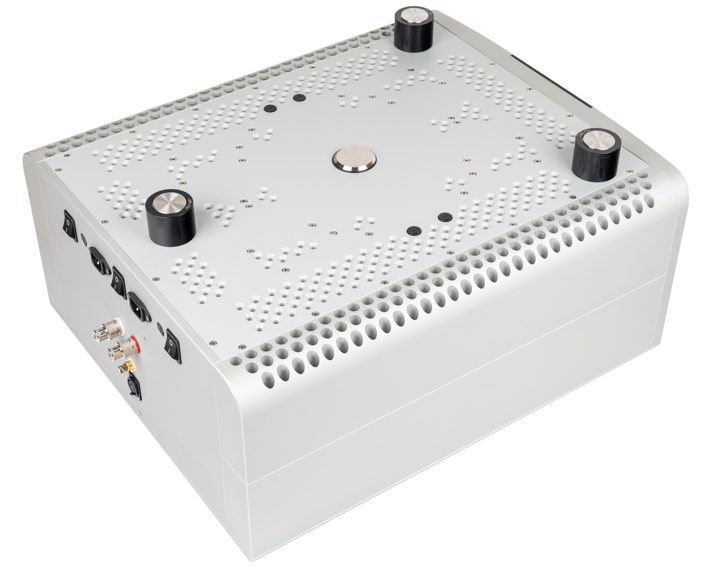
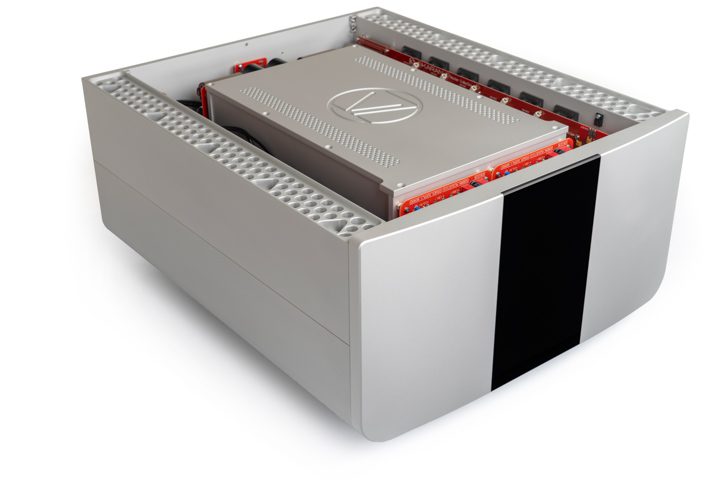
Karan Acoustics designed the main chassis to counter both concerns as a single-piece unibody made from a solid CNC-machined piece of very high-grade aluminium; this acts as a heatsink for the output devices while creating a non-resonant environment for the entire amplifier. This also helps to lower the noise floor of the amplifier itself. Continuing down the ‘impressive specifications’ line, all 105kgs of weight (per amplifier) are supported on three Critical Mass Systems CS2 1.5 supporting feet. The amplifiers are shipped in wooden crates, bringing the total shipping weight to 130kg per amplifier. Put another way; each one weighs more than a professional rugby player!

A good, big amplifier needs to do several things well; it needs to be essentially effortless in performance, with the power and headroom to express the preamplifier’s demands to the loudspeakers without getting in the way at all, but that’s a given. It also needs to have a significant sense of scale and speed so it doesn’t just sound like a big amplifier all the time. When you get to the top tier of power amplifiers, that should be a given too. But often isn’t.


Scintilating performance

However, what you get with the Karan is so much more. It’s a scintillating performance, showing you what the devices upstream and down are capable of and also pointing out where other amplifiers get it very wrong. This is the antidote to those amplifiers that push sound at you; initially impressive but ultimately wearing. Typically, that ‘doesn’t push music at you’ is code for ‘it sounds dull and dreary’, but in this case, the treble sparkles, and the midrange is clear and quicksilver fast.

The more time you spend with the top-end amplifiers, the more you realise there is usually some trade-off, even with the best of them. Some are faster at the expense of dynamics, and some vice versa. Some do detail and stellar high-frequency reproduction at the expense of making the sound too ‘in yer face’ exuberant and exciting. However, when you encounter an amplifier that doesn’t make those compromises, you discover just how common they are. The Karan Master Reference POWERa Mono amps are the amps that don’t compromise.

How this comes across is simple. Play a piece of music. It doesn’t matter what that piece of music is, just something you know well. It was ‘Entr’acte’ from Orange by Caroline Shaw and the Attacca Quartet [Nonesuch]. Other amplifiers will play you all the details in the string noises and the rest. Some will tease out the rhythmic or dynamic elements of this recording or maybe show its pace and speed.

Karan Acoustics Master Collection POWERa Mono

Eventually, they will begin to push past that initial ‘signature’ and show the recording in its complete form. The Karan amps give you the whole picture right from the opening bar. This could be unnerving but, in fact, is thrilling. It’s like hearing the recording for the first time or much more like hearing it live. Or, it’s like the first time you heard good audio, revising how you appreciate recorded music. In short, it’s that good.

All those usual aspects of performance are moved out of the way. You realise that discussing stereo soundstaging or vocal articulation is praising a product for not doing its job correctly. Those terms fall away when you hear it done right through the Karans. All that’s left is music. Sure, if you play Trentemøller’s ‘Chameleon’ [The Last Resort, Poker Flat] or Boris Blank’s ‘Electrified’ from the album of the same name [Polydor], the POWERa’s ability to grab hold of the bass and shake it out through your internal organs is deeply impressive. And it makes your loudspeakers seem physically larger when called upon in that manner.

But that’s only the start of what this is all about. Bass that treats your body to a spot of food processing is easy; listening to those synthesised pieces of music and finding the subtlety and instrumentation hidden below – and having that musical epiphany presented instantly – is something rare and to be treasured.


The Time Machine

I touched on this earlier, but where good audio is a time machine, putting you back to the point when you first heard that album, good audio takes you back to the first time you heard what hi-fi can do. The trouble with that experience is it is fleeting, and many of us spend a fortune trying to replicate and hold onto that feeling we got the first time we heard good audio.

Addiction specialists might talk about ‘reward centres’ in the brain and how that kind of fleeting ‘high’ creates a need in the addict, but with audio, the POWERa Mono resets your musical and audio levels each time you play a track; you get that ‘first time I heard it’ feeling repeatedly.

Then there’s the scale issue. Sounds played through the POWERa Mono are ‘right sized’ whatever you play. Move from a sizeable orchestral piece to something more small scale and vocal, and the Karan amps move with you effortlessly. Once again, this is something you realise more by recalling other amplifiers that do almost the same thing. This scales perfectly well, with no sign of either ‘tiny orchestra syndrome’ or ‘Attack of the 50ft Woman’ problems and to do that so thoroughly is exceptionally rare.

Karan Acoustics Master Collection POWERa Mono

To summarise the Karan Acoustics Master Collection POWERa Mono in musical terms, I need ‘Spitfire’ from Public Service Broadcasting’s Inform Educate Entertain album [Test Card]. It’s not a demonstration quality track; just a pounding rhythm coupled to some noisy samples from the 1942 British movie, The First of The Few. It’s easy to get it wholly wrong on a big system, but get it right, and I’m back building Airfix kits; and this got it so right, I could smell Humbrol enamel!

The only downside to these amplifiers is that they spell the end for Karan’s existing KA M line of power amps. While these big power amps are not in the same sonic league as the Master Collection models, they are (somewhat) more affordable. I doubt something like the KA M 2000 would be a steppingstone to the POWERa Mono (and there will likely be a POWERb line that would make such jumps even harder to justify). Nevertheless, it would be nice to have something more attainably priced in the Karan portfolio just to make the Master Collection even more of a goal for some.


Endless Scale

That’s nit-picky, however, as the Master Collection POWERa Mono is the best balance of performance in terms of sheer power output and the quality of that power that you can get right now. This is an amplifier with endless scale, and dynamic range yet doesn’t shout about those properties… simply letting you know they are there when you need them. An amplifier at once capable of brute force and terrific refinement sets the Karans apart from the pack.

Karan Acoustics Master Collection POWERa Mono

There are some exceptional amplifiers on the market at the top end, and there’s a solid argument to say there’s one no one path up that mountain (the long-winded version of YMMV: ‘Your Mileage May Vary’). But there is a personal path up that mountain, and for me, that means the Karan Acoustics Master Collection POWERa mono power amplifiers. They are the best amplifiers I have heard so far.

TECHNICAL SPECIFICATIONS

  • Type: Mono solid-state power amplifiers
  • Power output: 2.1kW into 8Ω, 3.6kW into 4Ω, 6kW into 2Ω
  • Peak power output: 2.4kW at 8Ω
  • Inputs: 1 balanced (XLR) and 1 unbalanced (RCA)
  • Input impedance: 30kΩ (balanced/unbalanced)
  • Input sensitivity: 2.0V/RMS (for max output)
  • Frequency Response: 20Hz-20kHz ±0dB, DC-300kHz, -3dB
  • Gain: +36dB
  • Distortion THD/IMD: 0.03%
  • Signal to noise ratio: >120dB unweighted
  • Dimensions (W×H×D): 50.4 × 29.2 × 60.3cm per amplifier
  • Weight: 105kg per amplifier
  • Price: £79,995 per pair

Manufacturer: Karan Acoustics

URL: karanacoustics.com

UK distributor: Audiofreaks

URL: audiofreaks.co.uk

Tel: +(0)208 948 4153

Back to Reviews

The post Karan Acoustics Master Collection POWERa Mono appeared first on Hi-Fi+.