Tag Archives: phono stage

Gold Note PH-5 phono stage

Let me say from the outset that I’m already the very completely satisfied proprietor and person of a Gold Note phono stage. I’ve the corporate’s PH‑10 mannequin with the elective exterior energy provide they usually have been on the coronary heart of my reviewing system for quite a few years now. Thus when the UK distributor known as me to ask if I’d evaluate the newest of those small kind issue gadgets, the PH-5, I accepted with alacrity.

Unboxing it revealed a unit that may be very clearly a sibling of the PH-10. On the fascia, the management dial on the appropriate has gone, as all of the user-changeable parameters are actually accessed through a contact display screen. On the rear panel, the principle change is that there are solely a single pair of RCA enter sockets with an earthing submit. There are nonetheless a pair of RCA outputs, a pair of balanced XLR outputs, an IEC mains enter socket with a rocker change for energy on and off and a DIN plug for connection of an exterior PSU.

All the changes

In phrases of the technical specs the PH-5, has all of the changes one would count on – there are 9 enter impedance decisions from 10Ohms to 47kOhms, 4 acquire choices, and selectable enter sensitivity. Capacitance for the Moving Magnet choice is ready at 220pF. Unusually among the many phono phases which have come via my system, the PH-5, identical to my PH-10, provides the person three completely different equalisation curves – RIAA, Decca London and American Columbia. Power consumption is 10W in operation and fewer than 0.5W in stand-by mode.

It weighs simply 1.2Kg, with a modest footprint off 200mm × 80mm × 260mm (WxHxD).

Gold Note PH-5 phono stage

I set the PH-10 on the shelf beneath my Linn Sondek LP12 and alongside the PH-10 PSU, and hooked up the arm leads, floor lead and pair of Audioquest Pegasus RCA interconnects. The cartridge within the Linn Ittok arm all through the evaluate was my trusty shifting coil Dynavector XX2. The output cables have been related to an acceptable enter on my PrimaLuna EVO400 built-in amplifier. I inserted a Shunyata Research Delta mains lead that was plugged into the identical firm’s Hydra6 energy distribution block.

Speakers used in the course of the evaluate interval have been initially Harbeth Compact7E-S XDs, then Kudos Titan606s after which again to the Harbeths. Speaker cable was Audioquest Robin Hood.

All that remained was to energy the unit on then to maintain a finger on the touchscreen to convey to full operation from standby. By touching every changeable parameter on the display screen I used to be in a position to choose MC, RIAA, 22kOhms and acquire of +3dB, sooner than it has taken me to sort the phrases. I put my ear to the Harbeth grille and was met with full silence – not a touch of noise coming via from the PH-5.

Listening to the PH-5

Having been suggested by the distributor that this was a model new unit, I believed it was solely honest to spend a few days of taking part in earlier than settling right down to some severe listening. However, as I walked away having put the primary aspect of Analogue Productions” glorious 2018 double album compilation The Wonderful Sound Of Female Vocals (APP122), Julie London’s voice singing ‘Cry Me A River’ stopped me in my tracks. I ended up spending the subsequent couple of hours taking part in all 4 sides of that first album selection. It was an absorbing hear, with every of the voices coming via with fantastic realism. The PH-5 picked up on each tiny element and fed it via to the amplifier.

Gold Note PH-5 phono stage

Thus went my first few days with the PH-5. Every document that I performed got here via with that particular magic mud that we vinylistas crave. The EVO400 has that just about natural high quality to its sound signature that, paired with the Harbeths’ very naturalistic presentation, is a sonic world that I discover exceptionally straightforward to spend many hours with. The PH-5 doesn’t overdo issues when it comes to including one other layer of heat, it simply appears to let the music retrieved from the turntable circulation with out artifice.

The first three days glided by shortly however on the fourth day, having chosen a number of albums from the cabinets, I teed up considered one of my favourites, Gary Karr’s recording on the Firebird/Cisco label (CLP7058) of Rodrigo’s ‘En Aranjuez Con Tu Amor’, which can also be the title of the album. I’ve a selected love of double bass music, and Mr Karr is amongst its most interesting practitioners. Accompanied by Harmon Lewis on organ on some tracks and piano on others, Mr. Karr delivers eight tracks of beautiful magnificence. Through the PH-5 the fantastic tonality of his 1995 James Ham instrument shines via, and the emotional affect of the entire recital left me sitting immobile for a number of minutes after the ultimate notes of Barber’s ‘Adagio For Strings’ pale on the closing observe. Mesmerising stuff.

Composure regained

Having regained my composure I then hooked up my very own PH-10 PSU to the PH-5 (the distributor had assured me of the compatibility in our preliminary dialogue) through the umbilical DIN cable. With no thought to my emotional security I then performed each side of the album once more. As I had lengthy since found with my PH-10, the PSU took the efficiency of the cheaper PH-5 to a brand new degree. The sense of the horsehair bow in Mr. Karr’s expert hand shifting throughout the strings of his instrument was virtually holographic, and I used to be transported from a seat half manner again within the recording venue to someplace very close to the entrance. There was undoubtedly higher definition in these very important decrease octaves however additional up the frequency vary there was an audible improve within the realism of the listening expertise.

It was at about this time that I needed to change amplifiers, and exchanged the PrimaLuna for my different amplifier, which is the polar reverse, the Lyngdorf TDAI3400. This is an all digital design, through which is fitted Lyngdorf’s elective (although in my case mandatory) upgraded analogue import board, which supplies the choice of utilizing each XLR and RCA interconnects. I due to this fact switched to the Audioquest Pegasus XLR cables. Fancying a change of tempo I cued up my 1971 copy of Osibisa’s Woyaya on the MCA label (MDKS8005). Recorded at Air Studios in London, with Tony Visconti producing, this in 1971 was considered one of my first forays into what later turned often called world music. The seven musicians of the band have been variously from Ghana, Nigeria, Grenada, Antigua and Trinidad, making Osibisa a really Afro-Caribbean ensemble. I noticed them reside simply after this album was launched and the gig nonetheless sits amongst my favorite reside musical experiences. They play with pleasure, verve and implausible interplay, all of which may be very nicely captured on this disc. Through the PH-5/PSU the sense of being there within the studio is actual, and each side have been despatched within the short while, with the listener grinning broadly and clapping alongside to the advanced rhythms being created. On stage, the bassist Spartacus R had actual presence, and his instrument anchored the entire efficiency. On document, Mr. Visconti and his engineer John Punter had carried out an exquisite job of capturing that highly effective growl. The PH-5 did it full justice too.

The massive album pile

My play pile of albums grew greater and greater. I shall not bore you with a listing, however I performed heavy metallic, basic rock, pop, jazz, classical (each instrumental and choral), folks, reggae – in reality an entire snapshot of my musical style, and the PH-5 simply saved delivering. In the following days and weeks I attempted switching again from the XLRs to the RCA interconnects, however at all times returned to the XLRs as, to my ears at the very least, I felt there was a delicate however audible enchancment to the sound. I’m happy that Gold Note have carried the choice of cable interface ahead from the costlier PH-10. An organization much less dedicated to assembly audiophile wants may need been tempted to supply RCA solely.

Speaking of interfaces, the PH-5’s touchscreen is a delight to make use of. It is conscious of a light-weight contact and permits the person to modify between MC and MM setting, with the latter having fastened values however with the MC providing all types of choices. You can even dim the show.

Gold Note PH-5 phono stage

MY LP12 sits on prime of the rack, with the phono stage and PSU on the shelf beneath. I’ve found that the participant may be very delicate to any contact on different elements of the rack, in order that altering parameters on the PH-10 through its small dial must be carried out earlier than the arm is lowered to the document. The PH-5 display screen requires a naked minimal of a finger tip contact to vary, which means I used to be in a position to change settings whereas a document was taking part in. And I did simply that, together with altering the EQ between the three choices, which was very fascinating. The variations are delicate as I’d have anticipated, the Dynavector sounded finest via the RIAA, with impedance of 220Ohms and +3dB of acquire utilized.

As talked about earlier, in the course of the evaluate interval a pair of Kudos Titan606s arrived in my listening room and I performed once more a number of of the albums that had been used beforehand. The Titan606s common in-room response is rated to go right down to 30Hz, which gave me one other likelihood to listen to Gary Karr and the additional bass info in contrast with the Harbeths (which begin to roll off at 45Hz), and I used to be not upset. The PH-5 isn’t outclassed within the firm of far more costly gear. Switching again to the Harbeths didn’t really feel retrogressive nonetheless, simply completely different, and they’re most likely extra consistent with the PH-5 from a purchase order worth viewpoint.

Final Thoughts

There is little doubt that Gold Note have provide you with one other class chief within the PH-5. For comparability functions I changed the visitor piece with my very own PH-10 greater than as soon as within the evaluate interval, and with out having correct calibration gear I believed that they sounded remarkably related. There was a tad extra weight to recordings performed via the costlier system however whether or not that may be adequate to make me stump up the additional price if I have been shopping for once more, I’m truthfully undecided. The matching PSU might already be out there by now, and I’d strongly suggest including one to your PH-5 order.

For a small (about 30 folks sturdy) Florentine firm, Gold Note continues to supply glorious merchandise, all of which aren’t simply extremely useful however are very trendy too. With document gross sales, at the very least right here within the UK, having overtaken CD gross sales within the final 12 months, the Gold Note PH-5 provides new vinyl customers an inexpensive manner into the world of excessive efficiency package. It deserves to promote in giant numbers and ought to be added to any shortlist of apparatus to audition by these seeking to transfer ahead from, for instance, the inbuilt phono stage in an amplifier. I can solely give this the very best suggestion. Bravissimo Gold Note.

Technical specs

  • Type Solid-state phono preamplifier with equalization curve adjustment
  • Inputs 1× stereo RCA pair (MM/MC), with earth tag
  • Input Sensitivity 0.1mV (MC) as much as 10mV (MM)
  • Input impedance 10Ω–47kΩ (in 9 steps)
  • Gain MM; 40dB, MC; 60dB (with 4 choices; 0dB, +3dB, ±6dB)
  • Capacitance (MM Only) 220pF
  • Outputs 1× stereo RCA pair, 1× stereo balanced XLR pair
  • Output Impedance 50Ω
  • Equalisation Curves RIAA, Decca, Columbia, all with ‘Enhanced’ choice
  • Infrasonic filter 10Hz, 36dB/octave
  • Frequency response 20Hz–20kHz ±0.3dB (Enhanced mode, 20Hz–50kHz ±0.3dB)
  • THD < 0.05% @ 1kHz
  • Signal-to-noise Ratio 89dB
  • Dynamic Range 105dB
  • Dimensions (W×H×D) 20 × 8 × 26cm
  • Weight 1.2kg
  • Price £949

Manufacturer

Gold Note

Homepage – https://www.goldnote.it

PH-5 – https://www.goldnote.it/phono-stages/ph-5/

Distributors – https://www.goldnote.it/distributors/

UK distributor

Airt Audio

+44(0)754 879 6382

Back to Reviews

The submit Gold Note PH-5 phono stage appeared first on Hi-Fi+.
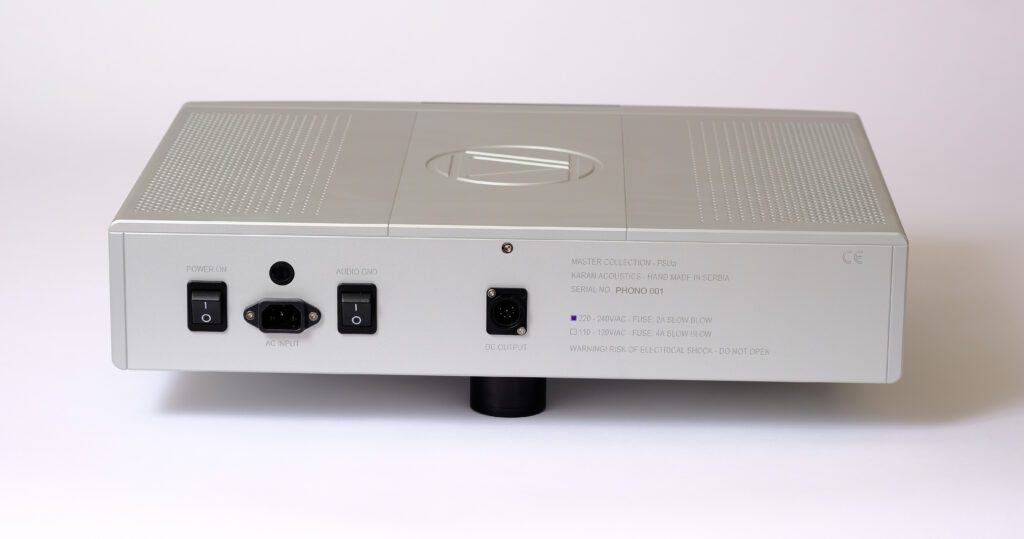
Karan Acoustics Master Collection PHONOa

In trying over the Karan Acoustics Master Collection PHONOa – the newest within the revised pinnacle-product line from electronics consultants Karan Acoustics – it happens to me that we’re at one thing of a pinnacle of efficiency, one that won’t be achieved once more. Milan Karan’s Master Collection line is an expression of his 30 years as an audio electronics designer. That means he started at a time when CAD/CAM was in its infancy and his first designs can be extra ‘on paper’ than the results of a program. Those abilities solely belong to designers from that point; most trendy electronics engineers look to packages like SPICE to prototype circuits.

However, these ‘stick and rudder’ designers who’ve been making merchandise for many years are sometimes not so set of their methods as to disregard the significance of recent know-how. As a consequence, we get the perfect mixture of experience and modernity; producing merchandise that construct upon a long time of painstaking testing, however produce sound high quality that might be nearly not possible at even the flip of the century, because of improved circuit design instruments and infinitely improved componentry. Enjoy it whereas it lasts!

While such reward may fall into ‘the cult of the designer’, this distinctive time additionally permits us to expertise for one thing that’s each uncommon and good to seek out; the cautious honing of a circuit over a long time. When founding his enterprise, Karan  looked for what he deemed to be a satisfying basic audio circuit for his preamplifiers (each line and phono) and energy amplifiers (each mono, stereo and built-in). Once he discovered it, he carried all of the constructive virtues these ideas from one technology to the subsequent, honing and perfecting it, saved bettering passive and lively parts as they grew to become out there. Guess what? All Karan Acoustics merchandise did get higher and higher with each change.

The Ship of Theseus

Which brings us to Master Collection, and the Ship of Theseus. The Ship of Theseus is a traditional thought experiment courting again to the philosophers of Ancient Greece; put merely, if each half on a ship was changed one piece at a time, is it nonetheless the identical ship? In the case of audio parts, ultimately, with each half being revised and changed, is the unique mannequin nonetheless the unique?

This is an issue each producer experiences in some unspecified time in the future. There are corporations that deal with this by altering the product identify suffix (Mark XXIV, anybody?), and there are others (like Karan) which might be content material with steady improvement. However, there comes a degree the place the subsequent evolutionary step is so vital, so giant that neither one other suffix change or just ignoring the problem isn’t sufficient. This is what occurred with Karan, and the result’s the Master Collection.

We have already seemed on the two-box and one-box preamplifier and the mono amplifiers within the Master Collection collection (in Issues 181, 191 and 203 respectively) and now it’s the flip of the phono stage. As earlier than, the Master Collection PHONOa is the highest, two-box mannequin with a single-chassis PHONOb ready within the wings and, as ever, the Master Collection replaces all present phono phases within the Karan line. This final comes with a little bit of a pointy consumption of breath, because it means the price of entry into Karan-land will increase markedly. However, as with the earlier preamp and mono energy amps, so does the efficiency. On previous kind, the single-chassis Master Collection mannequin confidently and comfortably out-performs the highest two-box mannequin from the out-going KA collection, with two-chassis fashions just like the PHONOa setting new requirements. This appears proper; on listening to the Master Collection PHONOa, these new efficiency benchmarks had been reached!

So, let’s take a look at what makes the Master Collection PHONOa a lot extra superior and, hopefully, particular than it’s final ‘common’ predecessor KA Phono Reference which managed to lift the bar throughout the solid-state phono preamplifier high division because it was.

For starters, Karan has put a whole lot of considering and sensible hours into the event of the brand new chassis for all Master Collection merchandise. He realised
that varied mechanical resonances (each exterior and inside), in addition to inside electromagnetic interferences have a big impact on the general sound high quality. Consequently, (and that is much more essential in phono preamplifiers because of very low voltage and excessive sensitivity audio alerts as such), the brand new chassis for each the primary unit and the ability provide are made out of a a lot superior materials and the tactic of becoming a member of panels and isolating the inner contents has been elevated by fairly a margin.

Karan Acoustics Master Collection PHONOa phono stage

Another step ahead relates particularly to the preamplifier chassis and its newly-designed stand-off pillars for circuit board reference to the chassis. They have been manufactured from a particular form of clear copper thus permitting the pure transients to stay audible, quite than destroyed by fallacious decoupling.

The last aspect of the mechanical enchancment chapter are the newest Critical Mass System toes, already current on all Master Collection merchandise, however this time they’re of an elevated top. While, to some, it might take away a little bit of the inherent magnificence Master Collection enclosures radiate by default (hopefully not additionally making the product much less usable with its elevated general top), they do have their significant contribution to the general sonic efficiency.

A brand new, improved, technology of Karan’s printed circuit boards can be evident within the PHONOa. They have a newly conceived isolation materials which separates lively tracks (traces) for the audio sign, energy provide and grounding rather more successfully than earlier than. Traces are manufactured from the most effective OFC copper and are of a considerable 75 micron thickness. This, mixed with an improved general design of the circuit boards structure, additional decreased the undesirable inter-component influences and any detrimental results that come up because of this.

On the circuit

Moving on to the circuits of the PHONOa themselves, the enter acquire stage is totally new each in design and within the alternative of superior lively parts with significantly decrease noise ranges, greater transient pace and wider bandwidth. The similar applies for the output part of the preamplifier and all switching required for the settings and inputs is now a lot quieter and much more remoted from the audio sign path.

As with the KA Phono Reference, the Master Collection PHONOa has three inputs that are, actually, three fully separate phono phases in the identical chassis! Every enter has nearly limitless flexibility when it comes to acquire, enter load and capacitance changes, culminating with open positions the place customers can insert passive parts of their very own worth alternative if that’s the case desired. Additionally, each enter has RIAA, EMI, Decca, Columbia and Teldec equalisation choices. All EQ settings make use of the perfect and quickest capacitors with an excellent low 0.5% tolerance. They are additionally extraordinarily quick and make sure the lowest doable deviations from every one of many curves.

Each acquire block has been given further capacitance for the primary capacitors, in addition to fastidiously chosen bypass capacitors to supply extra vitality whereas bettering the impulse response, too. Meanwhile, every phono enter additionally gives absolute polarity (section) reversal alternative and, for the primary time, every enter has its personal Mute facility which will be and is crucially useful in a phono preamplifier.

All inside wiring in addition to the umbilical cable connecting the primary chassis with the ability provide unit come from Cardas Audio, whereas enter and output connectors stem from WBT (RCA) and Neutrik (XLR). Being a very differential (balanced) design, like all Karan Acoustics merchandise, a beneficiant mixture of RCA and XLR interfaces is out there each on the enter and output finish of the part.

Moving to the Power Supply Unit, there’s a vastly elevated general capacitance reserve of 120,000µF (which provides it a reservoir capacitance that many energy amps would discover respectable), three ‘generously specified’ mains transformers (one for every audio channel with another for all of the switching and shows) and an Audio Ground Switching operate located on the rear panel of the ability provide unit. This permits the person to check the sound with the audio floor current or lifted in a secure and correct method each for the phono preamplifier itself and for another linked supply parts.

It’s a household affair

There is a temptation to reference this assessment in opposition to the predecessor; the KA Phono Reference reviewed in difficulty 117. Because in some ways the apple doesn’t fall removed from the tree and the efficiency that excellent phono stage delivered has the identical performance, intention and even primary sonic signature. But, lower than a minute into the listening and it was clear such an exploit was pointless. The Master Collection PHONOa is up to now past the efficiency of the KA Phono Reference they bear little greater than imprecise familial similarities. By shedding your self in these similarities, you find yourself failing to see simply what this phono stage is able to in sonic phrases.

It’s nearly shocking how good the Karan Master Collection PHONOa sounds, or – maybe extra precisely – how good your records and your cartridge sound when performed by means of the Master Collection PHONOa. That ‘musically sincere’ efficiency of each the earlier phono stage and its stable-mates within the Master Collection vary is immediately evident right here, as there isn’t a trace of a raise or a dip or any type of sins of fee and even omission right here. This is like direct-injecting vinyl into your ears, and it’s a fascinating expertise.

We all start listening exams with our benchmark requirements, and in lots of techniques that’s kind of the place it ends, however the PHONOa is so beguiling, so musically adept and welcoming that you just begin to attain for these items of music which have helped outline you as a music-lover; those that hooked you even earlier than audio bought beneath your pores and skin. For me, that’s Abbey Road by The Beatles. All of it, entrance to again. And when it performed out, the temptation to only put it again on and hear once more was nigh on irresistible. The PHONOa is adept sufficient to get previous all of the Ringo downplaying; his drum solo on ‘The End’ is sheer magic in fact, however different drummers typically reward him for being a drummer that ‘sits within the document’, and listening to him play that swampy Ringo Swing by means of this phono stage, I get that. Other phono phases make the music sound nice, however as a non-drummer understanding not solely how good Ringo was, however seeing it nearly by means of drummers’ eyes is a superb expertise, all of the extra so in that I’ve been listening to that document since I used to be about 10 and I by no means fairly understood what folks actually meant by that. Until now.

Karan Acoustics Master Collection PHONOa phono stage

Similar revelations had been forthcoming all through, and as they seem, you realise the rationale for his or her look is similar one meaning you don’t end up describing features of the phono stage’s efficiency in your word pad. It eclipses all that, and anyway that might simply be a collection of superlatives, as each sonic parameter is reset to a brand new commonplace. Images are exact, steady and completely dimensioned. Dynamic vary is within the ‘leap out of your seat’ stage when referred to as upon, however refined and filled with texture when enjoying extra legato music. You are within the corridor, within the studio… or generally contained in the piano (there are some odd mixes on the market). Each time you make a remark about efficiency on the pad, it’s about what the document or the artist is doing. The PHONOa transcribes that intention on vinyl completely and with out fuss. Or noise; this is without doubt one of the quietest phono phases on document (pun supposed).

There is a lot extra to say in regards to the Karan Master Collection PHONOa, but it surely’s simply extra of the identical. This is the most effective phono stage I’ve heard, and by no small margin. Sure, there are some exceptional phono phases, and lots of make music sound fabulous, however none make it sound fairly as ‘proper’ because the PHONOa. Honest with out brutality, detailed with out edginess or etched sound, tonally excellent, dynamically unparalleled and producing a soundstage that’s solely constrained by the document earlier than it and the system afterwards. This is how music ought to sound by means of the perfect of the most effective.

Technical specs

  • Type Solid-state phono-stage
  • Inputs 3× balanced XLR; 3× single-ended RCA
  • Outputs 1pr balanced XLR; 1pr single-ended RCA
  • Gain 48dB–71dB + one person definable setting
  • Loading 450Ω–47 kΩ + two person definable settings
  • Capacitive Loading 50pF–400pF
  • Replay EQ RIAA, EMI, Decca, Columbia, Teldec
  • Absolute Phase Switchable 0/180 levels
  • Dimensions W×H×D 504 × 141 × 390mm ea.
  • Weight (mixed) 32.1kg
  • Price £30,995

Manufacturer

Karan Acoustics

karanacoustics.com

UK Distributor

Audiofreaks

www.audiofreaks.co.uk

+44 208 948 4153

Back to Reviews

The publish Karan Acoustics Master Collection PHONOa appeared first on Hi-Fi+.

Aavik Acoustics R-580

As we near the end of our Aavik 580-Series journey, there’s a twist to the tail. What was hitherto Aavik’s top-of-the-line has just been eclipsed! The new 880 amplifiers – with industrial design from Flemming Rasmussen – have just been announced (at the time of writing). This doesn’t mean the existing 180, 280 and 580 lines are dead or that the 580 line doesn’t still provide peak performance; it’s that Aavik (and Ansuz cables and Børresen loudspeakers) just gave us a more prominent mountain. Given the top tier of the existing products was already well into the stratosphere, the new highest of the high end from Audio Group Denmark (the name of the parent company since 2020) is very high indeed. When it comes to the Aavik 880, have your butler’s butler take the helicopter du jour to scope them out!

Back to the round-up, and this time it’s the turn of the R-580 phono stage. And by now, you probably already know the drill; there are three models in the range with notionally the same basic design, with significantly improved casework and technology to make them considerably less influenced by the world beyond the chassis.

Cartridge care and feeding

Like every Aavik product, the R-580 comes supplied with a pre-paired Apple remote. This controls standby and mute and the impedance load to match the cartridge. You have an 18-step adjustment that runs between 50ohms and 10kohms. Meanwhile, the gain is fixed at a healthy 65dB, the first 40dB of which is amplified with zero negative feedback, while the final 25dB uses local feedback only.

The phono stage breaks with tradition by using a fully floating balanced circuit because an MC cartridge is inherently fully balanced and has a floating ground. It also breaks with tradition by eschewing J-FETs in favour of bipolar transistors. The only thing you could call a tradition with the trio of brands under the Audio Group Denmark umbrella is “if there is a tradition, let’s break with it.” In fairness, Michael Børresen isn’t just living the punk lifestyle and ‘smashing the system’ for the sake of it, but he has a gift for seeing what in audio needs a shake-up.

Aavik Acoustics R-580 phono stage rear

Perhaps the reason why the rest of the audio world went with J-FETs instead of bipolar transistors is that it didn’t look hard enough. The ones used in the Aavik phono stages come from the automotive industry and – in re-tasking them for audio use – the company happened upon an output device that allows an unprecedented low noise circuit for a phono stage, with a claimed signal-to-noise ratio of 94dB at 1kHz. Similarly, bipolar transistors are used in the RIAA section, maintaining a floating, balanced topology throughout the phono stage.

As discussed earlier, the circuit is common to all three phono preamplifiers in the Aavik line-up, and what changes is everything else. While all models in the Aavik range of electronics feature the company’s Tesla coils, dither circuitry and anti-aerial resonance ‘Square Tesla’ coils for noise cancellation, the R-580 comes bristling with more of them than any of the other phono stages in the line-up. It also takes the mechanical resonance issues seriously in the 580 range, with the R-580 having a pure copper chassis within a chassis to mitigate the effect of hysteresis, or the resonance of the chassis effectively ‘slowing down’ the sound of the electronics. This is intrinsic to all audio components, but by taking a no-compromise approach to the chassis construction, Aavik has managed to effectively undermine this taint on the sound of good LP replay. And given a phono stage amplifies a tiny signal, defeating noise is a good priority to have.

It’s worth pausing here a moment. What the three legs of the Audio Group Denmark do are to try and reduce the impact of interference of all kinds on an audio signal, so when you have a tiny audio signal (such as the millivolts generated by the generator of a moving coil cartridge), the more you reduce that impact, the less comes between signal and its amplifier. In a way, a phono stage is the most compelling proof of concept of the whole Aavik/Ansuz/Børresen system is designed to do.

Conceptual gauntlet

If the R-580 is the gauntlet thrown down to show the potential of the concept, it more than rises to the challenge. I fed a range of cartridges through the R-580; from the recently reviewed Titanic Audio through Hana and Kuzma and even the distinctive minty green body of the EAT Jo No 5 and the R-580 did the same thing every time; let the cartridge (and the music) speak for itself.

There used to be a school of thought that suggested you could hear a lot about a system from the lead-in groove of a record. It’s the finest hyperbole of course, but it does have a kernel of truth to it. Playing the lead-ins of Surfer Rosa by The Pixies [MoFi], I Was Walking Through The Woods by Buddy Guy [Chess] and an early pressing of Live at Fillmore East by the Allman Brothers [pink label Capricorn]. On each, you heard slight differences in vinyl formulation, how and when the mastering engineer brought the gain up, the quality and thickness of the vinyl and the degree of brutality (or otherwise) to which it had been subjected in a past life. Once you play those respective albums, similar differences in studio technique quickly dominate.

Aavik Acoustics R-580_Front_TopIsh

I think one of the things I like about the Aavik R-580 is its ability to be every inch the high-end masterwork when called for, packed full of detail and precision, with beautiful high frequencies, a liquid midrange, wonderful coherence, and a walk-in soundstage, constrained only by the intentions of engineer and producer. However, the R-580 never loses sight of these records being pieces of music and conveys the desires and musicianship of those in front of the microphone brilliantly too. All three of the albums I listed above have both powerful dynamics and a strong sense of rhythm. That makes them all very difficult for a phono stage to get right, as you are too often drawn to one side or the other. The R-580 is that rare thing… a phono stage that doesn’t take sides at all. You hear all the nuance in a recording, be it the filigree details that audio enthusiasts crave or the subtle interplays of musicians riffing off one another that draws music lovers deeper into a record.

There’s a levelling effect that permeates the R-580s performance, and it’s something I’ve not encountered before. It’s almost as if the rest of the LP chain doesn’t matter, as seeming differences between devices are reduced to a bare minimum. Sure, you are always going to hear the difference between cartridges because they are intrinsically different in performance; an extra wind to a coil here and another choice of cantilever there can make all the difference when you are dealing with a microscopic rock being dragged through a tiny groove and shaking things to generate tiny amounts of electricity. But when it comes to the rest of the signal chain, the differences are almost dismissed in the process. Granted, it’s unlikely that someone with a £20,000 phono stage is going to hook it to £100’s worth of second-hand Rega Planar 2 from a generation ago, but that levelling effect means you enjoy the sound of your turntable more, no matter how it does its turntable-y stuff.

FOMO no no

The only problem for the Aavik R-580 is FOMO; fear of missing out. If you analyse the phono stage requirements of most well-heeled vinyl-playing music lovers, they don’t need two inputs or balanced outputs. Many of these listeners don’t even need equalisation curves, as they are buying excellent new Analogue Productions, Impex, MoFi, Profil and Speakers Corner records instead of paying premium money for questionable second-hand records. Nevertheless, the audio world is drenched in FOMO; people who will own roughly zero 32bit, 728kHz PCM or octa-DSD recordings will insist their DAC supports such things, amplifier users will demand a dozen inputs when they never need more than two, and so on. To use Rolls-Royce’s old dismissal of specifications, the R-580 is more than ‘sufficient’ for most people’s needs. Plus, if you get really in need of something big to cling to, there’s always that huge LED display…

Perhaps of all the 580 Series, Aavik’s R-580 best explains why the skin-deep upgrades from 180 through 280 to 580 are so significant. Let’s not beat around the bush here; this is one of the very best phono stages out there, and that holds across the board. But when you get to the Aavik R-580, those extra levels of noise-reduction and interference control make this a genuinely ear-opening vinyl experience. The degree of precision and control it extends is incredible and the active noise reduction (inside a product that naturally spends its days trying to prevent the ingress of noise on a very low-level signal) is striking. It allows you to create the sort of unbalanced, uneven systems that only a reviewer could and extract sublime sound from them. If you ever wanted to know precisely how your cartridge sounds without being influenced by the wider world, the Aavik R-580 will tell you.

Technical specifications

  • Type Phono Stage Amplifier
  • Input Floating RCA (1x pair), earth tag
  • Output 1x pair RCA
  • Maximum input 5Vrms
  • Gain 65dB @ 1kHz
  • Load impedance adjustable from 50Ω to 10kΩ
  • Distortion <0.005% (THD at 1kHz, 0,5mV input)
  • Output impedance 120Ω
  • Aavik Noise Reduction 108 Active Tesla Coils, 248 Active Square Tesla Coils, 11 Dither circuits
  • Dimensions(WxHxD) 38×10.2×38.4cm
  • Weight 7.3kg
  • Price £20,000

Manufacturer

Aavik Acoustics

aavik-acoustics.com

Tel: +45 40 51 14 31

Back to Reviews

The post Aavik Acoustics R-580 appeared first on Hi-Fi+.