
The publish 2023 Editors’ Choice: Best Preamplifiers with DACs $5,000 – $10,000 appeared first on The Absolute Sound.
Tag Archives: preamplifier
High End Munich – May 18, 2023 – The distinctive new 300 Series contains the NSS 333 streamer, NAC 332 pre-amplifier. NAP 350 monoblock energy amplifier, NVC TT phono stage and NPX TT energy provide. Both the NSS 333 streamer and NAC 332 pre-amplifier can get pleasure from a efficiency enhance by including an NPX 300 energy provide. Designed and developed by Naim engineers in Salisbury, UK, the New Classic merchandise are on the forefront of innovation and know-how. Timeless, they’re fastidiously crafted and constructed to final. Sophisticated but easy to make use of, they are going to present years of listening pleasure.
“The new 300 Series is Naim at its purest – pushing the boundaries of what’s potential, in service of the sound. With cutting-edge innovation, very good connectivity, daring styling and distinctive efficiency, we are able to’t wait so that you can see and listen to this superb vary,” stated Steve Sells, Technical Editor (Hardware) at Naim Audio.
NSS 333 HIGH RESOLUTION MUSIC STREAMER
At the center of each good hi-fi system lies an excellent supply. The NSS 333 offers a high-resolution streaming answer which does precisely that, in its help of top-rate file codecs from UPnP gadgets and streaming providers.
Using the NSS 333’s inner DAC allows improved efficiency from different audio gadgets inside your system, benefitting from common management throughout the Naim vary; all operated from the intuitive Focal and Naim App.
- Latest Streaming Platform – Stream all of your favourite radio stations and music from Spotify, Apple Music, Tidal and Qobuz.
- Easy playback from all of your gadgets by way of Apple AirPlay 2, Chromecast built-in and top-quality Bluetooth.
- Works seamlessly with a variety of different Naim streaming merchandise, together with Uniti and Mu-so programs. Choose the identical music in beat-perfect sync or play totally different music in several rooms.
- Superlative construct high quality and delightful design, constructed to final.
- Full coloration excessive decision 5.5-inch show.
- Place anyplace – Balanced outputs for retained high quality over lengthy distance and rack mounting set up.
- Excellent distant management connectivity – Zigbee permits non-line-of-sight bi-directional management.
- 5W Standby – diminished energy consumption.
- Perfect accomplice for NAC 332 preamplifier and NAP 250 or NAP 350 energy amplifiers.
- Upgrade efficiency additional nonetheless by including NPX 300 energy provide.
NAC 332 HIGH-END ANALOGUE PRE-AMPLIFIER
Including quite a few parts derived from Naim’s flagship Statement S1 pre-amp, the NAC 332 is the analogue supply hub with out compromise, delivering the most effective in musical efficiency to your amplifier and loudspeakers.
It’s Naim’s most adaptable pre-amplifier so far, permitting the connection of headphones and the NVC TT phono stage for distinctive vinyl playback. Optimized circuit topology offers improved musical efficiency from all of your sources, managed by way of the handy distant quantity management and enter choice utilizing the Focal & Naim App.
- Dedicated preamplifier – much less inner noise for optimum sound high quality.
- Superlative construct high quality and delightful design, constructed to final.
- Built-in premium headphone amplifier (1.5W pure class A).
- Connect your turntable utilizing the non-obligatory NVC TT phono stage.
- Connect different sources, akin to your CD participant.
- Closest preamplifier design to the Naim Statement (NAC S1).
- Superior parts – through-hole parts for greater high quality efficiency.
- Place anyplace – Balanced outputs for retained high quality over lengthy distance and rack bay set up.
- Excellent distant management connectivity – Zigbee permits non-line-of-sight bi-directional management.
- Combines completely with NSS 333 streamer and NAP 350 energy amp.
- 5W Standby – diminished energy consumption.
- Upgrade efficiency additional nonetheless by including NPX 300 energy provide.
NAP 350 REFERENCE MONO-BLOCK POWER AMPLIFIERS
This state-of-the-art 175W mono-block design affords tailor-made functionality throughout a wide variety of loudspeaker choices, from single to a number of amplifiers, and its inner cooling system permits for discrete placement inside your chosen atmosphere. High present supply for dynamics – peaking at 1.7kW into low impedances – drives even essentially the most demanding loudspeakers.
- State-of-the-art mono-block amplifier answer – every amp providing 175W with 1.7kW peaks.
- Superlative construct high quality and delightful design, constructed to final.
- Temperature-controlled fan for discrete placement.
- The answer for essentially the most demanding loudspeakers.
- Best ever compatibility – true balanced XLR means straightforward connection.
- Versatile answer – from mono to a number of amplification answer (bi-amp, tri-amp and many others).
- Combines completely with NSS 333 streamer and NAC 332 preamplifier.
- 5W Standby – diminished energy consumption.
NVC TT & NPX TT REFERENCE MM/MC PHONO STAGE AND POWER SUPPLY
Enjoy your cherished vinyl assortment like by no means earlier than with this new Naim mixture – an evolution of the Naim Solstice Special Edition phono stage and energy provide pairing. The NVC TT is absolutely appropriate with transferring magnet and tailorable to your most popular transferring coil cartridge. It simply connects to the NSC 222 and NAC 332 pre-amplifiers, providing the perfect in elegant vinyl playback.
The NVC TT could be powered by the NSC 222 or NAC 332, or you possibly can add the improve NPX TT energy provide for peerless efficiency and wider connectivity choices.
- Superlative construct high quality and delightful design, constructed to final.
- Enjoy your cherished vinyl assortment like by no means earlier than.
- High high quality Phono stage for connecting any report participant you need (transferring magnet and transferring coil cartridges appropriate).
- Simple connectivity to NSC 222 and NAC 332.
- Fully tailorable to your most popular transferring coil cartridge: 16 selectable resistive values; 16 selectable capacitive values.
- Upgrade NPX TT energy provide obtainable.
NPX 300 POWER SUPPLY – THE INSTANT UPGRADE
Previously introduced earlier this 12 months with the 200 Series, this devoted energy provide offers an on the spot efficiency improve for a variety of Naim Classic fashions, together with the NSC 222 streaming pre-amplifier, NSS 333 streamer and NAC 332 pre-amplifier.
Pricing:
NSS 333 streamer – $10,999 USD / $13,999 CAD
NAC 332 pre-amplifier – $10,999 USD / $13,999 CAD
NAP 350 monoblock energy amplifier – $8,499 USD / $10,999 CAD
NVC TT phono stage – $3,699 USD / $4,799 CAD
NPX TT energy provide – to be decided
NPX 300 energy provide – $8,999 USD / $11,999 CAD
The availability of the NSS 333, NAC 332, NAP 350, NVC TT, NPX TT and NPX 300 will likely be obtainable October 2023. For extra data please go to: https://www.naimaudio.com/product/vary/new-classic.
The publish Naim Audio Reveals the Latest Addition to its New Classic Product Range: The 300 Series appeared first on The Absolute Sound.
The put up 2023 Editors’ Choice: Best Preamplifiers $10,000 – $30,000 appeared first on The Absolute Sound.
Uncategorized
The 2023 AXPONA Show: Robert Harley on Electronics
This AXPONA was simply essentially the most upbeat, finest organized, and effectively attended present outdoors Munich. But what actually made this 12 months’s occasion so heartening was the variety of the attendees. The halls and exhibit rooms have been filled with younger individuals and {couples} on the lookout for new methods to discover music. Fortunately, this present had loads of inexpensive merchandise for them to see and listen to, and with options and capabilities concentrating on how they wish to entry music.
Here are my picks of essentially the most fascinating new electronics on the present.
5 Most Significant New Products

PrimaLuna EVO 100 Phonostage
PrimaLuna, the corporate recognized for delivering wonderful worth and excessive build-quality, has launched a “swing-for-the-fences,” all-tube phonostage with the EVO 100. Nearly all tube phonostages make use of a step-up transformer or transistor acquire stage on the enter earlier than the tube stage to maintain noise ranges low. Realizing 65dB or extra of acquire with simply tubes can lead to a poor signal-to-noise ratio. PrimaLuna has addressed this problem with a large all-tube energy provide that makes use of a pair of EL34s, a tube often present in a power-amplifier output stage. The EVO 100’s tube complement consists of 4 12AX7s within the entrance finish, a 6922 for extra moving-coil acquire, and a pair of 5AR4 tubes as rectifiers. The EVO 100 presents three acquire settings (52dB, 56dB, 60dB). The first manufacturing models simply began delivery from distributor/retailer Upscale Audio. Price: $3695.

Aesthetix Pallena Preamplifier and Dione Power Amplifier
Aesthetix has a protracted historical past of creating exceptionally musical merchandise, a practice continued within the new Pallena preamp and Dione energy amp. The Pallena is a completely balanced tube preamp with a switched-resistor quantity management based mostly on that of the Calypso preamp. A fantastic characteristic is the flexibility to customise the Pallena to your wants or add functionality later. Specifically, you may add an non-compulsory phono module with acquire and loading changes. These changes may be constituted of the entrance panel or distant management. A second module provides digital-to-analog conversion that helps as much as 384kHz/24-bit PCM and DSD64 and DSD128. The Pallena comes commonplace with a headphone amplifier, or you may go for a completely discrete differential-input headphone amp. The modules are $1250 every.
The matching Dione energy amplifier is a hybrid design with a tube acquire stage and solid-stage output stage. The amplifier options zero suggestions and has differential balanced-bridged circuitry via the output stage. All inputs are provided on each unbalanced and balanced jacks. The energy transformers are, unusually, wound in-house. Power output is rated at 160Wpc into 8 ohms and 320Wpc into 4 ohms.
The Pallena and Dione are priced at $6500 every and are a step up from the spectacularly nice Aesthetix Mimas built-in amplifier that’s Neil Gader’s reference.

Cabasse Abyss Amplifier
One of essentially the most exceptional demos at this AXPONA wasn’t with one of many present’s greatest techniques, however with one in every of its smallest. French speaker maker Cabasse confirmed its Abyss “High-Resolution Connected Active Amplifier,” a 120Wpc built-in amplifier with built-in streaming. What’s particular in regards to the Abyss is the DSP processing inside that may drastically enhance the sound of any speaker, most dramatically with fashions from Cabasse. The DSP lets you inform the system the place your loudspeakers are positioned relative to room boundaries and the DSP will modify the frequency response for smoother bass. You may modify the tonal stability with the integral tilt controls. But right here’s the most effective half: When used with a passive Cabasse speaker, the amplifier will interact a DSP program particular to that speaker to clean out response. The frequency profiles of a variety of Cabasse audio system are programmed into the Abyss; you simply choose which one to interact. The DSP filter has 30 bands, permitting for very exact adjustment. Non-Cabasse audio system profit from a generic DSP algorithm. In addition, the Abyss has a patented processing algorithm known as Dynamic Fidelity Enhancer (DFE) that analyzes the sign’s dynamics and stage in actual time and modifies the sign to revive the music’s dynamics and bass extension at low listening ranges. Price: $1795.

Naim NSC 222 Streaming Preamplifier, NAP 250 Power Amplifier, and NPX 300 Power Supply
Naim confirmed the brand new 200-Series, comprising the NSC 222 streaming preamplifier, NAP 250 energy amplifier, and NPX 300 energy provide. The NSC 222 options Naim’s personal streaming engine that helps each streaming platform, Internet Radio, UPnP servers, and can also be Roon Ready. A front-panel show reveals the album artwork. The new preamp is managed by the Naim App, which additionally offers multi-room management over all of the Naim elements on the community. A high-quality headphone amplifier, inherited from the superb Uniti Atom Headphone Edition, is included. Price: $8999.
The NAP 250 energy amplifier carries the mannequin designation of an iconic Naim amplifier launched in 1975. This new sixth-generation mannequin is, after all, considerably up to date with the most recent expertise and design. It advantages from some circuitry developed for Naim’s quarter-million-dollar Statement energy amplifier, together with discrete power-supply regulation and the equivalent transistors within the output stage. The NAP 250 outputs 100Wpc. Price: $8999.
Finally, the NPX 300 energy provide continues a long-held Naim custom of offering an improve path via a really high-quality energy provide in a separate chassis. The NPX is designed to enhance the efficiency of the NPX 222 by delivering exceptionally clear DC energy to the streaming preamplifier. Price: $8999. I’ve heard a number of demonstrations of Naim’s outboard energy provides, and the advance in sound high quality was vital every time. The three models within the 200-Series share equivalent styling for a unified look. They are additionally housed in superbly machined aluminum chassis with distinctive build-quality.

Balanced Audio Technology VK-80t
MoFi Distribution confirmed the brand new all-tube BAT VK-80t energy amplifier to rejoice BAT’s 25th anniversary. The VK-80t outputs 60Wpc from the high-current 6C33C-B output tube, the identical tube present in BAT’s flagship REX 3 energy amplifier. This tube has a larger present capability that the 6550 discovered in lots of amplifiers. The enter stage is constructed round a 6H30 “SuperTube.” This new BAT may be operated as a stereo amplifier or a 120W monoblock. An auto-bias circuit simplifies possession. Available in black or silver. Deliveries of the $9995 unit start in Q2.
Auspicious Debuts
Air Tight ATC-7 Line Control Amplifier
The venerable Japanese artisanal producer debuted its reference linestage, the ATC-7 Line Control Amplifier. In growth since 2018, the ATC-7 is Air Tight’s assertion in linestages. The all-tube unit options three unbalanced and two balanced inputs, two pairs of 12AX7s, two pairs of 12AU7s, and a extremely superior new quantity management together with an progressive energy provide. The styling harkens again to traditional merchandise of the previous, with massive front-panel knobs moderately than a digital show. Much consideration was paid to the look and tactile really feel of the knobs; Air Tight wished to convey again the enjoyment of hands-on involvement in working an audio system on this age of touchscreens. In that spirit, the ATC-7 consists of 4 separate changes for tonal stability, two for “Presence” and two marked “Bass Compensator.” These mean you can dial within the sound to your significantly loudspeakers, room, and style. The stability management is a pair of knobs (one for every channel) marked “Gain Trim.” As with all Air Tight merchandise, the ATC-7 is constructed by hand to the best commonplace.
Technics SU-GX70X Streaming Integrated Amplifier
Technics’ new SU-GX70X streaming amplifier is filled with a bunch of superior options. The amplifier is digital, which means it retains digital enter indicators within the digital area all through the amplifier. Digital-to-analog conversion happens as a part of the switching output stage. The unit outputs 40Wpc into 8 ohms and 80Wpc into 4. It options Technics’ LAPC processing that “appears to be like” on the traits of the speaker the amplifier is driving and processes the sign to raised match the amplifier to the loudspeaker load. The SU-GX70X has two line inputs, mm phono, networking, Internet Radio, FM radio, Bluetooth, and each streaming service you may think about. It additionally does DSD as much as 5.6MHz. An HDMI enter is included with Audio Return Channel (ARC) for straightforward integration with a TV. You can management the unit through the entrance panel, distant management, or app. Price: $1999, with availability starting in late July.

AVM CS 5.3 and CS 30.3 All-in-One, and PAS Preamplifier
Udo Besser of Germany’s AVM was readily available to point out me the corporate’s new CS 5.3 all-in-one unit. The CS 5.3 is a community streaming amplifier with each streaming perform possible, HDMI enter for integrating with a TV, a phonostage with adjustable loading and acquire, and a whopping 330Wpc of Class D output energy. The CS 5.3 may be ordered as a hybrid unit with a tube enter stage at $12,800, or with a solid-state enter at $10,000.
If you don’t want that a lot energy, think about the brand new CS 30.3 all-in-one, a part of the brand new 30.3 line that brings AVM’s expertise and build-quality to a lower cost tier. The $5000 CS 30.3 is absolutely loaded functionally however presents 125Wpc of output energy. The 30.3 collection comes with the identical superbly machined aluminum distant management as AVM’s high fashions.
If you have already got an influence amplifier and wish to add extra options to your system, AVM confirmed the PAS preamplifier, which is basically a CS 5.3 with out the facility amplification stage. Price: $8000 with tube enter stage.
All the AVM merchandise are provided in black, silver, and chrome finishes, the latter carrying a small upcharge. Commendably, AVM has written its personal streaming engine software program and invested significantly in making a management app. I noticed a demo of the app and was drastically impressed by its energy, visible class, and ease of use. The app has an ingenious graphic show for multi-room management of an AVM system with a number of elements all through the house.
Rotel Michi Series 2 Integrated Amplifiers and Preamplifier
After a protracted quiet spell, Rotel launched three formidable merchandise within the upscale Michi Series. The first of two built-in amplifiers is the Michi X3 Series 2. The X3 options greater than 90 element upgrades, ESS ES9028PRO DACs, and reengineered energy provides. This powerhouse delivers 350Wpc into 4 ohms and features a full complement of analog and digital inputs, in addition to an mm phonostage.
If you need much more energy, the Michi X5 Series 2 will present 600Wpc into 4 ohms thanks partially to twin, in-house-manufactured, shielded, low-noise toroidal transformers. The X5 additionally advantages from element upgrades and consists of selectable mm or mc phono enter.
Finally, the Michi P5 Series 2 preamplifier options the ESS SABRE DAC tailored to “mono” mode for enhanced efficiency. It presents a full suite of analog and digital inputs together with MQA decoding, DSD as much as 4x, and mm and mc phono inputs. The X3 Series 2 is priced at $5799; the X5 is $7999; and the P5 is $4599. Availability begins in April.

WestminsterLab REI Class A Monoblock Amplifier and Quest Preamplifier
I noticed and heard an formidable new energy amplifier and preamplifier from an organization new to me, Hong Kong-based WestminsterLab. The compact amplifier, known as the REI, operates in Class A to ship 100W; but, the amplifier ran cool to the contact because of the VARI-BIAS expertise and heatsink design. The amplifier can double its output energy because the impedance is halved, all the best way all the way down to 2 ohms. The direct-coupled, no-global-feedback circuitry is absolutely discrete and realized with hand-matched elements. The REI may be bridged for 400W. The minimalist industrial design is uncommon and delightful, realized with CNC-machined aluminum and carbon fiber. The matching Quest preamplifier is equally tweaky, with a dual-mono absolutely balanced design and a discrete stepped attenuator. Prices: $32,900 per pair for the REI, and $25,100 for the Quest preamplifier. WestminsterLabs merchandise are distributed by HearThis in Newport Beach, California.

SoTM sPQ-100 Phonostage
Korea’s SoTM, maker of dozens of high-tech digital elements for community streaming, launched its first phonostage, the sPQ-100. Housed in SoTM’s acquainted wedge-shaped chassis, the sPQ-100 presents banks of DIP switches for high quality changes of the equalization curve. One place on every change is marked “RIAA” for setting the unit to accurately equalize for the worldwide commonplace. No pricing was introduced, however the sPQ-100 is predicted to promote for about $800 plus the price of one of many outboard energy provides provided by SoTM.
Mola Mola Lupe Phonostage and Perca Stereo Amplifier
The acclaimed phonostage constructed into Mola Mola’s Makua preamplifier has now been was a stand-alone unit with its personal energy provide. The new Lupe options three single-ended inputs and one balanced enter, balanced and single-ended output, and a subsonic filter, all housed in a half-sized chassis. Unusually, the mm and mc phases are fully separate; in most phonostages the mc sign merely goes via a further acquire stage. Any of the 4 inputs may be routed to the output to accommodate turntables with a number of tonearms. Price: $9850.
Mola Mola additionally confirmed a brand new stereo energy amplifier, the Perca. It delivers 150Wpc into 8 ohms and may double that score into 4 ohms. Price: $9850.
Leak Stereo 230 Integrated Amplifier
Talk a couple of legendary title from the previous. Leak confirmed, via its U.S. distributor MoFi Distribution, the brand new Stereo 230 built-in amp. The unit options mid-century-modern styling together with a brand new DAC part that gives full MQA decoding, DSD512, and decoding of any PCM sign. An HDMI enter with Audio Return Channel (ARC) permits the 230 to breed tv sound. An mm phonostage and devoted headphone amplifier are included. The 230 is Roon examined, however certification is pending. Power output is 75Wpc into 8 ohms, and 110Wpc into 4 ohms. Price: $1695
Robert Harley’s Best of Show
Best Sound (value no object)
I’ll title three techniques, in no explicit order.
Axiss Audio’s demo of the Gauder Akustik DARC 200 loudspeaker pushed by Soulution electronics with a Transrotor turntable and Air Tight Opus One cartridge. Spectacular dynamics, hard-hitting bass, fast, clear, non-fatiguing, and simply plain musical.
The Acora Acoustics VRC loudspeaker ($218,000) pushed by VAC Statement electronics sourced by an Oracle Delphi Reference turntable and cabled with Cardas all through. The sense of presence and immediacy was beautiful, as was the massive three-dimensional soundstage.
MBL’s not too long ago upgraded 101 Mk.II loudspeaker pushed by all-MBL entrance finish and electronics delivered the same old dose of MBL virtues—a surprising sense of lifelike presence, top-to-bottom coherence, large soundstage, and super bass extension and influence. Because of the 101’s omnidirectional nature each seat in the home was within the candy spot.
Best Sound (for the cash)
The Cabasse Rialto energetic loudspeaker. This small dice combines a concentric forward-facing driver with a rear-firing woofer, integral amplification, streaming, and even DSP room correction. You’ve heard the expression, “Just add audio system.” The Realto is, “Just add music.” The sound was stunningly nice for $4000 a pair. As a showgoer stated, “It’s scary good.” I couldn’t agree extra.
Most Significant Product Introduction
Magico S3. This new $45k speaker brings the sonic qualities of Magico’s flagship merchandise to its less expensive fashions. I might have thought I used to be listening to one in every of Magico’s M-Series audio system.
Most Significant Trend
Great enhancements in app-based consumer interfaces. Once crude and clumsy, the most effective interfaces are quickly changing into slick and highly effective. Examples: Server-maker Innuos’ spectacular customized music-management system and AVM’s app management of its all-in-one techniques with multiroom functionality. That sort of software program growth is extraordinarily costly however delivers a superior buyer expertise.

Most Coveted Product
The Hill Plasmatronics plasma tweeter. Dr. Alan Hill, the physicist who invented the plasma tweeter 40 years in the past, was readily available to witness the primary public show of his driver in 4 many years. The plasma driver, which has no diaphragm and thus no shifting mass, was paired with an Eminent Technology LFT-8c, crossed over at 1kHz. The sound was extremely lifelike and easy—essentially the most pure and reasonable copy of upper-midrange and treble I’ve ever heard. Thanks to Tony Salsich, Joe Galanti, and Ron Hoering for spending the time, effort, and expense to showcase this exceptional expertise and landmark piece of high-end historical past.
The submit The 2023 AXPONA Show: Robert Harley on Electronics appeared first on The Absolute Sound.
The following is a press launch issued by Bryston.
Peterborough, Ontario | March 24, 2023 – Bryston (bryston.com), a number one producer of ultimate-performance audio electronics and loudspeakers for music and cinema techniques out there by means of the best sellers worldwide, has introduced that the corporate will exhibit on the 2023 Montréal Audiofest, showcasing new merchandise together with the BP-19 preamplifier. The present is open to the general public and is being held on the Hôtel Bonaventure on March 24-26. Bryston might be welcoming attendees in Room Outremont 2.
Hear New Products from Bryston
Show attendees might be handled to the debut of Bryston’s BP-19 preamplifier, an ultra-high- efficiency design based mostly on the multi-award-winning BR-20 preamp. The BP-19 has been engineered for the devoted music fanatic, delivering lifelike performances, enhanced element, and a better sense of dimensionality and dynamics from all recordings. The sign path encompasses a absolutely balanced design from input-to-output, utilizing an array of very tightly matched elements and a compact circuit structure. This design achieves the bottom doable noise and superior frequent mode rejection. The BP-19 is meticulously handcrafted in Canada and comes with Bryston’s legendary 20-year guarantee.
New T10 Series Loudspeakers
Bryston can even debut the brand new Model T10 Active loudspeakers in Montreal. The model new T10 sequence is comprised of three new floor-standing fashions (referred to as T10, Middle T10, Slim T10) and three new bookshelf fashions (Tiny T10, Compact T10 and Mini T10). The new sequence will embody each passive and energetic fashions and have new crossover networks and a modern industrial design—all engineered and manufactured by Bryston in Canada.
The Montréal Audiofest attracts 1000’s of audio fans plus trade producers, distributors and retailers for a festive get-together celebrating the world’s most interesting high-performance audio techniques. The 2023 occasion will happen Friday March 24 to Sunday March 26 on the Hôtel Bonaventure Montréal.
Please go to bryston.com
The submit Bryston to Debut New Preamplifier and Loudspeakers on the 2023 Montréal Audiofest appeared first on The Absolute Sound.
Uncategorized
Gryphon Commander Preamplifier
In the movie Caddyshack, the character Ty Webb (performed by Chevy Chase) is an affable businessman and crack golfer who even performs properly when blindfolded. At one level, he undertakes to offer some free recommendation to the bold teenage caddy named Danny (Michael O’Keefe). As the duo survey the course on the venerable Bushwood Country Club, Webb recites a saying that he fancifully attributes to the well-known Seventeenth-century Japanese thinker and haiku poet Matsuo Basho: “A flute with no holes in it’s not a flute. A donut with no gap is a Danish.”
So, what does that make the Danish Gryphon Commander—a black aluminum two-chassis design with no exterior knobs or switches that primarily does nearly nothing to the audio sign? I’m no thinker, however I can attest that it makes the Commander not only a preamplifier however one thing of a magical instrument.
Your eyes will let you know quite a lot of the story. Put bluntly, the Gryphon Commander preamplifier is a commanding object. Its separate packing containers are related by three cables, that are the one slender factor about it. The hefty energy provide sits silently, whether or not in operation or not. So does the signal-processing chassis. No noise, no vibration, no nothing. Just obsidian silence. Quite a feat for a big energy provide that accommodates 4 custom-made 36VA toroidal transformers, two for every left and proper channel, that go a great distance towards rendering this preamp as potent as quite a lot of amplifiers. The energy provide can be able to powering a forthcoming phono- stage from Gryphon in addition to a digital supply. A considerable distant management with a rubber pad on the again to keep away from scratching furnishings controls the Commander, until you resolve to make use of your fingers and make use of the 4.3″ TFT capacitive touchscreen.
Situating the Commander in my {custom} HR-X stand required two individuals to make sure that the preamp didn’t get dented or scratched or take a bit out of the stand itself. Fortunately, Jeff Fox of Command Performance AV in Falls Church, Virginia, and Anthony Chiarella, the Director of Sales and Marketing for Gryphon North America, have been each available to assist set up it safely. All the fuss proved to be well worth the effort. The Commander, which is the successor to the corporate’s earlier Pandora preamplifier, didn’t open up an auditory Pandora’s field. Instead, it supplied a reminder of the significance of nice energy exercised with accountability.

In the previous few years, I’ve listened to a wide range of glorious preamps, together with the Boulder 3010 and the Ypsilon PST-100, Mk. II. My present reference is the Swiss battery-powered darTZeel NHB-18NS, which features a phonostage. The Commander introduced its personal distinctive mix of attributes to the sonic desk. I didn’t solely get pleasure from listening to it; I reveled in its dynamic prowess and its capability to resolve positive particulars, each of which will be traced to its superlatively low noise ground. Throughout my audition, the Commander did as little to change the sign emanating from digital or analog sources as I’ve ever heard a preamp do. It could be onerous to think about a extra linear and immaculate element.
It might sound paradoxical, however the quiescence of the Commander was instantly audible. It offered silky black backgrounds on recording after recording. One CD that I very a lot loved listening to on the Commander, for example, was a reside recording from December 2010 of the legendary Chicago Symphony Orchestra brass part taking part in every thing from Bach to Percy Grainger, from Gabrielli to Prokofiev. All the facility on faucet meant that the Commander was in a position to situate every instrument securely in its personal area. This was significantly noteworthy, because it have been, on a spooky piece by the Mexican composer Silvestre Revueltas referred to as “Sensemaya.” The tuba emerged from what appeared like prehistoric depths with an nearly voluptuous tone, conveying properly the instrumental rendering of the Cuban poet Nicolas Guillen’s saga a couple of ritual Afro-Caribbean chant that’s recited through the killing of a snake. And drumsticks had a extra authoritative and life like crack to them. Then there was the CSO brass’ rendition of Bach’s C minor Passacaglia and Fugue which vividly shows the clarion may of the ensemble. The precision of soundstaging on Bach’s blockbuster work was actually marvelous, and the piccolo trumpets had a piping high quality to them that was wholly endearing.
Another factor all the facility of the Gryphon buys you is easy leisure—not the soggy variety that you simply discover when collapsing right into a La-Z-Boy, however one thing a lot tauter and extra elegant. The sheer exactitude of the Commander meant that there was no sense of smearing or bloat, which translated into an enviable readability of musical line. This attribute was abundantly obvious once I streamed Roberta Flack, who made an abortive try at a profession as an opera singer then took R&B to new heights, singing “Jesse” or “I’m the Girl” on her basic album Killing Me Softly. The Commander’s lack of grain and its iron-fisted management allowed it to focus on the lilting and lissome high quality of her voice. Something comparable occurred on a Concord LP of the Warren Vache Trio referred to as Midtown Jazz. The elegant breathiness of Vache’s cornet taking part in on numbers comparable to “I’m Old Fashioned” was by no means extra in proof on my stereo system. On Count Basie Remembered [Nagel Heyer Records], which options the New York All Stars taking part in reside in Hamburg, Germany, every thing snapped into place. When a preamp exerts the form of grip that the Commander does, it turns into so much simpler to hint the interaction of an ensemble, in addition to its circulation. The rhythm turns into audibly snappier on swing music, because the devices, from piano to guitar, appear to cease and begin only a hair extra rapidly. The command of the Commander supplies that “you’re there” sensation that each one audiophiles in good standing are inclined to covet.
The may of the Commander additionally signifies that it could actually distill the music to its essence, stripping away any digital detritus or encrustation. This got here dwelling to me whereas listening to the well-known German soprano Elisabeth Schwarzkopf. She made many recordings underneath the supervision of her husband, Walter Legge, who headed the classical music division at EMI/Angel. One such LP was a 1975 launch on the EMI label referred to as Songs I Love that I lately picked up off eBay. Its excellent high quality instantly displays the notoriously authoritarian Legge’s fastidious consideration to element (he was recognized, amongst different issues, as “the autocrat of the turntable”). Two notable songs on this recording are Schubert’s “To Silvia” and “Still Sea.” In her insightful memoir of Legge, On and Off the Record, Schwarzkopf observes, “Schubert didn’t soak himself in his poets; his nature was so stuffed with music, so wealthy in melody, that just about any piece of verse was sufficient to stimulate his creativeness.” Still, it nearly goes with out saying that these two songs, which set to music poems by Shakespeare and Goethe, traverse the very best creative peaks, no matter Schubert’s inattention to poetry. In listening to them by way of the Commander, I heard an unprecedented degree of readability on the vocal strains and within the relationship between voice and piano that made it simplicity itself to observe each the textual content and Schwarzkopf’s musical intention. In this regard, it jogged my memory of the mesmerizing transparency that I skilled when lately visiting my pal Ali Saad’s elaborate Avantgarde Trio setup in Beverly Hills.
More Schubert was on faucet once I reached for the Austrian baritone Florian Boesch’s 2012 recording of the Viennese composer on the Hyperion label. As you’ll anticipate, Hyperion did a bang-up job, however the Commander took it to a brand new degree by way of pellucid playback. It could be straightforward to confuse the calm that the Commander conveys with placidity. But that’s actually not the case in any respect. Rather, the reserve energy signifies that essentially the most delicate tonal shadings at pianissimo ranges—these umbratile passages that may be so haunting in classical music—are conveyed with stupendous constancy on songs comparable to “Der Wanderer.” My consideration didn’t wander. On the opposite, on quite a few recordings I used to be impressed by the Commander’s capability to seize the tonal shadings of a wide range of singers.
As you’ll anticipate, the brute pressure of the Commander additionally signifies that it exerts a level of management within the bass that’s fairly uncommon. On jazz recordings, the place the recording of the standup bass can usually be a little bit murky, the Commander reached proper down into the nether areas to clear issues up. And on numbers the place you simply rock out—Pharrell Williams’ Girl or Isaac Hayes’ Shaft—the Commander, in tandem with darTZeel 468 amplifier, offered a bass basis that was each richly sonorous and rock strong. On Williams’ hit track “Happy,” the cymbal within the background might hardly be crisper. What’s extra, there was merely no sense of bass bloat on numbers comparable to “Gush,” the place Williams evocatively croons about “eager to get soiled, woman.” Suffice it to say that the efficiency of the Commander is all the time pristine.
Perhaps the easiest way to explain the Commander is as a preservation gadget. It preserves the sign about in addition to a Boulder preamp however provides a level of silkiness to the proceedings. And it’s received actual cojones. If you’re the form of particular person that wishes to go straight to the supply, as my colleague Jonathan Valin likes to say, then the Commander actually ought to be at your beck and name. Compared to the darTZeel preamp the Gryphon lacks a little bit of the supernatural musical circulation and midrange bloom that’s the hallmark of that preamplifier. But the Commander has superior dynamics, a decrease noise ground, higher management of the bass, and extra correct transient pitch definition. The Commander occupies a spot on the very apex of musical playback and casts a fascinating spell, whether or not or not you occur to be a devotee of the fabled Basho.
Specs & Pricing
Inputs: Four pairs XLR balanced, two pairs RCA single-ended
Outputs: Two pairs XLR balanced, one pair RCA single-ended
Input impedance: 18k ohms balanced, 12k ohms single-ended
Gain: 18dB
Frequency response: 0.1Hz–1.5MHz at –3dB
Dimensions: Audio/management unit, 18.8″ x 9.3″ x 17.9″; energy provide, 18.8″ x 9.29″ x 17.3″
Weight: Audio management unit, 67.2 lbs; energy provide, 84.2 lbs.
Price: $63,000
GRYPHON AUDIO NA Inc.
9 Lynn Court, Woodcliff Lake, NJ 07677, USA
Anthony Chiarella, Director of Sales & Marketing
(201) 690-9006 (workplace)
(201) 264-7217 (cell)
[email protected]
The submit Gryphon Commander Preamplifier appeared first on The Absolute Sound.
Uncategorized
2023 Editors’ Choice: Preamplifiers $5,000 – $10,000

Audible Illusions L3B
$5295
A purist design based mostly on a single Russian 6H23n-EB triode per channel, the L3A distills the perfect attributes of contemporary tube sound: exact transients, an in depth presentation, and pure but non-euphonic textures. It is its insistence on the sonic fact that defines it as a real reference line preamp. The L3A’s capability to retrieve the music’s rhythmic drive and drama makes it one of the sonically persuasive line preamps available on the market. Audible Illusions’ greatest effort thus far and among the finest line preamps DO has auditioned over time at any value: audible illusions on a grand scale! DO, 259

PrimaLuna EVO 400
$5295
The EVO 400 isn’t solely PrimaLuna’s greatest line preamp providing ever, nevertheless it additionally holds its personal towards ultra-high-end competitors. It’s arduous to flee the impression that it was designed from the bottom up on an influence amplifier chassis. It options huge and complex energy provides, high-voltage regulation, unique passive elements, and tube rectification by way of a pair of 5AR4s. Miraculously, it manages to mix the virtues of contemporary tube sound with the tonal heft and timbral realism afforded by classic tube preamps. If purity of expression and tonal realism are sonic priorities, get able to embrace the EVO 400. DO, 305

Atma-Sphere MP-3
$5590 ($6500 with LOMC phono)
This no-frills tubed preamp from Atma-Sphere is a must-hear for the purist music lover. Offering a crystal-clear, clean, and concise window on the music, the MP-3’s expansiveness is an ideal match for each tube and solid-state amplification. Balanced-only operation, phono optionally available. SK, 184

Aesthetix Calypso/Calypso Signature
$6000/$8500
The all-tube Calypso delivers many of the efficiency of Aesthetix’ two-box $13,000 Callisto linestage for a few third the worth. Sonically, the Calypso is characterised by extraordinarily good dynamics and dynamic nuance. Although the treble is clean and considerably laid-back, transparency and determination are first-rate. Noise flooring is very depending on tube high quality, which has been variable. Competes with the megabuck preamps. The Signature model improves on the Calypso’s already terrific efficiency with an expanded soundstage, richer portfolio of instrumental textures, extra air, longer decays, and better-defined bass. AT discovered that the Signature model imparted a hotter solid to timbres. RH, 151; AT, 196

Pass Labs XP-12
$6100
The XP-12 line-level preamp forgoes dual-chassis extravagance however sonically you wouldn’t comprehend it. Music abounds with beautiful orchestral layering and complicated three-dimensional soundspace vistas. There’s a stage of harmonic bloom throughout the spectrum, most notably within the infusion of resonance and decay cues round strings and winds. Anchored by the precision of Wayne Colburn’s single-stage digital quantity management from the Xs line, the XP-12 produced an nearly eerie sense of music spontaneously bursting forth within the right here and now. An outright discount. NG, 286

Lamm Industries LL2.1
$8490 ($8790, deluxe model)
This all-tube linestage preamp (with tube rectification) captures 80% of the sound of price-no-object preamps for a fraction of their value. Never in-your-face analytical, the LL2.1 frames particulars organically throughout the material of the music. Treble, bass, and transparency will be improved by utilizing the best after-market tubes. DO, 198

McIntosh C53
$8500
McIntosh’s C53 preamplifier replaces an entire shelf-full of parts, rolling a state-of-the-art linestage, phono- stage, DAC, equalizer, and headphone amp right into a single elegant, albeit massive field, with no compromises in efficiency. With 16 inputs and three outputs, the C53’s connectivity is unequalled, its DAC supporting each fashionable digital format, plus an ARC HDMI enter that appropriately decodes and mixes down film and TV sources for individuals who demand first-class AV copy by way of their two-channel setups. Its two phonostages are ok to obviate the necessity for separates. In addition to all this, the C53 gives battleship development and appears that simply radiate class, style, and elegance. One of PS’ reference preamplifiers. PS, 315

Aesthetix Janus/Janus Signature
$9000/$13,500
The Janus combines Aesthetix’ Calypso linestage with a scaled-down Rhea phonostage in a single chassis. The Signature model options upgraded elements within the similar circuit. The models share quite a few qualities: velocity and element; a low noise flooring; exact rhythms; dynamics which can be nearly reference-caliber; and a laid-back perspective. The quiet background and clean highs add as much as lengthy hours of superb, fatigue-free listening. AT, 196

MBL Cadenza C11
$9200
With civilized sonics, each ethereal and open, dynamics which can be full of life, and dimensionality and imaging which can be distinctive, the C11 is a pleasure to make use of in live performance with different Cadenza gear, the place management and communication by way of Ethernet hyperlink is glitch-free. It can also be outfitted with one of the sonically clear analog quantity controls (by way of a motorized potentiometer) that we’ve come throughout. NG, 228

Mark Levinson No5206
$9900
Part of the extra reasonably priced (for Mark Levinson) 5000 Series, the No5206 sports activities a bunch of superior circuits and options. The dual-monaural sign path is direct coupled and pure Class A in operation. The audio path incorporates a single acquire stage mated to a digitally managed resistor-ladder quantity management. The No5206 is fitted with an integral DAC with MQA decoding and rendering and Bluetooth connectivity; the unit can deal with PCM as much as 384kHz/24-bit in addition to DSD as much as 11.2MHz. The No5206 even features a headphone jack with sufficient present drive to energy any ’telephones. The icing on the cake is an impressive mm/mc phonostage that includes a hybrid acquire know-how with an infrasonic filter and unusually complete cartridge-loading adjustment. The preamp is excellent with low-level passages, with decision restricted solely by the supply, not the preamplifier itself. AHC, 322

Pass Labs XP-22
$9975
The XP-22 is a big improve from the earlier mannequin on this slot. Based on new semiconductors and a brand new quantity management, the two-chassis XP-22 vaults the efficiency into one other league. The dual-mono energy provides function double-shielded toroidal transformers for even decrease noise. The output stage is extra strong, with the power to drive lengthy cable runs. The XP-22 is so clear that it improves upon the sound of operating a supply part straight into an influence amplifier—not one thing each linestage can declare. Musically significant element and determination are glorious. If the recording possesses the knowledge, the rendering of area will be dramatic and dynamics startling. AQ, 316

Yamaha C-5000
$9999
Yamaha put some coronary heart and soul into its return to the audio deep finish. While the NS-5000 audio system and GT-5000 turntable are more likely to entice many of the 5000 Series consideration, the C-5000 preamplifier deserves its personal highlight. This absolutely balanced, solid-state preamp incorporates a beautiful, absolutely discrete phonostage with a large 80dB of potential acquire. There’s a sense of a sign unimpeded. The C-5000 doesn’t require a sonic counterbalance elsewhere within the system. It additionally occurs to be one of the rewarding parts to only put your fingers on and use. An fascinating and distinctive possibility in high-end preamplifiers, particularly if a turntable is a vital a part of your system. AM, 308
The submit 2023 Editors’ Choice: Preamplifiers $5,000 – $10,000 appeared first on The Absolute Sound.
Uncategorized
Adventures in Analog: Chicago Area Dealer Event
The following is a press release issued by Kyomi Audio and Zanden Audio.
February 2023 – On Saturday, March 11th, 2023, in Addison, IL, Kyomi Audio and Zanden Audio will host an event exploring vinyl replay. We will demonstrate the effect of equalization and compare original pressings to famous audiophile ones. Zanden Audio’s 1200S phono stage, 3000mk2 line preamplifier and 8120F stereo power amplifier will be featured.
Since it was revealed that Mobile Fidelity’s highly regarded Ultradisc one-step records utilized a digital step in the mastering process, many audiophiles are wondering how they compare to the original all analog recordings. As part of the demonstration we will compare the Mofi Abraxas one-step to original pressings.
Many people believe that Mofi’s one-step Abraxas is the definitive recording. Michael Fremer suggested, “This might be the best record I’ve ever heard”. He compared it to other recordings of Abraxas, describing it as “mind-glowingly better than any of the other versions.” Join us for a day of music, and you will have the opportunity to judge for yourself. Is the Mofi one-step Abraxas the best pressing of Santana’s most enduring album?
Please RSVP Kyomi Audio at [email protected] or call (312) 513-2759 for more information.
The post Adventures in Analog: Chicago Area Dealer Event appeared first on The Absolute Sound.
This took a long time. During the lockdowns of 2020, we got the Audio Analogue Bellini Anniversary preamp and Donizetti Anniversary stereo power amp. And during those lockdowns, it got completely overlooked, in the way you can easily overlook a stereo power amp that comes in a box that Ikea might use to flat-pack a whole kitchen. It’s a shame because these two are a fine paring.
Let’s get the rant bit out of the way first; Audio Analogue came to fame in the mid-1990s thanks to its excellent Puccini integrated amplifier. That product does not define the brand; the Italian company makes a whole range of audio electronics from half-sized digital products (the excellent AAdrive and AAdac that we tested in Issue 193) as well as phono stages, integrated amps and these fantastic separate preamp and power amplifier. And yet, when talking about this upcoming review to audio-adjacent friends, it was always, ‘ah yes… the Puccini!’ That said, being known as ‘the Puccini brand’ is better than ‘Audio who?’!
Happy 27th Birthday!
The introduction wasn’t simply to fill space; the Puccini was Audio Analogue’s first product back in 1995. Twenty years later, Audio Analogue produced a version of the Puccini to celebrate that anniversary. That formed an Anniversary line of products (all designed in Airtech’s laboratories), including the more powerful Maestro Anniversary integrated amplifier, and Bellini Anniversary preamplifier and Donizetti Anniversary power amplifier.
Like Puccini and Maestro, Bellini and Donizetti are well-known names in Audio Analogue’s history and, like the Puccini Anniversary and Maestro Anniversary, the Bellini and Donizetti Anniversary models share little more than the name with their predecessors. The Bellini Anniversary is closer to the Maestro Anniversary, as it shares the same basic preamplifier circuit. However, the Bellini Anniversary adds an inductive-capacitive filtering system to the main power supply, designed specifically for the preamp. This filter is suggested to significantly reduce ‘disturbance’ from the mains in terms of ripple and potential EM interference.
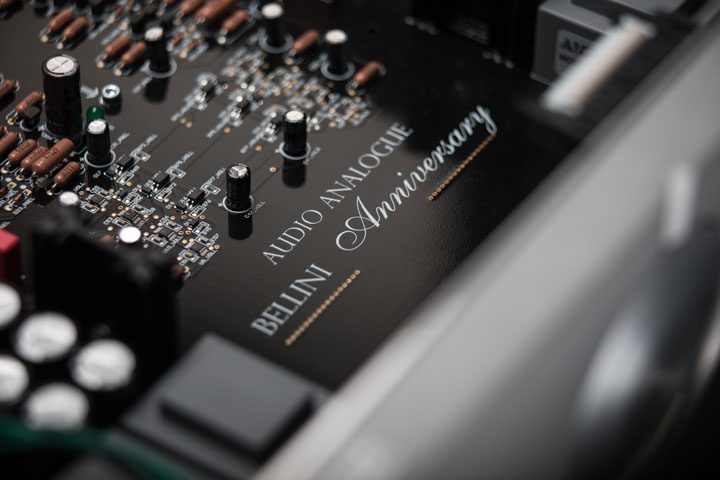
The four-layer circuit board uses Audio Analogue’s own SeGeSTA (Single Gain Stage Transconductance Amplifier) circuit to keep the noise floor low. The fully-balanced, dual mono preamp has no global feedback, and the board layout is designed to minimise potential noise and crosstalk ingress by reducing crossing points between input and output and between digital control sections and analogue inputs. What’s – pleasantly – surprising about the Bellini Anniversary is the extensive use of traditional components over surface-mount designs. This allows the amplifier to specify very high-grade components and affords the Bellini Anniversary owner better long-term repair options (if a resistor needs replacing, it’s a lot easier to do so with a discrete component than it is trying to unpick and replace a surface-mounted equivalent).
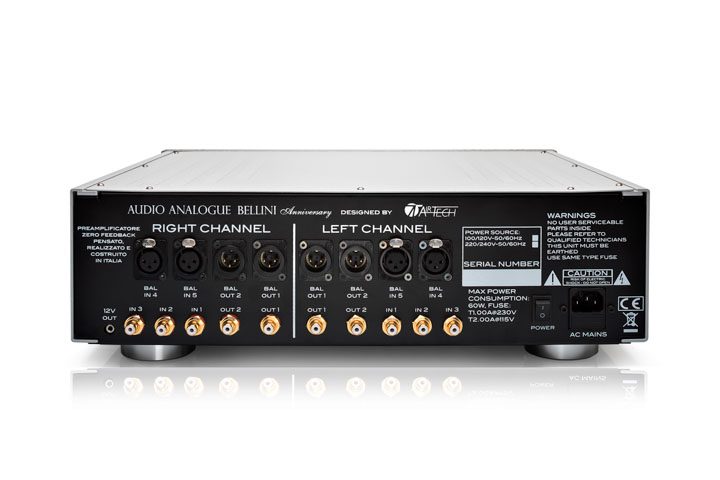
For a balanced design, there are a lot of single-ended inputs; the Bellini Anniversary has two balanced XLR and three RCA single-ended inputs, with two XLR and two RCA outputs. I think this is a good option for a domestic industry that has never fully embraced the joys of balanced inputs, but in listening, the balanced option used throughout sounds better.
The Bellini Anniversary’s basic functionality needs a bit of a run-up, as it’s perhaps not the most instantly intuitive design around. Having one control to drive standby, input selection and volume can take some time to understand, and until you get the knack of operating it… use the remote. Once you do get that knack, you’ll probably still want to use the remote because switching inputs involves pressing the button for the correct length of time and moving majestically in sequence through the inputs. Fortunately, these inputs are clearly marked with white LEDs on the front left of the preamp, while the volume is displayed through 22 white LEDs on the right-hand side. These are dimmable… from the remote.
Bring on the brute!
The Donizetti Anniversary (which also shares nothing but the name with its predecessor) is an absolute unit, a friendly brute of a 250W power amplifier that doubles to 500W into four ohms and 950W into two-ohm loads. There’s nothing out there in loudspeaker land that will trouble it; two beefy 1200VA transformers designed specifically for the amp help. Because the amp is a pure dual mono design, the two transformers stack one on top of the other, which gives the amp an uneven weight distribution. When coupled with some spiky heatsinks that run the length of the sides of the amp, this forward-tilted weight distribution makes the amplifier approximately 1.35 standard metric pigs to move; but once sited and the blood flow is staunched, it becomes the most docile of amplifiers unless provoked by music!
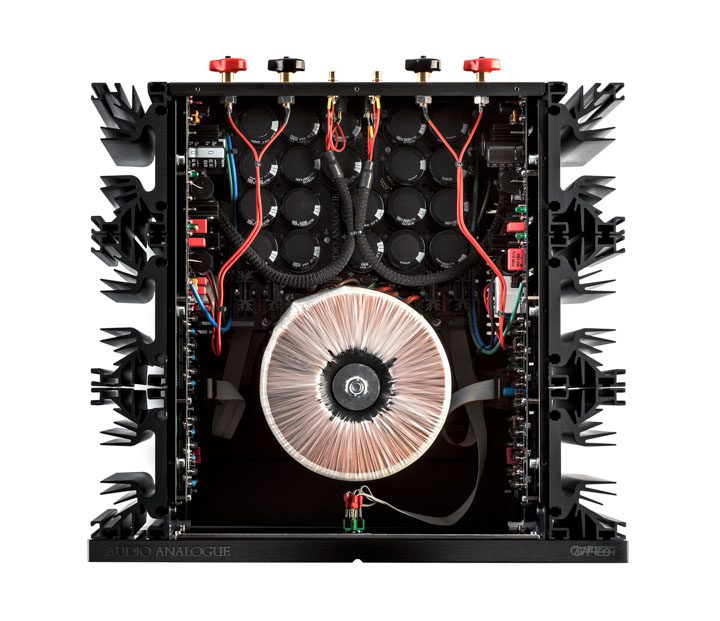
All that heatsinking does push for an observation about the Donizetti Anniversary. It takes a while to come on song. Not just in terms of its initial conditioning phase (I can’t speak about that as it all happened long before the amplifier arrived), but in terms of starting the amp from standby. It really only comes on song when the heatsinks are warm to the touch, which can take anything up to half an hour or more. It’s worth the wait, but those who demand instant gratification from their amplifiers will not like that their first few tracks played will lack the satisfying musical integrity they will experience later in the session.
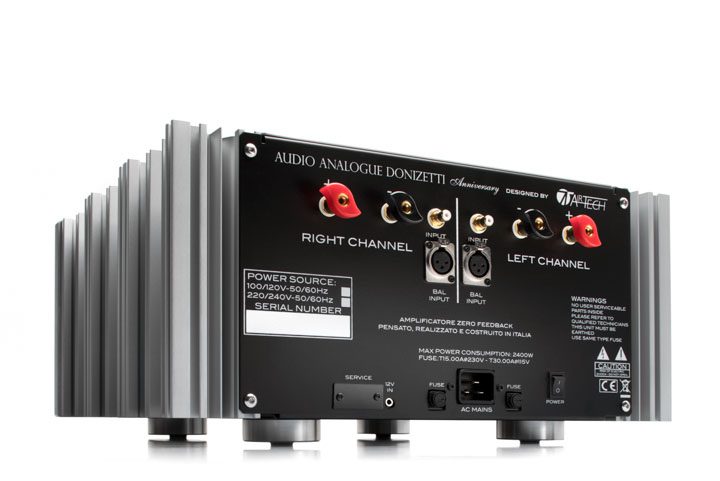
As with the Bellini Anniversary, the no-global feedback Donizetti Anniversary uses Audio Analogue’s SeGeSTA configuration, which in the Donizetti’s case is followed by a group of four transistors per side to deliver the requisite current without influencing the gain stage. It also has the same ‘minimal crossing points’ layout seen in the Bellini Anniversary, uses high-quality discrete components on four-layer boards, and sports 7N OCC copper case wiring throughout. With both balanced and single-ended inputs and high-grade speaker terminals at the rear and a single soft-start push button on the front, it’s likely all the amplifier you need. If it isn’t, there’s also an option to run two Donizetti Anniversary in dual mono… presumably if you want to use a pair of loudspeakers as a foghorn.
Sound quality
Within about 20 seconds into the listening, my notes read ‘mailed fist in a velvet glove’. It’s a cliché, but one that holds a lot of water when listening to the Audio Analogue Bellini and Donizetti Anniversary duo. The overall sound is refined and effortless… but with a lot of speaker-gripping control and sheer grunt in reserve should you decide to play it loud.
A sign of a good amp combination is that controlled power, where it doesn’t tip over into brightness or showy deep bass rumbling unless it’s called for. If that is the case, the Audio Analogue pairing is an extremely good amp combination. That first track was ‘Englishman in New York’ by Sting […Nothing Like the Sun, A&M] and it sounded extremely fine. The shape and texture of the music played had great flow and some force when called for and had plenty of grace and charm throughout. Sting’s odd diction is not the best test of vocal articulation, but I’d say it works well; perhaps the ‘refinement’ part of the sound makes him more ‘Mild Skin Irritant’ than ‘Sting’, but the combination paints the recording with all the right shades.
Swapping from this to ‘Insomnia’ by Faithless [Reverence, Cheeky/BMG] showed the space and power this duo has in abundance. I’m frequently shocked that this classic of Progressive House music is getting on for 27 years old but played loud it sounded fresh and exciting through the Audio Analogue pairing. That famous ‘drop’ is powerful and expressive and when the drums kick back in, you are back in the clubs again. That drop needs a system that is both sophisticated (it can sound too toppy) and dynamic enough to make it seem like it’s 1995 again.
Another telling sign of the quality of the Audio Analogue pairing was how happy they were when things changed. Swap over loudspeakers and the amps change their character to suit (up to a point… it’s still the same refined, warm balance with a holographic soundstage and lots of fluid midrange detail). Swap sources and the amps react accordingly. Even changing preamp and power amplifier shows their basic refined/warm/neutral sound shines through. They are at their best when you keep the amps in the Audio Analogue family, however.
Again and again, I found myself drawn into a wide, near holographic soundstage filled with instruments that have a sublime midrange, a subtly underpinning of bass, and a refined, never once brash treble. OK, so maybe the soundstage wasn’t so pronounced when playing some 1970s pub-rock recordings [‘She Does It Right’ by Dr Feelgood, Down By The Jetty, UA] but here it’s all about managing raw charm. You get to hear Wilko Johnson ripping through a Telecaster at a ferocious pace, and loses none of ferocity of that bridge pickup and its tweeter-shattering intensity. But what the Audio Analogue duo do so well is give this recording a sense of its own place in history. You can almost smell cheap beer, cheaper aftershave, and Canvey Island’s finest whelks when playing this record through the Audio Analogue duo, so natural is the sense of space and energy.
There’s always a trade-off somewhere in audio. Here it’s between absolute fidelity and wider musical approachability. Those sublime recordings – not just test records, but the ones you use to show off a system, like ‘Babylon Sisters’ from Steely Dan’s Aja [MCA] are reproduced extremely well, but lack a little of the top-end sparkle and vividness you hear through the very best audio electronics. On the other hand, records that are all-but unlistenable on top-notch audio systems – like the stupidly compressed ‘I Bet You Look Good on the Dancefloor’ from Arctic Monkeys Whatever People Say I Am, That’s What I’m Not [Domino] – sounded, well, OK. The compression was still apparent, the dynamic range of the recording paper thin, but the pace and fun of the track was retained and not so undermined by the sheer detail retrieval of the system.
I am in two minds about that trade-off. It renders a lot more music listenable but those recordings that don’t need a helping hand are less well presented.
Conclusion
The spectre of audio’s rose-tinted view of the past should be exorcised. We sometimes prize those classic big pre/power combinations from the 1980s, but if we listened to them today on a level playing field, I suspect a few of the Anointed Ones of audio wouldn’t hold a candle to this Audio Analogue pairing. It’s gentle, refined and sophisticated touch with music – that not only rolls with the punches but can also deliver a neat haymaker when required – is extremely alluring, especially for those who do not simply choose audiophile-approved recordings. The Audio Analogue Bellini Anniversary and Donizetti Anniversary is the pre/power combo that puts a smile on your face.
Technical specifications
Bellini Anniversary line preamplifier
- Inputs 3x RCA single-ended stereo pair, 2x XLR balanced stereo pair
- Outputs 2x RCA single-ended stereo pair, 2x XLR balanced stereo pair
- Input impedance 47kΩ
- Output gain 5dB (single-ended), 11dB (balanced)
- Frequency response (attenuation 0.5dB) 0Hz–200kHz
- Unbalanced output noise (Band 0 Hz–8kHz) 24µV, 9µV (A-wtd)
- Balanced output noise (Band 0 Hz–8kHz) 37µV, 14µV (A-wtd)
- SNR(0dB/A weighted/ref. 2Vrms) -107dB (single-ended), -103dB (balanced) – unbalanced output
- Finish Black or silver
- Dimensions(H×W×D) 140 × 450 × 380 mm
- Weight 12kg
- Price £6,000
Donizetti Anniversary stereo solid-state power amplifier
- Inputs 1x RCA single ended stereo pair, 1x XLR balanced stereo pair
- Input impedance 47Kohm
- Power on 8Ω load 250W (1,000W mono)
- Power on 4Ω load 500W (1,700W mono)
- Power on 2Ω load 950W (2,200W mono)
- Power Amp gain 26db
- Sensitivity (8Ω output nominal power) 2.3Vrms
- Frequency Response 0Hz 110kHz +0dB, -3dB
- SNR; >110dB
- Output resistance (rated power on 8Ω at 1kHz); 0.15Ω
- Noise reported at the input (0Hz-80kHz); 10µV, 4µV (A-Wtd)
- Finish Black or silver
- Dimensions(H×W×D) 221 × 450 × 428 mm
- Weight 41.2 Kg
- Price £11,000
Manufacturer
Audio Analogue
URL: audioanalogue.com
UK Distributor
Decent Audio
Tel: +44(0)1642 263765
URL: decentaudio.co.uk
The post Audio Analogue Bellini Anniversary and Donizetti Anniversary appeared first on Hi-Fi+.
Uncategorized
Métronome Technologie DSC
There are few parts of the audio world as contended as computer audio. From the humble USB-powered DAC to complicated devices that take the place of half your existing system, the ‘post-physical’ digital world is manifold, complicated to implement, and at times bewildering. By the standards of the rest of the audio world, the post-CD digital world is a hotbed of activity. The Toulouse-based Métronome Technologie has long been at the digital leading edge, thanks to products like its DSC.
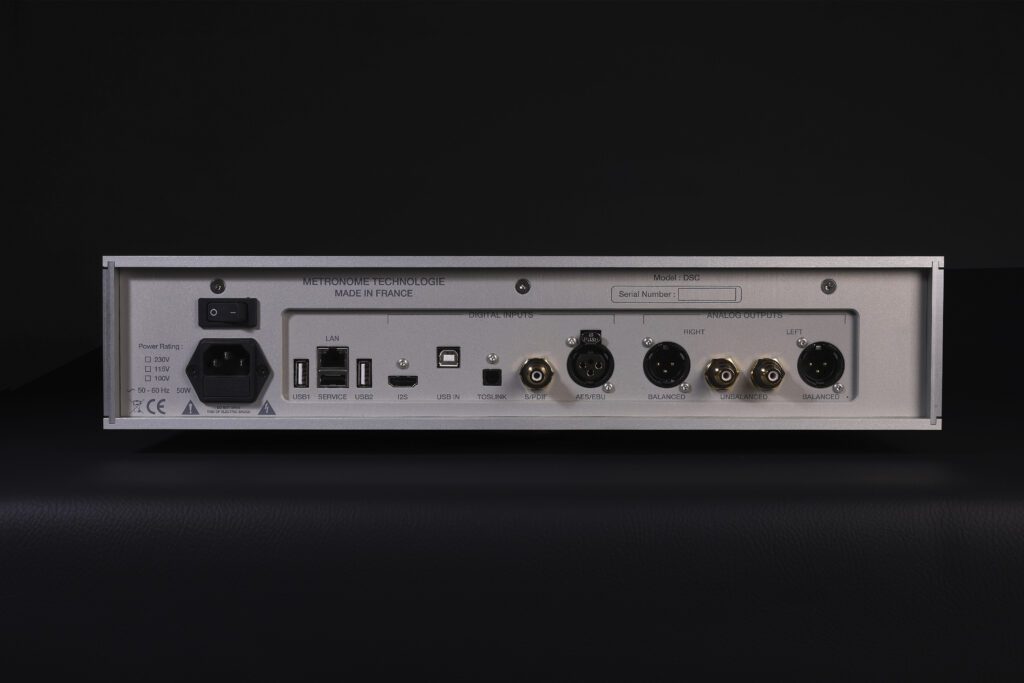
DSC (or ‘Digital Sharing Converter’) is at the ‘flexible’ end of the modern digital audio spectrum. It’s a networked streaming preamplifier and DAC in one, allowing signals from a vast array of digital sources (basically, if you can’t find a suitable digital input out of an array spanning Ethernet, two kinds of USB – for laptop users and those with USB hard drives full of music – coaxial and Toslink S/PDIF, AES/EBU on XLR and even I2S on HDMI… then you are either trying to prove a point or are just not trying hard enough).
To the max
You could simply use it as a DAC, maxing out the volume control and pretending the network side does not exist. And in this aspect, the DSC fares well; built on an ES9038PRO Sabre DAC, the Métronome device decodes PCM to 32-bit, 384kHz, DSD to DSD512 and supports MQA. You’d be a little crazy to do this because there are other products – even other Métronome products – that do the same job, and you would be paying a healthy premium to include sub-systems that never get used in this case, but its DAC section is no slouch.
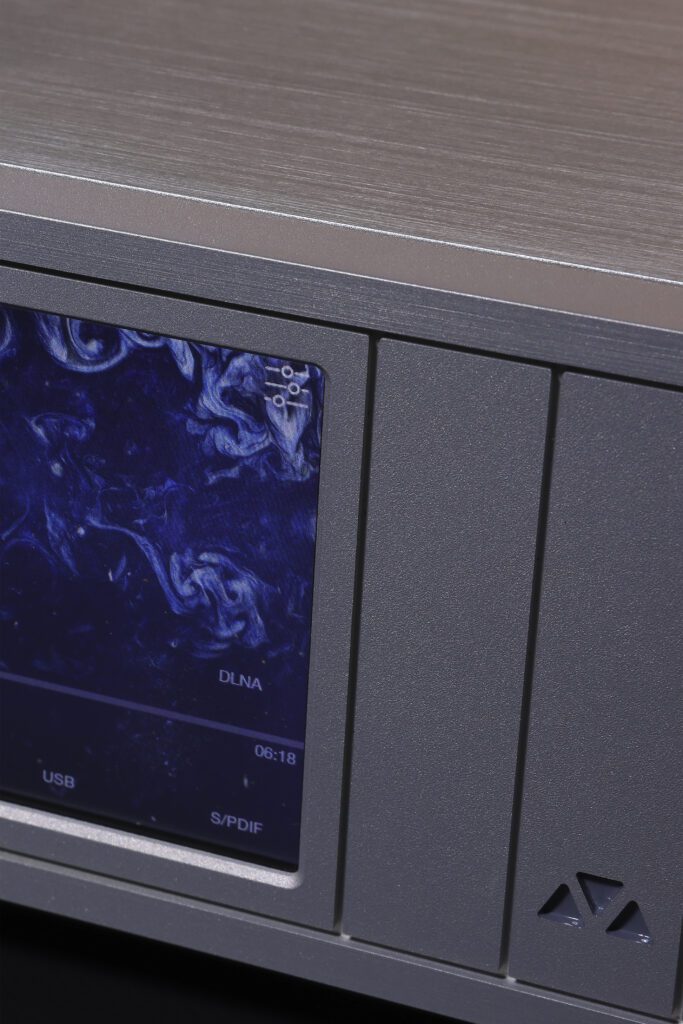
Realistically, Métronome DSC users will be looking for a single box to replace all their digital sources and preamplifier combined. This does preclude those with any analogue sources (unless they fancy a spot of digitisation first). However. it’s likely that by now, your view on analogue is either one of full embrace or total abandonment, and if the latter, the DSC ticks all your boxes for a top-end front end.
The DSC is a minimalist design with an industrial look reminiscent of some classic computer hardware architecture. You could convince someone that you’d installed a high-end blade server in your listening room, except for the absence of fan noise. However, the takeaway point from this is the solidity of the design; this is a heavily well-made product with the sort of care and attention that’s hard to find and harder to fault.
Plug & Play
Métronome also uses the term ‘Plug & Play’ in terms of its ease of use. That term was overused a few years ago and barely gets rolled out anymore. It seems appropriate here, as it is a device you insert into your system… and it’s done. This gets an order of magnitude easier if Roon is in the mix, as the DSC is Roon-ready.
Regardless of your feelings toward Roon, the DSC runs on a solid backbone of UPnP and DLNA connectivity. Wire it into your Ethernet network (you can use an aftermarket Wi-Fi dongle, but I’d argue against it on moral grounds), and if there is any kind of UPnP media server on the network, the DSC will act as its close friend, confidant and renderer. I used it with a Naim Uniti Core and the Melco D100, and in both cases, it made friends quickly.
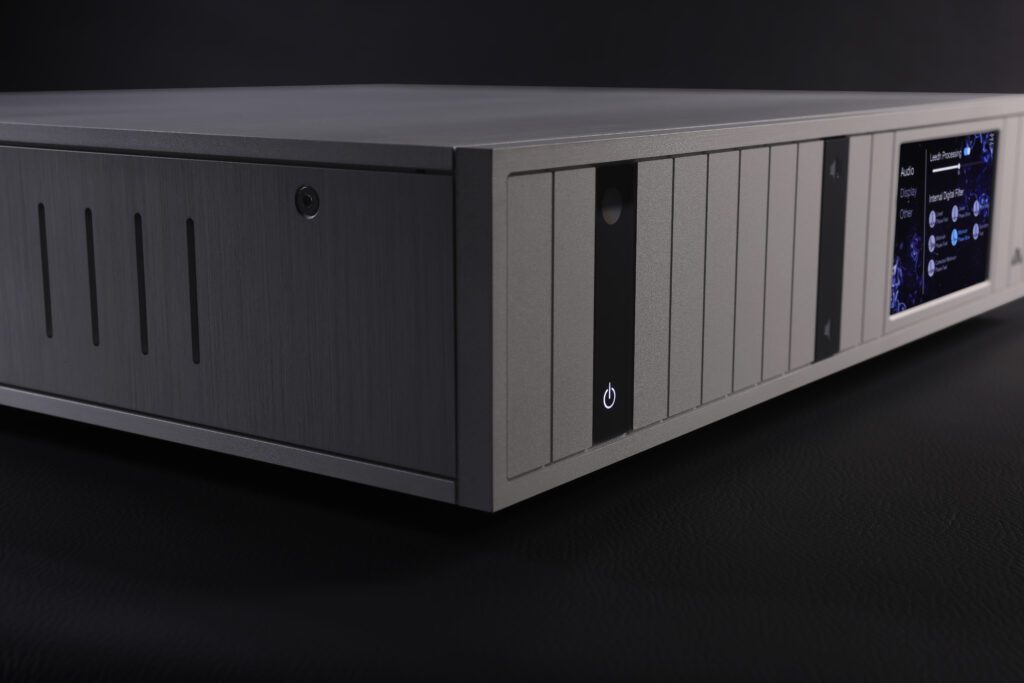
If you aren’t going down the Roon route, Métronome provides a remote handset to accompany the touchscreen and recommends the Mconnect app. I’m conflicted by this; the app is excellent, and I’d much prefer relying on this app than an in-house app that comes pre-broken, but I also think a bespoke app is a requirement at this price and performance point.
Yes, that requirement all but goes away in the presence of Roon, making an in-house app even less of a functional and practical proposition. However, for many, the control surfaces of a streamer begin and end with the app itself and by going with a third party (no matter how good), it might not show the Métronome DSC in the light in which it should be seen.
The Equaliser
Minor niggle aside, the Métronome DSC is an excellent musical equaliser, not in the ‘graphic’ or ‘parametric’ sense. It allows the user to join hands with online subscription services like Tidal, Qobuz, Spotify and Deezer, and interwebular radio through vTuner. These blend seamlessly into your local storage on computers or network-attached storage (NAS) boxes. Granted, you must sign up for these subscription services on a computer or tablet. But I don’t have a problem with this… entering your credit card details into a five-inch touchscreen (or worse, through the remote handset) breaks the minds and thumbs of modern mankind.
In a very real way, I’ve been saving the best until last. Although very well implemented, there aren’t many things that differentiate the Métronome DSC from similar streaming preamplifiers from several well-respected companies. If Métronome didn’t have an ace up its sleeve, it would still fare well against some big hitters in this hotly contested field. But there’s Leedh to contend with, and that is Métronome’s ace up its sleeve. Leedh is a French signal processing company with plans for every aspect of digital signal processing but is currently concentrating on volume in the digital domain.
Digital volume controls have (mostly) moved on from the crude truncation systems of early 24bit attenuators on 16bit digital files, but ‘moved on’ typically means ‘truncating a dithered signal’. Dithering relies on an excellent algorithm to prevent folding quantization noise into the original signal, and not all algorithms are created equal. Leedh actively minimises the number of bits used to quantize the digital signal so that the amount of information loss is reduced at the truncation stage.
This means the attenuation doesn’t undermine the performance of the signal but comes at a trade-off of fewer fine steps to that digital volume control. Put simply, if you want 0.1dB volume changes in the digital domain, you must put up with compromised digital sound at any volume thanks to quantization noise being mixed into the digital datastream. Leedh means wider volume steps but vastly improved sound quality.
Gaining ground
Leedh is gaining ground with manufacturers, with Lumin and Soulution joining Métronome taking up the Leedh challenge (and fellow French company Vermeer Audio set to follow soon). If you think the quantization noise of conventional digital volume systems is the lesser of two evils, then you’ve probably not heard Leedh at its best. It makes a solid case to be the only volume game in town!
Finally, the analogue side of things is well-covered by the DSC, with a set of RCA plugs for single-ended systems and XLRs for balanced. It doesn’t have much in the way of digital outputs. Still, with increasingly thorough Digital Rights Management systems preventing recording, digital outputs are more useful for multiroom systems than recording. Given the Métronome’s robust Ethernet connectivity, chances are if you are using multiroom, you won’t be outputting that digital signal from the DSC anyway.
The specifications and feature list of the Métronome are exciting and promising, but it still places the DSC in the middle of many rivals. Those will look to the top-end Linn and Lumin products and wonder if the DSC is just an also-ran. It isn’t.
Right where it counts
Métronome scores highly right where it counts; in the sound quality department. The company has long made a sound that is approachable, natural, and free from a lot of that detail-first brightness commonly associated with top-notch digital audio. However, it does this without smoothing over the top end of the signal or making the treble too recessed or fattening up (and slowing down) the bass. It just makes the sound less forward and musically interrogative… in a good way.
It’s an exceptionally clear-sounding device, neither warm nor bright sounding. If that character could be summed up in a single word, it would be ‘honest’. Streaming ‘Sooth Lady Wine’ by Matt Corby [Telluric, Mercury, Tidal], it gives the track that warm, lush, modern take on a 70s rock jam, but then flipping over to ‘Crossings’ by Nils Frahm and Peter Broderick [Graz, for World Piano Day, Tidal], the sound shifted to the clean, clear, chimey sound of a closely recorded piano. This is a sign of a very good device, as it’s not introducing its character into the performance.
Looking at specific performance aspects in a streamer, it acquits itself exceptionally well. It’s a detailed and dynamic performer with an extremely good soundstage in a field that, if we are being honest, doesn’t often do too well in soundstaging. That good soundstage sits comfortably wide of the boxes and appears quite deep. However, there isn’t much height information, even on classic Decca recordings where such spatial information is very well rendered (Solti’s take on Mahler’s Eighth, for example, locally streamed from a ripped CD). Given the little better than 2D sound often heard through streaming sources, this puts the DSC into the top tier. Meanwhile, the same Mahler piece is excellent at showing how much bombast the DSC can play, and it’s a lot!
Maybe most important in the Métronome DSC’s sound is how it makes music sound effortless and authentic. In that respect, it sounds closer to a good CD or even LP than most streaming devices. It moved so effortlessly from musical genre to genre that it played some poor recordings alongside some of the best without making the former sound like a dog’s breakfast by comparison. When you start listening to ‘The Sound Of The Underground’ by Girls Aloud [Polydor, Tidal] and thoroughly enjoying it as a damn fine pop record rather than getting a little snooty about the level of compression they used some 20 years ago, you know you are on to a bit of a winner.
Do it well
The more you listen to music through the DSC, the more you want to listen to music. That’s what the DSC does so well; we get so obsessed by high quality sound and the noises it makes, we often forget that behind all that, you need to have something that sounds good, and the DSC sounds damn good.
Another way to highlight the DSC’s quality is that it stands up to comparison. The comparison that few people are making is a like-for-like with CD. As something of a Brexit-meets-COVID bonus, I’ve been able to hold onto the excellent Gryphon Ethos CD player for far longer than I expected or deserved, but it indicates just how good CD can be. It’s difficult to ‘fess up’ to, but except for a few cases, when you play a CD against a ripped and streamed version of the same recording, the CD comes out on top. Only a handful of streamers get close to being on par with a very good player, and I’d struggle to find any streamer that takes on CD’s big guns and wins.
Perhaps it’s because Métronome’s sister brand Kalista makes one of those big guns of CD, but the DSC gets closer than most to that CD ideal. Compared with most streamers, the sound of streaming is flat and uninspiring. A few streamers give CD a run for the money with a more exciting and exuberant, and the Métronome DSC joins that select list of streamers that make the grade. This might sound like a hollow victory (a 21st Century format that finally outperforms a digital format that’s about to celebrate its 40th birthday), but it’s a victory, nonetheless.
Follow the Leedh-er
Finally, there’s that extraordinary Leedh volume control. It changes the game, getting you about as close to the music as possible. The closest we get to sound this good is with a passive or an autotransformer preamplifier. You might not think about how vital volume control can be until you hear just how good the next generation will be.
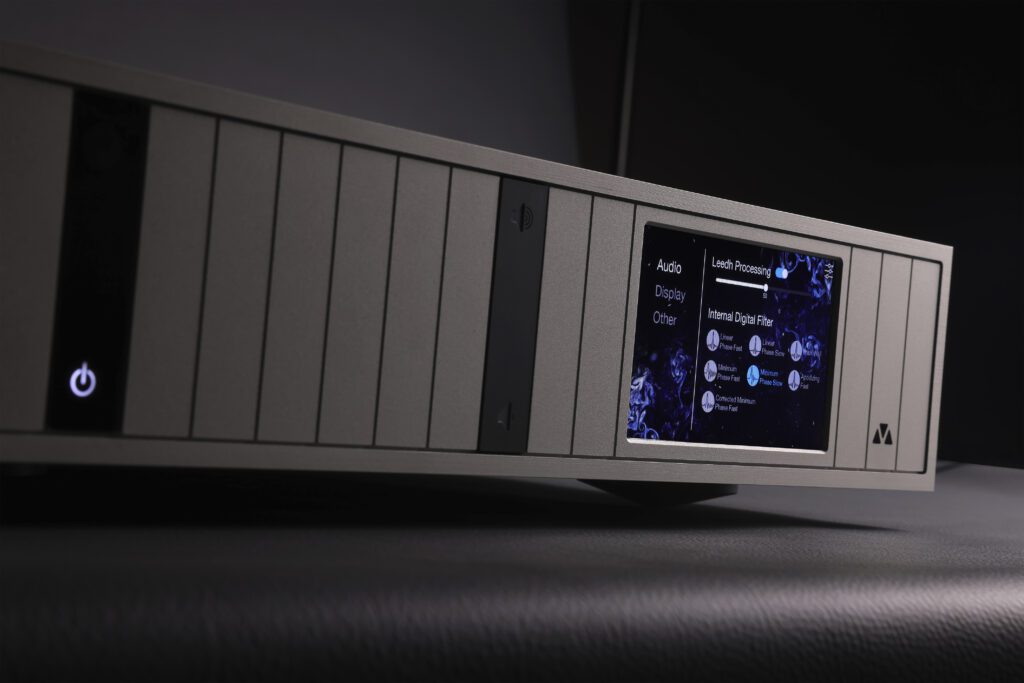
The two significant elements this volume control system brings to the sound are invisibility and consistency. You realise a couple of bars into a record that the pinch-point in audio is the volume control, and the Leedh concept just takes that away. This ties into the consistency issue, as the performance doesn’t change at any volume level. While there are more characterful and more immediately impressive streamers, this one stands with the best.
Many streamers seem to follow that quote by conductor Sir Thomas Beecham about the English; “they may not like music, but they absolutely love the sound it makes.” The Métronome DSC complete streamer/DAC/preamp system is one of the rare exceptions. It’s honest, accurate, neutral and above all, enjoyable. It’s a lot of money for a digital preamp, but you also get a lot of preamp for the money.
TECHNICAL SPECIFICATIONS
- Type: Digital Streaming Preamplifier/DAC
- Digital inputs: 1 Ethernet connector, 2 USB connectors, HDMI I²S (PCM & DSD), S/PDIF RCA, AES/EBU XLR, Optical Toslink
- Analogue outputs : Unbalanced adjustable gain @0dB 100 Ohms – RCA, Balanced adjustable gain @0 dB 2 kOhms – XLR
- Resolution: 32 bits/384 kHz DSD 64 to 512 (eq. frequency of 22.4 MHz)
- Dynamic range : -137 dB
- Distortion + noise : -122 dB
- Internal Processor: 32 bit
- Frequency bandwidth: 32 to 768 kHz
- Bandwidth: 10 Hz–20 kHz +/- 0.1 dB –
- Dynamic range: 127 dB
- Unbalanced adjustable gain: @0dB 100 Ohms – RCA
- Balanced adjustable gain: @0 dB 2 kOhms – XLR
- Dimensions (W×H×D): 430 × 105 × 430 mm
- Weight : 17 kg
- Price: £24,000
Manufacturer:
Métronome Technologie
UK Distributor:
Airt Audio
+44(0)1354 6525666
The post Métronome Technologie DSC appeared first on Hi-Fi+.
- 1
- 2