Tag Archives: Quadrophonic

Listening Report: Robert Fripp’s Exposures 32-Disc Boxed Set (Part 3, Live Frippertronics & More)

I could probably continue to write 20 additional reviews based on new discoveries and insights I’m still experiencing while exploring Robert Fripp’s breathtakingly massive and amazingly thoughtful Exposures boxed set.  

With this series of listening reports I hope I’ve at least given you, Dear Readers, a snapshot of what to expect and perhaps given some of you who have been on the fence about purchasing the set rational to — like me — leap off the board and dive into the rewarding waters of Frippertronics.  If you missed part 1, please click here and for part 2, click here.

Before I get into our last listening report of the series on the magnificent Washington Square Church concert recordings, I wanted to share some admittedly flowery, quasi-poetic language that came to me while listening to it. I got to to thinking about how I might explain what Frippertonics sounds like to a novice listener without using technical descriptions about guitars and loops ’n such.   

And then this paragraph came to me:

“Frippertronics sounds like clouds, floating, ebbing and tiding, merging dissipating, thundering and lightning, raining and revealing the sunshine within and around us… Would I be extreme if I said that perhaps Frippertonics is the sound of heaven? We can discuss that some other day…”

Colorful language aside, I felt there was something to these words, enough to include them here. I may continue massaging it over time, but I hope that for now it helps paint a picture of this distinctive and remarkable music.

And now, back to our regularly scheduled programming…

Available as part of the Exposures boxed set (including on CD, DVD and Blu-ray Disc) or as a standalone CD+DVD package (vinyl too!), the Washington Square Church concert is a special — and even unique — gem within the universe of all things Frippertronics. Freshly massaged, mixed and mastered from original tape sources by producer David Singleton, true to the buzz copy on the BurningShed website, this may well be “the finest example of Frippertronics in performance.”

What is so special about this?  

All of Fripp’s basic Frippertronic loops are thankfully in the archives. However, his solos over the loops weren’t always recorded save for this series of shows from 1981.  Unfortunately, they were not labeled properly so there was no clear way to figure out which solo went with which loop. DGM audio engineer Alex R. Mundy saved the day when he realized that the sound of the loops had been recorded at ultra low volume through the guitar pick-ups playing the solos. So by listening to non solo points at ear-bleed volume levels, he was able to identify and match up the solos to the particular loop. It was a painstaking process but the results allowed producer. David Singleton move ahead with mixing the audio of this final concert.

You can read about in the booklet in the Exposures boxed set as well as the individual Washington Square Church CD+DVD set. 

Once you are able to grok — yes, grok — the incredible technical hurdles the producers over came to bring this concert recording to us (a process probably even more painstaking than what the Zappa Estate undertook to bring us the Roxy concert film performances, click here for my review on that), one needs to just sit back and prepare to be mesmerized by this arguable epitome of live Frippertronics. 

Fripp’s playing is on fire in these performances made between July & August 1981. We get to hear a particularly refined and inspired Frippertronics presentation that no doubt benefits from his four years of touring and recording in this mode.  Here, we also get to witness (aurally, at least) Fripp at something of a crossroads given that in a month or so he would be unleashing his new Discipline project on the musical universe (ie. the next King Crimson). So don’t be surprised when you hear him launching into some of that fast, repetitive machine-gun fast fretwork he teased on “The Zero Of The Signified” and which would blossom into full flower in later songs like “Frame By Frame” on the Discipline album.

The song titles on the Washington Square Church DVD Audio Disc and Blu-ray Disc versions are simply labeled “Washington Square” followed by a roman numeral from I-XI. The performances are all variations on classic Frippertronics themes but are particularly focused and powerful in this show. 

Interestingly, as the album’s producers were going through the loops and matching them to solos, they discovered an anomaly: Fripp had played over the same loop at two different concert venues— one  at Washington Square Church and another at Inroads. In a process akin to Frank Zappa’s “xenocrony” concept — where unrelated recordings are combined to reveal remarkable synergy which never existed before in reality — album producer David Singleton was able to combine both solos into the final track on the album, “Washington Square XI.” 

Mr. Singleton describes the process in the liner notes. The two solos deliver very different feelings, one with a sort of “Scary Monsters” (Bowie) vibe while the other features the rapid-fire typewriter-on-steroids “Frame By Frame” (King Crimson) sort of playing. Together, these solo appear as a bit of a virtual duet. Interestingly at the point where one fades out the other picks up  as if it was planned. It wasn’t, the segue just happened when the two performances were aligned in the multichannel recording software. 

Another wonderful and wondrous moment in the Exposures boxed set. There is so much more but I think after these three listening reports you now have some idea of what to expect. There is much visual joy to look forward to as well in the booklet and the fantastic reproductions of concert posters and other memorabilia from the period included in the set.  

Exposures is arguably the most complete and in-depth multi disc boxed set to date from the King Crimson universe, if not all music in general.  It is that good.  If you are a Fripp fan, you need this one…

Listening Report: Robert Fripp’s Exposures 32-Disc Boxed Set (Part 2, Exposure, Under Heavy Manners, Dolby Atmos/DTS HDMA Surround & More)

If you missed part one of my exploration into Robert Fripp’s excellent new boxed set called Exposures, please click here to jump to it and catch up. I’ve tucked in much useful back up information and perspective there which will make today’s listening report that much easier for anyone reading to appreciate.

Assuming everyone is all caught up on all things Fripp-tastic, lets dive right in… 

Please note that this is technically my first formal review of an Atmos mix and I can’t think of a better maiden voyage than with Robert Fripp’s Exposure recordings as mixed by the great Steven Wilson. I have recently upgraded my living room home theater system so that I can now listen to the wealth of Dolby Atmos releases I’ve received in the past year. Prior to this review, so far I’ve been somewhat underwhelmed by many of the Atmos mixes I’ve tried — and thus have not written about any yet. But, I’m not entirely surprised as it is a new medium and some mixing engineers are probably getting instructions from the powers-that-be to not get too crazy on their titles. 

But it is worth noting that there is a difference between an outwardly wacky gimmicky mix vs.  one which tastefully uses all the surround fields to create an appealing immersive listening experience. 

Save for the Atmos mix of producer Steven Wilson’s own most recent solo release (click here for my earlier review of his The Future Bites which I hope to update at some point about the Atmos mixes), the mixes here on Exposures are the first compelling home audio use of the new Dolby technology which I have heard to date!

Not all of the albums included in Exposures are mixed in Dolby Atmos or DTS HD Master Audio, probably for very good reasons beyond the scope of this review.  But the ones that have been are significant within Robert Fripp’s catalog. 

The core original Exposure album is available here in 96 kHz, 24-bit DTS HD Master Audio 5.1 surround sound as well as 48 kHz, 24-bit 7.1 Dolby Atmos (and in Stereo!). Both options have their benefits and the two options mostly support one another for easy comparison and contrast. Even though technically the Dolby Atmos option is about half the size of DTS HD MA option, I didn’t notice any significant loss of fidelity between the two versions (so kudos to mixing engineer Steven Wilson for working that magic!). 

Listening to the “Fourth Edition” of Exposure in a new 2021 mix, one of the first things I noticed was that the ‘height” channels in the Dolby Atmos mix were (happily) being used for discrete instrumentation as well as room ambiance.  This is one of the big issues I had with many other Atmos mixes I’ve heard — most had opted to just throw some lazy reverb-y ambiance in there, much in the way that poorly crafted 5.1 mixes sometimes handle in the rear surrounds. I understand it is a safe method — keeping everything “true” to the original Stereo mix — but being bland doesn’t add any value to the surround mix. That approach is almost always ultimately disinteresting (at least to me, and I suspect others who hope for a bit more muchness from their home theater listening experiences).

Thankfully, Exposure in surround sound is not lacking in muchness here on Exposures! Plenty of it here to go around!

So for example, on “North Star” I heard delicate pedal steel guitar parts and scraping effects emanating from the Atmos channels toward the end of one song.  On “I May Not Have Had Enough of Me but I’ve Had Enough of You” there are these fantastic odd guitar “punches” (if you will) which percolate there. 

In addition to discrete information, the Atmos channels here are often used for height information which seems to help everything sound bigger, more to scale of the room they were recorded in. Not necessarily louder but just bigger, if you will. 

So on the title track “Exposure” the drums are particularly huge. At times it feels like the kick drum is in your face, as if you were standing in front of the stage in a club or small venue. 

“Mary” is utterly gorgeous, Terre Roche’s voice sounding hauntingly direct as is Peter Gabriel’s vocal on “Here Comes The Flood.”  “NY3” is more manic and intense than ever, if that is possible. 

When I listened to the Atmos mix of Under Heavy Manners, the impact was quite spectacular.  “Zero Of The Signified” is especially jaw-dropping with much huge sounding Frippery going on including (what sounded like a sort of) detuning of strings on his guitar to make fat roaring rhinoceros like sounds (akin to what his future band mate Adrian Belew would be doing in Discipline-era King Crimson and on his solo albums). There are some incredible washes of Frippertronica (if you will) flowing over and around at the end, with one loop sort of whipping behind the listener.  It is a subtle effect, but it is there for sure.

The extend mix of ”The Zero of The Signified” is a standout for me. Fripp’s wicked repetitive guitar signatures seem to ping-pong more aggressively around in the surround fields while Frippertronics tides crash on the shores of your listening sweet spot. Amazing, achingly beautiful feedback guitar — which I believe would make Hendrix cry — plus even more rhino rips appear front and center while frippertronics loops soar around.

At this moment I can more fully appreciate why Fripp eventually connected with Adrian Belew — they were both working on similar concepts from different directions!

“Red Two Scorer” is one of the most immersive Frippertronics mixes I’ve heard thus far, with seeming diagonal passes of sound at times, flying left-front to right-rear, left-rear to right-front. And its not gimmicky, just very very cool. I have only heard that attempted once before by none other than Frank Zappa (on the QuAUDIOPHILIAc version of “Waka Jawaka”)!

Perhaps the only curious — and maybe negative — detail I’ve found so far in comparing the different mixes happened when I switched to the DTS-HD Master Audio mix of Under Heavy Manners to attempt a crude A/B comparison of the two versions. The difference was almost too dramatic. The DTS mix felt immediately less immersive but it seemed to be more than that… Fripp’s guitars were toned down to the point where I wondered if there might be a problem with the technology delivering that particular mix.  I’m not sure what is happening there and it is certainly not a deal breaker for me at this point now that I’m Atmos-equipped, but thought it was important enough to bring up for those of you who might have any issues. 

There are also many many bonus options you’ll find in this realm worth exploring on Exposures. 

For example, Daryl Hall’s vocals on “Mary” on early versions of the Exposure album — presented as the wonderfully titled Breathless or How I Gradually Internalized The Social Reality Of Manhattan Until It Seemed To Be A Very Reasonable Way Of Life and Last Of The Great New York Heartthrobs — is mind numbingly gorgeous.  Hall’s vocals — which were initially blocked from release due to industry machinations back in the day, thus prompting the recording of Terre Roche’s beautiful but different replacement take, as heard on the first commercially released edition of the album — had eventually been released on CD several years back.  But honestly, hearing it in this form is like hearing it for the first time. Darryl feels like he’s right there in the room singing to you against Fripp’s beautiful electric guitar finger picking.  It is pretty knocked out!

“Morning” is another of the bonus tracks which jumped out at me while exploring Exposures on the Blu-ray Disc in the set.  This track feels like a preview of the rich acoustic sounds Mr. Fripp refined during his instructional Guitar Craft years (some of which you can hear on the League of Crafty Guitarists album) but with haunting Frippertronics flown in over it all. It is beautiful!

And so it goes on the Exposures boxed set.  One mesmerizing joy after another.  

Stay tuned as I’ll soon explore the amazing Washington Square Church performances in part three.

Tomita In Quadrophonic: Surround Sound Was Made For This Music

Back in the 1970s when I was a teenager just getting into music I remember hearing some recordings by Japanese synthesizer wizard, composer and arranger Isao Tomita and being simultaneously impressed and underwhelmed. The latter I attribute to my having been getting deeply into progressive rock and Frank Zappa in particular. I was already dipping my toes into the classical universe of artists who influenced Zappa such as Edgar Varese and Igor Stravinsky 

The first Tomita album I eventually picked up out of curiosity — this was before the days of being able to preview an album streamed on the Interwebs, folks… and this music wasn’t played on any radio stations I listened to — was indeed his interpretation of one of Stravinsky’s masterworks, The Firebird Suite. 

I love that piece of music and while it was on the surface impressive that he was able to perform the work, Tomita’s version left me kind of cold for some reason and I was never sure why. Wendy Carlos had already done some magical things combining classical music with synthesizers (her legendary Switched On Bach recordings).  And groups like Yes and Emerson Lake and Palmer (ELP) were taking synthesizers to wild extremes for the times, both incorporating touchstones of classical in their work. Yes legendarily opened its concerts with an excerpt from The Firebird and ELP even had even recorded an entire live album of a rock interpretation of Mussorgsky’s Pictures At An Exhibition. Renaissance brilliantly reinterpreted Rimsky Korsakov’s Scheherazade for a new generation to discover. 

So, while classical music was in the air for many of us back around this time, perhaps my expectations for a sizzling listening experience went beyond the scope of my teenage stereo system…

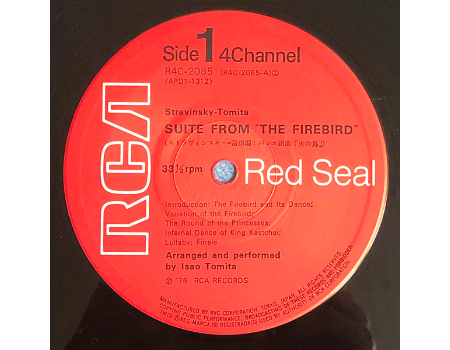
Fast forward and today I’m listening to a wonderful SACD from the Dutton-Vocalion label which contains the original 1970s quadrophonic mixes of Tomita’s Firebird and all I can think about are the phrases: “missed opportunity” and “ahead of his time.” 

The missed opportunity is that Tomita should have been touring with bands like Yes and ELP.  Apparently, Tomita performed live with a quadrophonic sound system which must have been a wonder to see and hear!  Groups like Pink Floyd had performed in quad even in the early 1970s. Note, there are recordings from Tomita’s live quad shows (click here  and here for a BBC transcription in Stereo which was apparently broadcast in quadrophonic sound back in the day, his first performance in England according to the website). 

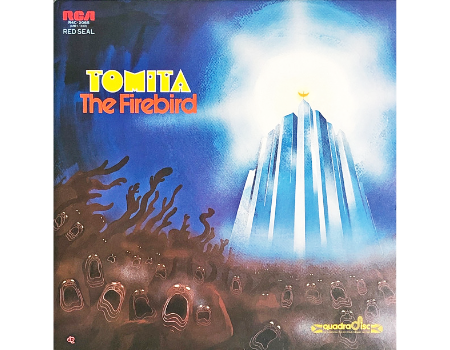
Original Japanese LP cover art for Tomita’s Firebird

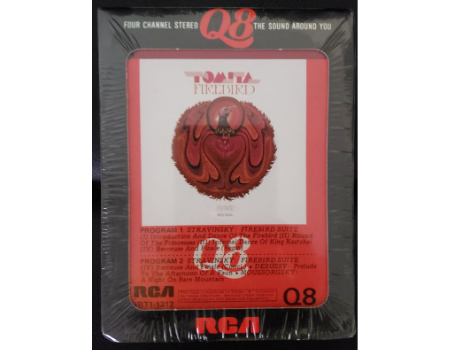
The ahead of his time part is that quadrophonic sound as a commercial medium back in the 70s simply wasn’t ready for prime time. Quad LPs and tapes were often available but getting those systems to work properly was apparently easier said than done. There were Quad broadcasts but you had to have one of the then new Quadrophonic receivers to be able to hear them. Not many had them yet, alas.

So, hearing Tomita’s original quad mixes of The Firebird today has been a revelation. This music which once left me cold now engages and excites me!

As an arranger, clearly he was in his sweet spot mixing for multi-channel, creating a wonderfully immersive mix which is not hung up on — and doesn’t pretend to try to — re-create a live soundstage. All his work was painstakingly programmed and performed. And here on The Firebird Suite he takes advantages of the otherworldly peaks and valleys in Stravinsky’s score and applies it to the design of the mix. The impact is wonderful.

It’s a little hard to describe this, especially if you don’t know this particular piece of music. Try to imagine in general a dramatic classical work or a movie soundtrack where the violins and cellos, horns and woodwinds that were percolating and soaring in those big epic sequences in monaural or stereo now swirled around, over and through you. That may give you an idea of what parts of this fine quadrophonic mix is like (especially when you sit in the “sweet spot” of your home theater or surround sound system listening area — that perfect zone for the listener to be seated in order to best appreciate a surround mix).

The other interesting thing about this fine version of Tomita’s Firebird is that when I compared the two channel Stereo mix on the hybrid SACD to a pristine conventional Stereo LP, they sound very much the same. This is a good thing and it seems to be a conscious effort on the part of the SACD’s producers as I have noticed this on several others of their releases which I have reviewed recently. They don’t try to modernize or brighten the recordings, so it feels true to the original.

Now if only there was some way to bring out more of these fun Tomita Quadrophonic mixes to  broader audience (ie. less expensive and more easily accessible, especially here in the United States), that would be a useful and wonderful occurrence.  

Perhaps with more impactful packaging (the liner notes here reproduce those from 1976 release and reveal nothing really about the four channel mixes) and a new push from domestic United States labels (Sony Classical owns this particular work apparently, even though it was originally on the RCA Records label), then there might be some stronger hope of bringing Tomita’s music to life again for new audiences to discover.  

Tomita’s music is ripe for rediscovery.

Cecil Holmes’ Soulful Surround Sounds on Quadrophonic SACD

Two years ago at a flea market I found a curious record that looked like one of many records riding the coat-tails of so-called “Blaxploitation” films and mining the bland-but-lucrative easy listening music market (Percy Faith, Arthur Fiedler’s Boston Pops, Henry Mancini, The Living Strings, etc.). The Black Motion Picture Experience was credited to a group I’d never heard of called The Cecil Holmes Soulful Sounds. It has turned out to be the most interesting of the genre which I’ve found so far, in part because of the back story I’ve just recently learned about.  

I’ve recently begun collecting — and reviewing — Quadraphonic SACDs being reissued by Dutton Vocalion out of England. I ordered several initially from them directly (but I see you can order many of these from Amazon, so poke around if you are looking for them — click on the title anywhere in this article and you’ll jump there).  Anyhow, I was pleasantly surprised to find The Black Motion Picture Experience by The Cecil Holmes Soulful Sounds as a featured Quad SACD release! 

Apparently Cecil’s albums had been issued on Quadrophonic 8-track Cartridges and Reel To Reel tapes back in the day. Who knew?

I ordered it right away and in general I’m not disappointed at all as it’s really quite fun hearing this music getting very deluxe treatment for which it clearly was built.  Cecil Holmes’ The Black Motion Picture Experience is produced with some heavies of the studio world (including an ascending Randy Brecker and Motown “Funk Brother” Bob Babbitt) so it grooves more than many standard faire easy listening records of this type. 

Cecil’s albums have been sampled by many modern artists including Mos Def, Brand Nubian, Ice Cube and even Rakim (as in Eric B. and…). Click here to jump to a recent search on WhoSampled, a terrific, fascinating website which helps people backwards engineer the DNA of current recordings to find the music’s roots. 

I think it is important to point out that Cecil Holmes was a very successful African-American record industry executive at the time — I knew there had to be an interesting backstory behind this curious album! From the liner notes and on the Dutton Vocalion website we learn: 

“This reissue comprises two albums fronted by music industry mogul Cecil Holmes. After a stint at the Casablanca label, where he was National Vice President and Manager of R&B Operations, he joined CBS Records in the early ’80s. As the label’s Vice President of Black Music A&R, he would spend the next ten years shaping the careers of Michael Jackson and Luther Vandross, overseeing Marvin Gaye’s Sexual Healing comeback and unwittingly ushering in the second coming of the boy band era when he gave New Kids On The Block their first recording contract in 1986. But before all of that, he’d been with the New York-based Buddah Records, where his acumen as an A&R man had earned him multiple industry awards and numerous gold records; he’d also been instrumental in signing Gladys Knight & The Pips and had shepherded the careers of leading artists including The Isley Brothers, Curtis Mayfield and The Impressions.”

So, Cecil had the background which led to the root idea for this album, aiming to beat the easy listening soft sounds producers to the punch with his own album of Soul and R ‘n B hits of the day. The Black Motion Picture Experience was apparently quite successful. There was an established market for this type of album, but Cecil brought his own vision to the project. That said, I own collections such as Joe Renzetti’s and Wes Farrell’s The Soultown Symphony (Sounds of Detroit) and numerous albums by The Soulful Strings (with the great Charles Stepney) which put out numerous albums on Cadet Records between 1966 and 1971. Soul Strings and a Funky Horn (1968) is another I found recently on the Solid State Records label. And then there are numerous soul strings knockoffs on budget labels.  

That said, Holmes may well have been the first African American producer of a session like this. Accordingly, this album has the right feel to make it work and hold up as a good listening experience today.  Holmes brought in Tony Camillo — who had driven hit sessions for no less than Gladys Knight and the Pips’ Grammy winning “Midnight Train to Georgia” — to shape these sessions.

So how does The Black Motion Picture Experience SACD sound? I think it is wonderful! The Stereo layer sounds very much like the LP mix, appropriately warm but plenty clear.  

The Quad mix is fun! For example, opening track “Across 110th Avenue” features bass and horns in the rear channels while guitars and drums somehow keep the rhythm clicking up front.

The mix design switches up a bit for “Slaughter,” putting some percussion and effects in the back. Holmes’ version of the early Michael Jackson hit “Ben” is one of my favorites here with strings in the back and lead-line flutes up front. The cover of Marvin Gaye’s “Trouble Man” is also super sexy, putting the saxophone behind you and the core rhythm section up front.

I did not spend much time comparing/contrastig the second album on the disc — Cecil’s follow on release, Music For Soulful Lovers — as my copy of that LP is horribly off center. So the SACD is a huge improvement for me even just listening to the Stereo mix and the Quad mix has a similar vibe to the earlier album. However, be forewarned that this other music is even more easy listening-leaning — it is kind of like if Barry White consciously made elevator music for a medical building. But, hey, that is ok. As you can see from the cover, this was intended as background music!

Here’s something extra crazy: you can even find The Cecil Holmes Soulful Sounds’ The Black Motion Picture Experience on Qobuz (click here) in 96 kHz, 24-bit Hi Res and on Tidal in CD quality (click here)!

But if you want to hear the Quadrophonic experience — if you have a home theater system set up that can play multi-channel surround sound from SACDs — you should pick up this Dutton Vocalion edition.