Tag Archives: Progressive Rock

Can World Music Bridge The Gap To Prog Rock? Part 2: New Music From The Alostmen

Yesterday I explored some fine and fascinating new music from Cuba by a group named Okuté. In my listening report I made a connection between this music which is usually categorized (at least here in the United States) under “world music” and acknowledge that it really has more in common with what many of us call “progressive” — and even “progressive rock” — music than many might consider. If you missed Part I on Okuté, please click here to catch on that story. 

Many of you know by now that I don’t usually write reviews based on low resolution digital files (ie. MP3s) as I feel it presents a skewed image of what the music might (or might not) be like. Unfortunately, that is all I had been sent many months ago about a group from Africa called The Alostmen. However, as I was working on the review about Okuté I was happy to find that The Alostmen now have their album streaming on Qobuz (click here) and Tidal (click here) in CD-quality. So the time felt ripe to finally share this music with you, Dear Readers. 

A paragraph from the official press release offers some insight to the music of Ghana’s The Alostmen, co founded by a musician named Stevo:

“Alostmen’s music is based around the Frafra traditions of the kologo, a stringed lute and uses purely traditional instrumentation in entirely new ways. The kologo is traditionally played a certain way but Stevo will play it at the shortest end of bridge and accentuate, almost Hendrix-style! He plays with a pedal sometimes and can keep it an octave down with a bass sound. He has evolved the instrument in his own way.”

Like Okuté, this music revolves around circular repeating patterns played on the Kologo and periodic call-and-response group chants. The rhythms are different of course than those from Cuba but still connected in some ways. 

The messaging on The Alostmen’s album is often quite very powerful. “Teach Me” was the first track which really caught my ear with its series of poignant parallels.  On their official video on YouTube, explains: “Lead singer Stevo Atambire tells how it is more rewarding in life to be a creator rather than just a consumer while Villy sings about acting too hastily and lacking focus in building a better world for ourselves. “

“Minus Me” could easily be transformed into a King Crimson tune (ala “Sleepless” and “Elephant Talk” ) with a bass line that reminds me of early Bohannon plus cool horn textures punctuating the pulse. 

The music here is wonderful in a stripped down way using this fascinating two string instrument. It has a very specific sound quite unlike anything I’ve heard on record, at least presented in the context of a full band setting with bass and percussion. Combined with distinct song structures, this music becomes quite a compelling listen.

You can hear The Alostmen on Tidal (click here) and Qobuz (click here) streaming in 16-bit, 44.1 kHz CD quality, both of which sound very good and quite rich.  The group also has a Bandcamp page so if you like this music be sure to support them any way you can. The album is available on CD and vinyl! If I can get my hands on the latter I’ll certainly do an update on this review for those of you who might be interested

I’ve posted some of The Alostmen’s videos below which are fun and at times powerful. I hope this group gets a chance to reach broader audiences and tour the world with their music. 

So there you have it… Coming full circle, there is some fine and fascinating new music to check out from around the world which may well fuel your polyrhythmic passions beyond the scope of progressive rock.  

Can World Music Bridge The Gap To Prog Rock? Part 1: New Music From Cuba’s Okuté.

I rarely hear anything from my online friends who are into progressive rock about newer musics from other locales (other than America and Europe) such as Africa and Cuba.  Some prog-leaning music fans these days bring up vintage recordings by Fela Kuti periodically — especially the ones with Ginger Baker — and fewer still King Sunny Adé. But interest there seems to end there, as if time stopped.  Yet, there is all this other music which happened and continues to happen; I wonder sometimes why the two paths don’t cross more frequently. 

Now, I certainly don’t purport to be a super expert on this topic but I do recognize that there is a massive universe of music out there to explore which doesn’t get played out as much as it should in America.  So I try to connect some cultural dots when I can (and mea culpa if I make some mistakes along the way! Let’s share the love of education, folks!).

That said, most prog fans love 1980s-era King Crimson and the seminal works of Talking Heads such as Fear of Music and Remain In Light. But — admittedly based on what I see happening in online forums on social media — most don’t seem to get down to the music that influenced those recordings or music that expands on that continuum.  Sometimes you’ll see a post about the brilliant Buena Vista Social Club album. I think I saw someone post about one of David Byrne’s productions on his Luaka Bop label. Heck, I think I’ve only seen one post about America’s early rhythm king, Hamilton Bohannon other than the occasional post I’ve made myself. It all seems rather disconnected at times…. 

Hold on to those thoughts for a moment…

When I learned of some new recordings from groups in Cuba and Ghana, my virtual ears perked up and I requested review samples as they sounded fascinating just reading about them.  Today we’ll explore a new release from Cuba’s Okuté. Hailing from Havana, Okuté’s press release gives a concise insight into the group’s and its intent: 

“Okuté uncovers deeply rooted pathways at the intersection of Cuban rumba and West African music. Okuté is as unfiltered as Havana itself, where lines blur between the sacred and profane, and between centuries and even millennia of melodies, rhythms and incantations. Lead singer Pedro “Tata” Francisco Almeida Barriel draws not only on traditional rumba, but also his deep knowledge of Arará, Abakua, and Lucumi religious music. Tata’s vocals cascade over the polyrhythms of the ensemble’s famous percussionists — the legendary Vizcaino family, Roberto Sr. and Roberto Jr., are joined by Machito and Ramoncito. Virtuoso trésero Coto and bassist Gaston Joya further lock into syncopations that conjure not only Arsenio Rodriguez, but the changui of Eastern rural Cuba.”

For those of you whom may not remember, last month I reviewed a fascinating and wonderful new boxed set all about Changui (click here to catch up on that in case you missed it).

From Okuté‘s Facebook page we get some additional insights worth noting:  “In the Yoruban religion Okuté is the creator of the cold waters that brought shackled Africans to the port of Havana. Here Rumba was born in solares, played on wooden cajons ferried across the waters, its rhythms still resounding centuries later.”

For me, the joy of listening to Okuté is the connective glue between the generations, the propulsive grooves and the instruments which tie them all together. These kind of hypnotic repetitive guitar signatures intertwining with the percussion lead me to make inevitable jumps back to King Crimson’s Robert Fripp and Adrian Belew who worked their guitar wizardry into a signature sound (on the albums Discipline, Beat and Three Of A Perfect Pair) which is still being expanded up on today (Fripp just completed another tour with a version of the band that features three drummers!).  

Certain songs on Okuté are already starting to work their earworms into my subconscious including the infectious “Chi Chi Rabako” and the tight-but-loose “Dveuelvame La Voz.” 

I love the slow build of “Gaston’s Rumba” with its upright acoustic bass solos at the start, and then aching strings floating atop which are greeted by an off-the-hook distorted electric guitar like solo (I think it might be a “Tres,” a guitar like instrument, perhaps 6-string to create a sound akin to a 12-string Rickenbacker guitar). Whatever it is I suspect it would make Robert Fripp proud and all this happens before the core song actually starts!  

If you had Bryan Ferry record a vocal on “Rumbarimbula” it might sound like some Afro-centric twist on vintage Roxy Music. “Orakinyango” actually has sonic textures which make me wonder if Okuté had listened to some of Fripp’s lush soundscapes — this is a beautiful mood piece. 

The recording on Okuté is excellent both on the CD quality streams you’ll find on Qobuz (click here) and Tidal (click here). There are some deep bass sounds here plus crisp-but-warm highs and a nice peppery midrange.  The vinyl sounds great too.  The only thing I was a little disappointed in was that my LP arrived quite warped — and the cover pretty bent up from shipping — although it plays fine. Given the careless cover damage from the mail handling, I wonder if it might have been left in a hot truck along the way. Hopefully your copy won’t have this sort of issue. 

Below are some samples of Okute’s music if you don’t have access to Tidal or Qobuz. 

Also be sure to check out their website at  okuterumba.com

Tune in tomorrow when I’ll explore some fascinating music from Ghana’s The Alostmen.

Tomita In Quadrophonic: Surround Sound Was Made For This Music

Back in the 1970s when I was a teenager just getting into music I remember hearing some recordings by Japanese synthesizer wizard, composer and arranger Isao Tomita and being simultaneously impressed and underwhelmed. The latter I attribute to my having been getting deeply into progressive rock and Frank Zappa in particular. I was already dipping my toes into the classical universe of artists who influenced Zappa such as Edgar Varese and Igor Stravinsky 

The first Tomita album I eventually picked up out of curiosity — this was before the days of being able to preview an album streamed on the Interwebs, folks… and this music wasn’t played on any radio stations I listened to — was indeed his interpretation of one of Stravinsky’s masterworks, The Firebird Suite. 

I love that piece of music and while it was on the surface impressive that he was able to perform the work, Tomita’s version left me kind of cold for some reason and I was never sure why. Wendy Carlos had already done some magical things combining classical music with synthesizers (her legendary Switched On Bach recordings).  And groups like Yes and Emerson Lake and Palmer (ELP) were taking synthesizers to wild extremes for the times, both incorporating touchstones of classical in their work. Yes legendarily opened its concerts with an excerpt from The Firebird and ELP even had even recorded an entire live album of a rock interpretation of Mussorgsky’s Pictures At An Exhibition. Renaissance brilliantly reinterpreted Rimsky Korsakov’s Scheherazade for a new generation to discover. 

So, while classical music was in the air for many of us back around this time, perhaps my expectations for a sizzling listening experience went beyond the scope of my teenage stereo system…

Fast forward and today I’m listening to a wonderful SACD from the Dutton-Vocalion label which contains the original 1970s quadrophonic mixes of Tomita’s Firebird and all I can think about are the phrases: “missed opportunity” and “ahead of his time.” 

The missed opportunity is that Tomita should have been touring with bands like Yes and ELP.  Apparently, Tomita performed live with a quadrophonic sound system which must have been a wonder to see and hear!  Groups like Pink Floyd had performed in quad even in the early 1970s. Note, there are recordings from Tomita’s live quad shows (click here  and here for a BBC transcription in Stereo which was apparently broadcast in quadrophonic sound back in the day, his first performance in England according to the website). 

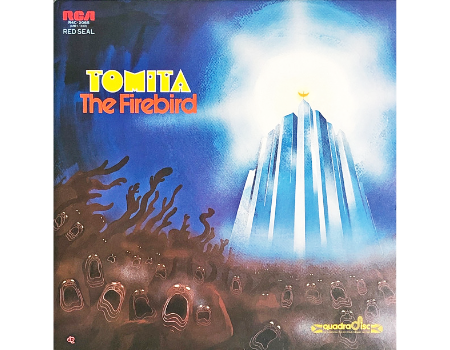
Original Japanese LP cover art for Tomita’s Firebird

The ahead of his time part is that quadrophonic sound as a commercial medium back in the 70s simply wasn’t ready for prime time. Quad LPs and tapes were often available but getting those systems to work properly was apparently easier said than done. There were Quad broadcasts but you had to have one of the then new Quadrophonic receivers to be able to hear them. Not many had them yet, alas.

So, hearing Tomita’s original quad mixes of The Firebird today has been a revelation. This music which once left me cold now engages and excites me!

As an arranger, clearly he was in his sweet spot mixing for multi-channel, creating a wonderfully immersive mix which is not hung up on — and doesn’t pretend to try to — re-create a live soundstage. All his work was painstakingly programmed and performed. And here on The Firebird Suite he takes advantages of the otherworldly peaks and valleys in Stravinsky’s score and applies it to the design of the mix. The impact is wonderful.

It’s a little hard to describe this, especially if you don’t know this particular piece of music. Try to imagine in general a dramatic classical work or a movie soundtrack where the violins and cellos, horns and woodwinds that were percolating and soaring in those big epic sequences in monaural or stereo now swirled around, over and through you. That may give you an idea of what parts of this fine quadrophonic mix is like (especially when you sit in the “sweet spot” of your home theater or surround sound system listening area — that perfect zone for the listener to be seated in order to best appreciate a surround mix).

The other interesting thing about this fine version of Tomita’s Firebird is that when I compared the two channel Stereo mix on the hybrid SACD to a pristine conventional Stereo LP, they sound very much the same. This is a good thing and it seems to be a conscious effort on the part of the SACD’s producers as I have noticed this on several others of their releases which I have reviewed recently. They don’t try to modernize or brighten the recordings, so it feels true to the original.

Now if only there was some way to bring out more of these fun Tomita Quadrophonic mixes to  broader audience (ie. less expensive and more easily accessible, especially here in the United States), that would be a useful and wonderful occurrence.  

Perhaps with more impactful packaging (the liner notes here reproduce those from 1976 release and reveal nothing really about the four channel mixes) and a new push from domestic United States labels (Sony Classical owns this particular work apparently, even though it was originally on the RCA Records label), then there might be some stronger hope of bringing Tomita’s music to life again for new audiences to discover.  

Tomita’s music is ripe for rediscovery.