40 years on and the go well with nonetheless suits.
Talking Heads’ full Stop Making Sense live performance is getting its first ever full vinyl launch on August 18 by Rhino.
The double-album launch comes with a replica of the unique booklet from the 1984 urgent, with extra notes from Talking Heads’ David Byrne, Chris Frantz, Tina Weymouth and Jerry Harrison and never-seen-before images.
It contains all tracks carried out within the movie, with hits “Psycho Killer”, “Burning Down The House” and “This Must Be The Place (Naive Melody)” that includes alongside unreleased songs “Cities” and “Big Business/I Zimbra”.
Check out the trailer, that includes Byrne’s iconic go well with, under.
Stop Making Sense was initially launched in 1984 and was shot over three nights at Hollywood’s Pantages Theatre whereas the group have been touring their album, Speaking in Tongues.
David Byrne wrote within the liner notes: “We had performed a stay album earlier than this, however coupled with the movie, and with the improved mixes and sound high quality, this report reached an entire new viewers. As usually occurs, the songs acquired an added vitality once we carried out them stay and have been impressed by having an viewers. In some ways, these variations are extra thrilling than the studio recordings, so possibly that’s why numerous people found us through this report.”
You can pre-order Stop Making Sense now, forward of its August 18 launch.
Tracklist:
Side One
1. Psycho Killer
2. Heaven
3. Thank You For Sending Me An Angel’
4. Found A Job
5. Slippery People
6. Cities *
Side Two
1. Burning Down The House
2. Life During Wartime
3. Making Flippy Floppy
4. Swamp
Side Three
1. What a Day That Was
2. This Must Be The Place (Naive Melody)
3. Once In A Lifetime
4. Big Business / I Zimbra *
Side Four
1. Genius Of Love
2. Girlfriend Is Better
3. Take Me To The River
4. Crosseyed And Painless
In early 2023 Lee Scoggins sat down with Jerry Harrison of the Talking Heads and collaborator Eric Thorngren to speak band historical past, the actual significance of sound mixing for the Talking Heads, and the influence of Audeze headphones.
Westport, CT (February 14, 2023)—There are many libraries that hold music business events, and even more that have their own recording studios, but few if any have the scale of the Westport Library in Westport, Connecticut. Presenting producers, panelists and even a few bona fide rock stars and hip-hop legends, the library’s VersoFest—named after its extensive recording studio—will return March 30 through April 2, 2023, once again underlining the institution’s offerings and commitment to the arts.
Talking Heads’ Chris Frantz, seen here being interviewed at the 2022 VersoFest, will return for this year’s edition to chat with megaproducer Steve Lillywhite.
Building on the success of last year’s inaugural VersoFest, which attracted more than 2,300 visitors over three days of concerts, panels and workshops, the library will host a variety of events, headlined by a keynote conversation between mega-producer Steve Lillywhite (U2, Rolling Stones, Peter Gabriel, Dave Matthews Band, Phish, The Killers, Psychedelic Furs and dozens more) and Talking Heads/Tom Tom Club drummer Chris Frantz.
Of note to live-sound pros will a 1:4 scale replica sound system of the Grateful Dead’s famed “Wall of Sound” PA. Designed and constructed by Anthony Coscia, the 500-plus speaker system will be on display all weekend, but will also be the focus of a 90-minute class recounting the short-lived history of the original PA system, the construction of the replica and more.
Spoken-word audio will also get its due with a “Why Is Audio So Hot?” podcast, streaming and radio panel with Sarah Van Mosel (iHeart Media) and Corey Boutilier (Connecticut Public Media), moderated by Steve Goldstein (Amplifi Media).
The Westport Library sports a Midas/d&b audiotechnik live sound system in addition to its SSL-centric Verso Studio.
Some of the other music-related offerings over the course of the festival will include:
Concerts with The Smithereens Featuring Marshall Crenshaw, Sunflower Bean and more.
A rock photography panel moderated by Dylan Hundley with Lynn Goldsmith (!), Julia Gorton, Katie Settel, and Michael Friedman.
A Music Oral History interview with Miriam Linna, founding member of The Cramps, Norton Records, Kicks Books, Kicksville Radio and more.
A “Business Of Music Panel” with A&R/tech consultant Dick Wingate.
A TV/Media Production Masterclass with Annette Jolles.
An “Evolving Rock Style” panel moderated by Rachel Felder (New York Times, Vanity Fair, New Yorker).
A Connecticut Hip Hop 50th Anniversary panel with DJ Grand Wizzard Theordore (inventor of the scratch), Tony Tone (Cold Crush Brothers), DJ Grandmaster Supreme (Lauryn Hi), DU Ragoza, DJ Billy Busch (Hot 93.7) and guest performances, hosted by DJ Terrible Tee.
This year’s edition will also see the addition of a record fair, an Alice Cooper stage-prop museum, a record label panel, a screenwriting masterclass, a documentary screening and a Saturday night “Laser Floyd” show, because of course.
VersoFest takes its name from the library’s well-appointed on-site Verso Studios, designed by producer/engineer Rob Fraboni (Bob Dylan, The Band, Eric Clapton, The Rolling Stones, Tim Hardin, The Beach Boys, Joe Cocker, Bonnie Raitt) and overseen by engineer Travis Bell. The facility centers around an SSL XL console, and sports outboard gear from the likes of UA, Tree Audio, Bricasti, Dangerous Audio, Empirical Labs and others; a variety of mics from multiple manufacturers, including Connecticut neighbors Telefunken and Sennheiser; and lots more. The library’s main open space/auditorium is likewise generously outfitted with a d&b audiotechnik PA and Midas M32 console at FOH.
VersoFest is free to attend but advance ticket registration is required. As an aside, I attended it last year, it was great, I’m probably going again this year, you can’t beat the price, and yes, you should go.
The key to interviewing legendary FOH engineer Frank Gallagher, host of Soundman Confidential, is to not interrupt, because much like an extended guitar solo, every story is headed somewhere unexpected—like this one, which starts off in late-1970s New York City.
“Manhattan—this was my old hood here. The B-52s, Talking Heads and The Ramones had the same manager; Broadway and 57th was the office. I lived on 85th and Columbus; the Bs used to be sent out as our opening act and we did shows in Central Park at Wollman Rink. I used to skate there every day in the winter—walk to Wollman Rink and then go to the office if I needed to. We played the Wollman Rink with the B’s and the next day, the New York Times had a glowing review of Talking Heads and how it sounded.
[John Rockwell wrote in the August 18, 1979 edition, “The same sound system that had exposed the B-52’s served the Heads superbly, revealing new subtleties in their textural ideas, and providing new confirmation of their success in evolving gripping, interesting live versions of songs….”]
“Talking Heads also played there in 1980, and I will tell you as a soundman—whoa! Talking Heads were very secretive and back then, there’s no cell phones, no faxes; the word would come from the office. I got a call: ‘10 o’clock tomorrow morning, Brit Row rehearsal.’ Britannia Row, Pink Floyd’s sound company, had a warehouse out in Long Island City. I get to Brit Row and there’s Bernie Worrell from Funkadelic. There’s Busta Jones, another bass player. There’s Adrian Belew. There’s Nona Hendryx. There’s Steve Scales, the percussionist. And I walk in on that! That’s how I found out about ‘the big band!’ As artists, Talking Heads were very protective of what they were doing and their thinking was, ‘If it don’t work, we don’t want anybody knowing it didn’t work.’ But I had no idea it was coming. I thought, ‘Get on with it. I’ve got a mixer, a box of mics, we just go at it.’ The whole sound for that nine-piece band was sculpted in one day.
“The first show we played with the big band was Heatwave Festival—60,000 people in a field in Canada—and the second show was Central Park. I’m thinking to myself, ‘Oh my God, what are we gonna do with this,’ but you just do it. The only thing I remember was Adrian Belew saying to me—and I usually hated notes from artists—Adrian said to me, ‘Frank, just make sure that everything I play sails over Central Park,’ and that was how I mixed that show—made it sail.’ Some of it’s on the live album, The Name of This Band is Talking Heads.
“Later that year, we were in Paris, set up at the Baltard Pavilion. U2 were the support, but their van broke down in Calais. Again, no cell phones in those days; they showed up with just guitars and drumsticks, and said, ‘Where can we get gear?’ I pointed at the stage and said, ‘Right there.’ They used Talking Heads’ gear as it was and played the show. And they’ve never forgotten.
“Years later, I was in Dublin with Buddy Guy—I toured with Buddy for years—so I called up Paul McGuinness, their manager. I said, ‘Is the Edge in town?’He said, ‘He is.’I said, ‘He should come down and see Buddy.’ And McGuinness said, ‘Well, why would he do that?’ I said, ‘He’ll get a free guitar lesson!’”
Frank Gallagher, seen here line-checking the B-52’s at New York City’s Beacon Theatre, has started his own podcast, Soundman Confidential, to explore the artist/engineer relationship.
New York, NY (February 9, 2023)—Frank Gallagher has a keen ear for two things—mixing a band and telling a story—and with a resume that includes engineering Talking Heads, Simple Minds, The Go-Go’s, The Bangles, Gang of Four, Buddy Guy, Suzi Quatro, Marshall Crenshaw, Skunk Baxter and dozens more on the road, he’s done a lot of one, which has led to a lot of the other. Blessed with a wry sense of humor and a Scots accent that sounds like a sly grin, there are few things he can’t get away with saying—which may explain his longevity in the field.
“I tell bands, if you’re not giving me what I need, there’s no point in me being here— you may want to find somebody else, because I’m not going to sit here and suffer and do damage control,” said the veteran FOH engineer, speaking backstage at New York City’s Beacon Theatre during a recent stop on the B-52’s farewell tour. “This band here, I’m going to give them notes tonight on the show last night. I’m a socialist when it comes to a show—we’re all equal, we’re all in this together!”
Gallagher’s Live Sound CV is epic—there’s also stints running a hip London eatery in the Seventies, helping open and book New York’s legendary Irving Plaza in the Eighties, production managing San Francisco’s annual OysterFest for 16 years, doing corporate audio to this day and more—but in recent times, he’s added another occupation to the list: Podcast host. An offshoot of an autobiography in the works, Soundman Confidentialfinds him talking to old pals and acquaintances, from rockers (Vernon Reid, Davey Johnstone and virtually all the aforementioned artists) to fellow audio pros (Ed Stasium, Steve Lillywhite).
“Originally, the premise was to explore the relationship between the soundman and the band,” he said. “How does what we do get in us— because sound is in us. I remember this vividly: I was three years old, living in a little Scottish mining village. Every year, the traveling fair would come by, and that was the first loud music I heard; it had to be loud to get over the hum of the generators. The speakers were big [Altec Lansing] Voice of the Theater models and they had these Vortexion amplifiers—metal, military-grade P.A. amplifiers that looked like an ammo case and were indestructible.”
The lure of loud sounds eventually snared Gallagher for good (“I got in a van in 1966 and never got out”) and by the early 1970s, he was mixing Suzi Quatro around the world on three prototype WEM six-channel mixers daisy-chained together and WEM Festival Stacks: “Incredibly clean, and you could do 4,000 people with a couple of bins; they’d blow the ice cream outta your cone.”
Moving on to work at UK audio provider Concert Sound, Gallagher was immediately sent to start a tour in Switzerland: “They couldn’t get anyone to do it; they said, ‘Pick up these two American bands in Zurich’—and it was Ramones and Talking Heads. Ramones had a full crew; Talking Heads had no roadies, no music out in Europe, nothing. The second man on the P.A. got to mix the opener, so I set them up at the Volkshaus in Zurich, and barely got a line check. They opened the doors, the place was sold out. Talking Heads came on stage, and first song, I was busy getting a mix. Second song, I began to pay attention. Third song, the hairs on the back of my neck stood up—‘Psycho Killer? What is this?!’
“True story: I went back to the hotel after the show, barely knew them, had a wee production meeting with them. I had a cup of tea and I said to Chris and Tina and David, ‘I have no idea what’s going on here— but I want in.’ Instant decision. I don’t believe in coincidences. Fate takes a hand, but you’ve got to be smart enough to take advantage of it; I’ve never been shy about letting people know. Talking Heads brought me to New York for a couple of shows at the Entermedia Theater in New York’s East Village; by that time, they had graduated from CBGBs. We started playing up and down the Eastern seaboard, and in America, I got used to using house systems, which I did not have the luxury of in England; I was so happy!”
The decades that followed found Gallagher moving to the U.S. permanently and honing mixing philosophies that he follows to this day:
“I believe in keeping it simple. I tell people it’s because I’m lazy, but that’s not the truth. I’m keeping it simple because I’ve learned the less there is, the less that can go wrong.”
“I never listen to the record. If I’ve got preconceived ideas about what’s going to come off the stage and it doesn’t meet expectations set by the record, that’s not really a good place to start. Also, I’m a realist: I have to deal with what’s coming off the stage because that’s all I have.”
“When I go into a house these days, I don’t touch the house settings because the guy’s usually got it dialed and why would I want to reinvent the wheel? Also, I want an easy day.”
“I don’t go over the top with effects. I’ve got one little reverb on drums and one on vocal—and if you can hear them, you’re lucky. I want it to be there without anybody knowing it’s that there, but when you take it away, you can tell.”
“Rock and roll bands are like buses: There’ll be another one along in a minute. Once you get a couple of names on your resume, people think it means something; it doesn’t. You’re only as good as your last show.”
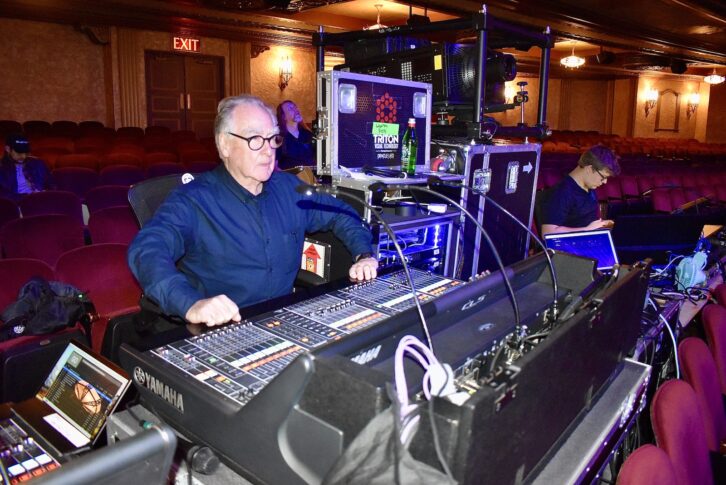
For the B-52’s tour, he adhered to all of those rules and more (“I don’t work for anybody with more than a two-truck tour anymore; the personalities, I don’t want to be dealing with all of that”). For the journey, he opted to mix on a Yamaha CL5 console using only onboard effects (“Never owned a Waves license”), capturing vocals on Shure wireless mics outfitted with Heil PR 30 capsules (“They give me another 10 dB before feedback over anything I’ve heard”).
The jaunt capped off a busy 2022 that saw Gallagher also mix runs with Gang of Four and Skunk Baxter, as well as tech at multiple corporate events. “Post-Covid, people are working again,” he said. “Hugo [Burnham], the drummer from Gang of Four, called and said, ‘Do you want to come out?’ I was quite enjoying being at home—Flagstaff is beautiful—and my wife said, ‘Get out of the house; go do this tour.’ And I’m not gonna say ‘my mojo,’ but my mix is back with a vengeance.”
The B-52’s tour may be over, but Gallagher will see them soon enough, helming the desk for their upcoming Vegas residencies in May and August; more runs with Baxter and Gang of Four, as well as Indian artist L. Shankar, are also in the offing. It’ll be a hectic year ahead, which suits him just fine. “I’ve lived a charmed life,” he admitted. “I’m from a little coal mining village in Scotland, got pulled in by the fairground, and had a restaurant in the middle and a dance hall in Manhattan, so I’m not afraid of anything really. Except my wife. Sometimes.”
Yesterday I explored some fine and fascinating new music from Cuba by a group named Okuté. In my listening report I made a connection between this music which is usually categorized (at least here in the United States) under “world music” and acknowledge that it really has more in common with what many of us call “progressive” — and even “progressive rock” — music than many might consider. If you missed Part I on Okuté, please click here to catch on that story.
Many of you know by now that I don’t usually write reviews based on low resolution digital files (ie. MP3s) as I feel it presents a skewed image of what the music might (or might not) be like. Unfortunately, that is all I had been sent many months ago about a group from Africa called The Alostmen. However, as I was working on the review about Okuté I was happy to find that The Alostmen now have their album streaming on Qobuz (click here) and Tidal (click here) in CD-quality. So the time felt ripe to finally share this music with you, Dear Readers.
A paragraph from the official press release offers some insight to the music of Ghana’s The Alostmen, co founded by a musician named Stevo:
“Alostmen’s music is based around the Frafra traditions of the kologo, a stringed lute and uses purely traditional instrumentation in entirely new ways. The kologo is traditionally played a certain way but Stevo will play it at the shortest end of bridge and accentuate, almost Hendrix-style! He plays with a pedal sometimes and can keep it an octave down with a bass sound. He has evolved the instrument in his own way.”
Like Okuté, this music revolves around circular repeating patterns played on the Kologo and periodic call-and-response group chants. The rhythms are different of course than those from Cuba but still connected in some ways.
The messaging on The Alostmen’s album is often quite very powerful. “Teach Me” was the first track which really caught my ear with its series of poignant parallels. On their official video on YouTube, explains: “Lead singer Stevo Atambire tells how it is more rewarding in life to be a creator rather than just a consumer while Villy sings about acting too hastily and lacking focus in building a better world for ourselves. “
“Minus Me” could easily be transformed into a King Crimson tune (ala “Sleepless” and “Elephant Talk” ) with a bass line that reminds me of early Bohannon plus cool horn textures punctuating the pulse.
The music here is wonderful in a stripped down way using this fascinating two string instrument. It has a very specific sound quite unlike anything I’ve heard on record, at least presented in the context of a full band setting with bass and percussion. Combined with distinct song structures, this music becomes quite a compelling listen.
You can hear The Alostmen on Tidal (click here) and Qobuz (click here) streaming in 16-bit, 44.1 kHz CD quality, both of which sound very good and quite rich. The group also has a Bandcamp page so if you like this music be sure to support them any way you can. The album is available on CD and vinyl! If I can get my hands on the latter I’ll certainly do an update on this review for those of you who might be interested
I’ve posted some of The Alostmen’s videos below which are fun and at times powerful. I hope this group gets a chance to reach broader audiences and tour the world with their music.
So there you have it… Coming full circle, there is some fine and fascinating new music to check out from around the world which may well fuel your polyrhythmic passions beyond the scope of progressive rock.