Chris Mock, FOH engineer for The Baboon Show, along with his Allen & Heath dLive CTi1500 digital mixing system.
Sweden (May 8, 2023)—Stockholm punk act The Baboon Show has been fortunately as much as no good for twenty years, and is at the moment making the rounds all through northern Europe behind its newest album, God Bless You All. Along for the trip is the band’s longtime FOH professional, Chris Mock, who put collectively a management system for the tour to maintain issues mild and transportable.
Key to the system is an Allen & Heath dLive CTi1500 digital mixing system, related to a dLive CDM32 MixRack, and Audio-Technica 3000 Series IEM wi-fi to ship the band’s potent model of punk-rock vitality.
“The CTi was my first alternative, since I usually tour with a dLive C2500 floor,” mentioned Mock. “We selected the attractive CTi1500, on which I can run the identical setup already used on my C2500. I really like the virtually analog really feel of engaged on dLive. It’s actually quick and intuitive in use – I work with quite a lot of results and trip quite a lot of faders in the course of the present, and the CTi1500 permits me to combine in a really dynamic, hands-on method. It’s a extremely nice artistic instrument in that method.”
A complete of 32 inputs come from stage into the CTi1500, together with a pair of electrical guitar mics, a “dust mic” on Niclas Svensson’s drum package, ambient microphones and extra. Mock describes, “All indicators are break up internally, so every enter has a channel for the FOH and one other one for the in-ear combine which is distributed to 6 stereo mixes. Our backline tech/monitor engineer makes use of an iPad related to the CDM32 to make adjustments in the course of the present and it really works completely.”
Mock eschews outdoors plug-ins and usually makes use of the on-board instruments within the dLive for results and such. “I exploit quite a lot of compression with The Baboon Show and love the parallel compression function each compressor options,” he famous. “The VCA spills are additionally tremendous helpful, which opens up an entire new dimension of layers in case you’re engaged on a small floor just like the CTi1500. This method I can entry all 64-plus channels, teams, impact sends and returns on the 12 faders I’ve. I exploit a number of the MushyKeys for DCA spills which is wonderful. I really like the brand new Bus Compressor which I mix with the multiband compression of the Dyn8 to connect my most important combine collectively.”
For its in-ear monitoring system, the band has Audio-Technica 3000 Series IEMs used along side the CTi1500. “The band loves the sound of the Audio-Technica system and it’s very easy and fast to set-up. The crew actually admire the straightforward design and performance of the IEMs and the Wireless Manager software program actually unlocks the facility of the system.
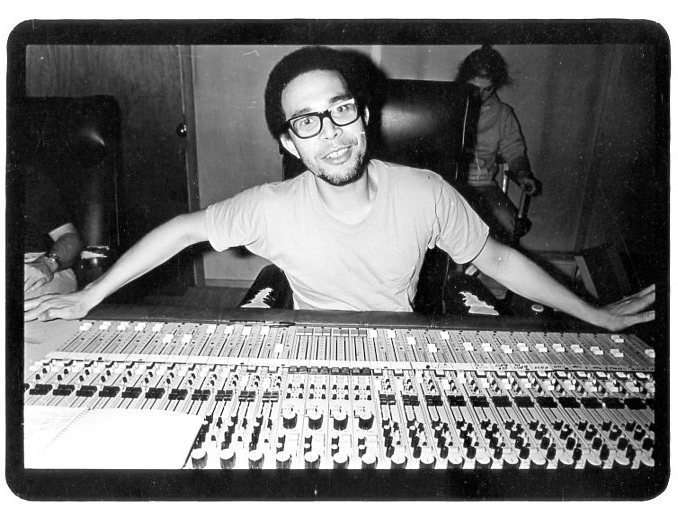
SPOT, recording Big Boys “Fun Fun Fun” at Third Coast Studio, Austin Texas; March 14 1982. PHOTO: Photobill/Bill Daniel; used with permission.
Sheboygan, WI (March 6, 2023)—Glenn “SPOT” Lockett, who helmed most of the most-influential records popping out of California’s early punk scene, died March 4, 2023 in Sheboygan, Wisconsin. Diagnosed with fibrosis in 2021, Locket was awaiting a lung transplant when he suffered a stroke three months in the past from which he by no means correctly recovered. A documentarian of the nascent Nineteen Eighties Los Angeles punk world by way of his pictures and music manufacturing work, Lockett was answerable for capturing a number of the earliest efforts by now-revered acts like Black Flag, Hüsker Dü, Misfits, Subhumans, Redd Kross, Meat Puppets, Minutemen and others. He was 71.
Lockett was born July 1, 1951 in Los Angeles, the son of Claybourne Lockett, a former fighter pilot with the Tuskegee Airmen in World War II. Initially raised in Hollywood, the youthful Lockett realized guitar at age 12, and developed a ardour for jazz and improvisational music that led to his as soon as auditioning for Captain Beefheart. Moving to Hermosa Beach within the mid-Nineteen Seventies, Lockett thrust himself into the realm’s thriving arts scene, capturing all of it along with his music, digicam lens and, quickly, recording tape, as he took up engineering after serving to construct a facility, Media Art Recording Studio on Pier Avenue.
While discovering his approach round a studio, Lockett started utilizing the pseudonym SPΘT—stylized in all-caps with a dot within the middle of the “O”—when he wrote freelance jazz document opinions for native weekly newspaper Easy Reader. Nonetheless, he primarily labored as a waiter in a vegetarian restaurant and it was there that he met fellow musician Greg Ginn. The two musicians usually jammed, and Lockett briefly performed bass in Ginn’s band, Panic, which might in the end evolve into Black Flag. When Ginn determined to start out his personal document label, SST Records, it was solely a matter of time earlier than Lockett turned deeply concerned as its in-house producer/engineer.
In the years that adopted, SPOT might frequently be discovered within the credit of the label’s releases as he recorded, combined and produced or co-produced most SST acts between 1980 and 1985. As a consequence, he had a hand in a number of the seminal punk releases of the period, together with Descendents’ debut album, 1982’s Milo Goes To College; Hüsker Dü’s acclaimed 1984 assortment, Zen Arcade; the primary three Meat Puppets albums; the primary two albums and an EP by Saint Vitus; and a half-dozen Black Flag releases, amongst others.
Most of these acts have been recorded at Hermosa Beach’s then-fledgling Total Access Recording Studios, nonetheless owned and operated at this time by producer/engineer Wyn Davis. Former Hüsker Dü frontman Bob Mould recalled the period in a Tweet memorializing SPOT, noting, “From 1982 to 1984, Hüsker Dü recorded 4 initiatives with SPOT. We labored at Total Access in Redondo Beach, CA, largely throughout the discounted in a single day hours. SPOT all the time inspired free expression and experimentation, at the same time as these recordings have been made as expeditiously as potential.” He added, “SPOT was an exquisite soul who cherished making music, documenting the scene, and unconditionally supporting all of the initiatives that bear his title. Thank you, SPOT. You gave a lot to all of us.”
While initially intently related to SST, SPOT produced, engineered and/or dealt with technical duties on numerous releases on by way of the 2000s for different labels, together with Touch And Go, Rykodisc, New Alliance, Homestead, Taang! and PVC, notably co-producing 1983’s Earth A.D./Wolfs Blood, the final Misfits album to function co-founder Glenn Danzig, which was launched on the singer’s personal Plan 9 label. Ultimately, SPOT would go on to supply greater than 100 records.
Fed up with Los Angeles, SPOT moved to Austin, Texas within the mid-Nineteen Eighties, the place he launched quite a few his personal solo, lo-fi experimental recordings through the years, earlier than ultimately transferring to Sheboygan, the place he printed a pictures assortment, Sounds of Two Eyes Opening—Southern California Life: Skate/Beach/Punk 1969-1982 (2014), amassing his work documenting the Los Angeles subscultures he ran in.
Former SST co-owner Joe Carducci introduced SPOT’s passing on Facebook, praising the producer’s recording type that he felt utilized “the primacy of dwell jazz taking part in into recording bands towards prevailing makes an attempt to melt or industrialize a back-to-basics arts motion in sound.” He added that SPOT had been writing a novel in recent times, Decline and Fall of Alternative Civilization, adapting a 10-hour on-line audio drama he had produced and narrated in 2016.
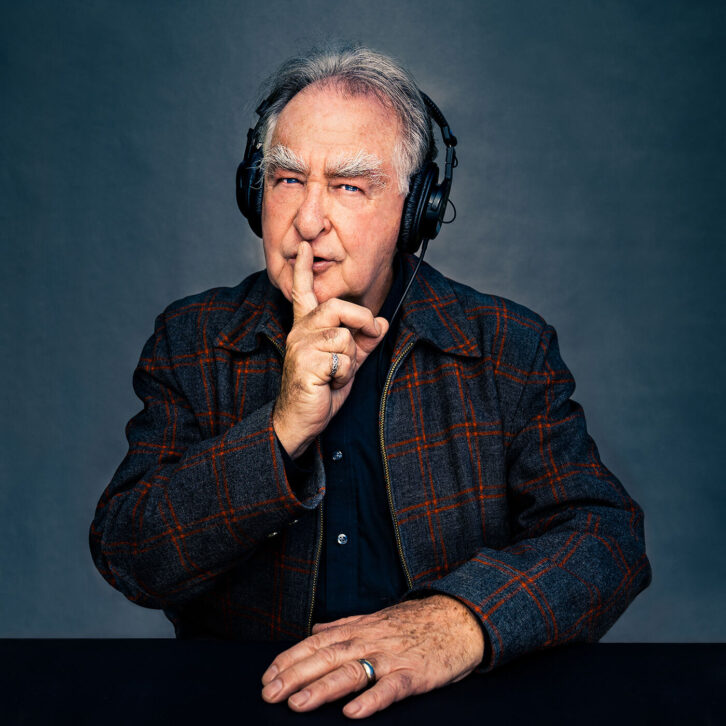
The key to interviewing legendary FOH engineer Frank Gallagher, host of Soundman Confidential, is to not interrupt, because much like an extended guitar solo, every story is headed somewhere unexpected—like this one, which starts off in late-1970s New York City.
“Manhattan—this was my old hood here. The B-52s, Talking Heads and The Ramones had the same manager; Broadway and 57th was the office. I lived on 85th and Columbus; the Bs used to be sent out as our opening act and we did shows in Central Park at Wollman Rink. I used to skate there every day in the winter—walk to Wollman Rink and then go to the office if I needed to. We played the Wollman Rink with the B’s and the next day, the New York Times had a glowing review of Talking Heads and how it sounded.
[John Rockwell wrote in the August 18, 1979 edition, “The same sound system that had exposed the B-52’s served the Heads superbly, revealing new subtleties in their textural ideas, and providing new confirmation of their success in evolving gripping, interesting live versions of songs….”]
“Talking Heads also played there in 1980, and I will tell you as a soundman—whoa! Talking Heads were very secretive and back then, there’s no cell phones, no faxes; the word would come from the office. I got a call: ‘10 o’clock tomorrow morning, Brit Row rehearsal.’ Britannia Row, Pink Floyd’s sound company, had a warehouse out in Long Island City. I get to Brit Row and there’s Bernie Worrell from Funkadelic. There’s Busta Jones, another bass player. There’s Adrian Belew. There’s Nona Hendryx. There’s Steve Scales, the percussionist. And I walk in on that! That’s how I found out about ‘the big band!’ As artists, Talking Heads were very protective of what they were doing and their thinking was, ‘If it don’t work, we don’t want anybody knowing it didn’t work.’ But I had no idea it was coming. I thought, ‘Get on with it. I’ve got a mixer, a box of mics, we just go at it.’ The whole sound for that nine-piece band was sculpted in one day.
“The first show we played with the big band was Heatwave Festival—60,000 people in a field in Canada—and the second show was Central Park. I’m thinking to myself, ‘Oh my God, what are we gonna do with this,’ but you just do it. The only thing I remember was Adrian Belew saying to me—and I usually hated notes from artists—Adrian said to me, ‘Frank, just make sure that everything I play sails over Central Park,’ and that was how I mixed that show—made it sail.’ Some of it’s on the live album, The Name of This Band is Talking Heads.
“Later that year, we were in Paris, set up at the Baltard Pavilion. U2 were the support, but their van broke down in Calais. Again, no cell phones in those days; they showed up with just guitars and drumsticks, and said, ‘Where can we get gear?’ I pointed at the stage and said, ‘Right there.’ They used Talking Heads’ gear as it was and played the show. And they’ve never forgotten.
“Years later, I was in Dublin with Buddy Guy—I toured with Buddy for years—so I called up Paul McGuinness, their manager. I said, ‘Is the Edge in town?’He said, ‘He is.’I said, ‘He should come down and see Buddy.’ And McGuinness said, ‘Well, why would he do that?’ I said, ‘He’ll get a free guitar lesson!’”
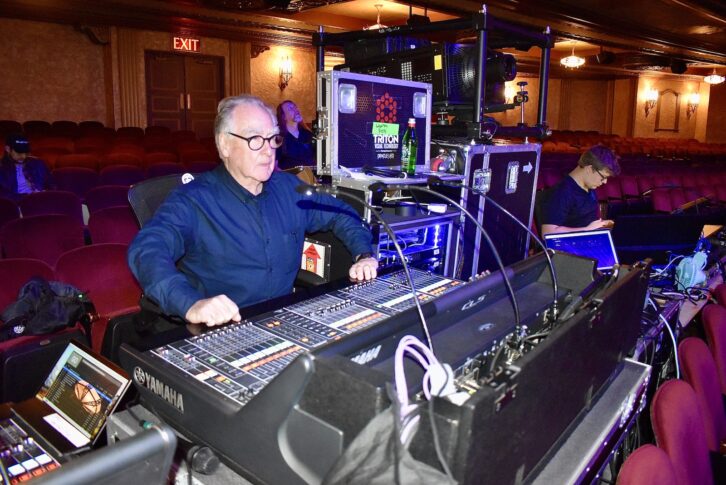
Frank Gallagher, seen here line-checking the B-52’s at New York City’s Beacon Theatre, has started his own podcast, Soundman Confidential, to explore the artist/engineer relationship.
New York, NY (February 9, 2023)—Frank Gallagher has a keen ear for two things—mixing a band and telling a story—and with a resume that includes engineering Talking Heads, Simple Minds, The Go-Go’s, The Bangles, Gang of Four, Buddy Guy, Suzi Quatro, Marshall Crenshaw, Skunk Baxter and dozens more on the road, he’s done a lot of one, which has led to a lot of the other. Blessed with a wry sense of humor and a Scots accent that sounds like a sly grin, there are few things he can’t get away with saying—which may explain his longevity in the field.
“I tell bands, if you’re not giving me what I need, there’s no point in me being here— you may want to find somebody else, because I’m not going to sit here and suffer and do damage control,” said the veteran FOH engineer, speaking backstage at New York City’s Beacon Theatre during a recent stop on the B-52’s farewell tour. “This band here, I’m going to give them notes tonight on the show last night. I’m a socialist when it comes to a show—we’re all equal, we’re all in this together!”
Gallagher’s Live Sound CV is epic—there’s also stints running a hip London eatery in the Seventies, helping open and book New York’s legendary Irving Plaza in the Eighties, production managing San Francisco’s annual OysterFest for 16 years, doing corporate audio to this day and more—but in recent times, he’s added another occupation to the list: Podcast host. An offshoot of an autobiography in the works, Soundman Confidentialfinds him talking to old pals and acquaintances, from rockers (Vernon Reid, Davey Johnstone and virtually all the aforementioned artists) to fellow audio pros (Ed Stasium, Steve Lillywhite).
“Originally, the premise was to explore the relationship between the soundman and the band,” he said. “How does what we do get in us— because sound is in us. I remember this vividly: I was three years old, living in a little Scottish mining village. Every year, the traveling fair would come by, and that was the first loud music I heard; it had to be loud to get over the hum of the generators. The speakers were big [Altec Lansing] Voice of the Theater models and they had these Vortexion amplifiers—metal, military-grade P.A. amplifiers that looked like an ammo case and were indestructible.”
The lure of loud sounds eventually snared Gallagher for good (“I got in a van in 1966 and never got out”) and by the early 1970s, he was mixing Suzi Quatro around the world on three prototype WEM six-channel mixers daisy-chained together and WEM Festival Stacks: “Incredibly clean, and you could do 4,000 people with a couple of bins; they’d blow the ice cream outta your cone.”
Moving on to work at UK audio provider Concert Sound, Gallagher was immediately sent to start a tour in Switzerland: “They couldn’t get anyone to do it; they said, ‘Pick up these two American bands in Zurich’—and it was Ramones and Talking Heads. Ramones had a full crew; Talking Heads had no roadies, no music out in Europe, nothing. The second man on the P.A. got to mix the opener, so I set them up at the Volkshaus in Zurich, and barely got a line check. They opened the doors, the place was sold out. Talking Heads came on stage, and first song, I was busy getting a mix. Second song, I began to pay attention. Third song, the hairs on the back of my neck stood up—‘Psycho Killer? What is this?!’
“True story: I went back to the hotel after the show, barely knew them, had a wee production meeting with them. I had a cup of tea and I said to Chris and Tina and David, ‘I have no idea what’s going on here— but I want in.’ Instant decision. I don’t believe in coincidences. Fate takes a hand, but you’ve got to be smart enough to take advantage of it; I’ve never been shy about letting people know. Talking Heads brought me to New York for a couple of shows at the Entermedia Theater in New York’s East Village; by that time, they had graduated from CBGBs. We started playing up and down the Eastern seaboard, and in America, I got used to using house systems, which I did not have the luxury of in England; I was so happy!”
The decades that followed found Gallagher moving to the U.S. permanently and honing mixing philosophies that he follows to this day:
“I believe in keeping it simple. I tell people it’s because I’m lazy, but that’s not the truth. I’m keeping it simple because I’ve learned the less there is, the less that can go wrong.”
“I never listen to the record. If I’ve got preconceived ideas about what’s going to come off the stage and it doesn’t meet expectations set by the record, that’s not really a good place to start. Also, I’m a realist: I have to deal with what’s coming off the stage because that’s all I have.”
“When I go into a house these days, I don’t touch the house settings because the guy’s usually got it dialed and why would I want to reinvent the wheel? Also, I want an easy day.”
“I don’t go over the top with effects. I’ve got one little reverb on drums and one on vocal—and if you can hear them, you’re lucky. I want it to be there without anybody knowing it’s that there, but when you take it away, you can tell.”
“Rock and roll bands are like buses: There’ll be another one along in a minute. Once you get a couple of names on your resume, people think it means something; it doesn’t. You’re only as good as your last show.”
For the B-52’s tour, he adhered to all of those rules and more (“I don’t work for anybody with more than a two-truck tour anymore; the personalities, I don’t want to be dealing with all of that”). For the journey, he opted to mix on a Yamaha CL5 console using only onboard effects (“Never owned a Waves license”), capturing vocals on Shure wireless mics outfitted with Heil PR 30 capsules (“They give me another 10 dB before feedback over anything I’ve heard”).
The jaunt capped off a busy 2022 that saw Gallagher also mix runs with Gang of Four and Skunk Baxter, as well as tech at multiple corporate events. “Post-Covid, people are working again,” he said. “Hugo [Burnham], the drummer from Gang of Four, called and said, ‘Do you want to come out?’ I was quite enjoying being at home—Flagstaff is beautiful—and my wife said, ‘Get out of the house; go do this tour.’ And I’m not gonna say ‘my mojo,’ but my mix is back with a vengeance.”
The B-52’s tour may be over, but Gallagher will see them soon enough, helming the desk for their upcoming Vegas residencies in May and August; more runs with Baxter and Gang of Four, as well as Indian artist L. Shankar, are also in the offing. It’ll be a hectic year ahead, which suits him just fine. “I’ve lived a charmed life,” he admitted. “I’m from a little coal mining village in Scotland, got pulled in by the fairground, and had a restaurant in the middle and a dance hall in Manhattan, so I’m not afraid of anything really. Except my wife. Sometimes.”
John “Feldy” Feldmann likes to stay busy. Over a three-decade career, he’s done just that, fronting bands, holding down A&R positions, co-founding a record label, and producing and writing for a list of artists as long as your arm.
Then came the pandemic. Feldmann, Grammy-nominated for his work with Blink-182 and Fever 333, got down to business in the studio at his home in Calabasas, CA, re-recreating back catalog hits by Goldfinger, his seminal California ska-punk band. The other far-flung band members contributed their tracks, with video, and Goldfinger’s Quarantine Video series was born.
Inspired, Feldmann sat down to write and produce a new Goldfinger album, the band’s ninth studio full-length since forming in 1994. Never Look Back was released Dec. 4 on his label, Big Noise.
Over Zoom, Feldmann gave PSN a virtual tour of his studio, where he’s currently working with Avril Lavigne, and talked about his pandemic productions.
On the Quarantine Videos:
The idea came out of me knowing my own brain and knowing that an idle mind is the devil’s playground. I have got to be busy, and at the time, we didn’t know what COVID-19 was, or if it was a straight killer. I came up with this idea to record my parts and see if the guys could do their own parts in their respective houses.
The first song was “Here in Your Bedroom,” which was apropos. I just ripped it off YouTube and put it in a Pro Tools session. We set up a click template and I sang and played along to the original. All these videos are one take of me playing guitar and singing. Everyone else would send me their takes and I’d put them in the session. I wanted it to sound like a live show, so our live mix engineer, Jon Graber, mixed all of them.
On Producing Never Look Back:
I wrote most of it in quarantine by myself. The whole album was recorded in quarantine. It’s a fun, nostalgic Goldfinger album. We’ve got ska, punk, reggae—all the flavors.
Mike Herrera, our bass player, lives in Bremerton, WA, and did all his parts at his studio. Moon [Valjean], the guitar player, lives in St. Louis; he did all his stuff on a little Pro Tools “light” system. Jon Graber has a studio and recorded [guitarist] Charlie Paulson there. Everything else was done here.
A lot of people want to sing their lead vocals to the vibe and hear the finished music to get the energy of the song, but I couldn’t do it that way. I would record my final vocals, all the doubles and all the harmonies, and all my guitars. I’m definitely a fan of Rupert Neve; I have the Brent Averil 1073s, the Vintech 1073s, I use the Slate Dragon as my 1176 modeler—I love that thing.
I sent everyone my finished parts with a click track. A lot of times I would program the drums; EZ Drummer has all my samples in their Pop Punk EZX. Travis Barker [of Blink-182] played a lot of the drums on the record; he lives in Calabasas. Nick Gross [Big Noise co-founder] also played some of the drums. I’ve got a great drum room and a great drum kit, so we cut all of the drums at my studio. They were one of the last things I did on this album.
I had Mike [Herrera] sing a bunch of stuff. He’d write a verse, send me the lyrics, and I’d say yes or no: “Maybe you can give it another shot.”
Monique Powell from Save Ferris sang on one song. I said, “Could you give me more ad libs? I don’t feel your presence.” She did four different takes. She was in an apartment in London on a laptop, screaming into an SM58, so I used [Antares] Mic Mod [software] and changed it to a Manley Reference Gold.
Every album I’ve ever made, I’m in the room with the musicians and I’m saying, “Let’s try that again.” But this time, I got the parts and had to make use of whatever they sent me. Thank God I’ve got such great musicians!