Uncategorized
2023 Editors’ Choice: Best Subwoofers $5,000 & Up
The put up 2023 Editors’ Choice: Best Subwoofers $5,000 & Up appeared first on The Absolute Sound.

The put up 2023 Editors’ Choice: Best Subwoofers $5,000 & Up appeared first on The Absolute Sound.
Göbel High-End could also be an unfamiliar title to North American audiophiles, however the German loudspeaker producer has loved huge reputation in its dwelling nation, all through Europe, and in Asia. The firm was based in 2003 by Oliver Göbel, who left his job as lead loudspeaker engineer at Siemens to forge his personal path. Göbel has particular experience in bending-wave transducers and developed an acoustic utility for the know-how for which he was granted a patent. That patent was the impetus for Göbel to begin his personal firm, specializing in high-end loudspeakers and refining bending-wave transducer know-how. This 12 months marks the Göbel High-End’s 20th anniversary.
Göbel’s firm has grown, transferring in 2022 to a brand new manufacturing facility close to Munich, constructed from the bottom up with Oliver Göbel himself offering the constructing’s architectural design. I had seen Göbel audio system on the Munich High-End present many occasions, however by no means bought an excellent take heed to them as a result of their massive exhibit room was all the time standing room solely. My first actual publicity to the agency’s merchandise got here on the 2022 AXPONA present, the place I heard the $90,000 Divin Marquis demonstrated by Elliot Goldman, Göbel’s U.S. distributor. As I (and Jonathan Valin) wrote in our present stories on the time, the Divin Marquis was one of many present’s finest sounds. It didn’t damage that the system included the Wadax Reference DAC and Reference Server entrance finish and was powered by CH Precision 10-Series electronics—reference-quality parts.
After the present, I did some analysis on Göbel’s know-how and have become intrigued by its Divin merchandise. The firm presents two strains—the Epoque Aeon Series that’s designed for smaller or moderate-sized listening rooms, and the very completely different Divin Series. The Epoque Aeon Series (two floorstanders, an on-wall, and two subwoofers) includes a flat-panel bending-wave driver that reproduces the vary from 160Hz to 31kHz, augmented by an impulse-response-compensated bass array configured in a approach that mates with the bending-wave driver’s dispersion. You can consider the design as an almost full-range driver (the bending-wave transducer reproduces an astonishing seven-and-a-half octaves) augmented by cone woofers. The visible look of the Epoque Aeon line is unmistakable; a skinny column dominated by the big, flat bending-wave transducer flanked by the cone woofers.
The three-model Divin line appears extra typical, however appears may be deceiving. The center Divin Noblesse reviewed right here ($250,000 per pair) has a symmetrical angular hourglass form with a really massive (5.6″) Air-Motion Transformer (AMT) tweeter within the center flanked above and under by an 8″ cone midrange driver and a 12″ woofer. The multifaceted enclosure is ported to the entrance by 4 ports per woofer, symmetrically positioned across the driver. Although the Divin Noblesse doesn’t make use of a flat bending-wave driver, the drivers’ design is knowledgeable by Oliver Göbel’s experience with bending-wave transducers. He used his information of versatile diaphragm conduct to remove inaccuracies within the Divin Noblesse’s pistonic drivers.

The extra I discovered concerning the Divin Noblesse’s engineering, the extra impressed I grew to become—this speaker is brimming with modern design methods that separate it from simply one other “cones-in-a-box” providing. I’ve gone into some element describing these improvements within the technical sidebar.
Notably, the speaker’s sensitivity is a whopping 95dB, with a flattish impedance curve and an impedance minimal of three.8 ohms (at 100Hz). These traits imply that the Divin Noblesse can be a very simple load for an amplifier and can seemingly work nicely when pushed by lower-powered amplifiers.
The Divin Noblesse was equipped with a pair of Göbel’s model new Divin Sovereign subwoofers ($29,500 every). The sub options an 18″ driver, integral energy amplification, DSP management, and the power to tune the sub’s parameters through telephone or pill from the listening seat.
Oliver Göbel and U.S. distributor Elliot Goldman visited to put in the system, together with set-up knowledgeable extraordinaire Stirling Trayle. Watching Trayle work is an expertise in itself; he combines unparalleled experience, a perceptive (and quick) ear, and an astounding work ethic to raise the efficiency of a system to sudden heights. Several producers have employed Trayle to put in their merchandise in my listening room (and at reveals), and for good motive—he will get persistently superlative outcomes. You can see what Stirling does at audiosystemsoptimized.com. The set up took a full two days, practically all that point dedicated to loudspeaker placement.
The Divin Noblesse presents two pairs of binding posts for bi-wiring or passive bi-amplification. This suited the CH Precision M10 amplifier; every amp may be configured as a monoblock or as a two-channel amplifier. We operated the pair of M10 amplifiers in passive bi-amplification mode; One channel of every amplifier drove the woofer part, with the opposite channel driving the midrange/tweeter. Of course, the Divin Noblesse may be powered conventionally by a single stereo amplifier or a pair of monoblocks. The Divin Noblesse was pushed full-range, with the subwoofers low-pass filtered. The subwoofers had been linked through a second line-level output from the CH Precision L10 linestage.
Switching loudspeakers after a number of years of residing with the very best loudspeaker I’ve had in my listening room (the Wilson Chronosonic XVX and Subsonic subwoofers) was a bit disconcerting. It took some adjustment to the completely different presentation, however as soon as the Divin Noblesse settled in I got here to understand this speaker’s particular qualities.
First, the Divin Noblesse is really a full-range speaker with huge bandwidth and seemingly limitless dynamic vary. The Divin Noblesse’s most salient attribute is a energetic higher midrange-to-lower treble area that brings element to the fore. This speaker’s decision, transparency, and readability via the midrange and treble had been beautiful; positive element reminiscent of percussion devices, a refined background vocal, or a piano line performed quietly beneath different devices, had been resolved with alacrity. I’ll offer you only one instance that might stand in for a lot of others. I’ve listened to the fabulous 1975 reside Eric Clapton album EC Was Here on many techniques, however by no means earlier than heard on the observe “Ramblin’ on my Mind” that the drummer’s trip cymbal has rivets. Also referred to as a “sizzle cymbal,” rivets give the instrument that shimmering sound and prolonged decay. The Divin Noblesse resolved the complicated microstructure of the cascading transients and decays of the rivets with astounding precision. If you extrapolate this instance to almost each instrument, throughout every kind of music, you’ll get an concept of how the Divin Noblesse presents music with terribly excessive stage of element.
This decision and readability weren’t confined to the treble. The midrange was equally resolved, a top quality that was immensely rewarding within the Divin Noblesse’s replica of the human voice. Vocals had been projected into the listening room with palpability and presence. I used to be startled after I performed the primary observe on Melody Gardot’s album Sunset within the Blue; her voice was projected between and in entrance of the audio system with vivid immediacy. Moreover, the Divin Noblesse revealed very positive nuances of expression, including to the tune’s influence. This observe might function one other instance of the Divin Noblesse’s resolving energy; the gently performed acoustic guitar accompaniment within the background was portrayed with readability in timbre, pitch, and dynamics on each observe. Similarly, the speaker’s energetic midrange rendered vocals extra intelligible. This clearer articulation allowed me to listen to nuances of vocal expression with newfound ease and readability.
Before listening to the Divin Noblesse, I appeared askance on the 8″ midrange driver (most are 6″ at most), notably an 8″ midrange coupled to an AMT tweeter. Nonetheless, after residing with this speaker, I’ve no reservations concerning the design. In truth, I have to conclude that the Divin Noblesse is, via the midrange and treble, the highest-resolution dynamic loudspeaker that I’ve heard in my listening room—its presentation of element and palpability strategy that of electrostats and Magneplanars.
That stated, there’s a positive line between this presentation of wealthy musical element and a vibrant, etched, and fatiguing sound. The Divin Noblesse walks proper as much as that line—however doesn’t cross it, in my judgment. This is a energetic, thrilling, upbeat—even thrilling—sounding speaker, however what stored the Divin Noblesse from veering into the realm of extreme brightness was the speaker’s purity, textural liquidity, lack of grain, and absence of metallic sheen (frequent to hard-dome tweeters). Significantly, the Divin Noblesse didn’t undergo from top-octave tizziness that emphasizes sibilance and imparts an artificial sound to cymbals—a sound likened to that made by a twig can. The top-octave smoothness and liquidity (along with the finely filigreed decision of element) allowed the speaker’s midrange and decrease treble to sound illuminated with out your entire presentation deviating into extreme brightness. It’s a fragile balancing act, however one which the Divin Noblesse pulls off with nearly miraculous ease. The 5.6″ Mundorf Air Motion Transformer tweeter, right here modified by Göbel and mounted in a customized waveguide machined from an aluminum block, is a spectacular transducer. It has super life, air, mild, extension, and velocity, but by no means sounds etched or fatiguing. Jonathan Valin’s evocative phrase, “illuminated from inside,” which he first used to explain the sound of Audio Research electronics, got here to thoughts.
These qualities rendered music with an upbeat sense of life and power. When Joe Pass is available in for the final solo on the observe “Contractor’s Blues” from the Count Basie LP 88 Basie Street (authentic Pablo LP), his hard-swinging entrance prompts the band to kick up their recreation to fulfill him. A number of bars into the solo, the drummer emphasizes the rhythm with rim photographs that lock within the groove, taking the power to the subsequent stage. The Divin Noblesse reveals, with super alacrity, these sorts of nuances of musical expression.
Another advantage of the Divin Noblesse’s energetic higher midrange is its readability of line and talent to resolve particular person devices and notes with out smearing or congestion. The album Mirror Mirror by Brazilian pianist Elaine Elias is a collection of piano duets alternating between her and one among her two musical idols, Chick Corea and Chucho Valdés (the album gained the Grammy in 2021 within the Best Latin Jazz Album class). The at-times fiery interaction between the 2 musicians might sound confused or congested via a lesser speaker, and the energetic Latin rhythms diluted by less-than-precise articulation of every observe. The Divin Noblesse superbly portrayed the 2 9′ grand pianos as separate devices, and in doing so, revealed the marvelously sympathetic interaction between Elias and Valdés or Corea. Each observe was recorded reside within the studio with the pianos dealing with one another; the Divin Noblesse splendidly recreated the sense of spontaneous event of those outstanding performances.
Even with out the subwoofers engaged, the Divin Noblesse went satisfyingly low within the bass, with loads of weight and energy. The subs added that further measure of fullness, bass dynamics, and, in fact, the expanded soundstage supplied by reproducing low-frequency spatial cues. The subwoofers added that “subterranean” element on organ recordings that you would be able to’t get even from the most important full-range audio system, in addition to extra weight and influence to kickdrum. A pair of 18″ woofers can transfer an terrible lot of air within the lowermost octave.
The bass had a pleasant bit of additional bloom and colour, though I wouldn’t characterize the speaker as having a “bottom-up” presentation. Rather, the Divin Noblesse delivered a satisfying fullness within the music’s basis, from the ability vary in orchestral music to the visceral purr of a Fender Precision bass. It is frequent for audio system to sacrifice pitch precision and transient efficiency for this heat and bloom, however that wasn’t the case with the Divin Noblesse. The speaker had very good decision of bottom-end info, with no smearing of transients, blurring of pitch, or dilution of timbral element. Kickdrum was tight and managed, with no overhang or bloat. Bass guitar was reproduced not simply as low-frequency info, however as strings plucked by fingers on the fretboard, with very good decision of the begins and stops of notes and exact interior detailing of the instrument’s texture. The Divin Noblesse superbly revealed the artistry of a few of my favourite bass gamers. The mixture of this stage of decision with weight and fullness was immensely satisfying. An awesome observe that highlights this synergy is the title observe from Spirogyra’s album Down the Wire, which options some funky, virtuoso, body-animating electric-bass enjoying. I used to be stunned by how nicely the Divin Noblesse resolved the pitches and dynamics of bass strains performed on the Hammond B3’s pedals by the late organist Joey DeFrancesco in his visitor stint on Lee Ritenour’s Six String Theory. The Divin Noblesse might get away with its contact of additional bloom and heat within the backside finish just because the bass sounded so exact and detailed.
In this problem’s From the Editor, I observe that high-sensitivity loudspeakers appear to have sure sonic qualities fairly aside from needing much less amplifier energy. One of those qualities is dynamic verve—the sense of suddenness on transients, of a extra vivid projection of the music into the listening room, and of a sense of ease on musical peaks, notably at excessive playback ranges. That just about describes the Divin Noblesse; the speaker had an thrilling, visceral, upbeat immediacy that was paying homage to a horn design however with out horn colorations. In truth, the Divin Noblesse’s dynamic efficiency was one among its finest qualities; it went loud effortlessly, reproduced transients with velocity and articulation however no fatiguing etch, had nearly no overhang or smearing, and by no means sounded congealed even throughout essentially the most complicated passages.
When contemplating a quarter-of-a-million-dollar loudspeaker, the efficiency bar is excessive, certainly. But the Divin Noblesse clears that bar with its excellent musicality. This is an immensely communicative speaker by advantage of its beautiful midrange and treble decision, dynamic verve, and transparency. I had many thrilling listening periods with the Divin Noblesse—thrilling in a uncooked, visceral, nearly primal approach. This isn’t a well mannered speaker that engages the mind on the expense of conveying the immediacy of performers making music within the second.
If you’re out there for a loudspeaker of this caliber, the Göbel Divin Noblesse must be in your quick checklist to audition. You might discover that its mixture of virtues as compelling as I did.
Divin Noblesse Loudspeaker
Type: Three-way dynamic loudspeaker
Driver complement: 12” woofer (x2); 8″ midrange (x2), AMT tweeter (x1)
Frequency response: 21Hz–24kHz (–3dB)
Impedance: 4 ohms (3.8 ohms minimal at 100Hz)
Sensitivity: 95dB 1W/1m
Finishes: Piano black lacquer (customized finishes on request)
Dimensions: 56cm x 168cm x 82cm
Weight: 260kg (572 lbs.) every, web
Price: $250,000/pr.
Divin Sovereign Subwoofer
Type: DSP-controlled, integrally powered subwoofer
Bass extension: 10Hz (–3dB level)
Driver: 18″
Integral amplifier energy: 2500W
Control: iOS or Android gadget
Finishes: Piano black lacquer (customized finishes on request)
Dimensions: 54 x 78 x 60cm
Weight: 145 kg (319 lbs.) every, web
Price: $29,500
GÖBEL HIGH END
Roedersteinstrasse 9
84034 Landshut
Germany
goebel-highend.de
[email protected]
BENDING WAVE USA (U.S. Distributor)
10404 West State Road 84, Suite 10
Davie, FL 33324
(954) 579-7463
bendingwaveusa.com
Associated Equipment
Analog supply: Basis Audio A.J. Conti Transcendence turntable with SuperArm 12.5 tonearm; Air Tight Opus cartridge; CH Precision P1 phonostage with X1 energy provide; DS Audio ST-50 stylus cleaner, Levin file brush, Degritter ultrasonic LP cleaner
Digital supply: Wadax Reference DAC, Wadax Reference Server, UpTone Audio EtherREGEN Ethernet swap
Amplification: CH Precision L10 Dual Monaural linestage; CH Precision M10 Dual Monaural energy amplifiers
AC Power: Shunyata Everest 8000 conditioner, Shunyata Omega and Sigma NR V2 energy cords; Shunyata AC retailers, 5 devoted 20A strains wired with similar size 10AWG; two Göbel AC energy cords (powering the subwoofers)
Support: Critical Mass Systems Olympus tools racks and Olympus amplifier stands; Center Stage2 isolation, Arya Audio RevOpods isolation
Cables: AudioQuest Dragon interconnects, AudioQuest Dragon Zero and Dragon Bass loudspeaker cables
Grounding: Shunyata Altaira grounding system
Accessories: The Chord Company GroundArray noise discount
Acoustics: Acoustic Geometry Pro Room Pack 12, ASC 16″ Round Tube Traps
Room: Purpose-built; Acoustic Sciences Corporation Iso-Wall System
The put up Göbel High-End Divin Noblesse Loudspeaker and Divin Sovereign Subwoofer appeared first on The Absolute Sound.
Magnepan UBS woofer evaluate
hi-fi+ Chief Content Officer Tom Martin opinions the Magnepan Ultrawide Bass System (UBS) woofer prototype.
For extra data on this producer, click on right here.
You can see way more on the Hi-Fi+ YouTube Channel, reminiscent of merchandise from Warsaw Audio Video Show and Capital Audio Fest, in addition to Tea Time with Alan and Pete.
Hi-Fi+ Editor Alan Sircom and Publisher Pete Collingwood-Trewin speak about what’s occurring within the high-end audio world, and reveal the 2022 Product of the Year.
Tea Time with Alan and Pete is simply one among a number of new sequence on the Hi-Fi+ YouTube channel designed for audiophiles of all ranges.
Another sequence is History of Audio, which goals to show viewers a little bit in regards to the History of Audio, which is perhaps a visit down reminiscence lane for a lot of. It additionally hopes those that watch will study from the various experiences of different audiophiles via their trials and tribulations with completely different gear.
While you’re on our YouTube channel, make sure to take a look at our Audio Basics sequence. So far, this sequence has lined what makes an awesome stereo system and discover an awesome stereo system.
Soon, you’ll find experiences from producers at audio reveals from all over the world. You can see the likes of Aurender, Focal Naim, AudioThesis, Schiit Audio, and Magnepan, simply to call a number of. Right now, you possibly can see what debuted at AXPONA 2022 and a bit from the Texas Audio Roundup, together with background on the Magnepan LRS+. You also can see movies from Pacific Audio Fest in Seattle, CEDIA 2022 in Dallas, and Capital Audio Fest.
You also can see extra product opinions in addition to extra from the Bristol Hi-Fi Show, Florida International Audio Expo, and Capital Audio Fest on the hi-fi+ YouTube channel coming quickly.
Be positive to subscribe to the YouTube channel so that you don’t miss any episodes!
The submit Magnepan UBS woofer evaluate appeared first on Hi-Fi+.

The ForceArea 30 brings the construct and sonic qualities of GoldenEar’s personal elite SuperSub Series into the sub-$1k market. Driven by 1000W digital amp, the forward-firing, 8″ long-throw driver is enhanced by a downward-firing passive radiator. Response drops into the higher twenty-cycle vary with conviction with little in the way in which of overhang artifacts or “slowness.” Dynamic impacts exit as cleanly as they enter—a tribute to the efficient managed tuning of the passive radiator. Beyond the visceral impression of deep bass response, the FF30 additionally helped to finish the ambient sonic panorama. A critical musical achievement, to not point out a flat-out blast. NG, 335

A particular spherical of applause is due this mini-sub for music lovers. The T/7x is even sooner and tighter than its forbear, but stays tonally supple, with well-defined timbres. It’s additionally remarkably potent for a single, forward-firing 8″ driver augmented by a quick-reacting, downward-firing 10″ passive radiator (and a clean 200W Class AB amp). The luxurious high-gloss lacquered enclosure with aluminum accents has inputs for high-level Neutrik Speakon (cable included), plus low-level RCA and LFE. Slightly traditional. NG, 265

The E Series subs was the least costly providing from JL Audio. Both Robert Harley and Jonathan Valin reviewed them and have been impressed with their excessive stage of efficiency and reasonable worth. Though less expensive, the Dominion Series shares a lot of the design know-how and all of the philosophy of JL’s extra upscale fashions. What differentiates the Dominions from the marginally dearer E’s? First the E Series subs have extra subtle electronics. Second, the Dominion drivers don’t use the dual-spider strategy of the E subs, and their baskets usually are not as deep. These variations apart, the sound could be very a lot the identical, which is to say excellent. SS/RH, 313

Almost impossibly small however packing twin lively drivers and twin passive radiators plus 1500W of Class D DSP-controlled energy, the little X captures the realism of the live performance corridor, imparting a well-anchored basis that extends into the low-30Hz vary (even touching the higher 20s). Bass is full-bodied and managed and reveals the requisite bloom and resonant maintain anticipated of a subwoofer within the backside octaves. It will mate fantastically with a variety of compacts and smaller floorstanders and match into virtually any room. Home cinema anybody? You betcha. A subwoofer of estimable shock and slam and musical subtlety that’s additionally a cut price, as well. NG, 286

Before he acquired the hefty, little e110 with 10″ driver (the e112 comes with a 12″ woof), JV was something however a fan of subwoofers, which all the time appeared to take extra away in midrange transparency, tone colour, and backbone than they paid again in bass-range extension, element, and energy. Crossed over on the proper frequency—which is simple to do with the directions that JL Audio offers and the unit’s manifold built-in controls—the e110 is the very first sub he’s heard that doesn’t screw up the sound of the principle speaker. Rather it appears to increase that sound into the underside octaves, producing the very best low-level decision of bass timbres and textures from any transducer of his expertise. JV, 244; RH, 252

Sandy Gross, the founding father of GoldenEar, has crammed an astounding quantity of know-how into this pretty diminutive subwoofer, together with a 1600W switching amplifier that’s managed by a 56-bit DSP system working at 192kHz. Add two 12″ long-throw lively drivers and two infrasonic drivers and you’ve got a recipe for a strong, bone-crushing sub. No matter the supply materials—rock, pop, or classical—the XXL will ship a deep and tuneful basis that helps create an airier and wider soundstage. There are sooner and extra highly effective subwoofers on the market (at three to 4 instances the fee) however the XXL won’t ever produce lower than satisfying efficiency in virtually any audio system. JHb, 264

The inheritor to the extraordinary S/5, REL’s newest isn’t just a step ahead, however quite a sonic leap into a distinct class. The bar has been raised on each function that made its forbear an inexpensive reference. Yes, it retains the forward-firing 12″ woofer and companion 12″ downward-firing passive however provides carbon fiber backing for power and accuracy. There are new units of customized filters, whereas the facility of its NextGen5 Class D amplifier has been bumped as much as 800 watts. Thus, it performs deeper and sooner with higher transparency, and reproduces spatiality and the dimensional outlines of a soundstage with a precision usually reserved for the headiest of flagship efforts. NG, 308

From the parents who lower their enamel designing a few of the first top-notch sub/sat techniques comes the X10—a 350W, 62-pound field of significant intent. It sports activities twin, push/pull, long-stroke, 10″ drivers (with a complete floor space equal to a single 15″ driver) in a sealed (acoustic-suspension) enclosure. As a THX-certified subwoofer, cinema-level output, room-rattling extension, explosive dynamics, and energy dealing with have been by no means a query. Paired with M&Okay’s S150 compact monitor, the X10 casts a seamless, dimensional soundfield pretty much as good as NG has attained in his listening room. This formidable mixture was by no means at a loss for thrilling musicality. NG, 326

Before he found the 210s, reviewer SHo tended to eschew a lot of the bass-centric jazz and classical music that he actually enjoys due to the lack to realize sensible SPLs. Once he put the 210s in his listening room, his music—and never simply music the place bass was distinguished—took on a complete new life. The 210s made a far bigger distinction in his system than every other part in a really very long time—and that’s saying rather a lot. If you’ve got a big room or actually like low bass, the Balanced Force 210s are important instruments to getting probably the most out of your music. Spencer Holbert, 252

Designed to reinforce (quite than substitute) the manifold controls already constructed into JL’s subwoofers, this all-analog crossover permits you to fine-tune the transition between your subs and your mains with a precision, subtlety, and effectiveness that JV has by no means earlier than skilled. The result’s a very seamless mix that, so far as JV can see, may be achieved in no different manner. Slightly masterpiece of actually helpful audio engineering—and a must-try if you happen to already personal one in all JL Audio’s bigger subwoofers, such because the Fathom or the fabulous Gotham, however will work with any subwoofer. JV, 254; RH, 283

This system is predicated on the concept the smoothest, most uniform bass response in a listening room is obtained by utilizing a number of subwoofers in varied (often uneven) positions. The Swarm consists of at a really cheap worth 4 subwoofer items and a 1000-watt amplifier. The subs are pushed in collection/parallel configuration in order that the amplifier “sees” the impedance of a single speaker. This thought, says REG, is the reply to bass in rooms. The Swarm, with the subs suitably positioned, produces bass all the way down to the underside and easily from there on as much as the place the principle audio system take over, and never simply at one place however over the entire room. The uniformity of response offers you a compelling impression of being immersed within the bass soundfield of the unique venue in a manner no single subwoofer can accomplish. REG, 252

The ActivXO subwoofer crossover is an up to date model of Wilson’s long-standing WATCH Controller. The all-analog ActivXO is a dual-channel unit, that means that it could management two subwoofers with unbiased fine-tuning of every. These changes embody the crossover frequency and slope, in addition to regularly variable section for every sub. Balanced and unbalanced inputs and outputs are offered. The ActivXO may be operated as a high-pass filter and a low-pass filter in these techniques the place high-pass filtering the principle audio system is desired. Alternately, the unit can low-pass filter the sign driving the subwoofer amplifier whereas leaving the sign driving the principle audio system unfiltered. RH, 308
The put up 2023 Editors’ Choice: Subwoofers Under $5,000 appeared first on The Absolute Sound.
In this assessment, Tom discusses the Legacy Wavelet DAC/Preamp/DSP, the JL Audio Dominion subs, and the dilemma in dialing in DSP and subs.
The put up The Legacy Wavelet DAC/Preamplifier & JL Audio Dominion Subwoofers | DSP Dilemma & System Review appeared first on The Absolute Sound.
In this episode of Audio Basics, Tom talks about the significant, pernicious problems of bass in home audio systems.
The post 4 Major Problems with Bass and Subwoofers | Audio Basics appeared first on The Absolute Sound.
With 16 total woofers, the Magenpan Ultra-Wideband Bass System is setting out to solve more than one of the much maligned bass problems in high-end audio.
The post 16 Woofers: Magnepan Ultra-Wideband Bass System First Listen appeared first on The Absolute Sound.
The $900 GoldenEar ForceField 30 Subwoofer with 1,000-watts of power, built-in DSP, and a downward facing passive radiator, all in a small 11″x16″x12″, makes for a small but mighty addition to GoldenEar’s line-up and potentially for your system. Check out our thoughts on how it sounded in the video above.
Show Notes:
We review it here as a woofer, where the intended application is to augment smaller speakers (e.g. stand-mount monitors) that may roll off in the upper bass especially when placed for optimal imaging (away from bass reinforcing walls). A woofer like the Forcefield 30 can fill in the mid-bass in such applications. Since “subwoofer” is what people have decided, in a bit of linguistic mangling, to call these speakers (and those designed to augment deep bass and those to be used for home theater sound effects) we’ve gone with the standard terminology.
To extend this point, as a woofer paired with the Golden Ear BRX monitors, the Golden Ear Forcefield 30 allowed us to gain 10db@90hz and 12db@70hz and 10db@50hz. This filled in the rolloff we experienced with the BRX alone and had the mid-bass level similar in magnitude to the midrange of the BRX. Below 50hz gains quickly became minimal, though this is not what we tried to achieve with the positioning, crossover setting and level setting we settled on in our musical tests. Output above 200hz was essentially unaffected with our setup.
While the Forcefield 30 has DSP on board, this is not room correction DSP. DSP is also useful for tuning the driver to the cabinet and for limiting driver excursion at low frequencies with high output (to prevent driver damage and to lower distortion).
Read more about the Forcefield 30 subwoofer here.
Ancillary equipment:
Bryston 3BCubed power amp
Sanus speaker stands
Audio Research Reference 6 preamp
dCS Lina streamer/DAC
dCS Lina master clock
Audioquest digital, line level and speaker cables
Shunyata Venom power director and AC cables
Vicoustic Wavewood diffusors
RPG bass traps
The post May the GoldenEar ForceField Be With You… | GoldenEar ForceField 30 Subwoofer appeared first on The Absolute Sound.
In part, this discussion of the MBL 101 X-Treme loudspeaker system is as much a discussion about the importance of a good dealer as it is related to the loudspeaker itself. You see, the 101 X-Treme isn’t the sort of loudspeaker you can ‘use’ out of the box; it requires precise and careful equipment partnering and installation and (generally) the kind of demonstrations that are more about working the client around the product than the other way around. In other words, this is as much about KJ West One in Central London as it is about MBL.
Listening to a pair of well-matched Radialstrahler MBL 101 X-Treme (to give it its full name) is perhaps understandably a rare event in the UK. The logistics involved and the size of typical listening rooms precludes too many dealers from being able to demonstrate the loudspeakers adequately, and the ‘set-up and settle down’ time needed to make these loudspeakers sing precludes rocking up to a show unless you can book the listening room two or three days in advance. This last one is almost impossible because many UK-based hotel/conference centres are fully booked during the week, meaning the Friday ‘get in’ for a Saturday show is commonplace. By MBL standards, that means the 101 X-Treme will be fine-tuned, bedded in and ready to sing at its best by about Thursday… four days after the show has ended.
KJ West One took the bold move of installing the MBL 101 X-Treme for the long game. The store handed over its main listening room to the MBL 101 X-Treme installation for some months in early 2022, allowing its clientele – and prospective MBL clients in the country – to visit the speakers in a fixed setting to hear them at their best.
Well, almost. KJ West One took the lockdowns to refurbish its listening room, testing several different room acoustics systems… and unfortunately, none are entirely up to the task. Ultimately, the room is both limited in speaker-to-listener distance and has a relatively low ceiling for large full-range designs. So, the room itself is working at about 90-95% of the potential, even if the loudspeakers were fully bedded in place and installed perfectly for the room.
This is not an ideal setting for a review. We should ideally have weeks to really get under the skin of a product, especially one at this price level, but recently such things have become increasingly difficult. Supply-chain concerns, the difficulties and costs involved in international shipping, and the relative scarcity of UK reviewers with listening rooms that could both take on the project in terms of time, load management and logistics make this more of a ‘visit’ than a ‘review. It’s also not exactly the newest device we have reviewed, and one that’s far outside our usual remit. But listening to the MBL 101 X-Treme isn’t something you turn down when you get the chance.
The MBL 101 X-Treme lives up to the ‘extreme’ name. It’s a sizeable four-tower loudspeaker that weighs in at close to one ton all up. It’s available as a full system too, which means a floor full of amplification. MBL wants to show its flagship off in the best possible light, which means a floor-full of MBL’s monoblocks, the matching preamplifier and even the digital front end from the company’s Reference Line.
All up, whether or not you go down the full MBL amplifier route (and I suspect most prospective owners will end up with the full MBL package, or at least the amp/speaker combination, this is an audio system that is going to cost somewhere north of half a million… be they Pounds, Euros, or Dollars. Spending that kind of money on audio equipment is mainly self-filtering about room size; although the Big City Rule still applies (no matter the cost of the system, the cost of the real estate that sits beneath it is greater), so I can’t imagine too many 101 X-Treme systems end up in an apartment in the Mid-levels in Hong Kong… except maybe that 3,400 sq ft one that sold for $59m a couple of years ago.
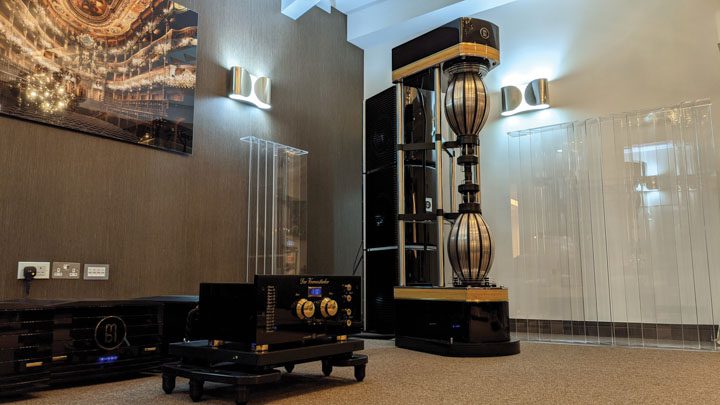
What makes the 101 X-Treme so ‘extreme’? A big part is the omnidirectional speaker drivers in the main units, those distinctive onion-shaped transducers that look like something from a sci-fi movie. These units are hand-built in MBL’s factory, each one taking two weeks to build in a combination of coach-building and hand-crafted technology reminiscent of another era. This isn’t mass-production techniques building quasi-disposable equipment; it’s like hand-crafted measurement instruments from the Victorian era, except made to meet 21st Century standards and demands… along with slightly less brass and fewer galvanometers.
Normally, this kind of engineering would be overkill. Still, the Radialstrahler driver itself lends itself to this kind of precision engineering, and the pinnacle of that engineering takes time to construct. The Radialstrahler is a vertical circular laminate driver. The driver membranes (or lamellas) look like the outer faces of segments of an orange, each ‘orange’ equating to a specific frequency range, like a tweeter, midrange or bass woofer. The shape is more ‘oblate spheroid’ than round. All the segments stack vertically and are fixed at the top to a central rod arrangement, with the motive force of the drivers coming from a moving coil driving a thrust bearing at the base of the driver. The moving coil and magnet form a single unit with the coil moving in the air gap of the magnet. Where a conventional cone acts as a piston, the Radialstrahler pulsates outward organically because the vertical movement of the driver bends the lamellas in all directions. The result is sound that is radiated in an almost complete 360° sphere; an ideal point source in fact.
This idea underpins all of MBL’s omnidirectional designs, but when it comes to the 101 X-Treme, there are a lot of omnidirectional drivers in the same plane. The mirroring of the tweeter, midrange, and bass in the main units requires a heroic amount of rigidity of chassis, which goes some way to explaining the 265kg weight of the main unit; there are four thick steel rods to stop the top driver array from crashing into its mirror below.
The second tower on each side is almost a conventional active subwoofer… if ‘conventional’ to you is a sextet of proprietary side-firing 12-inch bass drivers with their balanced amplifier in a lacquered wood tower that stands over 6’1”. To make this system more manageable it breaks down into separate parts, but stacking a trio of the speaker unit, amplifier/second speaker unit, and third speaker unit is still something of a Herculean task for an installer.
MBL demonstrates ‘how’ it can be done, and there are few ‘proofs of concept’ more impressive than the 101 X-Treme. Still, perhaps a higher-order question is ‘why?’ The conventional radiating loudspeaker – whether a horn design, a cone-and-dome box or a dipole panel – radiates sound directly from driver to ear. Even though every conventional loudspeaker radiates sound off-axis and dipole/bipole designs radiate sound to the back and front of the loudspeaker, this direct approach is very much at odds with how instruments in the real world propagate sound. Suppose you think of an instrument like a grand piano. In that case, while the sound is directed toward the audience by the direction of the piano lid, there is also a lot of piano sound radiating out in all directions. In a live concert, close to three-quarters of the sound we hear is indirect, reflecting off the walls, floor and ceiling of a concert hall. Anyone who has heard the sound of instruments played in an anechoic chamber will know just how crucial that mix of direct and indirect sound is to give musical instruments their tonality and body.
The omnidirectional loudspeaker is not a new concept and was especially popular in the 1960s and 1970s. Products like the Bose 901 in particular championed indirect sound, and products like the Harman Kardon Citation 13 and the Sonab OA5 (and more modern designs from the likes of Shahinian and arguably some forms of Amazon Echo) rely on omnidirectional principles.
However, these designs rely on conventional pistonic drivers placed in different directions. One could argue this is less ‘omnidirectional’ and more ‘multi-directional’. By contrast, MBL is part of a select group (including German Physiks and Duevel) who make true omnidirectional loudspeaker designs.
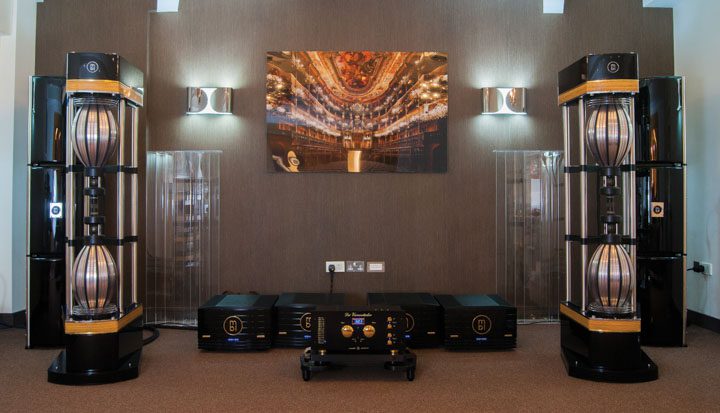
Seemingly a paradox, omnidirectional designs are less troubled by first-reflection problems caused by sound bouncing off side walls, ceilings and floors. This is because a conventional drive unit tends to ‘beam’ sound from these reflection points and instead of that focused beam of treble energy bouncing off your side walls, the omnidirectional loudspeaker is projecting sound more evenly everywhere around the room, functionally cancelling out those first-reflection hot-spots. It’s still never a good idea to put any kind of loudspeaker in a highly reflective space for the same reason why a live string quartet sounds very different in a small concert hall than it does in a glass atrium.
As discussed earlier, a ‘go-see’ has to be more of an initial impression of a loudspeaker than a thorough evaluation. Even a quick listen to the 101 X-Treme is an ear-opening experience. These are not the loudspeakers that can be used for background listening; while they play well at low levels, the 101 X-Treme draws you into the music like a siren (only without the whole ‘being dashed on the rocks’ part). If you want to play music to chop food, or to be in the background while reading a book, look elsewhere (or instead, add another system) because the 101 X-Treme demands your full attention.
This comes as a double-edged sword; the intensity of focus and sense of being a part of living, breathing musical events renders some recordings hard to stomach. Poorly recorded tracks (not ‘consciously lo-fi’… badly compressed ‘Loudness War’ casualties) are an unsettling experience, but one that makes you angry with the engineers rather than the system itself. You feel the urge to drag the producer, engineer and mastering engineers to your listening room, play them what they made and demand an apology.
Then you put something on that is well-recorded. Maybe some classic slice of late 1950s clubby jazz or an intelligently recorded singer in a studio. And you… stop. You stop and listen. Your pulse rate slows. You move quickly into that relaxed alpha wave brain state and remember why music is often used as a therapeutic key to unlocking people. Yes, of course, the omnidirectional nature of the sound makes this a visceral experience, and soundstaging elements and staging precision take on an entirely different aspect. But it puts you there in the room with the audience in a genuinely uncanny manner that is as beguiling as it is different to the norms of audio.
I thought that such a different sound might be something of a hurdle, that you would miss the more direct projection of conventional loudspeakers, but that isn’t the case at all. OK, so the big, more diffuse sound of a singer takes some getting used to, partly because we are so used to hearing singers amplified (even in classical music settings now), but even that isn’t a big jump to make in reality.
The Radialstrahler MBL 101 X-Treme is a big name for a big system that needs a big room and an even bigger budget to create a big sound. It’s also uncompromising in its approach; it’s like being driven in a Maybach… you know you’ve ‘made it’ when you reach this level. While it’s a system to show off and not a system for those wanting background music to their lives, it’s more than just expensive ‘bling’, and you can hear that even from a brief listening session.
MBL Akustikgeräte GmbH
Our thanks to KJ West One
+44(0)20 7486 2862
The post Radialstrahler MBL 101 X-Treme appeared first on Hi-Fi+.
CEDIA Expo 2022 highlights include Ascendo 50″ subwoofer, Focal Naim, PSB Speakers, and more.
Lance Profyt takes us around some of the CEDIA Expo 2022 in Dallas. Stops include Focal Naim, PSB Speakers, NAD Electronics, Ascendo, Devialet, Gallo Acoustics, and more.
Stay tuned for Part 2 from CEDIA.
For more information on the products seen in this video, visit the following links:
https://www.focalnaimamerica.com/
https://www.ascendo.de/en/loudspeaker/subwoofer.html
https://www.psbspeakers.com/
https://nadelectronics.com/
https://www.devialet.com/
https://galloacoustics.com/
You can see this video and more on the Hi-Fi+ YouTube Channel, such as Tea Time with Alan and Pete.
Hi-Fi+ Editor Alan Sircom and Publisher Pete Collingwood-Trewin talk about what’s happening in the high-end audio world.
Tea Time with Alan and Pete is just one of several new series on the Hi-Fi+ YouTube channel designed for audiophiles of all levels.
Another series is History of Audio, which aims to teach viewers a little about the History of Audio, which might be a trip down memory lane for many. It also hopes those who watch will learn from the varying experiences of other audiophiles through their trials and tribulations with different equipment.
While you’re on our YouTube channel, be sure to check out our Audio Basics series. So far, this series has covered what makes a great stereo system and how to find a great stereo system.
Soon, you can find reports from manufacturers at audio shows from around the world. You can see the likes of Aurender, Focal Naim, AudioThesis, Schiit Audio, and Magnepan, just to name a few. Right now, you can see what debuted at AXPONA 2022 and a bit from the Texas Audio Roundup, including background on the Magnepan LRS+. You can also see videos from Pacific Audio Fest in Seattle, CEDIA 2022 in Dallas, and you’ll see reports from Capital Audio Fest coming next month.
You can also see additional product reviews as well as more from CEDIA Expo 2022 in Dallas on the hi-fi+ YouTube channel coming soon.
Be sure to subscribe to the YouTube channel so you don’t miss any episodes!
The post CEDIA Expo 2022 highlights part 1: 50″ Subwoofer? appeared first on Hi-Fi+.