
Tag Archives: system

A series of listening bars and spaces have opened across London, offering a social music experience that is an alternative to clubs. Jumi Akinfenwa spoke with the founders of three such venues–All My Friends, System and Jumbi–to understand the growth and aims of these spaces.
At the beginning of 2022, the North London club, The Cause, closed down. First opening its doors in 2018, the closure of the temporary venue, exacerbated by the COVID-19 pandemic, signalled the end of an era for some. “We’ve had a lot of uncertainty within our organisation,” says Stuart Glen, the club’s co-founder. Because of the precarious nature of the nighttime economy, the team started looking into “all sorts of other activities”, which led them to launch All My Friends in East London’s Hackney Wick.
Initially open for three months (“we want to feel out how the site will work and how it will operate,” Glen explains), it is one of several new openings in the capital that seem to adopt a more laid-back approach to the ‘big night out’ without compromising on audio quality and music curation.


“The key bit is the Tannoy,” reveals Jojo Mathiszig of System, a few miles north, in Islington. “I thought it was such a beautiful speaker. I was looking for three years before I could get a pair.” Dating back to 1976, the sound system is a focal part of this late-night hangout spot that operates out of a butcher shop, Stella’s, two nights a week. With a nightly rotation of selectors, the idea for the bar stemmed from the listening bars that Mathiszig stumbled across on his travels.
“There’s this place called Bar Martha, and a place called JBS in Japan and they’re a lot different from what we do, but I guess that was probably the first introduction I had to listening bars and that kind of environment.” Whilst the concept of the listening bar isn’t a new addition to the London audiophile landscape, for Mathiszig, the existing venues did not directly cater to him and his demographic. “Those places sometimes seem almost quite uptight. There is that air within listening bars, right?” he suggests. “Sometimes it actually isn’t the most welcoming place, so I thought it’d be great if we could have somewhere a little bit more casual, a little bit more fun.”
Though touting themselves as a “hi-fi rum shack,” rather than a listening bar, across the river, Jumbi similarly adopts an open-door policy that is better suited to their community. “If you go to a listening bar in Japan, you’re not allowed to talk,” co-founder Bradley Zero says. “There are obvious parallels, but [Jumbi] is a talking space, a dancing space, a hearing space, a meeting space. It’s a drinking space.”
Situated in the South London neighbourhood of Peckham which has seen rapid gentrification over the past decade, the team felt it pertinent to include those who made the area what it is today, with much of the staff comprising those who grew up in the area but didn’t feel welcome in other bars. “There’s this risk that it’s gonna have a negative impact in the community in the long term,” he suggests of new bars in gentrified areas. “So the way to approach it is by platforming and providing space for these communities that are at risk of not being included.”


With one turntable that faces a wall of Zero’s own record collection, Jumbi has taken an “anti-performance” approach that encourages “deep listening” as he coins it. “When it gets busy, people are cheering between songs and giving a round of applause,” he says gleefully. “The audience is actually, ironically, a lot more engaged.” Rudi Minto de Wijs runs Jumbi’s cultural programming and points to the range of selectors who have come through its doors, such as Haseeb Iqbal, Shy One and Ruby Savage, but stresses that DJing experience isn’t essential– just a good ear. “You don’t have to be able to mix,” he says. “Without meaning to sound too conceptual, essentially people are storytellers, whether they’re picking records from Bradley’s collection or bringing their own.”
Similarly, not constrained by a music policy, System hones in on their selectors, giving them the freedom to play whatever they wish, typically records they wouldn’t play in clubs or on the radio. “We want to make the focus around the DJs as well,” Mathiszig says. “That’s why there’s a different person every night. You’re coming to hear someone’s selections.” With most of the DJs also having shows on Mathiszig’s radio station, Kindred, there is a readymade community at System, adding to its pared-back feel. Glen points to The Cause’s extended family as the real catalyst for the venue. “It’s literally a collaboration of all our friends coming together,” he says. “All the friends we’ve met so far and all our friends we’re yet to meet.”


Unlike its predecessor, this latest venue asks less of its visitors, offering a place for them to take in as much or as little as they want. “It’s a place you can come in, and you can stay as long as you want. You can come in to say hello to people. You can drink if you wish to drink. It’s completely up to the person coming down,” Glen says. With the current cost-of-living crisis in the UK impacting venue owners and attendees alike, providing non-committal spaces to listen to well-curated music without having to pay a premium seems to be a more attractive option for many. “It’s fucking expensive to live at the moment,” Mathiszig exclaims. “But that’s also why it works. The best thing about us being in the butchers is that we’re sharing the cost of the rent.”
With this new wave of bars ushering in a low-pressure way to listen and interact with new music and fellow music lovers, could we be seeing the dawn of a change of pace? Perhaps it’s too soon to tell, but for Bradley Zero, the beauty lies in the uncertainty. “The nice thing about what we’ve created is that some of it wasn’t really planned,” he says. “I’m already blown away by how the space is being used and really excited to see where it will grow.”
Words by Jumi Akinfenwa
Combining Sonus faber’s Italian heritage and design expertise, the Omnia wireless system offers a suite of features that allows users to connect to a variety of media and seamlessly integrate Sonus faber’s signature natural sound into any lifestyle. Omnia is equipped with two new trademarked technologies from Sonus faber: a touch-sensitive illuminated top panel called Senso, which allows direct control of the system and indicates mode, volume, and active streaming services; and Crescendo, an advanced signal-processing system which combines a mix of in-phase bipole and anti-phase dipole sound. Crescendo can be optimized to perform in any environment thanks to room-placement options and EQ modes selectable on the Web-based set-up page. The acoustic package features a four-way closed box with seven drivers driven by a 490W amp. Finally, there’s built-in Chromecast, Bluetooth, and AirPlay2, and access to streaming services via Tidal Connect and Spotify Connect. Plus, Omnia is Roon ready. A handheld remote control is included.
Price: $1995
The post Future TAS: Sonus faber Omnia Wireless Tabletop System appeared first on The Absolute Sound.

Austin, TX (April 30, 2021)—The Austin Stone Church (ASC) serves a community of nearly 8,000 weekly attendees throughout its six locations, and it’s most recent campus was added last year during the pandemic. Getting it up to speed meant that the ASC team and Brown Note Productions (BNP) did a number of AV updates over the course of 2020, including the installation of a d&b audiotechnik Y series line array system; in fact, all of the church’s locations sport d&b systems.
The extensive updating of the new 832-seat contemporary worship campus is necessary, as the church is aiming for it to become its primary broadcast campus along with offering regular Sunday services that feature seven musicians/vocalists (drums, keys, guitar, bass, and playback, as well as three lead vocalists). There are two services per week at the new campus.
Creating Spellbinding Live Sound for Harry Potter
“The main challenge with this install was the raked, fan shape of the space and trying to deliver a similar experience to every seat,” states Ryan Robertson, production audio manager, Austin Stone Church. “The previous system was an old clustered point source system that really did a poor job of that; you could move what felt like five feet in any direction and have a very different experience. One of our main objectives with any of our new venues is to give each person that attends the same experience, whether in the front row or way back in the corner. No other manufacturer does as good of a job of that than d&b in my opinion. Every system really does follow the ‘more art, less noise’ motto by putting sound only where it needs to go, especially when ArrayProcessing is deployed. I always feel confident when mixing on a well deployed d&b system that what I’m mixing at front of house is being heard and felt in essentially every seat in the venue. This install is no exception. On top of that, there is a clarity and sonic signature of d&b that fits perfectly with the style of music we are mixing and is highly preferred.”
System highlights include eight Y8 and eight Y12 loudspeakers, a trio of J-SUBs ground subwoofers, a pair of d&b J-INFRAs on the outside of the sub array, eight E6 loudspeakers for front fills, a Y10P loudspeaker, two Y7P loudspeakers for out fills, eight 30D amplifiers, a 10D amplifier and a DS10 Dante bridge.
The front of house is outfitted with a DiGiCo S31console with Dante I/O and Focusrite AES interface, and a Q-SYS Control system utilizing a d&b plug-in for complete AV system control and automation allowing for “self-serve” AV modes for a wide variety of uses. An Avid Pro Tools Dante-enabled broadcast package is provided for livestream and post-production use.
“The new d&b system sounds fantastic,” adds Robertson. “The power and clarity of the system really draws you in as a listener. It was fun to see the reactions and smiles on the face of our leadership team as they listened to it for the first time. Their main reaction was how intelligible everything was. They felt like they could actually hear distinctly everything that was happening in the mix, not just a wall of sound. The band has said they have a new level of confidence in what they play and sing and that it is accurately being conveyed into the room. It makes them that much more excited to get up early on a Sunday and lead our people.”
Brown Note Productions • www.brownnote.com
d&b audiotechnik • www.dbaudio.com
Who among us has not on occasion pushed himself to the limit just to see how far, high, fast, strong he could be? Even I’ve done it once or twice, I think. But Sony, Sony has over the years periodically released products that were produced to show what could be done if all its creative forces were brought to bear. I’ve had the pleasure of reviewing several of Sony’s Z Series components, perhaps so named because they had zero chance of selling in large quantities. It was not that they weren’t superb performers, but their feature sets were sufficiently idiosyncratic and their prices sufficiently high that broad audience appeal was never in the cards. The DMP-Z1 ($8995) was a prime example of this kind of effort. From its rigid, milled-aluminum, H-shaped chassis that isolated the digital and analog circuitry, to its five separate battery power supplies that isolated the digital and analog sections from AC power, to its customized, analog, rotary volume controller that could adjust the volume of four separate signal paths, it displayed a level of engineering reserved for state-of-the-art signature products. Alas, it was heavy, slow to boot up, and could only output to headphones or USB-C. I loved its sound, but its ergonomics were not something most audiophiles could live with on a day-to-day basis.
Sony’s latest Z Series offering, the SA-Z1 ($7999) is a nearfield loudspeaker system with built-in amplification and input selection, along with a bevy of special sonic adjustment options. It is a complete system that only requires users to supply a source or two. It is capable of producing state-of-the-art sound, but it must be set up precisely to achieve its full potential. How precisely? Keep reading and we will burrow down into the depths of the SA-Z1 speaker system’s obsessive search for sonic perfection.
Tech Tour
The SA-Z1’s set of technical innovations include a cavalcade of unique advancements that display a level of forward thinking you won’t find in most audio components regardless of price. Let’s start with physical innovations and then move on to the electronics. The SA-Z1 is built on Sony’s FBW (Frame Beam Wall) chassis, which is a frame-and-beam construction with walls cut from a solid aluminum block. The enclosure itself comprises six pieces of aluminum plate. By using two different aluminum alloys combined with an assembly technique based on traditional Japanese construction methods, Sony’s engineers claim they have effectively suppressed “unnecessary audible resonance.”
The drivers in the SA-Z1 are mounted in a special way that attempts, through its physical and electronic design, to combine the best sonic elements of a single-driver design with the frequency response and power-handling characteristics of a multiway. While technically the SA-Z1 is a two-way speaker, it differs from conventional two-ways in several respects. First, let’s look at the physical side. The main tweeter is a 19mm (¾”) titanium-sputtered aluminum dome, which is vertically flanked by two 14mm (9/16″) “assist” tweeters. Sony calls this the “I-ARRAY” system: three tweeters mounted on a plate situated in front of the main forward-firing woofer—to simulate a coaxial driver arrangement. Sony calls its dome tweeter design a “balanced dome” because the voice coil works at a point where the weight of the diaphragm and the air load are balanced, pushing the dome’s break-up mode to a point above 100kHz (for the assist tweeters).
There is a second woofer inside the cabinet, which is placed so it is back-to-back with the forward-firing woofer. Sony refers to this as the “Tsuzumi” layout because it is similar in shape to the traditional Japanese drum. This rear-firing woofer is situated so that bass-expansion ducts allow low frequencies to expand to the sides as well as to the front. Large aperture slits located behind the rear driver’s diaphragm keep air turbulence from affecting the driver’s linear motion. The woofer’s specially designed, die-cast zinc basket also helps suppress piston-motion vibration.
Each driver subsystem has its own unique digital power amplifier. There is one for the main tweeter, a second for the assist tweeters, a third for the forward-firing woofer, and a fourth for the rear-firing woofer. Why so many amplifiers? Because by combining the amplifiers with FPGA-control Sony could accomplish some spectacularly accurate time and phase alignment. The SA-Z1 system allows for the precise adjustment of the wave front. According to Sony, “the SA-Z1’s multi-amplifier system and unique field programmable gate array (FPGA) perfectly synchronizes the wavefront between driver units. The precisely aligned wavefront and broad frequency response are capable of delivering both the power of an expansive orchestral sound stage or the focus of an intimate solo.”
The power amplifiers are also special. Sony’s original S-Master amplifier circuit was a non-feedback digital design. The ZA-Z1 expands that circuit by adding a second amplifier that acts as a feed-forward amp to correct digital switching errors. Users have the option of using either the digital amplifier by itself or with the analog feed-forward engaged. The power amplifiers employ a Gallium Nitride (GaN) MOSFET. The higher switching speed of the GaN reduces ringing. According to Sony, “this means that the amplification errors are significantly reduced, even before the signal is error-corrected by the feed-forward amplifier.”
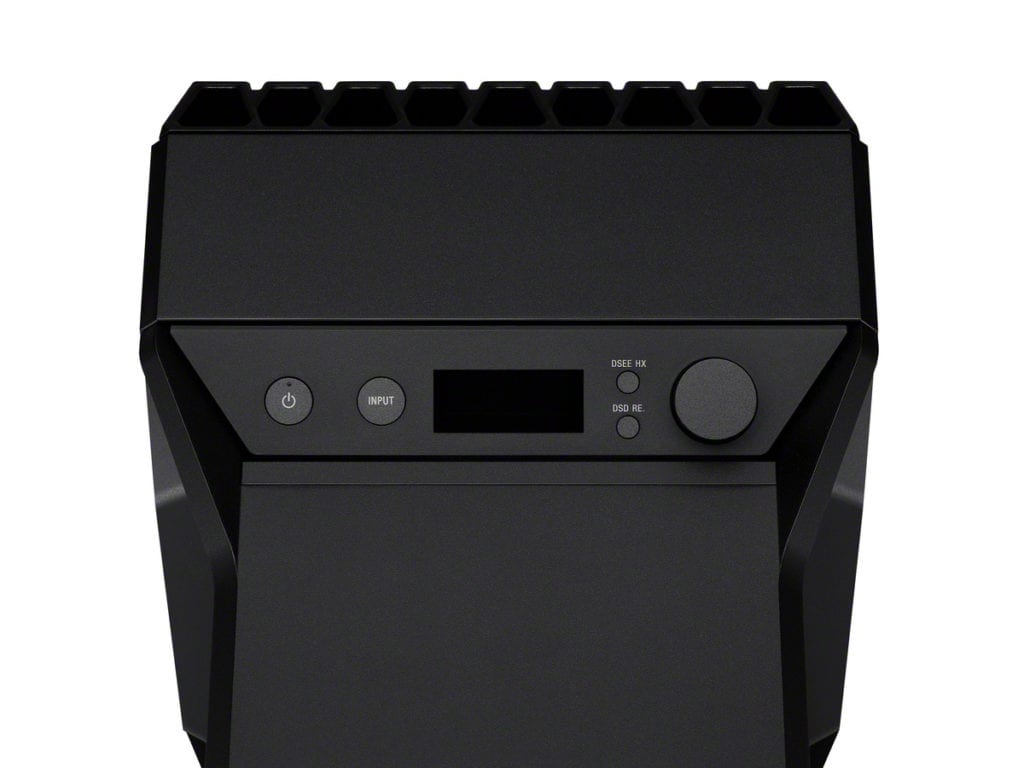
Because Sony could not find any off-the-shelf digital signal processors (DSP) that could accomplish its design goals, the SA-Z1 design team opted to build, from the ground up, its own field programmable gate array (FPGA). Using an FPGA allowed the SA-Z1 designers to include a multiplicity of signal processing that, so far, is unique to the SA-Z1. Sony begins with a user-engageable remastering DSD engine that converts any and all PCM signals into DSD 11.2MHz. The SA-Z1 can also upscale PCM via DSEE HX processing, which according to Sony, “intelligently recognizes instruments, voices, and musical genres. By identifying these and the relative energy of audio, it can accurately rebuild audio lost during digital compression.”
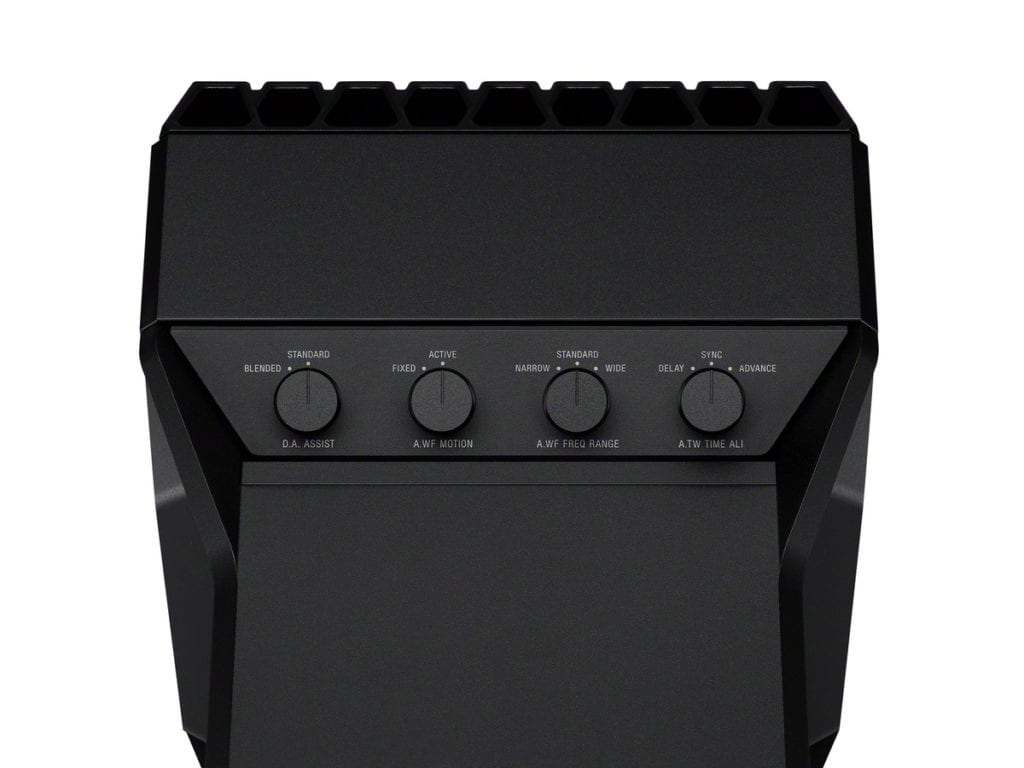
Another feature enabled by the FPGA is Sony’s “D.A. Assist,” which allows the user to choose between two different amplification schemes. In the “standard” position, the analog amplifier acts only as an error corrector for the digital amplifier. In the “blended” position, the analog amplifier begins to drive the speaker units along with the digital amplifier, giving the overall sound a less digital, more analog sound. Further sonic control comes from the “Assist Woofer Motion” controls. These allow you to lock the rear woofer in place rather than use it as an assist to the front-firing woofer. “Active” drives the woofer via the amplifiers while “fixed” does not. You can also change the frequency range covered by the rear-firing woofer when in active mode. The “narrow” setting provides the tightest bass; “standard” offers a wider affected frequency range; and “wide” is the most expansive range.
On top of all the previously mentioned special FPGA-enabled features, the most interesting one added to the Sony SA-Z1 is undoubtably the “Assist TW Time Alignment.” This allows the user to intentionally change the time alignment between the main tweeters and the assist tweeters. The “sync” setting delivers perfectly time-aligned sound between the drivers. The “advance” setting moves the main tweeters alignment ahead of the assist tweeters, while the “delay” setting retards the main tweeters’ response in relation to the assists. When would you want to intentionally take the drivers out of time alignment? When you find that you want a more incisive “forward” sound or a “softer,” more euphonic presentation, which will, of course, be based on the source’s sonic characteristics and your own musical tastes.
Setup and Ergonomics
The first time I saw the Sony SA-Z1 speaker system was at a special demonstration at the 2019 Rocky Mountain Audio Fest. At that time, I wrote: “For the listening session I was plunked down into a comfy chair that placed my ears about four feet from the loudspeakers and vertically just below the main tweeter array. The loudspeakers themselves were placed about six inches back from the front edges of a butcher-block-topped, black-cloth-covered table. The rear of the speakers were about seven inches from the wall. The reason I’m spending space describing the setup is that positioning the new Sony speaker system is critical to its optimal performance.”
When the SA-Z1 system arrived, it had been over eight months since the last time I saw the system properly set up. It arrived with a single informational sheet with only four lines of physical set-up instructions: “For optimal performance the speakers need to be set up on a desk, not speaker stands. As a starting point, set the sheet speakers 730mm apart and 150mm from the back wall. Do not toe-in the speakers. Ideally, main center tweeters should be at the same height as the listener’s ears.” That was the sum total of set-up info.
So, like a good audiophile, I tried to follow the instructions as closely as possible. I converted my shipping/receiving/storage room adjacent to my main system and office for use with the Sony system. It already had a nice rock-hard butcher-block table for a surface that was positioned by a wall suitable for use as the main wall for the Sony system. I also had an old stuffed chair with a lower than average seating position that put my ears exactly parallel with the Sony’s main tweeters. The primary difference between my final setup and the Sony setup at RMAF was that I placed a small oriental rug on the table, because the front of the table surface extended further in front of the loudspeakers than the table surface at the Sony demo. I employed the rug to eliminate midrange and upper frequency “floor bounce” from the table surface.
After starting with Sony’s recommended set-up dimensions, moving speakers up, down, wider, narrower, closer and farther from the wall, I decided that, yes, the Sony recommendations produced the best overall performance, but a guy’s gotta try. The SA-Z1 comes with a remote, which turned out to be a very useful addition that saved a lot of standing, reaching, and lunging for the controls, which were located on the top of the left-hand loudspeaker in my setup, just out of reach from my listening seat.
During the early stages of setup, I was surprised to discover that the SA-Z1 speaker system does not support a subwoofer. I lugged a sub into position, under the table, snaked the RCA cable from the sub to the back of the left-hand SA-Z1 speaker enclosure, which has all the input and output connections (you can easily make it the right-hand via a switch in the back), and discovered there simply were no subwoofer or line-level outputs available. The reason for this omission is that the SA-Z1 designers decided that it would be too easy to screw up the sound with a subwoofer to allow end-users the power to do so. How you feel about this, and how it affects your opinion of the SA-Z1 system, depends on how much you value low bass. Midbass, the SA-Z1 does rather well, but low bass, no matter how you configure the SA-Z1 system, will remain minimal at best.
The SA-Z1 has a plethora of inputs, including balanced analog XLR, unbalanced analog RCA, unbalanced analog stereo mini, USB-B, TosLink, and, finally a special digital Walkman input. The only inputs you won’t find are RCA SPDIF or AES/EBU digital. I was able to connect a Sony NW-WM1Z via the digital Walkman connection with no issues. All the analog inputs also functioned properly. The only input glitch I came across was an Astell & Kern SP2000 player that would not produce sound via the USB digital connection but worked fine via its analog outputs. (A HiDiz AP-80 connected without issues via that same digital input.) Other sources used during the review included the Project Pre-Box S2’s analog outputs. The Pre-Box S2 was connected via SPDIF to a Raspberry PI 3 with Allo Hat with a Roon-compatible software package installed for streaming sources.
As for outputs, as I mentioned earlier, there are no line-level or subwoofer outputs. The SA-Z1 system also does not support headphones. It is its own self-contained thing—a complete musical universe unto itself…but what a universe it is!
Sound
Occasionally, I invite a friend over for a listening session once I get a new piece of gear installed and set up to my satisfaction. It always useful to get another take on what I’m hearing. In this age of Covid-19 that was a bit harder to engineer, but really no big thing. The first slightly muffled words out of my masked friend Josh’s mouth, after about ten seconds of listening, were “This is crazy!” Of course, I wondered what exactly he meant by that. It took him a while to fully explain what those three words encompass. I will try to paraphrase.
Listening to the system for the first time for him was like stepping into a room that contained a really great stereo system. And Josh (that’s his real first name) has more than 20 years of experience listening to really great systems in purpose-built rooms. The Sony system creates a three-dimensional soundfield that envelops the listener in the same way a finely tuned room-based system can, but it does it in a much more confined space, hence the crazy part of the exclamation. After a couple of minutes of listening Josh turned and said, “I have to close my eyes to listen because when I open them, what I hear is so different from what I’m seeing. I just can’t relate…”
What he was seeing was two modest-sized black boxes sitting on a table, but what he was hearing was a life-sized recreation of a musical event.
Harry Pearson, founder of The Absolute Sound, was the first writer that I remember using the phrase “Time Traveling Machine” when referring to a stereo system. During my listening time with the Sony SA-Z1 system, I found that phrase bouncing around inside my brain on a regular basis. This phenomenon was especially striking when I played some of the live concert recordings of the Boulder Philharmonic that I’ve made over the years. I went back to one particular recording, made via DSD64 in 2013, of a modern piece by Richard Danielpour, “A Woman’s Life,” featuring soprano Angela Brown. Through the SA-Z1 Ms. Brown’s voice bloomed beautifully as she leaned on a note while her image dimensions remained rock-solid with clearly defined parameters that did not change as her dynamics went from pianissimo to forte. Also, the celeste and xylophone ostinato figure from the back of the orchestra had a clarity and definition to each note that many systems tend to blur slightly, but through the SA-Z1 each rapid-fire hit remained distinct.
The spatial precision of the SA-Z1’s soundstage presentation was state of the art. With small groups, such as my recordings from the Rockygrass Academy workshops, each instrument was precisely placed, with clearly defined dimensions and height and width cues. When I played a large orchestral recording or a big pop production, the soundstage width, height, and depth rendition followed the dictates of the recording with superb accuracy. If the recording was wide, so was the SA-Z1’s soundstage, but with mono recordings the image seemed no wider than a dime.
One of the more alluring characteristics of a tube-based system comes from its smooth, electronically grain-free textural presentation. The SA-Z1’s midrange has a purity and lack of electronic texture that is reminiscent of a great tube-based system, but without the negative aspects of noise or tube-aging artifacts. The only textures present with the SA-Z1 are those in the recording itself. Even on tracks with intentional textural distortion such as “Xanny” by Billie Eilish, the SA-Z1 retains the delicacy and purity of the vocals and background bits while preserving all the intentional edginess of the ragged bass burbles and rumbles underneath.
Given that the SA-Z1 has no subwoofer for low bass, and only four small 4″ woofers, even with all of Sony’s port and DSP wizardry, it can’t be expected to produce much in the way of low bass below 50Hz, and it doesn’t. But by way of compensation, the bass that the SA-Z1 does have is extremely good as far down as it goes. Take that cut “Xanny” for instance—the SA-Z1 captures all the subtle and not so subtle textures of the bass’s leading edge so well that the lack of follow-through at the extreme bottom of its range isn’t so noticeably missing. Also, the harmonic balance doesn’t sound lighter than neutral, as often happens when a system doesn’t extend to the bottom octave. Fortunately for those listeners who crave a neutral harmonic balance the SA-Z1 design team didn’t try to warm up the sound to compensate for the lack of low bass like many “classic” mini-monitors do. Straight, clean, and neutral sums up the SA-Z1 harmonic spectrum.
Sony’s published specifications claim that the SA-Z1 system’s high-frequency range extends up to 100kHz. I doubt that any human could, subjectively, confirm or deny the validity of this particular specification. My own hearing gets up to 13kHz, so I’m not a lot of help on that bat-ear stuff, but like many older audiophiles, my hearing below my upper threshold has become even more sensitive to those upper frequency anomalies that are still within my purview. Like its midrange, the SA-Z1’s upper frequencies had a purity and lack of electronic character that were exemplary. The string-section sound on my own recordings had an airy quality that captured all the delicacy and air of massed strings.
As you might surmise, the SA-Z1 is most definitely a one-person system. Stereo choo-choo (placing a listener behind the main sweet spot) doesn’t deliver the same immersive sound. Listening from across the room won’t impress you either—it sounds like a small system. No, you have to “assume the position,” and settle down into that lower-than-average comfy chair for the SA-Z1 to do its magic. And the sweet spot is small—just large enough that some head-bobbing to the music won’t kick you out of the right spot. But move more than three or four inches to one side or the other and you’ll be outside the ideal listening window. Moving your head forward a couple of inches also affects the soundstage—it got even bigger and wider to the point where it was almost like listening to big headphones, before I got too close and the imaging finally broke down. There is an ideal listening spot for the SA-Z1, and it’s obvious when you’re in it.
I’m sure that some percentage of readers turned the page to another review when they came to the technical description of the SA-Z1’s DSP processing because some audiophiles firmly believe that the less you do to an audio signal the better it will sound, and any amount of DSP is not a good thing. One-half hour listening time with the SA-Z1 could change their minds. I found that with most PCM material I preferred the DSD transcoding and upsampling to 11.2MHz. With upsampling engaged the music had a more natural, relaxed, and grain-free quality. I also found the DSEE HX to be sonically beneficial to the point where, after initial and several subsequent A/B listening sessions, I left it in the “on” position. Clarity and spatial precision marginally but universally improved with DSEE HX activated.
It only took a pair of A/B sessions comparing the active with the locked bass for me to conclude that the active bass was by far superior to the locked setting. The bass was fuller with the active setting but still well-defined with no bloat. The tightest bass was realized with the “narrow” setting, just as Sony indicated in its manual (which arrived via e-mail about a month into the review). Most of the time the “standard” setting was my preferred option.
The final bit of DSP, and most likely the one to cause the most raised eyebrows, was the “synch” control, which allows the user to move the tweeters in front of, in synch with, or behind the woofer’s time alignment. Ninety-five percent of the time I preferred the properly time-aligned setting, but occasionally I found a nasty pop recording that benefitted from the “delay” setting.
Summary
Daring to be different is something that Sony has perfected over its long history. While nothing will be as earth-shaking as the original Sony Walk-man and the portable music revolution that followed in its wake, Sony continues to innovate in form, function, and performance while most other companies are content to create “best value for the money” or “most expensive” audio components. The Sony SA-Z1 is a prime example of Sony’s innovative prowess. It sets a new standard for what small desktop speaker systems can do in soundstaging, harmonic purity, dynamic acuity, and low-frequency speed and definition. What the SA-Z1 lacks is commensurate low bass to match the rest of its frequency range, and provisions for an SPDIF or AES/EBU digital input. And no, you can’t just add a subwoofer.
I would advise any audiophile who listens primarily to a nearfield system for his reference to experience the Sony SA-Z1 system. I wouldn’t be at all surprised if some listeners who walked in with no intention of acquiring the SA-Z1 system find that they can’t leave for home without it. Josh is 99% sure he’s buying one for his new office…it is simply that good.
Specs & Pricing
Type: Active desktop loudspeaker system
Driver complement: One ¾” (19mm) soft-dome tweeter, two 9/16″ (13mm) soft-dome tweeters, two 4″ (100mm) midrange/bass drivers per side
Frequency response: 51Hz–100kHz (-10dB)
Formats supported: PCM up to 768/32, DSD22.4MHz
Analog inputs: Balanced XLR, unbalanced RCA, unbalanced stereo mini jack
Digital inputs: USB-B, TosLink, Sony Walkman
Power output: 106W (total)
Dimensions: 7 7/8″ (199mm) x 8¼” (207mm) x 12 7/8″ (326mm)
Weight: 23 lbs., 2.4 oz.
Price: $7999
The post Sony SA-Z1 Nearfield Listening System appeared first on The Absolute Sound.