Author Archives: Steve Dickinson

EgglestonWorks Emma Evo

Earlier this yr, in problem 205, I reviewed the EgglestonWorks Nico Evo stand-mount loudspeaker. It’s the one stand-mounter within the present EgglestonWorks lineup and at £6,500, together with stands, the least costly mannequin they make. But lots of their sellers apparently view the £7,900 Emma Evo because the entry stage EgglestonWorks mannequin. I received to questioning about this; is the Nico Evo the odd-man-out? Does the Emma Evo sound someway extra ‘EgglestonWorks’ than the Nico? Is there a presumption that EgglestonWorks prospects aren’t actually stand-mount folks? Only one solution to discover out, actually…

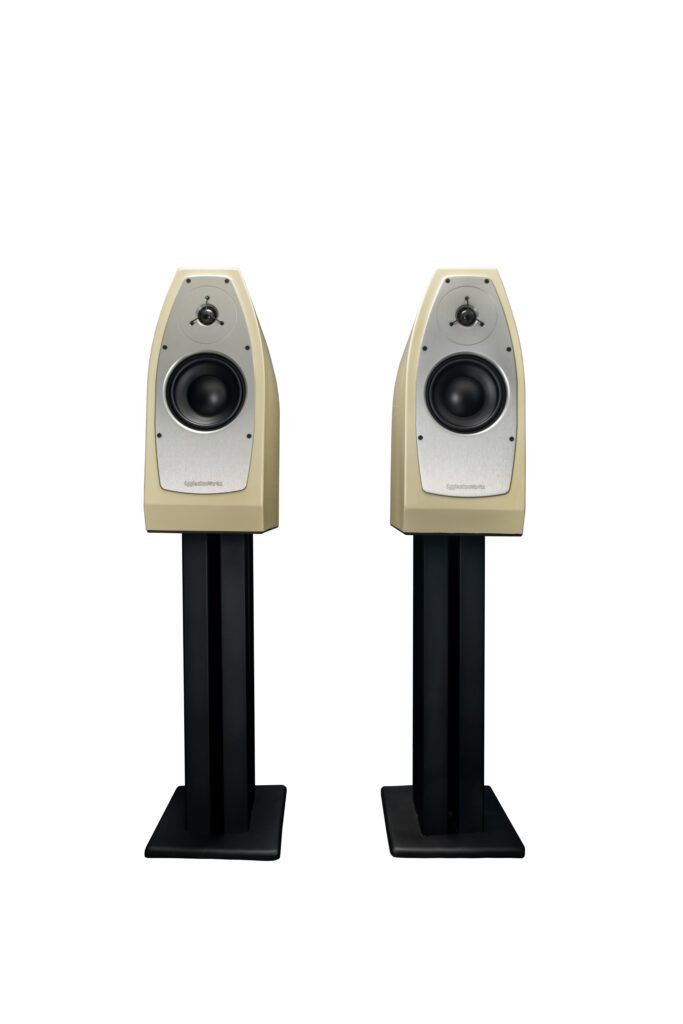
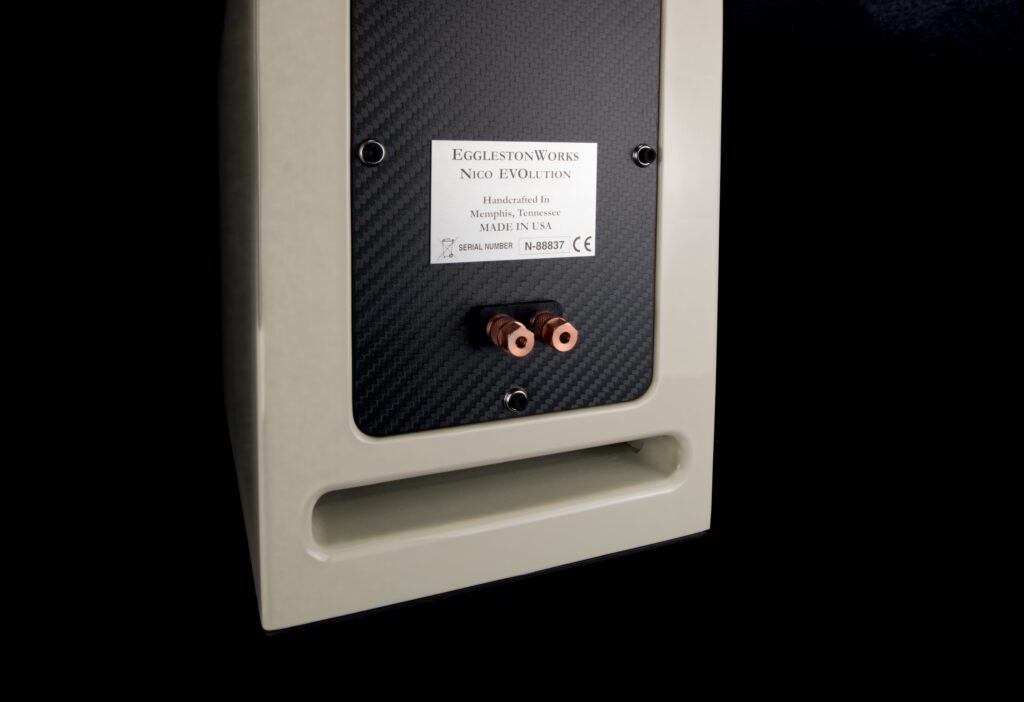
The Emma Evos duly arrived, completed neatly in a silver-grey automotive gloss end that can most likely mix into a variety of décor kinds. Visually, they draw very a lot on the Nico Evo, a tapering higher cupboard, tiny prime plate with a ‘fastback’ downward-sloping rear, and the acquainted backward-leaning EgglestonWorks stance. The metallic entrance plate now homes a second bass/mid unit to the Nico’s one, however the precise tweeter and bass/mid drivers are the identical for Nico and for Emma. Forever in the past, it appears now, I commented that the equipped stand did the Nico Evo few favours, so it’s going to be attention-grabbing to see how the floorstander shapes up.

EgglestonWorks Emma Eco

EgglestonWorks have now had stand-mount designs of their vary for nearly a decade, the Nico Evo being descended from the unique Nico, however drawing on classes discovered from the rather more costly Viginti. The Emma Evo took many design components from the Nico Evo, notably by way of cupboard development, the usage of the slotted reflex port, and crossover know-how. So if we’re searching for a lineage right here, Emma is an even bigger Nico, somewhat than Nico being a stand-mount Emma.

It’s not a very massive loudspeaker, it’s the smallest floorstander EgglestonWorks provides, however neither is it the kind of mannequin you’ll be able to unobtrusively drop right into a small room and not using a second’s thought. Clever design means it hides its bulk nicely, nevertheless it’s taller and deeper than you recognize at first look, and a superb deal heavier than a few of its friends on the value. It’s large enough that you’re entitled to count on a little bit of helpful heft in its efficiency, nevertheless it’s not the kind of bruiser that wants some room round it if it isn’t to dominate the area. In quick, it reveals each signal of being probably in that Goldilocks zone for a superb vary of UK-sized rooms. After my optimistic expertise with its smaller sibling, I had excessive hopes for this one.

Of infants and bathwater

So many manufacturers of extremely regarded stand-mount loudspeakers appear to stumble when creating a floorstander. There’s a magic one thing that so typically will get misplaced within the transition from small and agile, with pinpoint imaging, to scale, weight and beneficiant dynamics. It occurs so typically, it’s simple to assume these are mutually unique traits and the very best you are able to do is attain a suitable compromise, that you simply’re at all times going to throw out the ‘disappearing loudspeaker’ child within the ’scale and dynamics’ bathwater. Partly, maybe, the challenges of cupboard design are simpler to resolve in a smaller enclosure; perhaps a full vary design exposes the inexpensive drivers you may get away with in a bandwidth-limited mini monitor. Or simply presumably, what we’re listening to so typically is the designer’s journey on the large loudspeaker studying curve.

Compromise, what compromise?

Whatever the explanation, the Emma Evo doesn’t endure from this malaise. The child has been bathed, and stays intact. Similar drive models are used additional up the EgglestonWorks meals chain, and the port design and crossover know-how derives from that used within the £46,000 Viginti. There are tradeoffs, clearly you’ll be able to’t make an £8,000 loudspeaker the way in which you make a £46,000 loudspeaker. But EgglestonWorks inform me plenty of that they discovered when creating the cupboard for the Viginti has discovered its approach, through the Nico Evo, into the Emma Evo. So I feel that, value apart, it’s not notably useful to consider the Emma as an entry-level mannequin, and on the value they face some stiff competitors so let’s simply assess them on their very own phrases. That’s in line with EgglestonWorks’ personal expressed philosophy, to let every mannequin be the very best it may be, and to not obsess over becoming it into a variety at a value level.

EgglestonWorks Emma Eco

As anticipated, the Emma Evo fills in additional of the underside octave than the Nico Evo, it brings scale and weight commensurate with the larger cupboard and driver floor space; gratifyingly, although, it concedes little or no to the Nico by way of that disappearing act that small cupboard loudspeakers can obtain.

Lucid

If single-word critiques ever turn into modern, my alternative for the EgglestonWorks Emma Evo can be ‘lucid’. But as long as our esteemed editor sees match to fee an extra 1999 phrases, I’m joyful to oblige. What I imply by ‘lucid’ is that the loudspeaker reveals insights deep into the music. There’s readability and articulation to the presentation; a delicate vagueness has been disposed of, virtually as if a light-weight nicely has been reduce into the soundstage, the higher to light up these denser, innermost areas. To use one other visible analogy, it’s as if the loudspeakers discovered a depth of subject you didn’t realise was out there.

Take Freddy Kempf, enjoying Prokofiev’s Second Piano Concerto with the Bergen Philharmonic [BIS, SACD]: I was struck by how rather more clearly I may observe the interior workings of the orchestra. When you attend a dwell efficiency, the orchestra is arrayed earlier than you and it’s simple sufficient to observe an instrumental line, or a phrase, just about at will. Whereas even superb hi-fi typically dissolves right into a extra impressionistic view, you expertise the orchestra as an entity, with solely the extra outstanding traces being out there for inspection. The Emmas approached this side of the dwell expertise extra intently than something I can recall at this value, with textures and tunefulness nicely past the norm.

EgglestonWorks Emma Evo

And all of it works on smaller-scale music, too. Antonio Forcione Live [Naim] and ‘Tarantella’ gave me textures and timbres, intimacy and ebullience; it was very clear how essential each member of this small ensemble was to the entire of the musical occasion right here. It does assist flip music again into an occasion – that sense of efficiency, of a gaggle of individuals with a standard purpose, that may typically be ignored, sadly, by techniques which don’t resolve in addition to the Emmas can. Timing is essentially essential right here, too. ‘Maurizio’s Party’ from the identical album: bass notes from the cello have been tight and tuneful, solidly underpinning the music; the percussion is quick, but additionally fully-textured, the shapes of the notes have time to completely develop, they aren’t reduce off within the pursuits of tempo or dynamics. Olafur Arnalds ‘This place was a shelter’ from For now I’m Winter [Mercury Classics] was filled with fine-boned element, splendidly contrasting the sonorous piano and ethereal electronica with tight, sinewy enjoying from the string quartet. This loudspeaker appears to experience bringing out the complete, lush element and color in a efficiency, however not candy-coated – there’s a agency grip on actuality right here, in all its multi-layered complexity.

For so long as I can keep in mind, I’ve been an advocate of straightforward, first order crossovers, and the significance of preserving the part relationships to the good thing about timing, and imaging. Yet right here I’m, marvelling at a loudspeaker so generously endowed with strengths in so lots of the areas I worth, and it has a <checks notes> fourth-order crossover. Umm. The crossover know-how has trickled down from the a lot larger, rather more costly Viginti, so clearly some very helpful classes have been discovered.

Along got here a spider

If I had a criticism, I might be aware that the decrease treble can occasionally draw consideration to itself. It’s probably not vibrant – it is a material dome tweeter in any case– however every so often there’s a slight fizz on the prime of the midrange. I seen it first on Elbow’s ‘One day like this’ from The Seldom Seen Kid [Geffen] when Guy Garvey’s vocals exhibited greater than his customary stage of softly silken sibilance, and the occasional barely acid edge to a be aware right here and there. But right here’s the factor: I’d take off each the magnetic grilles and a three-pronged metallic ‘spider’ that protects the tweeter. I’d additionally toed the audio system in a lot as I normally do. Refitting the spider and adjusting the speaker placement to roughly straight down the room handled plenty of this higher midrange artefact. Resting the speaker spikes on AcouPlex discs instead of the metallic cups that have been offered additionally paid dividends by way of the sense of movement and musicality. This is clearly a loudspeaker that rewards a bit experimentation in placement and setup. Oh, and I additionally found I used to be typically listening fairly unfeasibly loud, maybe 3 or 4 dB louder than my customary stage. I most likely owe my neighbours a bottle of one thing good.

This in some respects displays simply how clear these loudspeakers are, as apart from that barely ‘scorching’ higher midrange, the kind of distortion artefacts that usually give cues as to loudness have been largely absent. EgglestonWorks don’t make any suggestions as to energy dealing with, the drivers are ‘sturdy’ and can deal with just about something you throw at them, apparently, and as I discovered with the Nico Evo, I do assume the Emma Evos recognize a superb dollop of high quality energy. Stanley Clarke’s ‘Bass Folk Song No. 5’ from The Stanley Clarke Band [Heads Up] didn’t have fairly the last word diploma of ‘push’ within the funky bit and there’s maybe a temptation to show it up a bit extra to compensate. Perhaps that is the place the compromise is discovered. If so, it’s a reasonably well-chosen one.

EgglestonWorks Emma Evo

The EgglestonWorks Emma Evo has maybe essentially the most lucid, limpid and insightful presentation of any loudspeaker at its value that I’ve but heard. Time and once more I discovered myself marvelling on the sheer depth of subject this loudspeaker may reproduce. Take Jacques Loussier, ‘Pastorale in C Minor’ from Plays Bach [Telarc]: there’s beneficiant spatial separation between the trio, with stable, secure and convincing pictures of the gamers. Instrumental color is vivid, and constant, timing tight and exact. There’s an oddity in the way in which André Arpino performs percussion on this observe, persistently simply behind the beat for complete sections of the music. It’s fairly disconcerting, however clearly intentional; the Emma Evo reveals the percussion to be set nicely again within the soundstage, however that’s not why he’s a bit late, he’s very clearly doing this on objective as a result of he locks-in to different sections of the identical observe. It’s these types of insights that elevate the Emmas above the competitors.

So the place the Nico Evo exemplified the very best in a smallish, standmounting loudspeaker – coherence, velocity, imaging, invisibility – the Emma Evo takes these qualities and provides scale, weight and one other layer of color and texture. You nonetheless get all of the tempo, coherence and readability, the limpid, lucid imaginative and prescient into the guts of the music, however you additionally get a bit extra of that coronary heart. It’s fairly clear that if there’s a ‘home sound,’ each the Emma and the Nico Evos conform to it. The Emma Evo isn’t a big loudspeaker, although neither is it small, however due to the sheer ranges of perception and element there’s no actual sense that you simply’re being short-changed on large-scale performances, and small-scale stuff simply invitations you proper in to share within the intimate, immersive music-making expertise. They reply to a bit tweaking, and so they’ll reward high quality within the upstream components of your system, they’re simply so very communicative of what’s occurring. They are proof that in shifting from stand-mount to floorstander you don’t should compromise on the strengths of a superlative small loudspeaker, you’ll be able to simply add different qualities on prime should you do it proper.

Technical specs

  • Type Two-way floorstanding, reflex-loaded loudspeaker with rearward-facing slotted port
  • Driver complement 1× 1” material dome tweeter, 2× 6” poly composite mid/woofer
  • Power dealing with no higher restrict specified
  • Crossover frequency 2.1kHz
  • Crossover kind Single-wired, low cross and excessive cross crossover 4th order Linkwitz Riley Acoustic slope through a 2nd order electrical circuit
  • Frequency response (in-room, typical) 30Hz-24kHz +/-3dB
  • Impedance 6 Ohms nominal, 4.1 Ohms minimal at 150Hz
  • Sensitivity 88dB for 1 Watt at 1 Metre
  • Dimensions (H×W×D) 1090 × 190 × 400mm
  • Weight 31 Kg every
  • Finishes white, silver or black excessive gloss end. Any automotive paint color by association (additional price choice)
  • Price £7,900/pair

Manufacturer

EgglestonWorks

www.egglestonworks.com

UK Distributor

Auden Distribution

www.audendistribution.co.uk

Back to Reviews

The put up EgglestonWorks Emma Evo appeared first on Hi-Fi+.
EgglestonWorks Emma Evo

Earlier this yr, in concern 205, I reviewed the EgglestonWorks Nico Evo stand-mount loudspeaker. It’s the one stand-mounter within the present EgglestonWorks lineup and at £6,500, together with stands, the least costly mannequin they make. But a lot of their sellers apparently view the £7,900 Emma Evo because the entry degree EgglestonWorks mannequin. I received to questioning about this; is the Nico Evo the odd-man-out? Does the Emma Evo sound by some means extra ‘EgglestonWorks’ than the Nico? Is there a presumption that EgglestonWorks clients aren’t actually stand-mount folks? Only one technique to discover out, actually…

The Emma Evos duly arrived, completed neatly in a silver-grey automotive gloss end that may in all probability mix into a variety of décor kinds. Visually, they draw very a lot on the Nico Evo, a tapering higher cupboard, tiny prime plate with a ‘fastback’ downward-sloping rear, and the acquainted backward-leaning EgglestonWorks stance. The metallic entrance plate now homes a second bass/mid unit to the Nico’s one, however the precise tweeter and bass/mid drivers are the identical for Nico and for Emma. Forever in the past, it appears now, I commented that the equipped stand did the Nico Evo few favours, so it’s going to be attention-grabbing to see how the floorstander shapes up.

EgglestonWorks Emma Eco

EgglestonWorks have now had stand-mount designs of their vary for nearly a decade, the Nico Evo being descended from the unique Nico, however drawing on classes discovered from the way more costly Viginti. The Emma Evo took many design components from the Nico Evo, notably when it comes to cupboard building, the usage of the slotted reflex port, and crossover know-how. So if we’re on the lookout for a lineage right here, Emma is a much bigger Nico, relatively than Nico being a stand-mount Emma.

It’s not a very massive loudspeaker, it’s the smallest floorstander EgglestonWorks gives, however neither is it the form of mannequin you may unobtrusively drop right into a small room with out a second’s thought. Clever design means it hides its bulk properly, but it surely’s taller and deeper than you recognize at first look, and deal heavier than a few of its friends on the value. It’s sufficiently big that you’re entitled to count on a little bit of helpful heft in its efficiency, but it surely’s not the form of bruiser that wants some room round it if it isn’t to dominate the house. In brief, it reveals each signal of being probably in that Goldilocks zone for vary of UK-sized rooms. After my optimistic expertise with its smaller sibling, I had excessive hopes for this one.

Of infants and bathwater

So many manufacturers of extremely regarded stand-mount loudspeakers appear to stumble when creating a floorstander. There’s a magic one thing that so typically will get misplaced within the transition from small and agile, with pinpoint imaging, to scale, weight and beneficiant dynamics. It occurs so typically, it’s straightforward to assume these are mutually unique traits and one of the best you are able to do is attain an appropriate compromise, that you simply’re all the time going to throw out the ‘disappearing loudspeaker’ child within the ’scale and dynamics’ bathwater. Partly, maybe, the challenges of cupboard design are simpler to resolve in a smaller enclosure; perhaps a full vary design exposes the cheaper drivers you may get away with in a bandwidth-limited mini monitor. Or simply probably, what we’re listening to so typically is the designer’s journey on the large loudspeaker studying curve.

Compromise, what compromise?

Whatever the rationale, the Emma Evo doesn’t undergo from this malaise. The child has been bathed, and stays intact. Similar drive models are used additional up the EgglestonWorks meals chain, and the port design and crossover know-how derives from that used within the £46,000 Viginti. There are tradeoffs, clearly you may’t make an £8,000 loudspeaker the best way you make a £46,000 loudspeaker. But EgglestonWorks inform me a variety of that they discovered when creating the cupboard for the Viginti has discovered its means, by way of the Nico Evo, into the Emma Evo. So I feel that, value apart, it’s not notably useful to consider the Emma as an entry-level mannequin, and on the value they face some stiff competitors so let’s simply assess them on their very own phrases. That’s consistent with EgglestonWorks’ personal expressed philosophy, to let every mannequin be one of the best it may be, and to not obsess over becoming it into a spread at a value level.

EgglestonWorks Emma Eco

As anticipated, the Emma Evo fills in additional of the underside octave than the Nico Evo, it brings scale and weight commensurate with the larger cupboard and driver floor space; gratifyingly, although, it concedes little or no to the Nico when it comes to that disappearing act that small cupboard loudspeakers can obtain.

Lucid

If single-word evaluations ever grow to be trendy, my alternative for the EgglestonWorks Emma Evo can be ‘lucid’. But as long as our esteemed editor sees match to fee an extra 1999 phrases, I’m pleased to oblige. What I imply by ‘lucid’ is that the loudspeaker reveals insights deep into the music. There’s readability and articulation to the presentation; a delicate vagueness has been disposed of, virtually as if a lightweight properly has been reduce into the soundstage, the higher to light up these denser, innermost areas. To use one other visible analogy, it’s as if the loudspeakers discovered a depth of area you didn’t realise was obtainable.

Take Freddy Kempf, enjoying Prokofiev’s Second Piano Concerto with the Bergen Philharmonic [BIS, SACD]: I was struck by how way more clearly I may comply with the internal workings of the orchestra. When you attend a reside efficiency, the orchestra is arrayed earlier than you and it’s straightforward sufficient to comply with an instrumental line, or a phrase, just about at will. Whereas even superb hi-fi typically dissolves right into a extra impressionistic view, you expertise the orchestra as an entity, with solely the extra outstanding traces being obtainable for inspection. The Emmas approached this side of the reside expertise extra intently than something I can recall at this value, with textures and tunefulness properly past the norm.

EgglestonWorks Emma Evo

And all of it works on smaller-scale music, too. Antonio Forcione Live [Naim] and ‘Tarantella’ gave me textures and timbres, intimacy and ebullience; it was very clear how necessary each member of this small ensemble was to the entire of the musical occasion right here. It does assist flip music again into an occasion – that sense of efficiency, of a gaggle of individuals with a typical purpose, that may typically be neglected, sadly, by methods which don’t resolve in addition to the Emmas can. Timing is basically necessary right here, too. ‘Maurizio’s Party’ from the identical album: bass notes from the cello have been tight and tuneful, solidly underpinning the music; the percussion is quick, but additionally fully-textured, the shapes of the notes have time to completely develop, they aren’t reduce off within the pursuits of tempo or dynamics. Olafur Arnalds ‘This place was a shelter’ from For now I’m Winter [Mercury Classics] was stuffed with fine-boned element, splendidly contrasting the sonorous piano and ethereal electronica with tight, sinewy enjoying from the string quartet. This loudspeaker appears to enjoy bringing out the complete, lush element and color in a efficiency, however not candy-coated – there’s a agency grip on actuality right here, in all its multi-layered complexity.

For so long as I can keep in mind, I’ve been an advocate of easy, first order crossovers, and the significance of preserving the part relationships to the advantage of timing, and imaging. Yet right here I’m, marvelling at a loudspeaker so generously endowed with strengths in so most of the areas I worth, and it has a <checks notes> fourth-order crossover. Umm. The crossover know-how has trickled down from the a lot greater, way more costly Viginti, so clearly some very helpful classes have been discovered.

Along got here a spider

If I had a criticism, I might observe that the decrease treble can once in a while draw consideration to itself. It’s not likely vibrant – it is a material dome tweeter in spite of everything– however every now and then there’s a slight fizz on the prime of the midrange. I seen it first on Elbow’s ‘One day like this’ from The Seldom Seen Kid [Geffen] when Guy Garvey’s vocals exhibited greater than his customary degree of softly silken sibilance, and the occasional barely acid edge to a observe right here and there. But right here’s the factor: I’d take off each the magnetic grilles and a three-pronged metallic ‘spider’ that protects the tweeter. I’d additionally toed the audio system in a lot as I often do. Refitting the spider and adjusting the speaker placement to kind of straight down the room handled a variety of this higher midrange artefact. Resting the speaker spikes on AcouPlex discs rather than the metallic cups that have been supplied additionally paid dividends when it comes to the sense of movement and musicality. This is clearly a loudspeaker that rewards just a little experimentation in placement and setup. Oh, and I additionally found I used to be typically listening fairly unfeasibly loud, maybe 3 or 4 dB louder than my customary degree. I in all probability owe my neighbours a bottle of one thing good.

This in some respects displays simply how clear these loudspeakers are, as apart from that barely ‘scorching’ higher midrange, the form of distortion artefacts that usually give cues as to loudness have been largely absent. EgglestonWorks don’t make any suggestions as to energy dealing with, the drivers are ‘strong’ and can deal with just about something you throw at them, apparently, and as I discovered with the Nico Evo, I do assume the Emma Evos recognize dollop of high quality energy. Stanley Clarke’s ‘Bass Folk Song No. 5’ from The Stanley Clarke Band [Heads Up] didn’t have fairly the final word diploma of ‘push’ within the funky bit and there’s maybe a temptation to show it up just a little extra to compensate. Perhaps that is the place the compromise is discovered. If so, it’s a reasonably well-chosen one.

EgglestonWorks Emma Evo

The EgglestonWorks Emma Evo has maybe probably the most lucid, limpid and insightful presentation of any loudspeaker at its value that I’ve but heard. Time and once more I discovered myself marvelling on the sheer depth of area this loudspeaker may reproduce. Take Jacques Loussier, ‘Pastorale in C Minor’ from Plays Bach [Telarc]: there’s beneficiant spatial separation between the trio, with stable, steady and convincing pictures of the gamers. Instrumental color is vivid, and constant, timing tight and exact. There’s an oddity in the best way André Arpino performs percussion on this monitor, persistently simply behind the beat for complete sections of the music. It’s fairly disconcerting, however clearly intentional; the Emma Evo reveals the percussion to be set properly again within the soundstage, however that’s not why he’s just a little late, he’s very clearly doing this on function as a result of he locks-in to different sections of the identical monitor. It’s these kinds of insights that elevate the Emmas above the competitors.

So the place the Nico Evo exemplified one of the best in a smallish, standmounting loudspeaker – coherence, velocity, imaging, invisibility – the Emma Evo takes these qualities and provides scale, weight and one other layer of color and texture. You nonetheless get all of the tempo, coherence and readability, the limpid, lucid imaginative and prescient into the guts of the music, however you additionally get a bit extra of that coronary heart. It’s fairly clear that if there’s a ‘home sound,’ each the Emma and the Nico Evos conform to it. The Emma Evo isn’t a big loudspeaker, although neither is it small, however due to the sheer ranges of perception and element there’s no actual sense that you simply’re being short-changed on large-scale performances, and small-scale stuff simply invitations you proper in to share within the intimate, immersive music-making expertise. They reply to just a little tweaking, and so they’ll reward high quality within the upstream components of your system, they’re simply so very communicative of what’s happening. They are proof that in shifting from stand-mount to floorstander you don’t must compromise on the strengths of a superlative small loudspeaker, you may simply add different qualities on prime if you happen to do it proper.

Technical specs

  • Type Two-way floorstanding, reflex-loaded loudspeaker with rearward-facing slotted port
  • Driver complement 1× 1” material dome tweeter, 2× 6” poly composite mid/woofer
  • Power dealing with no higher restrict specified
  • Crossover frequency 2.1kHz
  • Crossover kind Single-wired, low cross and excessive cross crossover 4th order Linkwitz Riley Acoustic slope by way of a 2nd order electrical circuit
  • Frequency response (in-room, typical) 30Hz-24kHz +/-3dB
  • Impedance 6 Ohms nominal, 4.1 Ohms minimal at 150Hz
  • Sensitivity 88dB for 1 Watt at 1 Metre
  • Dimensions (H×W×D) 1090 × 190 × 400mm
  • Weight 31 Kg every
  • Finishes white, silver or black excessive gloss end. Any automotive paint color by association (additional value choice)
  • Price £7,900/pair

Manufacturer

EgglestonWorks

www.egglestonworks.com

UK Distributor

Auden Distribution

www.audendistribution.co.uk

Back to Reviews

The put up EgglestonWorks Emma Evo appeared first on Hi-Fi+.

EgglestonWorks Emma Evo

Earlier this 12 months, in problem 205, I reviewed the EgglestonWorks Nico Evo stand-mount loudspeaker. It’s the one stand-mounter within the present EgglestonWorks lineup and at £6,500, together with stands, the least costly mannequin they make. But lots of their sellers apparently view the £7,900 Emma Evo because the entry degree EgglestonWorks mannequin. I obtained to questioning about this; is the Nico Evo the odd-man-out? Does the Emma Evo sound one way or the other extra ‘EgglestonWorks’ than the Nico? Is there a presumption that EgglestonWorks prospects aren’t actually stand-mount individuals? Only one strategy to discover out, actually…

The Emma Evos duly arrived, completed neatly in a silver-grey automotive gloss end that can in all probability mix into a variety of décor types. Visually, they draw very a lot on the Nico Evo, a tapering higher cupboard, tiny high plate with a ‘fastback’ downward-sloping rear, and the acquainted backward-leaning EgglestonWorks stance. The metallic entrance plate now homes a second bass/mid unit to the Nico’s one, however the precise tweeter and bass/mid drivers are the identical for Nico and for Emma. Forever in the past, it appears now, I commented that the equipped stand did the Nico Evo few favours, so it’s going to be fascinating to see how the floorstander shapes up.

EgglestonWorks Emma Eco

EgglestonWorks have now had stand-mount designs of their vary for nearly a decade, the Nico Evo being descended from the unique Nico, however drawing on classes realized from the rather more costly Viginti. The Emma Evo took many design components from the Nico Evo, notably by way of cupboard building, using the slotted reflex port, and crossover expertise. So if we’re in search of a lineage right here, Emma is an even bigger Nico, fairly than Nico being a stand-mount Emma.

It’s not a very giant loudspeaker, it’s the smallest floorstander EgglestonWorks presents, however neither is it the form of mannequin you possibly can unobtrusively drop right into a small room with out a second’s thought. Clever design means it hides its bulk effectively, however it’s taller and deeper than you recognize at first look, and a superb deal heavier than a few of its friends on the worth. It’s sufficiently big that you’re entitled to anticipate a little bit of helpful heft in its efficiency, however it’s not the form of bruiser that wants some room round it if it isn’t to dominate the area. In quick, it reveals each signal of being probably in that Goldilocks zone for a superb vary of UK-sized rooms. After my optimistic expertise with its smaller sibling, I had excessive hopes for this one.

Of infants and bathwater

So many manufacturers of extremely regarded stand-mount loudspeakers appear to stumble when growing a floorstander. There’s a magic one thing that so typically will get misplaced within the transition from small and agile, with pinpoint imaging, to scale, weight and beneficiant dynamics. It occurs so typically, it’s simple to suppose these are mutually unique traits and the most effective you are able to do is attain an appropriate compromise, that you just’re at all times going to throw out the ‘disappearing loudspeaker’ child within the ’scale and dynamics’ bathwater. Partly, maybe, the challenges of cupboard design are simpler to resolve in a smaller enclosure; possibly a full vary design exposes the cheaper drivers you will get away with in a bandwidth-limited mini monitor. Or simply probably, what we’re listening to so typically is the designer’s journey on the large loudspeaker studying curve.

Compromise, what compromise?

Whatever the rationale, the Emma Evo doesn’t undergo from this malaise. The child has been bathed, and stays intact. Similar drive models are used additional up the EgglestonWorks meals chain, and the port design and crossover expertise derives from that used within the £46,000 Viginti. There are tradeoffs, clearly you possibly can’t make an £8,000 loudspeaker the way in which you make a £46,000 loudspeaker. But EgglestonWorks inform me lots of that they realized when growing the cupboard for the Viginti has discovered its method, through the Nico Evo, into the Emma Evo. So I believe that, worth apart, it’s not notably useful to think about the Emma as an entry-level mannequin, and on the worth they face some stiff competitors so let’s simply assess them on their very own phrases. That’s in line with EgglestonWorks’ personal expressed philosophy, to let every mannequin be the most effective it may be, and to not obsess over becoming it into a spread at a worth level.

EgglestonWorks Emma Eco

As anticipated, the Emma Evo fills in additional of the underside octave than the Nico Evo, it brings scale and weight commensurate with the larger cupboard and driver floor space; gratifyingly, although, it concedes little or no to the Nico by way of that disappearing act that small cupboard loudspeakers can obtain.

Lucid

If single-word opinions ever turn out to be trendy, my alternative for the EgglestonWorks Emma Evo can be ‘lucid’. But as long as our esteemed editor sees match to fee an extra 1999 phrases, I’m blissful to oblige. What I imply by ‘lucid’ is that the loudspeaker reveals insights deep into the music. There’s readability and articulation to the presentation; a delicate vagueness has been disposed of, nearly as if a light-weight effectively has been lower into the soundstage, the higher to light up these denser, innermost areas. To use one other visible analogy, it’s as if the loudspeakers discovered a depth of discipline you didn’t realise was accessible.

Take Freddy Kempf, enjoying Prokofiev’s Second Piano Concerto with the Bergen Philharmonic [BIS, SACD]: I was struck by how rather more clearly I might observe the internal workings of the orchestra. When you attend a dwell efficiency, the orchestra is arrayed earlier than you and it’s simple sufficient to observe an instrumental line, or a phrase, just about at will. Whereas even excellent hi-fi typically dissolves right into a extra impressionistic view, you expertise the orchestra as an entity, with solely the extra distinguished traces being accessible for inspection. The Emmas approached this facet of the dwell expertise extra intently than something I can recall at this worth, with textures and tunefulness effectively past the norm.

EgglestonWorks Emma Evo

And all of it works on smaller-scale music, too. Antonio Forcione Live [Naim] and ‘Tarantella’ gave me textures and timbres, intimacy and ebullience; it was very clear how vital each member of this small ensemble was to the entire of the musical occasion right here. It does assist flip music again into an occasion – that sense of efficiency, of a gaggle of individuals with a standard purpose, that may typically be missed, sadly, by techniques which don’t resolve in addition to the Emmas can. Timing is essentially vital right here, too. ‘Maurizio’s Party’ from the identical album: bass notes from the cello have been tight and tuneful, solidly underpinning the music; the percussion is quick, but additionally fully-textured, the shapes of the notes have time to completely develop, they aren’t lower off within the pursuits of tempo or dynamics. Olafur Arnalds ‘This place was a shelter’ from For now I’m Winter [Mercury Classics] was stuffed with fine-boned element, splendidly contrasting the sonorous piano and ethereal electronica with tight, sinewy enjoying from the string quartet. This loudspeaker appears to experience bringing out the total, lush element and color in a efficiency, however not candy-coated – there’s a agency grip on actuality right here, in all its multi-layered complexity.

For so long as I can keep in mind, I’ve been an advocate of easy, first order crossovers, and the significance of preserving the part relationships to the good thing about timing, and imaging. Yet right here I’m, marvelling at a loudspeaker so generously endowed with strengths in so most of the areas I worth, and it has a <checks notes> fourth-order crossover. Umm. The crossover expertise has trickled down from the a lot greater, rather more costly Viginti, so clearly some very helpful classes have been realized.

Along got here a spider

If I had a criticism, I might notice that the decrease treble can every so often draw consideration to itself. It’s not likely shiny – it is a cloth dome tweeter in spite of everything– however on occasion there’s a slight fizz on the high of the midrange. I observed it first on Elbow’s ‘One day like this’ from The Seldom Seen Kid [Geffen] when Guy Garvey’s vocals exhibited greater than his customary degree of softly silken sibilance, and the occasional barely acid edge to a notice right here and there. But right here’s the factor: I’d take off each the magnetic grilles and a three-pronged metallic ‘spider’ that protects the tweeter. I’d additionally toed the audio system in a lot as I normally do. Refitting the spider and adjusting the speaker placement to roughly straight down the room handled lots of this higher midrange artefact. Resting the speaker spikes on AcouPlex discs rather than the metallic cups that have been offered additionally paid dividends by way of the sense of move and musicality. This is clearly a loudspeaker that rewards a bit experimentation in placement and setup. Oh, and I additionally found I used to be typically listening fairly unfeasibly loud, maybe 3 or 4 dB louder than my customary degree. I in all probability owe my neighbours a bottle of one thing good.

This in some respects displays simply how clear these loudspeakers are, as aside from that barely ‘sizzling’ higher midrange, the form of distortion artefacts that usually give cues as to loudness have been largely absent. EgglestonWorks don’t make any suggestions as to energy dealing with, the drivers are ‘strong’ and can address just about something you throw at them, apparently, and as I discovered with the Nico Evo, I do suppose the Emma Evos recognize a superb dollop of high quality energy. Stanley Clarke’s ‘Bass Folk Song No. 5’ from The Stanley Clarke Band [Heads Up] didn’t have fairly the last word diploma of ‘push’ within the funky bit and there’s maybe a temptation to show it up a bit extra to compensate. Perhaps that is the place the compromise is discovered. If so, it’s a reasonably well-chosen one.

EgglestonWorks Emma Evo

The EgglestonWorks Emma Evo has maybe essentially the most lucid, limpid and insightful presentation of any loudspeaker at its worth that I’ve but heard. Time and once more I discovered myself marvelling on the sheer depth of discipline this loudspeaker might reproduce. Take Jacques Loussier, ‘Pastorale in C Minor’ from Plays Bach [Telarc]: there’s beneficiant spatial separation between the trio, with strong, secure and convincing photos of the gamers. Instrumental color is vivid, and constant, timing tight and exact. There’s an oddity in the way in which André Arpino performs percussion on this observe, constantly simply behind the beat for complete sections of the music. It’s fairly disconcerting, however clearly intentional; the Emma Evo reveals the percussion to be set effectively again within the soundstage, however that’s not why he’s a bit late, he’s very clearly doing this on objective as a result of he locks-in to different sections of the identical observe. It’s these kinds of insights that elevate the Emmas above the competitors.

So the place the Nico Evo exemplified the most effective in a smallish, standmounting loudspeaker – coherence, velocity, imaging, invisibility – the Emma Evo takes these qualities and provides scale, weight and one other layer of color and texture. You nonetheless get all of the tempo, coherence and readability, the limpid, lucid imaginative and prescient into the center of the music, however you additionally get a bit extra of that coronary heart. It’s fairly clear that if there’s a ‘home sound,’ each the Emma and the Nico Evos conform to it. The Emma Evo isn’t a big loudspeaker, although neither is it small, however due to the sheer ranges of perception and element there’s no actual sense that you just’re being short-changed on large-scale performances, and small-scale stuff simply invitations you proper in to share within the intimate, immersive music-making expertise. They reply to a bit tweaking, and so they’ll reward high quality within the upstream components of your system, they’re simply so very communicative of what’s occurring. They are proof that in transferring from stand-mount to floorstander you don’t should compromise on the strengths of a superlative small loudspeaker, you possibly can simply add different qualities on high in case you do it proper.

Technical specs

  • Type Two-way floorstanding, reflex-loaded loudspeaker with rearward-facing slotted port
  • Driver complement 1× 1” cloth dome tweeter, 2× 6” poly composite mid/woofer
  • Power dealing with no higher restrict specified
  • Crossover frequency 2.1kHz
  • Crossover kind Single-wired, low cross and excessive cross crossover 4th order Linkwitz Riley Acoustic slope through a 2nd order electrical circuit
  • Frequency response (in-room, typical) 30Hz-24kHz +/-3dB
  • Impedance 6 Ohms nominal, 4.1 Ohms minimal at 150Hz
  • Sensitivity 88dB for 1 Watt at 1 Metre
  • Dimensions (H×W×D) 1090 × 190 × 400mm
  • Weight 31 Kg every
  • Finishes white, silver or black excessive gloss end. Any automotive paint color by association (additional value possibility)
  • Price £7,900/pair

Manufacturer

EgglestonWorks

www.egglestonworks.com

UK Distributor

Auden Distribution

www.audendistribution.co.uk

Back to Reviews

The submit EgglestonWorks Emma Evo appeared first on Hi-Fi+.
EgglestonWorks Emma Evo

Earlier this 12 months, in subject 205, I reviewed the EgglestonWorks Nico Evo stand-mount loudspeaker. It’s the one stand-mounter within the present EgglestonWorks lineup and at £6,500, together with stands, the least costly mannequin they make. But lots of their sellers apparently view the £7,900 Emma Evo because the entry degree EgglestonWorks mannequin. I bought to questioning about this; is the Nico Evo the odd-man-out? Does the Emma Evo sound by some means extra ‘EgglestonWorks’ than the Nico? Is there a presumption that EgglestonWorks clients aren’t actually stand-mount folks? Only one approach to discover out, actually…

The Emma Evos duly arrived, completed neatly in a silver-grey automotive gloss end that may in all probability mix into a variety of décor kinds. Visually, they draw very a lot on the Nico Evo, a tapering higher cupboard, tiny prime plate with a ‘fastback’ downward-sloping rear, and the acquainted backward-leaning EgglestonWorks stance. The metallic entrance plate now homes a second bass/mid unit to the Nico’s one, however the precise tweeter and bass/mid drivers are the identical for Nico and for Emma. Forever in the past, it appears now, I commented that the equipped stand did the Nico Evo few favours, so it’s going to be fascinating to see how the floorstander shapes up.

EgglestonWorks Emma Eco

EgglestonWorks have now had stand-mount designs of their vary for nearly a decade, the Nico Evo being descended from the unique Nico, however drawing on classes realized from the rather more costly Viginti. The Emma Evo took many design parts from the Nico Evo, notably by way of cupboard building, using the slotted reflex port, and crossover know-how. So if we’re in search of a lineage right here, Emma is a much bigger Nico, slightly than Nico being a stand-mount Emma.

It’s not a very giant loudspeaker, it’s the smallest floorstander EgglestonWorks gives, however neither is it the form of mannequin you’ll be able to unobtrusively drop right into a small room with no second’s thought. Clever design means it hides its bulk properly, but it surely’s taller and deeper than you respect at first look, and a great deal heavier than a few of its friends on the worth. It’s sufficiently big that you’re entitled to anticipate a little bit of helpful heft in its efficiency, but it surely’s not the form of bruiser that wants some room round it if it isn’t to dominate the area. In brief, it exhibits each signal of being doubtlessly in that Goldilocks zone for a great vary of UK-sized rooms. After my constructive expertise with its smaller sibling, I had excessive hopes for this one.

Of infants and bathwater

So many manufacturers of extremely regarded stand-mount loudspeakers appear to stumble when creating a floorstander. There’s a magic one thing that so usually will get misplaced within the transition from small and agile, with pinpoint imaging, to scale, weight and beneficiant dynamics. It occurs so usually, it’s simple to assume these are mutually unique traits and the most effective you are able to do is attain a suitable compromise, that you simply’re at all times going to throw out the ‘disappearing loudspeaker’ child within the ’scale and dynamics’ bathwater. Partly, maybe, the challenges of cupboard design are simpler to resolve in a smaller enclosure; possibly a full vary design exposes the inexpensive drivers you will get away with in a bandwidth-limited mini monitor. Or simply presumably, what we’re listening to so usually is the designer’s journey on the large loudspeaker studying curve.

Compromise, what compromise?

Whatever the explanation, the Emma Evo doesn’t endure from this malaise. The child has been bathed, and stays intact. Similar drive models are used additional up the EgglestonWorks meals chain, and the port design and crossover know-how derives from that used within the £46,000 Viginti. There are tradeoffs, clearly you’ll be able to’t make an £8,000 loudspeaker the way in which you make a £46,000 loudspeaker. But EgglestonWorks inform me numerous that they realized when creating the cupboard for the Viginti has discovered its manner, through the Nico Evo, into the Emma Evo. So I believe that, worth apart, it’s not notably useful to consider the Emma as an entry-level mannequin, and on the worth they face some stiff competitors so let’s simply assess them on their very own phrases. That’s consistent with EgglestonWorks’ personal expressed philosophy, to let every mannequin be the most effective it may be, and to not obsess over becoming it into a variety at a worth level.

EgglestonWorks Emma Eco

As anticipated, the Emma Evo fills in additional of the underside octave than the Nico Evo, it brings scale and weight commensurate with the larger cupboard and driver floor space; gratifyingly, although, it concedes little or no to the Nico by way of that disappearing act that small cupboard loudspeakers can obtain.

Lucid

If single-word opinions ever develop into modern, my alternative for the EgglestonWorks Emma Evo could be ‘lucid’. But as long as our esteemed editor sees match to fee an extra 1999 phrases, I’m comfortable to oblige. What I imply by ‘lucid’ is that the loudspeaker reveals insights deep into the music. There’s readability and articulation to the presentation; a delicate vagueness has been disposed of, nearly as if a lightweight properly has been minimize into the soundstage, the higher to light up these denser, innermost areas. To use one other visible analogy, it’s as if the loudspeakers discovered a depth of subject you didn’t realise was obtainable.

Take Freddy Kempf, enjoying Prokofiev’s Second Piano Concerto with the Bergen Philharmonic [BIS, SACD]: I was struck by how rather more clearly I may observe the internal workings of the orchestra. When you attend a dwell efficiency, the orchestra is arrayed earlier than you and it’s simple sufficient to observe an instrumental line, or a phrase, just about at will. Whereas even superb hi-fi usually dissolves right into a extra impressionistic view, you expertise the orchestra as an entity, with solely the extra outstanding strains being obtainable for inspection. The Emmas approached this side of the dwell expertise extra intently than something I can recall at this worth, with textures and tunefulness properly past the norm.

EgglestonWorks Emma Evo

And all of it works on smaller-scale music, too. Antonio Forcione Live [Naim] and ‘Tarantella’ gave me textures and timbres, intimacy and ebullience; it was very clear how necessary each member of this small ensemble was to the entire of the musical occasion right here. It does assist flip music again into an occasion – that sense of efficiency, of a bunch of individuals with a typical goal, that may usually be missed, sadly, by techniques which don’t resolve in addition to the Emmas can. Timing is basically necessary right here, too. ‘Maurizio’s Party’ from the identical album: bass notes from the cello have been tight and tuneful, solidly underpinning the music; the percussion is quick, but in addition fully-textured, the shapes of the notes have time to completely develop, they aren’t minimize off within the pursuits of tempo or dynamics. Olafur Arnalds ‘This place was a shelter’ from For now I’m Winter [Mercury Classics] was stuffed with fine-boned element, splendidly contrasting the sonorous piano and ethereal electronica with tight, sinewy enjoying from the string quartet. This loudspeaker appears to enjoy bringing out the total, lush element and color in a efficiency, however not candy-coated – there’s a agency grip on actuality right here, in all its multi-layered complexity.

For so long as I can bear in mind, I’ve been an advocate of straightforward, first order crossovers, and the significance of preserving the part relationships to the advantage of timing, and imaging. Yet right here I’m, marvelling at a loudspeaker so generously endowed with strengths in so lots of the areas I worth, and it has a <checks notes> fourth-order crossover. Umm. The crossover know-how has trickled down from the a lot greater, rather more costly Viginti, so clearly some very helpful classes have been realized.

Along got here a spider

If I had a criticism, I might be aware that the decrease treble can now and again draw consideration to itself. It’s not likely vivid – this can be a cloth dome tweeter in any case– however every so often there’s a slight fizz on the prime of the midrange. I observed it first on Elbow’s ‘One day like this’ from The Seldom Seen Kid [Geffen] when Guy Garvey’s vocals exhibited greater than his customary degree of softly silken sibilance, and the occasional barely acid edge to a be aware right here and there. But right here’s the factor: I’d take off each the magnetic grilles and a three-pronged metallic ‘spider’ that protects the tweeter. I’d additionally toed the audio system in a lot as I normally do. Refitting the spider and adjusting the speaker placement to kind of straight down the room handled numerous this higher midrange artefact. Resting the speaker spikes on AcouPlex discs rather than the metallic cups that have been offered additionally paid dividends by way of the sense of movement and musicality. This is clearly a loudspeaker that rewards a little bit experimentation in placement and setup. Oh, and I additionally found I used to be usually listening fairly unfeasibly loud, maybe 3 or 4 dB louder than my customary degree. I in all probability owe my neighbours a bottle of one thing good.

This in some respects displays simply how clear these loudspeakers are, as aside from that barely ‘sizzling’ higher midrange, the form of distortion artefacts that usually give cues as to loudness have been largely absent. EgglestonWorks don’t make any suggestions as to energy dealing with, the drivers are ‘sturdy’ and can deal with just about something you throw at them, apparently, and as I discovered with the Nico Evo, I do assume the Emma Evos respect a great dollop of high quality energy. Stanley Clarke’s ‘Bass Folk Song No. 5’ from The Stanley Clarke Band [Heads Up] didn’t have fairly the final word diploma of ‘push’ within the funky bit and there’s maybe a temptation to show it up a little bit extra to compensate. Perhaps that is the place the compromise is discovered. If so, it’s a reasonably well-chosen one.

EgglestonWorks Emma Evo

The EgglestonWorks Emma Evo has maybe essentially the most lucid, limpid and insightful presentation of any loudspeaker at its worth that I’ve but heard. Time and once more I discovered myself marvelling on the sheer depth of subject this loudspeaker may reproduce. Take Jacques Loussier, ‘Pastorale in C Minor’ from Plays Bach [Telarc]: there’s beneficiant spatial separation between the trio, with strong, secure and convincing photographs of the gamers. Instrumental color is vivid, and constant, timing tight and exact. There’s an oddity in the way in which André Arpino performs percussion on this observe, constantly simply behind the beat for complete sections of the music. It’s fairly disconcerting, however clearly intentional; the Emma Evo exhibits the percussion to be set properly again within the soundstage, however that’s not why he’s a little bit late, he’s very clearly doing this on goal as a result of he locks-in to different sections of the identical observe. It’s these kinds of insights that elevate the Emmas above the competitors.

So the place the Nico Evo exemplified the most effective in a smallish, standmounting loudspeaker – coherence, velocity, imaging, invisibility – the Emma Evo takes these qualities and provides scale, weight and one other layer of color and texture. You nonetheless get all of the tempo, coherence and readability, the limpid, lucid imaginative and prescient into the guts of the music, however you additionally get a bit extra of that coronary heart. It’s fairly clear that if there’s a ‘home sound,’ each the Emma and the Nico Evos conform to it. The Emma Evo isn’t a big loudspeaker, although neither is it small, however due to the sheer ranges of perception and element there’s no actual sense that you simply’re being short-changed on large-scale performances, and small-scale stuff simply invitations you proper in to share within the intimate, immersive music-making expertise. They reply to a little bit tweaking, they usually’ll reward high quality within the upstream parts of your system, they’re simply so very communicative of what’s occurring. They are proof that in shifting from stand-mount to floorstander you don’t should compromise on the strengths of a superlative small loudspeaker, you’ll be able to simply add different qualities on prime in case you do it proper.

Technical specs

  • Type Two-way floorstanding, reflex-loaded loudspeaker with rearward-facing slotted port
  • Driver complement 1× 1” cloth dome tweeter, 2× 6” poly composite mid/woofer
  • Power dealing with no higher restrict specified
  • Crossover frequency 2.1kHz
  • Crossover kind Single-wired, low go and excessive go crossover 4th order Linkwitz Riley Acoustic slope through a 2nd order electrical circuit
  • Frequency response (in-room, typical) 30Hz-24kHz +/-3dB
  • Impedance 6 Ohms nominal, 4.1 Ohms minimal at 150Hz
  • Sensitivity 88dB for 1 Watt at 1 Metre
  • Dimensions (H×W×D) 1090 × 190 × 400mm
  • Weight 31 Kg every
  • Finishes white, silver or black excessive gloss end. Any automotive paint color by association (additional value possibility)
  • Price £7,900/pair

Manufacturer

EgglestonWorks

www.egglestonworks.com

UK Distributor

Auden Distribution

www.audendistribution.co.uk

Back to Reviews

The put up EgglestonWorks Emma Evo appeared first on Hi-Fi+.
EgglestonWorks Nico Evo

EgglestonWorks. The name conjures up a product that emerges, dusty and rusty, from a foundry in West Yorkshire (perhaps adjacent to the Sugden amplifier mines?), not a high-end loudspeaker manufacturer from Memphis. But 25 years ago the home of Elvis Presley, and the innumerable legends of Sun Records, Stax Records and Gibson guitars begat another musical hero in the form of EgglestonWorks’ first offering, the Andra. I first encountered them in the UK a decade or so ago and was struck by the big hearted, dynamic sound, but rather more by the candy apple red and emerald green high gloss paint finishes of the demo models on show. And EgglestonWorks still make a thing of offering these auto paint finishes, to special order, so if you want your speakers to match your lipstick pink Rolls Royce or your purple metalflake Bugatti, give these guys a call.

EgglestonWorks Nico Evo

The Nico Evo is the only standmounting loudspeaker in the range, and priced as the entry level product at £6,000, including a pair of substantial, and heavy, metal stands. However, and somewhat pervesely, there are a few dealers who view the (£7,500) Emma Evo floorstander as the entry point to EgglestonWorks’ range – given the Nico is the only standmount on offer it sometimes gets put in a different category entirely. This might give the designers a little latitude, perhaps there’s less expectation that the standmounters will conform to any ‘house sound’ and they can perform in their own terms. Having said that, EgglestonWorks themselves say that their design objective is just to make each model the best it can be for its price, there’s no pressure to compromise just to integrate a model into a range, nor are they benchmarking against competitors’ products. So this one is designed to give the user the benefits of a standmounting loudspeaker, not merely to enter the market at a price point.

Mid Sized

The Nico Evo is a mid-sized design, recognisably an EgglestonWorks product from the metal plate and sloping front baffle (for a measure of time alignment); clever cabinet design reduces the sense of visual mass, keeping the volume where it is needed, around the 150mm bass/mid driver and rear-facing slotted reflex port. The cabinet tapers towards the top in a boat-shaped form, what top plate there is, is small, with a significant downward slope toward the rear. A recess in the baseplate fits snugly over the top plate of the supplied stands, but the base is rectangular so most aftermarket stands are usable. I used both the supplied stands and a pair of considerably lower mass stands of a similar (600mm) height.

It’s no surprise that the first impression on moving from my Amphion Argon 7LS floorstanders is of the reduced heft in the lower bass. EgglestonWorks’ own measurements reflect this, an in room usable bottom end at around 40Hz is entirely in keeping with a standmounting design of this size. First impressions are usually valid but not definitive, though, and what you get in return here is vivid imaging and arrestingly convincing vocal portrayal. In fact, vocal and instrumental timbres are generally rendered very convincingly indeed, guitar is almost uncannily ‘guitar’, piano is natural, rich and sonorous, and if it lacks the ultimate degree of bottom-end weight and power, it more than makes up for it in speed, agility and tunefulness. It’s a bit like the difference between a 9’ Steinway, and a 7’6” Steinway that’s just been prepped by the best piano technician in town.

Relish The Power

The speakers do seem to relish a bit of power. EgglestonWorks give a recommended minimum, but no upper power handling limit. The drivers are, they say, ‘robust’. I used them with a 180W Accuphase E470, and a 250W Hegel H390 and they absolutely sang when I turned the wick up a bit. There’s clearly plenty of headroom here, no sense of compression or shoutiness at really quite antisocial volume levels, they just go louder without apparent strain. It’s a genuinely impressive trait and I think you could use these in quite a large room and not feel short-changed; these are clearly not standmounters designed just for a modestly-sized domestic setting.

EgglestonWorks Nico Evo

This all seems to translate readily into the way the speakers depict the performance. Phrasing is both easy to follow and entirely unforced; if the musicianship is there the Nico Evos can bring it to you. Dynamics feel largely free and unconstrained, despite the modest driver size. Stanley Clarke’s ‘Bass Folk Song No 6’ from The Stanley Clarke Band [Heads Up], the instrument is vivid, colourful and beautiful, but the striking thing is the degree of insight into his playing, the phrasing, his style and technique. The music was just more enjoyable and enthralling. I’ve heard deeper bass, sure, but there is real quality on display here, taut and fast and tuneful, and rather better behaved than many ported designs I’ve encountered. The lucid, limpid presentation and the absolute level of communication of that musical intent, and how it was realised in the performance, was easily worth the trade in that bottom octave. I was reminded of EgglestonWorks’ own aim, to make each speaker the best it could be for its price. They could probably make this box go deeper, but if that meant losing some of this agility and communication, then the speaker would not be the best it could be. As it is, the bass response is deep enough, and so fast, solid and tight so you just don’t miss the stuff that isn’t there.

Spatial Detail

Smaller cabinet sizes also seem to help with imaging, and the Nico Evos excel at projecting a clearly delineated image, whether a small jazz trio, or a symphony orchestra and chorus. The spatial detail they evoke, and the stability of the soundstage they project is up there with the better box loudspeakers I’ve encountered. They do have that lovely habit of just disappearing – one of the main benefits of standmounting designs in my experience, but one seldom achieved quite as convincingly as this. The drivers used here are very similar to those employed in the larger, often much more expensive models, and their quality is apparent since they just don’t seem to draw attention to themselves. Timbres and textures abound, from the sheer variety of different marimba voices conjured up on the title track from Simon Haram’s album Frame [Black Box], to the interplay of sax, guitar and tabla on Andy Sheppard’s toe-tapping ‘Peshwari’ from Learning to Wave [Provocateur Records], and all helped by that uncanny way with imaging that larger, floorstanding speakers so often struggle to emulate.

But sometimes, not everything gelled quite so well. Take ‘Roxanne’ from Sting’s live album All This Time [A&M], his bass playing, never shy at the best of times, became intrusive, the timing was slightly off and its tunefulness a touch vague; similarly on ‘Brand New Day’ the pulse of the bass was ever so slightly behind the beat, but not in the deliberate way that a good jazz musician might play with the rhythm. Vincent Charbonnier does it subtly and effectively for the Jacques Loussier Trio, try ‘Pastorale in C Minor’ from Plays Bach [Telarc], and it really contributes to the groove. The Nico Evo’s gave me most of that, but something wasn’t quite right.

Stands and Sting

Given the quality of almost everything else, I suspected the speaker wasn’t entirely to blame here. Substituting a pair of relatively lightweight stands was revealing. Sting’s bass playing now took its proper place and everything locked in as it should. Even tracks that had previously impressed, were better. Back to Stanley Clarke, this time ‘Bass Folk Song no.10’, electric rather than acoustic bass now, and there’s a highly dynamic whipcrack riff which, on the supplied metal stands, had lacked that ultimate degree of impact and emphasis, the leading edge of the note didn’t pin you back in the seat quite as much as I know it can do. Overall, the funkiness and the groove had felt a little bit forced, it didn’t strut, or push the beat in quite the way I expect. The bass playing came across as clever, rather than musically relevant and engaging. But change to lower mass stands and the musicianship is clear, compelling and draws the listener in, the speed and agility takes a significant leap forward and any suggestion that the playing was a little prosaic is quickly banished. I’m inclined to think that this is a truer representation of the abilities of these increasingly engaging speakers.

EgglestonWorks Nico Evo

EgglestonWorks hasn’t gone for a niche in the market – a standmounter for places where their floorstanders won’t fit. It has instead taken the opportunity to deliver what a good standmounting loudspeaker does best, be that imaging, coherence, speed, or intimacy. And it can go loud and drive hard without obvious signs of strain, so it’s clearly not just a smaller speaker for smaller spaces. I could well imagine this as a winning solution for a larger, but acoustically ‘difficult’ room. Subject to my reservations about the supplied stands, I think EgglestonWorks have largely succeeded in their aim to let the Nico Evo be the best loudspeaker it can be for its price.

TECHNICAL SPECIFICATIONS

  • Type: 2-way stand mounting, reflex-loaded loudspeaker with rearward-facing slotted port
  • Driver complement: 1× 25mm soft dome tweeter, 1× 150mm poly composite mid/woofer
  • Power handling: minimum 50W recommended, no upper limit specified
  • Crossover frequency: 2.3kHz
  • Crossover type: Single-wired, low pass and high pass crossover 4th order Linkwitz Riley Acoustic slope via a 2nd order electrical circuit
  • Frequency response: (in-room, typical) 38Hz–25kHz +/-3dB
  • Impedance: 8 Ohms nominal, 6.8 Ohms minimum at 180Hz and 4.5kHz
  • Sensitivity: 87dB for 1 Watt at 1 Metre
  • Dimensions (H×W×D):
    480 × 210 × 400mm (cabinet)
  • Weight: 13 Kg each
  • Finishes: white, silver or black high gloss finish. Any automotive paint colour by arrangement (extra cost option)
  • Price: £6,000/pair, including stands

Manufacturer:

EgglestonWorks

URL: egglestonworks.com

UK Distributor:

Auden Distribution

Tel: +44(0)7917 685 759

URL: audendistribution.co.uk

Back to Reviews

The post EgglestonWorks Nico Evo appeared first on Hi-Fi+.

Russell K. RED 120Se

These loudspeakers got me doing something I sometimes forget to do. When I start with a new review product, I calibrate by listening to a handful of familiar tracks. But it’s easy to focus on those tracks and forget about the music on the rest of the album. On at least two occasions during the work-up for this review, I found myself listening to the entire CD rather than just the track I’d put it on for. If you compare your loudspeakers on a cost-per-unit-volume basis, I may need to help you reassess because the Russell K. RED 120Se’s aren’t priced like your typical thirty-something litre offering; but that’s OK because they don’t perform like one, either. These loudspeakers have continually reminded me I have a great music collection with some astonishing performances captured in it. Not every speaker that has graced these rooms has managed that.

Russell K. RED 120 Se

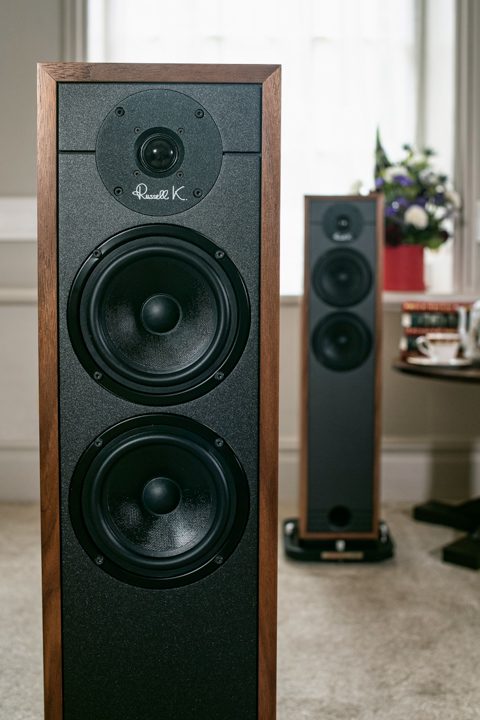
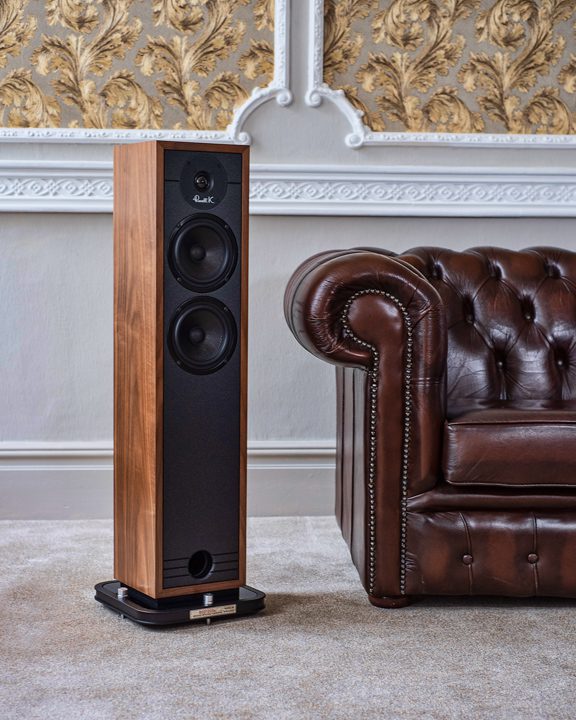
There’s no shortage of well-regarded, smallish floorstanding loudspeakers at comfortably under a metre tall and maybe 20cm wide. It’s a nice size for a domestically acceptable product that promises decent all-round performance without dominating a modest-sized living space. I expect many are sold to their owners for precisely that reason. That probably explains why the majority are also keenly priced; £3,000 will buy you a very respectable, well-reviewed product from any one of a number of makers, and they’ll doubtless do an excellent job for a lot of people. So why might you, dear reader, be interested in a speaker of this size that costs twice as much as those?

Unconventional approach

Let’s assume then that, like many people, this is a size of loudspeaker that ticks a lot of boxes for you. But you’ve been there, done that, and now require more. Moving on, you may have assumed, will require moving on to something bigger.

The Russell K. approach to loudspeaker design is a little different. And it’s why you might want to read on if you’ve got this far. Manufacturers can keep development costs down by keeping to familiar recipes; conversely, being a bit different can be costly. Neither the cabinets, nor the drivers, nor yet the crossovers here are what you would call entirely conventional, but this isn’t the sort of wilfully idiosyncratic design that screams ‘owned by a single bloke’ either.

Russell K. cabinets are undamped. Tradition has it that you’ve got to damp your cabinets, or they’ll resonate and sing along. However, designer Russell Kauffman maintains that while damping may prevent cabinets from resonating along with the music, it also stores energy, releases it out of time, smearing transients and timing cues, and generally messing up the bass in particular. His solution is to manage the cabinet resonance by careful bracing and attention to detail on the internal structure of the loudspeaker so that if the cabinets do join in, they do so manageably, notably in time with the music, and crucially, they stop when the signal stops.

Russell K. RED 120 Se

It seems to work; music I’ve thought of as complex, or dense, has revealed itself more lucidly. Take ‘Fiesta’ on the Chick Corea and Gary Burton duets album The New Crystal Silence [Concord]: you hear more deeply into the tonal differences between piano and vibraphone; the instruments remain distinct, separate and easier to discern in the busiest, most complex, or most dynamic passages. The notes start and finish when they should, and if you hear them, all the better for it. These are revealed as better, more exciting instruments, and the musicians are also clearly having a lot more fun.

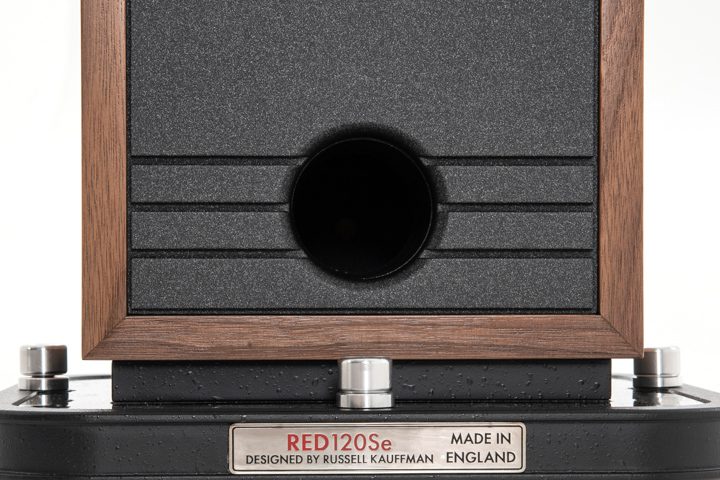
Russell also uses these internal bracing shelves to manage the drivers’ loading and airflow within the cabinet. The bracing subdivides the cabinet into zones for each driver and is perforated by carefully sized and positioned apertures that impede airflow beyond a given frequency. Each driver sits within its division of the cabinet, and thanks to the way the bracing acts as a form of acoustic impedance, the bass cabinet can behave more like a sealed box; midrange energy stays mainly in the region of the midrange driver and only the lower frequencies use the whole of the larger chamber. The bass reflex system uses an internal port to tune the output, this vents into a small cavity which effectively contains any port resonances within the box, and thence it exits into the room by a small, forward-facing port. The port system has been tuned to a positively subterranean 21Hz. Because little to no midrange energy finds its way into the chamber vented by the port, there is no appreciable chuffing or other ‘noises off’ to distract the listener.

Upgraded drivers and crossovers

Compared to the regular RED 120, the Se edition comes with upgraded tweeters and reworked crossovers. The tweeter used in the RED 120 is a 25mm soft dome with a ferrite magnet system, a copper-clad aluminium voice coil with a copper Faraday ring, a second magnet, and a metal face plate feature in the Se version. Two 5” bass units deal the lower frequencies with impregnated paper cones of curved, optimised acoustic profile. The motor uses a high-power ferrite magnet, a 25mm voice coil over an aluminium former, and a Faraday ring. The paired bass drivers are connected in a two-and-a-half-way configuration, the upper driver handling bass and midrange, while the lower one handles only lower bass with a crossover which starts to roll off above 80Hz.

Russell chooses his drivers by auditioning them ‘raw’. No enclosure, no baffle, no crossover, no test tones, just a driver connected to an amplifier via its lead-out wires. Doing this highlights how many decent quality drivers, even from respected brands, exhibit audible compression and distortion. By contrast, Russell’s drivers for his loudspeakers are cleaner and more dynamic, and the Se versions are audibly improved over the stock design.

This process allows some scope for originality on the crossovers. A modified 12 dB per octave slope rolls off both tweeter and bass/mid, with only one coil in the bass path and one capacitor in the treble signal path. Tweeter attenuation is via a Zobel network with deliberately misaligned component values as opposed to the conventional L-pad resistor set-up. This avoids having resistors in the signal path, and the component values have been adjusted by ear, using speech and music. The -Se variant crosses over at a relatively low 1800Hz (the RED 120 crosses over at 2200Hz) because this is a better match with the upgraded tweeter, and there’s an additional small capacitor in parallel, which gives the crossover a faster rise time. Low bass uses an enclosed field iron core inductor for improved power handling and low energy leakage. This Se variant has a second, similar inductor in the return path, effectively creating a balanced circuit. This is said to improve bass tunefulness.

Does it work?

It would be fair to say that the RED 120Se loudspeakers concede a little to the larger RED 150 in terms of scale and weight. I used the RED 150s happily in my room for a few years, and the ‘120s are a smaller box with smaller drivers, after all. But it’s very quickly evident that the (£700 more expensive) RED 120Se is the better loudspeaker. The difference is most noticeable in large-scale orchestral music, which trades a little of the sheer size for a lot of the purpose and musicianship. Arvo Pärt, Symphony No. 4 [ECM], the second movement features some deep, dark notes from strings and bass drum, and while there’s no significant shortage of impact here, what really impresses are the instrumental textures, the contrast between xylophone and strings, or violin/violas and cello/bass. The RED 120Ses show you how the composer creates and maintains tension and the way the conductor achieves that through the performance; other speakers which go deeper have been known to gloss over this sort of thing, concentrating instead on giving you an impressive hit of bass, somewhat divorced from its musical context. Freddy Kempf, Prokofiev, Piano Concerto No. 2 [BIS, SACD] shows his exemplary articulation and tone and a real insight into the interpretation through his phrasing.

Russell K. RED 120 Se

The RED 120Ses exert very good control of the different musical forces. The music remains lucid even in the busiest, most energetic passages, in a way reminiscent of a live, unamplified performance. When called upon, they will play very loud indeed without losing their composure, but they don’t do this by being buttoned-up; the music remains expressive and eloquent, the excellent sense of spatial detail intact, so the way the different orchestral forces have been set to work with each other, or with a soloist, is quickly and clearly perceived. Maybe there’s something to this notion of choosing the cleanest, most uncoloured drivers from the outset.

Scale, or proportion?

One takeaway is that bass, scale and depth are all very well but not sufficient. And perhaps more than that, what’s really important is a sense of proportion. Take ‘Log’, a piece for six pianos by Graham Fitkin [Decca]. Now six pianos in an average domestic listening room are about as appropriate as a symphony orchestra and chorus, so there needs to be some accommodation here. Me? I’ll happily trade some size and heft for an image that maintains the proportions. I want to appreciate the component elements’ relative masses, sizes and power, so I can hear deep into the performance. The RED 120Ses help me follow an individual pianist’s contribution, appreciate the timbral differences, the contributions of acoustic and electric instruments, and sense the way the centre of mass of the music shifts around in the soundscape as individual pianos take their lead. I am won over by the performance, not run over by shock and awe.

So, talking about overwhelming performances, Hugh Masekela’s ‘Stimela’ from Hope [Analogue Productions, SACD] has often hinted at colours and textures. Masekela’s vocal verges on uncanny, the voice and percussion working so tightly together for emphasis, and the evocative timbres of sax and trumpet just take this already compelling track to another level of immersiveness. It’s such a warhorse – I defy anybody to go to a hi-fi show and not hear it at least once – it’s quite easy to become inured to the power of its message through over-familiarity. The RED 120Se’s made it fresh again.

Russell K. RED 120 Se

They are also very good at telling you what’s going on in the rest of your system. Change what the CD player sits on, and you hear the effect. Change what the speakers rest on, and you hear that too. Most of this review was conducted with the spikes resting on AcouPlex discs, which brought out the subtleties of phrasing in ways that made regular metal spike cups, coins, or floor protectors sound unconvincingly uncommunicative. A little attention to placement, support and isolation will pay dividends here.

So many audio touchpoints and benchmarks are hit with precision by the RED 120Se: I have talked quite a lot about timbre and colour; we also have articulation, pitch and tunefulness – Renaud Garcia-Fons’ bass is an exemplar: tight, tuneful and full of texture on ‘Berimbass’ from Arcoluz [Enja], so those claims as to improvements to the bass via the crossover tweaks ring true. And perhaps implicit in the speakers’ ability to hear deep into the mix is a facility with imaging – Patricia Barber’s quartet on Café Blue [Premonition Records, SACD] has real presence and form; and last, but arguably most important of all, we have timing – the quartet is absolutely ‘on it’ with an almost telepathic cohesiveness. These modestly-sized speakers have redefined what I expect from this size of cabinet and driver complement. That £6,000 asking price doesn’t feel like a stretch at all.

Technical specifications

  • Type 2½ -way floorstanding, reflex-loaded loudspeaker with internal porting, and forward-facing reflex port. Braced, thin‑walled cabinet with no internal damping
  • Driver complement 1× 25mm soft dome tweeter; 2× 5” impregnated paper cone bass/bass-mid drivers with optimised acoustic profile
  • Power handling nominal 120W programme
  • Crossover frequency 80Hz and 1.8kHz
  • Crossover type Single-wired, phase optimised; tweeter via zobel network with misaligned component values, 12dB per octave slope; Low bass 6dB per octave via enclosed field iron core inductors
  • Frequency response (in-room, usable) 25Hz–22kHz
  • Impedance 4–8 Ohms nominal, 5 Ohms minimum at 50Hz and 300Hz (4 Ohms minimum at 20kHz)
  • Sensitivity 86dB for 1 Watt at 1 Metre
  • Dimensions (H×W×D) (including plinth) 910 × 200 × 190mm
  • Weight Approx. 18 Kg each
  • Finishes Real wood veneers Oak with white baffle;
    Walnut with black baffle; Black Oak with black baffle
  • Price £5,950/pair

Manufacturer

Russell K. Ltd, Dunstable, Bedfordshire, UK

Tel: +44(0)1582 477355

Homepage – https://www.russell-k.com

Product – https://www.russell-k.com/red-120se/

Dealers – https://www.russell-k.com/russell-k-dealers/

Back to Reviews

The post Russell K. RED 120Se appeared first on Hi-Fi+.

Accuphase DP-570 CD/SACD Player

Turns out it’s been a while since I last reviewed a CD player. A few years, in fact. And to be honest, given my long-term player of choice is the dCS Puccini that came in for issue 65 and never really left, any review units following that always had to go some to get my attention. But somewhat to my surprise, it’s been ten years since I bought that dCS player. Probably the most obvious reason why I haven’t reviewed a CD player in a while is that there are rather fewer on offer these days, streamers and DACs having elbowed them out of the limelight somewhat. But some manufacturers have kept the faith, and one, Accuphase, has also managed consistently to produce the sort of players which might conceivably have tempted me away from my beloved Puccini in the intervening years.

The DP-570 is very new; the first units only arrived on UK soil a month or two ago. It’s the middle in Accuphase’s lineup of one-box players, above the (CD only) DP-430, but below the rather luxuriant DP-750 which itself sits below the 2-box DC-/DP-950 units. It’s the least expensive player to offer both CD and SACD playback (at £10,200 it felt wrong to call it the cheapest), and it replaces the DP-560 which came out 5 years ago (Accuphase product cycles are reassuringly long). You need to be a bit of an Accuphase geek to spot the physical differences between the outgoing and incoming models, maybe a slightly different button here, or slightly different display line there, and the finish on the top plate is more refined but Accuphase evidently hasn’t felt the need to revisit the styling decisions it made decades ago. And to be fair, it’s a handsome unit with a reassuringly solid build, and the sort of silkily silent loading mechanism that just makes you go ‘Ooh!’.

The build quality is part of the company philosophy, the in-house developed transport mech is carefully constructed and mounted so as to minimise the opportunities for vibration, motor noise and other extraneous energy affecting the reading of the disc. The ultimate objective being the pursuit of ultra low noise performance. Accuphase claims a signal to noise ratio of 120dB, which is 1dB (12%) better than the outgoing player’s already excellent figures, giving an output noise voltage of just 2.5µV. The DAC chip in the DP-570 is the same ESS Technology 32bit ES9028PRO unit found in the DP-750, the DP-570 using half the chip’s 8 DACs in parallel for each channel (the DP-750 doubles up on the chip count, using all 8 DACs in parallel for each channel). This employs Accuphase’s ‘MDS+’ approach to multiple delta-sigma D/A conversion, for improved linearity and signal to noise performance across the entire frequency range. Accuphase claims almost double the noise, linearity and distortion performance of conventional delta-sigma D/A technology.

It’s no surprise to find the Accuphase ‘house’ sound firmly established in the DP-570’s presentation. I shouldn’t really refer to it as a ‘house’ sound, though, because that implies the equipment is voiced to give a certain presentation, whereas I think the way Accuphase sounds is just the way it comes out when you engineer products according to their philosophy. At its simplest, I’d sum it up as a very organic hint of subtle warmth, an underpinning sense of calm, and an unforced and entirely natural-feeling level of detail. Oh, and an almost uncanny way with timing. The opening section of Alfred Brendel’s account of the Arietta from Beethoven’s Piano Sonata no. 32 in C minor [Philips] is a study in measured calmness, exquisitely metered out by the DP-570, making it all too easy to relax into the music, switch off your critical faculties and just enjoy the moment…

But enough of that sort of thing, this review isn’t going to write itself, unfortunately. There are generous input and format options, the player reads two-channel CD and SACD discs, including hybrid (two-layer) CD/SACD discs and CD-R/-RW, DVD-R/-RW/+R/+RW data discs, but not Blu-Ray. There are coaxial, optical and USB digital inputs; optical and coaxial digital outputs, and HS-Link input/output options. So you can use this as a transport, a DAC, or a one-box player for a wide range of physical formats. The USB input will accept sample rates of up to 384 kHz PCM and up to 11.2MHz DSD (ASIO), while the coaxial and optical inputs accept up to 192kHz and 96kHz PCM respectively.

So the tech side seems to be thoroughly sorted. Internal layout is neat, with the key functional blocks of componentry (power, digital, analogue and control circuitry) carefully separated and isolated from each other, and from the transport mechanism. Accuphase talks about the handbuilt, small production volume values of its manufacturing, and I’m going with ‘team of skilled technicians in immaculately kitted out workshop’ rather than ‘bunch of blokes in shed with solder-scorched workbenches, and screwdrivers and pliers on a pegboard’ which once formed the backbone of the British audio industry. Switches, buttons and mechanisms are a haptic delight – silky, positive and very nicely weighted. This sort of thing matters when you’re dropping a five-digit sum of money, but I’ve encountered more expensive kit that doesn’t have this level of tactility.

The post Accuphase DP-570 CD/SACD Player appeared first on Hi-Fi+.

Accuphase DP-570 CD/SACD Player

Accuphase DP-570 CD/SACD Player

Turns out it’s been a while since I last reviewed a CD player. A few years, in fact. And to be honest, given my long-term player of choice is the dCS Puccini that came in for issue 65 and never really left, any review units following that always had to go some to get my attention. But somewhat to my surprise, it’s been ten years since I bought that dCS player. Probably the most obvious reason why I haven’t reviewed a CD player in a while is that there are rather fewer on offer these days, streamers and DACs having …